Meditation on Isaiah 11:1-10
Second Sunday of Advent
Rev. Dr. Karen Crawford
First Presbyterian Church of Smithtown
Dec. 7, 2025
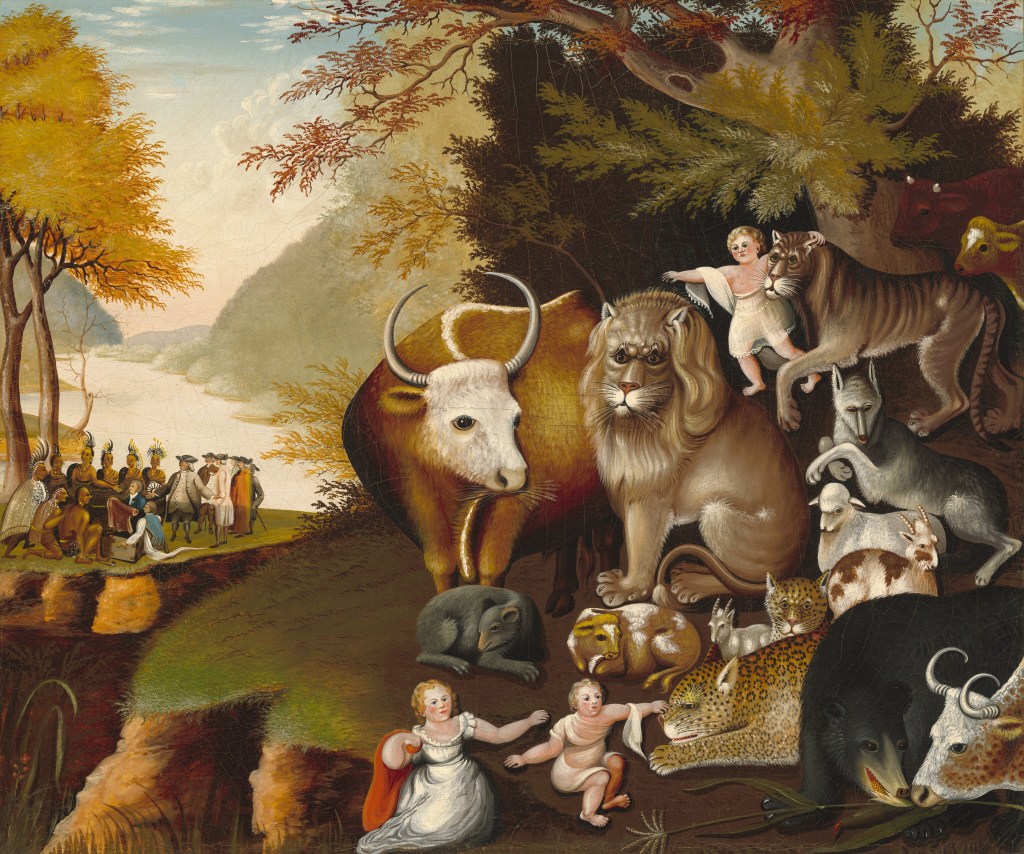
What did you picture in your mind as I read this familiar passage? Did anyone see the tree stump sprouting? A lion, ox, asp, adder, lamb, cow, wolf, and bear? Did any of you see Jesus as the little child that led them?
If so, you are not alone. The 19th century American artist, Edward Hicks, imagined the same thing. Have any of you seen some of the paintings from his “Peaceable Kingdom” series?
I have seen one at the National Gallery of Art in Washington, D.C., but there is also one on display at the Met in New York City. And there are others, all of them different, but all based on this same reading from Isaiah. You could say that this artist was more than a little obsessed with Isaiah’s vision. He longed to share Isaiah’s vision with his broken world. Most of all, he longed for Christ’s Peaceable Kingdom and hoped that it would happen in his lifetime.
Edward was born in 1780 in Bucks County, PA, to Anglican parents. His mother died when he was just 18 months old. His father, being a Loyalist, was left without any money after the British defeat in the Revolutionary War. Edward was adopted by two family friends—David and Elizabeth Twining, who brought him up as a Quaker on their farm. When he was 13, Edward was apprenticed to a local coach maker, William Tomlinson. During the 7-year apprenticeship, he discovered that he had a talent for ornamental painting. When his apprenticeship ended in 1800, he went into business for himself, “painting with decorative motifs not only on carriages but also signs, furniture, and household objects.”[1]
When he officially became a member of the Society of Friends in 1803, he was criticized for his choice of vocation, “which was at odds with the Quaker values of simplicity and utility. Painting is a worldly indulgence, they said. Taking their rebukes to heart, Edward gave up painting for a time and tried his hand at farming, but this venture was unsuccessful.”[2] It wasn’t until he reconciled these two passions—art and faith—and pursued both that he found happiness and success. In 1811, when he was 31, he set up a painting shop in Newtown, PA, and became a minister. This meant that he was often called away to other states to preach. As Quakers were not paid for preaching, his painting provided the income for his growing family. Edward and his wife, Sarah, had four children at the time and were expecting a fifth.
In 1820, he painted his first “Peaceable Kingdom.” He would paint the “Peaceable Kingdom,” with variations in the scene, more than 100 times in his life, but always with “predators and prey lying down together in harmony, and a little rosy-cheeked child—the Christ child—leading them.”[3] Rev. John Buchanan, former pastor of Fourth Presbyterian Church in Chicago and moderator of the PCUSA, says that Edward “portrays the animals looking straight at the viewer with wide-eyed wonder.” “Peace is startling,” says Buchanan, who went home to be with the Lord in February. “You don’t see it often, maybe ever. In the middle of the picture is a child…with eyes also wide open as if startled by this unlikely reality.”[4]
Edward didn’t attempt to commercialize his “Peaceable Kingdom” paintings. Most were given away to family and friends, works such as the one now housed at the National Museum of Art, with William Penn signing a treaty of perpetual friendship with the Lenape Indians in 1681 on the banks of the Delaware. “This, Edward thought, is what it looks like to put into practice the values of brotherly love and peace that Christ came to teach us. Penn did honor this treaty, but his successors did not—a fact that Edward was painfully aware of.”[5]
By bringing to life on canvas the ancient prophecy of Isaiah, he expressed his “yearning for unity and peace, especially in light of the 1827 … schism within the Society of Friends, the first in the denomination’s history.”[6] “His Kingdom paintings reference the schism through a blasted tree trunk, which doubles…as a reference to the ‘stump’ of Jesse out of which Christ sprung up.”[7]
The author of this Isaiah text most likely lived in the 8th century BCE, a time when the Israelites were facing “impending doom by Assyrian conquerors coming from the north.”[8] They chose words and images to “evoke hope and longing for a Davidic king who would rescue the threatened people.” This righteous, God-appointed leader, will care about and pay attention to the meek and the poor, reflecting God’s care toward all God’s creatures. “Upon the earth, evil and wickedness will be brought to ruin by his word and breath. … Young animals will curl up together. Cows and bears will graze in the same place. Even the lion will eat straw. The nursing child will play with venomous snakes. There will be not hurt or destruction in God’s holy mountain.”[9]
David’s house is symbolized by a tree cut down with an ax. But a shoot shall come out! A branch shall grow from his roots. “All is not lost for the people of Judah, because from the Davidic line will emerge a king whose reign will be one of peace and righteousness.”[10] “A king will emerge from Bethlehem who will lead his people with wisdom and understanding, counsel and might, and the knowledge and fear of the Lord.”[11]
Over time, Edward became more cynical about human beings’ ability to live in peace. His attitude is reflected in his work. “While his early Kingdom paintings from the 1820s show animals in joyful company with one another, the animals in many of his middle- and late-period paintings are tense or exhausted, or even bare their teeth in open hostility.” One displayed at Yale and in the DuPont Winterthur Museum reveal the Christ child holding onto the lion’s mane in “forcible restraint rather than gentle guidance.” Later, the artist would say that witnessing the dissension in his faith community “destroyed his hope of ever seeing established in the here and now a kingdom like the one Isaiah envisioned. But that realization only caused him to cling to Christ all the more tightly.”
I think Edward had come to grasp the nature of Advent living—not just the four weeks we set aside in the church year, but an extended time of living in the already and not yet. This is what characterizes our life as Christ’s followers. We are in the long season of waiting for Christ to come again and establish his Peaceable Kingdom, once and for all.
The image that stands out to me, as it must have for Edward Hicks, is of the little child that will lead them. Christians can’t help but see a prophecy of Jesus our Messiah in this ancient text written hundreds of years before his birth. But we also yearn for a different world for our children and grandchildren right now. Don’t we? This longing for a different world for our children is reflected by Edward’s images of children in his time, painted in period clothing. It isn’t a vision that comes easily in this age, though, of children living in peace with one another and all God’s creatures, just as it didn’t come easily in Isaiah’s time or in the time in which Edward lived. It’s hard to imagine something we have never experienced but always wanted.
While I can’t imagine what our church will be like centuries from now, I know that one thing will not have changed. It will always take a village to prepare the children for their callings, just as it took a village—including adoptive parents, the Society of Friends, and an apprenticeship to a coachmaker—to equip Edward Hicks for his vocation as an artist and unpaid itinerant preacher. He traveled by horseback from his Pennsylvania home to Friends’ meetings in New York and Canada, Maryland and Virginia, Ohio and Indiana, to share Isaiah’s vision of peace on earth, something he once thought would be possible for human beings to bring about simply by living out biblical principles.
On this Second Sunday of Advent, when we light the candle of peace, we hold onto hope for a peace that we cannot yet see, except by faith and in holy glimpses, such as when we baptize and celebrate Communion.
In a moment, we will come to the Lord’s Table to experience God’s love, mercy, and grace and be reconciled, forgiven, and healed. We come to eat of the bread and be nourished in our faith, to drink the cup of salvation and be transformed, more and more, into the likeness of the One who is with us now and coming again to bring about his Peaceable Kingdom.
When the wolf shall live with the lamb;
the leopard shall lie down with the kid;
the calf and the lion will feed together,
and a little child shall lead them.
Let us pray. Gracious God, thank you for the vision you gave to your prophet, Isaiah, the vision of the Peaceable Kingdom. We long for that Kingdom to come to fruition. We long for a different world for our children and grandchildren, a world where your lovingkindness, peace, and justice shall reign over all Creatures and no one will be hungry, hated, oppressed, sad, or afraid, ever again. Thank you for your Spirit that lives with us now and helps us cling to our faith, cling to Jesus, when nothing else makes sense, as Edward Hicks did. Show us a glimpse, dear Lord, of this Peaceable Kingdom when we partake of the bread and cup at your Table. Then send us out, equipped, to share your vision as Christ’s Body for the world. Amen
[1] Victoria Emily Jones, “The Peaceable Kingdoms of Edward Hicks,” from an Art and Theology blog at https://artandtheology.org/2016/12/06/the-peaceable-kingdoms-of-edward-hicks/
[2] Victoria Emily Jones, “The Peaceable Kingdoms of Edward Hicks.”
[3] Victoria Emily Jones, “The Peaceable Kingdoms of Edward Hicks.”
[4] John Buchanan, “Preaching Advent Texts: Hope, Peace, Courage,” Journal for Preachers 34, no. 1 (2010) 10.
[5] Jones, “The Peaceable Kingdoms of Edward Hicks.”
[6] Jones, “The Peaceable Kingdoms of Edward Hicks.”
[7] Jones, “The Peaceable Kingdoms of Edward Hicks.”
[8] Leanne van Dyk, Connections, Year A, Vol 1: Advent Through Epiphany (Louisville: Westminster John Knox, 2019), 18.
[9] David A. Davis, Connections, Year A, Vol. 1,19.
[10] Noel Leo Erskine, Feasting on the Word, Year A, Vol.4 (Louisville: Westminster John Knox, 2010), 28.
 Sharing God's Love and Grace