The Message of Christmas

Meditation on Luke 2:1-20 (KJV)

Rev. Dr. Karen Crawford

First Presbyterian Church of Smithtown

Dec. 24, 2025
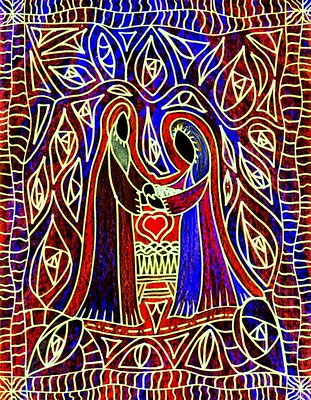
Art by Stushie, used with permission

When I was growing up, I always enjoyed setting up my mother’s porcelain nativity scene or creche, as she called it. I carefully unwrapped each figure from its protective tissue— Mary and Joseph, the Baby, the wise men, shepherds, and angels, and a variety of animals—camels, donkeys, cattle, and lambs. One by one, I placed them on a bed of cotton, creating a scene that told the story that I envisioned from the Bible, and from Christmas cards and light displays in front yards, churches and shopping malls.

My older brother would sometimes frustrate me by changing the positions of the figures. One year, he placed the Baby in the center and all the other figures surrounding him in circles. He was less concerned, I think now, about what the scene looked like and more concerned that everyone who had come seeking the Child would be able to gaze upon him with nothing to obstruct their view. Now that I am grown, I have come to understand that his scene reflected his own perspective and interpretation of the story—what he believed.

And this is what the Lord desires for each of us, dear friends, that we see ourselves in the story of Christ’s birth! May it not just be an intellectual exercise but rather a work of the heart. Martin Luther in the 16th century says, “We must both read and meditate upon the Nativity. If the meditation does not reach the heart, we shall sense no sweetness, nor shall we know what solace for humankind lies in this contemplation.”[1]

The story begins with Mary, a vulnerable young woman, who is terrified when visited by the angel Gabriel, whose name means “Power.” He “was commander in chief of the heavenly host, the keeper of the sword, the marshal of the divine Majesty,” says Luther in one of his Christmas Eve sermons. “A thousand angels were at his beck, and their radiance was more dazzling than a hundred suns. If angels were to speak to us in the majesty they enjoy in the presence of God, we could not endure the sight.”[2]

The lowly shepherds, outside working in the rural countryside all night, are fighting to stay awake and stay alive to protect the flocks when they are visited by angels. They, like Mary, are terrified at the visitation, not only because angels are powerful and scary, but because they are living in a time of Roman oppression and violence. They live afraid to say anything against emperor or empire or the puppet leaders of their towns, cities, and villages. Those who do would be severely punished or disappear, never to be seen again.

Mary and Joseph go to Bethlehem, a small town of maybe 400 people now overflowing with travelers forced to come for the census. This census isn’t just a gathering of random demographic information; it has a dark purpose—to calculate the wealth of the people. It will undoubtably mean higher taxes and more oppression for the poor. The couple arrive on foot, exhausted after their long journey of 7 to 10 days, with no money, no house, no place to rest.

And then, it happens. It came to pass, while they were there, “the days were accomplished that she should be delivered.” Why on earth would God choose such a time and place for Mary to go into labor, without a midwife or female relative or friend to help her? And this is her first child. Luther estimates that she is between the ages of 13 and 15 years, although others say she could have been as young as 12—just a baby herself.

Luther says of the Nativity story, “God allows the godly to be powerless and oppressed so that everyone thinks they are done for, yet even in that very moment God is most powerfully present, though hidden and concealed. When the power of man fails, the power of God begins, provided faith is present and expectant.”[3]

Why didn’t anyone help them? Luther asks his flock. Shame on the town of Bethlehem! He goes on, “There are many of you in this congregation who think to yourselves: ‘If only I had been there! How quick I would have been to help the Baby! I would have washed his linen. How happy I would have been to go with the shepherds to see the Lord lying in the manger!’ Yes, you would! You say that because you know how great Christ is, but if you had been there at that time, you would have done no better than the people of Bethlehem.”[4]

Luther challenges his hearers to respond to the Christmas story with acts of compassion. “Why don’t you do it now?” he asks. “You have Christ in your neighbor. You ought to serve him, for what you do to your neighbor in need you do for the Lord Christ himself.”[5]

How are each of you are feeling tonight? There’s always a time, usually within a few days of Christmas, that I suddenly feel overwhelmed. Any of you feel that way tonight? That happened to me last night. My way back to peace and joy was to dig deeply into Luke’s gospel to what the real Christmas is all about—the story that happened thousands of years ago in Bethlehem and, in its hearing and contemplation, is still working in us, transforming our hearts and minds into the likeness of Christ. Sisters and brothers, you and I know that hope of Christmas isn’t connected with most of the busy stuff that we take on during this time of year that leads to our feeling overwhelmed.

Are you ready for the message of Christmas, according to Luke? Before I share it with you, will you promise that you will take it with you and share it with others? The good news has always been meant for all people, and with Luke, especially those who are poor and marginalized. As Jesus, in Luke 4:16-19, will quote Isaiah in his first sermon in Nazareth, “The Spirit of the Lord is upon me, because he has anointed me to bring good news to the poor. He has sent me to proclaim release to the captives and recovery of sight to the blind, to set free those who are oppressed, to proclaim the year of the Lord’s favor.”

The message of Christmas is Emmanuel—God with us. We are not alone here.  A gracious and loving God has come to us as one of us—a baby in a feedbox. God in Christ is physically present with us.As John says, “And the Word became flesh and lived among us.”  

Luke declares that the Son who came to us as a human being is Savior, Messiah, and Lord. Historian and Bible Scholar Justo Gonzalez urges us to think of Christ’s salvation not as an avoidance of eternal damnation but rather as “healing, liberation, freedom from the bondage of sin, and the promise of eternal life.”[6] “Messiah” or “Christ” in Greek means “Anointed One.” Luke believes that Jesus “is the one who will fulfill all the promises made to Abraham and his descendants, that he will restore the throne of David and do away with all oppression and injustice.”[7] The most radical title, yet, may be in calling him “the Lord.” This is the Greek translation of the sacred, unpronounceable name of God (Adonai or YHWH) in the Hebrew Bible. “Luke’s Savior and Messiah is not one more among the long line of saviors, liberators, and anointed ones whom Israel has known along its history; he is the Lord!”[8]

The message of Christmas is God’s perfect gift. Isaiah 9:6 says, “Unto us a child is born, a Son is given.” We don’t do anything for this gift. And we can’t do anything to make the Lord change God’s mind and take the gift back. But the gift of Christ is not just for humanity, in general—but for you and me. It’s both plural and particular. Luther says, “This is for us the hardest point, not so much to believe that He is the son of the Virgin and God himself, as to believe that this Son of God is ours.”[9] “Of what benefit would it be to me if Jesus would have been born a thousand times and it would have been sung daily in my ears that Jesus Christ was born but that I was never to hear that Jesus Christ was born for me?”[10]

Finally, the message of Christmas carries with it PEACE and JOY that cannot be taken away from us because their source is Christ. The joy of the Lord, Nehemiah 8:10 tells us, is our strength. The good news of great joy brought by the angel to the shepherds is, like the Gift, both plural and particular. The Greek word is second person plural (in the sense of y’all) but also dative, a case we don’t have in English. In Greek, it is used for things that come directly to another party. “So the announcement of the angel is not a generic, all-purpose bulletin. It is personalized. This good news is for you.”[11]

 I still love my mom’s creche, which has come to live in my home. I have many other nativity scenes, too, collected over the years from cultures around the world, some of which I leave out all the time as a reminder of the message of Christmas. For Christmas isn’t just a day that we celebrate with gatherings, food, and presents. The gift of Christ and the work of spiritual transformation in our hearts, minds, and lives go on and on.

 A favorite nativity of mine, which I keep in my church office, features Native American children dressed as Mary, Joseph, and the Babe, along with wise men, shepherds, angels, and a collection of animals, including dogs. When little Grayson and other children visit, they are often drawn to it and want to touch it. The stable is a porcelain teepee with a tea light candle that when lit, glows as if it is a comforting fire rising from the roof.

Each creche reminds me of the importance of every person, everywhere, being invited by the Lord to see themselves in the story of Christ’s birth, and to contemplate the meaning of it for their lives. My prayer is that you will share the message of Christmas with a world that so desperately needs to hear it. Share it through your words and compassion. For whatever we do to help a neighbor in need, we are serving the Lord.

Let the words of angels ring in your ears as we sing Joy to the World and walk out into the darkness: “Fear not; for behold, I bring you good tidings of great joy, which shall be to all people. For unto you is born this day in the city of David a Savior, which is Christ the Lord.

This good news is for YOU!

Let us pray.

Holy God, thank you for coming to us as one of us, a child in a manger, who has promised to come again, not as a helpless babe, but as the King of kings, Lord of lords and Prince of Peace to bring the fulfillment of the angel’s announcement. Emmanuel, help us to feel your loving presence with us always—in the happy times and in the painful times, as well. Remind us that the message of Christmas isn’t just for humanity, in general, but for us in particular. May we be filled with gratitude for the perfect gift of your Son, our Messiah, Savior, and Lord, and be stirred to serve you through our words and acts of compassion for neighbors in need. In the name of Emmanual we pray. Amen.


      [1] Martin Luther, Martin Luther’s Christmas Book (Kindle Edition).

      [2] Martin Luther, Martin Luther’s Christmas Book. Kindle edition. “Annunciation” sermon.

      [3] Martin Luther, Martin Luther’s Christmas Book. Kindle edition. “Visitation” sermon.

      [4] Martin Luther, Martin Luther’s Christmas Book. Kindle edition. “Nativity” sermon.

      [5] Martin Luther, Martin Luther’s Christmas Book. Kindle edition. “Nativity” sermon.

    [6] Justo Gonzalez, Luke, from Belief: A Theological Commentary on the Bible series (Louisville: Westminster John Knox, 2010 ), 36.

    [7] Justo Gonzalez, Luke, 39.

    [8] Justo Gonzalez, Luke, 39.

    [9] Martin Luther, Martin Luther’s Christmas Book, Kindle Edition.

     [10] Roger Nelson, “God in the Particular,” The Nativity of the Lord, The Christian Century, Dec. 19, 2025.

     [11] Roger Nelson, “God in the Particular, Dec. 19, 2025.

And a Little Child Shall Lead Them

Meditation on Isaiah 11:1-10

Second Sunday of Advent

Rev. Dr. Karen Crawford

First Presbyterian Church of Smithtown

Dec. 7, 2025

Edward Hicks, “Peaceable Kingdom,” National Gallery of Art, Washington, D.C., image is public domain

What did you picture in your mind as I read this familiar passage? Did anyone see the tree stump sprouting? A lion, ox, asp, adder, lamb, cow, wolf, and bear? Did any of you see Jesus as the little child that led them?

If so, you are not alone. The 19th century American artist, Edward Hicks, imagined the same thing. Have any of you seen some of the paintings from his “Peaceable Kingdom” series?

 I have seen one at the National Gallery of Art in Washington, D.C., but there is also one on display at the Met in New York City. And there are others, all of them different, but all based on this same reading from Isaiah. You could say that this artist was more than a little obsessed with Isaiah’s vision. He longed to share Isaiah’s vision with his broken world. Most of all, he longed for Christ’s Peaceable Kingdom and hoped that it would happen in his lifetime.

Edward was born in 1780 in Bucks County, PA, to Anglican parents. His mother died when he was just 18 months old. His father, being a Loyalist, was left without any money after the British defeat in the Revolutionary War.  Edward was adopted by two family friends—David and Elizabeth Twining, who brought him up as a Quaker on their farm. When he was 13, Edward was apprenticed to a local coach maker, William Tomlinson. During the 7-year apprenticeship, he discovered that he had a talent for ornamental painting. When his apprenticeship ended in 1800, he went into business for himself, “painting with decorative motifs not only on carriages but also signs, furniture, and household objects.”[1]

 When he officially became a member of the Society of Friends in 1803, he was criticized for his choice of vocation, “which was at odds with the Quaker values of simplicity and utility. Painting is a worldly indulgence, they said. Taking their rebukes to heart, Edward gave up painting for a time and tried his hand at farming, but this venture was unsuccessful.”[2] It wasn’t until he reconciled these two passions—art and faith—and pursued both that he found happiness and success. In 1811, when he was 31, he set up a painting shop in Newtown, PA, and became a minister. This meant that he was often called away to other states to preach. As Quakers were not paid for preaching, his painting provided the income for his growing family. Edward and his wife, Sarah, had four children at the time and were expecting a fifth.

In 1820, he painted his first “Peaceable Kingdom.” He would paint the “Peaceable Kingdom,” with variations in the scene, more than 100 times in his life, but always with “predators and prey lying down together in harmony, and a little rosy-cheeked child—the Christ child—leading them.”[3] Rev. John Buchanan, former pastor of Fourth Presbyterian Church in Chicago and moderator of the PCUSA, says that Edward “portrays the animals looking straight at the viewer with wide-eyed wonder.” “Peace is startling,” says Buchanan, who went home to be with the Lord in February. “You don’t see it often, maybe ever. In the middle of the picture is a child…with eyes also wide open as if startled by this unlikely reality.”[4]

Edward didn’t attempt to commercialize his “Peaceable Kingdom” paintings. Most were given away to family and friends, works such as the one now housed at the National Museum of Art, with William Penn signing a treaty of perpetual friendship with the Lenape Indians in 1681 on the banks of the Delaware. “This, Edward thought, is what it looks like to put into practice the values of brotherly love and peace that Christ came to teach us. Penn did honor this treaty, but his successors did not—a fact that Edward was painfully aware of.”[5]

By bringing to life on canvas the ancient prophecy of Isaiah, he expressed his “yearning for unity and peace, especially in light of the 1827 … schism within the Society of Friends, the first in the denomination’s history.”[6] “His Kingdom paintings reference the schism through a blasted tree trunk, which doubles…as a reference to the ‘stump’ of Jesse out of which Christ sprung up.”[7]

The author of this Isaiah text most likely lived in the 8th century BCE, a time when the Israelites were facing “impending doom by Assyrian conquerors coming from the north.”[8] They chose words and images to “evoke hope and longing for a Davidic king who would rescue the threatened people.” This righteous, God-appointed leader, will care about and pay attention to the meek and the poor, reflecting God’s care toward all God’s creatures. “Upon the earth, evil and wickedness will be brought to ruin by his word and breath. … Young animals will curl up together. Cows and bears will graze in the same place. Even the lion will eat straw. The nursing child will play with venomous snakes. There will be not hurt or destruction in God’s holy mountain.”[9]

David’s house is symbolized by a tree cut down with an ax. But a shoot shall come out! A branch shall grow from his roots. “All is not lost for the people of Judah, because from the Davidic line will emerge a king whose reign will be one of peace and righteousness.”[10] “A king will emerge from Bethlehem who will lead his people with wisdom and understanding, counsel and might, and the knowledge and fear of the Lord.”[11]

Over time, Edward became more cynical about human beings’ ability to live in peace. His attitude is reflected in his work. “While his early Kingdom paintings from the 1820s show animals in joyful company with one another, the animals in many of his middle- and late-period paintings are tense or exhausted, or even bare their teeth in open hostility.” One displayed at Yale and in the DuPont Winterthur Museum reveal the Christ child holding onto the lion’s mane in “forcible restraint rather than gentle guidance.” Later, the artist would say that witnessing the dissension in his faith community “destroyed his hope of ever seeing established in the here and now a kingdom like the one Isaiah envisioned. But that realization only caused him to cling to Christ all the more tightly.”

I think Edward had come to grasp the nature of Advent living—not just the four weeks we set aside in the church year, but an extended time of living in the already and not yet. This is what characterizes our life as Christ’s followers. We are in the long season of waiting for Christ to come again and establish his Peaceable Kingdom, once and for all.

The image that stands out to me, as it must have for Edward Hicks, is of the little child that will lead them. Christians can’t help but see a prophecy of Jesus our Messiah in this ancient text written hundreds of years before his birth. But we also yearn for a different world for our children and grandchildren right now. Don’t we? This longing for a different world for our children is reflected by Edward’s images of children in his time, painted in period clothing. It isn’t a vision that comes easily in this age, though, of children living in peace with one another and all God’s creatures, just as it didn’t come easily in Isaiah’s time or in the time in which Edward lived. It’s hard to imagine something we have never experienced but always wanted.

While I can’t imagine what our church will be like centuries from now, I know that one thing will not have changed. It will always take a village to prepare the children for their callings, just as it took a village—including adoptive parents, the Society of Friends, and an apprenticeship to a coachmaker—to equip Edward Hicks for his vocation as an artist and unpaid itinerant preacher. He traveled by horseback from his Pennsylvania home to Friends’ meetings in New York and Canada, Maryland and Virginia, Ohio and Indiana, to share Isaiah’s vision of peace on earth, something he once thought would be possible for human beings to bring about simply by living out biblical principles.

On this Second Sunday of Advent, when we light the candle of peace, we hold onto hope for a peace that we cannot yet see, except by faith and in holy glimpses, such as when we baptize and celebrate Communion.

In a moment, we will come to the Lord’s Table to experience God’s love, mercy, and grace and be reconciled, forgiven, and healed. We come to eat of the bread and be nourished in our faith, to drink the cup of salvation and be transformed, more and more, into the likeness of the One who is with us now and coming again to bring about his Peaceable Kingdom.

When the wolf shall live with the lamb;
    the leopard shall lie down with the kid;
the calf and the lion will feed together,
    and a little child shall lead them.


Let us pray. Gracious God, thank you for the vision you gave to your prophet, Isaiah, the vision of the Peaceable Kingdom. We long for that Kingdom to come to fruition. We long for a different world for our children and grandchildren, a world where your lovingkindness, peace, and justice shall reign over all Creatures and no one will be hungry, hated, oppressed, sad, or afraid, ever again. Thank you for your Spirit that lives with us now and helps us cling to our faith, cling to Jesus, when nothing else makes sense, as Edward Hicks did. Show us a glimpse, dear Lord, of this Peaceable Kingdom when we partake of the bread and cup at your Table. Then send us out, equipped, to share your vision as Christ’s Body for the world. Amen


     [1] Victoria Emily Jones, “The Peaceable Kingdoms of Edward Hicks,” from an Art and Theology blog at https://artandtheology.org/2016/12/06/the-peaceable-kingdoms-of-edward-hicks/

     [2] Victoria Emily Jones, “The Peaceable Kingdoms of Edward Hicks.”

     [3] Victoria Emily Jones, “The Peaceable Kingdoms of Edward Hicks.”

     [4] John Buchanan, “Preaching Advent Texts: Hope, Peace, Courage,” Journal for Preachers 34, no. 1 (2010) 10.

     [5] Jones, “The Peaceable Kingdoms of Edward Hicks.”

    [6] Jones, “The Peaceable Kingdoms of Edward Hicks.”

     [7] Jones, “The Peaceable Kingdoms of Edward Hicks.”

     [8] Leanne van Dyk, Connections, Year A, Vol 1: Advent Through Epiphany (Louisville: Westminster John Knox, 2019), 18.

     [9] David A. Davis, Connections, Year A, Vol. 1,19.

    [10] Noel Leo Erskine, Feasting on the Word, Year A, Vol.4 (Louisville: Westminster John Knox, 2010), 28.

    [11] Erskine, Feasting on the Word, Year A, Vol.4, 28.

Keep Awake

Meditation on Matthew 24:36-44

First Presbyterian Church of Smithtown

First Sunday of Advent

Pastor Karen Crawford

Nov. 30, 2025

Today Jameson and Susan Gensinger light the candle of hope on our Advent Wreath. Thank you to Betty Deerfield and Peg Holthusen for making our wreath, once again, this year and to Jonathon Deerfield, Betty’s son, for making the stand.

Jim and I recently returned from a trip to Ireland. Many times, over the years, I had heard him talk about his Irish relatives and the farm where his mother had grown up. Both of Jim’s parents were immigrants from Northern Ireland in the early 20th century. His father was from County Antrim, his mother, County Down. Jim had traveled to Ireland to meet his family with his parents in the 1960s and then 30 years later, after they had passed. We both felt it was time to go back.

Jim reached out to his cousin George Heaney, who lives not far from Belfast, in Ballyclare, County Antrim. George immediately responded, graciously inviting us to stay with him and his wife, Karen, in their home, with a visit to George’s childhood home in County Down near the Mourne Mountains, which was also not far from the farmhouse where Jim’s mother and George’s father had grown up, with their other siblings.

Jim and George Heaney in Carrickfergus Castle.

The trip would include a reunion of the Heaney family living in the area. We met in a small hotel in the nearby fishing village of Kilkeel. Jim and I were seated in the middle of a long banquet table. George gave a speech, welcoming all the cousins and their families, those who were able to come. It was the first time the group had ever gotten together in one place, though they all lived, except for George and his brother Roland, in the same rural area. It took two relatives coming from America, George said, to bring the family together. After dinner, Jim and I pulled up chairs to visit with people at the far ends of the table. Somehow, I ended up by myself with the mostly male farmers at one end, while he was with other relatives at the opposite end, including George’s younger brother Roland, a church planter in the Irish republic, and his wife, Susan.

It turns out, sheep farmers in Ireland aren’t that talkative. At least, they weren’t with me, not at first. I tried to think of something to say to break the ice. I could only think to talk about the weather, as people in Ireland often do. It had rained every day of our visit, with the sun only occasionally peeking through the clouds for a few minutes or, if we were lucky, a few hours.

“Do you ever get tired of the rain?” I asked. The farmers burst out laughing, as if I had made a joke. “YES!” they said.

The night of the reunion was the beginning of a warm conversation with folks who live without the technology we take for granted. Most of these farmers don’t have computers, internet, or cell phones. They don’t know each other’s mailing addresses, which came as a surprise to us! They don’t have to. They know where each other lives. If they want to talk with each other, they can pick up a landline phone or go to the other’s home.

They were curious about our family and, yes, American politics. They were curious about me, first because I am Jim’s wife and then because they learned that I am a Presbyterian pastor. In Ireland, few pastors are women, especially in the Presbyterian Church. At the end of the evening, we gathered for group photos, and then came the hugs, some of which were so hard they nearly took my breath away. Cousin Elizabeth’s son, William, who had listened silently to my conversation with the other farmers, had tears in his eyes when he said how easy it was to get busy with his work, which he loved, and let the time go by—and not take time to do the things that really mattered, such as this visit with family. “We have to make the time,” he said, his voice shaking with emotion. He thanked us, again, for coming, as did the others. And we promised that we would write.

***

This getting busy with the day-to-day work of living, of which we both love and by which we can be consumed, is what this passage in Matthew is about. Jesus is trying to convey the urgency of preparing our hearts for his return, without having any idea when it will be. We must stay awake to spiritual realities and stay strong in faith, even while we go about the routine of everyday living. This is what Paul tells the church at Thessalonica in his letter, which predates Matthew’s gospel. Paul says that Christ’s followers must aspire to live quietly, minding their own affairs, working with their hands, behaving properly with outsiders, and being dependent on no one, because there may be a long wait for the Lord. The Early Church assumed that Christ’s return would be sooner rather than later, and they were beginning to lose hope when years begin to pass without the promise being fulfilled. Paul offers this vision of Christ’s return:

But we do not want you to be uninformed, brothers and sisters, about those who have died, so that you may not grieve as others do who have no hope.For since we believe that Jesus died and rose again, even so, through Jesus, God will bring with him those who have died.For this we declare to you by the word of the Lord, that we who are alive, who are left until the coming of the Lord, will by no means precede those who have died.For the Lord himself, with a cry of command, with the archangel’s call and with the sound of God’s trumpet, will descend from heaven, and the dead in Christ will rise first. Then we who are alive, who are left, will be caught up in the clouds together with them to meet the Lord in the air, and so we will be with the Lord forever. Therefore encourage one another with these words.” (I Thess. 4:13-18)

It is interesting to consider the context in which Matthew’s gospel was written—after 70 CE and before 107 CE. Theologian Anna Case-Winters say this was during a time when “there was conflict and division in the community of faith; when some were insiders and others were outsiders; when political and religious leaders were coopted, mistrusted, and discredited; when the great majority of the common people were without power; when cultures clashed.”[1] Jesus tells his followers, who keep pressing him for details, that when he comes again, it will be unexpected. Only God will know. Earlier in this chapter, Jesus speaks of the suffering of the community of faith leading up to his return—suffering from within and without. “There will be ‘wars and rumors of wars’ (24:6). Hatred and persecution from ‘all the nations’ will put them at risk of torture and death. In their own faith communities, there will be those who betray one another or are led astray by false prophets. Their love for the Lord and (the Torah) will ‘grow cold.’”[2]

Christ gives four examples of what his return will be like. The first one is from the Bible. It will be like the time of Noah. He built the ark for his family and some animals to escape the flood that was to come. His neighbors had no idea this was going to happen. They were busy eating, drinking, marrying, and giving their children in marriage when the waters suddenly came and swept them away.

The next three examples are from the time and place in which Jesus and his disciples lived. These provide a window into daily life in his agricultural society. The first two remind me of the popular and controversial Left Behind series by Tim LaHaye and Jerry Jenkins of the 1990s. Two are working in the fields. One is taken, the other left. Two women will be grinding meal together. One will be taken, the other left.

Keep awake, Jesus tells his disciples. Keep awake because you won’t know when I am coming back.

The final example is the most intriguing to me. Jesus compares himself to a thief in the night. His society, like ours, knew well the habits of burglars. If the homeowner knew the thief was coming, he would have stayed up and prevented the thief from entering. But how can one stay awake all the time, just in case a thief will come?

The point is that we will never know when he is coming back—until he has come. Friends, let us not worry about the timing, but focus, instead on making sure our hearts and minds are in the right place, so that we are doing the things that really matter, as William, our Irish relative said so emphatically when we said our goodbyes.

Let us encourage one another to do the things that the Lord wants us to do—engaging in acts of kindness, love, and generosity—throughout Advent, and especially on this day when we light the candle of hope. For this is how we live into hope—we stay in prayer and keep on doing what the Lord calls us to do, so that when he comes unexpectedly, he will find us faithful.

The most touching goodbye of the reunion was when one of the women, after William had spoken to us, had tears in her eyes as she held my hands. She looked deeply into my face and said with confidence and longing, which reminded me of the confidence and longing of Christ’s followers as we wait in hope for the Lord’s promise to be fulfilled.

 “You will come back,” she said, warmly, squeezing my hand as if we were sharing an intimate secret. “I know you will come, again.”  

Let us pray.

Faithful, gracious God, thank you for your Son’s promises to us—his promise to be with us always, even to the end of the age, and his promise to come back at a time when we won’t expect him. We trust you, Lord, for this mystery. But Lord, teach us what it means to keep awake, for how can we be awake and ready when you come like a thief in the night? Stir our hearts and minds to be focused on spiritual things and doing the things that really matter throughout this season of Advent and Christmas, and the new year to come. Don’t let us take any steps on a wrong path or go astray. Keep us walking in your will with hope and confidence, shining the light of Christ through our acts of kindness and generosity. May we long for you as we long for the ones we love in this world when we are apart. In the name of Emmanuel, God with us, we pray. Amen.


       [1]Anna Case-Winters, Matthew from Belief: A Theological Commentary on the Bible (Louisville: Westminster John Knox, 2015), 1-2.

      [2]Anna Case-Winters, Matthew, 271.

I Am the Resurrection and the Life

Meditation on John 11:17-27

In Memory of Marge Duddleston

Nov. 12, 1943 – November 20, 2025

Nov. 24, 2025

Marge loved the feeling of the sun on her face. She looked for any window with sun.

She liked a warm bath. She loved the beach.

Her outfits always matched. She liked sparkles and fuzzy blankets and soft clothing. She always wore lipstick. She loved a good meal, such as homecooked steak. She loved red wine. In a box!

She loved to travel to faraway places: South Africa, Asia, Europe, Aruba, Turks and Caicos are a few of them. She flew with her two girls, Nancy and Janice, to Hawaii when Nancy was 12. She liked camping and traveled to Mount Rushmore and other destinations in an RV with Janice, her son-in-law Matthew, and her two grandsons. She took her whole family on cruises. She liked skiing. She was brave enough to pet the sting rays at the Riverhead aquarium. She loved the holidays and enjoyed hosting family gatherings.

She loved chocolate. Any kind.

Marge was born in 1943 to Inez and Randolph Ellis. Her father served in the military in the early years of their marriage, and they moved from place to place. She was born in Washington, D.C. but never talked about it with her girls. She wasn’t there long. Inez and Randolph moved to New York and Marge grew up in Rosedale. Randolph became a NYC fireman. Inez, a nurse.

Marge was an only child. Her mother said it was never the right time to have more children. The family thinks that Inez may have been traumatized by the experience of having a baby, then having to move from place to place because of Randolph’s service.

Marge followed in her mother’s footsteps and became a nurse. She attended Brooklyn Hospital’s nursing school after she graduated from high school in 1964. She gained many dear friends from her nursing class. They remained friends throughout her life. They carried the honorary title and role of “aunt” and were extended family for Marge’s daughters.  

She was a good nurse, dedicated to her patients. She would help neighbors, family, and friends who came to her for medical advice or assistance. She went back to school and became a board-certified diabetes educator.

Everything in Marge’s life wasn’t all sweetness and light. You would never know it from meeting her and sitting at her lovely table exquisitely set for guests. She chose not to dwell on difficult times or past disappointments. She never got stuck. Her marriage ended after 18 years. But that was a new beginning for her. That was when she bloomed! She became more and more herself!

Marge chose to live in hope and faith.

Her daughters say she could do almost anything. She worked full time, bought food, cooked dinner, cleaned house, washed clothes, helped them with their homework, and drove them to all their activities. She cut her own lawn and planted flowers—impatiens and yellow daffodils at their Valley Stream home. She became skilled at home improvements. Sunday afternoon visits with her family often included a project—such as spackling and painting a wall, putting up wallpaper, pulling up carpet.

“She was an incredible Mom,” Nancy says. “Fiercely independent, she taught us there wasn’t anything WE couldn’t do.”

Martha of Bethany in this passage in John is another strong woman. She is the same one who was trying to whip up a feast in her home for Jesus and his disciples. But her sister, Mary, was no help at all. She just sat at Jesus’s feet, hanging on every word. Martha had no problem complaining to Jesus about Mary. She asked him to tell Mary to help her with the meal.

But Jesus saw how worried and distracted Martha was. He lifted Mary as the example, that day, the one who was choosing the “better part.” Not that serving Jesus and his disciples a meal was not a good thing to do. Without Martha, there may have been no meal at all.

We never hear about Martha’s husband or children. She may not have had any. She is the head of this household, which includes a younger sister, Mary, and younger brother, Lazarus, as well as some servants. Martha may have chosen not to marry or perhaps she was a widow, some say. In any case, she doesn’t rely on a man to provide for her or complete her.

In today’s passage, Martha had already sent word to Jesus that the one he loved—Lazarus—was seriously ill. But Jesus didn’t answer right away. When he finally made it to Bethany, Lazarus had already been in the tomb 4 days. But Martha, hearing that Jesus was coming, met him on the edge of town. She didn’t wait for him to get to her house. She took the initiative. Mary, on the other hand, stayed home, overcome with her grief and not able to move forward.

 Martha, this time, is the example of strong faith, the one who chooses the better part by bringing her grief and disappointment right to Jesus. She says, “Lord, if you had been here, my brother would not have died.” Still, she holds onto hope. She isn’t stuck in the past. She is quick to forgive and trust. She says, But even now I know that God will give you whatever you ask of him.” 

“I am the resurrection and the life,” Jesus says. “Those who believe in me, even though they die, will live, and everyone who lives and believes in me will never die. Do you believe this?” 

Martha, even before Jesus raises her brother from the tomb, says. “Yes, Lord, I believe that you are the Messiah, the Son of God, the one coming into the world.”

Marge retired from nursing after about 40 years. She sold the house in Valley Stream and moved to a 55 plus community in Lake Grove for a new chapter. She was ready to spend time with her daughter Nancy and her twins, Brianna and Nicole, when they came into this world. She was ready for more adventures and to make new friends.

 One of the first things she did after moving to the area was find a church. She was determined to become more active in volunteering in a church in her retirement. The Presbyterian church in Smithtown was warm and welcoming. She joined the congregation on March 17, 2009. She immediately began serving. I discovered last night that her name is on the inside cover of the 2010 picture directory. She served on the new directory committee as soon as she joined, calling people and making appointments for them to come and have their photos taken.

 Her faithful involvement with the flock deepened. She was ordained a deacon on April 11, 2011. She served as our church’s volunteer coordinator for the Smithtown Food Pantry. She joined one of our women’s circles. And she found that she had a talent for cleaning the glass and brass of the church until everything shone and sparkled.

The part of Marge’s story that touches my heart is that, even though she liked everything sparkling clean, and even scrubbed out the refrigerator when she was at a weekend rental, she was the kind of grandmother who wasn’t afraid to get dirty. Gaga, as her grandchildren called her, would get down on the ground with them and make a mudpie. Build a castle in the sand. Draw with chalk on the driveway. She even tried to ride a bike when the children were riding theirs. Gaga was the kind of grandmother to have a picnic with her grandchildren on the front lawn. She dressed up every year on Halloween in a banana costume to go trick or treating with Brianna and Nicole.

Marge’s last home on earth was Good Shepherd Hospice in Port Jeff. She was there less than one day. But there, the Lord provided for her need for a peaceful, caring place where she could be made comfortable after struggling through some uncomfortable days and nights. At her bedside, the family and I and those who were like family held hands and prayed. We took our concerns right to the Lord, like Martha, and the Lord answered our prayers.

The beautiful woman in her red flowered gown, silver hair neatly combed, traveled to her everlasting home on Thursday, Nov. 20. Just imagine! She now sees her Savior face to face. He has wiped away every tear, taken away all her pain and confusion. She has entered the joy that he prepared when he died and rose again and sent his Spirit to live with us and be our Comforter, Healer, Strength, and Guide.

That same joy is waiting for you and me, for all who trust in God’s grace, mercy, and love and in the Son, the Light of the world. For those who sometimes struggle with difficulties and disappointments but also see life as a great adventure for those who, like Marge, bravely embrace it—taking time to build castles in the sand, draw with chalk on a driveway, pet sting rays, and enjoy picnics on the front lawn with grandchildren. Those who choose hope and faith each day, like Marge, and don’t get stuck looking back. Those who offer friendship to their neighbor and the stranger, serve the Lord with gladness, and share God’s love.

The Lord spoke to Martha in her grief. He speaks to you and me, today, in this place. The Spirit is urging us to grow in faith and trust and receive the Lord’s comfort and healing for a broken heart. Christ says to us, we who yearn to seek his face and have every tear wiped away, “I am the resurrection and the life. Those who believe in me, even though they die, will live, and everyone who lives and believes in me will never die. Do you believe this?” 

May you answer your Lord, as Martha did, with confidence, “Yes, Lord, I believe that you are the Messiah, the Son of God, the one coming into the world.”

Amen.

For you will be his witness to all the world

Meditation on Acts 22:1-16

Reverend Dr. Karen Crawford

First Presbyterian Church of Smithtown, NY

Nov. 9, 2025 (Baptism of Saylor Marie Schulz)

Art by Stushie, used with permission

Today, as we baptize little Saylor, we share more stories of the leaders of the Church, beginning with the dramatic conversion of Paul and his need to be baptized, like Saylor, as he began his journey of faith. But before talking about the apostle, I would like to share the story of Smithtown’s most famous preacher, the Rev. Joshua Hartt.

Hartt was born on a farm in Dix Hills on Sept. 17, 1738. He was a 34-year- old Princeton grad when he was ordained an evangelist by Suffolk Presbytery in 1772. He was installed to serve Smithtown, his first church, on April 29, 1774. This was the year the British Parliament imposed the Intolerable Acts, an attempt to disarm the colonists, which led, a year later, to the Revolutionary War battles of Lexington and Concord in April 1775.

Hartt often preached on Liberty. His sermons contained inflammatory phrases, such as, “He who hath no sword, let him sell his garment and buy one!” and “Beat your plowshares into swords and your pruning shears into spears and let the weak say I am strong.”[1] Not surprisingly, he was arrested and imprisoned at least 5 times. One time, he was arrested after he “overtly attacked the conduct of officers and soldiers of the British Army.”[2] He “was chained to a slave and thrown on a wagon for transportation to New York’s Provost Jail, located on what is now the site of City Hall Park.”[3] Along the way, “he was taunted by a young lieutenant, who reportedly said, ‘How do you like your company?’ Hartt replied, ‘Better than yours.’”

Smithtown was without a preacher while Hartt languished in prison from May to October 1777, where he became ill with fever. The surprising twist to the story is that Hartt befriended Ethan Allen in prison. Allen, when Hartt came near to dying, “knelt at (his) bedside and prayed for his recovery.”[4] Hartt was soon released and paroled. Allen shook Hartt’s hand as he left, saying, “Goodbye Rev. Hartt, when you go home tell your wife that while you were sick and nigh unto death, Ethan Allen, a servant of the Most High God, prayed over you and you recovered.”[5]

Hartt returned to ministry and continued to preach his Liberty sermons. He “so enraged the British who were occupying Long Island, that it is said that two soldiers went to the door of the Smithtown Church and fired their rifles at Reverend Hartt in the pulpit.”[6] But the bullets whistled over his head and left him unharmed. For many years, bullet holes over the pulpit of the old meeting house were proof of the attempt at his life. As for the story of Hart being prayed for by Ethan Allen, “it became a matter of considerable pride, and he mentioned it frequently in public.”[7]

Paul’s conversion on the road to Damascus has been shared for so long in so many faith communities that having “a road to Damascus experience” has become synonymous with “a sudden, dramatic turning point in a person’s life, a moment of profound realization … that leads to a fundamental change in direction.” So profound was Paul’s change that he would no longer be known by his Hebrew name, Saul of Tarsus.  He would, by Acts 13:9, be known only by his Latin or Greek name, “Paulos” or “Paul,” as we say.

It’s easy to forget when we read Paul’s letters that Saul was breathing threats and murder for Christ’s followers before the Lord stopped him in his tracks. Christ appeared as a great light from heaven and a voice saying, “Saul, Saul, why are you persecuting me?” The Lord would tell him to get up and continue to Damascus, where he would be told, “everything that has been assigned” for him to do. The light left Saul completely blind. The only way he could reach his destination was by holding the hands of his traveling companions.

His first mentor in the faith was a devout Jewish man named Annanias who heals him of his blindness. He tells him how the God of his ancestors had “chosen him to know God’s will,” “to see the Righteous One, and to hear his own voice.” He tells Saul about God’s plan—that he would be a witness to all the world of what he has seen and heard. But there was one thing that Saul must do, first. He needs to be baptized. And now why do you delay?” Annanias asks. “Get up, be baptized, and have your sins washed away, calling on his name.”

Friends, now you know of Paul’s conversion and baptism, but I have more to tell you about our most famous preacher. Do you want to hear the rest of Hartt’s story? I want to share with you about his more human and pastoral side, which began to be revealed after his near-death experience in the British prison.

Hartt’s contribution to the ministry and his community’s wellbeing was so much larger than his patriotic acts and inflammatory speeches. He was a doctor, “giving out potions and nostrums, as well as bleeding anyone who seemed to need it.” He was “a local scribe and wrote many legal writs for residents of Smithtown and Huntington.”[8] He was a farmer and land surveyor who pressured the federal government into building a lighthouse at Eatons Neck. He surveyed vast areas of the Mohawk Valley in western New York, working “the frontier, sleeping by campfires and bringing the order of a Christian God and civil engineering to the wilderness. Afterward, he (told) stories, like the time he awoke one morning to find a rattlesnake in his blankets.” After a few years of frontier living, he returned home to his wife, Abigail Howell, and his 10 children in Fort Salonga, where he planted a church after he left Smithtown in September 1787. Oh, and he worked as a teacher of some of his own and his community’s children, recording their names and tallying their attendance in a journal.

Evelyn Briggs Baldwin, a member of the New York Genealogical and Biographical Society, had this to say about him in 1911, “Blessed with a vigorous mind, he also possessed a splendid physique, weighing three hundred pounds, and notwithstanding his spirit of progressiveness, he was in manner mild and conciliatory.”[9] The Rev. Joshua Hartt went home to be with God on Oct. 3, 1829, in his 91st year.

What his churches would remember him by, most of all, was that he was “The Marrying Minister.” He would marry more than 1,000 couples and would have an even longer list of baptisms. They all would be recorded in his journal. Many were done in Smithtown. Reading the list, we can imagine just how many young people were settling here and building homes and growing families. In 1776 alone, the year that our country declared its independence, he married 30 couples, four of them on January 14 and four more on October 14. Dick Mehalick says that “it was the general feeling of engaged couples of that period that they were not properly married unless the Rev. Joshua Hartt performed the ceremony.” Are you wondering about his marriage fee? His grandchildren said that “he was wont to remark that he had received in fees “all the way from £50 to a copper ladle.”

As we remember our church’s history for our 350th anniversary this year, recalling stories from our congregation’s early days, I have to say that my experience in ministry has been both similar and different from the pastors who have come before me. I feel very grateful for them because I know I would not be here—and nor would you—if it weren’t for the 33 installed pastors who came before me.

I encourage you now to consider the legacy of our church. What will it be, centuries from now? How will our faith and service be remembered by our community?

If I am remembered, I hope that my flock will recall my love for the children. And that there was always joy when we baptized.

I have some connections with Hartt’s experiences. I served as a schoolteacher and writer, though never a doctor or frontier land surveyor. And I never found a rattlesnake in my blankets! My family has always been important to me, as I am sure that Reverend Hartt’s wife and 10 children were important to him. Like Hartt, I graduated from Princeton. But I don’t give fiery, political sermons. And I have never been shot at in the pulpit or gone to jail for my preaching. Not yet.

It gives me a good feeling to consider that Hartt and all the pastors going back to that little meeting house have all shared messages from the same Holy Scriptures and proclaimed the same gospel of salvation by grace through faith, a gift from God.

May the Spirit help us to do God’s will in the future, with the bravery of Rev. Hartt and dreams and visions like Paul’s to guide and sustain us along the way.

May our love lead us to hold one another’s hands as traveling companions on this journey, like Saul when he was blinded by the light.

And may we bear witness to all the world to what we have seen and heard.

Will you pray with me?

Let us pray.

Gracious and Loving God, thank you for our congregation’s leaders for the last 350 years, such as Joshua Hartt, and for all the faithful who gathered for worship and to be equipped for service in the little meeting house and in this beautiful place. Thank you that we continue to baptize, as Paul was baptized, and Your Son, our Savior was baptized for our sakes. Thank you for your Spirit that continues to claim our children, such as Saylor, in their baptisms and empower them and us to do your will. With your help, dear Lord, may we bear witness to the world to all that you teach us in your Word and from our ancestors’ stories and our own stories. May we be moved to speak of all that we have seen and heard. In Christ’s name we pray. Amen.


     [1] Richard Mehalick, Church and Community: 1675-1975, A History of the First Presbyterian Church of Smithtown (NY), 66.

     [2] George Wallace, “He Preached His Way into Prison,” The Northport Journal, (March 16, 1995), 20.

     [3] George Wallace, “He Preached His Way into Prison,”20.

     [4] Richard Mehalick, Church and Community, 66.

    [5] George Wallace, “He Preached His Way into Prison,” 20.

    [6] Richard Mehalick, Church and Community, 66.

    [7] George Wallace, “He Preached His Way into Prison,” 20.

     [8] Richard Mehalick, Church and Community, 67.

     [9] Evelyn Briggs Baldwin, The New York Genealogical and Biographical Society (New York, NY, April 1911),129.

“Zacchaeus, Hurry and Come Down”

Meditation on Luke 19:1-10

First Presbyterian Church of Smithtown, NY

Reverend Dr. Karen Crawford

Nov. 2, 2025

All Saints Sunday

“Call me Sis,” said Julia Beckman, when I first met her. “My friends call me Sis.”

So, we were to be friends, from the first moment, though I was also her pastor. Sis was a member of Merritt Island Presbyterian Church. She was 88 when we met.

The tall woman with long legs, naturally blond curly hair going grey and twinkling blue eyes, had many hobbies since she retired from teaching and coaching in 1989, including golf.  Nothing stopped her from doing them until her body started catching up to her age; she had chronic back pain but seldom complained. When I asked how she was, she would say, “Same old, same old.”  She had never married, never had children. It was a choice, she said, shaking off any regrets. “I’ve had a good life.”

 She was still driving a car she called Big Red when we met. She drove me around town in it, and we went to lunch. Big Red had taken her frequently to Panama City to see family 7 hours away or to Daytona or New Smyrna to spend a week or weekend with a friend.

Julia was born on rural Merritt Island, when it was sand, palm trees, mosquitos, snakes, and bungalows without a/c. This was decades before the space race and the Kennedy Space Center, long before the causeway was built. Julia had to rely on her long legs to carry her over a wooden bridge to high school on the mainland each day. For there was no high school on Merritt Island until the 1960s. And her family didn’t have a car.

Her mother raised Sis and her 4 older brothers on her own. Her father had left the family soon after Sis was born. This was in March 1927—when the Great Florida Land Boon of the 1920s had crashed and the area had sunk into a deep economic depression.[1] Her mother gave birth at home as there was no hospital on Merritt Island and no money for a hospital birth, if there was.  The doctor made house calls, but he didn’t get around to recording her birth until days later and then forgot which day she was born. Her mother always said that her birth certificate was wrong. Birthdays were not big celebrations when she was growing up, anyway.

Sis overcame many obstacles in her life to achieve what she could dream. She graduated high school, went on to earn a bachelor’s from Florida State in 1949 and then a master’s from Vanderbilt. She taught physical education in Miami, then as an assistant professor at Mercer University in Macon, Georgia. She often wished she had finished her Ph.D., but she didn’t need it to teach or coach, she said, which she went on to do for 35 years, most of it at the high school from which she graduated.

After I had moved to Ohio, I received a call from her nephew, Roy. I feared he would be telling me that she had passed. But he shared happy news; she was being inducted into the Space Coast Hall of Fame. She was 95. The Space Coast Daily told how her female players, with no varsity opportunities, sought her help to offer them wider-ranging opportunities for play. The result was her creation of the Girls’ Athletic Association. This allowed players to compete with other teams in basketball, volleyball, softball, track and field, gymnastics, cheerleading, tennis and golf.[2] She shared how she had played women’s softball and basketball in WWII, and how it was for girls in what she called the “Dark Ages,” when women were considered “too delicate to play full-court basketball.” “Glad that changed,” she said. [3]

Sis was always an encouragement for me. I hope you have people like Sis in your life! She urged me to pursue a doctorate before I was seriously thinking about it. She continued to encourage me years later when we talked by phone, even after she had to give up her house on Banana River Blvd and move to a nursing home. Sadly, the once athletic and energetic woman was wheelchair bound for the last months of her life.

She worried that I would forget about her. I assured her that we would always be friends.

On All Saints Sunday, we encounter Zacchaeus, someone we know from Sunday School and that wonderful song. His story has always connected well with children because he was small and had no friends. So eager was he to see Jesus, he climbed a sycamore tree. Doesn’t every child want to climb a tree?

If you picture Zacchaeus in one of our massive American sycamores, with the peeling bark, you’ve got the wrong tree. It was a sycamore fig tree, cultivated since ancient times, native to Egypt, and brought to Israel by the Philistines in the Iron Age.[4] The sycamore fig tree is mentioned 8 times in the Bible, but only once in the New Testament—right here with the story of Zacchaeus, found only in Luke. “Its figs, although inferior in taste and sugar content to a true fig, were in ancient times widely consumed by the poor. Its wood was also important and was used as building timber for homes and ancient Egyptian coffins.[5]

This was a popular and valuable fruit tree in Jericho during the time of Christ. And there are other stories, outside the Bible, about Jesus and sycamore fig trees. One says that the Holy Family took refuge in this tree when they fled to Egypt after Jesus was born. The Coptic pope Theophilus of Alexandria, who lived until the early 5th century, tells the story that Joseph had a walking stick, which Jesus broke as an infant. When Joseph buried the pieces of the stick, a sycamore fig grew forth and provided shelter. [6]

Zacchaeus is the chief toll collector. And he is rich. Jericho is an important customs station for the major trade route between Judea and lands east of the Jordan.[7] His fellow townspeople see him as a sinner and corrupt because he is a Jewish man working for the Romans, collecting tolls from his own people. [8] Jesus sees Zacchaeus and calls to him by name, looking up and saying, “Hurry and come down, for I must stay at your house today.” The small man hurries down and is “happy to welcome him.” But the crowd grumbles about Jesus going to the home of a sinner. Both Jesus and Zacchaeus ignore the complaints.

Arriving at the small man’s home, Jesus declares that salvation has come. For this is a conversion story. Zacchaeus won’t look back. He already had the right attitude toward wealth. The text never says that he intentionally cheated anyone. In fact, he is revealed to be more generous with his money and possessions than is required by Mosaic law.

We don’t run into Zacchaeus again in the Bible after this passage in Luke. But we know that he remained faithful to Christ’s call. Early Christian literature identifies “Zacchaeus the Publican” as the first bishop of Caesarea, a port city on the coast of the eastern Mediterranean.

We come to the end of our passage, overjoyed with the choices that Zaccheaus has made to look for Jesus, look to be seen by him, and welcome him into his home and heart. But then we realize that all along, when we thought that Zacchaeus was the one looking for Jesus, Jesus was the one looking for him. He says, “For the Son of Man came to seek and save the lost.”

Today, on All Saints, we remember and give thanks for the people whose lives touched ours in countless ways and helped to make us who we are and who we will become. We give thanks for the gift of loving them and being loved by them. People like my dear friend Sis, who drove me around in Big Red and threw her curly blond head back whenever she laughed. Who remembered to send cards on my birthday and call on Christmas Eve. And how we cried and cried when I moved away.

Sis went home to be with the Lord in March. She was 98.

As we continue our worship and after you leave the building today, may you remember the one who called to Zacchaeus, “Hurry and come down,” and feel the loving presence of the Spirit. And if you ever feel lost, may you see a tree that reminds you of the story of the chief toll collector who became a bishop. And that the One who sought out Zacchaeus is looking for you, too.

Let us pray.

Gracious God, thank you for the gift of our salvation through the sacrifice of your Son and that we can always come to you and seek your face. Thank you that we are no longer lost, but that we have been found by you. That in your Kingdom, we are not defined or judged by our bank accounts, geography, or occupation. We have new identities that will never be taken away from us; we are all beloved Children of God. Thank you for the gift of family and friends to love and for the love they offer us. Thank you for the faithfulness of all the saints, the Body of Christ in every time and place. Dear Lord, strengthen and comfort those who are grieving the loss of loved ones today. Lighten the burden that they are carrying. Grant them your peace and healing. In Jesus’ name. Amen.


      [1] Historic Brevard (2016) at https://brevardfl.gov/docs/default-source/historical-commission-docs/not-508-historical-landmarks/2016-brevard-county-landmark-guide.pdf?sfvrsn=8b794af4_6

      [2] https://spacecoastdaily.com/2025/04/obituary-brevard-sports-pioneer-and-educator-julia-beckman-98-passes-away-peacefully-march-18-of-natural-causes/

      [3] https://spacecoastdaily.com/2025/04/obituary-brevard-sports-pioneer-and-educator-julia-beckman-98-passes-away-peacefully-march-18-of-natural-causes/

      [4] Anchor Bible Dictionary, 1032.

      [5] Michael Zohary, Plants of the Bible (1982), 68.

     [6] https://en.wikipedia.org/wiki/Ficus_sycomorus

     [7] Anchor Bible Dictionary, 1032.

     [8] Anchor Bible Dictionary, 1032.

Be Still and Know

Meditation on Psalm 46

Reverend Dr. Karen Crawford

First Presbyterian Church of Smithtown

Reformation Sunday

Oct. 26, 2025

Art by Stushie, used with permission

We’ve been hearing about AI lately. Artificial Intelligence. If you don’t know what I am talking about when I say AI, that’s OK. I don’t know what I am talking about, either. Not really.

Earlier this week, Jim and I watched an interview with Nobel prize winning computer scientist Geoffrey Hinton. Hinton, who is called the godfather of AI, is afraid that the technology he helped to build may “wipe out the world.”[1] At the same time, he “acknowledges its potential benefits, such as scientific discovery. He advocates for safety regulations and suggests that we prioritize building AI that cares about people.”[2]

That’s news to me—that computers could “care” about people.

AI seems to be everywhere. When I open a Zoom meeting, AI wants to listen and take notes. I always say no. When I type a document in Word, an AI assistant pops up and asks if I need help. No, I do not! When I text or email, AI anticipates what I am going to say and tries to fill in the words before I have written them. Often, they are wrong! Sometimes I don’t catch the AI edits until it’s too late. Has that happened to you?

We have Alexa in our house. Do you? When I ask her the weather, which is about the only questions I ever ask her, I think she is about 50% correct. She says we live in Street James, instead of Saint James. I’m not sure how to fix that. Yesterday, she told us that there was a freeze warning in our area, in Coshocton, Ohio. I would be worried if we still lived there. I don’t know how to fix that, either.

Last night, I wondered if Alexa could have a different voice. We wasted a few minutes listening to other choices for Alexa’s voice and had trouble getting her to stop with the offerings. In the end, I opted to keep her voice the same, as if she is a human being we have come to know.

Have you noticed that Alexa is able to carry on conversations better these days? When she tells me the weather, I say, “Thank you.” She has different responses for my “Thank you.” Yesterday, she said, “You’re very welcome.” And added, “It’s my job.”

Does it ever bother you that Alexa is always listening? Have you ever been talking to someone and Alexa interrupts, and says something like, “Hmmmmmm. I don’t know about that.” After the weather report, she often tells us we have a “new notification.” Do I want to hear it? Jim usually says no. When I say yes, she tells me that according to our Amazon orders, it’s probably time to buy cereal, again.

She’s probably right.

Now if only we could train her to pick up the Amazon boxes off our front step, open them, put all the groceries and household supplies away, and take the boxes to the recycling pile. Then, she would be truly useful.

Christian Century magazine’s cover story in September was on AI. Splashed on the cover was, “Can AI do ministry?” Episcopal priest Danielle Hansen, while recovering from a serious hiking accident, wrote an article called, “My artificial chaplains,” posing theological questions to AI spiritual counselors.[3]

AI has been “wowing us left and right,” she says. “It can generate a high school English essay on The Scarlett Letter in a matter of a second. It can summarize research findings and complete complicated math equations faster than my fingers can enter them into a calculator. Ask chatbots anything, and they will have an answer—which gives the impression that they’re tantamount to an omniscient, omnipotent God, even though I believe this is more of a golden calf situation. Still, maybe I’m wrong,” she goes on. “Maybe AI can replace a minister. Maybe it can replace me.”[4]

Hansen says that options for “AI-based spiritual care are now as plentiful as the fruit hanging from the tree of knowledge in the garden of Eden.” Her phone’s app store has a section labeled “AI-Powered Divine Chats.” You can, “‘Text Jesus,’ which allows you to chat with the members of the Holy Family, each of the disciples, and a spiritual counselor named David, who is tanned and chiseled, with teeth the same bright white color as the pages of the open Bible in his hand. Beneath his photo is a disclaimer: ‘This A.I. chatbot provides responses on available data. Interpretations and accuracy may vary.’ Satan is also available for conversation, but only with a paid subscription.”[5]

I wish I were making this stuff up!

When David asked how he might support Hansen on her spiritual journey, she told him what had happened. He replied too quickly, “I’m so sorry to hear about your fall.” He then went on to tell her how “it’s human nature to question why bad things happen to good people. ‘Life has its challenges. And accidents can happen simply due to the nature of living in a fallen world.’ He cites the story of the man born blind in John 9:1-3, reports that God is present in (her) troubles and suggests that this experience might help (her) heal … physically and spiritually.”[6]

“So neat. So tidy,” Hansen says. Then, “an advertisement pops up … for an investing app called eToro.” Hansen, who oversees the chaplaincy program and teaches in Emory University’s Candler School of Theology, concludes, “I would fail David if he were my student.”[7]

Today, on Reformation Sunday, we give thanks to God and for our ancestors in the faith who were courageous enough to bring about important changes in beliefs and practices. We recall Martin Luther’s nailing of his 95 Theses on the Wittenberg church’s door on Oct. 31, 1517, and his work trying to reform the Roman Church, especially when it came to the Church forcing the people living in poverty to buy indulgences to secure theirs and their loved one’s salvation. Money that was raised went into pope Leo X’s pet projects, such as the building of Saint Peter’s Basilica and supporting his lavish lifestyle.

There were other important Church reformers before Luther, however, such as John Wycliffe and his associates in England, who worked on a translation of the Bible into English beginning in the 1370s. This allowed for his followers, the Lollards, to read God’s Word for themselves and make their own decisions about interpretation and living out their faith, rather than submitting to the authority of the medieval Roman Church.

Today, it is appropriate on Reformation Sunday that we welcome Liliana into the Body of Christ through the sacrament of Baptism and remember with joy our own baptisms. Liliana has been claimed by Christ and will experience, as we do through faith, newness of life every day. She will be empowered by the Holy Spirit, just as our Reformation ancestors were, along her faith journey, with the help of her family and her church family. Friends, she cannot be the woman of God that God wants her to be without your help.

My hope for Liliana and all our children and youth is that they will grow and mature in spirit, something that cannot come about through any computer revolution or artificial intelligence. There’s no substitute for the gathering of the people of God for worship and fellowship in person, with the Spirit dwelling in our midst, and for the age-appropriate, hands-on learning and relationships that grow in Sunday School.

As for what the reformers long ago would think of AI, I have no idea. I don’t think they could have imagined there would ever be computers or phones, let alone AI chaplains or apps called, “Text Jesus.” They might like that we can read our Bibles in our own languages on our smart phones that we carry with us every day. But I know they wouldn’t like the way that we are so attached to our phones that we are less than present with the people we are with. And they wouldn’t like how busy our “high tech” lives have become, so busy that we rarely “unplug” and have little time to be still and know the Lord, who is our refuge, in every day and age.

The Psalmist in 46 describes a feeling of stillness and “knowing” and being with God when he is out in nature. God is a very present help in trouble. This feeling of closeness to the Lord calms and encourages him. He says, “Therefore we will not fear, though the earth should change, though the mountains shake in the heart of the sea though its waters roar and foam, though the mountains tremble with its tumult.”

Words cannot describe that feeling of stillness and peace that comes over me—of knowing God and being known by God—when I walk in a dense forest or on an empty shoreline. But also, when I am writing my Sunday messages or notes to care for my flock, and when I am leading worship and prayer.

When do you have a feeling of stillness and peace with God, my friends? How does it feel?

 I pray that you will slow down and have more of these quiet, still moments and come to know God more. May you come to realize that the God who knows you is a very present help for you, a place of peace and rest, in times of trouble.

And may your children and grandchildren be stirred to search for God in the silence, out in nature and everywhere, and know the One who is a very present help in times of trouble, as well.

“Be still and know that I am God!” the Psalmist sings and urges us to join in with him as God’s people have done for thousands of years. ‘I am exalted among the nations; I am exalted in the earth.’ The Lord of hosts is with us; the God of Jacob is our refuge.”

Let us pray.

God who is our refuge, thank you for being a very present help to us, especially in times of trouble. Thank you for waiting for us in the silence and beckoning us to come closer and know you more. Thank you for the reformers of the faith long ago, for their courage and persistence, for their willingness to embrace change. Help us to have this same courage and persistence and an openness to change as your Spirit leads. Thank you for knowing us and loving us. Please bless and empower Liliana and her family, and all our children and grandchildren, in their journeys of faith. Teach us to slow down, put down our phones, and be still, dear Lord of hosts, and know you who are our refuge. Amen.


       [1]Matt Egan, The Godfather of AI reveals the only way humanity can survive superintelligent AI (Aug. 13, 2025, CNN) at https://www.cnn.com/2025/08/13/tech/ai-geoffrey-hinton#:~:text=Hinton%2C%20a%20Nobel%20Prize%2Dwinning,that%20AI%20wipes%20out%20humans.

      [2] Matt Egan, The Godfather of AI.

      [3] Danielle Hansen, “My artificial chaplains,” Christian Century Magazine (Sept. 2025), 48.

      [4] Danielle Hansen, “My artificial chaplains,” 48.

      [5] Danielle Hansen, “My artificial chaplains,” 48.

     [6] Danielle Hansen, “My artificial chaplains,” 48.

     [7] Danielle Hansen, “My artificial chaplains,” 50.

Pray Always! Do Not Lose Heart!

Meditation on Luke 18:1-8

Reverend Dr. Karen Crawford

First Presbyterian Church of Smithtown

Oct. 19, 2025 (Baptism of Oliver Reinhardt)

Art by Stushie, used with permission

Did anyone read Anne of Green Gables as a child? The story is by Canadian author Lucy Maud Montgomery and is set in a farming village on Prince Edward Island in the late 19th century.

I read the book as a child and now I’m being charmed with the TV series streaming on Netflix. It’s called, Anne with an E.

Anne Shirley is 11. She has spent all but a few months of her life in an orphanage or sent to work as an unpaid servant, caring for large families, many of whom have treated her cruelly.

She has never known the love, safety, and sense of belonging of a family until she is sent

by “mistake,” to live with Matthew and Marilla Cuthbert, two older siblings, neither of whom has been married or had any children.

Matthew and Marilla have requested a boy to help with the farm-related chores. When Anne shows up, the quiet, reserved Cuthberts don’t know quite what to make of the little red-haired girl who never stops talking and has a vivid imagination. To make things more difficult, Anne has been traumatized by her experiences. She has flashbacks, remembering the cruel punishments, and is terrified that she might, once again, do something to displease the people who have taken her in and be sent back to the orphanage.

The first night of her stay with the Cuthberts, Marilla takes her to room and helps her get ready for bed. She tells her to say her prayers and then is horrified when Anne announces matter-of-factly that she never says her prayers. Marilla asks, “Don’t you know who God is, Anne?”

The girl has memorized the catechism from church because she likes the sound of the old-fashioned words. She responds promptly, “God is a spirit, infinite, eternal, and unchangeable in His being, wisdom, power, holiness, justice, goodness, and truth.” But she has never been taught to pray or that she can have a relationship with God. Marilla is a private person and isn’t sure how to teach Anne to pray. She finally tells her to just thank God for her blessings and ask politely for the things that she wants. Anne obediently thanks God for the beautiful views of the countryside on the wagon ride from the train, then prays that she’ll be allowed to stay at Green Gables, and that God will make her good-looking someday. She ends her prayer like a letter with “I remain, Yours respectfully, ANNE SHIRLEY.” The next night, she prays alone without prompting, after an emotional day. She is growing in her relationship with God—learning who God is. She tells the Lord that it’s OK if she’s not good looking, but please let her stay with Matthew and Marilla. And she has learned to say, “Amen.”

Today, as we baptize little Oliver and make a promise to help the family nurture him in the faith, we are reminded of the importance of learning to pray and not just assuming that children know how or will learn without our modeling it for them. We are encouraged to pray the prayers we learn in church (such as the Lord’s Prayer) or have memorized as children, such as “God is great; God is good,” and “Now I lay me down to sleep.” But we are also encouraged to pray the prayers that spring forth from our daily life, using words that come from our own hearts and minds, and tap into true longings, such as Anne’s desire to be safe and secure, living in a home with a loving family.

Today, in our Luke reading, Jesus tells a parable to teach his disciples to pray always and not to lose heart. His example of praying with persistence is a widow, who would, along with the orphan, be among the most vulnerable people in their society. Widows play prominent roles in Bible passages in the OT and New. Ruth and Naomi come readily to mind from Ruth; they are widows without children and models of faithfulness. In the second chapter of Luke, a widow named Anna blesses Jesus in his infancy. She is described as “one who never left the temple but worshiped there with fasting and prayer night and day.” In Luke 7, Jesus has compassion for a widow and raises her only son from the dead. Jesus will again hold up a widow as a faithful example in Luke 21 when he praises one who drops just two copper coins in the treasury—giving all that she had.

In Acts, we hear about the concern for widows in the daily distribution of food (Acts 6:1-6) and in Peter’s raising of Tabitha, also called Dorcas, in 9:39-41. She is “devoted to good works and acts of charity,” and is gifted at making clothes for other people. In 1 Timothy 5:3 and 5, we read, “Honor widows who are really widows…The real widow, left alone, has set her hope on God and continues in supplications and prayers night and day.” James in 1:27 says that caring for orphans and widows is “religion pure and undefiled by God.”  

The widow in Luke 18 is a victim of some act of injustice. We don’t know the particulars, but she is bold and relentless in her demand for justice. She doesn’t appear to be afraid of the unjust judge, who neither fears God nor respects people. She keeps pressing him, until finally, just wanting to get rid of her, he gives in.

Here is a funny thing in this passage. The Greek of the unjust judge’s inner monologue isn’t really that he is afraid the widow will “wear him out,” as it says in our NRSV Bibles. The Greek literally says that he is afraid of “being punched under the eye.” The language of a “black eye” is a boxing metaphor that adds humor to Jesus’ story, just before he explains the meaning of the parable for his followers. This is it: God will render justice to God’s chosen ones, those who pray for it—crying out to him day and night. So don’t give up. Don’t lose heart.

Today’s passage ends with a lingering question. “And yet, when the Son of Man comes,” Christ asks, “will he find faith on earth?” Will we ever give up on prayer, crying out to God? May it never be so.

Anne’s story is one of hope and healing for the red-haired orphan and for Matthew and Marilla, who prayed for a farm hand, but instead, receive a devoted daughter. God knows what we need, dear friends, before we ask. The Lord beckons us to come to His Son, who says in Matthew 11, “Come to me, you who are weary and carrying heavy burdens. And I will give you rest.” And in Matthew 7:7-8, “Ask and it will be given to you, seek and you will find, knock and the door will be opened to you.”

To Ollie’s family, and to every family, I encourage you to pray with your children and grandchildren so that they can hear models of simple prayer. Let them know that you are praying for them. With all the life skills that they will need, prayer is one that should not be overlooked. Let them know that God is always listening with love and will respond.

As the Apostle Paul tells us in Philippians 4:6, “Do not be anxious about anything, but in everything by prayer and supplication with thanksgiving let your requests be made known to God.” And in 1 Thessalonians 5:16, “Rejoice always; pray without ceasing, and give thanks in all circumstances; for this is the will of God in Christ Jesus for you.”

Sisters and brothers, may your prayers strengthen and guide you and your family always.

Don’t give up. Don’t lose heart!

So that when the Son of Man comes, he may find us faithful.

Let us pray.

Gracious and loving God, teach us to pray like your Son, the persistent widow, and the Apostle Paul. Lead us to teach our children and grandchildren to pray with our own good models of simple prayer. Draw Ollie and the other children of the church closer to you so that they learn when they are young to cast their burdens upon you—to ask, seek, and knock. May they all come to know your love! Stir us to pray for justice and peace and for all our longings. Help us to never give up. To never lose heart. And when you come again to take us to yourself, may you find us faithful. Amen.

Praising God with a Loud Voice!

Meditation on Luke 17:11-19

First Presbyterian Church of Smithtown

Reverend Dr. Karen Crawford

Oct. 12, 2025

Art by Stushie, used with permission

I had a nice phone conversation with Sue Potter Spencer yesterday. Does anyone remember the Potters? Sue, who now lives in Weston, MA, mailed me a large envelope of church materials belonging to her parents, Edwin and Marjorie Potter, from the 1960s. She had come across the materials while going through some family papers. They stirred good memories for her, and she hoped they would stir good memories for us, too.

Her father was chair of the financial campaign in 1962 when the church was preparing to build an 9,800 square foot addition for Christian education. They hadn’t yet raised the $300,000 that would be needed for both building and the interior furnishings, but they went ahead with the plans. The church was responding to what was happening both inside and beyond its walls. The Rev. Raymond Case writes of the unprecedented growth—from 300 members in 1955 or so to 600 in June 1961, with 400 young people enrolled in Church School. Rev. Case says that this is due to a population shift and explosion on Long Island “far beyond the wildest imagination of any real estate promoter.”

To understand what was happening at the time, I had to look no further than the bulletins that Sue sent, revealing the congregation welcoming, in June 1961, a Confirmation class of 40 students! George Ludder and Lucia Spahr were in that class!

The church hoped to lay the foundation by April 1, 1963. The reason to expand, they say, is that the Church School was “literally bulging at the seams.” The new Church School facilities would help the church to grow. The thinking at the time is that “Home buyers always investigate church facilities, with an eye to providing the best for their children.”

Two years after the Christian Education building is complete, the church starts the Village Presbyterian Pre-School in 1965. Although it is begun with the members’ needs in mind, the cooperative helps the church grow even more as families join the congregation after their kids begin attending the pre-school.

Sue Potter Spencer remembers the church of this time. She writes, “My family was deeply involved in the life and ministry of First Presbyterian Church of Smithtown from the late 1950s through 1972. My parents and their four children (Don, Sue, Kathy, and Judy) lived in St. James and attended church services nearly every Sunday until we relocated to Westport, CT in 1972. During those years, my parents served on many committees. My father sang in the choir at the 11:00 service and played clarinet in the church members’ band …. My mother served as Superintendent of the Sunday School after the addition was completed and, along with my father, organized and called regular square dances and folk dances at the church.

“My siblings and I attended Sunday School and when we were old enough helped out in the classrooms. We sang in the Primary and Chapel choirs at the 9:00 service led by choir director Robert Lawton. I remember singing Let All Mortal Flesh Keep Silence for the introit before processing each Sunday. We were routinely at the church from 8:00 until almost 1:00 when my parents were finally done visiting with everyone. We knew every nook and cranny of the church and especially liked hiding in the closets under the stairs at the front of the church.”

Today, we read about the grateful outsider in the gospel of Luke whom Jesus heals of a contagious skin disease. The man who is healed is a model for us because of his response to the merciful gift. He falls at Christ’s feet and praises God with a loud voice. Jesus makes a point to emphasize that this man whom he healed is not of their faith community. He is a Samaritan, an enemy of the Jewish people of the time. This Samaritan, who is not welcome in his hometown, anymore, because of his sickness, lives on the margins of the village with the Jewish men who suffer with the same disease.

Jesus comments on the man’s status to those who have witnessed this miracle. He seems to be asking, “How can a Samaritan believe in me and my power to heal, when Jewish people do not?” The answer is because faith is a gift offered to all who seek to follow him. No one is excluded. And not only is the gift of faith offered to this man; he is healed, a gift that essentially grants him a whole new life and restores him to his own family and community.

But the man doesn’t seem anxious to go home. For his healing is not just a bodily healing. His healing is spiritual, as well. He has been made whole.

Jesus doesn’t seem to warmly welcome him, at first, after he is healed. He is a “foreigner,” Christ says, and the word makes me cringe. Isn’t “foreigner” what we call people who are not like us? People whose differences stir fear and suspicion in us, as they did in ancient days?

He is a “foreigner,” Christ says, using the word his own people would use when they see a Samaritan, though Jews and Samaritans have a common ancestry. They are both descendants of the ancient Israelites.

Jesus is challenging his community’s prejudice, when he points out that a Samaritan and not a Jew is doing the righteous thing. Jesus already did this in Luke 10 and shocked his audience when he tells a parable with a Samaritan man as the one who is “good,” caring for a Jewish man set upon, beaten, and left for dead by robbers on the road from Jerusalem to Jericho.

“Were not ten made clean?” Jesus’ words ring in my ears. “So where are the other nine? Did none of them return to give glory to God except this foreigner?” Then he turns to the grateful man who is no longer unclean, and says to him, in the hearing of the villagers, “Get up and go on your way; your faith has made you well.”

This passage in the context of our looking back at our history this year and leaning forward into the future God has planned stirs me to consider two questions. The first is, “How did we treat the stranger, the outsider, in our faith community in the past?”

Looking at the enormous growth of the church in the 20th century, I have to say that we were willing to take on an expensive building project, one in which we hadn’t raised even half the money before we began, and we did this to welcome young families coming to our community. As the population shifted and grew, this little church had a vision to nurture the faith of the children of our new neighbors. The Village Presbyterian Preschool served the members and children of the community, too.

My second question is, “How do we treat the stranger, the outsider, in our faith community today?”

Last week, on World Communion Sunday, I emphasized how the Lord’s Table is open to all people, no matter our age or religious background. The Sunday School children were invited to stay for the liturgy and the partaking of the bread and cup. This is the Lord’s Table, and Christ welcomes all to come to him, all who seek to be made one with him and all his followers, in every time and place.

And while the Christian Education building is no longer overflowing with Sunday School children and youth, like it once was, it has been opened wide to numerous community groups, along with our parish hall and narthex. We were the charter organization for Boy Scout Troop 214 of Hauppauge back in 1959, which still has about 35-40 active scouts. Over the years, 145 of the scouts, including our own Daniel Davidsen in August, have earned the rank of Eagle Scout.

We were talking about this in book group this week, but Nanume, a Korean Presbyterian congregation, met for worship, food and fellowship, and Bible study in our building for about 20 years—until they were able to move into their own space a couple of years ago, closer to Stony Brook University.

And I know that healing takes place in our building for those struggling with alcohol and drug addiction. I have heard stories. AA meets 6 days a week in our building to provide support and encouragement for those on sober journeys.

Another way that we welcome the stranger, the outsider, to our faith community is through our livestream. All you need is an internet connection and you can join with us in worship on Facebook and YouTube. Our livestream connects with people, right where they live, in the privacy of their home. My blog—pastorkaren.org—is the same way. You can read my message for every service, including our funerals, from any place in the world if you have a computer, tablet, or smart phone.

We don’t know what unexpected changes will happen in our ministries as we seek to follow Christ in the years to come. But I do know that our faith and gratitude will be required. It’s no accident that the gifts of faith and gratitude often come together in the gospels. I am not sure that one can be present without the other. Can we be faithful without being grateful to the God who loves us so much and made a way for our salvation, the God who continually welcomes and restores by grace those who go astray?

Sue Potter Spencer’s gratitude for the church of her childhood and its pastors is evident throughout her letter.  She writes, “Thank you for all you do to nurture and sustain the life of a church that meant so much to our family. In times like these, strong and caring churches are more important than ever, offering hope, community, support, and encouragement in a world that often feels uncertain and divided. It brings me great joy to think that First Presbyterian continues to be such a place.”

Dear friends, may we, like Jesus, welcome and bless the stranger and outsider with our friendship. May we seek to bring about healing and wholeness in Christ’s name through our prayers, worship, and witness. May we, like Sue Spencer, be grateful for one another, our siblings in Christ, and this ministry, that has continued for generations. With God’s grace and our faith, may we continue in ministry for generations to come.

May we, like the man who is healed when he cries out for mercy, respond to God’s goodness with loud praise. The man to whom Jesus says, “Get up and go on your way; your faith has made you well.”

Let us pray.

Healing God, thank you for your Son’s mercy and compassion for the sick, even the outsiders from his own faith community. Lead us, by your Spirit, to welcome and bless the stranger and outsider with our friendship. Grant us your power as we seek to bring healing and wholeness through our prayers in Christ’s name. Help us to be grateful, dear Lord, for all that you have done, and for your everlasting presence with us. May we be faithful to give you loud praise and serve you for generations to come. In your Son’s name we pray. Amen.

Embracing our History, Living our Faith

Meditation on 1 Cor. 3, selected verses (MSG)

First Presbyterian Church of Smithtown, NY

The Reverend Dr. Karen Crawford

Oct. 5, 2025, in honor of our 200th/350th anniversaries

Photo by Tony Scarlatos

    Four years ago, when I was in conversation with a committee seeking a pastor for the Presbyterian church in Smithtown, I was curious how a congregation could endure so many years. They eloquently shared the church’s story, or at least the last 100 years or so, of pastors who stayed for decades, shepherding a diverse body of people. The story includes some difficult interim periods between called pastors, when the people missed their beloved ministers, felt like sheep without a shepherd, struggled to carry on, and lost their peace.

    But I could see that the church had weathered many storms and had remained strong in hope and faith, with God’s grace. I felt compassion for the group that desired their ministry to be made known to their community, and not just the familiar white building with a clock tower looming over one of the busiest intersections in town. They did not want to be seen as a relic of the past or museum.

    We don’t know the exact day or even the season when the first church is organized in Smithtown. No records remain concerning its formation. But historians believe that the year is 1675. And that the first church is this church.

Photo by Tony Scarlatos

     Nine years have passed, in 1675, since Richard Smith receives the clear title to the lands comprising Smith’s Town.[1] Smith, an immigrant from England, had come to the New World with a tide of religious refugees seeking freedom from persecution, land to farm, and a community in which to raise their children to live out their dreams. Smith’s church in 1675 is more like a family chapel. The little wood meeting house is built on a frontier settlement on a rise of a hill off a dirt wagon path, where Moriches and Nissequogue River roads intersect.[2]

      Smith and his family aren’t Presbyterians. They are Congregationalists, free to govern their individual churches without interference from any higher church authority. They are free to draft their own statements of belief and decide on their manner of worship. Congregational churches had been in existence on Long Island for 25 years in 1675, but only one Presbyterian Church had been founded; that church was planted in Jamaica three years before at the western end of Long Island.[3] There were no presbyteries in America in the 1600s. The Presbytery of Philadelphia would be formed in 1706, followed by the Synod of Philadelphia in 1717. The first General Assembly would be called more than a century after our congregation was founded—in 1789, after the Revolutionary War, with the creation of a national Church, the Presbyterian Church in the United States of America.

     In the 1600s and 1700s on Long Island, there aren’t enough pastors for every Congregational church and little money to pay them. Smith’s family and neighbors solve the problem by sharing pastors with the Congregational Church of Setauket in the early years. The first minister is probably Nathaniel Brewster, who serves Setauket from 1665 to 1690.[4] Brewster is among the first graduation class of 9 men from Harvard College. Our first recorded minister is shared with Setauket, as well, beginning in 1697; he is George Phillips, another Harvard grad.[5] Richard Smith passes away in 1692, but his children and their families and neighbors continue to gather at the meeting house.[6]

    Finally, the church is able to call its first resident minister in 1712—a 28-year-old Yale grad named Daniel Taylor, who takes on a second job as the town clerk. Another pastor, Abner Reeve, is called to serve the flock at the meeting house in 1735. The 25-year-old Yale grad is from Southold, Long Island.[7]

    The little flock decides to become affiliated with the Suffolk Presbytery a few years later, though some members are reluctant to give up their Congregationalist leanings. Then in 1750, they sense the Lord leading them to a new mission field. The business center of the Town, which had grown to about 700 people, had evolved in our present general location. So, the little wooden building is dismantled and reassembled here on donated land from Obadiah and Epenetus Smith.[8]

    The flock in 1750 numbers just 7 people, who, at the time, don’t have a resident pastor. They are in one of those uncomfortable interim periods. Napthali Dagget, a Yale grad, who would be ordained here in September 1751, dedicates the rebuilt Church. The seven members are Obadiah Smith, Susannah Smith, George Phillips, Elizabeth Phillips, William Saxton, Dorcas Saxton, and Mary Blydenburgh.[9]

      It is an act of hope and faith and God’s grace for the fledgling congregation. Soon after the relocation, 14 more people join, including a man named Peter with no last name, an African American who may have been brought here as a slave in his youth.[10]

     The congregation has some tough times ahead. The early part of the Church’s second century is one of political and religious turmoil.[11]

   The colonists are defeated in the Battle of Long Island. The entire island falls under British military rule in 1776. Some residents flee across the Sound to Connecticut. Those who stay are harassed by British troops. These troops help themselves to 6,396 feet of lumber from our meeting house and from the fencing and horse sheds on the property.[12] And our minister from 1774 to 1787, the outspoken patriot Joshua Hartt, a Princeton grad, is fired on by a British soldier during a worship service. He is arrested and placed in British prisons on several occasions.[13]

    By 1797, the church is struggling. Session records say that the congregation is “destitute of a pastor and … in a deranged and broken situation.”[14] The Presbytery advises the divided church to draw up a covenant that each member would sign. And they do. The congregation promises to “watch over one another in the Love of the Lord and give up (themselves and theirs) to the discipline of the Church, according to the direction of Christ.”[15] They promise to “hold Communion with each other in the Word of God, and in the careful and diligent Use of the Ordinance of Jesus Christ, so long as (they) continue together in this relation(ship) by the Grace of God.”[16]

    Disagreement continues between factions in the congregation in 1810, this time, over the use of the meeting house. Caleb Smith, President of the Board of Trustees, orders that “no person be permitted to enter without permission.”[17] The following year, in 1811, a new minister comes, Bradford Marcy, who serves Smithtown and Babylon concurrently, and during his pastorate, Articles of Agreement are drawn up reuniting dissenting members.[18]

     About a decade before the congregation begins its first Sunday School, the first schoolhouse in Smithtown, where the poet Walt Whitman taught for 2 years, is organized in 1802 in a small frame building on the western boundary of our church property.[19] I wonder if the Sunday School came about as an outreach to the students next door to the church?  In 1813, our church is incorporated with the name we carry today: the First Presbyterian Church in Smithtown.[20] A Female Charitable Society, the first women’s association of our church, is organized in 1816.[21] All of this is taking place in the original meeting house building.

Photo by Tony Scarlatos

   In 1823, the congregation votes to build a new church. The Trustees have $1,410 for that purpose,[22] and the builder will be George Curtiss.[23] The flock waits two years after their new house of worship is finished in 1825—till all the debts have cleared—before this building is dedicated for a holy use.[24] Ithmar Pillsbury, a minister representative of the presbytery, presides over the service on Sept. 9, 1827, because the church is, once again, without a resident pastor.[25]

    It is another leap of faith for the now 32 members.[26] With the new building, the pastoral leadership of the Rev. Pillsbury, installed in 1830, the congregation’s outreach, and by the grace of God, the church grows by 52 new members, and will rise again in 1840, under a new pastor’s leadership. Many of the old Smithtown names are recorded at this time: Smith, Blydenburgh, Wheeler, Miller, Mills, Hallock, Arthur, Saxton, Hawkins, Conkling, Davis, Wood, Vail, and Bailey.[27]

   Today, as we rededicate this sanctuary and ourselves for a holy use, and celebrate 350 years of ministry, we give thanks for all Christ’s followers who came before us who gave of their time, treasures, and talents—from all that they had, all that they were, and all that they would become. The seeds of faith were sown long ago in the hearts of the pioneers who came from the Old World to the New and planted and watered the seeds in their children.  

   As we move forward into our future, the next 350 years, we are called to continue to plant and water and pray for the growth. May we never forget that it’s not the one who plants or the one who waters who is at the center of the process, but God, who makes things grow. May we be forever grateful to the foundation of the spiritual building already laid for us all: Jesus Christ.

Photo by Tony Scarlatos

   The Lord, who was with our ancestors, is with us still. Our call to love and serve God and neighbor has never changed, though Smithtown hardly resembles the tiny, pioneer town it once was.

    Dear friends, may we leap like a deer over every obstacle and weather every storm like an oak tree. May we never forget where we came from—a little wooden meeting house on the rise of a hill, off a dirt wagon path, where Moriches and Nissequogue River roads intersect.

May we embrace our history but never get stuck in the past. May we forgive one another and dwell in peace during times of uncomfortable transitions and uncertainty. May we lean into our future with courage, hope, faith, and God’s grace, without any second guessing, no looking back with regrets. May we remember that WE and not the building, no matter how precious it is to us, are God’s house, a holy temple, and servants of our Master Lord.

Let us pray.

Holy God, we thank you for the centuries of ministry in the name of your Risen Son, and that you have empowered us in this place and in a little wooden meeting house at the intersection of two dirt wagon paths, on the rise of a hill. Thank you for all your beloved children who have come before us, worshiped here, loved one another, served this community, planted seeds, watered, and prayed for growth. Guide us into the future with courage, hope, faith, and grace. Amen.

Here is a link to the Presbyterian News Service article of our anniversary celebration:

https://pcusa.org/news-storytelling/news/2025/10/7/pcusa-congregation-celebrates-350-years-serving-its-long-island-community


      [1] J. Richard Mehalick, Church and Community: 1675-1975, the Story of the First Presbyterian Church of Smithtown, NY (Second Edition, 2010), 17.

      [2] Mehalick, 23.

      [3] Mehalick, 16.  

     [4] Mehalick, 17.

     [5] Mehalick, 18.

     [6] Mehalick, 17.

     [7] Mehalick, 19.

     [8] Mehalick, 27.

     [9] Mehalick, 28.

    [10] Mehalick, 28.

    [11] Mehalick, 45.

     [12]Mehalick, 46.

     [13] Mehalick, 46.

     [14] Mehalick, 46.

     [15] Mehalick, 47.

     [16] Mehalick, 47.

     [17] Mehalick, 56.

     [18] Mehalick, 56.

     [19] Mehalick, 57.

     [20] Mehalick, 56.

     [21] Mehalick, 71.

     [22] Mehalick, 58.

     [23] Mehalick, 76.

     [24] Mehalick, 58.

     [25] Mehalick, 58.

     [26] Mehalick, 59.

     [27] Mehalick, 60.

Practical Resources for Churches

Everyone has a calling. Ours is helping you.

Consider the Birds

Pastor Karen shares thoughts on faith, scripture, and God's love and grace revealed through backyard wildlife.

F.O.R. Jesus

Fill up. Overflow. Run over.

Becoming HIS Tapestry

Christian Lifestyle Blogger

Whatever Happens,Rejoice.

The Joy of the Lord is our Strength

Stushie Art

Church bulletin covers and other art by artist Stushie. Unique crayon and digital worship art

The Daily Post

The Art and Craft of Blogging

WordPress.com News

The latest news on WordPress.com and the WordPress community.