
Guest Speaker/Worship Leader: Dulcie Stoepker McLeod
First Presbyterian Church of Smithtown
June 4, 2023
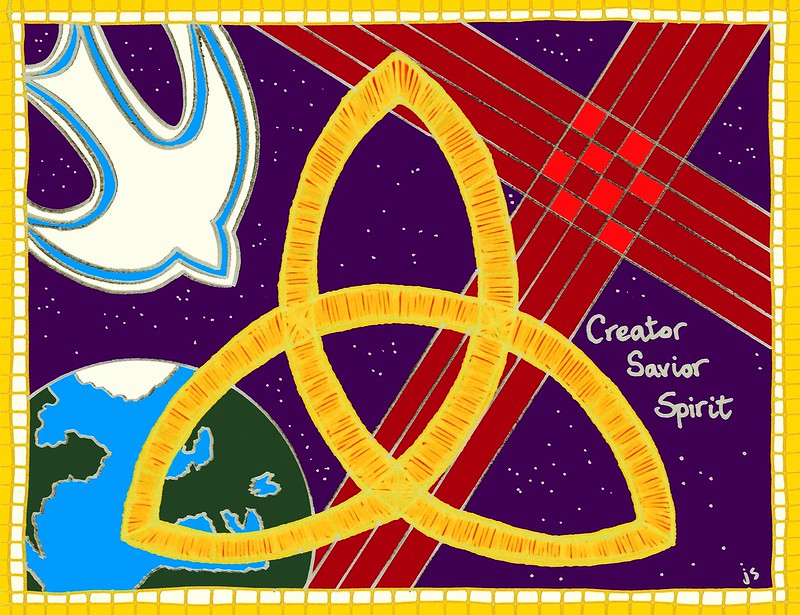
I want to talk today about a set of triplets. No, it’s not 3 children! And it’s not the Trinity, although this is Trinity Sunday. It’s the trio found in Paul’s first letter to the Corinthians, Chapter 13, verse 13: “So now faith, hope, and love abide, these three; but the greatest of these is love.” This is probably one of the best-known passages from the New Testament, and it’s easy to see why.
Everyone knows that faith is important in the life of a Christian. We refer to our brand of religion as our faith, we talk about our faith journeys, and we encourage one another to believe in the triune God and to live lives that will be guided by and pleasing to that triune God. Likewise, to live that sort of life will surely involve spreading the good news of God’s love and being Christ’s loving hands in this world. Faith and love are essential components of Christian life, and love (the greatest of the three) sort of drives the good things that we try to do in God’s name.
But hope? In my experience, and maybe in yours as well, hope is the least mentioned of these triplets. It feels as if hope is kind of…well, it’s kind of what we do when we aren’t sure what to do, or what comes next. Is hope really as important as Paul makes it out to be? What is it, and how does it work in the Christian life?
Well, I’ve done a little bit of research, and for starters, apparently there are 3 kinds of hope: false hope, static hope, and active hope.
People want to have hope. We even say that people are “holding out hope” for a miracle. And we certainly don’t want to trash talk miracles, because they probably occur more often in our lives than we even realize. But false hope is sold by charlatans, and that sort of hope does no one any good except those charlatans. We might think of the peddlers of “cure-all” tonics back in the 1920’s—some elixir that is “guaranteed to cure everything from indigestion to arthritis—and it’ll give you sex appeal, to boot.” {Side note: they’re still out there—but now they’re on the internet.] And when we tell ourselves that nothing is wrong when something is definitely wrong—well, we’re selling that kind of false hope to ourselves.
Now, the second kind of hope–Static hope–isn’t so bad. But it’s just sort of a placeholder to tamp down our worries. “I hope she makes her flight.” “I hope the test doesn’t ask me about Chapter 7; I didn’t actually study that one.” We say we hope, but we can really only wait to see what happens. Saying “I hope it doesn’t rain on Saturday” doesn’t move the future one way or the other—not one inch.
But then there’s active hope. This is hope where we look around to see what we can do to improve the chances of a positive outcome. We look around to see what we can do. So, what can we do? What actions can we take?
Well, prayer, of course. We have to have hope that God will take up for us what we cannot do for ourselves. But that’s just it. God never said, “Don’t try anything tricky, now. Just stay home and pray and see what happens.” If that were the case, then the apostles would have stayed in that upper room, praying that the rest of humanity would somehow magically turn to God and believe in the saving love of Jesus Christ. We know that that is not what happened. The apostles knew that hope was part of the mission, part of the job description. Spreading hope for redemption and new life was what they did as they traveled the world. And having hope was square one. I do not think that they could ever have done what they did if they weren’t moved by faith and love, while leaning into hope.
Now, you know what they say—that once we learn some new word or fact, we begin to see it all around us. Maybe it was always there but now we’re beginning to notice it. I don’t typically read Psychology Today, but the cover story of the June issue—which I spotted at the grocery checkout line—was about HOPE (all caps). And here’s a very relevant tidbit from a book I finished reading on Friday afternoon. The book is Why the Greeks Matter, by Thomas Cahill, and the point he makes as he closes his final chapter is that hope was one of the defining traits of—not the Greeks—but Jews and Christians.
Here’s a quote. He states that the worldview of the New Testament stressed “the adventure of a personal journey with God, a lifetime journey in which [human beings were] invited to unite [themselves] to God by imitating God’s justice and mercy…Time is real…[I]t does not repeat itself but proceeds inexorably, which makes each moment—and the decisions I make each moment—precious. I am not merely an instance of [a human], I am this particular, unrepeatable human being, who never existed before and will never exist again. I create a real future in the present by what I do now. Whereas fate was central to Greeks and Romans, hope is central to Jews and Christians. Anyone who doubts the great gulf between these two worldviews has only to reread the speeches Hector makes [in The Iliad] to realize the impossibility of putting such speeches on the lips of any believing Jew or Christian: [and here’s the snippet]
‘And fate? No one alive has ever escaped it,
neither brave man nor coward, I tell you—
it’s born with us the day that we are born.’ “
We can easily recognize that this idea is in complete opposition to the triplets of 1 Corinthians. So hope, it turns out, is recognized as a central and essential part of the Christian worldview.
Now, here’s another perspective.
An article in the Washington Post a few months back looked at hope from the point of view of journalism. But I think that some of the author’s points were just as applicable to everyday people. With so many terrible things happening in the world, talking about hope or hopefulness sounds almost delusional. And, frankly, being cynical feels like a protective shield against having our hearts broken. But apparently it’s just the opposite. Scientists have been studying hope for over 30 years and they have begun to see it as a skill that can be taught and strengthened. More than 2,000 studies have shown that those who practice hope do better in sports, school, and work. “They manage illness, pain, and injury better and score higher on assessments of happiness, purpose, and self-esteem.” People who know how to tap into hope are better able to bounce back from traumas like domestic violence, child abuse, and other terrible situations. I’m thinking of those who lives are shattered by war, poverty, or natural disasters.
So hope is actually good for us. Active hope means taking up a challenge to see the future in brighter terms and believing that we “actually have a role to play in making it better.” “If [hope] were an equation, it would look something like: hope = goals + roadmap + willpower.”
Here’s where I have to include an example from my own life experience. My mother was the one to call when I felt that there was no hope and I just didn’t know what to do. So, if I called home from college, let’s say, in a panic because “I have 2 exams tomorrow, plus I need to get more research done for a huge paper due on Wednesday, but I’m already drooping with exhaustion from a late night studying last night and I just don’t know what to do.” Now, here’s Mom: “Okay. Okay.” This was always the starter, followed by “Let’s think.” And she would ask some questions about relative importance of factors, and then she’d make some recommendations like “What if you—fill in the blank with actions that could be arranged to get the most bang for the buck.” And voilá! Suddenly there are goals plus a roadmap. And my mother fed me willpower with a steam shovel. I always channel her when my own children have felt helpless and unable to muster hope. Giving someone hope when hope is gone—active hope, not the false, pie-in-the-sky kind but active hope—is really God’s work. I believe that.
You remember the saying “Faith without works is dead”? Many works are driven by love, but maybe some start out driven by hope.
If we believe that there is a chance and that we can help to drive up the success rate of that chance, then we are exercising our active hope. In fact, the anticipation of what tomorrow may bring—when looked at as a challenge that we are ready to meet with a combination of positivity and realism—makes each day glow with expectation. Planning for upcoming events and activities (like the kind we enjoy through our Christian fellowship) keeps each present day hopeful and keeps us from dwelling on the past or on times when things didn’t go our way. Hope helps us to live life fully—the life that God wants for us, not a shadow existence where we give up our lives to fear and doubt and regret. There’s an old Mexican proverb: “I never ask God to give me anything. I just ask God to put me where things are. I can do the rest.” That’s living with active hope! Think about the difference between saying, “I wish” and “I hope.” If you say that you wish our congregation could do or be something in the next year—well, that may just be wishful thinking. But if you say that you hope that we will—now you’re ready to put yourself and the church on the path to action and potential success.
I actually got into this examination of hope by reading the obituary of a man called Brother Andrew. He died last October, at the age of 94. (If you are on Session, you may recall my speaking about this man.) He had grown up in the Netherlands, during the Nazi occupation. His family made it their calling to share what little they had with the hungry and homeless. As an adult, he made it his mission to bring Bibles (ultimately millions of Bibles over his lifetime) to Christians behind the Iron Curtain who had none. You may recall how difficult, even risky, it was to practice the Christian faith during those Cold War days. In the former Czechoslovakia, pastors had to have their sermons approved by the government before they could preach them. Think about that for a moment. People in Macedonia could only attend church after dark. To be seen going to a worship service was just too dangerous.
And many of these faithful Christians (because who could doubt their commitment to the faith when they were willing to worship under threat)—many of these Christians had no Bibles. They were starting to lose hope that those in the West even thought about them and their struggles to practice the most basic forms of Christian worship. But Brother Andrew traveled back and forth many times, ostensibly as a teacher but most importantly as a smuggler of Bibles. And wherever he went, he brought hope.
Once, when he was traveling to the former Yugoslavia, his car already weighed down with hidden Bibles, his traveling companion hopped into the front seat with a carton of Ukrainian Bibles on his lap. His thinking was “If we’re going to be arrested for carrying in Bibles, we might as well be arrested for carrying in a lot of them.”
So Brother Andrew’s mission was to embrace a challenge—much as the apostles did. They traveled the world teaching faith, preaching love, and spreading hope to people who had lost sight of it.
So here’s today’s message, in a nutshell:
- Remember that hope is really important. Paul said that love was the most important of the three, but if he didn’t think that hope was important, he wouldn’t have included it in that trio of mindsets in 1 Corinthians. Hope is important to our Christian life.
2. The best way to keep hope going is with prayer and action. Hope means that we haven’t given up. And sometimes hope primes the pump of action.
Remember:
Hope = Goal + Roadmap + Willpower. That doesn’t mean that we should waste effort on those things that we cannot change! Remember that the serenity prayer concludes with “and the wisdom to know the difference.” Sometimes we need to pray for strength to endure what cannot be changed or doesn’t go our way. But we shouldn’t throw in the towel on living. Leaning into hope keeps us focused on what we CAN do, even when we can’t fix everything. And why shouldn’t we have hope? We walk each day with Jesus—our savior and our friend.
And, lastly, we can encourage others to have hope. People need to know that others care about them. They’re not forgotten. Nothing can lead a person to lose hope faster than feeling entirely unseen or forgotten. We don’t have to cross international borders, like Brother Andrew, to bring hope. There are so many ways that we can be smugglers of hope right in our own neighborhoods and families wherever we see people—Christian or not—who feel forgotten, lonely, or afraid. The world is full of these people, isn’t it? Lifting people up and giving them a reason for hope is part of our mission as Christ’s hands in the world. After all, it’s linked forever between faith and love.
Will you pray with me?
Heavenly and Triune God,
Keep us ever mindful of our many blessings. Alongside faith and love, help us to lean into hope—for ourselves and for the world. And may we always be bringers of hope—even smugglers of hope–to those who need to know that they are seen and that they are loved.
In Jesus name we pray. Amen
 Sharing God's Love and Grace