Meditation on John 8:31–36
First Presbyterian Church of Smithtown
Pastor Karen Crawford
Reformation Sunday: Oct. 29, 2023
A few days ago, I took the right hands of my son, James, and his bride, Andrea, and prayed over the rings they would place on each other’s fingers. I began to speak the words that James and Andrea would echo, phrase by phrase, their voices shaking with emotion, their eyes shining with tears.
“Andrea, I give you this ring as a sign of my love, a pledge of my faithfulness, and a symbol of the covenant we make this day.”
I give thanks to God for the honor and privilege that it was to preside over my son’s wedding—here in our beautiful sanctuary. I am so grateful to my flock—especially those who served behind the scenes to help make the special day even more special.
Everything was perfect, including the weather. Andrea’s family flew from Minnesota for what became a destination wedding. They traveled to New York, some of them, for the very first time.
I shared a personal message at their wedding—something I rarely do, as the wedding service nearly always seems complete without it. I tried hard not to embarrass James—and I borrowed a theme from the Back to the Future movies. I said, if only we had the DeLorean time machine—not to go back and fix something that was broken in the past, but to give hope and peace to James, who never wanted to move to Minnesota.
If only the James and Andrea of today, I said, wearing their wedding finery, could show up at our home next to the church in Renville, Minnesota, 12 years ago. Their mission would be to tell James the good news—the good future God had planned! For God cares about the desires of our hearts, dear friends!
But then, it was the process of loss and grief, and then healing, growth, and love that made James the strong man he is today. It was painful, at times, for all of us who were out of our comfort zones in rural Minnesota, where the winters are long and cold. Leaving our old lives—and friends—behind.
They met in college, a year after we arrived—James and Andrea. They dated for 11 years. They became engaged in an old-fashioned way two years ago. Then they called me on Zoom to share the news—and ask me if I would marry them. The decision to be married in this church came a year later, when they visited us in Smithtown last summer.
I quoted the text couples often choose for their weddings—First Corinthians 13, composed by a single man named Paul who wrote of God’s love thousands of years ago. I urged them, of all that love is, to be patient and kind. To say, “I love you. I’m sorry. I forgive you—and I love you even more.”
God is our model for patience and kindness. God is so patient. God is so kind!
On Reformation Sunday, we look back on the history of the Christian Church and remember some of the people and events that worked together to move the Church onto a different, more faithful path, which led, hundreds of years later, to where we are today.
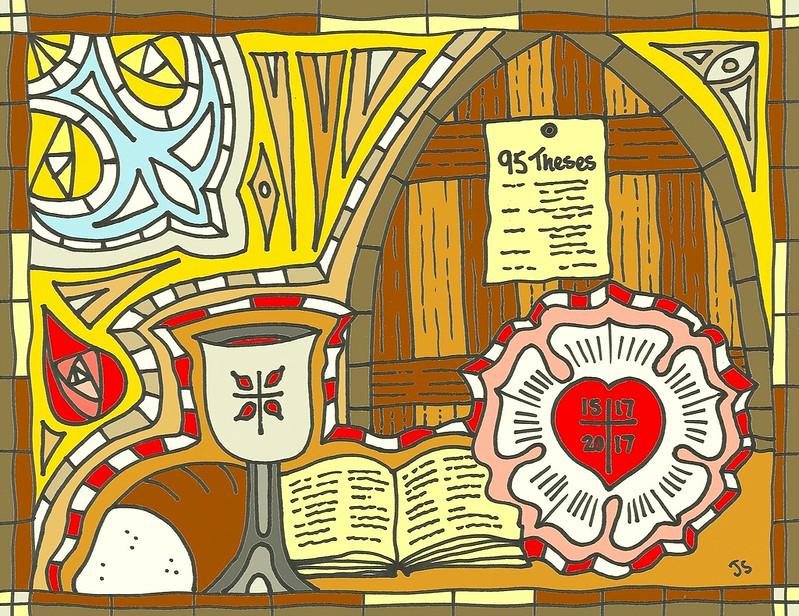
The date for Reformation Sunday in the church year falls as close to Oct. 31 as possible, to commemorate Martin Luther’s posting of his 95 Theses on the Wittenberg castle church door. Actually, we don’t know the exact date that he nailed his Theses to the door, urging the Roman Church to reform; it could have been as late as mid November! But we do know that he sent the Theses enclosed with a letter to Albert of Brandenburg, the Archbishop of Mainz, on Oct. 31, 1517.
Luther called for changes in belief and practice. He believed that individuals could be saved only by personal faith in Jesus Christ and the grace of God. He objected to the Church’s practices of works-based righteousness– pilgrimages, the sale of indulgences to obtain forgiveness, and prayers addressed to saints. He advocated the printing of the Bible in the language of the people, rather than Latin, so they could read and understand Scripture with the help of Gutenberg’s new invention: the printing press.
But it’s unfair to give all the credit for the Protestant Reformation to Martin Luther alone. He followed countless reformers of the Church calling for a return to biblical teachings. Some better-known ones who came before Luther include John Wycliffe, at Oxford University, and Jan Hus, at Charles University in Prague. Luther joins other Protestant reformers of the 15th and 16th Centuries–French Theologian John Calvin, Scottish Minister John Knox, and Swiss Pastor Ulrich Zwingli, who trace many of their theological understandings to the ideas of a person of color, born in the 4th century, A.D. I am speaking of the North African Saint Augustine of Hippo—in what is today Algeria.
And there are other, less famous people to remember and honor today, on Reformation Sunday. The writings, teachings, and lives of countless religious women over the centuries have also helped to shape the Christian Church around the world. Sadly, most people don’t know about them. Do you know of Hildegard of Bingen, Mechthild of Magdeburg, Julian of Norwich, Margery Kempe, Catherine of Sienna, Bridget of Sweden, Clare of Assisi, and Teresa of Avila? These are just a few whose stories and contributions to the Church are coming to light and being shared after hundreds of years of being overlooked or ignored.
But rather than make Reformation Sunday an ode to the heroes and heroines of the faith or focus on the historical differences and disagreements between Protestants and Catholics, let us, instead, consider the ongoing work of the Holy Spirit in every believer to bring about the Church’s transformation. For Reformation Sunday is about change!
This isn’t about us seeking to reform ourselves or the church according to our own personal preferences. That’s always a temptation! Presbyterians and other believers in the Reformed Tradition hold to the motto, Ecclesia reformata, semper reformanda, that is, “the church reformed, always reforming,’ according to the Word of God and the call of the Spirit.”
Our gospel reading in John today is about Christ inviting those who are beginning to believe in him to have a change of heart so they may follow him and experience new life. “If you continue in my word, you are truly my disciples,” he says, “and you will know the truth, and the truth will make you free.”
There’s only one problem with his statement—the talk of being “made free.” That puts them on the defensive and a promise becomes the obstacle to their following Jesus. “Made free from WHAT?” they want to know. They say with pride, “We are descendants of Abraham and have never been slaves to anyone.”
Does this surprise you? The history of the Israelite people, the whole story of Moses leading them out of captivity in Egypt, has been forgotten. They miss the point that Jesus is trying to make—the hope for all eternity for sinners, needing a Savior—in this world and in the world to come. The kind of freedom we have is the freedom from our bondage to sin and death.
That means living in confidence, sure of God’s loving purpose for our lives during the most uncomfortable or unhappy times. This is how the Spirit molds and changes us, when we go through the process of loss and grief, then come to experience God’s healing, growth, and love through the people God has sent to care for us and for us to care for them.
The encouragement during trials from the epistle of James comes to mind. “Consider it pure joy, my brothers and sisters,” he says in chapter 1, “whenever you face trials of many kinds, because you know that the testing of your faith produces perseverance. Let perseverance finish its work so that you may be mature and complete, not lacking anything.”
In my wedding reflection on Thursday, I told my youngest son how proud his family is of him. How happy we are that he and Andrea have found each other. How we love them both. How they are better together than they were apart.
I pray that the Holy Spirit that brought about their growth and transformation will continue to guide and strengthen them in their marriage and help them keep all the promises they made that day. And that the Lord would help them to be patient and kind. I know if they seek to love with patience and kindness, all the rest will fall into place.
This is what I pray for all of us. That our relationship with the Lord and one another will be like a strong marriage. We have chosen to live in loving covenant. We can’t help but deal with change as a congregation when the world around us is changing every day. Our calling and challenge are always to be faithful—to know Christ and to walk in his loving ways, as best as we can. And if we fall, to get back up again. To welcome the continuing reformation of the heart and mind of every believer.
Sometimes, we need to say, “I love you. I’m sorry. I forgive you—and I love you even more.”
The Lord will bless our church family with growth and maturity if we are patient, dear friends. If we are kind. Our Triune God is our perfect model for love!
The Lord is so patient. The Lord is so kind. The promise is that will not lack anything!
If the Son of God has made us free, we are free indeed!
Let us pray.
Holy One, thank you for your Word and the self-giving example of your Son, Jesus Christ, who invites us, right this moment, to embrace a change of heart and new life by faith. Thank you for the promise of freedom from the burden of sin and death through belief in the Son, our Savior, and commitment to drawing nearer to him in prayer, following in His ways as best as we can. If we fall, please lift us up. Encourage us when we are uncomfortable or unhappy about our life’s situation. Some of us are going through difficult times, dear Lord. Some of us are struggling with serious health challenges or grieving the loss of a loved one. Some of us are caring for a loved one with health problems, and we feel afraid for the future. Strengthen us each day, God of compassion, that we might continue in the ministry you have called us to as individuals and a church of Jesus Christ. Teach us to always be patient and kind, with our families by birth and marriage and our family of faith, especially in times of trial or differences of opinion. For you are so patient. You are so kind! In your Son’s name we pray. Amen.
 Sharing God's Love and Grace