
Meditation on John 3:14-21
Pastor Karen Crawford
March 10, 2024
We honored the life of Lois Netter yesterday. Our sanctuary was filled with family, friends, and our church family who came to give thanks to God for the gift of her life and remember how she touched our lives with her kindness, goodness, and faith.
During the sharing of memories, one speaker who had known Lois for more than 60 years said that Lois never had a bad word to say about anyone. In this day and age, it’s a rare thing to have someone who truly lives by the wise saying of Thumper’s mother in Walt Disney’s Bambi, “If you can’t say something nice, don’t say nothing at all.”
She never complained, though she suffered a long time. She was positive and cheerful, a gracious host, a good cook. She was an avid reader and a member of numerous book discussion groups, including ours at the church. She was a deacon and longtime knitter whose prayer shawls provided comfort, beauty, and warmth to others for decades. She was a former ESL teacher who lived overseas with her husband, Andy, a guidance counselor, touching the lives of students in Thailand, India, Japan, Pakistan, Peru, and Poland.
Lois didn’t have a mold that everyone needed to fit in. She was curious about you, accepted you as you are, saw the good in you, embraced you for it, and told others about it. She was a good friend, compassionate and loyal.
I wore the purple stole of Lent yesterday at her celebration of life in this Holy Season. I read a scripture often read as we draw nearer to Easter—the story of the raising of Lazarus in John 11. We wondered why Jesus waited to heal the one he loved, after he received word from his friends, Mary and Martha, that their brother was ill. Why did he wait until Lazarus died to return to Bethany? He was met on the edge of town by Martha, who, though grieving and disappointed with Jesus, had not yet given up hope. “Lord, if you had been here, my brother would not have died,” she says. “But even now I know that God will give you whatever you ask of him.”
Jesus will say something surprising. “I am the resurrection and the life,” he says. “Those who believe in me, even though they die, will live, and everyone who lives and believes in me will never die. Do you believe this?”
“Yes, Lord,” she says, “I believe that you are the Messiah, the Son of God, the one coming into the world.”
Comparing these two conversations with Jesus—Martha in chapter 11 and Nicodemus in chapter 3—we find significant differences and common themes. Both are about life and death, suffering and salvation, belief, rebirth or resurrection, and healing. But Martha, though her brother has been in the tomb for 4 days and there is the stench of death, still holds onto her faith in Christ’s power to heal and save. The whole Jewish community is gathered around the sisters and at the tomb. Everything is said and done in the open. Jesus even prays aloud so that all would hear and know that he was speaking to the Father—and that God was the source of his healing power. When he calls forth the dead man from the tomb, he invites the community’s full participation in his healing and new life when he cries out, “Unbind him and let him go!”
Nicodemus doesn’t have faith or friendship with Jesus, unlike Martha—not yet. His conversation is in secret, maybe because he is afraid. Much is made of his coming at night. “Darkness and night symbolize the realm of evil, untruth, and ignorance,” says Raymond Brown, who was Professor Emeritus of Biblical Studies at Union Theological Seminary in New York. “In 23:30, Judas leaves the light to go out into the night of Satan; Nicodemus, on the other hand, comes out of the darkness into the light.” [1]
Another reason is possible for Nicodemus coming at night. It’s also rabbinic custom to stay up at night to study the Law. And he may just want to be alone with Jesus. He has questions! He wants answers—and to know Christ more.
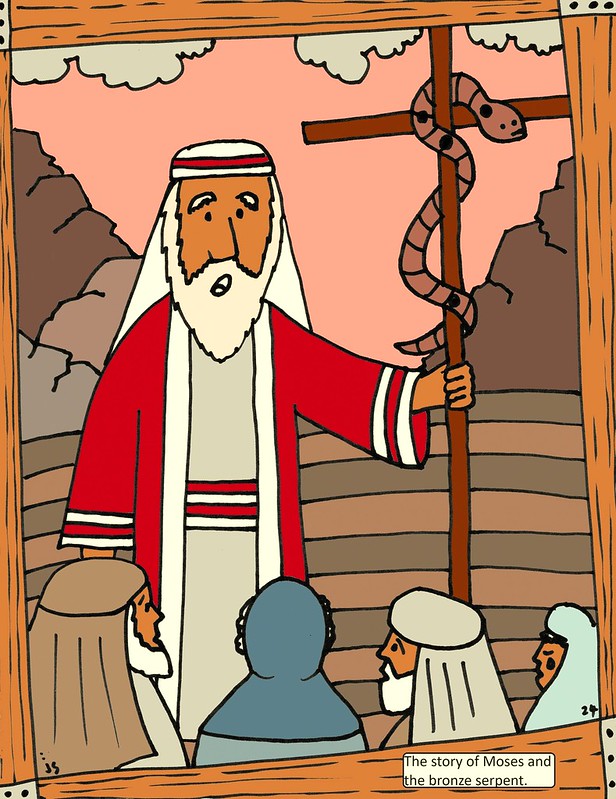
Jesus connects the Old Testament wilderness stories with the promise of the New Covenant, saying,“And just as Moses lifted up the serpent in the wilderness, so must the Son of Man be lifted up, that whosoever believes in him may have eternal life.”
With the pandemic years still so close to us in time—when illness and death seemed to surround us daily—the image of the serpent in the wilderness is more meaningful than ever! I think I usually skip over this imagery in this passage, probably because I don’t like snakes! But with the pandemic and the words of Jesus here, meant to bring light into our darkness, I am seeing things differently. The snake is a sign of Christ’s healing for the world.
“It is one of the most unusual Christological symbols in the New Testament: Christ the Snake,” writes Roger Gench in Presbyterian Outlook. [2] “Odd though it may be, it is well worth pondering. In both the ancient and modern world, snakes were and are symbolic of our deepest, most ominous fears, but also of life, death and rebirth — indeed of healing. Psychologists have associated snakes in dreams as harbingers of transformation and new beginnings.” [3] Gench, a theologian in residence at Second Presbyterian Church in Richmond, points out that the American Medical Association’s logo is “the healing snake upon a pole.” [4]
The Israelites in Numbers 3 complain against God and Moses, “Why have you brought us up out of Egypt to die in the wilderness? For there is no food and no water, and we detest this miserable food.” The Lord responds by sending poisonous serpents. Many Israelites die! But when the people confess their sin to God, the Lord tells his servant, Moses, to make a snake out of bronze and put it on a pole. Then, whenever someone is bitten, that person need only look upon the serpent of bronze in faith—and live!
Nicodemus is a Pharisee and a member of the Jewish Sanhedrin, the highest governing body of the Jewish people, composed of 70 members—priests (Sadducees), scribes (Pharisees), and lay elders of the aristocracy. [5]When he asks Jesus, “How can anyone be born after having grown old?” he is talking about himself! He isn’t mocking him. He is struggling with Christ’s teaching, following the Jewish belief that it is in the struggle and wrestling with the Law, God’s Word, that truth is found, understanding dawns, and meaning is made for today.
“Can one enter a second time into the mother’s womb and be born?” he asks. Jesus again mentions the kingdom of God and the need to be born of water and Spirit. The wind blows where it chooses, and you hear the sound of it, but you do not know where it comes from or where it goes.
Nicodemus asks, “How can these things be?” You can almost see a smile dancing on his lips. And Jesus seems to return that smile, saying playfully, “Are you a teacher of Israel, and yet you do not understand these things?” Of course, Jesus knows what Nicodemus knows. That’s how this passage began, with Christ knowing “what was in everyone,” meaning their hearts.
Soon, we reach today’s passage, when Christ brings up the story of the saving of the Israelites with the bronze snake lifted on a pole as foreshadowing his own suffering and death, when he is lifted on a cross so that “whoever believes in him may have eternal life.”
Why would God do such a thing? John 3:16: “For God so loved the world that he gave his only Son, so that everyone who believes in him may not perish but may have eternal life.” Listen! The word translated loved (agapasen) in John 3:16 isn’t in the past tense in Greek. It is in the aorist, which defies time and “implies a supreme act of love.” [6] It is past, present, and future. God has always and will always love the world! 1 John 4:9 interprets and personalizes John 3:16, saying, “In this way was God’s love revealed in our midst: God has sent His only Son into the world that we may have life through him.”
Jesus is defining this New Covenant in himself as no longer exclusive to Israel. The proof of God’s inclusive love is in 3:17, through the giving of a Savior for all people. “Indeed, God did not send the Son into the world to condemn the world, but in order that the world might be saved through him.”
Nicodemus will appear two more times in John’s gospel. He will remind his colleagues in the Sanhedrin (John 7:50-51) that the law requires that a person be heard before being judged. And he will come to Jesus once more at night, after the crucifixion. He will help another formerly secret follower, Joseph of Arimathea, prepare Christ’s body for burial in John 19. He will provide 100 pounds of spices for embalming–a sign of a royal burial, fit for the King of kings!
Yesterday afternoon, when we shared memories of our friend and sister in the faith, we saw the signs of God’s love for the world in our very own community, in our very own church family.
If we look around the room right now, we can see the signs of the love and grace of God in the Communion of the saints. The Spirit has brought you to worship today, to praise God and be strengthened for your journey. You have come to be encouraged in your walk with the Light of the World and to encourage someone else. Like Nicodemus, you have come to know, a little bit more, the One who knows us completely.
Like the snake-bitten Israelites who looked in faith upon the bronze serpent high on a pole—and lived, I invite you now to come in faith to Jesus, lifted high on a cross. May you find healing for body and soul!
If we listen for His voice, Christ will lead us to do His good works that testify to our faith.
This is how otherswill come to know the God who so loves the world!
Let us pray.
Holy One, thank you for your love for the world, a love that was shown when you did not withhold your Only Son. But instead, you gave him up, lifted high on a cross for our healing, like the Israelites of old who were healed by the bronze serpent on a pole. Lord, show us the signs of your present and coming Kingdom in this Holy Season of Lent, signs that are all around us, if only we have eyes to see and hearts to walk in your Light—with you—each day. Lead us to do your good works, as our dear sister Lois did, and testify to our faith. Help us as we seek to share the good news of your love with all the world. In Christ we pray. Amen.
[1] Raymond Brown, The Gospel According to John (I-XI) in the Anchor Bible series (New York: Doubleday, 1966) 130.
[2] Roger Gench, “Fourth Sunday in Lent: March 14, 2021” in the column, “Looking into the Lectionary” in Presbyterian Outlook, March 12, 2021, at https://pres-outlook.org/2021/03/4th-sunday-in-lent-march-14-2021/
[3] Roger Gench, March 12, 2021.
 Sharing God's Love and Grace