
Message on Mark 10:46-52
First Presbyterian Church of Smithtown, NY
Pastor Karen Crawford
Fifth Sunday in Lent
March 17, 2024
Yesterday, when we gathered for our Spring Beautification Day, I watched a man pulling weeds. Another man climbed a tall ladder to restore a spotlight on our cross. Young men and older cleared out old furniture and pulled down ceiling tiles and blinds to make ready for a new, nursing mothers’ and baby changing room. A woman sorted through bags of donated shoes and clothing. Others labored in the kitchen, polishing offering plates, clearing shelves, and scrubbing cabinets, counters, and refrigerators. Others tidied the church office and vacuumed the choir loft.
Boy Scouts from Troop 214 came, with several adults, to help carry heavy items outside to a truck for donation or place in the trash. It was a mild, sunny Saturday morning, when people could have found something else to do, maybe more fun and relaxing.
They came, and they served.
One of the things I like about our beautification days is the way members take ownership of the spaces they are cleaning or organizing. You can tell by their movements and expressions that they know this is their church! These workdays provide an opportunity for people to use gifts and talents they might not ordinarily use on Sunday mornings.
I LOVE the comradery. Friends helping friends, laughing, and talking. By the end of the day, we are all better friends than we were before. We are always united when we engage in shared ministry, particularly hands-on ministry. Often, the experience leads to our eyes being opened to what we weren’t really seeing before. We start to notice things about the church building when we go through the nooks and crannies and closets. We come to see ourselves and our ministry with a fresh perspective.
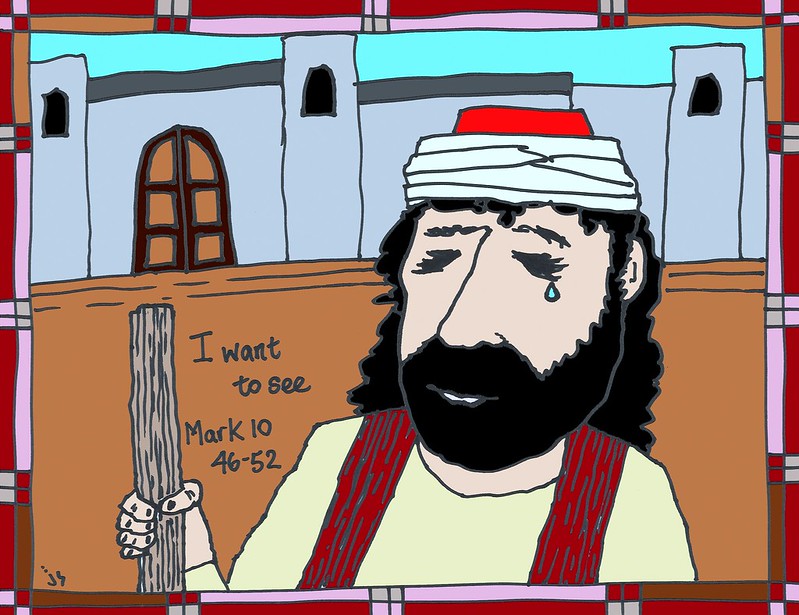
Today, we continue our series of Healing Stories with the blind beggar in the tenth chapter of Mark. He is “Bartimaeus, Son of Timaeus,” and at first glance we are excited that, finally, the person whom Jesus heals has a name! Not so with Simon’s mother-in-law, healed of her fever. Not so with Jairus’s daughter, raised from the dead. Not so with the unnamed woman, healed of bleeding after she touched the fringe of Christ’s garment. Not so with the paralyzed man, lowered down on a mat through a hole dug in Jesus’s roof.
But then, we realize that we don’t actually know this man’s name, either. Bartimaeus is Aramaic for “Son of Timaeus.” So Mark is really saying, “Son of Timaeus” in Aramaic, then “Son of Timaeus” in Greek. All we know is this is Timaeus’ son.
Up to now, most of the healing stories have fallen into a pattern. Most were healed, not when they asked Jesus for healing, but when someone else asked for them. They were not marginalized or despised. They were very much connected to their community.
But today, the one who is healed is yelling by the side of the road. He is a beggar and has no one advocating for him. He hears Jesus, who is walking through Jericho on the way to Jerusalem for the Passover. His yelling annoys the people around him who tell him, very sternly, to shut up.
He shouts even louder! “Jesus, Son of David, have mercy on me!” “Son of David” is a messianic title. Bartimaeus is only the second person in Mark to call Jesus by this title. The blind man is the one who sees Jesus as he really is. [1]
Blindness was common in this part of the world, possibly caused by the glare of the sun and infection, when eyes became encrusted with matter. People didn’t know the importance of hygiene and cleanliness, and, if they were poor like Bartimaeus, they may not have had access to soap and clean water. Adding to the problem were the flies that persistently settled in the matter-encrusted eyes and spread the infection from one person to another. [2]
Some things to notice about this healing story. It isn’t just a healing story. And this is often the case with healing stories, as we have discovered in this series. This is a call story. Even the word for “call” is repeated. But Jesus isn’t the first to call to him, like he does the fishermen in Mark chapter 1, “Follow me and I will make you fish for people.” Bartimaeus calls to Jesus and keeps calling, until Jesus stops in his tracks and says, “Call him here.” The crowd calls to the blind man, “Take heart! Get up! He is calling you.”
Earlier in this chapter, at 10:17, a man approaches Jesus, asking, “Good teacher, what must I do to inherit eternal life?” After talking with him about his obedience to the Commandments, Jesus tells him that he lacks one thing. “Go, sell what you own, and give the money to the poor. And you will have treasure in heaven; then come, follow me.” When he hears this, the man is shocked and goes away grieving, for he has many possessions.
Bartimaeus responds to Christ’s call by throwing off his cloak, likely his only possession! This is a bold action. “A blind man who tosses something aside in a crowd may never find it again. He is doing completely what the rich man could not bring himself to do—casting aside everything he possesses to come to Jesus.” [3]
The one who cannot see, but knows Christ’s identity, quickly finds his way through the crowd to the Holy One.
The next part is maybe my favorite part of this passage, when Jesus asks him a question. He wants to know about the blind man’s faith. He reveals the love and compassion of God in his kindness toward this man, who is obviously rejected by his community.
“What do you want me to do for you?” Jesus asks, echoing the question he asked of his disciples, James and John, vying for the most important positions in a misunderstanding of Christ’s kingdom just before they reach Jericho and hear the shouts of Bartimaeus. Jesus asks the two disciples, “What is it that you want me to do for you?” They say that they want to sit at his right hand and his left, in his glory. Jesus answers, “Whoever wishes to become great among you must be your servant, and whoever wishes to be first among you must be slave of all. For the Son of Man came not to be served but to serve, and to give his life as a ransom for many.”
Bartimaeus answers Jesus’s question. “My teacher, let me see again.” Jesus says, “Go; your faith has made you well.” There is no need for Jesus to physically touch Bartimaeus for this healing, not like when he took the hand of Jairus’s daughter and Simon’s mother-in-law and lifted them up. Not like in Mark chapter 8, when he heals a blind man in Bethsaida, who begs him to touch him. Jesus takes the man by the hand and leads him out of the village, puts his saliva on the man’s eyes, and lays his hands on him. Amy-Jill Levine calls this “a two-stage miracle”—only found in Mark. Jesus asks, “Can you see anything?” The man looks up and says, “I see people, but they look like trees, walking.” Jesus lays his hands on his eyes once again, and he sees everything clearly. [4]
This Greek word translated “made well” in chapter 10, in the healing of the Son of Timaeus, is sozein. You know what I am going to say because we have talked about this in our healing stories. This means made well physically or spiritually or both. [5] Jesus is essentially declaring, like he did to the woman who touched the fringe of his garment, “Your faith has healed you and saved you.”
We aren’t left wondering, when we reach the end of this passage, what will happen with Bartimaeus. Mark tells us that he follows Jesus on his way. Unlike the rich man, he has answered the call. Bartimaeus is the perfect disciple. He gets everything right, in contrast to the other disciples, who constantly doubt and misunderstand the mission of the one who came to suffer and give his life as a ransom for many. Despite their close proximity to Jesus, walking with him and joining in his ministry daily, they lack vision and insight.
I find hope in this passage for all who wish to be Christ’s followers, even those who are not perfect and don’t always get it right. That pretty much sums up the entire Body of Christ in the world. The Lord is SO patient with us. God’s love and mercy is everlasting. Have you ever stumbled and fallen? God still loves you. God still has a plan! Today is a new day!
I invite you to stay after worship today, when we gather for another important labor of our ministry—our annual meeting. Our focus is on celebrating the ministry and giving thanks to the Holy Spirit for guiding and helping us all the way. We give thanks for our faithful members, whose generous giving of themselves, their time, talents, and treasure, has made ministry possible and fruitful here in Smithtown—for many, many years. With God’s blessing, and our faithfulness, we will serve the Lord and our community for many, many more years to come.
Yesterday, at our church’s Spring Beautification Day, I saw the greatest servants working hard behind the scenes. Relationships were strengthened by a shared, hands-on mission in Christ’s name.
Friends, let’s keep on doing the good and kind things that we have been doing, and trust with the simple, childlike faith of Bartimaeus.
May the Lord bless us with vitality and abundance as we let go our tight hold on our possessions and embrace the Lord’s plan, God’s vision for this community that God so loves.
There is One who desires to heal and save us. One who invites us all to draw near, and asks us this day, “What do you want me to do for you?”
We cry out, with the Son of Timaeus, “Let us see again.”
Let us pray.
Heavenly Parent, thank you for your love and mercy, hearing us as we cry out to you for healing and salvation. Thank you for the strength and guidance of your Holy Spirit as we seek to follow in your loving ways. Help us when we stumble and fall, when we don’t get it right, like Christ’s earliest disciples. Bless us as we seek to be obedient to your Word. Give us your vision as your church, like you did for Bartimaeus, when your Son was walking the road to Jerusalem, drawing near to the cross where he would give his life as a ransom for many. In the name of our Precious Lord we pray. Amen.
[1] William C. Placher, Mark (Louisville: Westminster John Knox Press, 2010) 154.
[2] William Barclay, The Gospel of Mark (Philadelphia: Westminster Press, 1975) 189.
[4] Amy-Jill Levine, Signs and Wonders: A Beginner’s Guide to the Miracles of Jesus (Nashville:Abingdon Press, 2022) 92.
 Sharing God's Love and Grace