
Meditation on John 6:1-15
Pastor Karen Crawford
First Presbyterian Church of Smithtown, NY
July 28, 2024
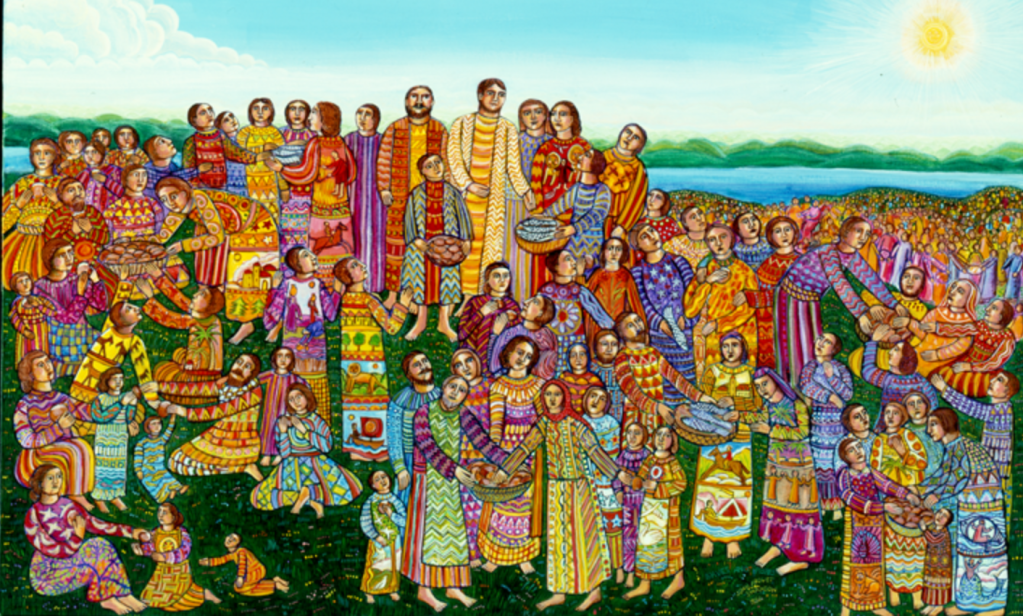
John August Swanson, artist
“A shoe factory sends two marketing scouts to a region of Africa to study the prospects for expanding business. One sends back a telegram saying,
“SITUATION HOPELESS STOP NO ONE WEARS SHOES
“The other writes back triumphantly,
“GLORIOUS BUSINESS OPPORTUNITY STOP THEY HAVE NO SHOES.” [1]
This story is from a book called, The Art of Possibility: Transforming Professional and Personal Life by Rosamund and Benjamin Zander. Has anyone heard of this book before? This was required reading for an interim ministry training I attended in Montreat, NC, five or six years ago.
The Zanders write, “To the marketing expert who sees no shoes, all the evidence points to hopelessness. To his colleague, the same conditions point to abundance and possibility. Each scout comes to the scene with his own perspective; each returns telling a different tale. Indeed, all of life comes to us in narrative form; it’s a story we tell.” [2]
So, this is my question. Are you a person who sees the world through a perspective of abundance and possibility? Or are you a person who sees the world through a perspective of scarcity and limitations? In other words, are you a half-full glass kind of person? Or are you a half-empty glass kind of person?
What’s YOUR story? Where did YOU get your perspective? What were your parents’ and grandparents’ stories? Did you grow up in an especially hopeful time or was it a time of anxiety and scarcity? How did that shape who YOU are today?
I was thinking about my grandparents this week who lived through the Great Depression. I found an old photo of Grandma in her 20s in a wedding dress from May 8, 1936. That would make a big difference in how you see the world—the narrative you know and tell for the rest of your life, if you grew up in a family that struggled during a time when many families across the country were struggling.
My mother’s mother used to tell stories of not having money growing up as Norwegian immigrants in a big family, with 11 children, in Pleasantville, NJ, near Atlantic City. But they still had fun, even without much money. They rolled up the living room carpets and danced with their friends to records on the Victrola. If the ice cream man came down the street, they might look under the couch cushions to find a nickel to buy a treat. I always thought that was amazing—that the couch cushions might be a good source for ice cream money. And that ice cream cost only a nickel!
But throughout Grandma’s life, even when she wasn’t poor as an adult, after she married a butcher from City Island, she had a certain narrative or perspective that wasn’t going to change. She was always afraid of scarcity—of not having enough. She was warm and hospitable, generous and kind, giving of herself to friends, neighbors, family, and church family. She was faithful to attend worship, always active in her church, busy with choir and rummage sales. When I was anxious, she would tell me to pray and “trust in the Lord.”
But she was afraid something might happen, and nothing would ever take that anxiety away, even when she was living with my parents in her last years in Florida. She lacked nothing.
Jesus knew his disciples well, just as he knows us well. It’s interesting to see the different perspectives of Christ’s followers in John chapter 6 today. He knew what questions to ask, what buttons to push, to help grow their faith and transform their thinking. In this case, he was testing Philip, asking him a question, though Jesus already knew what he was going to do.
There’s a crisis. A true situation of scarcity exists on the northeastern hillside of the Sea of Galilee, the lowest freshwater lake on earth. This miracle appears in all four gospels. This story was passed down, from anxious generation to generation, community to community, to give them hope, especially in times of real scarcity and need.
A crowd of people has been following Jesus because they see him healing the sick—they see the “signs,” John says. Jesus and his disciples have crossed to the “other side of the Sea” and climb a mountain to get away from the demands of ministry, take a rest from the crowd. The people find Jesus, anyway.
When he looks up and sees the crowd coming toward him, he asks Philip, “Where are we to buy bread for these people to eat?”
Notice he doesn’t say, “Where are we going to get the money to buy bread for people to eat?”
Philip, with his math mind, quickly calculates how much money they would need to buy bread for everyone, saying, as if Jesus had asked, “Where are we going to get the money to buy bread for people to eat?” “Six months’ wages would not buy enough bread for each of them to get a little.” In Greek, this is “200 denarii” not six months’ wages. One denarius is the usual pay for a day’s work as a laborer.
So Philip—glass half empty or half full? At least he’s thinking about how it could be possible to help all the people in need. Philip knows the compassion and healing power of Christ is real. But, like us, he has the only perspective he knows—and that’s one where they only have a little bit of money to care for all the disciples—a true situation of scarcity, and now they need a lot more money to buy a whole lot of bread to feed a hungry and persistent crowd.
But then there’s Simon Peter’s brother, Andrew. He impresses me! He seems to have a good relationship with children. In a society that ignores children, he notices and befriends a child—speaks with him. The boy shows the former fisherman his five barley loaves and two measly fish—probably enough for a little boy’s lunch, and no more.
What is the child’s perspective? Is he a half empty glass person or half full? He has hope (doesn’t he?) that the little bit of food he has will make a difference. He has that child-like faith that Jesus says all of us need to enter the Kingdom of God. And gentle Andrew honors the boy’s generosity and tells Jesus about this gift. He doesn’t send the boy away.
Then Andrew does what we do when we are afraid to get our hopes up or when reality sets in. Have you ever had your hopes up about something and then realized that it just wasn’t going to happen? “It isn’t possible.” Or maybe that’s just what we tell ourselves to protect our hearts from painful disappointment.
After telling Jesus about the gift, Andrew says, “But what are they among so many people?” He’s having doubts. Suddenly, the boy’s gift isn’t enough. Andrew is, after all, in the “real” world with Philip, measuring the amount of food against the number of people and coming up extremely short.
Jesus then tells the disciples to make the people sit on the grass. This writer knows how to build suspense! What are the disciples thinking when they are telling people to sit on the grass? They have already decided that there’s no way Jesus can feed all those people. But they do it, anyway. They trust Jesus, though the math doesn’t add up, and it doesn’t make sense. They are examples to us, not always, but at this moment in the story.
And what are those people thinking when Jesus’s disciples are telling them to sit on the grass—and not telling them to go home? “Something good is going to happen. But what?” Jesus has given them hope for a miracle, like the signs they have seen when he has healed the sick.
Jesus blesses the bread—gives thanks to God. And then, in John’s account, Jesus himself gives the food to 5,000 people. He doesn’t give it to the disciples to distribute. The food comes directly from Jesus to the hands and mouths of the hungry. When everyone has had enough and are “satisfied,” he asks the disciples to gather up all the leftovers, “so nothing may be lost” or wasted. From the fragments of five barley loaves, after 5,000 people have eaten, the disciples fill 12 baskets. This is the miracle that persuades the crowd, now with full bellies, “This is indeed the prophet who is to come into the world.” And they want to take Jesus by force and make him their king!
This is the world they know—a world where a king is the only answer, though kings have come and gone and don’t care if they are hungry.
I think of situations in our lives where our own anxiety and thoughts of scarcity hold us back from taking risks or simply living in the peace of the present. I didn’t live through the Great Depression. I have never gone hungry. But, like my Norwegian-American grandmother, I worry sometimes. Maybe it’s just in my nature to do that.
This passage is powerful if we let it challenge the way our minds work. We are like Philip, immediately doing the math, any time we consider doing compassionate ministry. We are like Andrew, hoping for a miracle that begins with a small gift, but then reality sets in or we just talk ourselves out of it. We think it just isn’t possible.
When are we going to let go of anxiety and fear and live faithfully, as Christ is calling all his disciples to do? We live in an anxious age, with 24-hour news telling us we should be worried and fearful. Yes, there are real things to worry about in this world. And yet, the abundant blessings of God surround us. God’s mercy and goodness will follow us all the days of our lives. Like my faithful grandmother, we lack nothing, when we trust in the Lord!
Let us believe in a God who provides more abundantly than we can ever imagine. In Christ, we are new creations. I’m not a half empty glass person. And I’m not glass half full!
Like the psalmist sings, “My cup runneth over!”
Will you pray with me? Let us pray.
Holy Spirit, fill us now to overflowing! Breathe on us, your new Creations. Remove from us all anxiety and fear for scarcity. Transform our thinking. Help us to live in this present moment, trusting your abundance, trusting in the love and embrace of a God who is never going to let us go. Thank you for your provision, sometimes in surprising ways, for our families and church family for many generations. Give us a hunger for spiritual things, a hunger that only Christ our Savior, the Bread of Life, can satisfy. Use us to reveal your mercy, peace, and grace to our anxious world. In Christ’s name we pray. Amen.
[1] Rosamund Stone Zander and Benjamin Zander, The Art of Possibility: Transforming Professional and Personal Life (NY: Penguin Books, 2000), 9.
[2] Rosamund and Benjamin Zander, The Art of Possibility…, 9.
 Sharing God's Love and Grace