
Meditation on John 6:24–35
Pastor Karen Crawford
First Presbyterian Church of Smithtown, NY
Aug. 4, 2024
I am getting ready to leave town for a few days to see my son in Colorado.
My husband, Jim, will be taking care of my important daily chores while I am away—watering plants and feeding and watering my cat, Liam, and, of course, caring for the birds, the most difficult of all tasks. I probably have 7 or 8 different kinds of feeders that handle a variety of food for different species of birds and other wildlife, including chipmunks and squirrels—suet, seed, and raw peanuts, shelled and in the shell.
In my backyard, there’s something for everyone. All are welcome.
My favorite birds of all? The blue jays. You always know when they are around; they are noisy and a tad bit aggressive. I always think they have leadership qualities. They are also smart, handsome, and fun to watch, with all their playful antics.
We have had a family of blue jays each summer now and have been blessed to watch them grow in all their stages, from fledglings to juveniles to young adults. Every morning, when I go downstairs, the jays are looking in our windows that open to the backyard, as if to say, “Where ARE you? We’re WAITING!” When I walk outside, they flap their wings and make SO much noise, as if they are saying, “Yippee! Breakfast!”
As soon as I sprinkle the shelled peanuts over the sunflower and safflower seed in the trays, they start swooping down, even with me standing there or close by. They stuff three, four, or more shelled peanut halves into their beaks until they can’t close their mouths. Then, they fly off to the trees or dive into the bush beside the feeders to eat them on the ground.
I had a thought yesterday, as I watched them eat, “I wonder what they think of me?” I am definitely a food source for them. They probably see me as the peanut and sunflower seed lady. But I am starting to think there may be something more to our relationship—that isn’t just, “Give us this food, always.”
Sometimes, they watch and follow me around when I am gardening, after they have eaten their fill, and there is still more food in the trays. The youngest blue jays especially seem attached and, well, curious, as if they are wondering, “Whatcha doing?” If I go in the house briefly and leave my gardening tools outside, I have seen them sitting on my deck chairs or on the shepherd’s crooks, looking around, as if they are waiting for me to come back out and play.
Today’s gospel lesson is the beginning of a heated debate with Jesus and the crowd. The people have been following him ever since the miracle feeding of the 5,000 with a couple of bread loaves and some fish. Jesus and his disciples are on a mission to the towns along the western shoreline of the Sea of Galilee for the past two days. The people have tried to force him to be their king, but he manages to escape to the hillside. This time they commandeer a boat to find him on the other side of the sea. “Rabbi, when did you come here?” they ask.
Jesus confronts the motives behind their questions, answering with a double Amen for emphasis! That’s what “very truly” is. Verse 26, he’s saying, “Amen, amen, I tell you, you are looking for me, not because you saw the signs, but because you ate your fill of the loaves.” The miracles each reveal an aspect of Jesus’ divine identity, and though they have experienced something miraculous in the multiplication of the bread, says theologian Max Lee, “the crowds have no idea who Jesus truly is.” [1]
Jesus challenges three wrong ideas “held by the crowds that keep them in a state of unbelief.” [2] First, they don’t understand the significance of the multiplication of the bread. Jesus wants them to focus on the spiritual food, which lasts forever, rather than on the actual bread, which is only temporary—fills us one day or for one meal, and then we need more. His scolding of the crowds reminds us of that conversation Jesus has with Peter in Mark 8:33, when Jesus predicts his own death and Peter rebukes him. Jesus says, “You do not have in mind the things of God but only human things.” [3]
Second, the crowd doesn’t understand the works they must do. Is it the works of the Law, required by ever pious Jew? Is it specific works to “trigger the arrival of God’s Kingdom,” [4] perhaps banding together as revolutionaries? No, Jesus says. The one thing they need to do is BELIEVE. V. 29: “The true work of God is to believe in the one whom the Father has sent.” This belief is not just an intellectual activity—I believe in Jesus, some people say, but then go about their lives their own way, not caring about the purposes of God and how Jesus may want them to live. This belief is “an abiding trust in, and allegiance to, Christ. The crowds are shocked that Jesus would ask a total commitment from them, and so they demand” more signs, more evidence to prove his identity as the Messiah before they will believe. [5]
And finally, they misunderstand the source of the manna during the 40 years of wilderness wandering. They think the source is MOSES! Jesus wants them to know that it isn’t Moses who feeds God’s people with bread from heaven. It is the LORD! The other misunderstanding about the manna is that they think it is only food to nourish their physical bodies. In the Jewish tradition of interpretation, the manna is also symbolic of heavenly food—spiritual nourishment. “It is the metaphor for consuming and living out the Torah. By consuming heavenly food and wisdom, that is, by faithfully obeying the Law of Moses, Israel sought to experience eternal life and God’s sustaining presence.” [6]
In a little while, we will pray the Lord’s Prayer, saying “Give us this day our daily bread.” When we pray this, we aren’t just asking for the Lord to nourish our bodies every day—give us food, always. We are asking for heavenly food, spiritual sustenance for another day in our journeys of faith.
This passage stirs me to think about my relationship with the Lord, and how we, too, can fall into the pattern of just seeking God when we want something or more of something God has given us. OR something we absolutely need, such as healing for ourselves, a member of our family, or church family. We eagerly seek God for healing and provision!
None of these things are wrong—just as it wasn’t wrong for the people to hunger for more actual bread and seek the source. That’s what we would do, too! What’s wrong is when we forget that our relationship with God in Christ means so much more than the promise of peace in a world to come and provision for our needs in this world.
You and I—we have a hunger for spiritual things. That’s why we are here in worship today! You could have been many other places! But you have come here to meet the Lord and receive God’s love from your pastor and other sisters and brothers in Christ.
Every human being has a longing for spiritual things, without necessarily being aware of it. The Lord God, who breathed into us the breath of life at Creation, has placed a hunger inside of us that only a loving relationship with God can satisfy, a space that only God can fill. As St. Augustine so famously said, “Thou has made us for thyself, O Lord, and our hearts are restless until they rest in thee.” [7]
While I am not exactly sure about my relationship with the blue jays—am I “peanut lady” or something more?—I have no question in my mind that my cat, Liam, will grieve when I’m not home this week. It isn’t just about food with him.
Jim, who gets up earlier than I do, often goes down to do the chores in what he calls “Liam’s Lair” in the basement. He sets up the food, cleans the box. But Liam waits for me to walk downstairs with him and stroke him until he purrs and rolls on his back in contentment. Then, he will eat a few licks of his canned cat food before taking a few bites of the dry. If I try to go upstairs before he is finished, he grabs me with his paws, hoping I will stay a little longer and spend more time with him.
Every time Liam does this, reaches for me and wants a little more of me, I remember how the Lord is jealous for my time and attention, as well. That I need to SLOW down and make more time for God and me alone. But of course, we are juggling the many tasks and responsibilities of our daily lives, too. Summers are busy!
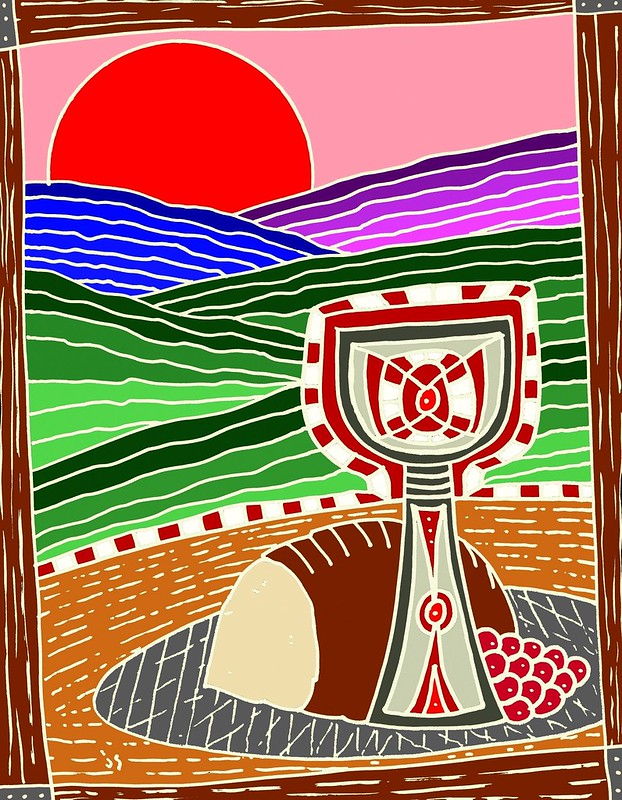
In a few moments, we will celebrate our spiritual Communion with our Lord and one another. This is an OPEN Communion table, where all are welcome! Only one food—the BREAD OF LIFE that nourishes us to live new lives in Him—will be needed and served.
This is the time to SLOW down, dear friends, and remember that our faith is not in an institution or religion. It’s not in a building or rituals and traditions, boards and committees.
The foundation and center of our faith is Christ himself, the one whom God sent for love and mercy for the world. He IS the Bread of Life and the only Bread of Life, the one who gives us the food that endures for eternal life.
Our redeemer.
The one who hears our cries and responds.
The one who makes what is broken whole.
The one who longs for us to recognize and enjoy his presence with us, forevermore.
Will you pray with me? Let us pray.
Bread of Life, feed us, now, with the food that endures for eternal life. While we worry so much about material and temporary things of this world, we are also hungry for you, for spiritual things, for the things of God. Strengthen our commitment to you, dear Lord, so that every day is lived for you, to glorify you, and be a witness of your humble, loving ways. Remind us when we are rushing around foolishly and anxiously that our hearts were restless until we found our rest in you. Thank you for the gift of faith to believe in the works you have done—how you gave yourself on a cross for the sake of the world. Open our eyes to your presence with us when we celebrate Communion today and when we walk with you each day. Amen.
[1] Max J. Lee, Connections: A Lectionary Commentary for Preaching and Worship, year B, vol. 3 (Louisville: Westminster John Knox Press, 2021), 209.
 Sharing God's Love and Grace