Meditation on Ephesians 4:25—5:2
Pastor Karen Crawford
First Presbyterian Church of Smithtown, NY
Aug. 11, 2024
Just got back from my trip to Denver to see my son, Jacob, on Friday night. My plane was delayed. Then we flew through storms that made my flight kind of like an amusement park ride that you wished you had never gone on.
The plane rocked back and forth, back and forth. It bumped up and down, up and down.
I had bought a salad to eat on the plane, but the ride was so uncomfortable, I didn’t bother to take it out of my bag.
A little boy – maybe 2—was taking his first ride on a plane with his family. He was sitting right behind me. It wasn’t the seat I had purchased online, but at the last minute, the flight attendant called me to the desk and asked if I wanted a “comfort row seat.” Jim had put me on the waiting list, without my knowledge.
I said yes. I am sure it was God’s will! There was a lesson to be learned.
Right from the beginning, the boy didn’t want to wear his seatbelt. He told his dad that he couldn’t see out the window if he had his seatbelt on. His dad tried to reason with him. He told him that if he didn’t wear the seatbelt, he might fly out of the plane. (I was smiling at that.)
The fight over the seatbelt went on a bit more, and then the boy started crying out for his mom. If Dad doesn’t say yes, maybe Mom will. Mom and Dad switched seats so Mom could be sitting right beside him. She gave him snacks and toys, comforted and tried to distract him, while he was wearing his seatbelt. He was OK for a while. But this was a 4-hour flight. And it was like an amusement park ride gone bad.
The pilot gets back on the P.A. when we have been in the air for about an hour. He tells us that we will have to remain seated, with seatbelts on, for the entire flight because, and I paraphrase, he was going to do some fancy flying to get around the storms, and we were still going to encounter rough air. The whole time, the passengers remained calm, except for the little boy—scared out of his wits when the plane started bucking like a Bronco.
“Let me out of here! Let me out of here! Let me out of here!” he cries. His mother tries to calm him down from the seat next to him, but there’s no calming him down, this time.
I start to pray– for the parents and the frightened boy. Within moments, she unsnapped the seatbelt and took him into her lap. He stopped crying.
We all sighed with relief. That rule—wearing the seatbelt throughout the flight when there might be rough air—it was made with good reason. It’s a good rule—to keep people safely in their seats, when they might fall if they try to walk around.
That rule was broken so that the higher law of love, kindness, and compassion that the Lord requires of us could be kept. It was God’s grace!
We encounter new rules, new ways for living as Christians in our passage in Ephesians today. This letter—written with long, beautiful Greek sentences and some different vocabulary and language than we find in letters confirmed by scholars to be, without a doubt, written by Paul—may have been written by a later disciple of Paul, strongly influenced by his teachings. Scholars first came to this conclusion doing a close study of the Greek letter in the 1790s. Many believe this to be the case today.
This doesn’t make it any less inspired, any less Holy Scripture! By the middle of the Second Century, Ephesians had a wide circulation, passed from church to church, and was accepted as an official book of the Bible—canonical. The focus is on the Body of Christ—the Church. Three main themes in the letter are: 1. Christ has reconciled all creation to himself and to God; 2. Christ has united people from all nations—Jews and Gentiles—to himself and to one another in his church; and 3. Christians must live as new people. The third one is the message of our passage today—new ways for the beloved children of God and why we should embrace them.
It’s interesting to look at the old ways as a kind of a window into the past. Who were these new Christians, the saints “in Ephesus” as the letter says, who are “faithful in Christ Jesus”? I wish we knew more about them. They may have been Gentile Christians—and this was the assurance they needed that they were as welcome as Jewish Christians and the teaching they needed for what that new way of life would look like, when they weren’t living with the same culturally accepted behaviors and emotions as their unbelieving neighbors.
In the new life, there’s no place for falsehood. Some ancient cultures actually saw lying as a good character trait—if you were a good liar. Now, we must speak the truth with our neighbor. Lying hurts the family of God. Then, a discussion of anger. It’s complicated. Anger can be good and bad for the faithful. “Be angry but do not sin” – so, be angry for the things that would upset the Lord, such as injustice, violence, suffering, and cruelty. But then, those familiar words of wisdom, “Do not let the sun go down on your anger.” Let go of your anger when it’s time to sleep, followed by the warning that if you hold onto your anger, you may be opening yourself to temptation to sin.
The grace and mercy of the Lord is evident with, “Those who steal must give up stealing.” Are those who have committed crimes welcome in the community of faith? Yes, of course, but just like everyone else, they must turn from their sinful ways.
This next part is intriguing to me. The new life in Christ means to continue to work for a living, in ordinary jobs of the time, but let it be good work that we do with our own hands. I can’t imagine the writer saying this to extremely wealthy people, who don’t work for a living, so I can imagine the congregation as being more ordinary people—farmers, tradespeople, craftsmen—who have learned certain skills for their occupations. But the labor now has a new purpose. This is important for us to remember today. We don’t work just so that we have a comfortable life for ourselves and our families but so that we “have something to share with the needy.”
The list of bad behaviors goes on, but now we are getting to the meat of the teaching. He’s building to a climax. “Let no evil talk come out of your mouths,” he says—this is something that has always been a struggle for the people of God. Use your words, he is saying, to bring life to the world. Say “what is good for building up, as there is need, so that your words may give grace to those who hear.” This reminds me of Psalm 19:14, “Let the words of my mouth and the meditation of my heart be acceptable in your sight, O Lord, my rock and my redeemer.”
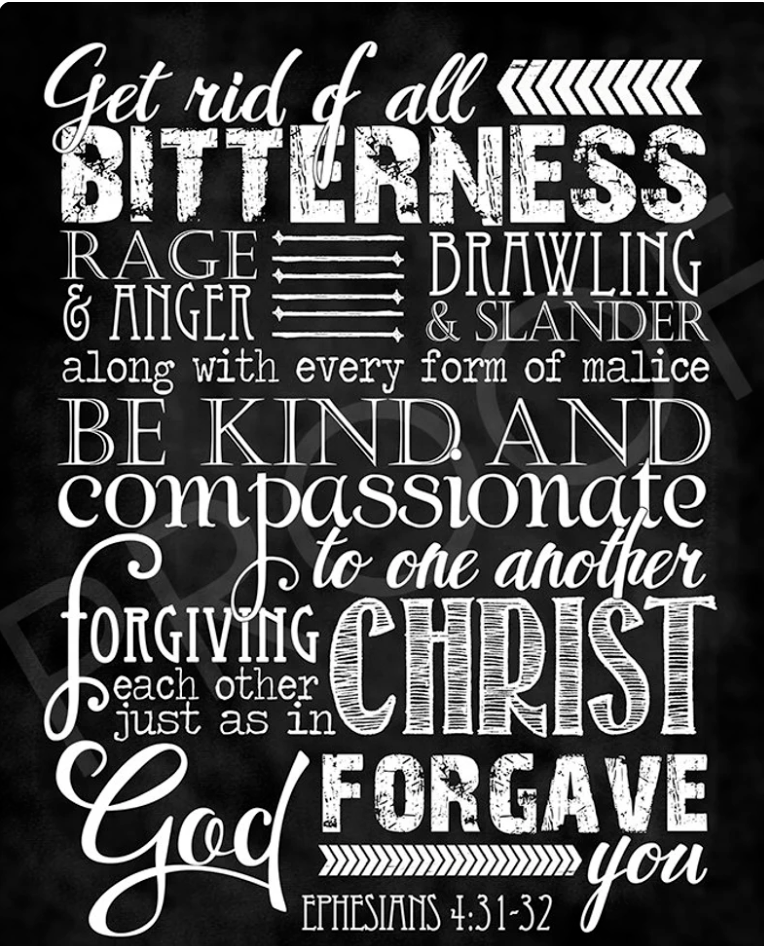
We put away these next behaviors that grieve the Holy Spirit, which sealed us for salvation. Remember—God loved us first and chose us. The Holy Spirit stirred us to accept Christ’s call and faith is a gift. Things to put away now: Verse 31,“bitterness and wrath and anger and wrangling and slander, together with all malice.”
Finally, this is what our new life in Christ looks like. Verse 32: kindness. Tenderheartedness. “Forgiving one another as God in Christ has forgiven you.” Think about how this would be received by ancient cultures, those who value taking revenge if they or their loved ones are hurt by someone. Even ancient Israel lived “an eye for an eye.”
This has all changed, now in Christ. We have the power by the Holy Spirit to forgive those who have hurt us.
Ephesians 5:1 sums up the teaching. The children of God are called to be “imitators of God, walking in love, as Christ loved us and gave himself up for us, a fragrant offering and sacrifice to God.”
About a half hour before my plane landed at JFK, the pilot’s voice came on the P.A. telling us to put away tray tables and electronic devices and pass our trash to the flight attendants without delay, as the conditions were going to be too rough for them to be walking the aisles. They needed to fasten their seat belts, too.
The little boy began to cry, once again, as his parents urged him to follow the directions, for his own safety. He kept insisting that if the plane were landing, then he WOULDN’T need to wear his seatbelt anymore! “We’re landing! We’re landing!” he kept saying, assured he was winning the argument
And I thought about this passage—and how we want to argue with God, when God’s rules for the new life in the Body of Christ don’t seem to work for us in our given situation. We want to hold onto anger. We want to hold onto unforgiveness. We want the tenderness of God for ourselves, but it’s a lot harder to be the tenderness of God for one another, all the time—to walk in humble, sacrificial love, all the time, as Christ loved us and gave himself up for us.
I didn’t turn around to see the little boy for the next 30 minutes or so because we were being bounced around in ways that I have never experienced on an airplane before. When we finally touched down, I was surprised the whole plane didn’t burst into applause. I was praising God.
I looked behind me when we finally made it to our gate, and I stood to gather my belongings. That’s when I caught the eye of the mother. I smiled at her, and she smiled at me. The little boy, face flushed from crying, was sound asleep in her arms. He was so cute when he was sleeping!
I thought, again, about the love, mercy, and grace God has for sinners like us. For people who try to live by the rules for the new life, who are grateful for all that Christ has done, and yet we fall back into the old ways that are comfortable and easier, especially when we are stressed.
We cry and yell and resist what God wants us to do—for our own good and for the good of the Body of Christ. And our tenderhearted God never stops loving us. The Spirit never gives up on us.
Let us do the same for one another, loving one another tenderheartedly, forgiving one another. May our words build up and bring life to the world as we imitate our kind and compassionate God, who never stops welcoming us back into the Lord’s embrace.
Will you pray with me?
Holy, merciful, and compassionate God, thank you for your grace for sinners, who struggle to walk in the new ways we are called to walk, now that we are living new, resurrected lives in Jesus Christ. Thank you for the example of our Lord, who gave himself up for us and for the world, a fragrant sacrifice and offering to God. Strengthen us, when we are tempted, to put away all the old bad behaviors that aren’t good for us or for our families, neighbors, and the Body of Christ. Help us to use our words to build up and bring life and so that others see your loving ways in us. In Jesus’ name we pray. Amen.
 Sharing God's Love and Grace