First Presbyterian Church of Smithtown, NY
Pastor Karen Crawford
Aug. 25, 2024

One of our gardeners, Betsy, drove me to meet Sister Mary Lou Buser at her garden ministry in Brentwood a little more than a week ago. She was an “expert” interview as part of my doctoral research on the spirituality of gardening. I was emailing with Sister Mary Lou and the garden manager, Heather Bolkas, before I realized the connection between Mary Lou and Betsy’s mother, Pat. Pat and Mary Lou are good friends, who have known each other for decades, going back to when Mary Lou lived in an apartment at Sweetbriar Nature Center in Smithtown. Pat and Mary Lou, both master gardeners, were volunteers there working to restore Mrs. Blydenburgh’s garden. Pat was on her way to garden with Mary Lou at Sweetbriar on a September morning in 2001 when she heard on her car radio about the terrorist attack on the World Trade Center.
Mary Lou is the founder of the Sisters of St. Joseph Garden Ministry. Have you heard of it? The Ministry seeks to “model organic agricultural principles but also to teach children their connection with the earth and to foster a community spirit among adults.” They offer eco-contemplative experiences and embodied prayer in the garden, such as Yoga and Tai Chi for teens and adults and nature courses for children, such as “Hands on Earth Play” and “My Grown-Up and Me in the Big Outdoors” for ages 4-7, and “Soil, Worms and Compost” for the upper grades. What interested me is “The Spirituality of Bread Making,” a retreat for adults in February, in which they go from soil to sacrament, making bread in an outside brick oven from the winter wheat they have grown in the garden.

I first learned about the ministry when I heard about the sisters’ Thursday morning prayer gatherings in the garden throughout the summer. I reached out for details, and the next thing I knew, I was scheduling a time when Betsy and I could come and hear Heather and Sister Mary Lou’s stories.
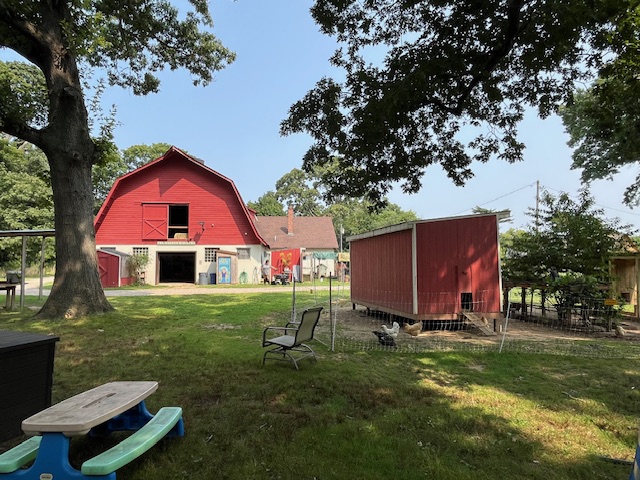
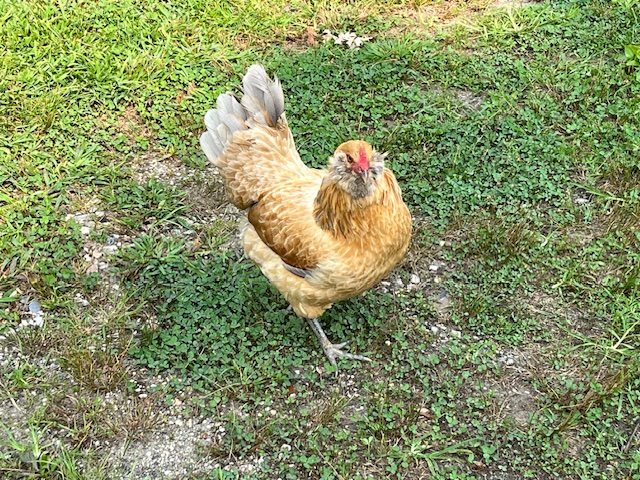
As Betsy and I arrive on Aug. 16, a chicken greets us in the yard. The chickens have names such as Cleo, Carol, Boots, and Wheezy.
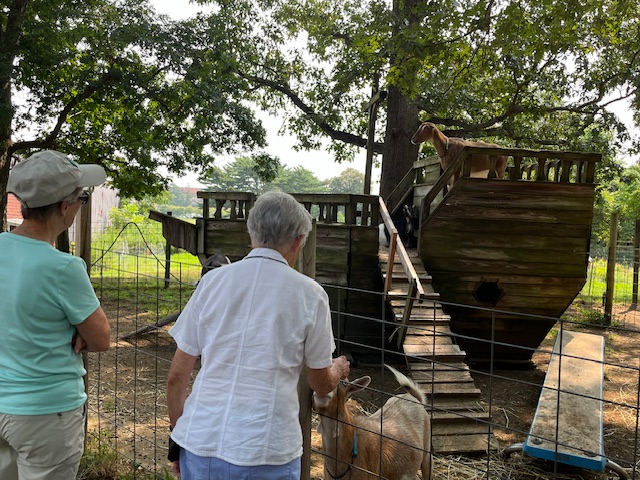
“It’s easier to ask for forgiveness,” Mary Lou quips, “than ask for permission.” A volunteer carrying a bunny interrupts our interview to say that it has escaped its pen. Again. “That happens all the time,” Mary Lou says. “Probably dug a hole.” There are other animals who have found a permanent home with the garden ministry—honeybees for pollination and honey in hives built by a volunteer—and goats over the years—Lamanchas, Nubians, and Nigerian Dwarfs with names such as Austin, Hamilton, Fiona, Elsa, and Eloise. A lady takes them for a walk every night, and they follow her.
The garden property includes twenty-four 4 by 16-foot community garden plots, where neighbors may plant, water, tend, harvest, and consume their own produce and enjoy their own flowers, without paying a fee. They have an annual community picnic at the garden, in which all are invited to bring a “tasty dish” to share. The same families return, year after year.


I can’t explain it, but it feels like we are on Holy Ground. Maybe because of all the love and generosity practiced. Maybe it’s because of all the prayer. Maybe it’s simply because of God’s grace.
“It’s grounding, healing, connecting with the earth,” Heather says. “The embodied work (of the garden) is lifegiving and necessary for survival.” The preschool on the campus, Shepherd’s Gate, offers hands-on nature programs and even a full nature immersion program that connects with the garden ministry. Before the tour following our interview, Heather apologizes for the weeds that have overwhelmed the garden and volunteers this year. Vegetables, picked 7 days a week in season, are offered at what looks like a farm stand, but without price tags or someone minding the counter. A wooden sign above says, “The Sharing Table.” The table has a cooler, donation box, and fresh floral bouquet. The motto is, “Take What You Need/Give What You Can.” “Vegetables served 11,500 meals last year,” Heather says. “Chickens shared 6,000 eggs.”

“Take What You Need/Give What You Can.”
“Vegetables served 11,500 meals last year,” Heather Bolkas says. “Chickens shared 6,000 eggs.”

As we prepare to leave, a calico cat darts out from underneath Betsy’s car. “That’s why they don’t have voles,” Betsy says, and we laugh. Betsy has voles in her garden! Time has passed quickly, and I am sad to leave. My mind circles back to Mary Lou’s humble story.
The ministry started with a love for the earth, cultivated at home. When she was a child, her father planted a Victory Garden during the Second World War. “Dad planted tomato seeds,” she says, “and we watched them come up.” Mary Lou, who has served as a science teacher at Holy Family and a physical therapist, said she was listening to a man named James Hansen in the 1980s talk about global warming. Hansen, with degrees in physics, math, and astronomy, was Director of the NASA Goddard Institute for Space Studies when he testified to Congress in 1988, advocating action to avoid dangerous climate change.
Mary Lou said to herself, “We better do something about it now.” So, she decided to plant an organic garden. She was aware of how food was grown in “Big Ag,” she said, and that this was a cause of global warming. She thought, “If I could start a little garden, I can make a difference.”

She started with a few tomato plants, peppers, cucumbers, and beans. The garden grew. “I was a little ahead of my time in the 80’s,” she says. “I had two sisters who helped me.” The first plot was 15 by 15 or 20 by 20. They had to put a fence around it, not because of deer, but because of the horses on the property that would get into it. Whatever the garden produced, Mary Lou put on a little table for anyone to take. The garden expanded every year. Chickens came later, and the eggs went on the table, too. People dropped off rabbits no longer wanted after Easter—and the ministry grew to include them, as well.

Mary Lou knew a beekeeper, and one day in church, she asked him to make a beehive for them. Heather came in 2011, offering to help Mary Lou by weeding one hour a day. Her responsibilities and hours grew, too.

But the journey from the first small, garden plot in the 1980s to the thriving garden ministry today was a difficult one. Mary Lou had no encouragement, at first. “The other sisters thought I was crazy,” she says. She worked in the garden in the evenings, after working her day job. “I am glad I started it, and I am glad I stuck with it,” she says. Since she began the gardening ministry, her faith has changed. She has come to know and “believe in a different God,” she says, than when she was growing up. “I can feel God’s presence with me more in a garden (than anywhere else),” she says. “I am glad that I know this God now. God who creates all the time. God who loves.”
Today, following our worship in the sanctuary, we will go to an outdoor sanctuary—out in God’s creation—to dedicate our new prayer garden. The garden is a generous gift of Daniel Davidsen to bless the church for his Eagle Scout Project. It is my hope that this garden will be USED and TENDED by our church and community and not forgotten. There’s nothing sadder than a garden that is neglected. It is my hope that this garden will thrive and grow, for years to come, and will stir our members to plant their own gardens at home and share the produce, as Judy Michon does on the hallway table. It is my hope that the garden, like Sister Mary Lou’s, will be organic—that whatever will be used to care for our prayer garden, will be kind to the earth and healthy for human beings and non-human creatures.
We will ask for God’s blessing on this holy space and on all hands that, with God, will co-create with it. May all who come and spend quiet time on the bench or labor with hands in the soil—planting, weeding, watering, pruning—meet the God of the garden there.
The God who creates all the time. The God who loves.
Will you pray with me? Let us pray.
Holy One, God our Gardener, thank you for the gift of this wonderful life on your beautiful earth. Stir us to love your Creation, more and more, and to take better care of it—till it and keep it, as you charged the first human being in your Garden of Eden. We ask a blessing on Sister Mary Lou, Heather, and the garden ministry in Brentwood. Thank you for their example of perseverance. May they touch even more hearts, souls, and lives in years to come, feeding people with produce and prayer. And we ask a blessing on Daniel Davidsen, and our new prayer garden. We give you thanks! May it become a holy space for each of us, a place where we meet you, where faith is strengthened and renewed, where we experience afresh your unconditional love, and are moved to share it with others. In your Son’s name we pray. Amen.
 Sharing God's Love and Grace