Meditation on Mark 10:17-31
Pastor Karen Crawford
First Presbyterian Church of Smithtown, NY
Oct. 13, 2024

I lost a dear friend this week. Erma Ahrens was 104.
Early Wednesday morning, her son and daughter-in-law, Dave and Lou Ann, called to tell me the story. The loss of Erma, and hearing the voices of sweet Lou Ann and Dave, who are also special friends, brought me to tears. It meant that all my hopes of finally getting to Minnesota and visiting her would never come to pass. Erma, originally from Iowa, was the wife one of the former pastors of the rural congregation that I served in my first call, a few miles north of Renville, MN. Her husband died suddenly while he was serving another small Minnesota church. Erma had only a few months to grieve and figure out where she was going to live before she had to move out of the manse. She didn’t have a job or a home. She was probably in her late 50s or early 60s. She hadn’t worked outside the home or church for many years. She moved back to Iowa, got a job in a dress shop. Got an apartment.
She relied on her faith and the knowledge that she was a child of God, and that the God who loved her would provide for her. And that for God, all things are possible. Amen?
Our gospel reading in Mark today presents challenges for those seeking to follow Jesus with their lives today. The question relates to having a right attitude, the right mindset to live humbly, in Christ’s example, but also it raises the sticky question of our relationship with wealth. Can we have possessions and be faithful to Christ’s call?
While I am tempted to skip over this tricky passage, we would bump into this same story in Matthew 19 and Luke 18. This passage follows Jesus blessing the little children and saying to his disciples, who had been pushing them away, “Truly I tell you, whoever does not receive the kingdom of God as a little child will never enter it.” And then this man, “setting out on a journey,” kneels before him and asks Jesus, “Good Teacher, what I must I do to inherit eternal life?” I like to believe that this man is wrestling with how to live faithfully, but perhaps doesn’t yet realize that being faithful requires a change of heart, which leads to changes in our lives.
First of all, there is NOTHING we can do to INHERIT eternal life. It’s not something that is inherited, though certainly faith may be passed down from generation to generation. Secondly, there’s NOTHING we can DO, period, to earn or achieve eternal life.
The commandments Jesus mentions are only the second table of the Ten Commandments, the ones having to do with our relationships with other people rather than with God. They focus on external behaviors, maybe because of the man’s question, “What must I do?”
The man assures Jesus, “I have kept all these since my youth,” to which Calvin scoffs, “But, intoxicated with foolish confidence, he fearlessly boasts that he has discharged his duty properly since childhood.” [1] Luther, too, dismisses the man’s claim in his commentaries, “Where is he who keeps the Decalogue (or Ten Commandments)?” he asks. “Or who can fulfill the commandments?… After the Fall of Adam no one… has fulfilled the law.” [2]
Key to our understanding of this encounter is in verse 21. Jesus looks at the man and loves him! What’s spoken next is an invitation to join him in ministry, an invitation he extends to EVERYONE. He says, “You lack one thing: go, sell what you own, and give the money to the poor, and you will have treasure in heaven; then come, follow me.”
The truth is that the man had “good reason to be shocked. Traditional Jewish piety would usually have said that wealth was a blessing from God, a sign of divine favor. If you obey all the commandments, Moses tells the people of Israel in his final address to them, ‘the Lord will make you abound in prosperity.’ (Deut. 28:11).” [3] Proverbs 10:22 says, “The blessing of the Lord makes rich, and he adds no sorrow with it.” “The rich were expected to be generous and pious, but if they were, it would not have occurred to anyone to criticize their wealth.” [4]
As Reb Tevye dreams in Fiddler on the Roof,
Oh, Lord, you made many, many poor people
I realize, of course, it’s no shame to be poor
But it’s no great honor either
So, what would have been so terrible if I had a small fortune?
If I were a rich man
Ya ba dibba dibba dibba dibba dibba dibba dum
All day long, I’d biddy biddy bum
If I were a wealthy man
I wouldn’t have to work hard
Ya ba dibba dibba dibba dibba dibba dibba dum
If I were a biddy biddy rich yidle-diddle-didle-didle man.
Mark, Matthew, and Luke don’t tell us the end of the story of the man with many possessions; we don’t actually know if the man sold them, gave to the poor, and answered Christ’s call.
This is what Jesus says: “How hard it will be for those who have wealth to enter the kingdom of God!” –and that’s it harder than for a camel to go through the eye of a needle, which, in “Frederick Buechner’s … 20th century paraphrase, harder “than for Nelson Rockefeller to get through the night deposit slot of the First National City Bank.” [5] And this is what Jesus says to his disciples who ask him, “Then who can be saved?” “For mortals it is impossible, but not for God; for God all things are possible.”
I am just going to say it plainly. The problem isn’t the man’s wealth. The problem is his attitude toward it and his relationship with it. Jesus emphasizes his need to let go of his possessions and, instead, share and care for others; and this is something I have learned from serving with all my sisters and brothers in the faith, including my dear friend, Erma, who, in the end, had few possessions but was rich in friendships and had the love of all her extended family, as well.
When I met her in 2011, she had just moved back to Renville to a senior living community close to Dave and Lou Ann’s home. She had had some health scares and had ever so reluctantly given up driving and given away her car. Despite her health challenges, she walked every day, prayed, read the Bible, and meditated on a daily devotional. She looked after her friends at the senior living community and stayed active with her church. She didn’t miss worship unless the roads were impassable with snow.
She was a partner in ministry for me. We started an ecumenical Bible study at the senior living community. Most of all, she was a good friend. I used to visit her, have tea and watch her crochet, as she did every day. That was one way she felt she could serve the church and the Lord. She crocheted prayer shawls and baby blankets. She had a tiny spiral book where she kept record of the hundreds of shawls and blankets she had made for hospitals, family, friends, and her church. One day, I asked Erma, “Will you teach me to crochet?” So, she did.
She gave me a ball of yarn and a size J hook, and we sat side by side on her sofa, giggling like little girls. She taught me the chain stitch and single, double and triple crochet. Then, when I finished my first blanket, how to make a fringe. Those were peaceful, happy times for me, growing in friendship with Erma and learning to serve the Lord in a new way.
Up until a month ago, when she suffered some TIA’s that greatly weakened her, she was still crocheting prayer shawls and baby blankets. She never stopped thinking about, praying for, and caring for other people. She wrote me about a year ago to tell me that she had to give up her apartment in the senior living community and move to a town 15 miles away to a different assisted living facility, where she would only have one room and no kitchen. She said that she would miss cooking, but it was OK. She was making friends and getting used to the food. She never stopped believing that for God, all things are possible.
What about us? Do we believe this?
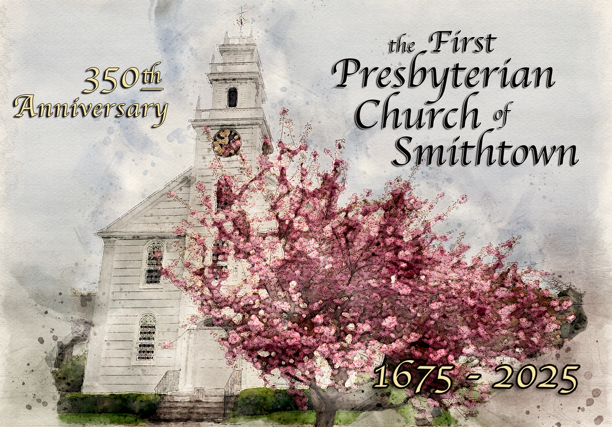
The truth is, sometimes, when I am meeting with the boards of our church, and we are trying to figure out how to do necessary repairs to our aging house of worship or just trying to pay the large bills of ministry today, we worry about the future. But this is the nature of ministry, dear friends. We have had these same worries since we were a meeting house by the river in 1675. How will we continue for the next 200 years or more? We have the opportunity now, today, to faithfully give of ourselves—our time, talents, and treasures—to the church from our abundance and even our scarcity, so that we may continue in ministry in this community, growing in love for one another, seeking to be obedient to Jesus Christ. We do this trusting that we can’t do this alone. With God, all things are possible.
It makes me smile to think of faithful Reb Tevye of Fiddler on the Roof, who loved his family and had an intimate relationship with God, so that he could to say to the One whom he knew was the source of all his blessings, the One who knew him better than he knew himself, the One who had a plan for his life, but maybe it wasn’t what Reb Tevye wanted …
If I were a rich man
Ya ba dibba dibba dibba dibba dibba dibba dum
All day long, I’d biddy biddy bum
If I were a wealthy man
I wouldn’t have to work hard
Ya ba dibba dibba dibba dibba dibba dibba dum
Lord, who made the lion and the lamb
You decreed I should be what I am
Would it spoil some vast eternal plan
If I were a wealthy man?
Let us pray.
Holy One, thank you for your love and grace for us and for the blessing of this church family and our beautiful house of worship. Thank you for the promise of eternal life through belief in the work of your Son on a cross. Lord, change our hearts and minds so that we have a right attitude and relationship with wealth and possessions. Free us from the temptation to love our stuff too much and grow in love for You and one another, instead. Provide for our congregation as we seek to continue in ministry, in your Son’s name, in this place. Teach us what it means to live out our faith that for You, all things are possible. Amen.
[1] John Calvin, Commentary on a Harmony of the Evangelists, Matthew, Mark, and Luke. Translated by William Pringle. Calvin’s Commentaries 16-17 (Grand Rapids:Baker, 1989)2:393.
[2] Martin Luther, “The Disputation Concerning Justification, 1536,” argument 27, trans. Lewis W. Spitz, Career of the Reformer IV, LW 34 (Philadelphia: Muhlenberg, 1960), 187.
[3] William C. Placher, Mark from “Belief, a Theological Commentary on the Bible” (Louisville: Westminster John Knox, 2010) 144-145
[4] William C. Placher, 144-145.
[5] Frederick Buechner, Telling the Truth (San Francisco: Harper & Row, 1977), 63.
 Sharing God's Love and Grace