Meditation on Ruth 1:22-2:13
Pastor Karen Crawford
First Presbyterian Church of Smithtown, NY
Oct. 20, 2024
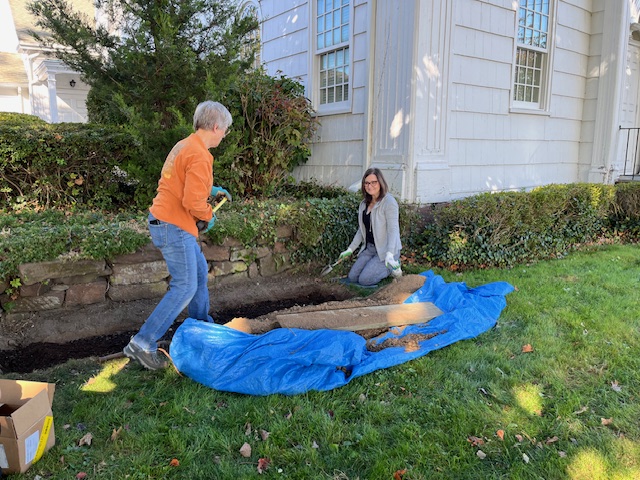
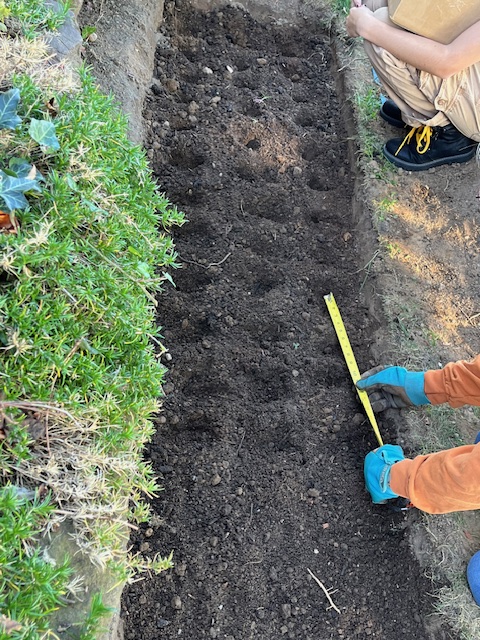
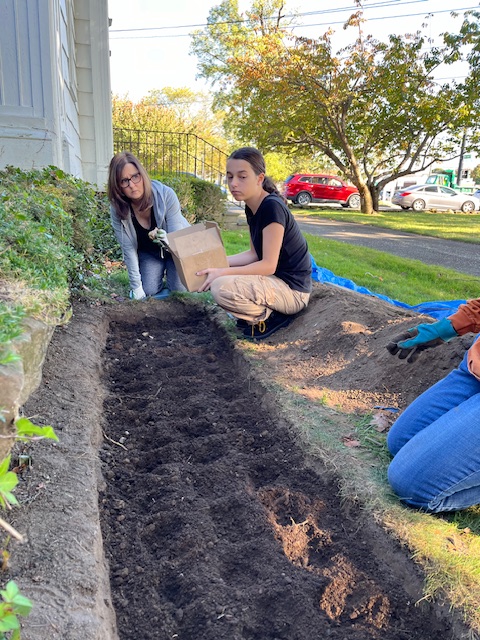
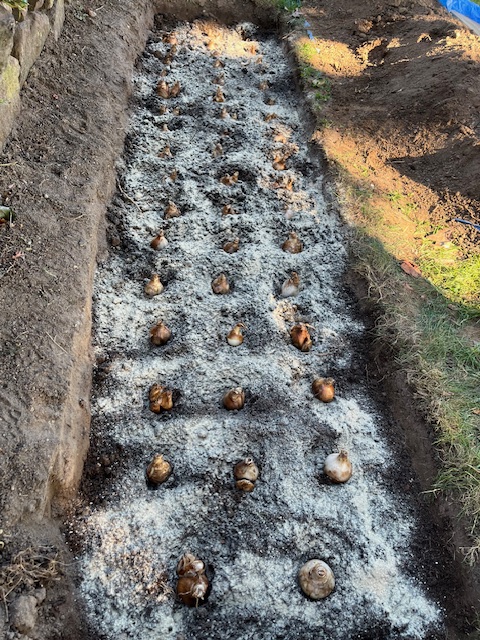
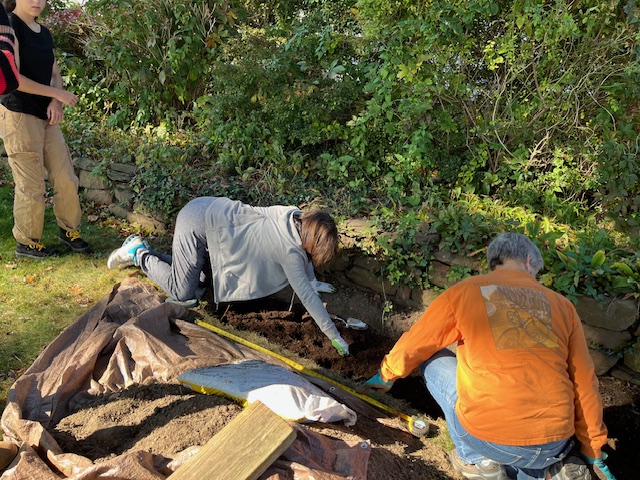
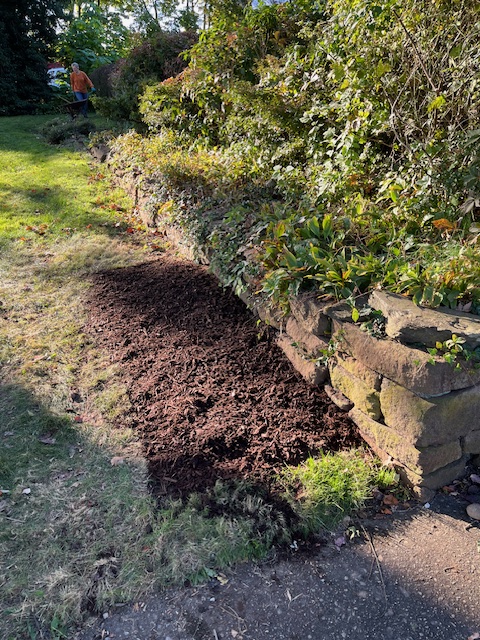
We planted a daffodil memorial garden in the churchyard yesterday in front of a low stone wall. Betty Deerfield and Nancy Swanson measured precisely and made the holes. Brianna and Nicole Swanson placed 100 bulbs into two freshly dug flower beds. We worked together to cover the bulbs with bone meal, soil, peat, compost, and mulch. Brianna and Nicole took care of watering with a watering can before enjoying Betty’s homemade oatmeal chocolate chip cookies.
Digging and preparing the flower beds on Thursday was the most difficult part of the project, perhaps. The ground was hard, unforgiving, and the wind was chilly, but the sun was shining, and Betty and Tom Sartain had the right tools–spades, wheelbarrow, tarps, and a rototiller. Betty brought zucchini bread and hot chocolate for fortification. Tom entertained us with stories. I arrived late, just in time to survey their work, make jokes about how the beds looked like cemetery plots, thank the gardeners, and enjoy refreshments.
Throughout the planning, digging, planting, fertilizing, and mulching, we laughed and talked and I got to know two of my Confirmation students and their gracious mom just a little bit better. Throughout our labor and conversation, we held onto the vision of what the garden might look like, not how it is at this moment in autumn—with only plain brown bulbs covered with soil and mulch—but how we imagine the garden will look like in March, April, and May next year, with bright yellow flowers opening on green stems and leaves.
Nancy said, “I can’t wait for spring!”
We pray that the garden will bring us closer as a church family, as we have shared the names of our loved ones with our dedications. And we pray that the garden will, every spring, stir us to enjoy the beauty of the long-lasting, early blooming flowers and remember the precious gift of our loved ones’ lives. May we also remember to tell their stories and love one another today.








The story of Ruth is, indeed, a love story. Some themes of this book include life and death; the resilience of families in grief and loss; persevering through famine and hunger; migration to foreign lands and going home; marrying outside the faith; and childlessness. In the four beautiful chapters is the story of real hardships by those living in a subsistence culture and their reliance on their faith in YHWH’s generosity, loyalty, and lovingkindness or hesed in Hebrew.
Hesed is the essential quality of covenant relationship. Everyone who enters into covenant with YHWH is then expected to demonstrate that same quality of hesed, lovingkindness, in all their relationships. “The prophet Micah (in 6:8) offers the memorable instruction, ‘And what does YHWH require of you—but to do justice, love hesed, and walk humbly with your God?’” [1]
The interesting twist in Ruth is that she is an outsider, a foreigner. She hasn’t been born into covenant with God, and yet she is welcomed into the fold and is held up as the example of loyalty and faithfulness. At the beginning of the book, an Israelite man named Elimelekh and his wife, Naomi, and two sons leave Bethlehem because of famine. They move to Moab. Elimelekh dies and the sons take Moabite brides, Ruth and Orpah. Then the sons die, leaving three childless widows; Naomi decides that it is time to return to her homeland. She has heard that YHWH has visited God’s people and given them bread in Bethlehem, a word that means “House of Bread.” Long years of famine have ended. And she wants to die with her own people.
Intermarriage with foreigners was expressly forbidden in the Torah (Exodus 34:16 and Deut. 7:3). Moses specifically forbids Moabites and Ammonites from coming into the congregation of YHWH, “even to the 10th generation… because they did not meet you with food and water on your way out of Egypt….”
But only love and acceptance may be detected in Naomi’s relationships with her daughters-in-law. She tells them, when they try to come with her to Bethlehem, “Go, turn back, each woman to the house of her mother.” She blesses them. “May YHWH do good faith (hesed) with you, just as you have done with the dead and with me. May YHWH grant it to you: Find rest, each woman in the house of her husband.” She kisses them. They lift up their voices and weep.
Orpah obeys Naomi and goes home to her mother, her people, and the faith of her birth, tearfully kissing her mother-in-law goodbye. Ruth is determined to stay with Naomi and embraces her new faith, saying, “Don’t press me to leave you, to turn back from following after you. For where you go, I will go. And where you stay the night, I will stay. Your people (is) my people, and your God, my God. Where you die, I will die, and there I will be buried. So may YHWH do to me, and may he add more to that—it is only death that will come between me and you.”
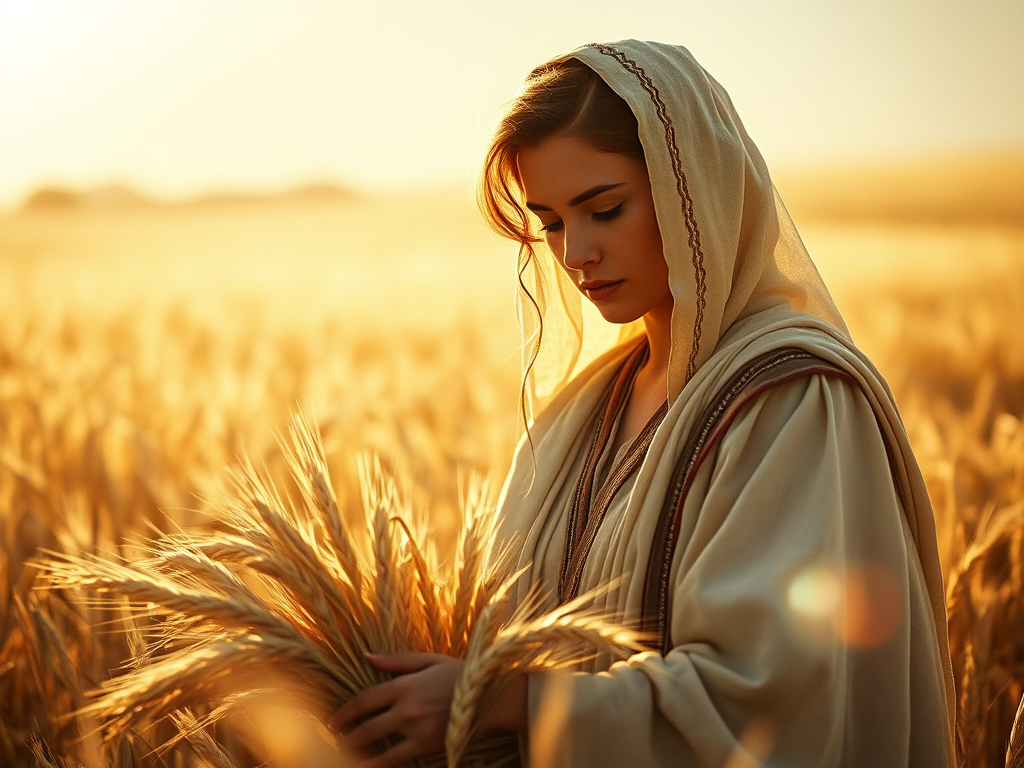
Ruth and Naomi return to Bethlehem at the beginning of the barley harvest.
We see hesed—God’s lovingkindness reflected in the lovingkindness of human beings—numerous times in this passage. Ruth and Naomi are hungry, so Ruth goes to work in the field of one of Naomi’s husband’s relatives. His name is Boaz. He is a man of faith and considerable means.
Ruth is given permission by the field supervisor to glean behind the hired harvesters and keep what she has gleaned, though she is an outsider. She is protected by an Israelite practice, a law, actually, that required Israelites to deliberately leave some grain in the field. “The unharvested grain was to be gleaned by the most vulnerable members of society: widows, orphans, and sojourners….” [2] People like Naomi and Ruth.
The greeting Boaz exchanges with his workers is a sign of hesed, God’s lovingkindness, and their faith. Boaz says to the harvesters, “YHWH—the Lord—be with you!” And they say, “May YHWH—the Lord—bless you!” These may be conventional greetings of the time, but they are included in the story to emphasize the good relationships Boaz has with his workers and that his relationships are governed by an “awareness of God as the Source of blessing and the One to whom we must answer for our treatment of others.” [3]
Boaz notices Ruth and asks, “To whom does this young woman belong?” That’s when we hear Ruth’s story told through the perspective of the supervisor of the harvesters. He doesn’t say anything bad about this foreigner. She is a Moabite, he says, who came with Naomi. She asked for permission to gather behind the harvesters. She is a hard worker—takes few breaks, he says.
Boaz reveals hesed when he warns Ruth, for her protection, not to “go gleaning in another field” but to stick close to the women working in his field. He has ordered the men not to touch her. He tells her that when she is thirsty, to go and drink from the jars of water the workmen draw.
Ruth notices his kindness, is moved by his graciousness, and falls on her face, bowing to the ground in gratitude and humility. She asks why he is being so kind, when she is nothing but a foreigner.
He knows her story, he says. He has heard what she has done for her mother-in-law after the death of her husband, and how she left her family and homeland behind to come and live with Naomi’s people, whom she didn’t know.
“May the Lord reward you for your deeds, and may you have a full reward from the Lord, the God of Israel, under whose wings you have come for refuge!” Boaz says.
We see God’s hesed when he invites her to eat with them and serves her bread, sour wine, and roasted grain. She eats until she is satisfied and has some left over and goes back to gleaning. Boaz tells the workmen to leave even more grain behind for her to take home.
She gleans until evening, then threshes, and takes home 30 to 50 pounds of barley, a staggering amount for a worker to take in her time, when male workers usually received one or two pounds a day! [4]
This sets the stage for the courtship between Ruth and Boaz in the next chapter, a romantic scene on the threshing floor; the next day, Boaz negotiates for Ruth’s hand with a closer relative of Elimelekh’s kin at the city’s gate; and finally the marriage of Ruth and Boaz, and Ruth giving birth to a son. Ruth will be the great grandmother of David, the second ruler of the united kingdom of Israel and Judah. She is included in the genealogy of Jesus in the gospels of Matthew and Luke.
After I finished planting the daffodil memorial garden with Betty, Nancy, Brianna, and Nicole, I stepped into our parish hall, where all kinds of hesed—divine and human lovingkindness—was going on. The Organization of Open Mic Performing Artists (OOMPA) was hosting a coat drive there. Numerous musicians played instruments and sang for the gathering of church and community folks, a pile of donated coats heaped in front of the stage. At the end of the four-hour event, Joanna Huang and Karen Dow played violin and viola–“Be Now Our Vision” and “How Great Thou Art” with Pablo Lavandera on piano; the choir sang three hymns; Pablo played three songs from his native Argentina; and the entire room was invited to sing a parting, “Stand By Me” on the stage.
It was a hesed kind of day, with our church connecting in loving ways with the earth by planting a garden; and sharing food, music, and friendship with a gathering of church and community folks, all with the same mind to help our needy neighbors keep warm in winter.
Next spring, around the end of March or early April, we will all be looking for 100 yellow daffodils blooming in our memorial garden, planted in front of the low stone wall. May the garden continue to bring us closer as a church family. And may the yellow flowers in springtime stir us to remember the precious gift of our loved ones’ lives, tell their stories, and love one another today.
Let us pray.
Holy One, thank you for your hesed, your loyalty, generosity, and lovingkindness. Thank you for the faithful example of Ruth, the outsider in your Son’s family tree. Thank you for the hesed of the faith community, for those who gave coats to warm our neighbors, those who shared musical gifts, and for the gardeners who planted flowers to bring us closer and help us remember our loved ones and tell their stories. Give us a vision of hesed for our community and country and give us wisdom and courage to make it happen. Amen.
[1] Ellen F. Davis and Margaret Adams Parker, Who Are You, My Daughter? Reading Ruth Through Image and Text, (Louisville: Westminster John Knox Press), 17.
 Sharing God's Love and Grace