Meditation on Luke 5:1-11
First Presbyterian Church of Smithtown, NY
Pastor Karen Crawford
Feb. 9, 2025
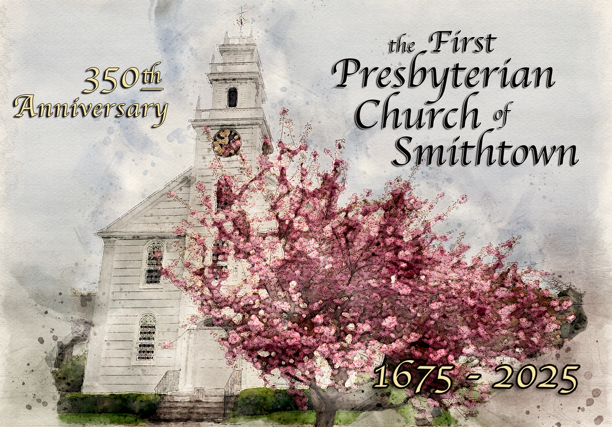
As we prepare to celebrate our 350th anniversary, I have been looking through old directories and history books. This week, I came across a black and white picture directory from 1968, featuring many young families. Who was here in 1968?
I recognize some names. Adele and Harold Carson, with their kids—Barbara, David, and Donna. Guido and Mabel Agostini, with John, Janice, Richard, and Linda. Lillian and Neil Munro, with Michele and Neil. Ethel and Karl Kraft, with Kenneth and Deborah. Charlotte and Edward Cheatham with Andrea and Gregory. Harriet and Henry Yost, with Catherine, Deborah, and Kenneth. Lois and Andy Netter, with Jeffrey, Stephen, and Carla. Evelyn and Ross Saddlemire, with Marcia, Terry, Lori, Susan, and Sandra. George and Virginia Newcomb with Gretchen. George Ludder with his family. Lucia Spahr with hers. And Bill and Shirley Russell. They look like teenagers!
Who was the senior pastor in 1968? The Rev. William E. Brown, Jr. from Erie, PA. He graduated from Yale University and Divinity School. He was installed in 1962, following Rev. Raymond Case, who served as our minister for 24 years beginning in 1938. One remarkable thing that I learned about Rev. Case was his close relationship with the Shinnecock Nation. He was recognized as “a blood brother” in 1935 and was given the name Chief Speaking Wind.
Rev. Brown had served as assistant minister at Montview Boulevard Presbyterian Church in Denver, CO, before he accepted the call here. His wife, Margretha, earned a master’s in theology from Union Theological Seminary in NY. She served as Secretary of the Commission on Ecumenical Mission and Relations for our denomination, the United Presbyterian Church in the U.S.A. When the Browns moved here, their son, Neil, was 4, and Stina was born while they served here. Rev. Brown was called to serve as the Associate Executive for Synod Ministries with the Synod of the Covenant in Columbus, OH, in 1973. We also had an associate pastor in 1968: the Rev. Donald Knight.
At the time, our church’s ministry featured a large Sunday Church School that met during both services. We had a Sunday night Senior High Fellowship, Westminster Night on Wednesdays for Jr. High and a three-year Confirmation program, culminating in a 9th grade pastor’s class. We had Senior Choir, Chapel Choir for 7th through 12th grades, and Junior Choir for 4th through 6th grades, all directed by Mr. Robert Lawton. Our organist was Mrs. Gloria Sandbeck. The church office was “staffed by Miss Mary A. Hackett of Greenlawn,” says our directory, “who combines quiet efficiency with diplomacy, a gentle humour and genuine concern. Her equal would be hard to find.” Our ministry included United Presbyterian Women, with 8 circle groups, the Kirk Club, a Parish Program with 33 leaders; the Village Presbyterian Pre-School that opened in 1965; a Flower Guild led by Ethel Greenleaf; and a whole host of sports, recreation, community service, and prayer groups.
As I study our history, the leadership and ministries of the congregation, and as I see the smiling photos of all the young children and families, I think about our faithfulness as a congregation. I am thankful for the many children and adults who have grown up and served here, for generations. Some, continue to serve! I wonder, though, what happened to those children in 1968 who aren’t here anymore? Did they get married, take employment, move away? Are they still on Long Island? Did the seeds of the gospel sown here take root? As did the first fishermen who responded to Christ’s call, did they drop their nets and follow him? Did they become fishers of people?
I’ve never actually caught a fish before. Who here has caught a fish? Great! How’s that feel? How’s it feel to fish for hours and not catch a single one? Let us try to imagine working as a fisherperson in Jesus’s time, piloting a small boat without a motor and working at night, all night, while the world slept. In the First Century, those fishing on the Sea of Galilee, today in northeastern Israel, near the borders of Jordan and Syria, may have caught 27 different species of fish. [1] The ones most talked about are carp, catfish, sardines, and tilapia (nicknamed St. Peter’s fish probably because of this passage). Scholars think that the day Jesus fed 5,000 people with five loaves and two fish, they were probably tilapia. The Jewish people may not have eaten the catfish because they were bottom feeders, therefore unclean. On the morning that the risen Christ fed his disciples grilled fish for breakfast, in John 21, they were probably tilapia, too.
If the fishermen were using nets that day with Jesus, they wouldn’t have caught fish as small as sardines. We are left pondering which of the 26 species of fish filled those two small boats and nearly sank them on the Sea of Galilee, the lowest freshwater lake on Earth. Or maybe you aren’t curious about the fish. It’s OK. The point really isn’t what kind of fish. But the enormous catch is a sign for those three, tired fishermen who had nothing to show for their work. And it’s a sign for us today. Still, Simon Peter lets Jesus climb into his boat, and they put away from the shore a little bit, so he could inspire the crowds with his preaching and teaching.
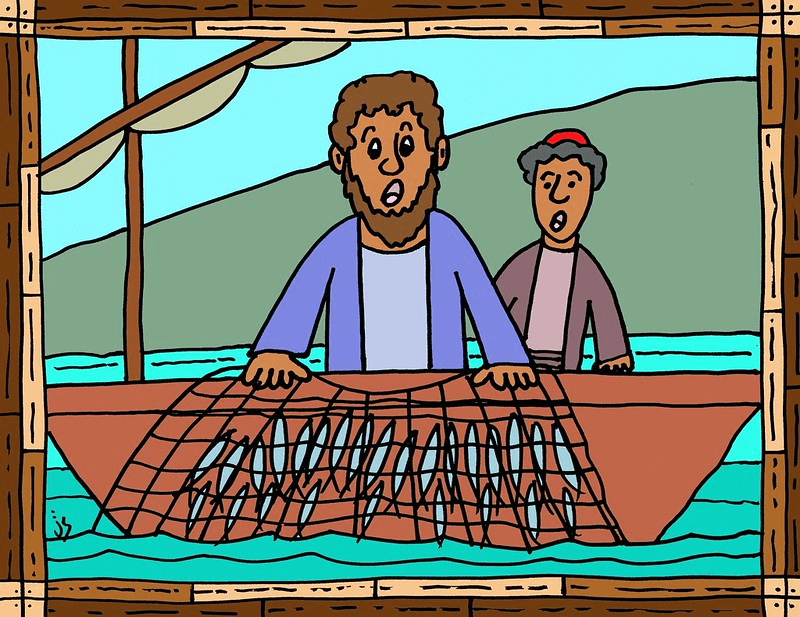
We don’t know what he said to the crowds that day. That doesn’t really matter, either. The actual sermon wasn’t preached with words. The sermon was the miracle catch, which came when a reluctant fisherman revealed a tiny spark of faith in a stranger whose knowledge of commercial fishing didn’t come close to his. Simon answers Christ’s request to go out into the deep water and drop down the nets, “Master, we have worked all night long but have caught nothing. Yet if you say so, I will let down the nets.” That tiny spark of faith was all that was needed. “They caught so many fish that their nets were beginning to burst.So they signaled their partners in the other boat to come and help them. And they came and filled both boats, so that they began to sink.”
Simon Peter is overcome with emotion. He didn’t really think they were going to catch anything. He was waiting to say, “I told you so.” He can’t ignore this Jesus, who seems to look right into his soul. And he does. “Go away from me, Lord, for I am a sinful man!” he says.
I don’t know about you, but I can imagine this kind of scenario happening with Jesus and me. Maybe not in the context of fishing, but certainly in the context of ministry here in Smithtown.
I get discouraged, too. I get caught up in the day-to-day work and long hours because I haven’t learned how to say, “No,” yet. I take on more than I need to do. In the back of my mind, I think I am afraid I will disappoint someone—maybe I am worried about letting God down. Because of this problem of not being able to say, “No,” I end up carrying a heavy net around with me, wherever I am. Wherever I go. I’ve answered the call, but that big ole net gets in the way of following the Lord, freely and unencumbered, with no concern for the future or the past—successes or failures.
That’s what God’s grace is all about. We need to accept God’s grace for ourselves, just as Christ had grace and a plan for Simon Peter. He comforted him, saying, “Do not be afraid.”
The congregation looks different today. We don’t have as many groups and activities. We don’t have as many children. We only have one worship service and two, multi-age Sunday School classes. But that congregation in 1968 knew the future would be different from the past. The history in the directory that year concludes, “This Church, with its illustrious past, is our heritage. A heritage not alone of timber and stone, but of Love and Devotion to God. Its past is in our hearts. Its future is in the hands of the inheritors and their heirs.”
Our calling, love, and devotion to God and one another hasn’t changed in more than 2,000 years. We are still invited to trust in the faithfulness of Christ, the work of his cross, the promise of resurrection, and the guidance of the Spirit every day of our lives.
There will be sometimes when we take on more than we can handle, forget to ask for help, fail to rest when we need to take a Sabbath, and feel tired and discouraged, like the three First Century fishermen who worked all night, caught nothing.
The Spirit of the Lord is reminding us of our call. Do not be afraid. At this moment, we are invited to leave our boats on shore. Drop our nets. Follow him. And fish for people.
Let us pray.
Holy One, we are grateful for your invitation to leave the things of this world behind and follow you. Thank you for your love and grace and faithfulness to your church, for many generations. We pray for all those children in 1968 and all the children with whom you have trusted us to love and nurture in the faith today. May the seeds that were sown take root and grow. Help us to respond to your call, with hope and joy, without hesitation. Stop us when we take on too much, forget to rest, forgo the Sabbath, and get discouraged. Teach us how to fish for people, day by day. Amen.
[1] https://aleteia.org/2020/04/16/what-kind-of-fish-did-the-risen-christ-feed-the-apostles
 Sharing God's Love and Grace