Meditation on Exodus 16, selected verses, and Luke 4:1-13
First Presbyterian Church of Smithtown, NY
Pastor Karen Crawford
First Sunday in Lent
March 9, 2025
Precious Lord, take my hand
Lead me on, let me stand
I am tired, I am weak, I am worn
Through the storm,
Through the night,
Lead me on to the light.
Take my hand, precious Lord,
And lead me home. – Thomas A. Dorsey [1]
Thank you to the 15 gardeners, ranging in age from 51 to 102, for opening your homes and gardens to me and sharing your stories in the summer and fall of 2024 and as a group in early spring 2025 for my doctoral project for Austin Presbyterian Theological Seminary.
Listen to the devotion here:

I had semolina bread for dinner last night. My husband is the bread maker in our household. So I asked him, “What’s semolina bread?” It was delicious. Ours had sesame seeds on the crispy crust and was warmed in the oven with butter. He explained that semolina is a kind of flour made from durum wheat, the same type of flour used for making pasta.
I had already been thinking about bread all week. We encounter Jesus in the wilderness, on this first Sunday in Lent, hungry and fasting for 40 days. The part in the story that stands out to me is the bread. For the first time, I smile a little when the devil tempts him, saying, “If you are the Son of God, command this stone to become a loaf of bread.”
How do you picture a loaf of bread? For me, the bread is a long loaf, like our Communion bread, and it comes wrapped in paper or plastic from a bakery or grocery store. The semolina bread we ate last night came from Uncle G’s.
But it didn’t really. And this is what I am getting at. When I think of bread, I think of the baked food that we eat, and even though I am mostly a vegetarian and a gardener, I don’t think of bread as being connected to the soil. Unlike other gardeners in our flock, I don’t grow many vegetables, at all.
Many of the gardeners told me that they want to grow FOOD for their families and themselves and FOOD to share with neighbors and friends. One gardener, I’ll call her Julie, said, “Well, flowers are pretty, but you can’t eat them. I like feeding people.” Betsy, Julie, Reese, and Belinda are mainly vegetable and fruit gardeners. Betsy is concerned about eating healthy and living in harmony with the earth. She does an extraordinary amount of canning, freezing, preserving, and cooking of what she grows. Nothing is wasted. Betsy, Belinda, Lily, and Julie make their own pickles, and Betsy and Belinda gave me raspberry jam and jelly, respectively, made from homegrown raspberries.
Jolene also grows food for her family, in addition to the multitude of annual flowers growing in containers around her yard. She grows five types of hot peppers—not sweet peppers—which she hangs, dries, grinds, and pours into jars to flavor her food. Her family’s favorite food grown in the garden, though, never actually makes it to her kitchen table. “Our best crop, she says, “is peas in the pod. We just love them.”
I have been doing them for years. I have never brought them in the house. I have never cooked them. We just eat them right off the vine. When the kids were younger and they had their friends over, I would see them out in the yard, picking them off the vine and eating them. One girl was like, “I don’t eat peas.” And I was like, “Well, you better try one of these.” And she was like, “Oh my gosh, these are delicious!” She was used to canned or frozen peas. There’s nothing like a nice raw pea from the peapod.
I can only imagine the girl who didn’t want to eat peas going home to tell her parents that night, “Guess what I ate? You should try them! They don’t taste anything LIKE peas!”
So, back to Jesus in the wilderness. I never could understand why the devil would tempt him with a stone, but bread in Jesus’ time was made into round loaves. A stone could resemble a loaf of bread in his culture. OK, so why bread? Why not tempt Jesus with a different food? Because bread was the food that everyone ate. That was the mainstay of their diet, along with fruits, such as olives, figs, and grapes. But there was another reason. The devil tempting Jesus to turn a stone into bread was to prove that he was the Son of God. For the Lord God had fed the Israelites bread in the wilderness in their 40 years of wandering.
God says to Moses in Exodus 16, “I am going to rain bread from heaven for you.” But what was bread from heaven? Was it even a vegetable or grown in the soil at all? In Exodus 16:14-15, we read how each morning, “When the layer of dew lifted, there on the surface of the wilderness was a fine flaky substance, as fine as frost on the ground. When the Israelites saw it, they said to one another, “What is it?” For they did not know what it was. Moses said to them, “It is the bread that the Lord has given you to eat.”
He had to tell them what it was! Usually, when someone serves you food, and you have to ask them what it is, you’re probably not very excited about eating it. The Israelites called it manna, which means, “What is it?”
It was “bread” like they had never seen or tasted before. Exodus tells is that it was “like white coriander seed, and the taste of it was like wafers made with honey.” Jerusalem botanist Michael Zohary says that this is a mysterious thing because coriander is never found in the desert. So it must have really tasted “like coriander” and not have been coriander, which is an annual herb in the carrot family that is native to Israel and “occurs as a weed among winter crops. Once widely cultivated as a condiment, its leaves are sometimes used to flavor soups, puddings, curries, and wines. It also has some medicinal value.”[1]
You’re not going to believe what some scholars think manna really was. In 1891, a man suggested that “manna was a sweet exudation produced by small scaly insects feeding on the tamarisk tree.” The sweet liquid “hardens quickly, drops to the ground, and is collected by the Bedouin as a substitute for sugar or honey.” For a long time, this was considered the scientific explanation for bread from heaven, but then people got to thinking about how those insects are seasonal, and there’s not that many tamarisk trees in the Sinai. So, it’s still a mystery.
Whether the bread from heaven came from plants or insects doesn’t really matter to me. What matters is that God provided food for the hungry Israelites from the natural world around them that sustained them for 40 years. Did they get tired of it? Yes. But no matter what it was, it was a miracle.
In this season of Lent, I would like to challenge us to be more thoughtful and intentional about the food that we eat. Let food be a spiritual practice for us, as we remember that God is the source of ALL our nourishment—body, mind, and soul–and that it isn’t just food we need to nourish our bodies, but the Word of God. This is the phrase that is missing from our Luke reading, when Jesus answers, “It is written, ‘One does not live by bread alone.’ He is quoting from Deut. 8:3 (NRSV), which says, “He humbled you by letting you hunger, then by feeding you with manna, with which neither you nor your ancestors were acquainted, in order to make you understand that one does not live by bread alone, but by every word that comes from the mouth of the Lord.”
And I will close my devotion today with a discussion of one another biblical plant that was eaten in the wilderness—not by Jesus, but by John the Baptist. Do you remember what John ate? Locusts and wild honey, right? Well, I always thought locusts were, you know, grasshoppers. But I learned that scholars think John the Baptist was actually a vegetarian. They have identified the fruit eaten from the “locust” in Matthew and the pods in Luke, in the story of the Prodigal son eating the pods that the pigs were eating, as the fruit from a carob tree.
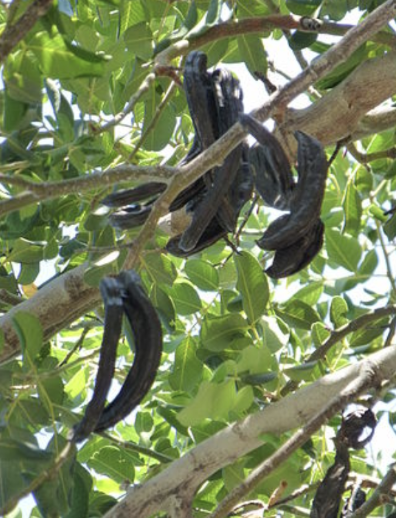
Carob, which has a sweet and chocolatey flavor, is native to Israel and is called, “St. John’s Bread.” The Arabs make a sweet syrup from the pulp of the fruit from the medium-sized evergreen tree; it contains as much as 50 percent sugar and is consumed by both human beings and animals.[2]
You know, we are so critical of our bodies. God doesn’t look at us in the same critical way that we do. Instead of us worrying about our weight, size, or shape, instead, let us eat without anxiety and give thanks to God for our food, especially when we eat bread, remembering the miracle feeding of God’s people in the wilderness and our daily bread, the Word of God, Jesus Christ, the true Bread from Heaven that nourishes us to eternal life.
Let us pray.
Holy One, thank you for your Bread from Heaven, the manna that fed your children for 40 years in the wilderness and Your Son, whose body nourishes us to eternal life. Thank you for feeding us every day. Help us to recognize what is truly food, grown from soil in your Creation, and be more intentional, especially during this holy season, about what we take into our bodies. Teach us to make good choices so that what we eat truly is food to strengthen us to serve you and our neighbors with joy, all the days of our life. Amen.
[1] Thomas Dorsey in Giving Thanks, Poems Prayers and Praise Songs of Thanksgiving, edited by Katherine Paterson, 36.
[2] Michael Zohary, Plants of the Bible (Cambridge: Cambridge University Press), 92.
[3] Zohary, Plants of the Bible, 63.
 Sharing God's Love and Grace