
Tell Me About Your Garden Series
Third Sunday in Lent
Pastor Karen Crawford
March 23, 2025
Many thanks to the 15 gardeners who opened their homes, hearts, and gardens to me and shared their stories as part of my doctoral project for Austin Presbyterian Theological Seminary.
Listen to the devotion here:
I transplanted my fig tree branch about a month ago. This was the branch that was given to me by two gardeners—George and Lottie—that I rooted in water. It was doing great in the water, though it took a while for the roots to grow. It was just a stick for a long time.
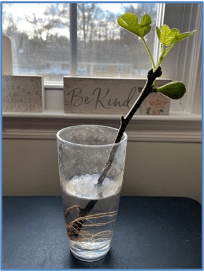
Finally, around Christmastime, it produced a green fig and then two leaves in January.
By February, I decided that it probably needed soil. Then, not long after I planted the fig tree in potting soil and gave it a good watering, the leaves shriveled and dried up. I thought, “Oh no.”
I asked myself, if I were a fig tree, what would my problem be? Is it not enough sun? Maybe it’s lonely on the bathroom counter? I brought the tree into my home office and put it in a sunny window, on top of my printer. Then, I tried to ignore it for a week or so and see if it might recover on its own. Maybe it was in transplant shock.
A couple weeks passed, and the leaves fell off. I looked at my cat, wondering if maybe he chewed them off, but he looked as puzzled as I was concerning the fig tree.
I mentioned the problem during our gardeners’ gathering on March 9. George and Lottie tell me not to worry. They will give me another branch. Fig trees are hard to grow, they say. Kaitlyn advises that I recycle it. Let it become soil again in the compost pile. Learn to let go. And that’s very tempting.
I put the tree out of my mind for a few days, then a week and a little more, as I was busy with ministry. Then, early this week, I transplanted the little seedlings that grew from seeds planted the end of February/beginning of March and the peace lily that Nanume Church had given me for my installation three years ago. The peace lily was completely root-bound. When I pulled it out of its pot, there was barely any soil left. No wonder the leaves had been turning yellow, despite my regular watering and its home in a sunny window. Now the peace lily is divided in three large pots, with fresh soil, enriched with compost. The plants already look greener and healthier, with new growth—only two days after the transplanting.
While all the transplanting went well for the seedlings and the peace lily, I can’t help but wonder how I might help the fig tree. Having this passage come up in the lectionary this week was fortuitous. At least, I thought so, but then I realized that it is one that scholars debate and find problematic. It isn’t as difficult as the passage in Matthew 21 where Jesus is portrayed cursing a fig tree that doesn’t bear fruit. That just doesn’t sit with me well, the picture of Jesus, through whom all things were made, cursing any part of God’s Creation.
In this passage in Luke, I don’t like how the man tells the gardener to cut down the fig tree in his vineyard, because for three years, he’s been watching that tree, and it hasn’t born any fruit. Maybe a fig tree takes longer to bear fruit than other trees. Maybe it had a hard three years, struggling with drought, insects, or some other problem that we don’t know about. But then something in me says, “Three years is a long time waiting for fruit. Maybe it IS a waste of soil, and it would be better, as Kaitlyn says, recycling it to the compost pile.
And then the gardener in the parable brings me joy. He intervenes on behalf of the fig tree and offers to do more to try and help it grow. He says, “Sir, let it alone for one more year, until I dig around it and put manure on it. If it bears fruit next year, well and good, but if not, you can cut it down.” This is the part that inspires me—what the gardener is willing to do to spur the tree to bear fruit. There is so much compassion here. And by helping the tree, he is helping the production of the entire vineyard. And he is helping himself, so that he can say to the man, perhaps the owner of the vineyard, next year, “I did all that I could as your gardener, and now look at all the fruit this fig tree is bearing.”
This passage, when read alongside James 5, reminds me of how we are encouraged to live as we are waiting for Christ’s return—in loving community with one another. James encourages his church to be patient, until Christ’s coming, as “the farmer waits for the precious crop from the earth, being patient with it until it receives the early and the late rains. You also must be patient.” People living in Palestine in the First Century practiced dry farming, relying not on irrigation, but solely on the rains for crops to grow and bear fruit.
This passage in Luke, read alongside Hebrews 10, makes me think about what we can do to “provoke or spur one another to love and good deeds,” just as the gardener was willing to loosen the soil around the tree and fertilize it to spur it to bear fruit. The writer of Hebrews says that the way to spur one another to love and good deeds is by “not neglecting to meet together” as some people were making a habit of not gathering, and by “encouraging one another all the more” as the Day of the Lord’s return approaches.
Today’s lesson stirs me to consider my own growing conditions and seasons of abundance and dormancy. When have I had my most fruitful seasons, and born the fruits of the Spirit: love, joy, peace, patience, kindness, goodness, faithfulness, gentleness, and self-control? I will share some thoughts.
First, being planted in the right soil helps! I know the old saying, “Bloom where you are planted,” and that’s true, but whenever possible, go and plant yourself with the people who spur you to love and good deeds. Don’t hang around too much with the barren fig trees, unless you are trying to fertilize them and spur them to love and good deeds. Stay away from places that aren’t good soil for you, places where you know you won’t be at your best, grow, and bear fruit.
Second, don’t wait for others to feed you. Mature Christians know how to eat. Come to church with open hearts and minds, ready to be nourished. Open your Bible and read at home. Put on worship music and sing. Take a walk in nature, plant some seeds, visit a friend, help someone in need, and seek the Lord with confidence in prayer.
Third, ask for help. Sometimes it’s hard to ask for help when you are struggling. But when you ask for help, you provoke someone else to love and good deeds. You give them a ministry opportunity and you make THEM feel needed. Everyone is needed. Then, it’s a domino effect. When they serve you or help the church family, they spur you and others to love and good deeds.
So back to the gardener and the barren fruit tree. Don’t you wish that Jesus would tell us the end of the story? Don’t you want to know if the tree stayed barren or if, the following year, when the man returned, the gardener was able to say, “Come and see all the fruit your fig tree is now bearing. All because of a little manure and a lot of patience.”
Scholars say this passage is about divine judgment deferred and an invitation to repentance. Our loving and gracious God is so patient. The God who knows us better than we know ourselves wants to be known. Christ welcomes all to receive his forgiveness and love, and then come, follow him.
Finally, what about my fig tree, which is now back to being a stick? Well, after I transplanted the peace lily, I transplanted the fig tree, once again. At first, I thought, am I just wasting my time and my good transplant soil? But then I did it, anyway. I gave it a new, clean pot. When I pulled it gently out of the other soil, I saw that those wonderful roots that had grown last winter in water are now all gone. What happened in the first transplanting? I don’t know. Something must have been wrong with the soil. It’s a mystery.
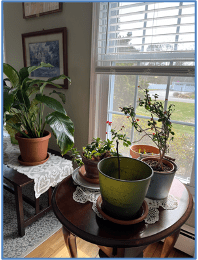
Now, the fig tree is on a sunny table with a flourishing Crown of Thorns with red flowers, a pot of Julie’s garlic, with green shoots pushing through the soil, and a healthy succulent, given to me by a church member when I arrived. Maybe living in a strong, growing community, with good soil and sun, will spur my barren fig branch to send out new roots and leaves. Perhaps, someday, it will bear fruit. I haven’t given up hope, not yet, just as the Lord never gives up on me.
What about you, dear friends? Do you need the gardener’s fertilizer and tender loving care? What spurs you to love and good deeds? What will you do to spur one another in this season of Lent?
Let us pray.
Gracious Gardener, thank you for your love and mercy for us, for being patient with us through all the seasons of our lives, seasons of abundancy and seasons of dormancy. Thank you for never giving up on us, no matter what, and the continual help we have from your Holy Spirit, feeding, guiding, and strengthening us to follow your Son. Spur us, dear Lord who is always with us, to love and good deeds. Teach us how to spur one another so that we all grow, bloom, and bear spiritual fruit. Amen.
 Sharing God's Love and Grace