Meditation on John 13
Maundy Thursday
First Presbyterian Church of Smithtown, NY
Pastor Karen Crawford
April 17, 2025
Listen to the devotion here:
Jesus is with his disciples for another meal in our reading in John tonight. He is eating, again! Have you ever noticed how many meals that Jesus eats in the gospels? And that some of the most profound and intimate interactions he has with others happen in the context of a meal?
This was my experience during our Wednesday night Lenten suppers. They were a time of teaching, learning, and sharing stories. Members presented on the history of sports and building secrets; the history of ministry with women, children, and youth; and the history of handbells. And they were more than teaching and learning, sharing stories and eating soup, salad, bread, and cookies. Something beautiful and meaningful happened as we enjoyed our simple and not so simple meals, some prepared by numerous hands, others prepared by one or two. We grew closer to one another. We grew in friendship and love. Everyone was welcome to our Lenten soup suppers. No one was turned away. I even invited a stranger who had come for an AA meeting and got lost in our building.
The Pharisees and scribes are critical of Jesus eating and drinking with everyone, welcoming all to his table and happily eating meals at the homes and tables of others, even the outcasts, such as tax collectors and prostitutes. In Mark 2:15-17, while Jesus is having dinner at Levi’s house, many tax collectors and “sinners” are eating with him and his disciples. Levi is his Hebrew name, but you may recognize him better as Matthew, his Greek name. Matthew was a tax collector who worked for the Greek-speaking Romans. When the Pharisees see him eating with “sinners” and tax collectors, they ask his disciples: “Why does he eat with tax collectors and sinners?” The word sinners is repeated so we don’t miss the point; Jesus never discriminates! Everyone, regardless of their past or current lifestyle, is worthy of his time, gifts, wisdom, and caring ways. Jesus’ table is open wide to every category of people, acceptable and unacceptable, in his time. On hearing the Pharisees’ question, Jesus says to them, “It is not the healthy who need a doctor, but the sick. I have not come to call the righteous, but sinners.”
The same Levi (Matthew) gives a great banquet for Jesus at his house in Luke 5:29-32, and there’s a large crowd of tax collectors and others reclining at the table with them, as was the custom when they ate.The Pharisees and their scribes are complaining to his disciples, saying, “Why do you eat and drink with tax collectors and sinners?” His answer is almost identical to that in Mark. The meals have a greater purpose than simply nourishment for the body. The meals with Jesus are meant for the healing of the soul, redemption, and spiritual growth. Jesus says, “Those who are well have no need of a physician but those who are sick;I have not come to call the righteous but sinners to repentance.”
Likewise, in Matthew 9:10-13, while Jesus is having dinner at Matthew’s house, many tax collectors and sinners come and eat with him and his disciples. The Pharisees, who must also be at the dinner, see this and ask his disciples, “Why does your teacher eat with tax collectors and sinners?” Jesus hears and answers, “It is not the healthy who need a doctor, but the sick.But go and learn what this means: ‘I desire mercy, not sacrifice.’ For I have not come to call the righteous, but sinners.”
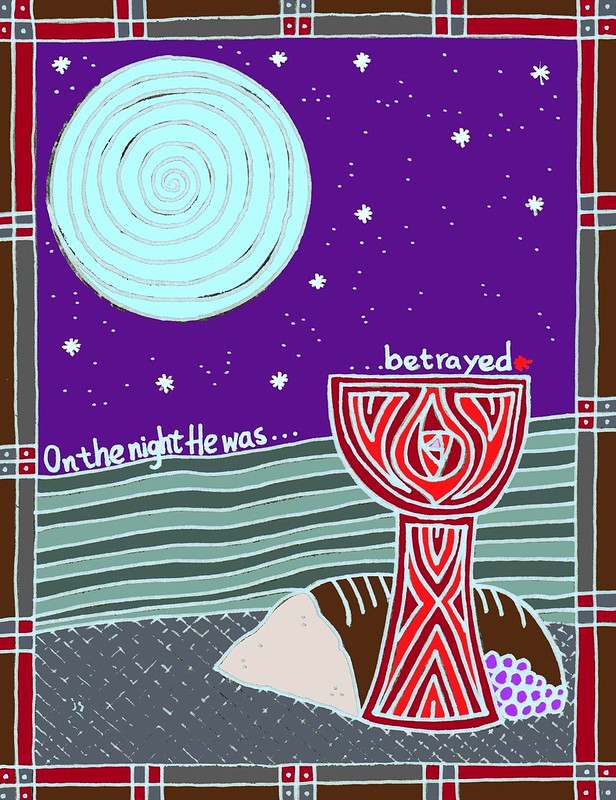
We don’t know where tonight’s meal is taking place in John 13, except that it is in Jerusalem. We don’t know what the group is eating, except for the bread and wine. We don’t know exactly when, except that it is before the Festival of the Passover and that it is the night that Jesus will attempt to prepare his disciples for their future, for we know that his hour has come. Tonight, he will be betrayed by one of his followers, who has joined him for the meal. But it would be wrong to assume that Judas, son of Simon Iscariot, is the only sinner in the group. Everyone with Jesus, even you and me, would count as “sinners,” for by his own definition, these are the ones whom Jesus chooses and calls. This passage in John is the first time that we hear that Jesus has loved his disciples and how he will love them “to the end.”
What’s different about this meal? The foot washing. The foot washing is the surprise for all who are gathered. He has taken on a servant’s position, laying down his outer garments and wrapping a towel around his waist. He reaches Simon Peter, first, whose response is shock and disbelief. This isn’t a job for their Teacher and Lord. Simon Peter says, “Lord, are you going to wash my feet?” And when Jesus tells him that he will understand later, Simon Peter insists, “Lord, you will never wash my feet.”
Jesus answers mysteriously, “Unless I wash you, you have no share with me,” and will later add, equally mysteriously, “One who has bathed does not need to wash, except for the feet, but is entirely clean. And you are clean, though not all of you.” For he knew who was to betray him; for this reason he said, “Not all of you are clean.”
Simon Peter will say almost comically, “Lord, not my feet only but also my hands and my head!” But he is not just joking around. Simon Peter is all in with Jesus—100 percent — until the moment he, too, will betray him, three times before the cock crows, after Jesus is arrested.
But even though Judas, son of Simon Iscariot, will set in motion the events leading to Christ’s death, and Jesus knows it, he welcomes him to the table. He feeds him bread dipped in wine with his own hand. He washes Judas’ feet. This is not just a host showing kindness to his guests. This is the gracious One to whom all things have been given, One who is from God, and on his way back to God. This is the Word who became flesh, the Lamb of God who takes away the sin of the world. This is the Good Shepherd, Living Water, and Bread of Life. This Word, Lamb, Shepherd, Water, and Bread includes Judas, son of Simon Iscariot, with the ones whom Jesus loves, the ones whom he counts as his own. The ones whom he will love to the end.
This humble act of foot washing, done only by the lowliest servants or slaves, is our Savior’s example to all of us on how to love one another. As the Apostle Paul will say in 1 Cor. 13, “love does not envy or boast; it is not arrogant or rude. It does not insist on its own way; it is not irritable or resentful; it does not rejoice at wrongdoing but rejoices with the truth.” Love is the greatest gift of all, a gift that the Spirit offers to everyone. This is a love like no other. It changes us—purifies and cleanses us from our sins. It strengthens us to love one another, as Christ has always and will always love us.
But what about this meal that is often called the “Last” Supper? The words of institution may not be here, like they are in Mark 14 and Luke 22, nor is his commandment for us to do this in remembrance of him. Still, this is Holy Communion, just the same.
And this won’t be Jesus’ last meal with his disciples. There’s another meal with the Risen Christ as the chef in John 21. The Lord invites the disciples, who have reluctantly returned to their former occupations as fishermen, to the beach for grilled fish. Jesus will say, “Come, have breakfast!” They will eagerly join him.
But even that Resurrection Breakfast won’t be the last meal with his disciples. For every time we gather to share a meal, and thank and invite Christ to be our guest, he is with us, eating with those who have been cleansed from sin and lovingly redeemed by him.
In a few moments, we will gather in small groups around the Lord’s Table to celebrate our Communion with Christ and be transformed, restored, and re-membered as his Body sent out for the sake of the world. As we do, we recall the holy meal with the ones whom Christ loved—his first disciples and all his disciples, in every time and place—the ones whom Christ will love to the end. Even the ones who will betray him—first Judas, who will put into motion the events that lead to Christ’s death and resurrection and our hope of abundant and everlasting life with him. And Simon Peter, upon whom Christ will build His Church. And we will remember his greatest commandment, shown by his humbling himself, to the form of a slave, to do the unthinkable—wash his followers’ feet.
He tells us now, “Love one another.” “Just as I have loved you, you also should love one another.By this everyone will know that you are my disciples, if you have love for one another.”
Let us pray.
Holy One, thank you for showing us what love is when you washed your disciples’ feet and when you gave your life for the world. Thank you for your love, grace, and mercy for sinners and for nourishing us body, mind, and soul when we celebrate Communion and whenever we eat a meal and invite you to be with us. Strengthen us to love the outcasts and so-called sinners of today and to live in love with one another, so that everyone will know that we are your disciples. Amen.
 Sharing God's Love and Grace