
Meditation on Acts 16:9-15
First Presbyterian Church of Smithtown
Rev. Dr. Karen Crawford
May 25, 2025
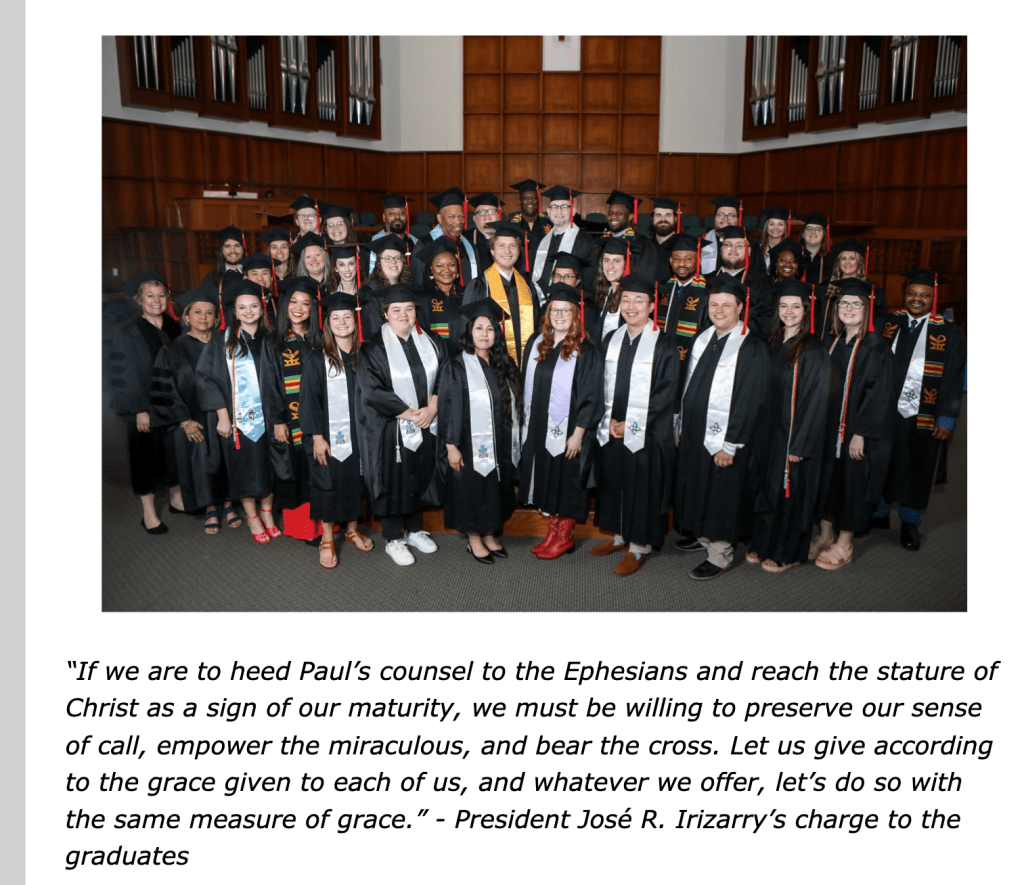
Last weekend was a whirlwind of activities, beginning with a long travel day on Friday to Austin, TX, due to weather-related delays. Jim and I finally arrived at our hotel at 4:30 a.m. Eastern Time Saturday. Later that day, we attended a worship service for the graduates and their families. Commencement was on Sunday. We journeyed home on Monday.
It was an exhausting weekend, and I was sad that no one else from my class was graduating with me. I didn’t know any of the students. But I am glad that I went. I was reminded of the faithfulness of God and the goodness of God’s people.
My motivation for attending was gratitude. I wanted to say thank you to the director of the program, the Rev. Dr. Sarah Allen, who had just begun her job when I started the program in January 2022. I wanted to say thank you to one of my teachers, Dr. William Greenway, who opened my eyes to the wonder and holiness of God’s Creation—particularly the non-human creatures—and encouraged me to incorporate this love and wonder in new ways in my ministry.
But the person that I wanted to say thank you to the most was my faculty reader and final teacher, Dr. Donghyun Jeong. He encouraged me to follow my heart and do my project—exploring the spirituality of Presbyterian gardeners—the way that I wanted to. He encouraged me to listen to a variety of voices, including biblical, theological, scientific, and poetic. But the voice he said that should be the loudest in the final written project was to be MY OWN. That was a little intimidating for me. He told me that I was the captain of this ship. He complimented me on my writing style and told me that he knew I could do it.
I approached the project in the way that I felt most comfortable, by telling a story, from the beginning to the end. It became a spiritual memoir, filled with photos of gardens, birds, and the people who shared their stories and gardens with me.
During the oral evaluation right after Easter, he told me that I had inspired him, who was not a gardener, to take his son out into their yard and dig with him, looking for the countless organisms that live under our feet in the soil. His son was grossed out by the bugs, he said, but it was a new, enlightening experience for father and young son, strengthening the connection between two people with God’s soil.
Just before Commencement began, while I was busy learning to line up, Dr. Jeong praised me to my husband. Near the end of commencement, he sang a solo in Korean: Everyone Who Longs for the Boundless Love of God.
He turned and sang the final verse looking at the graduates, catching my eye and holding it, as I sat in the front row. He sang in his native tongue,
“God is always watching over you;
God is watching you with loving eyes;
God is hearing you in all your prayers;
God is listening with tender, loving ears.
God shines light in every dark and fearful place we go
and will answer every little cry that you make,
so wherever you may go follow in God’s holy way
and trust God to take you home.”
We encounter the story of Lydia in Acts 16—a strong woman, business leader in her community, whose ears and heart were open to hear the word of the Lord and respond with enthusiasm. She was a God-fearer, a Gentile who had accepted the God and faith of Israel.
Paul, who led the journey to Philippi after he sees a vision of a Macedonian man pleading for help, brings with him Silas and young Timothy. They join Lydia and other women gathered on the banks of the Gangites or Ganges River on the sabbath “to go through the appointed Jewish service of prayer for the sabbath day.”[1] Why a river, you ask? There probably was no synagogue in this town. This was Paul’s routine when he arrived at a city—to worship in the local synagogue on the sabbath. The Jewish population in Philippi may have been small,[2] and “no number of women could compensate for the absence of even one man necessary to make up the quorum of ten”[3] required for worship.
Here in Acts is the only place we hear of Lydia in the Bible. I was dismayed to read one scholar’s interpretation (Valerie Abrahamsen) that Lydia’s story may be fictitious.[4] I don’t see any evidence for this. Her story would have been circulated in the Christian community in the late first century and beyond. Valerie suggests that her name may have been “adopted by Luke to refer to the region of Lydia in Asia Minor, where Thyatira was located.”[5] I think she may have simply been named for the region where she lived, like Mary Magdalene who was really Mary of Magdala, a fishing and trade city on the shore of the Sea of Galilee, where Mary was born.
“Thyatira, a Macedonian colony in Asia Minor, was known in antiquity for its excellent dye industry.” The purple dye was made “from the juice of the madder root,”[6] which was “still in use for the dying of carpets at the end of the 19th century.”[7] Lydia is a dealer, a seller of the “very precious commodity”[8] of purple goods, which were used “primarily for the clothing of royalty and the wealthy. Inscriptions have been found honoring the city’s guild of dyers, and Luke’s readers,” Valerie says, “may have associated Lydia with such a guild.”[9]
It’s interesting to me that people assume, since there is no husband mentioned, that she is a widow. “Women in Macedonia were noted for their independence…under Roman law (which governed life in the colony) freeborn women with three children and freedwomen with four children were… granted a number of privileges, including the right to undertake legal transactions on their own initiative.”[10]
The important thing to know is that Lydia listened as Paul and his friends spoke. Yes, she was listening to Paul, but she had really come to the river to talk to and listen for God’s voice. And she listens not just with her ears, but with her heart. She is seeking God’s will for her life. She hears the good news of Jesus Christ, the long-awaited Messiah. She acknowledges Jesus as Lord and, in response to her newfound faith and commitment to Christ, is baptized in the River Gangites or Ganges, along with her entire household, which includes children and servants.
Some of the more cynical voices say that she must have compelled her household to be baptized. So, it wasn’t a true believer baptism for them. But what if all the people are responding to the move of the Spirit in this place? What if she is not the only one who experiences conversion? What if Luke is trying to tell us that faith can be spread quickly through individuals and families and through a crowd of women gathered at the river to pray?
Lydia is so excited to hear the good news that Paul, Silas, and Timothy share that day that she urges them to stay at her home. She “prevails upon them.”
Another cynical voice, Gail O’Day, says that “Luke’s treatment of Lydia is self-serving. His ideal women throughout Acts merely provide housing and some economic resources to (male) Christian missionaries and allow men to preserve or assume leadership roles in the community.”[11]
But I don’t see her that way. I see Lydia, who listens with her heart, as a leader not just in the business community, but in the religious community, especially now with her newfound faith in Christ her Savior. Lydia is the first known convert to Christianity in all of Europe.
I believe she is moved by gratitude and a hunger to know Christ more when she invites Paul, Silas, and Timothy to stay with her in her home. And she doesn’t take no for an answer.
Looking back at my own faith journey, which continues on and in some ways has begun again with my Commencement from Austin Presbyterian Theological Seminary last Sunday, I have to say that listening is the most important act of faith that we can ever do. We listen for God’s voice in Scripture, through prayer, and in the voice of the gathered people in worship and with all the spiritual fathers, mothers, sisters and brothers whom God places in our life. We learn and grow from one another. We are supported and encouraged in the faith by one another.
What comes next for me? I don’t know. For now, I am glad to have finished a challenging program of theological study that required travel to Texas twice a year. I am ready for joy and rest, spending time with my family, and getting to know my flock and the Lord even more. I am ready for whatever the Lord has planned for our future together, dear friends.
May you be encouraged by my story to listen for God’s voice and to listen with all your heart. May you respond eagerly and gratefully when the Lord tells you to go and share your story and God’s love with others. For you know that
“God is always watching over you.
God is watching you with loving eyes;
God is hearing you in all your prayers;
God is listening with tender, loving ears.
God shines light in every dark and fearful place we go
and will answer every little cry that you make…”
And when the Spirit of the Lord comes knocking at your door, I pray you will invite Christ to come in and stay with you and your household. And, like Lydia, that you don’t take no for an answer.
Let us pray.
Holy One, Loving Lord, thank you for always watching over us, with loving eyes and hearing us in all our prayers. Thank you for watching over me, my family and church family, especially in these last three years, while I was going to school in Texas. Lord, teach us to listen for your voice with our hearts, as you listen, with tender, loving ears to all our concerns. Teach us to respond eagerly and gratefully, as did Lydia, and to see your light shining in every dark and fearful place. Lead us to share our stories and your love, knowing the power of the Spirit to use our words to bring others closer to you. May we invite you in to live with us forever in our hearts and homes. In Christ we pray. Amen.
[1] F.F. Bruce, The Book of the Acts (Grand Rapids: Eerdmanns, 1988), 310.
[2] Bruce, The Book of the Acts, 310.
[3] Bruce, The Book of the Acts, 310.
[4] Valerie Abrahamsen in Women in Scripture, edited by Carol Meyers (Grand Rapids: Eerdmanns, 2000), 110-111.
[5] Abrahamsen, Women in Scripture, 111.
[6] Bruce, The Book of the Acts, 311.
[7] Bruce, The Book of the Acts, 310.
[8] Abrahamsen, Women in Scripture, 111.
[9] Abrahamsen, Women in Scripture, 111.
 Sharing God's Love and Grace