Meditation on Luke 12: 32-34 and Hebrews 11:1–3, 8–16
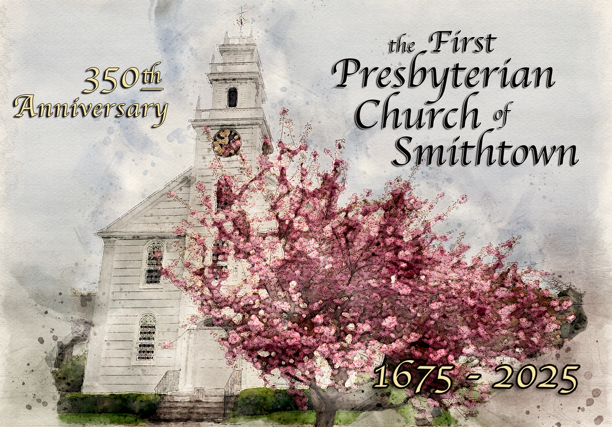
First Presbyterian Church of Smithtown
Reverend Dr. Karen Crawford
Aug. 10, 2025

My healing journey continued this week.
I am feeling better than I did a week ago and certainly better than two weeks ago, when I first hurt my back cleaning up my yard. Several of my gardening friends since then admitted that they, too, would have simply moved the heavy branch without thinking anything about it. It’s what we do!
Other people have encouraged me with their own stories of hurt backs and the ups and downs of their healing journeys.
What has been getting me down lately is just how much work and time it takes, not to mention expense, to recover from such an injury. This past week, I had doctor appointments and medical tests and treatments every single day.
On Friday morning, as I prepared to go to yet another visit to the chiropractor, I said to myself, I am done after this week. I am taking a break from all this medical stuff. Next week, I am taking my life back!
So here I am, on Friday, sitting with deep heat and electrical nerve stimulation on my lower back, waiting to see Dr. Amanda. I watch as she cares for two other patients ahead of me. One is a man with CP who arrives in a motorized scooter, plops down in a chair beside me, and relies heavily on his crutches to get to the treatment table. The other is a woman who struggles, after her session, with one hand to put her long brown hair in a ponytail. She is unable to lift the other hand past her shoulder. Dr. Amanda offers to help. The woman smiles and says thank you.
Afterward, the woman walks over to me and sits down in the chair vacated by the man with CP. “Hi, I’m Ruth,” she says. “You know, like the story of Ruth and Naomi in the Bible.”
I nod and say, “I’m Karen.”
She tells me about her illness as tears well up in her eyes. She was paralyzed four years. She spent many days in Stony Brook Hospital. She has MS. The disease also affects her eyes. She thanks God that she is able to walk again. “He is the One who healed me,” she said. “He is the One.”
Then, one day not too long ago, a friend was driving her to an appointment. A driver crashed into their stopped car from behind. Ruth sustained injuries to her spine. It was a disappointment, a setback. But she had faith that God would help her. She has hope, even now, that God helps her every day.
I thanked her for sharing her story with me and before I could say anything more, Dr. Amanda called me to the table. Later on, I thought more about Ruth’s testimony and I felt convicted of having so little faith for my own healing. And I thought about how the Bible is full of people with faith and even more with doubts and fears.
Take the disciples, for example, those who woke him up in Luke chapter 8, when he was curled up in the back of their boat, having a good sleep through a violent storm. They asked him if he cared that they were perishing? After he calmed the storm with a word, he asked them, “Where is your faith?” The terrified and amazed disciples looked at one another and asked, “Who then is this, that he commands even the winds and the water and they obey him?”
“Where is your faith?” I could hear Jesus asking me on Friday. And I couldn’t think of what to say.
The unknown author of the letter to the Hebrews has a lot to say about faith, though not quite as much as Paul, who uses the Greek word for faith or trust—pistis—35 times in the letter to the Romans alone. Pistis has an interesting history, my friends. It predates the New Testament and has a kind of “checkered past,” one scholar says, “in the culture of the early church. In Greek mythology, Pistis is one of the spirits who escaped Pandora’s box and fled back to heaven, abandoning humanity. In Luke’s gospel… when Jesus wonders, ‘Will the Son of Man find faith on earth?’ (Luke 18:8), he was speaking to a Hellenistic culture that believed the spirit of Pistis had already left.”[1]
For the disciples to understand and embrace this new idea about faith and trust and cling to it with all their might, they are forced to throw away what they thought and believed about pistis from their own myths and life experiences. And they and we are encouraged to open our hearts and minds to learn from Hebrews the multifaceted reality of faith, with all its strangeness. Let us dig a little deeper.
To the author of Hebrews, faith is not a doctrine or statement of belief. It is not easy to describe, but it is something that is lived out by God’s people every day. Without it, as we find out in a verse that is omitted from the lectionary reading (11:6), it is impossible to be pleasing to God. At the beginning of chapter 11, the author ties faith with HOPE. Faith is “the assurance of things hoped for.” We cannot have faith without HOPE. This means that we are hoping for things that we don’t yet have or haven’t yet come into being.
We hope for, say, peace on earth and the end of all wars and violence. Do we live in a world where there is peace and no wars or violence? We don’t live in such a world, not yet, but we hope for these things. More than that, we live into these things that we recognize are characteristic of the Kingdom of God that Christ ushered in. We can be peacemakers and lovers in our families, churches, and communities and do our part to work for peace. We do this because we have hope and faith that someday the risen Christ will return in glory to judge the earth and banish evil from his realm. All will be welcome at His banquet table—followers from east, west, north and south will gather there. There will be no suffering or pain. The lamb of God that takes the sin from the world will wipe away all tears. He will say to his followers, “Well done, good and faithful servant. Well done.”
Faith at the time of the early church is something that gets them in trouble with their neighbors. Faith provokes hostility and ridicule. Where is this Christ who was crucified and yet has saved you from your sins? The church perseveres and holds onto “the conviction of things not seen.” If you have faith for something, that means you haven’t seen it with your own eyes. There is only the testimony of others—the letters and stories people tell about Christ’s ministry on earth, his miracles and promises, the empty tomb and resurrection appearances, and so forth.
By the time the letter to the Hebrews, written around 64 to 69 A.D. when Christians were being persecuted under the Emperor Nero, which began after the Great Fire of Rome, very few of Christ’s followers had actually met Jesus face to face. They are the ones whom Jesus calls blessed in John 20:29, saying to Thomas, “Because you have seen me, you have believed. Those who believe without seeing are blessed.”
After the writer of Hebrews gives definitions for faith, he does as all good teachers do; he provides examples, going back to Creation. “By faith we understand that the world were prepared by the word of God, so that what is seen was made from things that are not visible…” In the chunk missing from our reading today, you will find other earlier examples, but we move to Genesis 12, to the call of Abram, who didn’t know where he was going or the timeline for the journey. He heard God’s voice and believed. His new name, Abraham, meant that he was going to be the Father of many nations. Through his family, all the world would be blessed. His descendants would number the stars and grains of sand by the sea. But, in the end, Sarai gave him only one child—Isaac—in their old age. And that was enough for God’s plan, though Abraham and Sarah saw only a glimpse.
The assurance of things hoped for. The conviction of things not seen.
God’s story would continue from generation to generation, and it continues today with us and the Body of Christ in Smithtown, on Long Island, and around the world. The woman that I met at the chiropractor had a strong Spanish accent. If I were to venture a guess, though it makes no difference, I would say she might be Roman Catholic or Pentecostal. She is still my sister, our sister, in Christ. If I hadn’t gone to that particular chiropractor on Friday, I might never have met her. I met never have had the opportunity to hear her testimony and be lifted at a time when I was beginning to lose hope. It was a God thing.
If I hadn’t gone on Friday, I might never have been moved to consider how God’s healing power is still very much alive and well in this place, in Smithtown, in this day and age—and how maybe, just maybe, this is God’s plan for you and me—that we, too, will be healed, on our journeys of faith.
It occurred to me then how it is more difficult to have faith for my own healing than to have faith for someone else’s. This may actually be a problem with many Christians. Why is it so hard for some of us to accept God’s grace, mercy, and blessing, when it’s so much easier to have faith that it’s God’s desire to offer grace, mercy, and blessing to someone else?
This is what I think: deep down, we blame ourselves for our illness or injury, every trial or challenge. We think we must have done something wrong and maybe because it’s all our fault, we deserve it. But that isn’t how God’s love works. We don’t get what we deserve! We are loved unconditionally. No matter what! Each of us has a future, filled with hope.
God who knows us better than we know ourselves knows that we struggle to have faith for our own healing and blessing. That’s just one of the reasons why it is so important for Christians to belong to a church and to actively participate and be in relationship with other Christians. We need other believers, we need our church family, to inspire us with their stories of healing and struggle. We need other people to be the hands and feet of Jesus and to remind us of the One who wasn’t really asleep in the back of the boat, the One who commands the winds and the water, and they obey him.
We need our siblings in Christ to hold us up with their prayers and loving words—when we find ourselves weak and overwhelmed by trials, losses, suffering or grief, when we might hear the Lord inquire of us, like he did the frightened disciples on the Sea of Galilee, “Where is your faith?”
Let us pray.
Holy One, thank you for your steadfast love and faithfulness to us, to every generation. Thank you for the healing stories in the Bible and of our siblings in Christ that give us hope, and the stories of the faithful. Lord, we can’t see your big plan. We only know the little piece that is today, right here, in our own lives. Help us to wait in hope and persevere in pistis, faith. Help us to not just talk about what we believe but to live it out. Help us to be pleasing to you. Forgive us when we are cranky and full of doubts and complaints, rather than trusting in your wisdom, guidance, and provision. Let us recognize your merciful hand in our lives and show mercy. Thank you for Ruth and the rest of the Body of Christ that surrounds us, within and beyond these church walls, ready to support us with their testimonies, prayer and loving words. In the name of our Savior we pray. Amen.
[1] David E Gray, Feasting on the Word, Year C, Vol. 3, ed. by Bartlett and Taylor (KY: Westminster John Knox, 2010), 330.
 Sharing God's Love and Grace