Meditation on Philemon
First Presbyterian Church of Smithtown, NY
Reverend Dr. Karen Crawford
Sept. 7, 2025
My mom and I just returned from our cruise, traveling from Norway to The Netherlands. It was amazing at times, especially when we were in the little village of Flam, and we had breathtaking views of the fjords.

We began our journey in Oslo, arriving after an overnight flight from JFK. Oslo is Norway’s capital and largest city, founded at the end of the Viking age in 1040 A.D. first as Anslo. Fire destroyed the city, built from logs, more than a dozen times. After burning down in 1624 during the reign of King Christian IV, a new city was built of stone, with the help of Danish masons. The new city was relocated closer to the fortress and re-named for its king—Christiana. In 1925, it became “Oslo,” a Norwegian word that might mean meadow at the foot of a hill or meadow consecrated to the gods or both.
We had two different bus and walking tours of the city with two different guides—first before the cruise and as a stop in a port along the way during the cruise. Our female guide, whose name I don’t recall, was a retired teacher who went with us to the Ski Museum and Tower, where the world’s oldest skis (thousands of years old!) are on display.

Then we went to the Vigeland Sculpture Park with 200 sculptures of bronze, granite, and cast iron, inside Frogner Park. The park was still beautiful, though it was pouring rain.
Our guide Roger, a teacher in an international school on a gap year, led us to the grounds at the king’s palace. We could walk right up to the gate and have our pictures taken with the guard! He pointed out the Munch museum and the building where the Nobel Peace Prize is awarded. We admired the architecture of the library and the new opera house. He took us to a scenic overlook, where we could view a new line of 12 tall buildings, each with distinctive architecture, between Central Station and the waterfront called the “bar code.” He pointed out floating salt spas at the waterfront that encourage people in winter to heat up in saunas, then jump in frigid water.
Then we went to a maritime museum, where we saw a man building a replica of a wooden Viking boat. Turns out, Vikings traveled all over the world with these tiny and medium sized wooden boats. New Viking settlements, from the 8th century to the 11th century when the Viking Age ended, are still being discovered and excavated.
What was unexpected to me about the Viking cruise was how they attempted to re-educate us on the Vikings and dispel myths and stereotypes (such as the horns on a Viking helmet. Vikings never had horns on their helmets!) They attempted to rehabilitate their unsavory reputation.
As our guide, Roger, said, matter-of-factly, “Yes, there was the pillaging.” Chieftains led raids for gold, silver, and other valuables from monasteries and churches. They ransacked Medieval villages. They captured people and sold them as slaves and kept them as wives and concubines. But then they gradually turned their focus to trade—not just food staples, such as grain and dried cod, but luxury items such as textiles, pottery, silks, spices, reindeer antler combs, walrus ivory, and jewelry. They built settlements on shores and became integrated into communities.
We are looking at one of my favorite of Paul’s letters in Scripture—the letter to Philemon. Paul, too, is attempting not only to rehabilitate the unsavory reputation of a runaway slave, but to reconcile a man with his community of faith and two siblings in Christ with each other.
Philemon lived in Colossae, in an area that is now Turkey, roughly a hundred miles inland from Ephesus, also in what is Turkey. The letter to the Colossians was being sent there at the same time as this letter. Philemon had become a Christian after hearing Paul preach.
“Paul had been thrilled with the way Philemon, a man of some means and influence, had responded to the gospel. It had gripped his heart and made him a man of love and generosity. He and his wife, Apphia, and their son, Archippus, had joined Paul in the work of the gospel. They had gone home to Colossae and made their home a place of love and hospitality, where the handful of Christians in the area had begun to meet.”[1]
Philemon, like every other person of wealth and substance in the biblical world, owned slaves. Scholar N.T. Wright says, “To them, this was a natural as owning a car or a television is for people in the Western world today. Indeed, most people would wonder how you could get on without them.”[2] One of Philemon’s slaves had run away, which was a capital offence. Worse, the slave may have taken some money to help him while he was on the run. He had gone to the nearest city—Ephesus—and perhaps when the money ran out, he had met Paul.
The slave’s name was Onesimus (Own-ee-si-mus). The Greek name means “useful.” Paul is playing with words when he says, “Formerly he was useless to you, but now he is indeed useful to you and to me.” In gratitude to Paul for telling him about Jesus and his love, “he had started to look after Paul in prison, to attend to his needs with a devotion”[3] that he may not have shown to his master. “He and Paul had become friends, brothers in the Lord Jesus, close partners in the gospel.”[4]
I read this letter with mixed feelings. Something in me questions why Paul would send a runaway slave who had accepted the faith and was partnering with him in ministry, caring for him in his time of need, back to his owner. Onesimus may be punished, though his master Philemon is a Christian, because he has broken the law! This week I had a new thought. What if Onesimus wants to go home to his family and his faith community? What if he is tired of living as an outlaw? Now that he has accepted Christ’s forgiveness and the new life that Christ offers those who believe, what if he wants to be forgiven, reconciled, and restored to right relationship with the people whom he loves? Maybe whatever caused him to run away doesn’t seem like such a terrible offense anymore, not after all he has seen and experienced in the real world and all that he has learned from watching Paul suffer in jail. Maybe he who has received Christ’s forgiveness wants to extend that forgiveness to those who have hurt him.
And what if Paul worries that he may die in prison, for many people did perish in prison, and he wants to be sure that Onesimus is safely returned to his family and Christian community?
I can’t help but think, though, that when he asks Philemon, near the end of his letter, to prepare a guest room for him, he writes as much to encourage Onesimus that they will be together again, as it is to stir Philemon to hope for Paul’s release and remind him of his need for the church’s prayers.
And what of Paul’s promise to pay Philemon whatever Onesimus owes? Wright says that this is a reminder to Philemon of what he owes Paul—his very life! Paul, probably in his 40s or 50s at the time of this writing, “will stand in the place of risk and pain, with arms outstretched towards the slave and his owner…He will close the gap not just between Philemon and Onesimus but between the two sides of the great divide,” Wright says, “that ran through, and in some places still runs through, the life of the world.” This is what Paul is trying to communicate in 2 Corinthians when he says that he has been “entrusted with the gospel of reconciliation.” Like us, Paul is seeking to put his faith into practice and discover what the cross means for our daily lives!
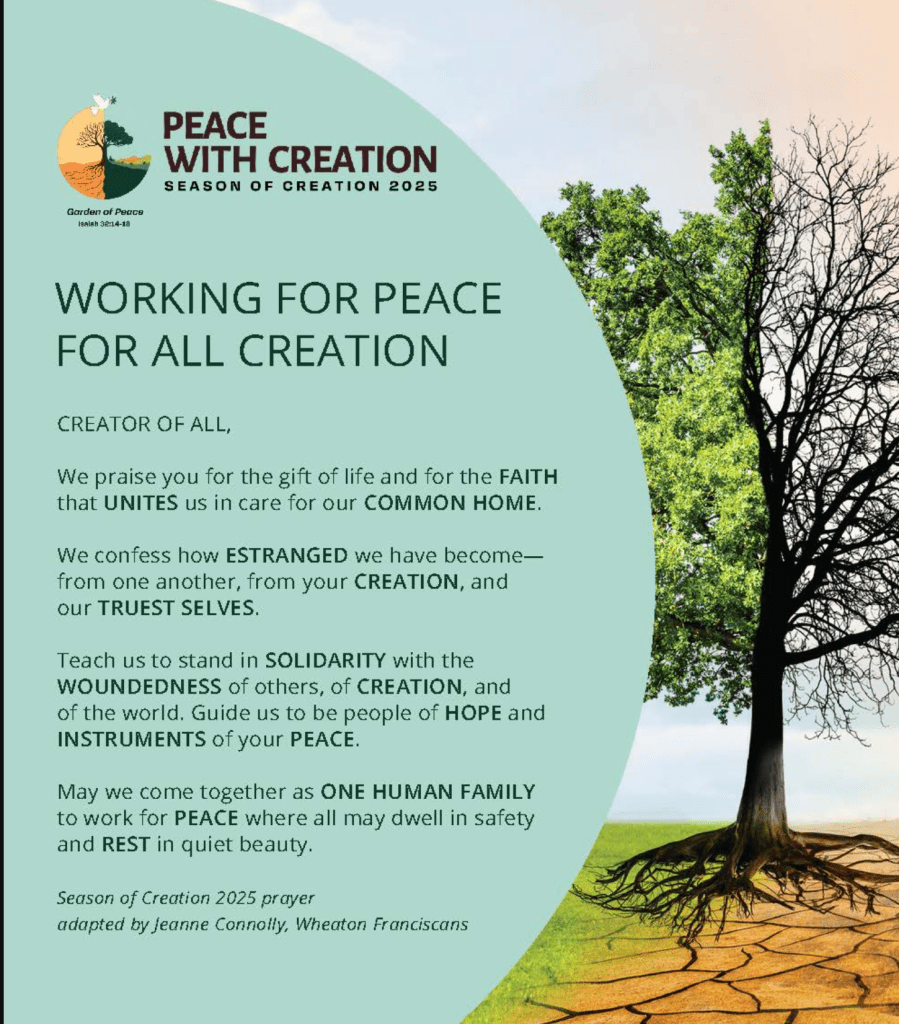
The phrase that touches me the most is when Paul says that he is making his appeal on the basis of love. On the basis of love. As I come to the end of my message today, on this day when we mark the World Day of Prayer for Creation, I urge you to consider the broken relationships in your life. We all have broken relationships in our families and our communities, but also we have broken relationships with the earth. Here on Long Island, we are frustrated with the deer and rabbits eating our trees, shrubs, and gardens. In Flam, where herds of reindeer graze, villagers plant grass and wildflowers on the rocky landscape, so that the animals have food to eat.
I can’t help but marvel at how Norway and The Netherlands are making use of green energy. They are tapping into the power of wind and water; the people are walking and bicycling more and using trains and buses that run on electricity. Gas stations are being converted to battery charging stations because if and when they drive, they are driving electric cars.
At the same time, Norway and The Netherlands and much of Europe these days is secular. Churches are empty or are being used for secular purposes—as libraries, coffee houses, stores, museums, and such. The people, more and more, refuse to identify with any religion at all. Yet they have this strong connection and concern with the earth.
And we, who believe that God made us and all Creation, in this country, don’t necessarily connect our Christian faith with our need to care for and be concerned about the health of our water, soil, forests, animals, and air.
So, what I am trying to say today is that those who are seeking to follow Christ therefore must also accept the great responsibility of which the apostle Paul spoke. We are entrusted with the gospel of reconciliation—reconciliation between God and human beings, reconciliation between human beings with one another, and reconciliation between humanity and all Creation.
What can just one person do, you ask? The problem of brokenness is so big. It’s overwhelming, at times, when I think about it. And then I remember Paul writing this letter to Philemon, seeking to restore what was broken between not just a master and slave but two people now on equal footing and value in the Church—those who have been made siblings by the blood of Jesus Christ.
Though I can’t say for sure, I have to think that if Paul’s letter is included in our Holy Scripture, Onesimus must have gone home to his master and family of faith and experienced welcome and grace. Why else would it be in our Bibles? This letter stirs me to consider how many people over the years have been inspired by the story of Onesimus—those who went astray, but then bravely came home? I believe that many broken relationships, because of the letter to Philemon, were made whole!
This is my hope for my flock. May each of us be open to the Spirit of transformation and be empowered to be instruments of Christ’s peace and healing. May we who have received Christ’s forgiveness learn to graciously extend that forgiveness to others. May we, like Onesimus, be made truly useful to the gospel mission.
I appeal to you, my sisters and brothers, on the basis of love.
Let us pray. Holy One, we give you thanks for this world of natural beauty that we enjoy—that feeds us and sustains our lives. Thank you for the way that you provide for all our needs through the abundant bounty of the land and those who labor in the soil. Forgive us, Lord, when we have forgotten our dependence on your wonderful world and taken for granted that natural resources will always be abundant, without our need to change our consuming habits. Stir our hearts, Lord, to embrace the call to be reconcilers, like the apostle Paul, and be made truly useful to the gospel mission, like Onesimus. May your Spirit empower us to be instruments of Christ’s healing and peace. In the name of our Triune God we pray. Amen.
[1] N.T. Wright, Paul for Everyone: The Prison Letters (KY: Westminster John Knox, enlarged print edition, 2015), 198-199.
[2] Wright, Paul, the Prison Letters, 199.
 Sharing God's Love and Grace