Meditation on Acts 22:1-16
Reverend Dr. Karen Crawford
First Presbyterian Church of Smithtown, NY
Nov. 9, 2025 (Baptism of Saylor Marie Schulz)

Today, as we baptize little Saylor, we share more stories of the leaders of the Church, beginning with the dramatic conversion of Paul and his need to be baptized, like Saylor, as he began his journey of faith. But before talking about the apostle, I would like to share the story of Smithtown’s most famous preacher, the Rev. Joshua Hartt.
Hartt was born on a farm in Dix Hills on Sept. 17, 1738. He was a 34-year- old Princeton grad when he was ordained an evangelist by Suffolk Presbytery in 1772. He was installed to serve Smithtown, his first church, on April 29, 1774. This was the year the British Parliament imposed the Intolerable Acts, an attempt to disarm the colonists, which led, a year later, to the Revolutionary War battles of Lexington and Concord in April 1775.
Hartt often preached on Liberty. His sermons contained inflammatory phrases, such as, “He who hath no sword, let him sell his garment and buy one!” and “Beat your plowshares into swords and your pruning shears into spears and let the weak say I am strong.”[1] Not surprisingly, he was arrested and imprisoned at least 5 times. One time, he was arrested after he “overtly attacked the conduct of officers and soldiers of the British Army.”[2] He “was chained to a slave and thrown on a wagon for transportation to New York’s Provost Jail, located on what is now the site of City Hall Park.”[3] Along the way, “he was taunted by a young lieutenant, who reportedly said, ‘How do you like your company?’ Hartt replied, ‘Better than yours.’”
Smithtown was without a preacher while Hartt languished in prison from May to October 1777, where he became ill with fever. The surprising twist to the story is that Hartt befriended Ethan Allen in prison. Allen, when Hartt came near to dying, “knelt at (his) bedside and prayed for his recovery.”[4] Hartt was soon released and paroled. Allen shook Hartt’s hand as he left, saying, “Goodbye Rev. Hartt, when you go home tell your wife that while you were sick and nigh unto death, Ethan Allen, a servant of the Most High God, prayed over you and you recovered.”[5]
Hartt returned to ministry and continued to preach his Liberty sermons. He “so enraged the British who were occupying Long Island, that it is said that two soldiers went to the door of the Smithtown Church and fired their rifles at Reverend Hartt in the pulpit.”[6] But the bullets whistled over his head and left him unharmed. For many years, bullet holes over the pulpit of the old meeting house were proof of the attempt at his life. As for the story of Hart being prayed for by Ethan Allen, “it became a matter of considerable pride, and he mentioned it frequently in public.”[7]
Paul’s conversion on the road to Damascus has been shared for so long in so many faith communities that having “a road to Damascus experience” has become synonymous with “a sudden, dramatic turning point in a person’s life, a moment of profound realization … that leads to a fundamental change in direction.” So profound was Paul’s change that he would no longer be known by his Hebrew name, Saul of Tarsus. He would, by Acts 13:9, be known only by his Latin or Greek name, “Paulos” or “Paul,” as we say.
It’s easy to forget when we read Paul’s letters that Saul was breathing threats and murder for Christ’s followers before the Lord stopped him in his tracks. Christ appeared as a great light from heaven and a voice saying, “Saul, Saul, why are you persecuting me?” The Lord would tell him to get up and continue to Damascus, where he would be told, “everything that has been assigned” for him to do. The light left Saul completely blind. The only way he could reach his destination was by holding the hands of his traveling companions.
His first mentor in the faith was a devout Jewish man named Annanias who heals him of his blindness. He tells him how the God of his ancestors had “chosen him to know God’s will,” “to see the Righteous One, and to hear his own voice.” He tells Saul about God’s plan—that he would be a witness to all the world of what he has seen and heard. But there was one thing that Saul must do, first. He needs to be baptized. “And now why do you delay?” Annanias asks. “Get up, be baptized, and have your sins washed away, calling on his name.”
Friends, now you know of Paul’s conversion and baptism, but I have more to tell you about our most famous preacher. Do you want to hear the rest of Hartt’s story? I want to share with you about his more human and pastoral side, which began to be revealed after his near-death experience in the British prison.
Hartt’s contribution to the ministry and his community’s wellbeing was so much larger than his patriotic acts and inflammatory speeches. He was a doctor, “giving out potions and nostrums, as well as bleeding anyone who seemed to need it.” He was “a local scribe and wrote many legal writs for residents of Smithtown and Huntington.”[8] He was a farmer and land surveyor who pressured the federal government into building a lighthouse at Eatons Neck. He surveyed vast areas of the Mohawk Valley in western New York, working “the frontier, sleeping by campfires and bringing the order of a Christian God and civil engineering to the wilderness. Afterward, he (told) stories, like the time he awoke one morning to find a rattlesnake in his blankets.” After a few years of frontier living, he returned home to his wife, Abigail Howell, and his 10 children in Fort Salonga, where he planted a church after he left Smithtown in September 1787. Oh, and he worked as a teacher of some of his own and his community’s children, recording their names and tallying their attendance in a journal.
Evelyn Briggs Baldwin, a member of the New York Genealogical and Biographical Society, had this to say about him in 1911, “Blessed with a vigorous mind, he also possessed a splendid physique, weighing three hundred pounds, and notwithstanding his spirit of progressiveness, he was in manner mild and conciliatory.”[9] The Rev. Joshua Hartt went home to be with God on Oct. 3, 1829, in his 91st year.
What his churches would remember him by, most of all, was that he was “The Marrying Minister.” He would marry more than 1,000 couples and would have an even longer list of baptisms. They all would be recorded in his journal. Many were done in Smithtown. Reading the list, we can imagine just how many young people were settling here and building homes and growing families. In 1776 alone, the year that our country declared its independence, he married 30 couples, four of them on January 14 and four more on October 14. Dick Mehalick says that “it was the general feeling of engaged couples of that period that they were not properly married unless the Rev. Joshua Hartt performed the ceremony.” Are you wondering about his marriage fee? His grandchildren said that “he was wont to remark that he had received in fees “all the way from £50 to a copper ladle.”
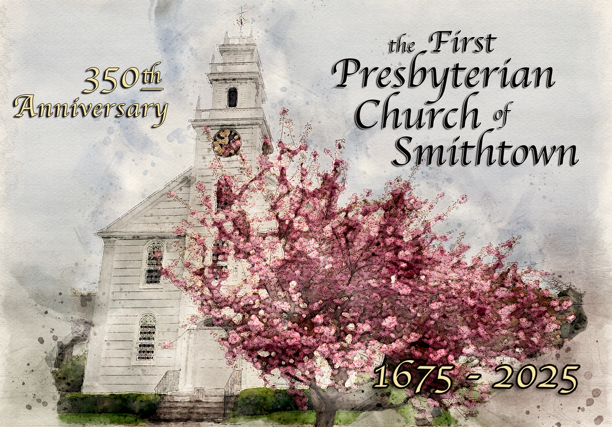
As we remember our church’s history for our 350th anniversary this year, recalling stories from our congregation’s early days, I have to say that my experience in ministry has been both similar and different from the pastors who have come before me. I feel very grateful for them because I know I would not be here—and nor would you—if it weren’t for the 33 installed pastors who came before me.
I encourage you now to consider the legacy of our church. What will it be, centuries from now? How will our faith and service be remembered by our community?
If I am remembered, I hope that my flock will recall my love for the children. And that there was always joy when we baptized.
I have some connections with Hartt’s experiences. I served as a schoolteacher and writer, though never a doctor or frontier land surveyor. And I never found a rattlesnake in my blankets! My family has always been important to me, as I am sure that Reverend Hartt’s wife and 10 children were important to him. Like Hartt, I graduated from Princeton. But I don’t give fiery, political sermons. And I have never been shot at in the pulpit or gone to jail for my preaching. Not yet.
It gives me a good feeling to consider that Hartt and all the pastors going back to that little meeting house have all shared messages from the same Holy Scriptures and proclaimed the same gospel of salvation by grace through faith, a gift from God.
May the Spirit help us to do God’s will in the future, with the bravery of Rev. Hartt and dreams and visions like Paul’s to guide and sustain us along the way.
May our love lead us to hold one another’s hands as traveling companions on this journey, like Saul when he was blinded by the light.
And may we bear witness to all the world to what we have seen and heard.
Will you pray with me?
Let us pray.
Gracious and Loving God, thank you for our congregation’s leaders for the last 350 years, such as Joshua Hartt, and for all the faithful who gathered for worship and to be equipped for service in the little meeting house and in this beautiful place. Thank you that we continue to baptize, as Paul was baptized, and Your Son, our Savior was baptized for our sakes. Thank you for your Spirit that continues to claim our children, such as Saylor, in their baptisms and empower them and us to do your will. With your help, dear Lord, may we bear witness to the world to all that you teach us in your Word and from our ancestors’ stories and our own stories. May we be moved to speak of all that we have seen and heard. In Christ’s name we pray. Amen.
[1] Richard Mehalick, Church and Community: 1675-1975, A History of the First Presbyterian Church of Smithtown (NY), 66.
[2] George Wallace, “He Preached His Way into Prison,” The Northport Journal, (March 16, 1995), 20.
[3] George Wallace, “He Preached His Way into Prison,”20.
[4] Richard Mehalick, Church and Community, 66.
[5] George Wallace, “He Preached His Way into Prison,” 20.
[6] Richard Mehalick, Church and Community, 66.
[7] George Wallace, “He Preached His Way into Prison,” 20.
[8] Richard Mehalick, Church and Community, 67.
[9] Evelyn Briggs Baldwin, The New York Genealogical and Biographical Society (New York, NY, April 1911),129.
 Sharing God's Love and Grace