
Meditation on Matthew 24:36-44
First Presbyterian Church of Smithtown
First Sunday of Advent
Pastor Karen Crawford
Nov. 30, 2025

Jim and I recently returned from a trip to Ireland. Many times, over the years, I had heard him talk about his Irish relatives and the farm where his mother had grown up. Both of Jim’s parents were immigrants from Northern Ireland in the early 20th century. His father was from County Antrim, his mother, County Down. Jim had traveled to Ireland to meet his family with his parents in the 1960s and then 30 years later, after they had passed. We both felt it was time to go back.
Jim reached out to his cousin George Heaney, who lives not far from Belfast, in Ballyclare, County Antrim. George immediately responded, graciously inviting us to stay with him and his wife, Karen, in their home, with a visit to George’s childhood home in County Down near the Mourne Mountains, which was also not far from the farmhouse where Jim’s mother and George’s father had grown up, with their other siblings.



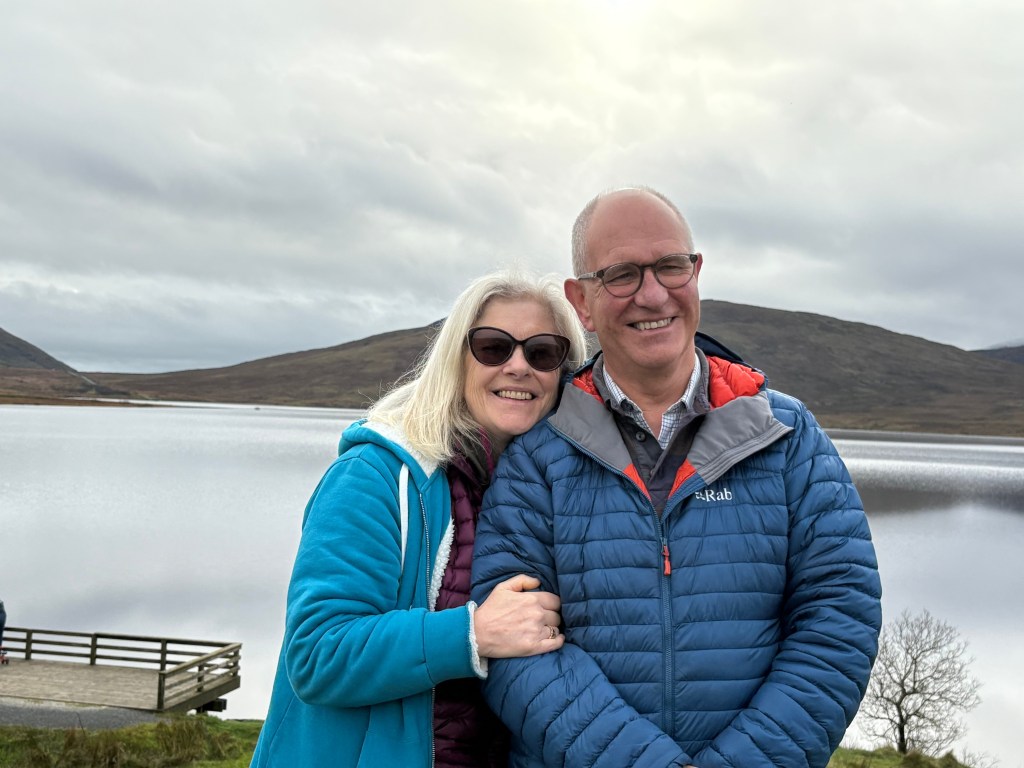
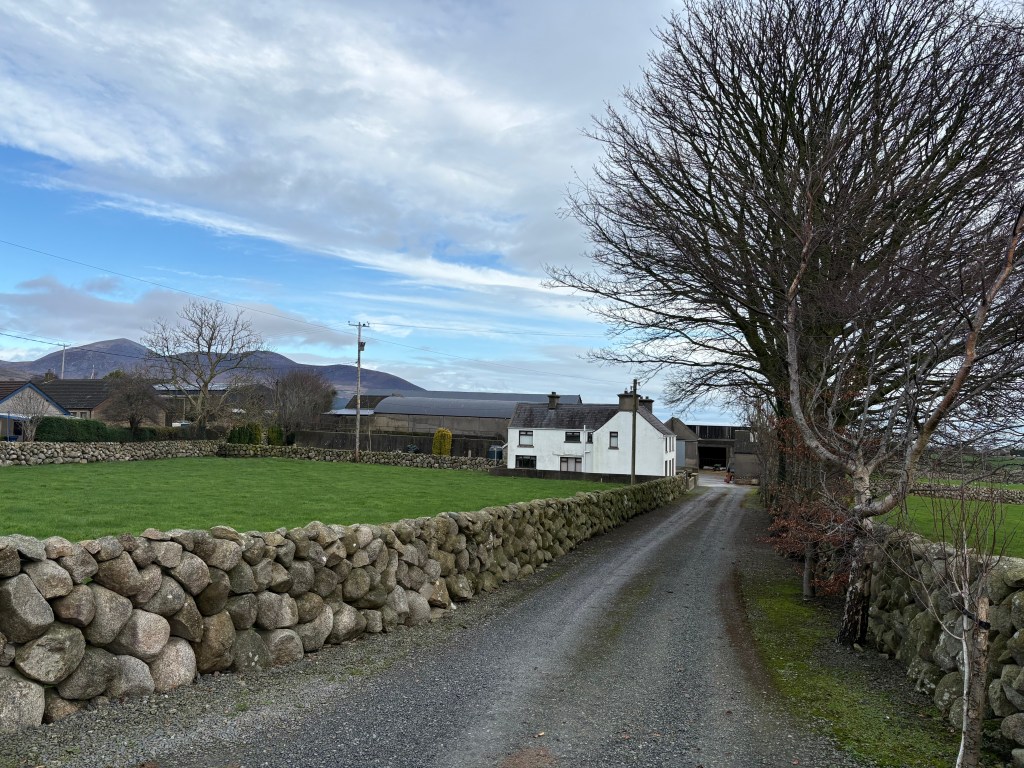


The trip would include a reunion of the Heaney family living in the area. We met in a small hotel in the nearby fishing village of Kilkeel. Jim and I were seated in the middle of a long banquet table. George gave a speech, welcoming all the cousins and their families, those who were able to come. It was the first time the group had ever gotten together in one place, though they all lived, except for George and his brother Roland, in the same rural area. It took two relatives coming from America, George said, to bring the family together. After dinner, Jim and I pulled up chairs to visit with people at the far ends of the table. Somehow, I ended up by myself with the mostly male farmers at one end, while he was with other relatives at the opposite end, including George’s younger brother Roland, a church planter in the Irish republic, and his wife, Susan.
It turns out, sheep farmers in Ireland aren’t that talkative. At least, they weren’t with me, not at first. I tried to think of something to say to break the ice. I could only think to talk about the weather, as people in Ireland often do. It had rained every day of our visit, with the sun only occasionally peeking through the clouds for a few minutes or, if we were lucky, a few hours.
“Do you ever get tired of the rain?” I asked. The farmers burst out laughing, as if I had made a joke. “YES!” they said.
The night of the reunion was the beginning of a warm conversation with folks who live without the technology we take for granted. Most of these farmers don’t have computers, internet, or cell phones. They don’t know each other’s mailing addresses, which came as a surprise to us! They don’t have to. They know where each other lives. If they want to talk with each other, they can pick up a landline phone or go to the other’s home.
They were curious about our family and, yes, American politics. They were curious about me, first because I am Jim’s wife and then because they learned that I am a Presbyterian pastor. In Ireland, few pastors are women, especially in the Presbyterian Church. At the end of the evening, we gathered for group photos, and then came the hugs, some of which were so hard they nearly took my breath away. Cousin Elizabeth’s son, William, who had listened silently to my conversation with the other farmers, had tears in his eyes when he said how easy it was to get busy with his work, which he loved, and let the time go by—and not take time to do the things that really mattered, such as this visit with family. “We have to make the time,” he said, his voice shaking with emotion. He thanked us, again, for coming, as did the others. And we promised that we would write.
***
This getting busy with the day-to-day work of living, of which we both love and by which we can be consumed, is what this passage in Matthew is about. Jesus is trying to convey the urgency of preparing our hearts for his return, without having any idea when it will be. We must stay awake to spiritual realities and stay strong in faith, even while we go about the routine of everyday living. This is what Paul tells the church at Thessalonica in his letter, which predates Matthew’s gospel. Paul says that Christ’s followers must aspire to live quietly, minding their own affairs, working with their hands, behaving properly with outsiders, and being dependent on no one, because there may be a long wait for the Lord. The Early Church assumed that Christ’s return would be sooner rather than later, and they were beginning to lose hope when years begin to pass without the promise being fulfilled. Paul offers this vision of Christ’s return:
“But we do not want you to be uninformed, brothers and sisters, about those who have died, so that you may not grieve as others do who have no hope.For since we believe that Jesus died and rose again, even so, through Jesus, God will bring with him those who have died.For this we declare to you by the word of the Lord, that we who are alive, who are left until the coming of the Lord, will by no means precede those who have died.For the Lord himself, with a cry of command, with the archangel’s call and with the sound of God’s trumpet, will descend from heaven, and the dead in Christ will rise first. Then we who are alive, who are left, will be caught up in the clouds together with them to meet the Lord in the air, and so we will be with the Lord forever. Therefore encourage one another with these words.” (I Thess. 4:13-18)
It is interesting to consider the context in which Matthew’s gospel was written—after 70 CE and before 107 CE. Theologian Anna Case-Winters say this was during a time when “there was conflict and division in the community of faith; when some were insiders and others were outsiders; when political and religious leaders were coopted, mistrusted, and discredited; when the great majority of the common people were without power; when cultures clashed.”[1] Jesus tells his followers, who keep pressing him for details, that when he comes again, it will be unexpected. Only God will know. Earlier in this chapter, Jesus speaks of the suffering of the community of faith leading up to his return—suffering from within and without. “There will be ‘wars and rumors of wars’ (24:6). Hatred and persecution from ‘all the nations’ will put them at risk of torture and death. In their own faith communities, there will be those who betray one another or are led astray by false prophets. Their love for the Lord and (the Torah) will ‘grow cold.’”[2]
Christ gives four examples of what his return will be like. The first one is from the Bible. It will be like the time of Noah. He built the ark for his family and some animals to escape the flood that was to come. His neighbors had no idea this was going to happen. They were busy eating, drinking, marrying, and giving their children in marriage when the waters suddenly came and swept them away.
The next three examples are from the time and place in which Jesus and his disciples lived. These provide a window into daily life in his agricultural society. The first two remind me of the popular and controversial Left Behind series by Tim LaHaye and Jerry Jenkins of the 1990s. Two are working in the fields. One is taken, the other left. Two women will be grinding meal together. One will be taken, the other left.
Keep awake, Jesus tells his disciples. Keep awake because you won’t know when I am coming back.
The final example is the most intriguing to me. Jesus compares himself to a thief in the night. His society, like ours, knew well the habits of burglars. If the homeowner knew the thief was coming, he would have stayed up and prevented the thief from entering. But how can one stay awake all the time, just in case a thief will come?
The point is that we will never know when he is coming back—until he has come. Friends, let us not worry about the timing, but focus, instead on making sure our hearts and minds are in the right place, so that we are doing the things that really matter, as William, our Irish relative said so emphatically when we said our goodbyes.
Let us encourage one another to do the things that the Lord wants us to do—engaging in acts of kindness, love, and generosity—throughout Advent, and especially on this day when we light the candle of hope. For this is how we live into hope—we stay in prayer and keep on doing what the Lord calls us to do, so that when he comes unexpectedly, he will find us faithful.
The most touching goodbye of the reunion was when one of the women, after William had spoken to us, had tears in her eyes as she held my hands. She looked deeply into my face and said with confidence and longing, which reminded me of the confidence and longing of Christ’s followers as we wait in hope for the Lord’s promise to be fulfilled.
“You will come back,” she said, warmly, squeezing my hand as if we were sharing an intimate secret. “I know you will come, again.”
Let us pray.
Faithful, gracious God, thank you for your Son’s promises to us—his promise to be with us always, even to the end of the age, and his promise to come back at a time when we won’t expect him. We trust you, Lord, for this mystery. But Lord, teach us what it means to keep awake, for how can we be awake and ready when you come like a thief in the night? Stir our hearts and minds to be focused on spiritual things and doing the things that really matter throughout this season of Advent and Christmas, and the new year to come. Don’t let us take any steps on a wrong path or go astray. Keep us walking in your will with hope and confidence, shining the light of Christ through our acts of kindness and generosity. May we long for you as we long for the ones we love in this world when we are apart. In the name of Emmanuel, God with us, we pray. Amen.
[1]Anna Case-Winters, Matthew from Belief: A Theological Commentary on the Bible (Louisville: Westminster John Knox, 2015), 1-2.
 Sharing God's Love and Grace