
Meditation on Luke 2:1-20 (KJV)
Rev. Dr. Karen Crawford
First Presbyterian Church of Smithtown
Dec. 24, 2025
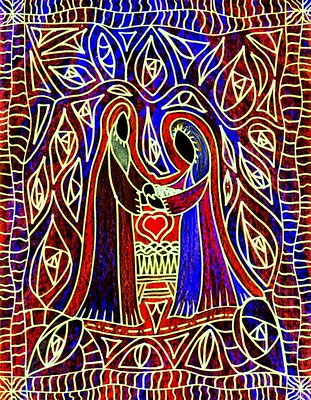
When I was growing up, I always enjoyed setting up my mother’s porcelain nativity scene or creche, as she called it. I carefully unwrapped each figure from its protective tissue— Mary and Joseph, the Baby, the wise men, shepherds, and angels, and a variety of animals—camels, donkeys, cattle, and lambs. One by one, I placed them on a bed of cotton, creating a scene that told the story that I envisioned from the Bible, and from Christmas cards and light displays in front yards, churches and shopping malls.
My older brother would sometimes frustrate me by changing the positions of the figures. One year, he placed the Baby in the center and all the other figures surrounding him in circles. He was less concerned, I think now, about what the scene looked like and more concerned that everyone who had come seeking the Child would be able to gaze upon him with nothing to obstruct their view. Now that I am grown, I have come to understand that his scene reflected his own perspective and interpretation of the story—what he believed.
And this is what the Lord desires for each of us, dear friends, that we see ourselves in the story of Christ’s birth! May it not just be an intellectual exercise but rather a work of the heart. Martin Luther in the 16th century says, “We must both read and meditate upon the Nativity. If the meditation does not reach the heart, we shall sense no sweetness, nor shall we know what solace for humankind lies in this contemplation.”[1]
The story begins with Mary, a vulnerable young woman, who is terrified when visited by the angel Gabriel, whose name means “Power.” He “was commander in chief of the heavenly host, the keeper of the sword, the marshal of the divine Majesty,” says Luther in one of his Christmas Eve sermons. “A thousand angels were at his beck, and their radiance was more dazzling than a hundred suns. If angels were to speak to us in the majesty they enjoy in the presence of God, we could not endure the sight.”[2]
The lowly shepherds, outside working in the rural countryside all night, are fighting to stay awake and stay alive to protect the flocks when they are visited by angels. They, like Mary, are terrified at the visitation, not only because angels are powerful and scary, but because they are living in a time of Roman oppression and violence. They live afraid to say anything against emperor or empire or the puppet leaders of their towns, cities, and villages. Those who do would be severely punished or disappear, never to be seen again.
Mary and Joseph go to Bethlehem, a small town of maybe 400 people now overflowing with travelers forced to come for the census. This census isn’t just a gathering of random demographic information; it has a dark purpose—to calculate the wealth of the people. It will undoubtably mean higher taxes and more oppression for the poor. The couple arrive on foot, exhausted after their long journey of 7 to 10 days, with no money, no house, no place to rest.
And then, it happens. It came to pass, while they were there, “the days were accomplished that she should be delivered.” Why on earth would God choose such a time and place for Mary to go into labor, without a midwife or female relative or friend to help her? And this is her first child. Luther estimates that she is between the ages of 13 and 15 years, although others say she could have been as young as 12—just a baby herself.
Luther says of the Nativity story, “God allows the godly to be powerless and oppressed so that everyone thinks they are done for, yet even in that very moment God is most powerfully present, though hidden and concealed. When the power of man fails, the power of God begins, provided faith is present and expectant.”[3]
Why didn’t anyone help them? Luther asks his flock. Shame on the town of Bethlehem! He goes on, “There are many of you in this congregation who think to yourselves: ‘If only I had been there! How quick I would have been to help the Baby! I would have washed his linen. How happy I would have been to go with the shepherds to see the Lord lying in the manger!’ Yes, you would! You say that because you know how great Christ is, but if you had been there at that time, you would have done no better than the people of Bethlehem.”[4]
Luther challenges his hearers to respond to the Christmas story with acts of compassion. “Why don’t you do it now?” he asks. “You have Christ in your neighbor. You ought to serve him, for what you do to your neighbor in need you do for the Lord Christ himself.”[5]
How are each of you are feeling tonight? There’s always a time, usually within a few days of Christmas, that I suddenly feel overwhelmed. Any of you feel that way tonight? That happened to me last night. My way back to peace and joy was to dig deeply into Luke’s gospel to what the real Christmas is all about—the story that happened thousands of years ago in Bethlehem and, in its hearing and contemplation, is still working in us, transforming our hearts and minds into the likeness of Christ. Sisters and brothers, you and I know that hope of Christmas isn’t connected with most of the busy stuff that we take on during this time of year that leads to our feeling overwhelmed.
Are you ready for the message of Christmas, according to Luke? Before I share it with you, will you promise that you will take it with you and share it with others? The good news has always been meant for all people, and with Luke, especially those who are poor and marginalized. As Jesus, in Luke 4:16-19, will quote Isaiah in his first sermon in Nazareth, “The Spirit of the Lord is upon me, because he has anointed me to bring good news to the poor. He has sent me to proclaim release to the captives and recovery of sight to the blind, to set free those who are oppressed, to proclaim the year of the Lord’s favor.”
The message of Christmas is Emmanuel—God with us. We are not alone here. A gracious and loving God has come to us as one of us—a baby in a feedbox. God in Christ is physically present with us.As John says, “And the Word became flesh and lived among us.”
Luke declares that the Son who came to us as a human being is Savior, Messiah, and Lord. Historian and Bible Scholar Justo Gonzalez urges us to think of Christ’s salvation not as an avoidance of eternal damnation but rather as “healing, liberation, freedom from the bondage of sin, and the promise of eternal life.”[6] “Messiah” or “Christ” in Greek means “Anointed One.” Luke believes that Jesus “is the one who will fulfill all the promises made to Abraham and his descendants, that he will restore the throne of David and do away with all oppression and injustice.”[7] The most radical title, yet, may be in calling him “the Lord.” This is the Greek translation of the sacred, unpronounceable name of God (Adonai or YHWH) in the Hebrew Bible. “Luke’s Savior and Messiah is not one more among the long line of saviors, liberators, and anointed ones whom Israel has known along its history; he is the Lord!”[8]
The message of Christmas is God’s perfect gift. Isaiah 9:6 says, “Unto us a child is born, a Son is given.” We don’t do anything for this gift. And we can’t do anything to make the Lord change God’s mind and take the gift back. But the gift of Christ is not just for humanity, in general—but for you and me. It’s both plural and particular. Luther says, “This is for us the hardest point, not so much to believe that He is the son of the Virgin and God himself, as to believe that this Son of God is ours.”[9] “Of what benefit would it be to me if Jesus would have been born a thousand times and it would have been sung daily in my ears that Jesus Christ was born but that I was never to hear that Jesus Christ was born for me?”[10]
Finally, the message of Christmas carries with it PEACE and JOY that cannot be taken away from us because their source is Christ. The joy of the Lord, Nehemiah 8:10 tells us, is our strength. The good news of great joy brought by the angel to the shepherds is, like the Gift, both plural and particular. The Greek word is second person plural (in the sense of y’all) but also dative, a case we don’t have in English. In Greek, it is used for things that come directly to another party. “So the announcement of the angel is not a generic, all-purpose bulletin. It is personalized. This good news is for you.”[11]
I still love my mom’s creche, which has come to live in my home. I have many other nativity scenes, too, collected over the years from cultures around the world, some of which I leave out all the time as a reminder of the message of Christmas. For Christmas isn’t just a day that we celebrate with gatherings, food, and presents. The gift of Christ and the work of spiritual transformation in our hearts, minds, and lives go on and on.
A favorite nativity of mine, which I keep in my church office, features Native American children dressed as Mary, Joseph, and the Babe, along with wise men, shepherds, angels, and a collection of animals, including dogs. When little Grayson and other children visit, they are often drawn to it and want to touch it. The stable is a porcelain teepee with a tea light candle that when lit, glows as if it is a comforting fire rising from the roof.
Each creche reminds me of the importance of every person, everywhere, being invited by the Lord to see themselves in the story of Christ’s birth, and to contemplate the meaning of it for their lives. My prayer is that you will share the message of Christmas with a world that so desperately needs to hear it. Share it through your words and compassion. For whatever we do to help a neighbor in need, we are serving the Lord.
Let the words of angels ring in your ears as we sing Joy to the World and walk out into the darkness: “Fear not; for behold, I bring you good tidings of great joy, which shall be to all people. For unto you is born this day in the city of David a Savior, which is Christ the Lord.”
This good news is for YOU!
Let us pray.
Holy God, thank you for coming to us as one of us, a child in a manger, who has promised to come again, not as a helpless babe, but as the King of kings, Lord of lords and Prince of Peace to bring the fulfillment of the angel’s announcement. Emmanuel, help us to feel your loving presence with us always—in the happy times and in the painful times, as well. Remind us that the message of Christmas isn’t just for humanity, in general, but for us in particular. May we be filled with gratitude for the perfect gift of your Son, our Messiah, Savior, and Lord, and be stirred to serve you through our words and acts of compassion for neighbors in need. In the name of Emmanual we pray. Amen.
[1] Martin Luther, Martin Luther’s Christmas Book (Kindle Edition).
[2] Martin Luther, Martin Luther’s Christmas Book. Kindle edition. “Annunciation” sermon.
[3] Martin Luther, Martin Luther’s Christmas Book. Kindle edition. “Visitation” sermon.
[4] Martin Luther, Martin Luther’s Christmas Book. Kindle edition. “Nativity” sermon.
[5] Martin Luther, Martin Luther’s Christmas Book. Kindle edition. “Nativity” sermon.
[6] Justo Gonzalez, Luke, from Belief: A Theological Commentary on the Bible series (Louisville: Westminster John Knox, 2010 ), 36.
[9] Martin Luther, Martin Luther’s Christmas Book, Kindle Edition.
[10] Roger Nelson, “God in the Particular,” The Nativity of the Lord, The Christian Century, Dec. 19, 2025.
 Sharing God's Love and Grace