Meditation for Ash Wednesday
Rev. Dr. Karen Crawford
First Presbyterian Church of Smithtown
Feb. 18, 2026
Yesterday, I was feeling especially grateful and the Lord brought one of my seminary professors to mind. I had seen the announcement of his retirement. But I wondered what became of him. I haven’t seen him since my graduation in spring 2010, when I had an attack of the nerves and Professor Paul Rorem told me to hold my head up high as I accepted my degree. Even as I was finishing an extremely difficult program of study, something in my heart told me that I didn’t deserve the honor.
I didn’t really fit in at Princeton, mainly because I was older than most of the M.Div. students and had had two careers before hearing the call to go to seminary and pursue ordination. But I had Professor Rorem as my Christian history teacher that first semester, and, though it was a huge class of maybe 50 students in a lecture hall, I saw his kindness right away. During our first exam, when we were furiously writing in those little blue books, he read the tension in the room and spoke gently to us, reminding us that God was with us. He said, “You are not alone.”
He made such an impression on me that I signed up for another history class with him the next semester—Women Leaders of the Medieval Church. In June 2021, when he was retiring after nearly 3 decades of teaching, he said of this class and his interest, when most historians and theologians were talking about “dead white men,” “There were dozens of women in the early and medieval church who were clearly leaders, whether preachers, theologians, or authors, whose stories need to be known and lifted up,” he said. “It’s a happy surprise for students when they see how many women were recognized for their writing and influence at that time, and the struggles and barriers that had to be negotiated.”[1]
After finishing his Medieval Women Leaders of the Church and doing a project on Julian of Norwich, I was determined to dig deeper into the 14th century writings of this anonymous anchoress. Professor Rorem invited me to come and serve as a teaching assistant in his Medieval Women Leaders of the Church in the final semester of my senior year and do an independent study of Julian. I led small groups and presented my findings about the two manuscripts, and I told her story with a lecture and slide presentation.
Professor Rorem saw something in me that I didn’t see. He wrote a recommendation for me to pursue Ph.D. studies, but at the same time, he talked me out of it. I still remember what he said to me that day in the dining hall, where he often met with students, talking about coursework and their future plans. It was a hard conversation when he told me that I had gifts for ministry. And that it would be a loss to the church if I pursued an academic career. Sure, you can get your Ph.D., he said. But it will take at least 5 years and that’s 5 years the church wouldn’t have you. He told me to finish the biblical languages requirement (I needed to take Hebrew) and the ordination exams. He told me to become a solo pastor of a small church, like he did, so that I would have time for writing and study. He said Presbyterians valued an educated clergy. He told me to pursue a Doctor of Ministry degree. I had forgotten that detail!
I didn’t want to hear this at the time. I just wanted to continue my writing, studying, and teaching because that was comfortable for me. I couldn’t imagine serving as a minister in a church. This was even after hearing the call to parish ministry in a life-altering experience as a state park chaplain in the summer of 2007.
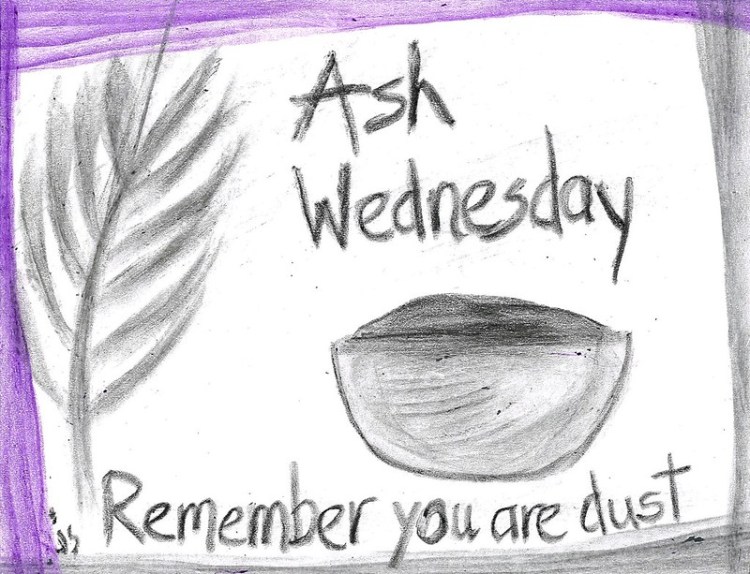
Today, on Ash Wednesday, we wear the ash as a sign of our frailty and mortality. God made us from the dust of the earth and someday our bodies will return to the dust. It is a humbling beginning to the Lenten season, which is right where our hearts and minds need to be.
Today, we are reminded of our great need for God’s mercy and forgiveness.
At the same time, we are reminded what our loving and gracious Lord can do with dust infused with God’s own breath. And how surprising resilient dust really is. Anyone who has ever dusted a table full of knickknacks and come back in a few days to find the dust has returned, knows how ever-present dust is in our lives. You can’t get rid of it no matter who hard you to try. So don’t bother dusting; it’s a waste of time. And you know how easily dust can be molded into different shapes, depending on the artist’s hands and the form or mold into which the dust or soil or clay is pressed and held until the work of art is ready. The prophet Isaiah speaks in 64:8, “Yet, O Lord, you are our Father; we are the clay, and you are our potter; we are all the work of your hand.”
The Artist, my friends, is still at work in we who are dust, and won’t stop until we are everything the Lord wants us to be so we can do the labor of Christ’s ministry. As Paul says in his letter to the Philippians, in 1:6, “And being confident of this, He who created or began a good work in you will carry it to completion on the day of Jesus Christ (when Christ returns).” What I am trying to tell you is that we aren’t just ordinary dust to be swept off with a dirty cloth. We are created by God and being recreated in Christ this very moment and till the end of time. We are dust with a sacred purpose and secret ingredient, as we are infused with the power of the Spirit of God. We are Holy Dust.
Paul is speaking with the church about his many trials, suffering, and persecution in his second letter to the Corinthians. His suffering is because of his call to serve Christ and because this conflicts with the cult of the goddess, Diana, in the city of Ephesus. His preaching causes a major economic and religious uproar. Gods made by human hands are idols, Paul says, and this is what the silversmiths are selling—statues of Diana—and making large profits. The apostle writes Second Corinthians in response to brutal verbal attacks by the Corinthians. In short, the church no longer trusts and respects him as their spiritual leader after what happened in Ephesus.
But Paul won’t give up on them. He writes of the need for forgiveness. He says in chapter 4, that we have a “treasure in clay pots, so that the extraordinary quality of the power may belong to God, not to us. We are under all kinds of pressure, but we are not crushed completely; we are at a loss, but not at our wit’s end; we are persecuted but not abandoned; we are cast down but not destroyed. We always carry the deadness of Jesus about in the body, so that the life of Jesus may be revealed in our body… revealed in our mortal humanity.” In chapter 5, we find that beautiful assurance, “For we know that if our earthly house, our present tent, is destroyed, we have a building from God, a house no human hands have built: it is everlasting in the heavenly places.” And that “in Christ, we are a new creation. Old things have gone and look, everything has become new.”
Paul, in our passage in chapter 6, lists the qualities that are necessary for the call to Christ’s ministry of reconciliation, qualities such as patience, endurance, kindness, and genuine love, qualities that the Corinthian church is not demonstrating with Paul or one another. And yet, this letter is kept and read in churches for hundreds of years and becomes a part of the canon of our Bible. We can only assume that the Corinthian church, at least some of Christ’s followers there, heard what Paul was saying and had a change of heart, a spiritual transformation.
I am thinking that maybe it is time to write Professor Rorem, whose kindness and encouragement pointed me onto the right path, even though it wasn’t what I thought I wanted at the time. That path brought me here to worship and serve the Lord with you today. I don’t know exactly what I will say in my letter to Professor Rorem, but I know that it’s time to say thank you, especially during this season of Lent, when we are humbled and brought to gratefulness for all that God has done through the suffering and sacrifice of the Son.
Some of you are carrying heavy burdens tonight, burdens that the Lord wants to take from you. Some of you need healing. You may be struggling with grief and loss, with family problems, work problems, or a health diagnosis for yourself or a loved one. Some have other worries distressing you. Some may be struggling with depression. I am here to encourage you, like others have encouraged me, and assure you that your Potter hasn’t forgotten you. God is still with you. You are firmly grasped by the Master’s hands. You are clay being molded into the shape that God will use for God’s own mysterious purposes. The One who began a good work in you will be faithful to complete it. Just wait and see. You are not what you used to be. In Christ, you are a new creation. You, my friend, are Holy Dust.
Let us pray. Holy God, thank you for creating us from the dust and breathing life into us. Thank you for being the Potter who is molding us, your clay, into what you can use for your mysterious purposes. Thank you for your grace and mercy, forgiving us for all our sins, and for holding us safely in the grasp of your loving hand, now and forevermore. Blow your Spirit into us, once more, dear Lord, and lead us to the right paths. Heal and give peace to those who are suffering. Stir us to demonstrate the qualities necessary for followers of your Risen Son, qualities such as patience, endurance, kindness, and genuine love. Amen.
[1] Alumni News, Princeton Theological Seminary, accessed Feb. 18, 2026, at https://ptsem.edu/about/the-quad/news/news-professor-paul-rorem-retires/
 Sharing God's Love and Grace