Meditation on Genesis 37:1-11 for First Sunday in Lent
First Presbyterian Church of Smithtown
Rev. Dr. Karen E. Crawford
Feb. 22, 2026
Yesterday was a beautiful day. Did anyone get out for a walk? If I didn’t know better, I might think that spring is right around the corner. I heard the cardinals singing, “Cheer, cheer, cheer,” and the tufted titmice scolding, as if I had come too close to a nest. Would you believe that the daffodils are coming up from the ground, under the snow?
But on the way back from my walk, dark clouds were rolling in. A chill was in the air. The weather was about to change.
And this is how it is with the beginning of the Joseph story.
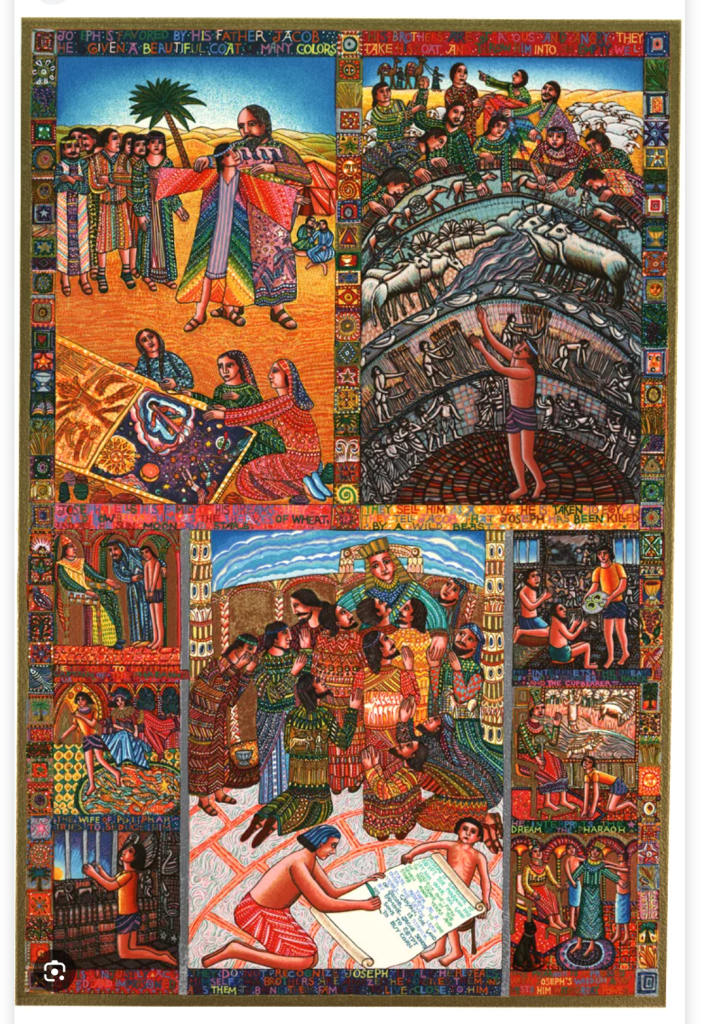
All is well with the 17-year-old favored son, the handsome one, who probably had his mother’s good looks. He is wearing the coat of many colors, the tunic with luxurious long sleeves that his father made for him! He didn’t make one for his other 11 sons.
The Joseph story extends from Genesis 37 to 50 and is the only one in the Bible considered a “novella.” It stands well on its own, and with the dramatic ups and downs and twists and turns of the plot, and well-developed characters, the Joseph story may be one of the best-known Old Testament stories in America.
It helps that the Joseph story was the one a 17-year-old Andrew Lloyd Weber chose to tell in the 1960s when he was commissioned by a prep school in London to write a Bible story set to pop music that the whole school could perform, no matter their musical ability. A 20-year-old Tim Rice offered his services as a songwriter.
The very first performance of Joseph and the Amazing Technicolor Dreamcoat took place on March 1, 1968, to an audience of 200 parents. Short and sweet at only 22 minutes, the show was embraced by the school, especially because of Rice’s clever lyrics alongside an Elvis-inspired performance of Pharaoh. Lloyd Weber and Rice brought Joseph to the stage again two months later at the Methodist Central Hall in Westminster; the audience was 10 times the size of the first. Amateur stage productions came to the U.S. in 1970. Joseph’s professional debut wasn’t until 1972 in Edinburgh. The Bible story was brought to the West End of London in 1973 with Gary Bond in the starring role. Joseph came to Broadway in 1982. Did anyone see it on Broadway?
The thing is the musical didn’t tell the whole story. There’s so much more to know about Joseph and how the Lord was able to use what human beings intended for evil as something good for many people. Joseph’s suffering and pain led to the saving of many lives, including his own family. But it took many years for the story to unfold.
My hope for this series is that you would come to know Joseph more and connect with his, and his family’s story in your life. May we all grow closer to the God whom Joseph knew, and may we find help and hope for the pain and brokenness in relationships that we human beings struggle with today. For Joseph’s is a story of love and hate, lies and deceit, grief and loss, hunger and famine, hope and despair, good and evil, birth and death, life and resurrection, forgiveness and reconciliation.
To understand who Joseph really was, you have to know something about his family history. Anyone here working on their family genealogy? My father spent decades researching our family tree. I think it helped him to know his parents and extended family better and his role, how he fit, in the family story. I think it made him feel more connected to a wider community, as my mom and dad, as he worked on the genealogy, used to travel around the world to meet newly discovered relatives, share stories, and swap family photos.
I would like to share some of Joseph’s family tree so you can see how he fits into his family and what role he plays in the family story. In Joseph’s time and culture, family was even more important than it is today. It was common for blood relatives to marry each other.
Joseph’s family was no exception. Joseph is the first child of Jacob’s beloved wife, Rachel, who was a relative of Jacob’s mother. Rachel’s father, Laban, was also Jacob’s uncle—his mother, Rebekah’s younger brother. Yes, Jacob and Rachel were first cousins!
Jacob didn’t plan it this way, but he had more than one wife at the same time. He had also married Rachel’s older sister, Leah, by accident. Men, can you imagine having two wives, and they are sisters? Genesis tells us that Jacob met Rachel first, at a well. She was a shepherdess. Her sister, Leah, had “weak eyes,” and Rachel was “shapely and beautiful.” Jacob fell madly in love with Rachel and agreed to serve her father Laban for 7 years, if Laban permitted him to marry Rachel.
Well, Jacob served seven years for Rachel, and “they seemed to him but a few days because of his love for her.” “Then Jacob said to Uncle Laban, ‘Give me my wife, for my time is fulfilled, that I may live with her.’ This is how they got married. Laban gathered all the people of the place and made a feast. When evening came, he took his daughter Leah and brought her to him; and he slept with her, thinking she was Rachel. When morning came, there was Leah! “What have you done to me?” Jacob cried. “I was in your service for Rachel! Why did you deceive me?’”
Laban had a lame sort of answer, saying it wasn’t the custom to give the younger daughter in marriage until the older daughter was married. If Jacob wanted Rachel, he could have her in a week—after the honeymoon with Leah—but he would have to work for his uncle 7 more years, which Jacob did.
But Rachel was barren for a long time, and this made her miserable. A woman’s purpose and worth as a wife was directly related to her bearing children. Leah was not barren. The explanation for Leah’s having many children while Rachel could not was that “The Lord saw that Leah was unloved and he opened her womb.”
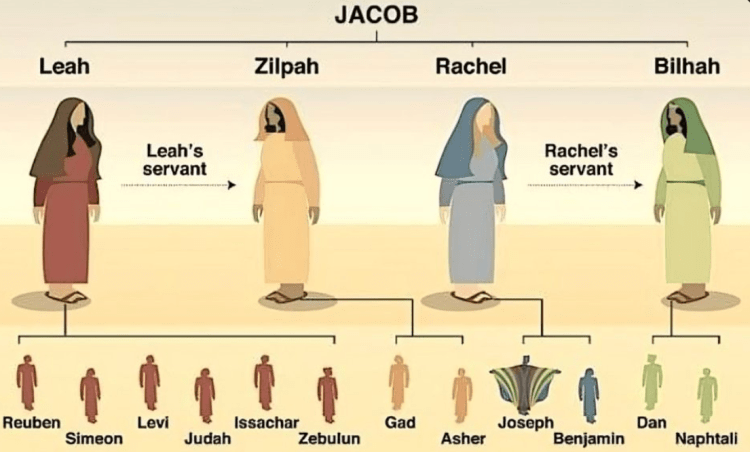
Leah gave Jacob six sons: Reuben, Simeon, Levi, Judah, Issachar, and Zebulun. She also gave birth to a daughter, Dinah. This is the only girl in the family. She gave her slave, Zilpah, to Jacob, so she could have more sons through her: Gad and Asher. Rachel’s slave, Bilhah, also gave Jacob two sons: Dan and Naphtali. (By the way, Bilhah and Zilpah were sisters, too.)
God finally “remembers” Rachel in Gen. 30:22-23 and removes her “disgrace.” She gives birth to Joseph. His birth stirs Jacob to decide to take his family back home to his parents, Isaac and Rebekah, who were aging. He had run away years before because he was afraid of his older twin brother, Esau, who had threatened to kill him because Jacob had stolen the father’s birthright. On the journey home to Ephrath, now Bethlehem, and shortly after an angel of the Lord wrestles with Jacob and gives him his new name, ISRAEL, Rachel goes into hard labor. She gives birth to her second son, Benjamin, in Gen. 35, and breathes her last.
So these are the 12 tribes of Israel (Jacob’s sons through Leah and her slave, Zilpah, and Rachel, and her slave, Bilhah): Reuben, Simeon, Levi, Judah, Issachar, and Zebulun; Gad and Asher; Dan and Naphtali; and Joseph and his younger brother, Benjamin.
And now you know why Jacob loved Joseph so much—not just because he was the child of his old age, but because he was the first son of the love of his life—Rachel, for whom he had waited for 7 years and worked for the deceitful Laban for 14. Rachel, who had died young while giving birth.
Friends, what happens when there is a favorite child in a family? The ones who are not the favorite get angry. They fight. That colorful tunic was like pouring oil on a fire. In Gen. 37:4, “when his brothers saw that their father loved (Joseph) more than any of his brothers, they hated him so much that they could not speak a friendly word to him.”
Joseph also had spiritual gifts the others did not possess. He was like his father, Jacob, who had a dream of angels going up and down a ladder when he was on the run from Esau, which was an assurance that heaven and earth were connected and that God was always with him, wherever he goes.
The Lord gives Joseph two dreams in this passage. Both are a window into the agricultural society in which Joseph lives. The one with the sun, moon, and stars stirs us to imagine Joseph and his brothers out with the flocks by day and night and the one with binding the sheeves of wheat help us imagine the acres of fields of crops that would be harvested, stored, ground, baked, and eaten by the community. Did you notice that Joseph doesn’t interpret his own dreams? But as soon as he tells them to his brothers, they seem to know exactly what they mean—that Joseph, a tattle tale who brings bad reports of them back to their father and who is a mere servant to the sons of the slave sisters, Zilpah and Bilhah—will rise above them all.
And there’s a chill in the air when we read, “And they hated him even more for his dreams and his words.”
His brothers are jealous of Joseph.
But their father can’t stop thinking about what he said.
Let us pray.
Holy One, we read the stories of your people from long ago in Genesis and they seem like they could have happened yesterday. They feel so real to us. Thank you for your Word. Families are still complicated, although maybe not as complicated as Joseph’s. Families still have their struggles with grief and loss, health and death, and with broken dreams and broken relationships. Carry us by your Spirit through this Patriarch’s story, through all the highs and lows, beautiful days and terrible days. Through story, Lord, we ask that you would allow us to hear your voice. Build up our faith in our Lord who still speaks to us and walks with us but seems far away in difficult times. May you bring healing and wholeness during this season of Lent and beyond to whatever might be broken in our families, neighborhoods, and world. Amen.
Jacob/Israel’s family
Isaac’s parents were Abraham and Sarah.
Jacob’s parents were Isaac and Rebekah. Jacob’s twin brother was Esau.
Here are the four mothers of the 12 sons or “tribes” of Israel:
 Sharing God's Love and Grace