
Meditation on Genesis 37:12-36
First Presbyterian Church of Smithtown
Reverend Dr. Karen Crawford
Second Sunday in Lent
March 1, 2026
Who came to our women’s retreat here at the church yesterday? It was so nice, wasn’t it? Many thanks to the team of women who made it happen! And some of the men who helped us set up on Friday night.
When I was preparing for “Consider the Lilies: Finding Peace in Anxious Times,” I started thinking about how some people tend to be more anxious than others.
I shared with our group that I think I have been anxious my entire life. I can’t remember a day when I wasn’t anxious. My parents told me that even when I was a baby, my body was tense when they held me. Except I found a picture of my dad holding maybe 1-year-old me in his lap after my bath. I looked happy. I’ve always loved my baths! And I was holding my blue plastic whale. That made me happy, I’m sure.

By the end of Genesis 37, we know so much about Joseph and his father and brothers. We know how the family system operates. We notice how everyone in the family is worried about what their father, Jacob/Israel, will think of them. They are all hungry for his love and attention.
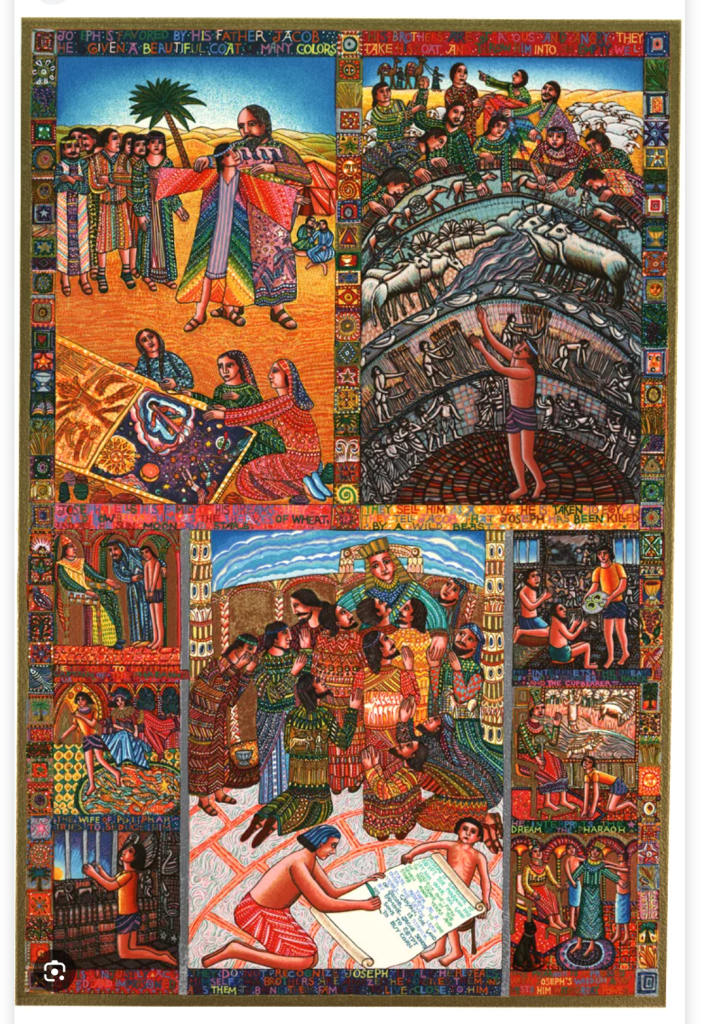
Today’s passage begins with Israel having an anxiety attack about his sons. He is worried that something has happened while they are out shepherding the family’s herds. He calls 17-year-old Joseph, the second to the youngest of 12 and the first child of Israel’s beloved wife, Rachel, who died giving birth to her second son, Benjamin. We haven’t met him, yet, but we will, and he will play a larger role later.
Israel asks Joseph in verse 13, “Are not your brothers pasturing the flock at Shechem? Come, I will send you to them.” Joseph answers, “Here I am.” This “Here I am,” is an echo of what Isaac says to Abraham in Genesis 22, when his father calls him to go up the holy mountain with him. On the mountain, Abraham will prepare to sacrifice his only son with Sarah, though he loves Isaac more than life itself. It is a test of faith. At the last minute, while Abraham is holding up the knife, God sends a ram, whose horns get caught in a nearby thicket. The ram becomes the sacrifice, in lieu of Isaac.
This “Here I am,” then, foreshadows immanent misfortune, but also Joseph’s own faithfulness to his father, Israel, and Israel’s God.
When Israel calls Joseph, the Hebrew tells more of the meaning than the English. He tells Joseph to go and check the shalom of his brothers. Shalom means peace, but also well-being, completeness, wholeness, welfare.
Shechem is an ancient city in what is now the West Bank and will be the first capital of the Northern Kingdom of Israel, and the place of the renewal of the covenant with God in Joshua 24. It is “blessed with an adequate water supply and fertile soil, and the city itself holds rich associations for Jacob and his family.”[1] This is where Jacob encamped “after returning from his long exile abroad, bought a plot of land, and set up an altar to the ‘God of Israel’ (33:18-20). Joseph’s remains were to be later interred in that very plot (Josh. 24:32).”[2]
However, Shechem had also “been the site of a bloody massacre carried out by the brothers, who had … captured the city (34)” after their sister, Dinah, daughter of Leah, went to visit the “daughters of the land” and was taken by force by the chief’s son, who was named Shechem. [3] The brothers rescued Dinah, killed Shechem and his father, the chief, “seized all the flocks, herds, and (donkeys), all that was inside the town and outside, all their wealth, all their children, and their wives, and all that was in the houses, they took as captives and booty.”
Are you wondering why Jacob would send his favorite son into such danger? Me, too. And why he would send Joseph off to be alone with his brothers in the wilderness, when they hated him so much?
Nahum Sarna, a Jewish scholar who edited the JPS Torah Commentary on Genesis, believes that “Jacob’s action is surprising and Joseph’s ready response no less so [and that] “clearly the brothers had … successfully disguised their true feelings and, indeed, there is no record of their having uttered any threats against Joseph.”[4]
Joseph’s journey to assess the shalom of his brothers meant a 50 mile walk from Hebron, where the family lived, to Shechem. Dothan was an ancient fortress town about 13 miles northwest of Shechem. The entire journey would have taken at least 5 days and he went alone.[5]
When Joseph’s brothers lay eyes on him, they are consumed with their hatred, which they no longer have to hide because their father isn’t there. “Here comes that dreamer!” they say. “Come now, let us kill him and throw him into one of the pits.” They rehearse the lie that they are going to tell.
But the oldest son, Reuben, whose mother was Leah, is the voice of reason and responsibility. He says, “Let us not take his life. Shed no blood!”
They throw him into a pit, a deep cistern carved out of rock used to gather and store water in the rainy season. “Dried out cisterns were occasionally used as temporary places of detention,”[6] and those committing murder would kill their victims near these pits and dispose of their bodies in them.
Reuben talks his brothers into throwing Joseph into the pit without killing him first. He is deceiving them, for he intends to go back to Joseph secretly and set him free.
Then the brothers all sit down to a meal, and they see a caravan of Ishmaelites go by and get a new idea. Maybe they can make some money and get rid of Joseph at the same time.
Remember how I said that everyone is related to everyone else in this story?
Well, the Ishmaelites who buy Joseph from his brother Judah are related to their great grandfather, Abraham, who had a child with his wife’s Egyptian maid, Hagar, before Sarah gave birth to Isaac, their grandfather. After Isaac is born, Sarah wants Hagar and her son, Ishmael, gone, so Abraham abandons the mother and child in the wilderness.
But God is with them. Ishmael, as Abraham’s son, is included in the promise of blessing of land and progeny. His descendants are the 12 princes who established tribes on the Arabian Peninsula. So, there are 12 tribes of Israel and 12 tribes of Ishmael. In the Islamic tradition, Ishmael is a patriarch and ancestor of the Prophet Muhammad.
Joseph is sold to a Midianite group of Ishmaelites, who came from the Northwestern Arabian Peninsula, primarily from what is now Saudi Arabia. He is sold for 20 pieces of silver.
I am wondering, at this point, if Judah will ever tell Reuben what really happened—that he persuaded the other brothers to sell him? Will Reuben tell his brothers that he was secretly planning to free him? Reuben, in the end, blames himself, as he is the eldest, for letting the situation get out of hand. When he sees the empty pit, he tears his clothes in grief and cries, “The boy is gone! Now what am I to do?”
They still have the ornamental tunic. They slaughter one of the young goats that they are supposed to be protecting in the herd. And they present the bloody, torn tunic to their father, who tears his clothes and mourns for many days, refusing to be comforted.
But the one whom Jacob presumes dead has been taken to Egypt and sold to Potiphar, a companion or advisor to Pharaoh in the royal court and his chief steward, which could mean that he is either a cook or “slaughterer, that is executioner.”[7]
Joseph is right where the Lord wants him to be.
At the retreat yesterday, some women shared how they saw God’s hand working in their lives during some of their most anxious times.
They told how the Lord used people in our church family to help them in their time of need—when God had them right where the Lord wanted them to be.
Let us pray.
Holy One, thank you for the story of Joseph and his brothers, which shows us how complicated and how human families have always been, and the difficulties that your people have persevered, with your help. We are amazed at the path Joseph took to get to Egypt, where he will eventually rise to power and be positioned to save many lives. But not without suffering and hardships to come and not without having a change of heart toward those who threw him in a pit and sold him into slavery. Help us, dear Lord, to persevere with the faith and strength of Joseph, who learned to trust in you and care for your people. Help us to see your hand in our lives during our anxious times. In Christ we pray. Amen.
[1] Nahum Sarna, Genesis, JPS Torah Commentary (Philadelphia: JPS, 1989), 258.
[2] Nahum Sarna, Genesis, 258.
[3] Sarna, Genesis, 258.
[4] Sarna, Genesis, 258.
[5] Sarna, Genesis, 258.
[6] Sarna, Genesis, 259.
[7] Sarna, Genesis, 263.
 Sharing God's Love and Grace