
Meditation on Genesis 39
Reverend Dr. Karen Crawford
First Presbyterian Church of Smithtown
March 8, 2026

I have been thinking about struggle lately. And the role of struggle in our lives and in our journeys of faith. It’s hard enough when we are amidst our personal struggles, but it can be even harder, at times, to watch someone else struggling and simply walk beside them, and hope and pray.
We can feel helpless when our loved ones, especially our children and grandchildren, are struggling. What do we want to do? We want to make everything better for them.
Sometimes, when we try to help someone whom we see struggling, we really need to pray about it, first. Because we aren’t always helping them. We may be robbing them of an opportunity to develop resilience.
Scripture tells us of the importance of struggle in our lives and how we need to learn to rely on the Lord for our strength. Isaiah 40:31 says, “But they who wait for the Lord shall renew their strength; they shall mount up with wings like eagles; they shall run and not be weary; they shall walk and not faint.” James 1:2-4 says, “Count it all joy, my brothers, when you meet trials of various kinds, for you know that the testing of your faith produces steadfastness. And let steadfastness have its full effect, that you may be perfect and complete, lacking in nothing.” Paul writes in Romans 5, “And we rejoice in our sufferings, knowing that suffering produces endurance, and endurance produces character, and character produces hope, and hope does not put us to shame, because God’s love has been poured into our hearts through the Holy Spirit who has been given to us.”
I stumbled on a fable this week about a little boy and a butterfly. Do you know the story? This is how it goes.
One day a little boy found a caterpillar and took him home to take care of him. He checked on the caterpillar every day and made sure he had plenty of leaves for food. Then the little boy noticed that the caterpillar was starting to spin its chrysalis. It was preparing for its metamorphosis. The little boy was so excited to see the butterfly that this caterpillar would become.

But first there would be a time of darkness, stillness, and rest before the big transformation.
After a couple weeks, he saw a small hole in the chrysalis. He noticed that the butterfly was struggling to get out of the chrysalis. When he saw the butterfly struggling so hard, he worried that it might not be able to free itself. He thought the butterfly needed his help.
He took scissors and cut the chrysalis to make the hole bigger. The butterfly emerged! But its body was swollen; the wings were small and shriveled. The little boy cried, “What happened?”
The struggle, it turns out, is necessary for a butterfly’s development. They “release a chemical when they’re getting out of their chrysalis that strengthens their wings. Their movements inside the chrysalis pump fluid into their wings, which help the wings expand. Their Houdini-like escape act helps them build the necessary muscles to do all things butterfly related.”[1]
In Genesis 39, 17-year-old Joseph has been cast into the pit by his brothers, then sold to his cousins, the Midianites, who will sell him into slavery when their caravan reaches Egypt. The Midianites are related to Joseph’s great uncle Ishmael, Abraham’s eldest son with his wife Sarah’s slave, Hagar. Through the life and trials of Joseph, the promise of God in Genesis 15:3 to his great grandfather, then still known as Abram, is beginning to be fulfilled: “Then the Lord said to Abram, “Know this for certain, that your offspring shall be aliens in a land that is not theirs and shall be slaves there, and they shall be oppressed for four hundred years.”
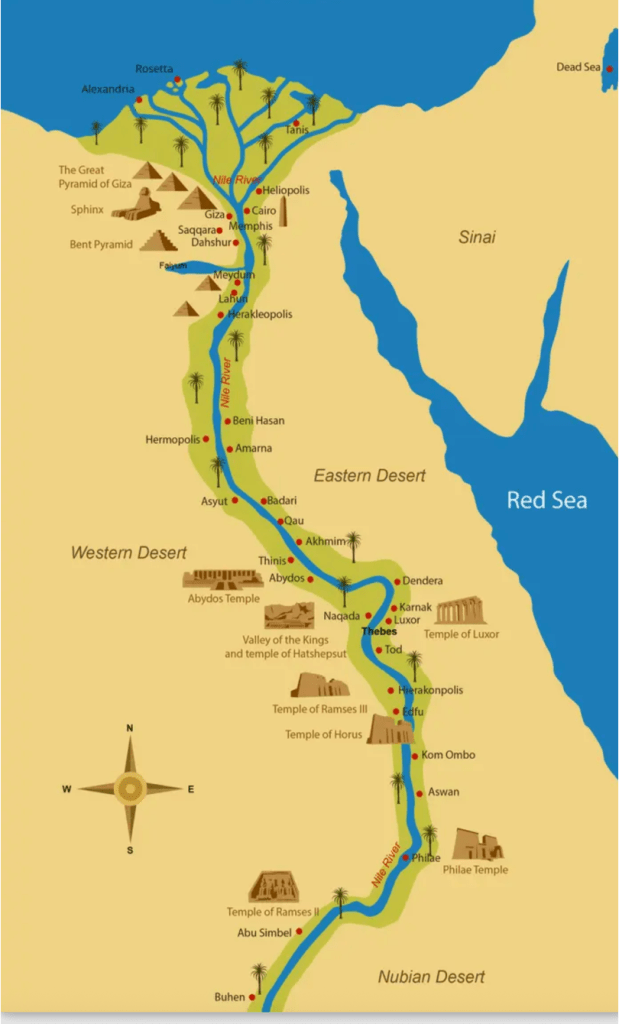
Joseph has been taken to Memphis, the ancient capital of Egypt, founded by the first Pharaoh on a floodplain of the western side of the Nile. Today, it’s about 12-15 miles south of modern day Cairo in the village of Mit Rahina.
In its golden age, it was a thriving regional center for commerce, trade, and religion, as well as the royal residence.
The city was thought to be under the protection of the god Ptah. The city is in ruins today,
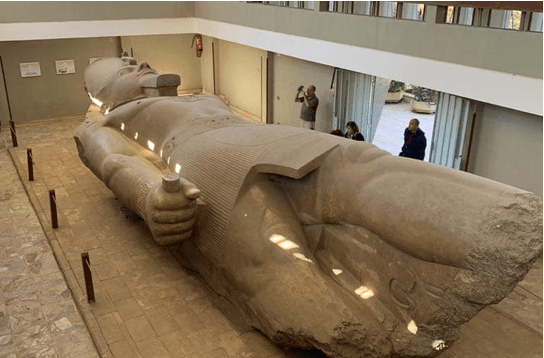
but its royal tombs and pyramids—the Memphis Necropolis—is a UNESCO world heritage site. What little has been discovered at Memphis is gathered in an open-air Museum in the village of Mit Rahina. The showpiece is a colossal limestone statue of Ramses II.
Joseph’s master is a man of high status and power, an adviser to Pharaoh in the royal court. Potiphar is chief steward and executioner, ready to act on Pharoah’s whims. And he takes a liking to Joseph. The young man flourishes, though he is a slave and has been forced to leave his identity, family, and former life behind. Don’t you wonder why he is able to bloom where he is planted? Because the Lord is with him.
This is the first time the Lord is mentioned in Joseph’s story. The word for Lord here is the unspoken proper name of the God of Israel—YHWH—and not the generic elohim. This divine name is used only in this chapter of Joseph’s story. The point is to “emphasize that the unfolding events in the odyssey of Joseph are key elements in God’s plan for Israel.”[2]
God being “with Joseph,” says Hebrew scholar Nahum Sarna, is the explanation for how a “spoiled lad of 17, utterly alone in a foreign land and in dire adversity, suddenly matures and acquires great strength of character. He can (and will) rise again and again in situations that would surely have crushed others.”[3] He is a “successful man.” “The Lord caused all that he did to prosper in his hands.”
Potiphar makes him his personal assistant, puts him in charge of the entire household. God, in the Lord’s mysterious ways, is moving Joseph into a position where he will be able to help more people. Unfortunately, Potiphar’s wife also likes Joseph and wants him. For Joseph is “handsome and goodlooking.” Notice that the wife isn’t named. She won’t be remembered by future generations—only that she was Potiphar’s wife. She takes hold of his garment and demands that he lie with her. Joseph runs for his life, leaving his clothing behind, not willing to betray the trust of his master or to sin before God!
Are you wondering how this young man has developed such a strong faith? The maturing of his faith and the formation of his character came from the struggle—first with his brothers, who threw him into a pit, and then as a slave, sold by his brothers and cousins, bought by an executioner.
No one witnesses Potiphar’s wife sexually harassing Joseph. It is a case of “he said, she said.” After all that Joseph has done to prove his trustworthiness and value to Potiphar, it means nothing because he is a slave. The wife manages to blame the incident on her husband, as well as Joseph, when she says, “The Hebrew servant, whom you have brought among us, came in to me to insult me,but as soon as I raised my voice and cried out, he left his garment beside me and fled outside.”
Potiphar is enraged and throws Joseph in jail. And get this, the prison is in his own house! Joseph is placed with other royal prisoners who have angered Pharoah. But the chief jailer recognizes Joseph’s gifts and entrusts him with the care of all the other prisoners. Why? Because the Lord is with Joseph, and whatever he does, the Lord makes it prosper.
Joseph’s father has no idea that all this is happening to his favorite son. His brothers have convinced their father that Joseph has been killed by a wild animal rather than admit the cruel things that they have done to him that has made him lost to his family forever. But if Jacob knew of Joseph’s situation, I am sure he would fight for Joseph’s rescue and release. He certainly wouldn’t have allowed his son to be sold into slavery or thrown into a deep pit. He would want to take all his pain and struggle away. But then the Lord would not be able to use Joseph for God’s wonderful plan—to save the lives of many people.
In the fable of the little boy and the butterfly, the butterfly was never able to fly. It could only crawl around with shriveled wings.
Dear ones, may you never be discouraged in times of struggle. The Lord your God is still with us and wants to help us in our metamorphosis from caterpillar to butterfly. Remember the butterfly and its shriveled wings. Don’t give up!
And now I will close with some famous quotes about resilience, before I pray.
“Our greatest weakness lies in giving up.
The most certain way to succeed is always to try just one more time.”
(Thomas Edison)
“Our greatest glory is not in never falling, but in rising every time we fall.”
(Confucius)
“Fall seven times, stand up eight.”
(Japanese Proverb)
“If you’re going through hell, keep going.”
(Winston Churchill)
“Only those who dare to fail greatly, can ever achieve greatly.”
(Robert F. Kennedy)
“Turn your wounds into wisdom.”
(Oprah Winfrey)
“I hope you never fear those mountains in the distance
Never settle for the path of least resistance.”
(Lee Ann Womack in “I Hope You Dance”)
Let us pray.
Holy God of Creation, you are our Lord, our God, and you are with us in every age. Thank you for your faithfulness to us, from generation to generation. Thank you that we can trust you as we seek you each day, sharing the load of our struggles and burdens with you. Help us, Lord, so that we never give up hope and that we keep on trying, no matter how often we fall or fail. Thank you that we can trust you to care for us and for all our loved ones. For you, O God who is Love, care for our families even more than we love them. Teach us, Lord, how to help people in ways that are truly helpful, that strengthen them in hope and body, mind, and soul as they continue their life’s journey and journeys of faith. Help us all in our metamorphosis from caterpillar to butterfly. In the name of Christ, Your Son, our Savior, we pray. Amen.
[1] https://rockpaperscissorsinc.com/what-we-can-learn-from-a-butterflys-struggle-to-escape-its-chrysalis/
[2] Nahum Sarna, The JPS Torah Commentary on Genesis (USA: Polebridge Press for the Jewish Publication Society, 1989), 271.
[3] Nahum Sarna, Genesis, 271.
 Sharing God's Love and Grace