
Meditation on Genesis 40-41, selected passages
Reverend Dr. Karen Crawford
First Presbyterian Church of Smithtown
March 15, 2026
Are any of you dreamers? Do you remember your dreams when you wake up?
I have had some vivid dreams in my life. I wouldn’t say that my dreams are a divine gift—or that I always even understand my dreams. But I can think of a few that may have had a deeper meaning for me.
When I was a young woman with small children, attending an evangelical church, I shared a puzzling dream that I had with an older Christian woman who had taken me under her wing. In the dream, the water was rising—and I was on some kind of higher ground, and I can still remember reaching forward to try and grasp the hands of people who were struggling under the water. I had a sense of urgency that I couldn’t stop reaching for them and pulling them out of the water. The woman told me that the water symbolized the Holy Spirit, and that through sharing my faith, I was reaching out to rescue those who were perishing. I didn’t sense any call to ministry at that point, and I sure didn’t see myself as an evangelist. I was a stay-at-home mother of three. But I did start a Bible study in my home for other mothers who were home with their children.
And I promptly forgot the dream, until recently, when I was thinking about Joseph and his dreams and his gift of interpretation. I think that the older woman, Krissy was her name, was right on the money. I was maybe 30 years old. It took a LONG time for any of that dream to become a reality.
Dreams feature prominently throughout the Joseph story, but it’s not until we reach chapter 41, which begins with Pharaoh’s dream, that we have a strong sense, finally, that the dreams of the handsome 17-year-old boy, with his coat of many colors, really are going to come true. As soon as we learn of Joseph’s ability to interpret the dreams of the cup bearer and the baker, for better and for worse, and that he is confident this ability has come from the Lord, we know that he is going to be the one who will interpret Pharoah’s dreams.
Notice how the dreams in Joseph often come in twos. In verse 32, Joseph says that having two dreams only confirm that the matter has been “determined by God, and that God will soon carry it out.” (JPS Torah Commentary) Joseph had two dreams with the same meaning in chapter 37. The cupbearer and baker both have dreams on the same night and Joseph, when he sees they are downcast, offers to help. He says to them, “Do not interpretations belong to God? Please tell them to me.”
We don’t know how long Joseph has been in prison by now. The passage starts, “After a while.” We get the feeling, though, that he may have been in the prison a long time! He may well have forgotten his own dreams of grandeur when he was a boy. He urges the cupbearer to remember him when all is well. “Please do me the kindness to make mention of me to Pharaoh and so get me out of this place.” This is the only time we hear him sharing his testimony in prison, saying that he was “stolen out of the land of the Hebrews,” and has done nothing to warrant being placed in a dungeon.
Chapter 40 ends with the cupbearer forgetting about him. Two more years pass in Potiphar’s prison before the cupbearer hears about Pharaoh’s dreams and how all the magicians of Egypt, all the “wise men,” are unable to interpret them. He remembers Joseph only when it might be used to his advantage with Pharaoh.
Does this talk of wise men or magicians remind you of the story of Jesus in Matthew, when the “magi” come from the East looking for the child who was born king of the Jews? The gospel writer intends for us to make that connection between Jesus and Joseph, as well as the story of Moses. In Exodus, Pharaoh’s magicians will fail again. However, Aaron’s staff swallows the rods of the magicians, and they fail to replicate the plague of gnats. They are forced to admit that the God of Moses and Aaron is more powerful than Egyptian magic.
When Joseph is brought before Pharaoh, he credits the Lord with his ability. He tells him that God cares not only about the Jewish people, but about Pharaoh and the people of Egypt. In the JPS Torah Commentary, Joseph says, “Not I! God will see to Pharoah’s welfare.” Just like the two dreams that Joseph had and shared with his family, the two dreams of Pharaoh have the same meaning.
I want to point out two things here. One is that dreams in Joseph’s culture are universally recognized as means of divine communication. (256). “God doesn’t figure explicitly in the content of (Joseph’s or Pharoah’s) dreams; yet it is taken for granted that He is the source of the message begin conveyed. The predictive aspect of dreams was (also) universally assumed in the ancient world.” (256). This is why Pharaoh is so troubled! He knows the dreams are important, but he doesn’t understand them, the assumption being because he doesn’t know the God of Israel, Joseph’s father.
The other thing I want to tell you about is famine. There is nothing more destructive to a people in ancient times than famine; it’s usually caused by drought or erratic rainfall, but sometimes it’s because of an infestation of insects or human conflicts—wars and attacks.
The ancients understood famine as sent by the gods, often as punishment; and the events of our text suggest that God is indeed the prime mover here.” (Everett Fox, The Five Books of Moses, 196)
The effects of this famine will be far reaching –throughout the land of Egypt and beyond. “Worldwide famine creates the backdrop for the family drama that is about to unfold.” (Fox, 196)
Famines cause economic and physical devastation in the ancient world. Farmers lose their farms when they can’t pay the taxes, and taxes are paid out of what the land produces. Famines can lead to widespread hunger and starvation, and something else—migration.
Famine occurs at least 16 times in the Bible. In the Old Testament, Joseph’s great grandfather, Abram, in Genesis 12, struggles with famine in Canaan. Where does he take his wife and family? To Egypt. In the book of Ruth, famine leads Ruth and her mother-in-law, Naomi, to leave Moab and return to Naomi’s hometown, Bethlehem. They arrive at the time of the harvest and Ruth meets her future husband, Boaz, when she is working in the fields. Without that famine in Moab, Ruth wouldn’t have met Boaz, they would never have given birth to Obed, who would be the father of David, and an ancestor of Jesus Christ.
Famine is mentioned in the New Testament. Jesus, in Matthew 24, tells his disciples that famine is one of the signs of his imminent return and the end of the age. In Acts 11, a prophet named Agabus visits the church at Antioch and, through the Spirit, predicts that a “severe famine would spread over the entire Roman world. (This happened during the reign of Claudius.) The disciples decide to take an offering and help the brothers and sisters in Judea.
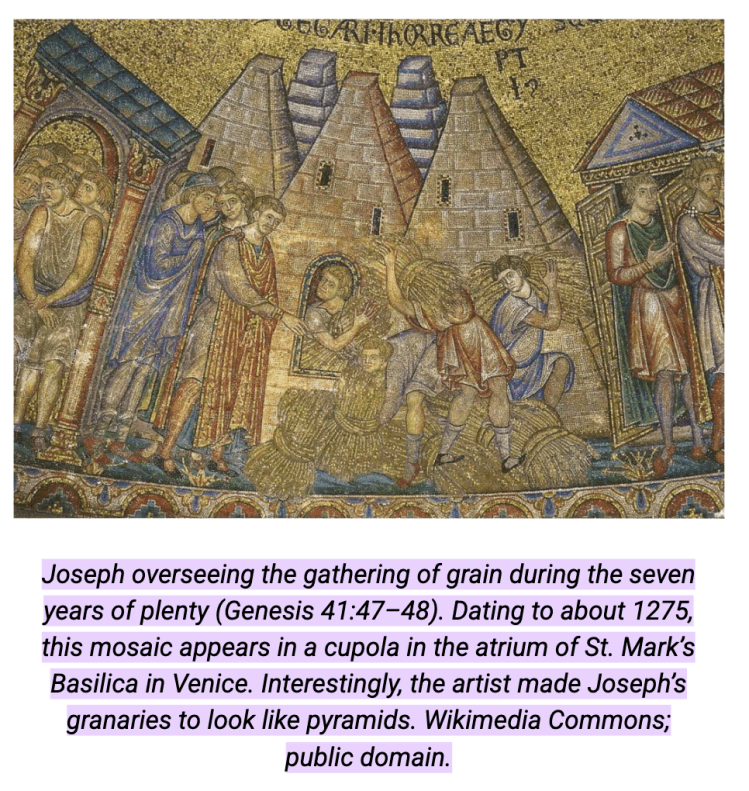
Back to Joseph. Not only does he interpret Pharoah’s dreams; he comes up with a solution to the problem of famine. But he makes it sound like the solution is Pharoah’s idea. He says, at verse 33, “Now therefore let Pharaoh select a man who is discerning and wise and set him over the land of Egypt.” Who is the one that Pharaoh will select? Joseph, of course. He tells him to appoint overseers and save 1/5 of the produce in the cities during the years of plenty as a reserve during the years of famine.
Pharoah is certain that God is using Joseph. “Since God has shown you all this, there is no one so discerning and wise as you.” He gives him his signet ring, places it on his hand. Joseph will be his second in command. He says, “See, I have set you over all the land of Egypt.”
He has waited for years in the prison in his master Potiphar’s house, caring for the other prisoners. And now, he will wear garments of fine linen and a gold chain around his neck.
Now he rides in a chariot and the people bow before him.
Soon he will have to decide just what kind of leader the Lord will have him be. Will he be another hard man like Pharoah, enjoying his power and privilege? And will everything that Joseph predicted from Pharaoh’s dreams come to pass? What then?
Dear friends, I hope that you are thinking about some of your dreams today and this week. I do believe that God can speak to us through our dreams, but the meaning might not be immediately obvious. Sometimes another person can help us find a deeper meaning.
So, keep on dreaming! Hold onto your faith! You might be in a time of plenty in your life. You may be in a time of famine. These times can go on for years and seem to have no end.
But like Joseph, the Lord our God is with you and me! And our lives are part of a much bigger plan than we can see.
I’ve had another dream, and this one I have had repeatedly. Do you want to hear about it? I am in some kind of a place, with many other people. The places are a little different each time. So are the people. Some I know. Some look familiar, but I have no idea who they are. Some are relatives who have passed away. Some are still living, but they are from my past and I don’t know why we are all in the same place together. I have a strange feeling as I walk from room to room.
Whenever I have that dream, I always tell Jim about it. He always asks the same question, “Where was the house??? Did you see anything that would give it away?” Sometimes, it’s at a seashore. I can hear the ocean. Other times, it’s in an old section of a town, with a lovely little garden in the back yard. Sometimes, it’s a snowy place.
I can’t explain the dream, but the strongest feeling I have is that it is in the mysterious age to come. I am not dreaming about this life at all. And while I don’t hear God’s voice, I know the Lord is with me. I am safe in God’s arms. I am home.
Will you pray with me? Let us pray.
Loving God, thank you for caring for the world, Jew and Gentile alike, even from the time of Joseph, when you cared about the people of Egypt who may have perished in the famine. Reveal your will and encourage us through our dreams. Help us to persevere in the faith and be a witness for your love, mercy, and generosity through years of scarcity and plenty. In the name of Jesus we pray. Amen.
 Sharing God's Love and Grace