
Meditation on Genesis 42:1-17
First Presbyterian Church of Smithtown
The Reverend Dr. Karen Crawford
Fifth Sunday in Lent
March 22, 2026
My youngest son, James, had a birthday yesterday. He turned 33! He is married to Andrea, and they live in North Mankato, Minnesota.
I think of my children every day. And I miss them because we are so far apart and have such busy lives. I never thought, when Joshua, Jacob, and James were little, that they would end up living in different states when they were grown.
I called James yesterday afternoon, and we talked for a while, and after we hung up, I missed him even more. But I am looking forward to his and Andrea’s visit after Easter when they come to housesit and care for our pets, while Jim and I are away.
Our children have very different personalities. Is that true for your kids? James has always been the peacemaker. He didn’t like it when there was any conflict in the family. Although he is the youngest, he has always been the responsible one, the one who worries about his older brothers. And he was the one who was the least shy of them all. Even as toddler, he wasn’t afraid to introduce himself to strangers. He made friends easily and wanted to please his teachers and parents.
But he was also the most sensitive and tenderhearted. And of my three boys, he was the most faithful. When I was a park chaplain, he was the one who walked with me from campsite to campsite, helping me invite people to children’s activities and worship on Sunday morning in the outdoor amphitheater. He was the one who insisted, when I was afraid to approach a large group of Harley riders in leather and spiked helmets, that they needed Jesus, too.
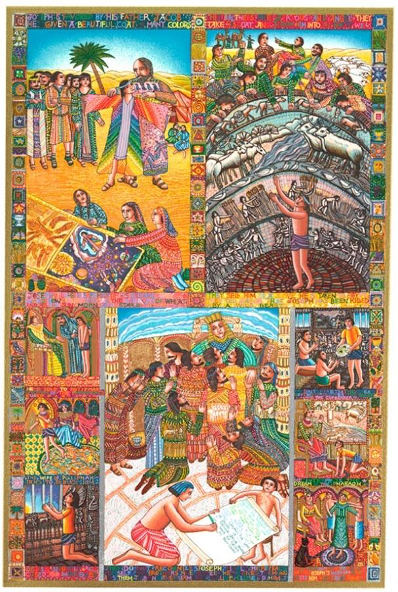
Joseph, the second to the youngest of 12, is the most faithful. He is the one with the spiritual gift of dreams with divine messages and the ability to interpret dreams that foretell the future. Though he lost his coat of many colors long ago, Joseph now wears robes of fine linen, gold chains, and Pharaoh’s signet ring.
The first time we see the word translated “chariot” in the Bible is when Joseph is riding in one. Chariots were first introduced in Egypt in the 8th century BCE as an instrument of warfare. (Sarna, JPS Torah Commentary: Genesis, 287). This chariot is a status symbol.
And there are other benefits with Joseph’s position as second in command. Pharoah says, “I am Pharaoh, yet without you, no one shall lift up hand or foot in all the land of Egypt.” (Meaning, “no action shall be taken” without your knowledge and assent.) And Pharaoh gives Joseph a new Egyptian name. Just as his father, Jacob, became Israel after he wrestled with an angel, Joseph will have a fresh start as Zaphenathpaneah. Pharaoh also gives him a wife—Asenath, daughter of Pot-phera, priest of the temple to the universal sun god Atum-Ra (later called ‘Helios’ by the Greeks).
Joseph is 30 years old when he is appointed Vizier (Prime Minister or Governor) of Egypt. The Pharaoh at the time may have been Amenemhat III (c.1678-1635BC). Joseph’s job leads him to travel throughout the land for the next 7 years of plenty. He makes sure the grain is gathered from the fields and stored in the cities. He collects a large quantity of produce, “like the sands of the sea, until he ceased to measure it, for it could not be measured.”
During the years of plenty, Joseph becomes the father of two sons with Asenath. The names of the sons tell us a great deal about Joseph’s state of mind. The first one is Manasseh, literally meaning, “he who causes to forget.” But Genesis 41:51 says the name means, “God has made me forget completely my hardship and my parental home.” Has he been able to heal from his brothers’ physical and emotional abuse? If he had truly forgotten it, he wouldn’t be mentioning it in the name of his first-born son. The second child is Ephraim, meaning, “God has made me fertile in the land of my affliction.” Has he forgotten the years of slavery and then being falsely accused and imprisoned in Potiphar’s house? No, he has not. He still sees Egypt as the “land of his affliction.”
But just as Joseph predicted, interpreting Pharoah’s dreams, the 7 years of abundance that the land of Egypt enjoyed come to an end. The 7 years of famine set in. When all Egypt experiences hunger and cries out to Pharaoh for bread, he tells them, “Go to Joseph; whatever he tells you, you shall do.” Joseph is the one who personally rations out grain not only to the Egyptians, but to everyone who comes for help.
The famine has extended to the land of Canaan. Chapter 42 begins with Jacob telling his sons that they need to go to Egypt and procure rations for the family, so that “they may live and not die.” The journey is at least 500 miles and will be the same journey that Joseph will make with his wife, Mary, and young Jesus, when they are fleeing from Herod in Matthew chapter 2.
Ten of Jacob’s sons make this journey on donkeys. Jacob doesn’t allow his youngest child, Benjamin, son of his beloved wife Rachel, to go with them. They make the journey, and they come before Joseph, who recognizes them and realizes that his dreams at 17 are now coming true. His brothers are bowing down to him.
Is anyone surprised at Joseph’s reaction to his brothers? He acts like a stranger to them, accuses them of being spies, and throws all 10 into the same dungeon where he languished for years, without hope of being released.
I believe he may be suffering from trauma. What we know about trauma today is that it takes time to heal. If the trauma goes on for years, as it did for Joseph, then his healing will take years, as well.
I discovered an article from January (https://alterbehavioralhealth.com/blog/stages-of-trauma-recovery/) that describes 7 stages of trauma, something like the stages of grief. The first four are: shock and denial, pain and anger, bargaining and shame, and grief and deep processing. The 5th is a turning point, when things start to change. The pain is not as severe. You have more good days than bad. You start thinking about the future and anger starts to cool down. The 6th is working through and integration. This stage is about rebuilding your life. You connect with people and do activities you enjoy. You set healthy boundaries and make new routines that support your healing. The 7th stage is acceptance, where trauma is a part of your life, but it doesn’t control you. You have learned from what happened and you can see how it changed you, because trauma changes you, but it doesn’t define who you are. Memories are not as painful. You are living a full life and not just surviving. You feel thankful for your own strength.
Who here thinks that Joseph has not reached the 7th stage of acceptance? I’m pretty sure he isn’t there, yet, despite all the years that have passed since he last saw his family.
He has a plan. His brothers are only in prison until they agree to go home and return with Benjamin. Joseph wants to see his beloved younger brother, with whom he shares a mother! Imagine how much he misses him! Benjamin was just a little boy when Joseph was taken as a slave to Egypt at 17. On the third day in prison, Joseph tells his brothers to bring Benjamin to him. “Do this and you shall live,” he promises. “For I am a God-fearing man.”
The brothers believe that actions have consequences, that we reap what we sow, though they don’t say specifically that God is punishing them for what they did to Joseph years before. “Because we looked on at his anguish yet paid no heed as he pleaded with us.” (This is the first time we hear that Joseph was pleading with his brothers when they threw him in the pit.) “That is why this distress has come upon us,” they say to each other. Do you remember the eldest? Reuben? The one who blamed himself for what happened, even though he didn’t do it? Reuben says, “Did I not tell you, ‘Do no wrong to the boy?’ But you paid no heed! Now comes the reckoning for his blood.”
They are speaking in front of Joseph, in a Canaanite dialect, and they don’t know that he understands every word. For there is an interpreter between him and them and Joseph is speaking an Egyptian language they don’t know. Joseph hears what they say, and he leaves the room so they can’t see that he is crying. Joseph has managed to rise to second in command over Egypt, and yet the thing that brings him to tears is his family problems. Is he crying because he realizes that they are sorry for what happened to him? Or is he crying at the memory of the years of trauma, remembering all the years that he has been angry with them, perhaps even hated them?
Joseph wipes his eyes, returns to them, takes his brother, Simeon, and has him bound while they watch. He releases the others with food for their starving households. For by now, all the brothers are married with children. Without them seeing him, he returns all the money that his brothers have brought to pay for the rations, slipping it into the bottom of the bags of grain so that they won’t discover it until they get home. This is a sign, I believe, that he wishes them no harm.
When the brothers return home without Simeon, and ask their father for Benjamin, Reuben, the oldest, says to his father, “You may kill my two sons if I don’t bring him back to you. Put him in my care, and I will return him to you.” But Jacob says, “No. My son must not go down with you, for his brother is dead and he alone is left.”
Jacob has 12 sons, but the only ones that truly matter to him are Joseph and Benjamin, Rachel’s children. He speaks as if Benjamin is the only son he has left.
The severe famine in the land continues. The rations will eventually run out.
Jacob is faced with a choice—let the whole family starve or risk sending one of his sons back to Egypt with his beloved Benjamin, whom he may never see again.
Will the family be reconciled? Will there be forgiveness? Will Joseph find healing after his years of trauma?
Come back next Sunday for the final chapter of the Joseph Story, “The Big Reveal.”
Let us pray.
Lord, we thank you for our families, for our children and grandchildren, whom we love. Thank you that each one is different, unique, and that you have a special plan for their lives. We lift up our children and grandchildren who may be struggling right now, especially those who are young adults. We ask that you be with them, guide and protect them, and provide for all their needs. Grant them wisdom and courage to weather these difficult times. We pray for peace in our families, dear Lord. Let there be forgiveness and healing wherever there is brokenness and hurt. Let your Spirit fill our hearts and households and reign over our lives, empowering us to walk in your loving ways. Amen.
 Sharing God's Love and Grace