Meditation on Matthew 28:1-10
Reverend Dr. Karen Crawford
First Presbyterian Church of Smithtown
April 5, 2026
He is Risen! Alleluia!
Every Easter, I remember my grandmother singing in church,
Jesus Christ is Risen Today. Alleluia!
Our triumphant holy day. Alleluia!
Who did once upon the cross, Alleluia!
Suffer to redeem our loss, Alleluia!
Grandma Springer sang in the choir at her Lutheran church for about 50 years.
I remember having a conversation with her when I was in my 20s. We were on our way home from an evangelical church that I attended at the time. I had been active with a group in college called “Inter-Varsity Christian Fellowship.” I was digging more deeply into the Bible and asking questions about my faith. Grandma was happy that I was going to church. She had prayed for me! She would go to any church with me, she said. If she didn’t go to church on Sunday, her whole week wouldn’t feel right. But when I talked with her about my questions, she would say that she never had them. She didn’t have the same burning need to know more about her faith. It was enough for her to simply trust in Jesus, her Lord.
I have been trying to read the newest book by Elaine Pagels off and on over the last 6 months. It’s called, Miracles and Wonder: The Historical Mystery of Jesus. I can only read about a chapter at a time before I have to put it away. Jim says this is quite a change from the old me who would never have read any of her books, or those of other scholars like her, such as John Dominic Crossan and Marcus Borg. They are looking for the Historical Jesus—not Jesus, the Messiah, that Grandma and I know. They are looking for irrefutable proof in the existence of the man outside the witness of the gospels and other early Christian writings. Of course, they don’t believe in the Resurrection. And they are wondering why so many people still do—and why the Jesus Movement continues.
Elaine is professor emeritus of religion at Princeton University. You might know her from bestselling book in 1979 called, The Gnostic Gospels. Her research focused on early Christianity and Gnosticism, which rose up about the same time as the Early Church, but was immediately declared a heresy. At the foundation of Gnosticism is the belief that the god who created our material world was a flawed, lesser god or demiurge. Salvation is possible through special knowledge directly revealed by a hidden, supreme being. Gnostics believe in Jesus, but not the Trinity. They believe that he was a divine being and never really human; he only appeared to be to lead humanity back to recognizing its own divine nature.
Elaine had already given up on several versions of Christianity, she says in her introduction, starting with the Methodist church she knew as a child. She gave up on the evangelical Christianity that she knew after answering Christ’s call at a Billy Graham crusade. This angered her father, who had struggled with “ferocious Presbyterianism” as a child. (Pagels, 3) Eighteen months after the Crusade, one of her closest friends, who was Jewish, died in a car crash. She looked for comfort at her church, and they told her that if he wasn’t born again, he wasn’t going to heaven. She gave up on Christianity, after that. But she was still drawn to religion. She later applied to a doctoral program in religion at Harvard, where she knew she would be challenged to think in ways she’d never imagined. (Pagels, 5)
She says later that in the last century, “many” Christians have come to think of the New Testament stories of Christ’s resurrection as “myth masquerading as fact…Were these reports based on hallucinations, or on projection, born of grief? Did Jesus’s disciples remove his body from his grave to fake a resurrection? Did someone else steal it, or, as a few historians suggest, was …. he never buried at all? Or were some reports claiming to document his resurrection telling of actual encounters with the risen Jesus, alive again after his death?” (Pagels, 163)
These were the same questions asked at the time of Christ’s death. Let’s go back to the crucifixion in chapter 27. Matthew says that when Jesus breathed his last, the curtain of the temple was torn in two. “Tombs were opened and many bodies of the saints who had fallen asleep were raised.” All who were keeping watch over Jesus, “saw the earthquake and what took place,” and they were terrified and said, “Truly this man was God’s Son.” “Many women were also there,” (verse 55) looking on from a distance; they had followed Jesus from Galilee and had “ministered to him.” The Greek word for ministered is the same root of the word that we use for “Deacon.” Who were the first deacons of the Church? The women who followed Jesus. Matthew names some of them. The most important is first: Mary Magdalene, who was probably a wealthy woman near the same age as Jesus’ mother. Mary the mother of James and Joseph is also named, and the mother of the sons of Zebedee,” who is Salome.
Evening came, and Joseph of Arimathea shows up and asks for Christ’s body. He would have been a wealthy man to have owned his own new tomb. For some strange reason, maybe it was the bad dreams his wife was having about Jesus, Pilate allows Joseph to bury Jesus. Earlier, Pilate had taken a bowl of water and washed his hands of the whole matter when the crowd was crying out for the death of Jesus the Messiah and the release of Jesus Barabbas, who had led an insurrection. A “great stone” was rolled “to the door of the tomb” and Joseph, a secret disciple, went away. Then, we learn in verse 61: “Mary Magdalene and the other Mary were there.” They were there the whole time, watching everything, but no longer from afar! There were “sitting opposite the tomb.” But the sun was going down; it was the Sabbath, and they had to go home.
They aren’t there when the Pharisees say to Pilate, “Sir, we remember what that imposter said while he was still alive, ‘After three days I will rise again.’ Therefore, command the tomb to be made secure until the third day; otherwise, his disciples may go and steal him away and tell the people, ‘He has been raised from the dead,’ and the last deception would be worse than the first.” Pilate answered, “You have a guard of soldiers; go make it as secure as you can.” The guard makes the tomb secure by sealing the stone. This posting of the guard is only in Matthew and was shared because at the time of this gospel writing, around 85 CE, the rumor that his disciples had taken the body was still being circulated.
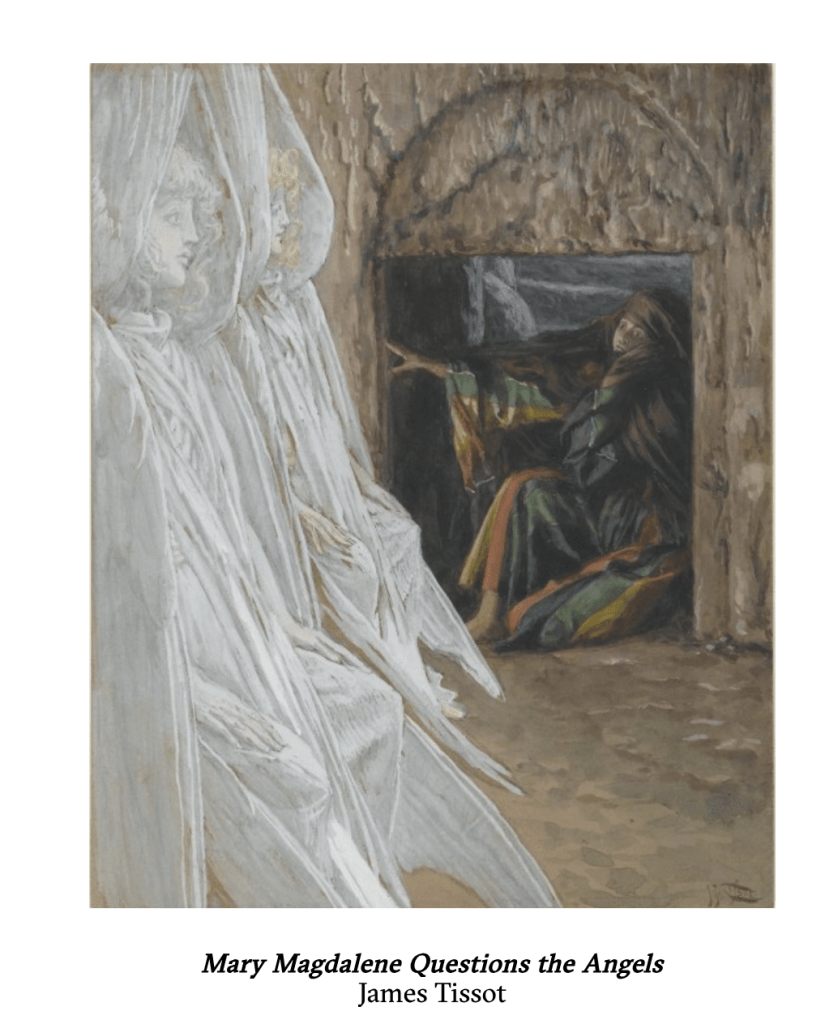
Early the next morning, the women come to “see” the tomb. In Matthew, they are not coming to anoint the body. They are looking for the risen Christ! He told them that he would be raised—and they had already experienced the earthquake, the tearing of the Temple curtain, the opening of tombs, and seeing saints rise from the dead. Why wouldn’t they come back to the tomb to look for Jesus? They arrive and experience another earthquake and an angel rolling away the stone. He knows that they are looking for Jesus; he tells them not to be afraid, invites them into the empty tomb to see for themselves, and assures them that they would see him in Galilee.
They leave with “fear and great joy” and run to tell the male disciples. The amazing thing is that in the patriarchy society in which they live, women are never counted. They cannot testify in court as witnesses because the testimony of women is considered unreliable. But when the risen Savior meets them on the road, they are the first witnesses, the ones on whom Jesus relies to share the good news and be believed. The word that comes out of his mouth isn’t really “greetings!” as the English translates. It is better translated, “Rejoice!” They worship him and take hold of his feet. This is kind of a funny detail, except when you realize that the important thing is that this is Jesus raised in the flesh—not a ghost or divine being that only appears to be human. Jesus commissions them, repeating what the angel has said. “Do not be afraid. Go and tell my brothers and sisters to go to Galilee; there they will see me.”
Meanwhile, the guards go into the city and tell the chief priests what happened. The priests meet with the elders, and they devise a plan to bribe the soldiers with a large sum of money. They pay them to lie and say, “His disciples came by night and stole him away while we were asleep.” Matthew says in 28:15, “And this story is still told among the Judeans today.”
I leave this Resurrection passage with joy in my heart. I can answer Elaine’s question with all honesty and conviction: “Yes. Some reports claiming to document his resurrection speak of actual encounters with the risen Jesus, alive again after his death.” Friends, Jesus is still alive and present with us! And I am grateful for a God who chooses to use women—the powerless people of Christ’s day. People who didn’t even count legally as people when it came to witnesses.
It is my hope that Christ will make his loving presence known to you, especially in times of grief and loss. God knows that we are looking for the risen Savior in hope, just as the two Mary’s were long ago. Jesus knows we are looking for him, and the wonderful thing is that our Lord is looking for us, too. He will never stop looking and loving, no matter the questions we ask, no matter our doubts, which are part of our journeys of faith. Jesus tells us that he has come to seek and save the lost. May he greet us on the roads of our lives, saying, as he did to the Marys, “Rejoice!”
So, today on Easter, when you gather with family and friends, I pray that you will give thanks for your Risen Lord for seeking and saving you, and for the people whose faith has touched your life. I pray you will give thanks especially for the women, whose testimony would not have been considered legal or reliable in the time of the Marys. And whenever you encounter obstacles or great stones in your life, as we all do, may you trust God and the angels to guide you through them. Remember: Nothing is impossible with God!
You know, times change. I don’t know if Elaine is correct when she says that “many” people question the validity of the Resurrection today. But I know that Jesus Christ is the same, yesterday, today and forever! All that mattered for my Grandma was a simple faith in her Lord, praising God in church, and prayer when something troubled her. I think the one thing that strengthened her joy was when she sang. I would hear her humming and singing hymns not just in church but as she did chores around her home. She never sang pop songs. I overheard her telling her friend, Gladys, that she was saving her voice for the Lord. I can still hear her sweet soprano voice:
Hymns of praise then let us sing. Alleluia!
Unto Christ, our heavenly King! Alleluia!
Who endured the cross and grave. Alleluia!
Sinners to redeem and save. Alleluia!
Let us pray.
Holy One, we praise and thank you for raising your Son after three days and the promise of life everlasting with him. Thank you that he continues to seek and save the lost, revealing your love, mercy, and grace for sinners. Thank you for the courage of the women who stayed as Christ was crucified and buried and returned to the tomb in faith the next day. Thank you for all who have continued to believe in the Resurrection and share their faith. Send us out, dear Lord, to tell of the Living Christ, with the power to transform us and enable us to live new, abundant, resurrected lives today. Amen.
 Sharing God's Love and Grace