The Gardener

Meditation on John 20:1–18

First Presbyterian Church of Smithtown, NY

Pastor Karen Crawford

April 9, 2023: Easter Sunday

Pastor sharing her message:

Art by Stushie

Are there any Star Trek fans here? Any Trekkies?

I’m not a fan. I can’t believe I am saying that in public. Not a fan of the original series that lasted 3 seasons, beginning with a failed pilot in 1965. They had to start over and make another one! Putting aside the problems of goofy special effects and terrible writing, with flat, stereotypical characters, and predictable plots, strong, smart women were almost completely left out of the story. The main characters were men; the decision makers WERE MEN. Even the stated mission was male-centered: “to explore strange, new worlds; to seek out new life and new civilizations; to boldly go where no man has gone before.”

The only strong female character I recall was Uhura, played by Nichelle Nichols. Do you remember her? She was a translator and the chief communications officer for the Starship Enterprise. But her character was less significant, often with fewer lines than the male officers—Kirk, Spock, Scotty, Sulu, Bones. Still, when she said, “Captain,” Kirk listened—and so did we. Her role was groundbreaking for African American actresses on American television at the time.

Nichelle Nichols playing Uhura on Star Trek in the mid 1960s.

 Nichols said that she felt like quitting on many occasions. She went as far as handing in her letter of resignation to Gene Roddenberry. He told her to take the weekend off and think about it. That weekend, she met the Rev. Dr. Martin Luther King, Jr. at a NAACP event. Star Trek was the only show that he and his wife Coretta would allow their three little children to stay up and watch.

When she told him that she was considering leaving the show, he persuaded her that she was making a difference—combating ignorance and opening doors for others to follow her. “You cannot, you cannot..,” he said, “for the first time on television, we will be seen as we should be seen every day, as intelligent, quality, beautiful people, who can sing, dance, and can go to space, who are professors, lawyers…If you leave, that door can be closed because your role is not a black role, and is not a female role; he can fill it with anybody even an alien.” [1]

Later, as she continued to play a role that often made her feel insignificant, she was encouraged by a flood of letters from women inspired by her work. Little girls wanted to be Uhura. Meanwhile, TV stations refused to run the show because there was a “black woman on the bridge.” Years later, Nichols would recruit the first women and minority astronauts for NASA’s Space Shuttle program. Her “radical impact” would be recognized and memorialized in the Smithsonian Air and Space Museum in Washington, D.C.

I feel completely different about the newest Star Trek that Jim and I stumbled upon a few weeks ago. Has anyone been watching Star Trek: Picard? The show is full of strong, smart women and men—whose characters are flawed and realistically human, even those who aren’t technically human beings. The series features the retired Starfleet admiral Jean-Luc Picard, played by Patrick Stewart. (It picks up where Star Trek: The Next Generation left off.)

Each season of Picard explores different aspects of the character in his old age. It begins with him “deeply affected by the death of the character Data…(and) the destruction of the planet Romulus. Retired from Starfleet and living on his family’s vineyard, he is drawn into a new adventure” when he is visited by someone who appears to be a “daughter of Data, one of several new synthetic beings, or ‘synths.’ Picard fights for their right to exist and gives his (human) life to save them.” [2]

He experiences a rebirth as a synth, not human anymore, but becoming more human than he was– more open and sensitive, introspective, caring. More of his past is revealed, and he begins to see himself and others with new understanding. He literally comes out of the darkness and, increasingly, into the light. In this new story, old enemies become friends and work together to solve large-scale problems that affect not just one planet or human beings, but entire universes, with a diversity of creatures.

In this new story, there is hope for change, for forgiveness and reconciliation, even with less than perfect parents, children, spouses, and friends. Even after years of brokenness. They are fighting old, bad habits and addictions—their own failings and inner darkness, as well as the baffling darkness of ignorance and misunderstanding in the people around them. And they are battling the ever-present threat of the darkness of evil, despite their efforts to eradicate it.

Lingering questions arise as the series draws to a close. What is life? What is death? And will love conquer all?

Mary’s story in the 20th chapter of John, though thousands of years old, is remarkably modern and relevant. This story deals with the same questions of life and death and the power of Love!

Although Mary is not numbered in the official original 12, she is not inferior to the male disciples. While many women in the Bible are not named, she is not just Mary, a common name for a woman in her time. She is specifically “Mary Magdalene” or Mary of Magdala, a fishing village. She is the strong and persistent one—the one who shows up, while the others are still sleeping or hiding. Don’t be tempted to see her tears as weakness! Remember how Jesus cried at the tomb of Lazarus.

While it is still dark, Mary Magdalene comes to the place where Jesus was laid. All by herself. This is dangerous! “Still dark” tells us how early it was. It’s the middle of the night! The darkness is also her grief and the ever-present evil in the world that cried out for the Messiah’s crucifixion and continues to threaten the safety of his followers. But it is also the darkness of misunderstanding and confusion by the disciples, who never expected Jesus to die. What do they do—now that he is gone? Now that the story didn’t end the way it was supposed to end?

As soon as Mary arrives at the tomb—she sees what she cannot understand. The heavy stone that cannot be removed has been removed! Notice, John doesn’t tell us yet that the body is gone! Mary tells us when she runs to Simon Peter and the other disciple, “the one whom Jesus loved.” “We don’t know where they have laid him!” she says.

They are all running now—but the one who beats them all to the tomb is the one who has only one role, as theologian Gail O’ Day writes, “to embody the love and intimacy with Jesus that is the goal of discipleship in John….Love and intimacy with Jesus gets to Easter first!”

The other two disciples who have responded to Mary see the empty tomb, the linen wrappings, and the cloth from his head; they “see” and “believe” but still DO NOT understand what they are seeing. For they don’t understand the scripture, John says, “that he must rise from the dead.” The darkness of ignorance leads to depression, fear, helplessness. The two male disciples go home, leaving Mary to look for Jesus. Look for answers. In a dangerous place. I can’t understand why the other disciples leave her—unless they are too afraid to stay or just expect her to follow them home.

In her darkness of grief, she weeps outside the tomb, looks inside, and discovers the first stream of light—two angels, dressed in white. But even the sight of the angels fails to lift her spirit. They ask why she is crying. She tells them that she doesn’t know where the people have taken Christ’s body.

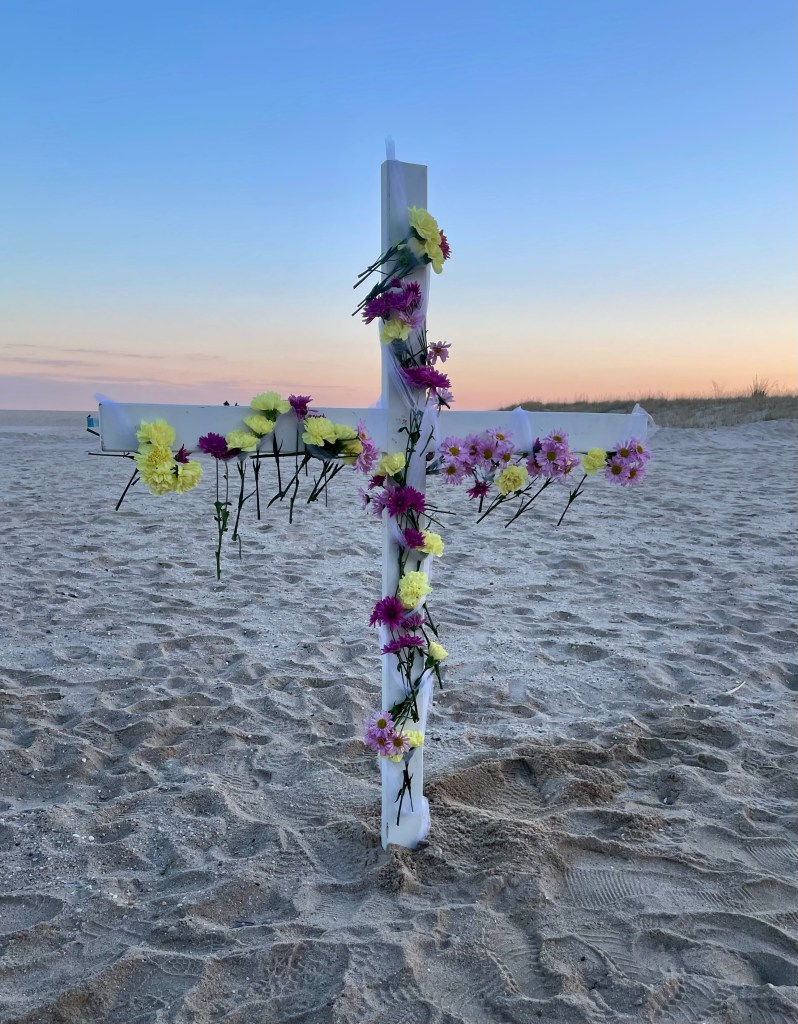
Dear friends, her own despair clouds her vision. Jesus is standing there, and she only sees “The Gardener.”  The problem isn’t locating a body. The problem is failing to see the Risen Christ!

We are Easter People, dear friends. We rejoice with Mary’s declaration, “I have seen the Lord!” and accept her call as our own—to tell others the good news. We have the power of Love within us to help us experience a kind of rebirth by faith, to live new, resurrected lives with Christ today.

We have come to worship our God of second chances, a merciful and gracious God who wouldn’t allow death to have the final word! A God who offers all of us new beginnings and transformation by the power of the Spirit and the suffering work of the Son! We trust in a God who longs to embrace us with everlasting, unconditional love and has promised to come again to carry us HOME.The challenge for all of us is, “How do we live as Easter People every day, throughout our struggles—on the inside and outside of us? How do we see the Risen Christ and the angels, when we are tempted to stare into the gloomy dark?”

Look around you now. These are just a few of the people whom God has placed in our lives, people who remind us of the marvelous things that God has done by the way they live each day. These are people who help to love you into being you—the you God wants for you. People who model grace and forgiveness and help us walk in the way of peace and kindness.

But as you are looking around this room—people are also looking at you. I am looking at you. You, too, without your knowing it, remind others of your hope in the Risen Christ by the way you live. You might get discouraged sometimes. You might feel like nothing is going the way you planned it to be. You might think you have a tiny, insignificant part in the story of God and the salvation of human beings. Maybe you think what you do doesn’t matter!

But that would be wrong. With the Spirit of Christ living inside of us and the Light of the World shining through us, we all play a starring role. Your faith is a gift from God to be shared, and you share it. You, too, have loved others into being the people God wants them to be. Don’t stop doing that! Cling to your hope in the Light of the World, who is longing to be seen and known. It’s all about love; being a faithful disciple of Christ is embodying love and intimacy with Jesus. Like Gail O’Day said, “Love and intimacy with Jesus gets to Easter first!”

We are all, like John, the disciples whom Jesus loves. This is our story, and for all the ages and generations! It never gets old! Each of us has a testimony to share, a vision God has given us.  A future filled with hope.

May we all be stirred to go and tell others, like Mary, “I have seen the Lord.”

Let us pray.

God of Love, Light of the World, thank you for our new and living hope! Love has conquered sin and death! Nothing can ever again separate us from your love revealed in Jesus Christ. Help us to live each day as people walking in the Light, not fearing the darkness or worrying about the future that you hold in your loving hands. Build up our faith and help us to be a witness as strong as Mary in the gospel of John. Help us to see you and be the people you want us to be. Going out to tell the world, “I have seen the Lord.” In the name of our Risen Savior we pray. Amen.

[1] “Star Trek’s Nichelle Nichols on Uhura’s Radical Impact,” Smithsonian channel, 6years ago at https://youtu.be/rtMNAHwPSgA

[2] Star Trek: Picard on Wikipedia at https://en.wikipedia.org/wiki/Star_Trek:_Picard


Known By Our Love

Meditation for Maundy Thursday

First Presbyterian Church of Smithtown, NY

Pastor Karen Crawford

April 6, 2023

Audio of Pastor Karen’s message:

Cheryl Katz, “Make Way for Pufflings,” Smithsonian, March 2023, https://www.smithsonianmag.com/science-nature/icelandic-town-goes-all-out-save-baby-puffins-180981518/

No one loves puffins more than the people who live on Heimaey (Hay MAH’ ee), a volcanic island off the southern coast of Iceland.

Cheryl Katz writes of their loving care of baby puffins or pufflings in her story, “Make Way for Pufflings,” in Smithsonian magazine last month.

 The 5-square-mile island “is the largest and the only inhabited one of the Westman archipelago,” she writes. About 4,400 people live on Haimaey in a town called Vestmannaeyjabaer (Vest MAN ah jar). The puffin population, for a few months out of the year, will exceed the human one. The cluster of volcanic isles are home to the largest colony of Atlantic puffins on earth. The seabirds spend most of their lives far off-shore in the cold waters of the North Atlantic. They come on land to breed. [1]

In March, as the days lengthen, folks begin looking forward to their return. More than a million puffins will arrive in the Westman islands to reunite with their life partners after being separated at sea. They “lay their single egg in an underground burrow dug out of the grassy cliffs. The July sea and sky will churn with birds ferrying food to their hungry chicks. The pufflings emerge at night from their underground digs in late August and September, when most of the adults have already departed for winter on the open ocean… heading to a seabird hot spot southeast of Greenland, along with jaunts from the Arctic to the Mediterranean. Now, it’s time for the chicks to follow the moon lighting their path to the water. For the next few years, the chicks will roam the North Atlantic on their own, possibly crossing the ocean before returning to their birth colony to breed.” [2]

https://www.smithsonianmag.com/science-nature/icelandic-town-goes-all-out-save-baby-puffins-180981518/

Then the terrible thing happens. Some of the baby birds, on their first flight “leaving the burrow, will get confused by the lights of the town.” [3] They go the wrong way and head inland, instead of out to sea! While they are strong swimmers, the puffins’ dense bones make it more difficult for them to take flight. When they are at sea, they use the water as a long runway. But if they land on the town’s streets, their “new wings are too weak to get them aloft from the flat ground, leaving them vulnerable to cars, predators, and starvation.” [4]

https://www.smithsonianmag.com/science-nature/icelandic-town-goes-all-out-save-baby-puffins-180981518/

But then the miracle happens—and this is how this island town of 4,400 people is known for its love for the puffins. Every year, the children of the community stay up late and on their own and with their parents, “they roam the town, peeking under parked vehicles, behind stacks of bins at the fish-processing plants, inside equipment at the harbor,” looking for “stranded young birds… in tight spots. Flushing them out and catching them is the perfect job for nimble young humans. But the whole town joins in, even the police.” [5]

https://www.smithsonianmag.com/science-nature/icelandic-town-goes-all-out-save-baby-puffins-180981518/

The community has been saving stranded, confused puffins for more than a century—probably since electric lights came to the town in the early 1900’s. The puffin population has continued to decline since then. An older man remembers rescuing 100 pufflings in one night when he was a boy. His daughter and all the other children out looking for puffins won’t see that many in one night or the whole season, anymore. That’s why the children are so intent on rescuing one caught under a truck bed, even if it takes all night. That’s love.

“Tonight, it will sleep on a bed of grass in a cardboard box. Tomorrow, (a) little girl in (a) bright orange jacket will stand on a cliff on the west side of the island. She’ll toss the puffling into the air and watch it sail off to sea.” [6]

https://www.smithsonianmag.com/science-nature/icelandic-town-goes-all-out-save-baby-puffins-180981518/

Here, in John 13, we hear the promise that Christians will be known to the world, but by only one way will we be identified as belonging to Christ. “I give you a new commandment,” he says, “that you love one another. Just as I have loved you, you also should love one another. By this everyone will know that you are my disciples, if you have love for one another.’

Our witness to a hurting world depends on one thing and one thing alone. Love. This is the kind of love that demonstrates kindness, goodness, hard work, determination, and sacrifice. It is not a passive, sit back and watch terrible things happen and do nothing love.

Love your neighbor as yourself is NOT a new commandment for the disciples; this is from Leviticus 19:17-18. What’s new in this commandment is that Christ’s disciples will be known by their love for their sisters and brothers in the faith.

     With this new commandment, you might think that the disciples always get along and are never jealous or competitive. Let me remind you of Mark 10:35-45 and Matthew 20:20-21, when the mother of James and John comes to ask Jesus “a favor.” “Declare that these two sons of mine will sit,” she says, “one at your right hand and one at your left, in your kingdom.” She wants them to have special status and authority over the others. Jesus replies, “You do not know what you are asking. Are you able to drink the cup that I am about to drink?” meaning, are they prepared to suffer and die with him? For Jesus will pray in the Garden of Gethsemane in Luke 22:42, on the night he is betrayed, “Father, if you are willing, take this cup from me; yet not my will, but yours be done.”

 James and John foolishly answer, “We are able.” Jesus says, “You will indeed drink my cup, but to sit at my right hand and at my left, this is not mine to grant, but it is for those for whom it has been prepared by my Father.”

The other 10 disciples will be angry with James and John when they find out. All of them want to have favored status! But Jesus will set them all straight, calling them together for a teaching moment. “Whoever wishes to be great among you must be your servant,” he says, “and whoever wishes to be first among you must be your slave;  just as the Son of Man came not to be served but to serve, and to give his life a ransom for many.”

The annual rescue operation on a volcanic island off the southern coast of Iceland is a shared mission that brings people together and closer to one another. It brings out the best in them as they work to save the pufflings.

 On a cold Nordic night, two sisters drive up and down quiet streets, shining flashlights out of car windows looking for confused and frightened pufflings who have gone the wrong way and are trapped in the wrong place. As the night goes on, the two women “talk about everything under the sun…. (One) is a mother of three girls who works as an aide for people with disabilities. She and her sister, “an EMT and mother of four, have been rescuing baby puffins since they were practically babies themselves, and they began teaching their own children before they were old enough to walk.”

   Like the puffin rescue mission, our calling to bring back people who have taken the wrong path, are confused, frightened, and trapped by the distractions of this world, brings us closer together—and stirs us to love each other more. May we become known as a congregation who loves one another as we seek to help and serve our neighbors everywhere and through our loving work, make the world a better place.

   Christ demonstrates the kind of love that is willing to suffer.

    “No one has greater love than this,” Jesus will say in John 15:13, “to lay down one’s life for one’s friends.”

Let us pray.

We want to know you, God, more and more, and become like your Son, who gave himself for our sakes, so that we might be reconciled with you. Thank you for your love shown through Christ’s suffering on a cross. We praise you for sending Jesus to be our Savior, Teacher, and Friend, who not only commands us to love and provides the perfect example; he enables us to love by the power of His Spirit that lives in our hearts. Bind us together in the unity of Spirit, in shared mission, dear God, so that we may have a strong witness to our communities, becoming known as Christ’s disciples by our love for one another. In His name we pray. Amen.


      [1] Cheryl Katz, “Make Way for Pufflings,” Smithsonian, March 2023, 28.

      [2] Katz, “Make Way for Pufflings,” Smithsonian, 30.

      [3] Katz, “Make Way for Pufflings,” Smithsonian, 31.

     [4] Katz, “Make Way for Pufflings,” Smithsonian, 31.

     [5] Katz, “Make Way for Pufflings,” Smithsonian, 31.

     [6] Katz, “Make Way for Pufflings,” Smithsonian, 34.

“Hosanna to the Son of David!”

Meditation on Matthew 21:1-11

First Presbyterian Church of Smithtown, NY

Palm Sunday: April 2, 2023

Pastor Karen Crawford

Audio of Pastor sharing her message:

Today—another first for me with my flock here in Smithtown. We entered our worship today in a procession from the parish hall, carrying our palm branches, singing a song of praise to the Lord.

I worried a little, not having done this before—anywhere. Not just with you. I was a little out of my comfort zone.

I wondered what it would feel like, moving from our routine of sitting in our appropriate places—the liturgist and me walking in during the prelude. I have my chair up front. You have your favorite pew.

We are Presbyterian, after all, and like things decently and in order.

Our entire congregation joined in with the procession—all ages participating.

Palm frond waving, just as the crowd did for the procession long ago. Palms not bought from a florist but quickly cut from trees growing along the road.

Today is a day to raise our voices. Today is NOT a day for silence! We sang,

All glory, laud, and honor
to you, Redeemer, King,
to whom the lips of children
made sweet hosannas ring.
You are the King of Israel
and David’s royal Son,
now in the Lord’s name coming,
the King and Blessed One.

We had no donkey for our procession. Have you ever had a donkey on Palm Sunday?

Pastor Heidi Neumark of Trinity Lutheran Church in Manhattan tells the story of serving a church in the Bronx and beginning a tradition of getting a real donkey for Palm Sunday. For the donkey is the most important symbol of the day. Palm Sunday is named for the palms that we wave, but it’s all about the donkey.

 “A child would put on their Jesus crown,” she says, “and ride a donkey named Baby around the block as we followed, waving palms and singing.” Everything went smoothly, she says, “until the year it didn’t, the day Baby refused to budge. Finally, with difficulty, we forced her back into her trailer. After that, we made do with a pony.”

A pony wasn’t available for Jesus on the day he entered Jerusalem—and a pony wouldn’t have the same meaning to the pilgrims in Jerusalem who had come for the Passover. Pontius Pilate would enter the city on a great steed, but he was a ruler of this world. Jesus has planned his arrival down to the smallest detail—even arranging with a local man to have a donkey and colt ready for him to ride at this stage of the journey. Up to now, he and his disciples have traveled on foot, like everyone else.

The man in the village is waiting for the secret phrase Jesus gives to the two disciples sent on the errand. “The Lord needs them,” Jesus tells them to say.

The Lord has stayed away from Jerusalem until this time, the time of the Passover. The law required every Jewish adult male living within 20 miles of the Holy City to come to Jerusalem for the Passover. Most of the people walked, and some came long distances. This was the greatest of their national festivals.

 Jesus could not have chosen a more dramatic time for his entrance. And this was undoubtably a choice.

He rode on the back of a donkey—or two—fulfilling the prophecy for the Messiah for whom everyone was waiting. He rode into a city overflowing with perhaps 2 million pilgrims, surging with religious expectation.

Riding the colt of a donkey never ridden means that the animal is suitable for sacred purposes. Christ is making a deliberate Messianic claim fulfilling the prophecy of Zechariah 9:9, as Matthew points out. The verse is:

“Rejoice greatly, O daughter Zion! Shout aloud, O daughter Jerusalem! Lo, your king comes to you; triumphant and victorious is he, humble and riding on a donkey, on a colt, the foal of a donkey.”

But Matthew leaves out “triumphant and victorious is he” to emphasize Christ’s humility.

The crowds receive him as their king. We know because they spread their cloaks down so that he would ride over them and be spared the dirt from the road. It’s worth noting that the people spreading their cloaks probably owned just one. Many who are waving branches for Jesus, the prophet from Nazareth in Galilee, would have recalled the story of Simon Maccabbaeus being greeted with shouts of joy and the waving of palm branches as he entered Jerusalem in 1 Maccabees 13:51:

“On the twenty-third day of the second month, in the one hundred and seventy-first year, the Jews entered the citadel with shouts of praise, the waving of palm branches, the playing of harps and cymbals and lyres, and the singing of hymns and canticles, because a great enemy of Israel had been crushed.”

The crowds greet him as they would have greeted a pilgrim coming for the Passover, using a phrase from Psalm 118:26, “Blessed be he who enters in the name of the Lord!” Only they also shout, “Hosanna!” Hebrew for, “Save us, now!”

William Barclay, Scottish New Testament scholar, explains that this would have been “a cry for help which a people in distress addressed to their king or their god.” It is a cry for “deliverance and for help in the day of their trouble; it is an oppressed people’s cry to their savior and their king.” (239)

Barclay asks, What can be said about Jesus from his entry into Jerusalem?

  1. He is courageous. He knows he is entering a hostile city. While the crowds of ordinary people are celebrating him, the religious authorities have already declared their hatred and have sworn to kill him. Jesus knows this. He knows what’s going to happen.
  2. He is claiming to be God’s Messiah, God’s Anointed One, who has come to cleanse the temple. He will reveal this further in the passage that immediately follows this one. He will enter the temple and cast out all who are buying and selling—turning over the tables of those selling doves. “It is written,” he will say, “My house shall be called a house of prayer, and you are making it a den of thieves.” And then he will heal the blind and the lame.
  3. It says something about his appeal. “It was not the kingship of the throne which he claimed; it was the kingship of the heart. He came humbly,” riding a donkey, not the despised beast that it is in the west, but a noble beast of the east. “The horse was a mount of war; the (donkey) was a mount of peace. He showed that he came not to destroy, but to love; not to condemn, but to help; not in the might of arms, but in the strength of love.”

Christ’s entrance into Jerusalem on this day doesn’t, however, bring peace. Matthew tells us, “The whole city is in a turmoil.” They are asking, “Who is this? Who is this?”

And saying, “This is the prophet Jesus from Nazareth in Galilee.”

I always have mixed feelings about Palm Sunday. We start out so joyfully, celebrating with the crowd on Passover that our Messiah has truly come. It’s a day full of good memories from childhood.

But a shadow is forever cast on this day, which is now called both Palm and Passion Sunday in many congregations. We are ALL more than a little out of our comfort zone, no matter what we do—procession or no procession, donkey or no donkey—when we retell this story.

Jesus knew what was going to happen. And we, who have read the rest of the story, know what’s going to happen, too. Something in us wants to cry out, “Jesus, no! Don’t ride the donkey to Jerusalem! We don’t want you to suffer for our sakes! Couldn’t there be another way to save us?”

We know the cross looms in the road ahead. And that Jesus, the humble king, who came to serve and not be served, is riding on to die.

A shudder passes through me when I think of the people laying their cloaks in the road. Waving palm branches. Shouting a royal welcome, “Hosanna to the Son of David!”

The same voices will soon be shouting for freedom for a criminal named Barabbas.

And for the one who rode the donkey, they will shout, “Crucify him! Crucify him!”

Let us pray.

Loving and Gracious God, thank you for the courage of your Son, who publicly proclaimed his identity, fulfilling the words of the prophet Zechariah, when he rode into Jerusalem on a donkey. He knew those who were laying down their cloaks and waving their palm fronds would betray him in the end. Thank you for the suffering work that he courageously did for a world you still love—and for our calling to remember and retell the story to all the generations, until everyone knows the good news: Jesus Christ is our Messiah, Savior, and Lord. In His precious name we pray. Amen.

White-Tailed Deer

Pastor Karen Crawford

First Presbyterian Church of Smithtown, NY

Lenten Devotion

March 31, 2023

Audio of this Lenten Devotion:

Deer in our backyard, Photo by Jim Crawford, used with permission

  My family and I moved to the North Shore of Long Island last spring. We quickly discovered that the clergy who lived in the house at 3 Oakfield before us were breaking the law. They had fallen in love with the abundant white-tailed deer that live in our St. James neighborhood. They fed them dried corn from long, plastic window boxes on the backyard deck. The Trustees warned me about what they had been doing—how it was illegal—and showed me a shrub chewed clean of leaves from the ground to 4 or 5 feet. Deer height.

    After we moved in, I found a large bag of dried corn in a coat closet by our front door. I threw it away. Later, when I was seized by love for the deer that wander our neighborhood and visit our yard, I wished I had kept some corn to share with them.

Photo by Jim Crawford, used with permission

     My name is Karen Crawford. I am the pastor of First Presbyterian Church in Smithtown. I have been enthusiastically watching the wildlife in my neighborhood and especially my back yard since January, as part of a project in a Doctor of Ministry program with Austin Presbyterian Theological Seminary. The project has included some Sunday messages and Lenten devotions, inspired by thoughts and experiences with wildlife and people, Scripture, and readings.

      The deer truly are our neighbors. They live up to 10 years and spend all of their lives in about one square mile; some of them have been here longer than my neighbors and me! The deer like to forage for food on the edges of our backyard—where it is overgrown with wild plants and shrubs. No pretty flower beds here—no delicious day lilies, tulips or hostas and other expensive annuals or perennials that deer enjoy.  Just a tangle of vines that connects wild growing things from ground level to the top of trees, split by nature and age. I know the trees are a big draw for the wildlife that come here, including the deer.

Photo by Jim Crawford, used with permission

     I often see them, when I least expect them, standing in the backyard, looking at our house, probably waiting for someone to come out and bring them something to eat. They see me feeding suet and seed to the birds, and they hold onto hope. When I see them, I have to pause from what I am doing and watch them. I am drawn to their quiet beauty and grace. I forget the worries that I was carrying before I saw them. A feeling of peace settles on me.

Photo by Jim Crawford

     Seeing the deer reminds me of how we are meant to share our environment with other creatures God has created. That we are not alone and are called to live responsibly and gratefully, loving our neighbors—animals and human—and desiring no harm to any of them. It doesn’t make me angry that they are in my yard or walking down my street, leading us to drive slowly or even stop our cars so that may safely cross.

Photo by Jim Crawford, used with permission

    I know my feelings about the deer—my love for them, despite the challenges of sharing our suburban environment with them—are not shared by many of my neighbors. I was afraid to talk about the deer in my Lenten devotions, for this reason. I know people have strong feelings about them—and I understand their feelings and share some of their concerns.

     I have heard about the near extinction of native plants, such as the Pink Lady’s Slipper orchid, partly because of the deer’s eating habits.

Image From U.S. Forest Service:
https://www.fs.usda.gov/wildflowers/plant-of-the-week/cypripedium_acaule.shtml

We are losing the understory of our forests, and so we are losing habitats for other species. [1] I can’t help but think, though, how we have destroyed the deer’s habitats by building communities and roads where there used to be lush forests. White-tailed deer were nearly hunted to extinction a century ago and perhaps it is a miracle that they survived at all. Neighbors swap stories of collisions and near collisions with deer on the roads, and yes, it is dangerous driving. We have to be especially watchful of the deer crossing roads in Suffolk County, especially at dusk and dawn, when they are most active–and yes, there is also rush hour traffic.

    I, too, am worried about Lyme disease. It is spread by black-legged ticks that use the deer for unwilling hosts. Lyme disease is a terrible thing! But I am not ready to blame the deer for the ticks! If it weren’t the deer, the ticks would find other unwilling hosts. Maybe we should look for more ways to control the tick population that wouldn’t hurt our environment, as well.

       I believe the answer to our struggles with the deer population isn’t to cull more deer or to sterilize them or to find a way to move them somewhere else. This is their home. The deer haven’t been known to thrive when they are removed from their environment.

      I have faith that there must be a better way to co-exist more peacefully. The better way may involve changing our attitudes toward the deer and seeing them truly as our neighbors and Creation kin. The better way forward won’t involve treating them as domesticated animals. They are wild creatures and should be left to live as God intended! I don’t believe the answer is to feed them corn, no matter how I long to help them with their nourishment, as I do for the birds. A better way to co-exist may mean not reacting to their presence as if they are a nuisance and intrusion, but to think more creatively about making a natural space for them in our communities. A better way to live together would be to not see them as unwanted visitors, trespassers, as they graze by the side of the roads on green growth and on the edge of forests and our backyards, where they may find food and shelter.

      God’s people felt differently about deer in ancient times. They had a completely different attitude. Deer were needed for their meat and skin and admired for their beauty, grace, speed, agility, and resilience. Scripture can lead us to see the deer and ourselves more clearly.

      The Hebrew Bible is full of deer imagery. The psalmist cries out in his need for God in 42:1, “As a deer pant for flowing streams, so pants my soul for you, O God.”  “God, the Lord, is my strength;” says Habakkuk 3:19 (ESV), “he makes my feet like the deer’s; he makes me tread on my high places.” The Lord answers Job’s questioning by pointing to the Creator still bringing forth life in 39:1. “Do you know when the mountain goats give birth? Do you observe the calving of the does?” Jacob, in Genesis 49:21, blesses Naphtali, likening him to a “doe let loose that bears beautiful fawns.” The prophet Isaiah speaks of redemption in 35:6, when the mute will sing with joy and “the lame man leap like a deer.” Proverbs 5:18 encourages marital fidelity with, “Let your fountain be blessed, and rejoice in the wife of your youth, a lovely deer, a graceful doe.” Deer are linked with romance and courtship in Song of Solomon (8:14) “Make haste, my beloved, and be like a gazelle or a young stag on the mountains of spices.” And in 2:9, “My beloved is like a gazelle or a young stag. Behold, there he stands behind our wall, gazing through the windows, looking through the lattice.”

     My wonder for the deer increased when I learned about the white, white- tailed deer in New York state. About 200 of them live in Seneca County, in the Finger Lakes Region. Deer Haven Park, a refuge of 3,000 acres, opened in 2017 on land that formerly housed an Army munitions storage facility. [2]  I am hoping to take a drive there someday and see the deer, up close. I wonder if they will steal my heart, like the white-tailed deer in my neighborhood?

White deer at Deer Haven Park, https://deerhavenpark.org/

      The deer in Deer Haven Park are not albino; they are leucistic, lacking pigmentation needed for the hair follicle to produce brown fur.  The recessive gene that causes leucism is rare among deer, [3] but the fence that surrounded the base isolated and protected the white deer from the rest of the world and led to the leucistic population growth.

     The white, white-tailed deer reserve is, in a way, a story of redemption. The place that supplied the means of war for more than 50 years was begun by the abrupt displacing of 162 families from their homes with only a few days’ notice. It has become a place of grace and peace, life and beauty for God’s creatures. Family members of those who lost their homes when the munitions storage facility was built have returned to visit, walk the empty lots where homes once stood, crops were sowed and reaped, even sifting through what is left of personal belongings.

     But most of the visitors to the park, open only for limited bus or guided auto tours, come not to remember or imagine a painful past, but to see if they can catch a glimpse of the wildlife, now free to roam, mostly undisturbed. They come hoping to see the rare deer.

White Deer at Deer Haven Park, https://deerhavenpark.org/

      Science explains their white coloring, but not the way people feel when they see the white deer.  “They are mystical creatures, as mysterious as the munitions facility itself,” says Dee Calvasina, author of a column and a book about Deer Haven Park. [4] White deer are the stuff of myths and legends. The Celts believed they were messengers from the Otherworld. Native American stories predict that “when a pair of all-white deer is seen together, it is a sign that the indigenous peoples of the Dawnland will all come together and lead the world with their wisdom.” [5]

White Deer at Deer Haven Park at deerhaven.org.

The white deer live in family groups with brown deer, as if they see and know no difference.    

Deer Haven Park, https://deerhavenpark.org/

Looking out my window overlooking Oakfield, I daydream of the white, white-tailed deer coming to visit with their brown counterparts. In my dream, our eyes meet. In their gaze, they speak wordlessly.  “Want to come out and play?” they ask.

       “I’ll be right there,” I say.

Photo from https://deerhavenpark.org/

Let us pray. Holy God of Creation, during this season of Lent, we ask you to create in us clean hearts, and that you would put a new and right Spirit within us. We repent of our self-centered ways, our failure to love as you love. We thank you for the wonderful wildlife that live all around us as our neighbors. Help us, more and more, to see them as your creatures and our kin. Help us to find a more peaceful, loving way forward to coexist and even to be a blessing to our neighbors, animal and human alike. In the name of Jesus we pray. Amen.

Bibliography

Calvasina, Dee, Tiziano Thomas Dossena, and Dominic Anthony Campanile. Beyond the Fence:

       The Amazing World of Deer Haven Park. Idea Graphics LLC, 2022.

Clemente, T.J. “Deer, Deer, Everywhere.” Hampton.com on Aug. 20, 2022.

Hanberry, Brice B.; Hanberry, Phillip. “Regaining the History of Deer Populations and Densities

       in the Southeastern United States.” Wildlife Society Bulletin. Aug. 27, 2020; 44(3): 512-518.

Muller, Peter. “The White Deer of Seneca Army Depot.” Accessed January 5, 2023.

Private Life of Deer. “PBS Nature Videos.” Accessed January 5, 2023.

https://www.dailymotion.com/pbsnature.


      [1] Taylor Beglane, “Deer Are Ravaging Long Island Forests.” Stony Brook Press, April 18, 2019 at https://sbpress.com/2019/04/deer-eating-and-diseasing/#:~:text=The%20story%20is%20similar%20all,of%20Environmental%20Conservation%20(NYSDEC).

    7 Dee Calvasina, Beyond the Fence: The Amazing World of Deer Haven Park, 7.

     [3] Peter Muller, “The White Deer of Seneca Army Depot.https://www.britannica.com/explore/savingearth/the-white-deer-at-the-seneca-army-depot

     [4] Calvasina, Beyond the Fence: The Amazing World of Deer Haven Park, 6.

     [5] Peter Muller, “The White Deer of Seneca Army Depot.https://www.britannica.com/explore/savingearth/the-white-deer-at-the-seneca-army-depot

Unbind Him and Let Him Go!

Meditation on John 11, Selected verses

Fifth Sunday in Lent

First Presbyterian Church of Smithtown

Pastor Karen Crawford

March 26, 2023

Audio file of Pastor Karen sharing her message:

Duccio di Buoninsegna (c 1255–1318), The Raising of Lazarus (1310–11), tempera and gold on panel, 43.5 x 46.4 cm, Kimbell Art Museum, Fort Worth, TX. Wikimedia Commons.

 So many people came to our church beautification day yesterday! Thank you to all who came and worked! We gathered with a shared mission—to clean and de-clutter, throw away what was no longer useful and make room for a new age of ministry. Together.

I was also given a guided tour of the oldest parts of our building, dating back to the 1800s. Bill Russel, John Agostini, and I crept down to the basement under the sanctuary and climbed up ladders and narrow wooden staircases to the bell tower. It was quite an experience, watching as Bill turned the ancient gears that changed the clock hands on three sides of the tower so that the time was accurate to a couple of minutes.

They let me ring the bell!

It was an historic moment. We decided that I am not only the first female pastor to climb to the bell tower, but probably the first female and maybe the first pastor to do so.

But more important than firsts for our church history books, we were making good memories together—all of us who came to serve our church yesterday. It wasn’t just about the work, the tasks that we were doing. It never is! It’s about the stories that are shared. Strengthening relationships. Growing in faith and hope. It was an opportunity to care for one another and care for our building, our place of worship and ministry for nearly two centuries.

I was thinking about this last night. Just before my first congregational meeting with you, a year ago, when you confirmed my call to ministry with you, I shared a message on Mark 2 about the man with paralysis. His friends tried to bring him to Jesus for a healing. When they arrived at his Capernaum home, they couldn’t get to him, because of the large crowd. So, the friends removed Jesus’ roof and lowered the man down on a mat in front of him. Jesus commented on the remarkable faith of the man’s friends, forgave the man of his sins, and said to him, “Take up your pallet and walk.” And he did! He was healed!

If it weren’t for the man’s friends, he would never have reached Jesus. He would not have been healed.

 “We need each other,” I remember saying. We need each other. With the Spirit, we can do powerful ministry together. We will find our healing and wholeness when we serve Christ together.

In John chapter 11 today, we read of the raising of Lazarus. But most of the story is about the faith of his two older sisters, Mary and Martha. We met them in Luke 10, when the sisters were hosting Jesus and his disciples for dinner; Martha was doing most of the work of preparation and serving, while Mary was sitting at the Lord’s feet, hanging on his every word.

Martha says to Jesus in frustration, “Lord, do you not care that my sister has left me to do all the work by myself? Tell her, then, to help me.”

Martha is experiencing different emotions in John 11 after Jesus delays for seemingly no reason coming to Bethany after he receives a plea for help from the sisters. By the time he arrives, Lazarus has been in the tomb 4 days! There is the stench of death.

 Martha confronts Jesus outside the town, saying, “Lord, if you had been here, my brother would not have died.”  She’s saying, “It’s your fault Lazarus is dead!” But she hasn’t given up hope in Jesus’ power to heal. “But even now I know that God will give you whatever you ask of him.” 

Most Jewish people during that time believed in the resurrection of the dead and peace on earth as markers of the messianic age, Amy-Jill Levine says.  Conservative and Orthodox Jews continue to affirm this belief in their daily prayers, and it is central to our Christian faith. But it isn’t enough for Martha at this moment. “She wants Lazarus with her now, not at the end of the ages.” (Signs and Wonders, 122)

Jesus says to her, “I am the resurrection and the life. Those who believe in me, even though they die, will live, and everyone who lives and believes in me will never die. Do you believe this?”

With Christ’s statement, “no longer does eternal life mean something later,” Levine says. “It means something now.” (122)

“Yes, Lord,” Martha says, even before he heals her brother, “I believe that you are the Messiah, the Son of God, the one coming into the world.”

She brings Mary to see Jesus. Mary says the same words Martha has said, “Lord, if you had been here, my brother would not have died!”

The Jewish community has come to mourn with Mary and Martha. Sharing the burden of grief is a communal calling. We are not meant to grieve alone.

Jesus sees the people weeping with Mary—and he starts to weep. He orders the stone at the front of the tomb be removed. He prays and says in a loud voice, “Lazarus, come out!” 

 The man awakened from death will be forever changed from the experience—as will the community who will always see him as the one Jesus raised from the dead. Many people come to believe in Jesus because of the raising of Lazarus.

He comes out of the tomb still wrapped from head to toe in his graveclothes.

I used to wonder why Jesus tells the community, “Unbind him, and let him go.” Couldn’t the One who raised him from the tomb after four days do the final unbinding? Jesus doesn’t really need help, does he?

But then I remembered how this is true of ministry, in general. The Lord never needs our help seeking and saving the lost! Christ claims us as his own and chooses to invite us to join him in his ministry. Follow him!  He wants to be in a close relationship with us! He wants to help us be in close relationship with one another!

It’s so easy to become burdened with the graveclothes in this world. That happened during the worst of the pandemic; church buildings closed, and we could only do virtual ministry. With congregations separated, we were vulnerable to division, fragmentation, and hopelessness!

We needed to be together in person, serving the Lord, helping each other live abundant and eternal lives by faith in the One who IS the resurrection and the life!

Friends, we are on the right path. And we will continue to find our own healing and wholeness, united in Christ, serving Christ together.

Unwinding and unbinding people of the graveclothes of this world, with the power of God’s love.

Let us pray. Holy One, thank you for this wonderful year of ministry that we have shared together in Smithtown. We have learned and grown in faith and faithfulness and have been abundantly blessed. We have loved, more and more. May your Spirit continue to empower us to do your will, serving and caring for others, seeking to unwind and unbind people of the graveclothes of this world. Help us to live new, abundant, and eternal lives, available to us right now through believing in the One who IS the Resurrection and the Life, our Savior, Jesus Christ, the Lord. Amen.

Chickens at the Post Office!

Lenten Devotion

Pastor Karen Crawford

First Presbyterian Church of Smithtown, NY

March 2023

Audio of Pastor sharing this devotion:

https://www.dreamstime.com/photos-images/marans-chicken.html

“See! the chickens round the gate
For their morning portion wait;
Fill the basket from the store,
Let us open wide the door;
Throw out crumbs and scatter seed,
Let the hungry chickens feed.” [1] 

                                                                                                       —The Chickens by D.A.T.

I arrived early for my 11 a.m. appointment at the post office. I waited and fretted in a black chair next to a locked door labeled, “Passport Office.” Did I have the right paperwork? Would I be, for some reason, denied? Would my passport arrive in time for a summer vacation?

Something catches my attention and I look up as a young woman enters, carrying a little boy on her hip. She notices a woman walking quickly behind her and invites her to go in front of her. Now she holds my attention—a woman who is kind and patient in a place not exactly known for kindness and patience. I watch as she is called to the glass window and asks for her package. In a moment, the room is filled with the sounds of PEEP PEEP PEEP PEEP PEEP PEEP. The little boy on his mother’s hip breathes a happy sigh. “Awwwww!” he says, bringing his ear closer to the box on the counter.

After a brief time, the woman carrying the box of PEEP PEEP PEEP PEEPing chickens and the boy still attached to her hip approach me on their way to the door. I can hardly contain myself.

“Do you have chickens?” I ask, excitedly. “Have you raised chickens before? Do they need an incubator? What kind of chickens are they?” The questions keep coming, before the woman can answer.

The woman smiles and is pleasant. Yes, she has raised chickens. No, you don’t need an incubator after the eggs hatch. No, they won’t go outside, just yet. These chickens will lay eggs that are a dark chocolate brown, she explains, pressing thumbs and fingertips together to show me the size of the large eggs. They are called “marans,” she says.

Cuckoo Marans from Cackle Hatchery at https://www.cacklehatchery.com/

Call them; now how fast they run,
Gladly, quickly, every one!
Eager, busy hen and chick,
Every little morsel pick;
See the hen, with callow brood,
To her young how kind and good!

With what care their steps she leads!
Them, and not herself, she feeds,
Picking here and picking there,
Where the morsels nicest are. [3] 

                                                                                                         — The Chickens by D.A.T.

One more question before the woman and little boy leave the post office. This one is addressed to the little boy. “Are you going to name them?” I ask. He nods shyly.

I want to ask more questions, but I realize that I am a stranger and here on Long Island, maybe you aren’t supposed to engage in long conversations with strangers in a post office. I want to ask, “Can I come home with you and see your chickens?”

https://www.chickensandmore.com/marans-chicken/cuckoo-marans-chicken/

I have this powerful desire to write a story about her chickens. Instead, I decide to write a Lenten devotion, even though these are not technically “wildlife” and they have not been encountered in my backyard.

But they are still in God’s Creation—and is it just a coincidence that the woman and her boy would pick up their carton of chickens at just the moment that I was also here, waiting for the passport office to open? I don’t believe in coincidences. I know this was one of those joyous moments that the Lord has planned for each of us—if only we are open to the Spirit and able to recognize what is meant to be a blessing, something to strengthen and encourage us in our walk of faith.

By now, I have practically forgotten my passport appointment and the summer vacation. I am happily present and not worrying for the future, which isn’t easy for me. A grey-haired gentleman with tattoos on both arms holds open the door to the Passport Office. His smile welcomes me.

I am answering questions and following directions, while I am thinking about—yes, chickens! What would it be like to care for pet chickens that lay dark chocolate brown eggs? Where would we keep them? What would we feed them? What would we do when they grow big? Would the neighbors complain if they turned out to be roosters, rather than hens?

As she calls they flock around,
Bustling all along the ground;
When their daily labors cease,
And at night they rest in peace,
All the little things
Nestle close beneath her wings;
There she keeps them safe and warm,
Free from fear and free from harm. [4]

                                                                                                     —The Chickens by D.A.T.

As I leave the post office, I think about how Jesus loves chickens. In Matthew 23:37 and Luke 13:34, passages that we sometimes read on Palm Sunday, he likens himself to a hen with his chicks when he looks upon the Holy City of Jerusalem with sorrow. “Jerusalem, Jerusalem! She who kills the prophets and stones those who are sent to her. How often I wanted to gather your children together, as a hen gathers her chicks under her wings, yet you were not willing!”

The chicks remind me of a God who is always searching for us, seeking us out, caring for us especially in times of anxiety or fear, wanting to embrace and feed us with God’s love—wanting to gather us with all God’s people, safe and secure beneath God’s wings.

Now, my little child, attend:
Your almighty Father, Friend,
Though unseen by mortal eye,
Watches o’er you from on high;
As the hen her chickens leads,
Shelters, cherishes, and feeds,

So by Him your feet are led,
Over you His wings are spread. [5]

                                                                                                   —The Chickens by D.A.T.

Throughout Lent, I have been trying to pay attention, PAY ATTENTION, to the beauty of God’s Creation and the Presence of God’s Spirit, wherever I am. I have looked at Creation with a new understanding of my connection to it and through it to God. My understanding has been shaped by the words of Scripture, theologians, writers, and poets.

Gerard Manley Hopkins famously writes in “God’s Grandeur” how

The world is charged with the grandeur of God.

It will flame out, like shining from shook foil;

It gathers to a greatness, like the ooze of oil

Crushed. Why do men then now not reck his rod?

Generations have trod, have trod, have trod;

And all is seared with trade; bleared, smeared with toil;

And wears man’s smudge and shares man’s smell: the soil

Is bare now, nor can foot feel, being shod.

And for all this, nature is never spent;

There lives the dearest freshness deep down things;

And though the last lights off the black West went

Oh, morning, at the brown brink eastward, springs —

Because the Holy Ghost over the bent

World broods with warm breast and with ah! bright wings.[6]

John Calvin writes in his commentary on Psalm 104, verse 1, “In comparing the light with which he represents God as arrayed to a garment, he intimates, that although God is invisible, yet his glory is conspicuous enough. In respect of his essence, God undoubtedly dwells in light that is inaccessible; but as he irradiates the whole world by his splendor, this is the garment in which He, who is hidden in himself, appears in a manner visible to us.” [7]

 I have taken seriously Sally McFague’s urging to pay attention to the natural world with a loving eye and not an arrogant eye, [8] which objectifies and seeks to use, dominate, or discard, rather than seek a relationship of mutual respect, kinship, and care. I have asked God to reveal where my heart needs changing—and I have seen God working in me, beginning with my frustration with squirrels, as I shared in my Ash Wednesday message.

The other day, Jim and I were watching squirrels wrestle over sunflower seeds in my feeders. The tiff led to a fight, which led to a chase and one squirrel free falling from the top of a tall tree. The squirrel landed on the hard ground—and lay there, a long moment, unmoving.

Shaking, I pull on my shoes and jacket and step outside. I don’t know what I can do to help him or her, but I have to see if the squirrel is all right. As I draw closer, whispering comforting words, the other squirrel runs away— uninjured—but the squirrel that had fallen took another moment, before it hobbles off in another direction, dragging its back left foot. I struggle to hold back tears at the thought of the pain he might be suffering from his injury—and the possibility that he was just made vulnerable to the cruel side of Nature—when animals eat and fight other animals, particularly weaker ones, to survive in the wild.

With my heart seized by Agape for the injured squirrel, I pray for healing. I ask the Lord to forgive my arrogance and open my heart to love all creatures, once again, a prayer lifted up many times, and yet, I still need more help.

The next morning, I watched three squirrels eating from the bottom of the feeders, alongside a variety of birds, with absolutely no animosity between them. I thought about the vision of the Peaceable Kingdom in Isaiah 11 that we often read in Advent. I prayed for peace—peace with God, peace with one another, peace within ourselves, just as we are. For how can we love as God loves, if we don’t begin with ourselves? This is my favorite part of that passage:

The wolf shall live with the lamb;
    the leopard shall lie down with the kid;
the calf and the lion will feed together,
    and a little child shall lead them.
The cow and the bear shall graze;
    their young shall lie down together;
    and the lion shall eat straw like the ox.
The nursing child shall play over the hole of the asp,
    and the weaned child shall put its hand on the adder’s den.
They will not hurt or destroy
    on all my holy mountain,
for the earth will be full of the knowledge of the Lord
    as the waters cover the sea.

Let us pray….

Holy God of Creation, Father and Mother to us all, thank you for Jesus and his love for all creatures, especially human beings, though he was scorned and rejected. Thank you for helping us to recognize your loving provision for us and your presence in Nature, which forever sings your praises. Thank you for these sparkling Holy Spirit moments, when we know you are whispering to us and seeking to bless us with something as small as the PEEP PEEP PEEPing of chicks in a post office and a little boy’s “Awwwwww.” In Christ we pray. Amen.


        [1] Poetry, Pick Me Up, “The Chickens By D. A. T,” November 4, 2022. https://pickmeuppoetry.org/the-chickens-by-d-a-t/./

       [2] https://www.cacklehatchery.com/product-category/baby-chicks/dark-brown-egg-layers/

       [3] https://pickmeuppoetry.org/the-chickens-by-d-a-t/

     [4] https://pickmeuppoetry.org/the-chickens-by-d-a-t/

     [5] https://pickmeuppoetry.org/the-chickens-by-d-a-t/.

    [6]  https://www.poetryfoundation.org/poems/44395/gods-grandeur

    [7]  https://www.ccel.org/ccel/calvin/calcom11.xiii.i.html

    [8] Sallie McFague, Super, Natural Christians: How We Should Love Nature (MN: Fortress Press) 33.

“Lord, I Believe!”

Meditation on John 9: 1-25 & 35-38

Pastor Karen Crawford

First Presbyterian Church of Smithtown, NY

Fourth Sunday in Lent: March 19, 2023

Pastor sharing her message:

Christ Healing the Blind by El Greco, from the Met https://www.metmuseum.org/art/collection/search/436572

They showed up one late afternoon, unannounced, when my husband, Jim, and I came back from a leisurely walk.

A cloud of black shapes had gathered in the tall trees of my back yard. The black shapes, moving and swaying and shrieking, covered the lawn and the feeders set out for woodpeckers and songbirds.

A scene from that classic Hitchcock movie, The Birds, flashed through my mind.

The Birds original movie poster from https://en.wikipedia.org/wiki/The_Birds_(film)#/media/File:The_Birds_original_poster.jpg

I did what any person might do, the first time a river of grackles and starlings descended on their property. The sound was almost deafening.

I yelled as loud as I could. “Get out!!”

Some of them flew away, surprisingly enough. But many stayed in the trees, waiting for us to go inside, as we inevitably would, so they could come and empty our feeders and intimidate the smaller birds that visit our yard.

Jim, who seldom sits outside, sat down on a deck chair, and I sat next to him, guarding the food we had set out for “nice birds” and wondering what to do.

“You know, they are just going to come back, right?” I asked Jim.

He answered, “I can sit here for a long time.”

Later, I googled “grackles and starlings” and found articles about “bully birds.” Anne Lisbon writes in, “10 Natural Ways to Keep Grackles and Starlings and Other Bird Bullies Away From Your Bird Feeder,”

“Grackles, from the blackbird family, are beautiful birds to watch. They shimmer in the sun with their iridescent blues, purple and greens like peacocks showing off. They are also super smart and fascinating to watch in flight. Their tails round up and turn into a rudder, steering them as they fly….

Grackle from All About Birds at https://www.allaboutbirds.org/guide/Common_Grackle/photo-gallery/485161

“Many define grackles, starlings and pigeons, as pests. Crop growers see their fields being damaged by crows and blackbirds. Homeowners see them as bullies. Grackles scare their beloved songbirds from their bird feeders and steal their food.” [1]

She suggests building a cage around bird feeders, feeding birds only at certain times of the day, and steering clear of seed mixes and sunflower seeds, which the blackbirds love almost as much as they love SUET. She suggests buying a suet feeder that requires birds to eat upside down. Woodpeckers, nuthatches, titmice, and chickadees can comfortably feed that way, but starlings, grackles, and other black birds, not so much, she says.

    I already have caged, tube feeders for the small birds; and I cut back on the seed in the open hoppers. I did buy two of the upside-down suet feeders, but none of the “nice” birds, so far, have figured them out! I saw a grackle hanging upside down, though, picking at the suet. They are smart! I’ll give them that!

    The truth is, there isn’t an easy solution to bullies in the world—not among birds and not among human beings, whom Jesus calls us to love, even those who act as enemies to us.

   Bullies in the community of faith are the subject of our gospel reading in John today. They are the religious authorities, the ones in power! They go after Jesus when he gives sight to a man blind since birth. They criticize him for healing on the Sabbath and label him a sinner, to keep him from teaching and healing in the synagogue and attracting followers. They start rumors that are effective at dividing the community.

The authorities demand that the man be brought before them. They fiercely interrogate him about how he received his sight.

The man says, “He put mud on my eyes. Then I washed, and now I see.” 

They go after the man’s parents, who are too frightened to answer their questions! If they say that they believe that Jesus gave sight to their son, they will be outcasts from the community in which they have lived their lives. None of their friends or family would be able to associate with them without being expelled, as well. They wouldn’t be able to earn a living, worship, or have a social life.

The bullies are in complete control—or at least they were, until the day of the miracle. This one act of God’s kindness stirs chaos, suspicion, and perhaps fear. Because bullies are often afraid of losing control.

This passage is less about healing than about what happens to a community in the aftermath of a miracle—and how some refuse to see the loving presence of God and the Light of Christ because it will mean changing their way of thinking, changing their way of being.  As one scholar (Richard Lischer) says, “the cure takes exactly two verses; the controversy surrounding the cure, 39 verses.” [2]

So why does Jesus do this? After all, he doesn’t heal every sick person. He doesn’t give sight to everyone who is blind. He chose this man and this miracle to show that, “Neither this man nor his parents sinned,” as his disciples were led to believe. “He was born blind so that God’s works might be revealed in him.” And many would come to know through this miracle that Jesus IS the Light of the world.

The religious leaders question, for a second time, the man whose eyes are opened in more ways than one. He answers carefully and honestly, “I do not know whether he is a sinner,” he says of Jesus. “One thing I do know, that though I was blind, now I see.” 

At the end of the passage, he will be driven out of the faith community. And Jesus will seek and find him. “Do you believe in the Son of Man?” he asks. “And who is he, sir?” the man answers. “Tell me, so that I may believe in him.” 

    “You have seen him, and the one speaking with you is he,” Jesus says.

    The man answers, “Lord, I believe.”

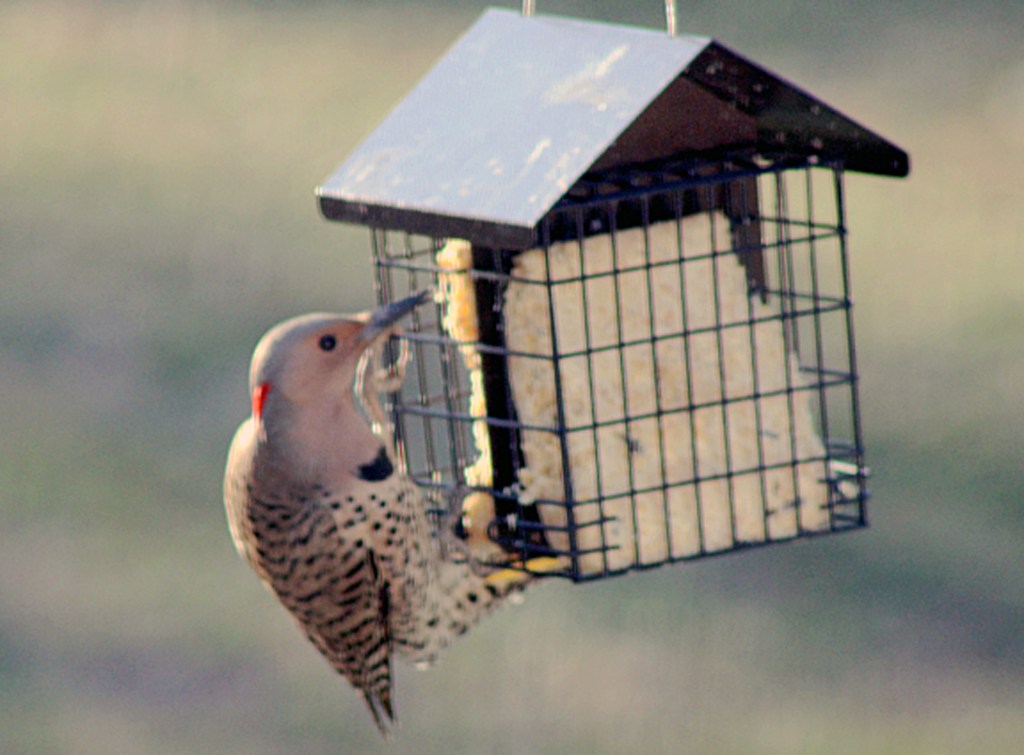
Last night at dinner, Jim told me that he saw our Norther Flicker with the yellow tail and black spots, on the suet, again. He took a photo.

Northern Flicker in our backyard; photo by Jim Crawford

Other woodpeckers, cardinals, robins, and small birds have returned, and though grackles and starlings are still coming daily, we are seeing the large flock, less and less.

Starlings; photo by Jim Crawford

Jim says to me, “You know, grackles and starlings are all part of God’s Creation.”

My experience with my bird project demonstrates to me the inevitable disappointment we experience whenever we try to do something good, no matter how small. Something out of our control will happen! But that doesn’t mean it’s the wrong thing to do—or that we need to change everything about how we are doing it. What we need is a change of heart and a new attitude.

I hope you know that I am not just talking about my birding project, now. This happens with jobs and families, with our callings and in our church families when we do ministry together. Things won’t always go as planned. But new opportunities for ministry open up, and we will later look back with wisdom and insight gained from the experience, and say with gratitude and praise, “Oh, that’s what God was doing!”

Sometimes we who are sighted are blind to the Wonder of God, shining with bright beauty all around us. We need to ask God to open our eyes to the miraculous in our lives, in our church, in our world—to turn our gaze to the blessings of every day.

May you and I permit the Light of Christ to shine through us, moment by moment, so that others may see and know Jesus, and say with all certainty, “Lord, I believe.”

Let us pray.

Holy One, thank you for the Wonder of your Creation—for all the plants, animals, birds, and human beings, formed in your image. Open our eyes, Lord, so that we see people with your eternal perspective, your unconditional love, your lavish grace. Give us a new attitude, when we need it, so that we walk in your ways without stumbling and do your will. Open the eyes of our faith to the miracles of everyday blessings, shining Christ’s Light for all to see through our obedience, kindness, generosity, and service. May we say with all confidence, “Lord, I believe.” Amen.


[1] nature-anywhere.com/blogs/bird-feeding-academy/10-natural-ways-to-keep-grackles-pigeons-starlings-and-other-bird-bullies-from-your-bird-feeder-from-your-bird-feeder2

     [2] Richard Lischer, “Acknowledgement (John 9:1-41)” in Christian Century, 2012.

The Power of One Woman’s Testimony

Meditation on John 4:5–30, 39-42

Pastor Karen Crawford

Third Sunday in Lent

March 12, 2023

Pastor shares her message:

My husband is a big fan of basketball—professional and college. Lots of basketball being played on our home TVs these days. I have been learning about “March Madness.”

But while the games are playing, I look out the window and say, “Look at the purple finches! Look at the red-bellied woodpecker!”

He invites, “Do you want to watch basketball with me?”

I answer, “I have to work on my sermon.”

Jim shared a heart-warming Associated Press basketball-related story with me a few weeks ago. Did you hear about Sister Jean? At age 103, she has published a memoir, Wake Up with Purpose: What I’ve Learned in My First Hundred Years.  [1]  She tells her life story, offers spiritual guidance, and shares lessons learned. “The beloved Catholic nun captured the sports world’s imagination and became something of a folk hero as the chaplain for the Loyola Chicago men’s basketball team that reached the NCAA Final Four in 2018.”

“At my age I’m always happy when I wake up,” she begins her memoir. “My alarm clock goes off each morning at 5 a.m. It takes me a couple of seconds to shake off the cobwebs. Then I sit up quickly. If I don’t, I might fall back to sleep. Can’t let that happen—I’ve got too much to do. First, though, I say a prayer. I put my feet on the floor and sit on the edge of my bed. Oh, God, thank You for bringing me this day and for letting me serve You once again. I then get myself cleaned and dressed and into my wheelchair. I don’t use the chair because I’m old. I broke my hip, and then I got shingles. I am hoping the chair is only temporary, but I’m not complaining. I know I’m blessed to have the chair and the ability to move those wheels, as well as plenty of people who are willing to push me around. Now that I’m clean and settled, I can begin my daily thirty-minute morning meditation.

“I take out my iPad and…study my gospel reading for the day. I guess there aren’t too many 103-year-old nuns using iPads these days—there aren’t too many 103-year-old people, period—but I’m pretty comfortable with modern technology. I’ve always said, if you’re not moving forward, you’re going to get left behind real quick. Adaptability is my superpower…

“When I was studying to be a sister, I learned to set aside time each day to sit quietly and think. Now, if I notice I’m distracted, which is natural, I try to get myself back to God. When you have so much on your mind, it’s easy to be distracted. We’re human beings, after all. Finally, I set aside the iPad and look out the window of my apartment at The Clare, an assisted living facility for senior citizens in downtown Chicago.

“The city is so peaceful at this early hour. There’s a hotel across the street, and I see lights in the rooms start to come on. I think about the people waking up in those rooms, and I pray that they will find joy on this day the Lord has made. I can see a corner of Lake Michigan peeking out from behind the hotel. I call that my piece of the lake. Sometimes, when the water is nice and calm, I can see sailboats out there. I think about those people on the boats and pray that they will be safe and enjoy their time on the water.

 “As I continue to pray and meditate, I consider my work for the day. …. on what’s going to be good about the day ahead, as well as what I’m not looking forward to. That’s okay, though, because I know whatever problems come up, they will get resolved. I trust that God has His plan in place. … I think we could all be a little happier and more productive if we set aside quiet time, especially at the start of our days… I believe that (God) listens to me as I talk to Him about my friends, my activities, and what I hope to do in my ministry at Loyola. Other times I like to sit by the lake and enjoy the beauties that God has created and shared with all of us. I thank Him for such gifts.

“Along with that time for reflection, I also understand we all need a pat on the back once in a while, including from ourselves. Before I go to sleep each night, I think of all the good things I did that day. That way I know I will wake up happy in the morning. Although, let’s face it, at my age I’m always happy when I wake up. And when I do, I sit up and start my morning ritual all over again, awash in gratitude that once again God has empowered me to wake up with purpose.” [2]

Our Gospel lesson takes us to Jacob’s well in Samaria—where Jesus has purposefully gone, sending his disciples off on an errand. When he asks for a cup of water from a woman who lives in a community that doesn’t “share anything in common” with his own Jewish community, he begins an important theological conversation. This unnamed woman has become famous over the centuries for her work in bringing Samaritans and others who have heard her story to come to know and follow Christ.

Don’t miss that it is scandalous that Jesus is speaking alone with a woman at the well in the middle of the day! Wells are not just places where people draw water. They are social gatherings, where men and women meet and fall in love or have marriages arranged. In Gen. 24:10-27, Abraham’s servant finds a wife for Isaac at Jacob’s well. In Exodus, Moses meets his future wife, Zipporah, at Jacob’s well.

Jesus talks with the woman about her marital status! What is he thinking?? If the number of times she has been married doesn’t cause eyebrows to raise, surely her living with a man who is not her husband will?! He shows himself to be divine when he says he can satisfy “the kind of spiritual thirst, expressed by the psalmist: ‘As a deer longs for flowing streams, so my soul longs for you, O God. My soul thirsts for God, for the living God.’ ” (Ps 42:1-2) [3] The living water “suggests a holy provision of basic human needs and an endless connection to God in Christ. The Samaritan woman may not understand how a request for well water has turned into something deeper, but her appetite for spiritual nourishment is awakened.” [4]

I needed to re-read this passage and the story of Sister Jean yesterday. I was weary and needed to be reminded of my source of joy and refreshment! Not anything in this world! I felt grateful, as I believe the Samaritan woman at the well did, at the end of her conversation with Jesus. The empty water jar is left, forgotten. She who was hiding in shame runs to the city and says with excitement, “Come and see a man who told me everything I have ever done! He cannot be the Messiah, can he?” Her Samaritan neighbors are stirred to meet Jesus because of the power of one woman’s testimony.

“It is no longer because of what you said that we believe,” they say, “for we have heard for ourselves, and we know that this is truly the Savior of the world.”

Jesus saves, dear friends. We merely point out the way! May you be empowered to share your powerful testimony of what God has done. You never know how many lives you have touched. Don’t grow weary of doing well, no pun intended!

Sister Jean, at 103, believes Loyola’s amazing run to the Final Four has given her a “holy opportunity.” “I can’t say I planned to live this long or decided a course of action that would allow it to happen. I just followed my instincts—and my calling to serve God….

 “I meet with the team before every game to offer a team prayer. I also pray with the fans shortly before tip-off. Then I watch the action from my wheelchair right next to the court. From where I sit, I can see everything that happens, including all the instances when the referees make a bad call—and I pray that those guys will get better eyesight.

“Sometimes, the players will stop and hug me on their way off the court. There’s nothing like hugging a sweaty basketball player after a big win. I may be an old nun, but I know my hoops. “On the day after each game, I send emails to the coaches and players offering my analysis of the game and a scouting report for our upcoming opponent….”

In the spring of 2018, Sister Jean reached a level of notoriety when her Ramblers made a Cinderella run to the Final Four of the NCAA tournament. “Every time we took the court, we were the underdogs,” she writes, “but our guys showed such great fight and teamwork.” They won four straight games. With each win, the press developed a bigger fascination with the old nun in a wheelchair wearing a maroon and gold scarf and Nike sneakers with the words ‘Sister’ and ‘Jean’ stitched onto them.

“By the time we all arrived in San Antonio for the Final Four, I was such a big deal that the NCAA set up my own press conference. They told me afterward I drew more reporters than Tom Brady did at the Super Bowl. At one point, a reporter asked how it felt to be a national celebrity. ‘International celebrity,’ I corrected. … This nun was flying.”

The tournament ended with their loss to Michigan in the Final Four. “I was disappointed, of course, but I was so thrilled for what those players and coaches had accomplished… I believe this was all a part of God’s plan.

“All I ever wanted to do was serve God, and my way of doing that has been to work with young people to educate them, encourage them, give them spiritual guidance, and help them live out their dreams…”

What are her plans for the next 100 years? “I hope to do what I’ve always done: use my words to help others learn, grow, serve God, and serve one another.” She hopes when people read her book, they will be able to wake up the way she does.

“I want them to wake up happy. I want them to wake up with purpose.

“And I want the Ramblers to win.” [5]

Let us pray.  Holy God, thank you for your wonderful plan for all of us. Help us to seek you in the morning and quench our spiritual thirst with your Living Water. Guide us so that we walk with you and become more like your Son. Give us courage to speak to those who are marginalized and share your unconditional love and grace. Empower us to wake up each day with hope and a godly purpose—to learn, grow, serve and know you more, and love one another. Amen.


     [1] Luis Andres Henao, “At 103, Sister Jean publishes memoir of faith and basketball.” AP,

 February 16, 2023.

      [2] Schmidt, Sister Jean Dolores. Wake Up With Purpose! (pp. vii-x). Harper Select. Kindle Edition.

     [3]  Andrew Nagy-Benson, Connections (Year A Vol. 2), p. 72.

     [4] Ibid.

     [5] Schmidt, Sister Jean Dolores. Wake Up With Purpose! (pp. x-xiv). Harper Select. Kindle Edition.

Chickadees!

Devotion for Second Week of Lent 2023

Pastor Karen Crawford

First Presbyterian Church of Smithtown, NY

Pastor Karen sharing her Lenten Devotion, Chickadees!:

Barbara Almstead photo, used with permission from Butterfly Garden of the Soul at https://www.facebook.com/butterflygardenofthesoul

“In Walden wood the chickadee
Runs round the pine and maple tree
Intent on insect slaughter:
O tufted entomologist!
Devour as many as you list,
Then drink in Walden water.”

– Ralph Waldo Emerson
Fragments on Nature and Life

https://discoverpoetry.com/poems/chickadee-poems/

Hello there!

My window is open in my office, overlooking my front yard. And though I cannot see any birds from this view, I can surely hear them. One of my favorites is calling right now, “Chick-a-dee-dee-dee!”

I can listen to these sweet songbirds all day long and never get tired of their voices, especially in this noisy environment of our Long Island suburb; traffic, planes, and trains roar by at all hours of the day and night. But when the sun rises, the chickadee is one of the first birds, along with the dark-eyed juncos, to visit the bush by my back door and the tube feeder beside it.

My name is Karen Crawford. I am the pastor of First Presbyterian Church of Smithtown, NY. I live in St. James with my husband and one of our sons, a cat named Liam, and a toy poodle named Minnie. Throughout Lent, I am posting weekly devotions to inspire my flock to joy and wonder about God’s Amazing Creation, as part of a doctor of ministry project with Austin Presbyterian Theological Seminary.

Their full name is “Black capped chickadee,” and, unlike some birds, they look and sound like their name. They range in size from 4 ½ inches to just under 6 inches, with the males slightly larger and longer than females. Also, unlike other birds, the males and females have the same color patterns. The male Chickadee isn’t flashier than the female. In addition to the black cap, they have a kind of black bib and short beak. Their bodies are white, rusty brown, and grey, with a slate gray tail.

I was talking to my friend, Peg, the other day about how much I like the Black-capped chickadees, but I am not sure if I also have Carolina chickadees, which look like the Black-capped, but are smaller. My birds look like teeny tiny balls! The Carolina Chickadees’ range includes our area but doesn’t go as far north as the Black-capped chickadees. The most obvious difference between the two species is that the Black-capped chickadees have white on their wings.

Scientists have been seriously studying the songs and calls of Chickadees since the mid 1970s. They have identified 13 distinct types of vocalizations that communicate different kinds of information. This information includes the “pecking order” of the birds, says writer Li Shen in the May 11, 2009 story, “Chickadees: What They Say and Why They Say It” at the Northern Woodlands website. “For example, the call that sounds approximately like “t-seedl-deet” is given by a bird higher in the order to warn off a lower-status bird. It would mean something like, ‘Buzz off! or ‘This is MY food!’ The chatter call, a rapid “chi-chi-chi-chi,” is given by the dominant bird, when it has driven off a subordinate, as if it were saying, ‘That’ll teach you!’  A short “czeet” whistle may serve to keep other members of a flock together while a particular bird is foraging—as if it were saying, ‘Here I am.’

Li Shen goes on, “Other calls respond to danger.  The high ‘zee’ warns of a fast-approaching predator, while the familiar ‘chickadee-dee-dee’ is used for a more stationary predator. Ornithologists have determined that the number of ‘dees’ increases in proportion to the threat. Thus, a chickadee will deliver perhaps five ‘dees’ when threatened by a large slow-moving predator bird, but as many as 23 ‘dees’ when endangered by smaller, quick and agile birds. The “chickadee-dee” call is used by chickadees as they gang up to scold a predator.”

This tells me that this tiny, adorable bird is bold and courageous to be willing to scold larger predators.

Barbara Almstead photo, used with permission from Butterfly Garden of the Soul at https://www.facebook.com/butterflygardenofthesoul

The songs and calls and cute appearance of these birds have inspired writers of prose and poetry, such as Hilda Conkling’s “Chickadee.”

The chickadee in the appletree
Talks all the time very gently.
He makes me sleepy.
I rock away to the sea-lights.
Far off I hear him talking
The way smooth bright pebbles
Drop into water . . .
Chick-a-dee-dee-dee . . .

The Black-capped chickadee is the state bird of Maine and Massachusetts and the provincial bird of New Brunswick.

Reader’s Digest: “A Welcome Sign from Every State in America.” Photo by VISIONS OF AMERICA/JOE SOHM/GETTY IMAGES

In 2014, the Black-capped chickadee was named the official bird of Vancouver for 2015. In 2022 the Black-capped chickadee was named the official bird of Calgary, Alberta. The bird is prominently featured on the standard Maine license plate, as well as welcome signs on major roadways in Massachusetts.

Barbara Almstead photo, used with permission from Butterfly Garden of the Soul at https://www.facebook.com/butterflygardenofthesoul

Although I am not an old movie expert, I do faintly recall a 1940 movie called, “My Little Chickadee,” a Western, staring Mae West and W.C. Fields. If I remember correctly, this was his nickname for Mae, who plays a singer from Chicago named Miss Flower Belle Lee. She is traveling on a stagecoach when she and other passengers are held up by a masked bandit. Mae has a fling with him and ends up being hauled before a judge. Wikipedia tells the story like this. “Offended by her indifferent manner, the judge asks angrily, ‘Young lady, are you trying to show contempt for this court?’ She answers, “No, I’m doing my best to hide it!'” She’s then run out of town and hops a train to Greasewood City, where it picks up conman W.C.Fields. He convinces her to marry him, persuading her that he is rich, when he really isn’t. I wonder if Fields’ character understands how bold and courageous Chickadees are when he calls Mae West, “My Little Chickadee”? Probably not. Knowing Mae West to be bold, brave, funny, saucy, and clever, she plays the Chickadee part 100% accurately.

Chickadees stay with us year-round. They are permanent residents, who get to know their habitats and wildlife and human neighbors. When I go out to fill my feeders, at least one Chickadee stays nearby to eat or watch from a bush while I am pouring seed into the hoppers. I think he or she is anticipating how the meal will taste—and they don’t want to be late for the meal or share it with another hungry bird or squirrel. It amuses me how they take one sunflower seed from the feeder, quickly fly back with it into the bush to hammer it and eat it, and then return to the feeder for another. Black- oiled sunflower seeds seem to be their favorite, but they also love insects, especially caterpillars, and berries.

It’s remarkable the way that Chickadees, like squirrels, will bury their uneaten food in various sites to save for later. They bury their food under “bark, dead leaves, clusters of conifer needles, or in a knothole” in a tree. (Wikipedia) Miraculously, unlike the squirrels, they have a long memory of where they have hidden their stashes. They go back and dig them up and eat them later.

Chickadees are not exclusive to their kind. They will flock with other birds, such as the tufted titmice, warblers, and nuthatches. One of the most unusual things about them is that they are able to withstand the cold temperatures of winter by lowering their own body temperatures as much as 12 degrees Celsius to conserve energy.

I have heard from various sources that Chickadees may be taught to eat from our hands. A lady on Youtube makes her own suet with peanut butter, corn meal, lard, and sunflower seeds, and we watch as a Chickadee feeds from a ball of suet in her outstretched hand. I confess, I am not ready to hand feed the birds. I am not sure that I am ready to be that up close and personal with those sharp beaks or to encourage the birds to chase after me for food.

But knowing this about Chickadees, how they may be tamed and taught, makes me admire them even more and praise the God who created them.

 I have this feeling, when they are watching me fill up the feeders, that they trust me and that maybe they WOULD eat right out of my hand, if I had a ball of homemade suet with peanut butter to offer them. I provide food for them every day, no matter the weather, to supplement what they can find in nature. I bundle up with boots and coat and head out the back door, even when it rains or snows. I come out with fresh fare—pouring the leftovers onto the ground for the doves and squirrels and restocking with new. I have heard that mold can grow on soggy seed and this can be toxic to birds. And believe me, these birds know the difference between stale, wet seed and fresh out of the bag seed. Like human beings, they have their preferences.

When I think of how the Chickadee trusts me, I think of what a big responsibility we have as human beings to gently care for our wild bird neighbors and to consider their needs, as well as our own.  But didn’t the Lord God give that responsibility to the first human beings when God Created the Garden and created man to till it and keep it? With every tree that is cut down and shrubs, vines and brambles removed, we are altering their habitat. We do this on Long Island, without thinking how it might affect the wildlife. We are all about pretty, tidy green lawns. Everything has to be perfect! I see heavy equipment in the fall and spring, with crews of lawn workers clearing off my neighbors’ tall trees and overgrowth, and reseeding the grass. In a matter of days, the homeowners have what appears to be a brand new, manicured lawn, free of weeds and vines. When we remove that overgrowth, we are taking away the homes, nesting and perching places, and food sources for many creatures, such as the friendly Chickadee. This is a good reminder that what people see as “perfect” may not be God’s intention for the Good Creation God has made. Let that encourage you when you talk yourself out of pulling weeds or blowing away the dead leaves, full of nice insects for our feathered friends to eat.

 And I think of how God wants us to trust, like the Chickadee, the One who provides for all our needs—body, mind, and soul–every day. There’s nowhere we can go to flee from God’s presence! During this Lenten season, I hope you will recall that God doesn’t want us to be afraid when we approach our Heavenly Parent in prayer. God wants to know us, just as we are, with all our strong personalities and sauciness like Mae West. And God wants to be known by us! Our sins have been forgiven! Our Good Shepherd has claimed us as His sheep through the cross and baptism.

God wants to hear everything—all of our many unique calls and songs—and assure us that we are safe, firmly in the grasp of the Master’s hand in this world and in the life to come. Nothing we can do can put us in danger of being separated from the One who loves with an everlasting, unconditional love.

We are forever God’s little Chickadees.

Will you pray with me? Let us pray.

Holy One, thank you for the marvelous Chickadee, with its adorable appearance that inspires poetry and cinema, its brilliant calls and songs, which lift our spirits throughout these winter days. Thank you for the opportunity to feed the hungry Chickadees and the way they teach us about trusting the source of our daily nourishment, for body, mind and soul. You alone are our God, our Provider and Protector. Thank you for your Word and Spirit that guide and strengthen us each day and for your everlasting, unconditional love. Amen.

Practical Resources for Churches

Everyone has a calling. Ours is helping you.

Consider the Birds

Pastor Karen shares thoughts on faith, scripture, and God's love and grace revealed through backyard wildlife.

F.O.R. Jesus

Fill up. Overflow. Run over.

Becoming HIS Tapestry

Christian Lifestyle Blogger

Whatever Happens,Rejoice.

The Joy of the Lord is our Strength

Stushie Art

Church bulletin covers and other art by artist Stushie. Unique crayon and digital worship art

The Daily Post

The Art and Craft of Blogging

WordPress.com News

The latest news on WordPress.com and the WordPress community.