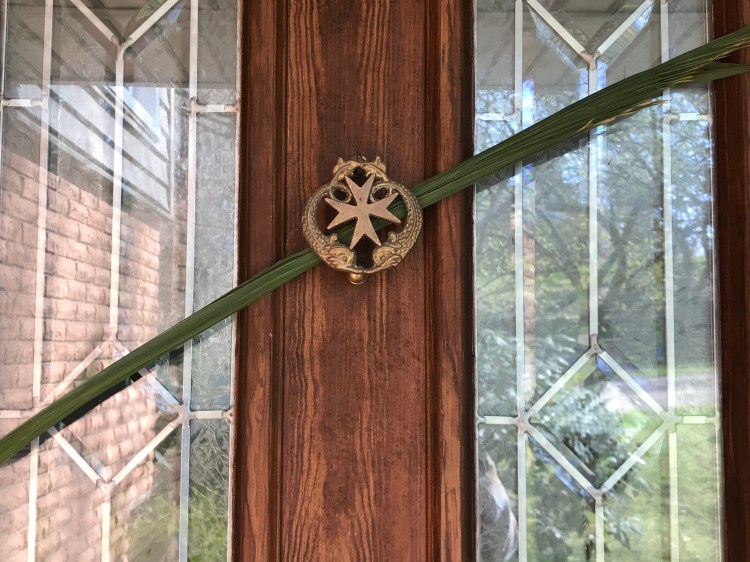
Thank you, Grace, for the gift of a palm leaf for Palm Sunday! God bless you all!
Rev. Dr. Karen E. Crawford, Pastor
Thank you, Grace, for the gift of a palm leaf for Palm Sunday! God bless you all!
Meditation on Matthew 21:1-11
Pastor Karen Crawford
The Presbyterian Church
142 N. Fourth St., Coshocton, OH 43812
April 5, 2020

When they had come near Jerusalem and had reached Bethphage, at the Mount of Olives, Jesus sent two disciples, 2 saying to them, “Go into the village ahead of you, and immediately you will find a donkey tied, and a colt with her; untie them and bring them to me. 3 If anyone says anything to you, just say this, ‘The Lord needs them.’ And he will send them immediately.” 4 This took place to fulfill what had been spoken through the prophet, saying,
5 “Tell the daughter of Zion,
Look, your king is coming to you,
humble, and mounted on a donkey,
and on a colt, the foal of a donkey.”
6 The disciples went and did as Jesus had directed them; 7 they brought the donkey and the colt, and put their cloaks on them, and he sat on them. 8 A very large crowd spread their cloaks on the road, and others cut branches from the trees and spread them on the road. 9 The crowds that went ahead of him and that followed were shouting,
“Hosanna to the Son of David!
Blessed is the one who comes in the name of the Lord!
Hosanna in the highest heaven!”
10 When he entered Jerusalem, the whole city was in turmoil, asking, “Who is this?” 11 The crowds were saying, “This is the prophet Jesus from Nazareth in Galilee.”
***
When you were a kid, what did you want to be when you grew up? I will tell you about me. Promise not to laugh, OK? First, I fell in love with reading books and thought I wanted to be a writer. Later, I read James Herriot’s All Creatures Great and Small. Have you read that book or watched the TV series? Being an animal lover, I decided I was going to be a rural vet like Dr. Herriot. The funny thing about my goal, well, there’s lots of funny things about it, since I am scared of blood and big dogs, let alone farm animals, but the funniest thing to me now, looking back, was that Herriot’s story about rural veterinary medicine in the 1940s was anything but glamorous or remotely comfortable. What was I thinking???
Herriot begins All Creatures by sharing the story of his helping a cow with a difficult birth. This was 7 months after the Scottish vet arrived to practice fresh out of school in the rural Yorkshire dales.
“They didn’t say anything about this in the books, I thought, as the snow blew in through the gaping doorway and settled on my naked back,” he writes. “I lay face down on the cobbled floor in a pool of nameless muck, my arm deep inside the straining cow, my feet scrabbling for a toe hold between the stones….Snow mingled with the dirt and the dried blood on my body. I could see nothing outside the circle of flickering light thrown by the smoky oil lamp which the farmer held over me. No, there wasn’t a word in the books about searching for your ropes and instruments in the shadows; about trying to keep clean in a half bucket of tepid water; about the cobbles digging into your chest. Nor about the slow numbing of the arms, the creeping paralysis of the muscles as the fingers tried to work against the cow’s expulsive efforts. There was no mention anywhere of the gradual exhaustion, the feeling of futility and the little far-off voice of panic.
“My mind went back to that picture in the obstetrics book.. A cow standing in the middle of the gleaming floor while a sleek veterinary surgeon in a spotless overall inserted his arm to a polite distance. He was relaxed and smiling, the farmer and his helpers were smiling. There was no dirt or blood or sweat anywhere.
“That man in the picture had just finished an excellent lunch and had moved next door to do a bit of calving just for the sheer pleasure of it, as a kind of dessert. He hadn’t crawled shivering from his bed at 2 o’clock in the morning and bumped over 12 miles of frozen snow, staring sleepily ahead till the lonely farm showed in his headlights. He hadn’t climbed half a mile of white fell-side to the doorless barn where his patient lay.
…. “There is always a time at a bad calving when you begin to wonder if you will ever win the battle. I had reached this stage.”
Well, I never became a rural vet, of course, but I never lost the desire to reach out to people where they live, hear their stories, walk in their shoes, and bring help and healing, of the spiritual kind. That’s my calling as a rural minister here in Coshocton. And these past few weeks, after we closed the doors of the church for health and safety, and I had to learn to minister outside the box, so to speak, I have had James Herriot moments, when I think, “Seminary didn’t prepare me for ministry in a pandemic. Forget Calvin, Barth and Luther! What’s going on here?!”
No, it isn’t helping birth a calf in the dead of winter, in the middle of the night, in the 1940s in the Yorkshire dales. But the feelings of helplessness, anxiety, and uncertainty are pretty close as I take, sometimes, faltering steps forward to do God’s work in this strange new world.
But I also know that the Spirit is still working in me, using all things for good. The Lord is teaching and growing us as His children. Amen? He is strengthening our faith and making us realize what’s really important. It’s not the building, is it? It’s not the kind of music we sing. Ministry is about communicating the gospel so that people can understand, accept, and receive it. For God came down to us as one of us—in the form of fragile humanity—to show us the way back to Him.
And ministry isn’t just about communicating with words during a worship service on Sunday; it’s about what we do the rest of the week, every day, how we embody the gospel of Jesus Christ, our gentle, humble Savior.
This Palm Sunday reading in the gospel of Matthew is often labeled in our Bibles as “Jesus’ Triumphal Entry.” Is that what it says in your Bible? Unfortunately, the editors missed the point of this passage. This isn’t a triumphal parade or a protest march. This is our humble King of Kings, so unlike any king or ruler or leader in our world today or of any age. So many things reveal his humility—his silence during this journey, with only his followers singing his praises. Hosanna means, “Save us!” It’s both a cry of need and the joyful announcement that the Savior has come, the long-awaited Messiah, the Christ, the Anointed One of God.
His followers have been walking with him a long time. They aren’t well dressed, and they aren’t used to being heard. They are those who have been healed from sickness and disease, those formerly possessed by demons. They are those whom Jesus fed and taught the good news of the Kingdom—the poor, marginalized, despised and outcast. The ones Jesus said are “blessed.” They aren’t waving some exotic form of plant—it’s exotic to us who don’t live in a tropical climate. Palm branches just happened to line the road where the people walked. But Matthew doesn’t say they are palm branches—and neither do Mark or Luke. They could have been other trees native to the area. It’s kind of like us waving branches from our maple, oak, and pine trees or forsythia, rhododendron or flowering quince.
His mode of transportation further demonstrates his attitude and purpose in coming to Jerusalem. This is one of the miracles of the day that we could miss in a cursory reading—that Jesus, who must have been an animal lover, a sort of donkey whisperer—was able to ride a colt that had never been ridden before. To an audience living in an ancient, agricultural society, this would have been a BIG deal. Nobody, especially a king or ruler—anyone who didn’t want to make a fool of himself—rides an unridden colt.
This is to fulfill the Old Testament prophecy of Zechariah, “Tell the daughter of Zion, Look, your king is coming to you, humble, and mounted on a donkey, and on a colt, the foal of a donkey.”
Friends, we have reached a critical point in our Lenten journey. We have begun Holy Week. There’s no turning back from this path. We are on the road to the cross with Jesus, where he will show his love and obedience to God by humbly giving his life, paying the price for our sins. He is riding on with no other purpose except to suffer and die for the sake of the world. But the story doesn’t end at the cross, either. We are also Easter people, people of hope amidst darkness and despair, who will rise up from ashes and death to live new and abundant lives with Him.
You may feel frustrated or afraid during these anxious, uncertain times. You might feel angry. You may feel sad and grieve. It’s OK to feel all these things. It’s OK to feel everything and to share your feelings with others. It’s OK just to be human, as God made us. For the Lord created us so that we would be in fellowship with Him and depend on Him and not ourselves. As Psalm 46 encourages us, “God is our refuge and strength, a very present help in trouble. Therefore we will not fear, though the earth should change, though the mountains shake in the heart of the sea; though its waters roar and foam, though the mountains tremble with its tumult.”
We might not be able to see one another right now, face to face, or give each other a hug, but we are growing in love and grace. We are learning to expect less than perfection of ourselves and our situations in life. We are learning gratitude for all God’s blessings—too many to name—our families, friends and neighbors and, yes, our Church. We are moving closer to one another because of this crisis and we are drawing nearer to God. Our hearts are changing. We are becoming more like His Son!
United by the Spirit, together in faith, we admit our need for our humble healer—in good times and hard times like these. We confess our need for our gentle Redeemer, who chose not a horse, but a donkey, the foal of a donkey, to ride to Jerusalem and bring salvation to the world.
Together we cry, believing God will deliver us, “Hosanna! Save us, Lord!”
Let us pray.
Holy One, Hosanna! Save us, Lord! We thank you for your Son, whom you sent to redeem us from our sins and lead us back to you. Our King of Kings shows us how to be humble and gentle, riding the colt of a donkey, as the prophet said, to bring salvation to Zion and all the world. He didn’t blast a trumpet or arrive in triumph. That wasn’t your plan. And his followers were not the wealthy and elite of his society, but the outcast and marginalized, who had experienced God’s grace, compassion and healing and recognized that their Messiah had come. Lord, we thank you that we can count on you to be our refuge in anxious, uncertain times like these. And that while everything around us seems to be changing, you are always the same Lord. Your steadfast love never ceases and we can rely on you and your mercies that are new every morning. Draw us nearer to you and help us to become more faithful, gentle, and humble, like your Son. In His name we pray. Amen.
“Be Like Jesus”
The Presbyterian Church of Coshocton, OH
Palm Sunday: April 5, 2020
Pastor Karen Crawford

The Presbyterian Church, Coshocton, OH
Pastor Karen Crawford
April 5, 2020
Prelude: Do Not Be Afraid Glory to God Hymnal #76
Sarah Heading, Soloist; Caroline Heading, Pianist
Refrain: Do not be afraid, for I am with you. Chosen and beloved, you are my own. Do not be afraid, for I have redeemed you: by your name I called you for my own.
Listen to Do Not Be Afraid:
Listen to my Greeting and Call to Worship:
Call to Worship (based on Psalm 118)
Sing our hymn with Caroline’s music; words below:
Hymn: Hosanna Loud Hosanna Caroline Heading, Piano
Hear me leading the call to confession, prayer of confession and assurance:
Call to Confession
Prayer of Confession
Lord, you hold nothing back, not even your Son. The lengths you will go to be in relationship with us are astounding. Jesus pours himself out for our sake and enters Jerusalem in order to take upon himself the sin of the world. Yet, we fail to respond with gratitude. We neglect to hear and heed your saving Word. We turn aside from your way and withhold that of which you have need. Forgive our fleeting faithfulness and our hollow shouts of Hosanna. Humble us, turn us toward you, help us to look to the interests of others, shape us into a closer imitation of Christ, our Savior. Amen.
Assurance of Pardon (based on Isaiah 50).
Time with Children and Youth!
Watch my message for children and youth:
Prayer for Illumination
Audio of prayer for illumination and scripture reading:
Scripture: Matthew 21:1-11
This is the gospel of the Lord. Praise to you, O Christ.
Meditation Humble King on the Colt of a Donkey
Video of my message:
Musical Meditation: Jesus Paid It All Caroline Heading, Piano
Audio of Caroline playing Jesus Paid It All:
Hear me leading the affirmation of faith, sharing joys and concerns, prayers of the people, Lord’s Prayer and Prayer of Thanksgiving/Dedication for our gifts to the Lord:
Affirmation of faith (The Apostles’ Creed)
I BELIEVE in God the Father Almighty, Maker of heaven and earth, And in Jesus Christ his only Son our Lord; who was conceived by the Holy Ghost, born of the Virgin Mary, suffered under Pontius Pilate, was crucified, dead, and buried; he descended into hell; the third day he rose again from the dead; he ascended into heaven, and sitteth on the right hand of God the Father Almighty; from thence he shall come to judge the quick and the dead. I believe in the Holy Ghost; the holy catholic Church; the communion of saints; the forgiveness of sins; the resurrection of the body; and the life everlasting. Amen.
Sharing Joys and Concerns
Dear friends, I invite you to email me your joys and concerns to karenpts@gmail.com and let me know if you want me to put your concern on our prayer list or just pray in my personal prayers. My joy is that my family is well and that we—you and I—are still able to come together for worship of our Living God.
Prayers of the People
Lord, your word sustains the weary. You bind up the brokenhearted and bring good news to the poor. As you enter into the chaos of Jerusalem, we trust you come to us in whatever turmoil we are experiencing. Even as some of us shout our praises, others among us cannot even murmur a word of hope. You see us all, lined up by the road, isolated in our homes, incarcerated or incapacitated, worried about our loved ones and those who are ill, exhausted from caring for the sick and laboring at essential work, and you are moved with compassion. You come to Jerusalem, getting ever closer to the cross, pouring yourself out in order to bring forgiveness, reconciliation and salvation.
Seeing you, humble, riding on a donkey, vulnerable and unwilling to turn away from suffering, we are bold to pour ourselves to you, crying, “Hosanna!” and “God, help us!” We do not know how to voice our deepest needs or fears or hopes or longings, yet you know them all before a word is on our tongues. We cast everything before you, Lord of all, trusting your promise of an easy yoke and a light burden. We call out for healing for the sick, relief for the suffering, justice for the oppressed, relief for the exhausted, hope for the downtrodden and comfort for those who mourn.
As we wonder what will come next, as we struggle with countless uncertainties and mounting anxieties, we look to you, the blessed One who comes in the name of the Lord, for help, for assurance and for the peace that passes understanding. As we draw close to you and attempt to follow, even to the cross, we rejoice in your near presence. We give thanks for your selfless sacrifice. We give thanks for the health care professionals, the grocery store workers, the frontline responders. We remain grateful for all of those on the Way with us. United in you, Lord Christ, we will stand together and stand up for those who have fallen by the wayside and walk with those who fear they have been forgotten. Strengthen us for the days ahead so that we will remain faithful to you, your will and your call, until we see you face to face. We make our prayer in the name of Jesus Christ, who taught us to say when we pray…
The Lord’s Prayer
Our Father who art in heaven, hallowed be thy name! Thy kingdom come, thy will be done on earth as it is in heaven. Give us this day our daily bread, and forgive us our debts as we forgive our debtors. And lead us not into temptation but deliver us from evil. For thine is the kingdom and the power and the glory forever. Amen.
Call for the Offering
Like that day long ago, we welcome Jesus to Jerusalem, waving palm branches, throwing our cloaks on the road, and giving him our gifts in joyous response to his entry into the world, into Jerusalem and into our lives. Let us worship God with today’s offering and help the Kingdom to grow. I invite you to send your gifts to The Presbyterian Church, 142 N. Fourth St., Coshocton.
Prayer of Dedication
Lord, take our gifts, offered in gratitude, never adequate, but in your grace, always blessed, multiplied and used to show your love, compassion and care. May the resources you have entrusted to us, freely given to you, make visible here and now Jesus’ timeless mission of justice and mercy. Amen.
Charge/Benediction
Listen to my closing remarks, charge and Benediction:
Postlude: What Wondrous Love Is This Caroline Heading, Piano
Listen to Caroline playing What Wondrous Love Is This:
© Presbyterian Outlook, 2020. Liturgy written by Jill Duffield and provided for free distribution.
April 3, 2020
Pastor Karen Crawford
The Presbyterian Church of Coshocton, Ohio
Dear friends,
I miss you so much! I hope you are doing well. Because of our inability to safely gather for worship and other groups for health and safety reasons, I will be sending out a newsletter to you each week giving you updates on what is happening with the church. It will be a way for me to stay connected with you! You may respond directly to my email with questions, prayer concerns, requests or needs, or just to let me know how your family is doing. I welcome your at home photos! It would be neat to share some of them in our electronic newsletter each week. Those who do not have email, will receive a paper copy in the mail.
Happy birthday today to Bill Gill and Louise Mickelson, Nala Layton on Saturday, and Julie Smith on Sunday! Happy belated birthday to Jo Kaser (April 1) and Tom Magness (April 2).
Happy anniversary to Lance and Dawn Fulks (April 4)!
Some of you have already received a check-in phone call from me. If you haven’t already, will you put my number into your contact list so you don’t think I am a pesky telemarketer when I call? My number is 321-634-4870. I am calling to say hello and ask if you need anything, and to be available for prayer, questions, storytelling–whatever will help you during this difficult time. Consider it a “home visit.” I just want you to know that I am still your pastor and we are still the Church together, no matter what happens in the world around us. Praise the Lord and rejoice always!
Worship online will continue this Sunday for Palm Sunday through my blog: pastorkaren.org and through links or video posts at the church Facebook site, as well as my Facebook site. For the first time ever, I will be sharing my messages with you from my home. Yes, it feels strange to me, too. But we will continue to worship, including on Maundy Thursday and Good Friday evenings, in spite of our not being able to gather together in our building. Praise the Lord that we are able to do this!
Those who ordered Easter flowers will still receive them! They will be delivered on Good Friday to the church and will be available for pick up outside the chapel entrance beginning around noon. Contact John Addy to make other arrangements for delivery if you are not able to be there for pick up.
Here is a link to one of my audio devotions this past week:
https://pastorkaren.org/2020/04/02/i-thank-my-god-every-time-i-remember-you/
Here is a link to last Sunday’s message–text, audio and video and bulletin. I read a story to the children, as well.
https://pastorkaren.org/2020/03/29/i-am-the-resurrection-and-the-life/
God bless you and keep you in His tender care!
Love,
Pastor Karen
Rev. Karen Crawford
The Presbyterian Church
142 N. 4th Street
Coshocton, OH 43812-1581
740-622-0486 • presbyteriancoshocton.org
God’s love is here for you!
April 2, 2020 Devotion
Pastor Karen Crawford
The Presbyterian Church, Coshocton, Ohio

Hear me sharing my devotion by clicking on this link:
Hello, friends!
How is today going for you? Hope everyone is well in your family. Do you need anything? Please let me know.
I had a good day yesterday—a feeling of peace in my heart that stayed with me. Looking back, I think it is because I was more focused on others most of the day, instead of thinking about my own situation or worrying. Worrying takes a lot of energy, doesn’t it? If you find yourself doing that, remind yourself that those anxious thoughts aren’t from the Lord and they aren’t good for you. And then do something to help someone else.
What did I do yesterday? My morning devotions, prayer, meals with my husband, Jim, and phone calls to members of our congregation. The funny thing was that so many of them said, “Who?” when I identified myself. Now, it could be that I have a 3-2-1 exchange and many people mistake me for a telemarketer, at first. But I think they were also surprised to hear from me because they weren’t my regular pastoral calls. They were people that God placed on my heart to call and say, “How are you? Do you need anything? Is everything OK in your family?” And, of course, I said to each one, “I miss you,” and “I look forward to when we are gathered together, once again, in worship.”
In the evening, I had a wonderful Zoom video conversation with the confirmation students and their mentors. They shared how they are feeling, as well as scriptures that are encouraging to them today. And they shared their prayer requests, which I wrote down and promised to pray for every day.
The apostle Paul wrote many letters to his churches when he was far away and sent them by personal messenger. He told them about his personal situation, which was usually difficult, to try and help them with their ministry, build up their faith, and share his affection. He always promised to pray. He wrote to churches no matter what was happening in his life. This included the numerous times that he was in prison isolated from the world and the people he loved because he shared with others about our Risen Lord.
In Philippians 1:2-6, he writes, “Grace to you and peace from God our Father and the Lord Jesus Christ. I thank my God every time I remember you, constantly praying with joy in every one of my prayers for all of you, because of your sharing in the gospel from the first day until now. I am confident of this, that the one who began a good work among you will bring it to completion by the day of Jesus Christ.”
The Scripture is still as relevant today as it was thousands of years ago in Paul’s time. We are isolated and struggling to encourage one another and build each other up in the faith. We aren’t in prison, but we don’t have the freedom of movement that we are used to. Let us keep reaching out to one another in various ways, praying for one another, and sharing God’s love and many promises, which He will be faithful to keep.
Listen again to this one: “I am confident of this, that the one who began a good work among you will bring it to completion by the day of Jesus Christ.” God’s not finished with us, yet. He loves us the way we are, but He loves us too much to leave us the way we are. The Lord is working in our hearts, transforming us, and in our midst as we seek to serve Him and others. Hold onto the promises of God’s Word and reach out with God’s love and compassion to your neighbor today. And may you be blessed with God’s peace and joy.
Remember, I am praying for you and thanking God for you. You are always in my heart.
Let us pray. Holy One, thank you for the promise that You who have begun a good work in and among us will bring it to completion by the day you return for your Church. Keep us focused on serving you and caring for others and not slip into worry or fear. Open our hearts to hear your voice today and respond obediently, just as your Son was always obedient to you when he came to save us from our sins. It’s in His name we pray. Amen.
Music: “I Know Who Holds Tomorrow” by Alison Krauss, The Cox Family.
Devotion for March 31, 2020
Pastor Karen Crawford
The Presbyterian Church of Coshocton, Ohio
If you click on the audio, you will hear my voice.
Hello, friends!
How are you, today? I miss you so much! I hope you are well and staying safe and healthy. I look forward to when we are gathering together in person, face to face, once again.
Since we can’t be together right now, I want to share a virtual word of encouragement.
While having my coffee this morning, I looked out my kitchen window and smiled when I saw the neighbor’s black cat at my bird feeders. I have never seen him actually catch a bird. He is well fed and cared for by his owners. It’s more like entertainment for cats to watch my feeders—television for felines.

But he wasn’t looking up at the birds this time. He was staring down at the ivy-covered soil behind them. He was very still—every muscle in his body tense. I know he was waiting for an appearance of a chipmunk. I know because I have seen chipmunks often running through the ivy there, sometimes eating seed from the feeders.
Funny, a bird landed not too far from the black cat while he was waiting for a chipmunk. He turned his head to look at it, but didn’t stir from his place of waiting. He wasn’t distracted. Soon, he was back staring at the soil. He knew that if he waited long enough, eventually, a chipmunk would pop out of its hole. He would get his reward!
One of my favorite scriptures is Galatians 6:9. “Let us not become weary in doing good, for at the proper time we will reap a harvest if we do not give up.”
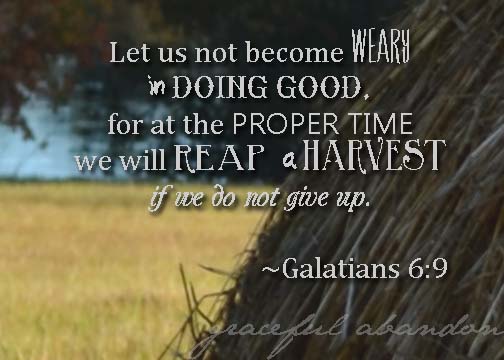
The apostle Paul is teaching the church at Galatia about continuing in the loving and peaceful ways of Christ, even when we don’t see the harvest. Yes, he is talking about patience and waiting while walking the journey of faith, sowing seeds of kindness, though we don’t see the seeds taking root or plants bearing fruit.
It isn’t just the fruit in others we are waiting for. It’s the fruit in ourselves.
I am waiting for God to strengthen me to be patient and do the things he asks me to do each day, without being disappointed or sad. I cannot minister as I am used to ministering since the Coronavirus began disrupting our lives, and we were forced to stay at home for our safety and for the protection of others. It’s very hard to not see the shining faces of my flock every Sunday. I know for you, it’s hard to be isolated from the ones you love.
What are you waiting for God to change in your heart and mind? Because with all this social distancing, it really is a battle of the heart and mind–not growing weary of doing good, even when it isn’t the life we are used to living.
I urge you, today, to not grow weary in the acts of kindness God is calling you to do. Keep on praying for healing and peace for all who are sick and help and protection for those caring for the sick and others having to be out working in the world. Don’t grow weary. Because at the time that God has ordained, we will reap a harvest—and see ourselves and our world transformed.
Let us pray.
Holy One, please heal the sick and help and protect the medical workers and caregivers, and all who must be out in the world each day. Help us to be patient and satisfied with the acts of kindness and goodness that you are leading us to do from our homes, unable to be with others, face to face. Thank you that you are using all of us to plant seeds and nurture one another in faith and love. We look forward to the harvest of peace and transformation of our world. In Christ we pray. Amen.
Music by Kari Jobe: “Be Still My Soul”
Here is a link to the audio and visual of the service this morning:
Here is a link to just the audio for this service, including music and both the children’s and adult’s message:
Here is the link to the bulletin for the order of service:
Meditation on John 11, selected verses
March 29, 2020
The Presbyterian Church of Coshocton, Ohio

11 Now a certain man was ill, Lazarus of Bethany, the village of Mary and her sister Martha. 2 Mary was the one who anointed the Lord with perfume and wiped his feet with her hair; her brother Lazarus was ill. 3 So the sisters sent a message to Jesus, “Lord, he whom you love is ill.” 4 But when Jesus heard it, he said, “This illness does not lead to death; rather it is for God’s glory, so that the Son of God may be glorified through it.” 5 Accordingly, though Jesus loved Martha and her sister and Lazarus, 6 after having heard that Lazarus[b] was ill, he stayed two days longer in the place where he was.
7 Then after this he said to the disciples, “Let us go to Judea again. .. Our friend Lazarus has fallen asleep, but I am going there to awaken him.” 12 The disciples said to him, “Lord, if he has fallen asleep, he will be all right.” 13 Jesus, however, had been speaking about his death, but they thought that he was referring merely to sleep. 14 Then Jesus told them plainly, “Lazarus is dead. 15 For your sake I am glad I was not there, so that you may believe. But let us go to him.” 16 Thomas, who was called the Twin,[c] said to his fellow disciples, “Let us also go, that we may die with him.”
17 When Jesus arrived, he found that Lazarus[d] had already been in the tomb four days. 18 Now Bethany was near Jerusalem, some two miles[e] away, 19 and many of the Jews had come to Martha and Mary to console them about their brother. 20 When Martha heard that Jesus was coming, she went and met him, while Mary stayed at home. 21 Martha said to Jesus, “Lord, if you had been here, my brother would not have died. 22 But even now I know that God will give you whatever you ask of him.” 23 Jesus said to her, “Your brother will rise again.” 24 Martha said to him, “I know that he will rise again in the resurrection on the last day.” 25 Jesus said to her, “I am the resurrection and the life.[f] Those who believe in me, even though they die, will live, 26 and everyone who lives and believes in me will never die. Do you believe this?” 27 She said to him, “Yes, Lord, I believe that you are the Messiah,[g] the Son of God, the one coming into the world.”
28 When she had said this, she went back and called her sister Mary, and told her privately, “The Teacher is here and is calling for you.” 29 And when she heard it, she got up quickly and went to him. 30 Now Jesus had not yet come to the village, but was still at the place where Martha had met him. 31 The Jews who were with her in the house, consoling her, saw Mary get up quickly and go out. They followed her because they thought that she was going to the tomb to weep there. 32 When Mary came where Jesus was and saw him, she knelt at his feet and said to him, “Lord, if you had been here, my brother would not have died.” 33 When Jesus saw her weeping, and the Jews who came with her also weeping, he was greatly disturbed in spirit and deeply moved. 34 He said, “Where have you laid him?” They said to him, “Lord, come and see.” 35 Jesus began to weep. 36 So the Jews said, “See how he loved him!” 37 But some of them said, “Could not he who opened the eyes of the blind man have kept this man from dying?”
38 Then Jesus, again greatly disturbed, came to the tomb. It was a cave, and a stone was lying against it. 39 Jesus said, “Take away the stone.” Martha, the sister of the dead man, said to him, “Lord, already there is a stench because he has been dead four days.” 40 Jesus said to her, “Did I not tell you that if you believed, you would see the glory of God?” 41 So they took away the stone. And Jesus looked upward and said, “Father, I thank you for having heard me. 42 I knew that you always hear me, but I have said this for the sake of the crowd standing here, so that they may believe that you sent me.” 43 When he had said this, he cried with a loud voice, “Lazarus, come out!” 44 The dead man came out, his hands and feet bound with strips of cloth, and his face wrapped in a cloth. Jesus said to them, “Unbind him, and let him go.”
***
Yesterday, we gathered for a small, private family service in our chapel to celebrate the life of John Baird and bear witness to the Resurrection. The decision to gather was made after much prayer, discussion, and careful consideration of our health situation. Although we are sorry that we couldn’t open the service to the church and wider community or have lunch together afterward, the service was a blessing, a gentle time of worship, song, prayer, and sharing stories and healing words. The tiny gathering was a reminder of what the Church is called and empowered to do, by the Spirit, wherever we are. We don’t have to be in the same building to love and serve God and neighbor and share our hope in God’s Son, through whom we have everlasting life.
Today is the Fifth Sunday in Lent! Next Sunday is Palm Sunday, the beginning of Holy Week, already. This day in the church year is sometimes called, “Refreshment Sunday,” as it is like the Third Sunday in Advent, when we light the pink candle and remember that while we are in a season of darkness, preparing for the birth of our Emmanuel, we can also rejoice and celebrate our God who has already come! Here on the Fifth Sunday, as we retell the story of the raising of Lazarus, we cannot help but look ahead to Easter and rejoice in our Risen Lord.
There’s so much here, but what speaks to me in this passage today is Jesus’ conversations and relationship with Mary and Martha. He first talks with Martha, the one without whom he wouldn’t have had that delicious meal at her home in the gospel of Luke because Mary wouldn’t lift a finger to help her. She meets him on the road, not waiting for his to arrive at her home. “Lord, if you had been here,” she says emotionally, “my brother would not have died!”
Still, she hopes against hope! “But even now,” she says, “I know that God will give you whatever you ask of him.” She doesn’t know that this two-day delay was intentional, as Jesus says in verse 4, “for God’s glory, so that the Son of God may be glorified through it.”
Then comes a theological discussion that reminds me of the one he had with the Samaritan woman at the well, who would go on to bring many others to the Lord by her testimony. Jesus wants to make sure that Martha understands his true identity. He has plans for her. He says, “I am the resurrection and the life. Those who believe in me, even though they die, will live, and everyone who lives and believes in me will never die. Do you believe this?” Though this is directed as a question, it is an invitation.
“Yes, Lord,” she says. “I believe that you are the Messiah, the Son of God, the one coming into the world.”
The miracle waits until all the community is gathered, including Mary, who sat at his feet when Jesus came to dinner at her home and hung on his every word. John says this Mary was also the one who poured the expensive perfume on his feet at another dinner party, then wept and wiped them with her hair.
The story of Lazarus unfolds in wonderful detail. When Mary sees Jesus, she says the same thing Martha has said. You can just imagine them repeating those words to one another, over and over, in the days following their brother’s death. “If only Jesus had come. If only he had come in time to heal him.”
And if you are wondering if God really cares about human suffering, then see how Jesus weeps after he sees Mary and her community weeping together. He is “greatly disturbed in spirit and deeply moved.” Our God loves us so much that he hurts when we are hurting. Just like those of you who have children of any age. Don’t you feel terrible when they are sad or suffering? God feels this way about us!
At the cry of, “Lazarus, come out!” the young man is restored to new life. He will never be the same again; nor will his family and community. Those who witness the miracle will believe in Jesus. But some will tell the Pharisees, who worry that if Jesus keeps on doing what he has been doing, “everyone will believe in him and the Romans will come and destroy” their holy place and nation. From that day on, they plan to put him to death.
A dark shadow falls over this day of joy, “Refreshment Sunday,” in our Lenten journey to the cross.
***
But we who have come to know Christ as our Savior, the Light of the World, refuse to allow evil or darkness to intimidate or discourage us. For we know that death doesn’t have the final word!
In this time of 24-hour news reports of sickness and death around the globe, it is tempting to give up hope for a miraculous healing of our world, because we haven’t seen or experienced it, up to now, just as Mary and Martha had never seen Christ raise someone from the dead. Maybe we have already prayed about the world’s healing, but gave up when we didn’t feel our prayers were being answered. Maybe you don’t think your prayers will make a difference.
We could choose to be like Mary and Martha, who sank into despair and blamed the Lord as they laid their brother in a tomb. Why hadn’t he come when they needed him? They didn’t anticipate the miracle that God had planned.
Or, we can use this time to keep moving forward in our walk of faith, drawing nearer to the cross, climbing into our prayer closets, digging into God’s Word, and seeking to follow in the footsteps of our Redeemer, from the comfort of our homes. You and me—we can be a healing balm for the world.
Here’s something that came to me when I was studying this passage. Would it change how we live if we decide right now to live as if we have no doubt that our lives don’t end at the grave? And what if we decide to give up all the plans we were making, filling up our calendars through 2020, and entrust our every moment to the care of our loving Lord?
What if we ask the Lord to reveal the miracles of love, transformation and reconciliation that he is doing every day? Because we serve a God of miracles, who weeps when we grieve and suffers with us.
Reach for the one who proclaims, “I am the resurrection and the life. Those who believe in me, even though they die, will live, and everyone who lives and believes in me will never die.”
He is asking you now, “Do you believe?”
Let us pray.
Holy One, we confess that we have been like Mary and Martha, and have not anticipated the miracles you have planned for us every day. We admit that sometimes we are stuck in our hurt and disappointment when things don’t go our way. Lead us to see the wonderful things you are doing in our midst, your every day miracles, and feel your loving presence with us, wherever we are, so we never feel alone. Teach us how to pray for the healing of the world and work for peace, transformation, and reconciliation as we seek to follow in Christ’s footsteps all the way to the cross. Stir us to let go of the plans that we were making and trust you to lead us in your will and care for us every moment of our lives. In Christ we pray. Amen.
Here is a video of the service:
Here is a link to the sermon text:
https://pastorkaren.org/2020/03/29/i-am-the-resurrection-and-the-life/
Here is a link to the audio of the complete service, including music and children’s and adult messages:
Fifth Sunday in Lent
The Presbyterian Church
142 N. 4th Street, Coshocton, OH 43812
Pastor Karen Crawford
Caroline Heading, Pianist

Prelude “In the Garden”
Greeting/Announcements
Opening Sentences
Thus says the Lord: “I will put my breath within you, and you shall live.”
In gratitude, we praise the Giver of Life.
Jesus says: “I am the resurrection and the life.
In gratitude, we praise the Source of our Being.
We gather to worship the One who frees us from the grave and stirs dry bones to life.
Spirit, come and enliven our worship!
Call to Confession
Prayer of Confession
Holy One, we have set our minds on wrong things—on selfish gain, not generous service; on pursuits that distract, not inspire; on tasks that diminish, rather than give, life. We long to set our minds on eternal things—on your way of mercy and compassion; on paths that lead to justice and peace; on living as people of hope. Spirit of God, dwell in us. Give us grace when we fall short, transform our hearts and renew our minds, and set us free to follow you faithfully.
Assurance of Pardon
Hymn
Time with Children and Youth: The Memory Box: A Book About Grief by Joanna Rowland
Prayer for Illumination
Scripture John 11:1-45
This is the gospel of the Lord.
Praise to you, O Christ!
Message “I Am the Resurrection and the Life” Pastor Karen
Hymn “It Is Well With My Soul”
Blessing
Postlude “The Solid Rock”
Devotion from All God’s Creatures: Daily Devotion for Animal Lovers 2020
Written by Amy Lively
Read by Pastor Karen Crawford, The Presbyterian Church, Coshocton, OH
Those who trust in the Lord will find new strength. They will soar high on wings, like eagles. They will run and not grow weary. They will walk and not faint. (Isaiah 40:31).

Jesus, please grow my faith and teach me to trust you during my wilderness seasons. As I wander and wonder, I am safe in your care. Bring me closer to you with each step. Amen.
Music: “It Is Well With My Soul,” sung by Audrey Assad
Everyone has a calling. Ours is helping you.
Pastor Karen shares thoughts on faith, scripture, and God's love and grace revealed through backyard wildlife.
Fill up. Overflow. Run over.
Christian Lifestyle Blogger
The Joy of the Lord is our Strength
Church bulletin covers and other art by artist Stushie. Unique crayon and digital worship art
The Art and Craft of Blogging
The latest news on WordPress.com and the WordPress community.
 Sharing God's Love and Grace