I Have Seen the Lord!

Meditation on John 20: 1-18

April 21, 2019

Easter Sunday

The Presbyterian Church of Coshocton


Slide46

     20 Early on the first day of the week, while it was still dark, Mary Magdalene came to the tomb and saw that the stone had been removed from the tomb. So she ran and went to Simon Peter and the other disciple, the one whom Jesus loved, and said to them, “They have taken the Lord out of the tomb, and we do not know where they have laid him.” Then Peter and the other disciple set out and went toward the tomb. The two were running together, but the other disciple outran Peter and reached the tomb first. He bent down to look in and saw the linen wrappings lying there, but he did not go in. Then Simon Peter came, following him, and went into the tomb. He saw the linen wrappings lying there, and the cloth that had been on Jesus’ head, not lying with the linen wrappings but rolled up in a place by itself. Then the other disciple, who reached the tomb first, also went in, and he saw and believed; for as yet they did not understand the scripture, that he must rise from the dead. 10 Then the disciples returned to their homes.

11 But Mary stood weeping outside the tomb. As she wept, she bent over to look into the tomb; 12 and she saw two angels in white, sitting where the body of Jesus had been lying, one at the head and the other at the feet. 13 They said to her,  “Woman, why are you weeping?” She said to them, “They have taken away my Lord, and I do not know where they have laid him.” 14 When she had said this, she turned around and saw Jesus standing there, but she did not know that it was Jesus. 15 Jesus said to her, “Woman, why are you weeping? Whom are you looking for?” Supposing him to be the gardener, she said to him, “Sir, if you have carried him away, tell me where you have laid him, and I will take him away.” 16 Jesus said to her, “Mary!” She turned and said to him in Hebrew, “Rabbouni!” (which means Teacher). 17 Jesus said to her, “Do not hold on to me, because I have not yet ascended to the Father. But go to my brothers and say to them, ‘I am ascending to my Father and your Father, to my God and your God.’” 18 Mary Magdalene went and announced to the disciples, “I have seen the Lord”; and she told them that he had said these things to her.


***


The first time I met Fred Rogers, I was a little kid. I saw him on his Public Television Show, Mr. Rogers Neighborhood.  I liked his puppets and the toy trolley  that introduced the land of Make-Believe. I wasn’t sure why he was always putting on a sweater and sneakers in the house. I always took off my sweater or jacket when I came home. I never wore shoes in the house. And his urban neighborhood was very different from my country home. For one thing, we didn’t have people from the community ringing the doorbell all the time, bringing packages and stopping by to say hello.

Slide34


But it was always a beautiful day in his neighborhood. And he looked right at me and called me his friend. The youngest of 3, with 2 working parents, I was a latchkey kid and lonely sometimes.

The second time I met Fred Rogers, I lived in another town and had 3 young children of my own. My life was chaotic and exhausting. But I always looked forward to lunch with Mr. Rogers and my kids at the middle of the day. That was one of the few times my oldest would sit on my lap, quietly transfixed on Trolley, and the world of Make Believe, puppets, musical guests and factory tours.


 I will never forget his excitement seeing how crayons were made. Rogers reminded me that it was a beautiful day in the neighborhood–and how blessed I was. I appreciated that he talked with my children about expressing their feelings in positive ways, being kind and to never be afraid to learn new things and ask questions. I liked that he sang all the time, even though he didn’t have an amazing voice. I didn’t know that he wrote all the songs he sang. One of my favorites is, “It’s You I Like.”

“It’s you I like,
It’s not the things you wear,
It’s not the way you do your hair
But it’s you I like
The way you are right now,
The way down deep inside you
Not the things that hide you…

It’s you I like.”

***

We can only imagine the sorrow and terror the first disciples felt on the morning after the Sabbath that followed Christ’s death. Were all their hopes and dreams of the Kingdom Christ proclaimed destroyed at the foot of the cross?

In John, Mary–and not any of the original 12 male disciples–is the first to arrive at the tomb, coming while it is still dark–probably between 3 and 6 a.m. It would be unusual and dangerous for a woman to come alone to a tomb, when grave robbing is common. But perhaps the grief is so great, she isn’t thinking clearly. All she can think about is Jesus’ body is gone! She doesn’t even react to seeing the angels in his tomb. It’s as if she cannot take it all in, nearly running into Jesus when she turns to leave–then mistaking him for a gardener. Imagine how ordinary and plain he must be for her to think he is a gardener. He is like us in every way, but without sin.

The repetition of, “Woman, why are you weeping” touches my heart, revealing that Christ and the angels care about Mary’s grief, though his death and resurrection are part of a much larger plan for the world. Mary has been a faithful follower since Jesus cast 7 demons out of her.  Because she is named more than a dozen times in the gospels, you might argue that she plays a more important role than most of the male disciples. Of course, Jesus knows she is looking for him when he asks, kindly and gently, “Who are you looking for?” I can almost see a twinkle in his eye. Can’t you?

She doesn’t recognize Jesus until he calls her by name. This makes me think of Isaiah 43:1,  “Fear not, for I have redeemed you; I have called you by name, you are mine.”

Jesus sends Mary off to be his messenger, telling the men at home, probably still sleeping, “I am ascending to my Father and your Father, to my God and your God.”

She tells them,  “I have seen the Lord!”

It won’t be until much later– after more appearances of the Risen Christ and the coming of the Spirit–that the disciples come to understand what has happened and what it all means.

On Easter, we celebrate our risen Lord and that we will be raised to new life with Him, a life of kindness and service that begins, with the Spirit’s help, in this world.

For Christ’s love compels us,” Paul says in 2 Cor. 5, “because we are convinced that one died for all, and therefore all died. 15 And he died for all, that those who live should no longer live for themselves but for him who died for them and was raised again …. 17 Therefore, if anyone is in Christ, the new creation has come: The old has gone, the new is here! 18 All this is from God, who reconciled us to himself through Christ and gave us the ministry of reconciliation.”

***

Though I never actually met Mr. Rogers in person, I finally got to know him after I became a pastor in 2011. And everything became clear. He wasn’t just a TV personality, and his show was no ordinary children’s program. He was a Presbyterian pastor, with a master’s from Pittsburgh Theological Seminary and a bachelor’s in music composition from Rollins College in Florida. Everything he was doing was a ministry calling ordained by our denomination.

Slide48

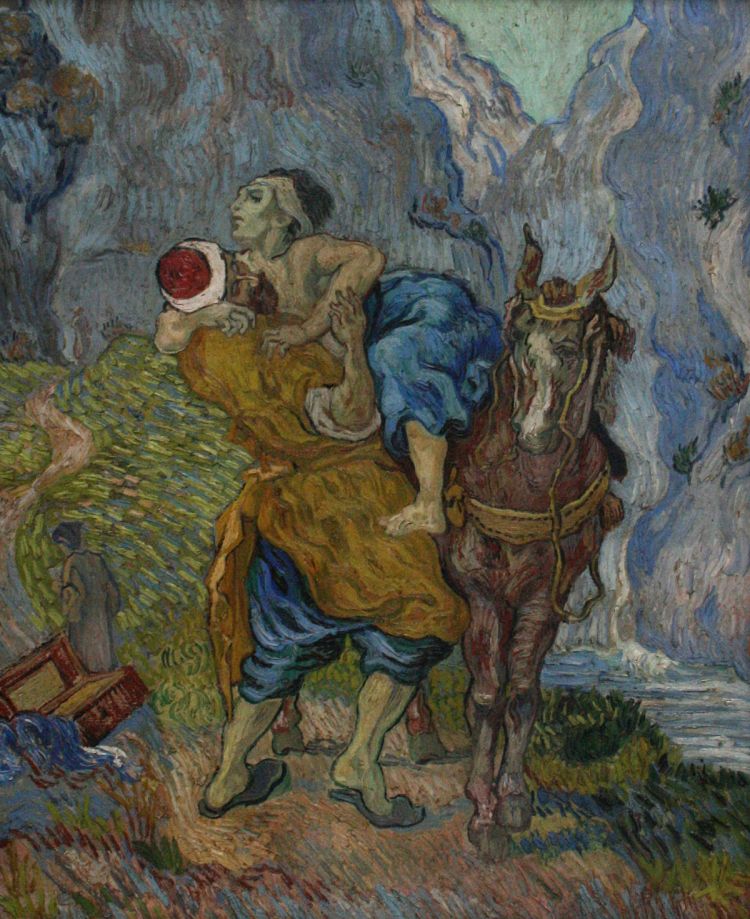
Without mentioning God, Jesus or Scripture, he revealed the Kingdom of God for children and families through his beautiful, loving neighborhood.Everything he said and did on that show pointed to Christ, as if he were saying, “I have seen the Lord!” His question, “Won’t you be my neighbor?” is an echo of the Good Samaritan parable, when a lawyer asks Jesus, “Who is my neighbor?” The neighborhood and Fred Roger’s gentle, joyful manner with children and adults were an invitation to embrace the love of God for all human beings, and to love, as He loves, even those who are different from us and may not love us.

Slide49

Mr. Rogers had the courage to address topics other children’s programs would not dare talk about, such as divorce, death, and racism. In 1968, his was the first children’s show to feature an African American as a regular member of the cast. Francois Clemmons, a classically trained tenor whom Rogers met in church, was persuaded to play a police officer named Officer Clemmons.

Clemmons recalls that in 1969, when some white people in Pittsburgh didn’t want African Americans swimming in public pools, the show featured Rogers, pants’ legs rolled up, resting his feet in a plastic baby pool on a hot day. He invited Officer Clemmons to come, sit down, roll up his pants’ legs, and rest his feet in the water with him. The camera closed in on the two brown feet next to the two white feet as they talked and sang about friendship. Near the end of the scene, Fred helped dry Officer Clemmons’ feet with a towel. They revisited this scene in their last episode together in 1993.

Slide53Slide52

Mr. Rogers never wanted the children to know he was sick–and frighten them. He died of cancer in 2003, just a few months after he stopped working. He had won 4 Emmy awards, a Peabody and a Presidential Medal of Freedom, among other honors, including having one of his iconic sweaters on display at the Smithsonian. But an acceptance speech for a 1997 Lifetime Achievement Award at the Daytime Emmys revealed his gratitude and humility, and took the audience by surprise.

Slide54

Fred said, “All of us have special ones who have loved us into being. Would you just take, along with me, ten seconds to think of the people who have helped you become who you are. Ten seconds of silence.”

And then he lifted his wrist, looked at the audience, looked at his watch, and said, “I’ll watch the time.” There was stunned silence as people slowly realized that he wasn’t kidding. Then the seconds passed, and the tears started to flow as people did as he asked. After 10 seconds, Mr. Rogers looked up from his watch and said softly, “May God be with you all.”

My friends, on this joyous Easter Sunday, in this beautiful church, when we are reminded of Christ’s resurrection and our promise of being raised with him, will you take a moment and consider who loved you into being– who helped you become who you are, encouraged you in your walk of faith? And told you what a special person you are. Because you are.

Beloved, leave this place today with the love of God in your heart, the hope of eternity because of the living Christ. And go and show and tell everyone you know, by living a life of grace, generosity, mercy and love,

“I have seen the Lord!”

And may God be with you all!

Let us pray.

Holy One, we thank you for the blessings of this day–of time with loved ones and remembering loved ones and beautiful Easters past. Thank you for all the saints who showed the way to follow Christ, saints such as Mary Magdalene, who isn’t even called a disciple, though we know she was. Thank you for their persistence and obedience to your Son’s command to share the Good News. Christ is risen from the dead! Thank you for sending your Son to be the sacrifice for our sins–for making a way when there was no way for us to be reconciled with you and one another. Help us to reveal through our kindness and service, using all the gifts and resources you have given us, our hope in Christ and the promise of being raised with Him to new life. In His name we pray. Amen.


Known By Our Love


Meditation on John 13, selected verses

Maundy Thursday 2019

The Presbyterian Church of Coshocton


Maundy Thursday.jpg

Now before the festival of the Passover, Jesus knew that his hour had come to depart from this world and go to the Father. Having loved his own who were in the world, he loved them to the end. The devil had already put it into the heart of Judas son of Simon Iscariot to betray him. And during supper Jesus, knowing that the Father had given all things into his hands, and that he had come from God and was going to God, got up from the table, took off his outer robe, and tied a towel around himself. Then he poured water into a basin and began to wash the disciples’ feet and to wipe them with the towel that was tied around him. He came to Simon Peter, who said to him, ‘Lord, are you going to wash my feet?’ Jesus answered, ‘You do not know now what I am doing, but later you will understand.’ Peter said to him, ‘You will never wash my feet.’ Jesus answered, ‘Unless I wash you, you have no share with me.’

     Simon Peter said to him, ‘Lord, not my feet only but also my hands and my head!’ Jesus said to him, ‘One who has bathed does not need to wash, except for the feet, but is entirely clean. And you are clean, though not all of you.’ For he knew who was to betray him; for this reason he said, ‘Not all of you are clean.’

      After he had washed their feet, had put on his robe, and had returned to the table, he said to them, ‘Do you know what I have done to you? You call me Teacher and Lord—and you are right, for that is what I am. So if I, your Lord and Teacher, have washed your feet, you also ought to wash one another’s feet. For I have set you an example, that you also should do as I have done to you. 

     …Very truly, I tell you, whoever receives one whom I send receives me; and whoever receives me receives him who sent me.’

        After saying this Jesus was troubled in spirit, and declared, ‘Very truly, I tell you, one of you will betray me.’ The disciples looked at one another, uncertain of whom he was speaking. One of his disciples—the one whom Jesus loved—was reclining next to him; Simon Peter therefore motioned to him to ask Jesus of whom he was speaking. So while reclining next to Jesus, he asked him, ‘Lord, who is it?’ 

       Jesus answered, ‘It is the one to whom I give this piece of bread when I have dipped it in the dish.’ So when he had dipped the piece of bread, he gave it to Judas son of Simon Iscariot. After he received the piece of bread, Satan entered into him. Jesus said to him, ‘Do quickly what you are going to do.’ 

     Now no one at the table knew why he said this to him. Some thought that, because Judas had the common purse, Jesus was telling him, ‘Buy what we need for the festival’; or, that he should give something to the poor. So, after receiving the piece of bread, Judas immediately went out. And it was night.

    When Judas had gone out, Jesus said, ‘Now the Son of Man has been glorified, and God has been glorified in him. If God has been glorified in him, God will also glorify him in himself and will glorify him at once. 

      Little children, I am with you only a little longer. You will look for me; and as I said to the Jews so now I say to you, “Where I am going, you cannot come.” I give you a new commandment, that you love one another. Just as I have loved you, you also should love one another. By this everyone will know that you are my disciples, if you have love for one another.’

***

I have been spending more time out in my yard and neighborhood, now that spring has finally arrived! It has arrived, right? No more snow, right? Moving to Coshocton in January, I have anxiously awaited the departure of snow and cold and looked forward to discovering what kinds of trees, shrubs and flowers are growing around our Ohio home.

Now, the forsythia is covered with the unmistakable yellow flowers and leaves. Delicate bunches of white flowers are opening on our dogwood. Purple blossoms are beginning to show up on our lilacs.

But what about the other trees and shrubs? The ones with leaves just barely unfolding and many branches still bare; it’s hard to tell what they are! I have looked at Ohio tree identification websites, and concluded that I won’t know what we have, for sure, until they produce their leaves and flowers and/or seeds and fruit.

It’s this way with Christ’s followers. We are identified by the spiritual fruits we bear—the words and actions of a faithful life. Jesus tells us in Matthew 7:16-18, “By their fruit you will recognize them. Are grapes gathered from thorn bushes, or figs from thistles?  Likewise, every good tree bears good fruit, but a bad tree bears bad fruit.”

Here, in John 13, we hear the promise that Christians will be known to the world, but by only one way will we be identified as belonging to Christ. “I give you a new commandment,” he says, “that you love one another. Just as I have loved you, you also should love one another. By this everyone will know that you are my disciples, if you have love for one another.’

Our witness to a hurting world depends on one thing. Love.

Love your neighbor as yourself is NOT a new commandment for the disciples; this is from Leviticus 19:17-18. What’s new in this commandment is that Christ’s disciples will be known by their love for their sisters and brothers in the faith.

With this new commandment, you might think that the disciples always get along with each other and are never jealous or competitive. If you believe this about the first disciples, let me remind you of Mark 10:35-45 and Matthew 20:20-21. The mother of James and John, sons of Zebedee, comes to ask Jesus a favor, she says. “Declare that these two sons of mine will sit, one at your right hand and one at your left, in your kingdom.” She wants them to have special status and authority over the others. Jesus replies, “You do not know what you are asking. Are you able to drink the cup that I am about to drink?” meaning, are they prepared to suffer and die with him? For Jesus will pray in the Garden of Gethsemane in Luke 22:42, on the night that he is betrayed, “Father, if you are willing, take this cup from me; yet not my will, but yours be done.”

James and John foolishly answer the Lord, “We are able.” Jesus says, “You will indeed drink my cup, but to sit at my right hand and at my left, this is not mine to grant, but it is for those for whom it has been prepared by my Father.”

The other 10 disciples will be angry with James and John when they find out, as you can imagine they would be. All of them want to have favored status and think they deserve it! But Jesus will set them straight, calling them together for a teaching moment, a spiritual lesson. 25  “You know that the rulers of the Gentiles lord it over them,” he says, “and their great ones are tyrants over them. 26 It will not be so among you; but whoever wishes to be great among you must be your servant, 27 and whoever wishes to be first among you must be your slave; 28 just as the Son of Man came not to be served but to serve, and to give his life a ransom for many.”

Jesus doesn’t offer the new commandment until Judas has gone out. For Jesus already knows that he is not one of them. The Lord knows every thought and plan of human beings, says Psalm 94:11. The Lord searches the heart and knows the intention of every thought, says Jeremiah 17:10. And the fruits that Judas will bear—betraying the Lord for 30 pieces of silver—confirm that he is not Christ’s disciple.

This new commandment is difficult for the original disciples—and it’s still difficult for the Church today, isn’t it? We are divided into so many denominations and congregations around the world, they can hardly be counted. Almost every day, we hear of conflicts in churches and denominations, with people leaving in anger to form new congregations and denominations because they can’t get along.

The kind of love we are called to have for one another isn’t a conditional love this world knows. It is the sacrificial, unconditional love that the Lord has for us and revealed to us on the cross. If we seek to deepen our relationship with Him—know him more and more, and the power of His resurrection, we will grow in love. We will become conformed to his likeness, says Paul in Philippians 3:10. And we will be known by His love that doesn’t hesitate to suffer for another.

“13 No one has greater love than this,” Jesus will say in John 15:13, “to lay down one’s life for one’s friends.”


Let us pray.

We want to know you, God, more and more, and become like your Son, who gave himself for our sakes, so that we might be reconciled with you. Thank you, Heavenly Father, for your love shown through Christ’s suffering on a cross. We praise you for sending Jesus to be our Savior, Teacher and Friend, who not only commands us to love and provides the perfect example; he enables us to love by the power of His Spirit that lives in our hearts. Forgive us, Lord, when we have chosen not to obey your new command, when we have failed to love and have been stubborn and prideful, rather than choosing to show mercy–and forgive. Strengthen us to resist the negative attitudes and influences of this world that can slip into the church, sow seeds of discontent and divide us. Help us so that we may have a strong witness to our communities, becoming known as Christ’s disciples by our love for one another. In His name we pray. Amen.

Blessed Is the King!

Meditation on Luke 19:28-40

Palm Sunday 2019

The Presbyterian Church of Coshocton

Palm Sunday.jpg


28 After he had said this, he went on ahead, going up to Jerusalem.

29 When he had come near Bethphage and Bethany, at the place called the Mount of Olives, he sent two of the disciples, 30 saying, “Go into the village ahead of you, and as you enter it you will find tied there a colt that has never been ridden. Untie it and bring it here. 31 If anyone asks you, ‘Why are you untying it?’ just say this, ‘The Lord needs it.’” 32 So those who were sent departed and found it as he had told them. 33 As they were untying the colt, its owners asked them, “Why are you untying the colt?” 34 They said, “The Lord needs it.” 35 Then they brought it to Jesus; and after throwing their cloaks on the colt, they set Jesus on it. 36 As he rode along, people kept spreading their cloaks on the road. 37 As he was now approaching the path down from the Mount of Olives, the whole multitude of the disciples began to praise God joyfully with a loud voice for all the deeds of power that they had seen, 38 saying,

“Blessed is the king
    who comes in the name of the Lord!
Peace in heaven,
    and glory in the highest heaven!”

39 Some of the Pharisees in the crowd said to him, “Teacher, order your disciples to stop.” 40 He answered, “I tell you, if these were silent, the stones would shout out.”

***

When I came to work in the church office on Tuesday, I discovered that I had a message from a member on my phone letting me know that another member had fallen and had been in the hospital. Then, she reminded me that callers to the pastor’s phone at church still heard Rev. Carlisle’s voice on the recorded greeting. She said, “I am glad you are here. And everyone I know is glad you are here. And we would like to hear your voice!”

That just made me smile! I had totally forgotten about changing the message on my voicemail at the church. So, I recorded a new message this week. But I have to tell you, it took me several tries to record my message. Every time I would play back my message, I would think, “Who is that little girl on the phone????” And then I thought, “Oh, my poor flock has to listen to a little girl’s voice every Sunday! I’m so sorry!”

I’ve never liked my voice. If only I had a different voice, you know, maybe like Morgan Freeman or James Earl Jones. I would like to be able to do a Darth Vader, “Luke, I am your father.”

Darth Vader

It took me quite a few years to be persuaded that I should use my voice to preach—and only because I am convinced that God wants us to serve the Church with every gift the Lord has given us. Our voices are a gift from the Lord!

It took longer, though, to persuade me to sing in a choir. I never sang in any choirs before about 2 years ago and only because I wanted to support the new choir director at my church. The choir was small, so I thought maybe if people saw that I was singing in the choir, they might also want to join the choir!

And now I can say that it’s a beautiful experience when we join together, blending our unique voices, to sing God’s praise. Something healing happens to us as we sing; don’t you feel it, too? Sometimes, I can feel the joy and peace of the Spirit working among us, making us one, drawing us nearer to the Lord.

***

I wonder if that’s how the disciples are feeling on that day when Jesus, riding on a colt, approaches the path from the Mount of Olives to Jerusalem.

jesusondonkey.jpg

They burst into singing–“the whole multitude” of them singing songs of joyful praise to God! The whole multitude are singing; no one is just walking along. And they are singing “with a loud voice”—one voice.

If you have your Bibles open to our passage in Luke 19, you’ll see several lines indented; this is a quote from Psalm 118, beginning at “Blessed is the king who comes in the name of the Lord!” If you flip back to the psalm, you will see that Luke has changed the original wording slightly from, “Blessed is the one who comes in the name of the Lord.” This is meant to be a royal procession as the disciples lay down their cloaks for Jesus to ride on.

But did you notice a couple things missing from our Palm Sunday scripture? There aren’t any palm branches in Luke’s account; but they are mentioned in Psalm 118, and in Matthew and Mark’s accounts of the triumphal entry into Jerusalem. And the people don’t cry out, “Hosanna!”—“Save us, now!” They do in Matthew 21 and Mark 11, but not in Luke.

And this gospel calls the animal Jesus is riding a “colt.” That can be a young donkey or a young horse. He doesn’t use the usual word for “donkey.” But  Christians for centuries have interpreted this passage to mean a young donkey, seeing our Savior’s ride into Jerusalem as the fulfillment of the OT prophecy of Zechariah 9:9: “Rejoice greatly, Daughter Zion! Shout, Daughter Jerusalem! See, your king comes to you, righteous and victorious, lowly and riding on a donkey, on a colt, the foal of a donkey.”

No doubt about it; singing in this jubilant procession is not just an act of worship; it is a political and subversive act; an act of protest and defiance against the Empire and its puppet leaders of the Jewish people. The disciples sing, “Blessed is the king!” They are bearing witness to Jesus and “all the deeds of power that they had seen.”

This king isn’t like the kings that have conquered them and enslaved them in times of war; this king isn’t like those that have ruled in times of peace and made false promises of provision and protection. This humble king has done miraculous feedings and healings; cleansed lepers and cast out demons; he has even raised the dead.

When the Pharisees say to Jesus, “Teacher, order your disciples to stop,” they may be afraid of retaliation from the local authorities or the Roman Empire. They may just be angry and offended by this show of support for the man from Galilee, the Nazarene. “I tell you, if these were silent,” Jesus tells the Pharisees, “the stones would shout out.”

He is not afraid, though he knows what is to come. He could have stayed out of the Holy City and quietly ministered in the villages and rural areas, without attracting too much attention, perhaps. But that’s not what he does. He remains obedient to the Father. He is in charge of all the details and turn of events on this day of the triumphal entry—saying to two of his disciples, “Go into the village …. and you will find tied there a colt that has never been ridden. Untie it and bring it here.” He tells them what to say if anyone asks why they are untying it. “Just say this,” he says, “The Lord needs it.”

As we watch in horror and helplessness, he turns his face to Jerusalem, knowing the cross looms ahead. We can imagine the disciples laying down their cloaks and singing with a loud voice, “Blessed is the king who comes in the name of the Lord!”  But we know they aren’t going to stand by him when they realize that the cost of discipleship, as Jesus taught in Luke 14:27, means picking up their crosses and following him.

pick-up-your-cross.png

Where will they be when Jesus is taken before Pontius Pilate, who is told by the Jewish assembly, “We found this man perverting our nation, forbidding us to pay taxes to the emperor, and saying that he himself is the Messiah, a king.” Will they be engulfed by the crowd that turns against Jesus, an innocent man, and demands that a murderer named Barabbas be set free?

Will they join their voices to shout with them, “Crucify him! Crucify him! Crucify him!”

Would we?

Will they remember, at all, the day they sang his praises for all the wonderful deeds he had done?

“Blessed is the king!”

Let us pray.

Holy One, you are our Savior, our Redeemer, our Lord! We cry out to you now, as the psalmist and the disciples did long ago, “Blessed is the King!” But we know how we can be weak and fearful. When we examine our hearts, we know that we wouldn’t be any different than your first disciples, that we would not have wanted to pick up a cross and suffer with you. Forgive us, Lord. Thank you for doing that suffering work on the cross for our sakes—and for your love, mercy and compassion for all sinners today. Help us to be strong and brave, Lord, and rely on your Spirit that lives within us as we continue to walk this Lenten journey to the cross. Speak through the voices that you have given us. Give us confidence and boldness. Lead us to serve you all of our days and sing songs of loud and joyful praise, with one voice, for the wonderful deeds you have done. In Christ we pray. Amen.


In Memory of Nonabel Lyon

b. July 9, 1923   d. April 5, 2019

Meditation on John 13:36-14:7, 12

The Presbyterian Church of Coshocton

April 13, 2019

     36 Simon Peter said to him, “Lord, where are you going?” Jesus answered, “Where I am going, you cannot follow me now; but you will follow afterward.” 37 Peter said to him, “Lord, why can I not follow you now? I will lay down my life for you.” 38 Jesus answered, “Will you lay down your life for me? Very truly, I tell you, before the cock crows, you will have denied me three times.

 14 “Do not let your hearts be troubled. Believe in God, believe also in me. In my Father’s house there are many dwelling places. If it were not so, would I have told you that I go to prepare a place for you. And if I go and prepare a place for you, I will come again and will take you to myself, so that where I am, there you may be also. And you know the way to the place where I am going.”Thomas said to him, “Lord, we do not know where you are going. How can we know the way?” Jesus said to him, “I am the way, and the truth, and the life. No one comes to the Father except through me. If you know me, you will know my Father also. From now on you do know him and have seen him….12 Very truly, I tell you, the one who believes in me will also do the works that I do and, in fact, will do greater works than these, because I am going to the Father.”

***

Nonie Hooper grew up on a farm in Meigsville, Morgan County, the oldest girl of 6 kids during the Depression years. When asked about her childhood, she would recall hard work and hard times, even as a small child. She learned to do things such as churn butter, and she was tied to a chair to wash dishes before she was big enough to reach the sink. If she wasn’t working at home, she was working for neighbors. But the work for neighbors was easier and more enjoyable—a break from the hard work at home.

It wasn’t love at first sight, but Nonie and Cecil knew one another at Malta-McConnellsville High School. The first time they spoke was when Nonie, with friends at the entrance to the opera in McConnellsville, called for Cecil to save her a seat. It’s hard to believe a woman as shy as Nonie would be the first one to speak—and not Cecil, the outgoing one. But she must have seen something special in the young man who would become her husband on April 5, 1942—5 months before he would be drafted into the U.S. Army. He was sent to serve as a medical technician in the 113 General Hospital in the Persian Gulf Campaign in Iran in WWII. Nonie and Cecil were married in a Presbyterian church in McConnellsville, where Cecil had become a member in high school. Then, she didn’t see him again, save for once after his initial training, until late 1944 or 45. She kept all the letters Cecil sent her during the war, treasuring every word—fearing each one might be the last word she would ever hear. While her husband served his country overseas, Nonie went to Meredith Business College in Zanesville and got a job in Columbus, working for the State bridge commission and several other Ohio State offices.

But the Lord had a plan for their lives together. Cecil did come back from the war and they settled down in McConnellsville. Nonie quit her job after Cecil came back, as many women did, to concentrate on making a home and raising their 2 girls—first came Diane, then Pamela. When Pam was 3, the family moved to Coshocton County where Cecil worked as a carpenter. In 1957, Nonie and Cecil joined The Presbyterian Church here. That was back when women wore hats and white gloves to church. Nonie had many hats, some with flowers, some with a little veil on the front. The girls wore them, too. The family sat together in the balcony, with Cecil often serving as an usher. Nonie’s involvement in church included serving in the kitchen, helping to cook and serve meals for the annual congregational meetings, and joining with Presbyterian Women for their circles and many mission projects, such as crocheting baby layettes for needy families. What she liked to crochet the most was white lace doilies and lace-edged handkerchiefs. She did this in her spare time, when she wasn’t caring for her husband and kids and their country house, tending to a large garden, canning vegetables and fruits in summer, planting and raising flowers, cooking from scratch and selling Avon door to door. Nonie’s cooking knowledge was evident in the early 1960s when she was the first to call in to a local radio station and answer correctly a question about how much salt is needed to cook fish. She won a $10 shopping spree!

Nonie, first and foremost, was a mother. She had definite ideas about what was good and what wasn’t good for her girls. She wasn’t a fan of TV. The girls would come home from school and she would tell them the TV was broken, so they had to go outside and play. And the TV was broken; the TV repairman had showed Nonie how to take one of the TV tubes out and she would hide it in a dresser drawer. She wanted the girls to ride bikes, play in the creek, tramp through the woods and go sled riding in winter—probably things she had wanted to do as a child, but was often too busy with chores to do.

She wanted peace in her home, so when the girls were fighting, as they often did, she came up with unique punishments. Once, they had to sit in chairs, facing one another, holding hands and looking into one another’s eyes. Another time, Nonie preached a sermon, Diane told her, just like Billy Graham! Anger turned to laughter. Once in a while, the punishment waited till Dad got home. Like the day the girls, acting on Diane’s idea, dug a swimming pool in the garden. Nonie let them do it; it kept them busy. Away from the TV. But when Cecil got home, Diane had to fill the hole back in.

Diane recalls fondly evenings on the front porch swing, smelling honeysuckle and snapping beans with Mom. Pamela remembers eating Mom’s butterscotch raisin meringue pie and the peace of sitting beside Nonie, newspapers spread across their laps, peeling tomatoes for canning.

Years later, Diane would come to know her mom in a new role– doting grandma, sending care packages to the grandkids, not just on birthdays and holidays but just ‘cause, and making up silly bedtime stories to their grandchildren’s delight when they were small.

***

The disciples are troubled in John 14; Jesus has told them it is soon time for him to leave. He has already told them that he must suffer and die and be raised on the third day. But they can’t comprehend that; they can’t accept the possibility that they will no longer be with their dearest friend. Because that’s how they see him, no matter what they say. It won’t be until after the empty tomb that they begin to see the Lord in a different light and their relationship in a new way.

When Peter asks, “Lord, where are you going?” they are too upset, too grieved, too scared, perhaps, to listen and be comforted when Jesus assures them that they will later follow him.

Peter asks again, “Lord, why can I not follow you now? I will lay down my life for you!”

Jesus knows that while Peter’s heart is genuine, none of the disciples will be faithful in the end. “Will you lay down your life for me?” he asks. “Very truly, I tell you, before the cock crows, you will have denied me three times.”

But the Lord doesn’t hold Peter’s frailties against him. This is a gracious and merciful God that we serve.  And this is God’s plan for salvation—Jesus gave his life so that all the world would not have to perish in its sins, but might have everlasting life through belief on Him.

“Do not let your hearts be troubled,” Jesus says. Don’t worry! “Believe in God, believe also in me… If you know me, you have seen and know the Father!”

Someday, Jesus will come again and take us to himself. There are many dwelling places, many rooms in the Father’s House. It’s not like here, when we can’t always live with our loved ones, because of jobs or school or because of growing older and becoming more vulnerable and needing a place where we can receive special care.

We will all be together in the Father’s House.


***


After Cecil died in 1994, Nonie struggled with her health and mobility, and, though she traveled some with Pamela, she became almost bedridden in the past 20 years. She held onto her faith. She read her Bible and devotionals.

Then, 3 years ago, she moved to Altercare when her health needs could not be met at home.

She never stopped worrying about her daughters. She would ask Pamela, who remained in the house they had shared since she was 3, if she had been eating and was she cooking for herself? Pam would tell her mother, “Yes, I’ve been eating. Have YOU been eating?”

While mothers will always be mothers and see their children as kids, there comes a time when our roles may shift, relationships change, and parents and children may see one another in a new way. They become more like friends.

Pamela would bring fresh flowers to her mom’s room at Altercare to remind her of her country home, where once upon a time, they lived together as a family of 4, with a large garden that very nearly became a swimming pool.

Three weeks before Nonie died, she told her family she wanted to go home. She was adamant about going home. They didn’t understand, then, that it wasn’t the home on Orange Street. She was ready to go home with the Lord. And she did–on what would have been the 77th wedding anniversary for her and Cecil.

Now, we see in a mirror dimly. But then, we will see face to face. Salvation is a gift, my friends, we receive by faith.There is room enough for everyone in the Father’s House. For you. For me! For all who love Christ and seek to do the works of love that he leads us to do—even greater things than he, says Jesus, the Messiah and Son of the Living God. Someday, he will come again and take us to himself. Our Lord, our Savior. Our brother. Our friend.

Amen!

This Fellow Welcomes Sinners

Meditation on Luke 15:1–3, 11b–32

Fourth Sunday in Lent

March 31, 2019

The Presbyterian Church of Coshocton

      prodigal

     Now all the tax-collectors and sinners were coming near to listen to him. 2And the Pharisees and the scribes were grumbling and saying, ‘This fellow welcomes sinners and eats with them.’  3 So he told them this parable:

11 Then Jesus said, ‘There was a man who had two sons. 12The younger of them said to his father, “Father, give me the share of the property that will belong to me.” So he divided his property between them. 13A few days later the younger son gathered all he had and travelled to a distant country, and there he squandered his property in dissolute living. 14When he had spent everything, a severe famine took place throughout that country, and he began to be in need. 15So he went and hired himself out to one of the citizens of that country, who sent him to his fields to feed the pigs. 16He would gladly have filled himself with the pods that the pigs were eating; and no one gave him anything. 17But when he came to himself he said, “How many of my father’s hired hands have bread enough and to spare, but here I am dying of hunger! 18I will get up and go to my father, and I will say to him, ‘Father, I have sinned against heaven and before you; 19I am no longer worthy to be called your son; treat me like one of your hired hands.’ ” 

20So he set off and went to his father. But while he was still far off, his father saw him and was filled with compassion; he ran and put his arms around him and kissed him. 21Then the son said to him, “Father, I have sinned against heaven and before you; I am no longer worthy to be called your son.” 22But the father said to his slaves, “Quickly, bring out a robe—the best one—and put it on him; put a ring on his finger and sandals on his feet. 23And get the fatted calf and kill it, and let us eat and celebrate; 24for this son of mine was dead and is alive again; he was lost and is found!” And they began to celebrate.

25 ‘Now his elder son was in the field; and when he came and approached the house, he heard music and dancing. 26He called one of the slaves and asked what was going on. 27He replied, “Your brother has come, and your father has killed the fatted calf, because he has got him back safe and sound.” 28Then he became angry and refused to go in. His father came out and began to plead with him. 

29But he answered his father, “Listen! For all these years I have been working like a slave for you, and I have never disobeyed your command; yet you have never given me even a young goat so that I might celebrate with my friends.30But when this son of yours came back, who has devoured your property with prostitutes, you killed the fatted calf for him!” 

31Then the father said to him, “Son, you are always with me, and all that is mine is yours. 32But we had to celebrate and rejoice, because this brother of yours was dead and has come to life; he was lost and has been found.” ’

***

Years ago, I learned that I gave birth to at least one strong-willed child. I learned this from books by Dr. James Dobson of Focus on the Family fame. Well-meaning friends with well-behaved children recommended these books. I was disappointed to find that these books didn’t have all the answers to godly parenting for me. Every child is different. Every parent is different. Every family situation is different. We should never compare ourselves to other parents; I know I did and couldn’t understand why what worked for them didn’t help my kids and me.

Parenting is ALWAYS hard—because it matters SO much. You just love your children SO much and you don’t want to make any mistakes, especially the ones your parents made with you. But we do. We mess up. If anything will bring us to our knees, humbly seeking the Heavenly Father’s wisdom, patience, and grace—it’s being a parent!

Reading the Bible as not just a pastor, but a mother, it’s encouraging to me that I am not the only one who struggles with parenting.  You should be encouraged, too! Plenty of biblical families were dysfunctional, going back to Adam and Eve, who also had 2 sons—Cain and Abel. And we know how that ended! First there were two; then there was one. Or Isaac’s twin sons—Jacob and Esau, with Jacob tricking his aging father and stealing his older brother’s birthright. And then Esau wanting to kill him and Jacob having to run away.

***

“This fellow welcomes sinners,” the scribes and Pharisees grumble at the beginning of our gospel reading today in Luke 15. “This fellow welcomes sinners and eats with them!”

the-prodigal-son-3-638

Then the lectionary leaves out the next 2 parables that Jesus tells in response—the Lost Sheep and the Lost Coin. They all fit together. All 3 have the same general message; God rejoices over repentant sinners! God cares about everyone and desires all to be saved. In Luke, these parables come before what has been known traditionally as, “The Parable of the Prodigal Son,” though it might be more accurate to call it, “The Parable of Two Lost Sons.”

The story begins on the day the younger demands his inheritance and his father gives it to him. We can imagine what family life was like before this day. Were there always disagreements between father and son and anger and resentment between brothers? And where was the mother? Had she died, perhaps in childbirth, as many women did? And was the younger spoiled by the father because he was the child of the preferred wife, in his old age, like Jacob spoiling Joseph and giving him the beautiful coat? That’s what comes to mind when the father in this parable tells his slaves, “Quickly, bring out a robe—the best one—and put it on him.” Why did the father give him his inheritance? Was he weary of the arguing? Did he just want peace in his home?

Considerable time has passed since the son left, with no word to his family; they fear he is dead. The son going to a distant country is a rejection of his kin and small, tight-knit community—the kind where everybody knows everybody else’s business. Why else would the entire village be invited to his homecoming party?

The father is over the moon about his son’s return, telling the older one, who shames him by refusing to attend the party, “But we had to celebrate and rejoice; this brother of yours was dead and has come to life; he was lost and has been found.”  This father has never given up hope that his son will change and come home a different man. Imagine, he is watching for him and sees the son while he is still far off! Filled with compassion, he runs, without worry about what the neighbors think. He puts his arms around him, kisses him.

I wrestle with this as an example of a repentant sinner. Does he really have a change of heart? It doesn’t seem like it to me. Why does he come home? Does he miss his family and realize how much hurt he has caused? No. Is he ashamed of what he has done? No. He comes home because he runs out of money and is hungry. He is feeding the pigs and has an AHA! moment. These pigs are better off than I am. The hired hands “have bread enough and to spare, but I’m dying of hunger.” So he hashes a plan, considers carefully what he is going to say to his dad when he returns. He is going to ask to be treated like a hired hand, but he stills uses the intimate, kinship language of “Father.” Beginning at v. 18, “I will get up and go to my father, and I will say to him, ‘Father, I have sinned against heaven and before you; I am no longer worthy to be called your son….” And so he does. He uses the exact words that he rehearsed.

The story ends with the father trying to comfort and persuade the elder one to forgive the younger and be glad that he’s home. Instead, he is jealous and bitter. We are left hanging, wondering what will happen. Will the elder son, who is great at pointing out the log in his brother’s eye, but can’t see the splinter in his own—come to have mercy on his brother—and forgive?

Often, preachers invite us to choose the character with whom we identify in the story. Are you the prodigal, who ran away from God, then “came to yourself” and realized your need for the Lord and that you had squandered God’s gifts to you?  Are you the older brother, who has been in a church a long time, laboring for the Kingdom, but has trouble accepting and forgiving others? Maybe you have a little of both of these brothers in your journey of faith?

Or maybe you see yourself as the struggling parent, for this is a parable, a story with layers of meaning as a teaching device. The father isn’t necessarily our Heavenly Father, though he certainly is loving, patient and merciful. Are you unable to keep the peace in your family? Are your children jealous and resentful of one another? Or are you waiting and hoping for a wayward child to come to the end of themselves, realize their human frailty and need for God, and come home?

Are you praying that your family, broken and wounded now, will be made whole?

If you could write an ending to the story, what would it be? Mine would be that the two lost sons would both be humbled and turn back to the Lord who has never stopped loving them. They would forgive one another and they would tell their father that they love him and thank him for his love, patience and generosity. And the father would realize God’s grace for him—that no matter how perfect a parent we try to be, we can only love and forgive our children and teach them all that we can for as long as they are open to receiving our teaching. Because sometimes parents are the last people that children will listen to.

God has sent the Son to redeem the world by becoming one of us and, in obedience to the Father, willingly suffered and died so that the world would not perish in its sins, but might, through belief on Him, live eternally. As the choirs will sing in their anthem, Love Held Him to the Cross. That’s the point of today’s message. There’s no one for whom Christ did not give his life! For love.

He died for you!

cross-of-jesus-christ.jpg

Have you accepted God’s love and mercy? Have you had a change of heart? If you haven’t, it’s time. Let go of the mistakes of the past. Forgive yourself. Don’t look back.

You can trust in the one about whom the Pharisees and scribes complained, “This fellow welcomes sinners.”

Let us pray.

Holy One, thank you for your generosity and kindness to us. Thank you for sending your Son to welcome sinners and to show us your love when he died on a cross. We pray for the families in our community. Heal what is broken, Lord. Make us whole. Strengthen us to do your will. Help us every day. Teach us to walk in your ways and never depart from the faith in which we were raised. We lift up those who are struggling with parenting. Give us hope and mercy, patience and wisdom, courage and grace. We lift up the wayward children—maybe we are one of them. Forgive us for our sins and draw us back to you. Lead us on the right path. Show us the way to your heavenly home. In Christ we pray. Amen.

Eat What is Good

Meditation on Isaiah 55:1-9

Third Sunday in Lent

March 24, 2019

The Presbyterian Church, Coshocton, OH

Ho, everyone who thirsts,
come to the waters;
and you that have no money,
come, buy and eat!
Come, buy wine and milk
without money and without price.
2 Why do you spend your money for that which is not bread,
and your labor for that which does not satisfy?
Listen carefully to me, and eat what is good,
and delight yourselves in rich food.
3 Incline your ear, and come to me;
listen, so that you may live.
I will make with you an everlasting covenant,
my steadfast, sure love for David.
4 See, I made him a witness to the peoples,
a leader and commander for the peoples.
5 See, you shall call nations that you do not know,
and nations that do not know you shall run to you,
because of the Lord your God, the Holy One of Israel,
for he has glorified you.
6 Seek the Lord while he may be found,
call upon him while he is near;
7 let the wicked forsake their way,
and the unrighteous their thoughts;
let them return to the Lord, that he may have mercy on them,
and to our God, for he will abundantly pardon.
8 For my thoughts are not your thoughts,
nor are your ways my ways, says the Lord.
9 For as the heavens are higher than the earth,
so are my ways higher than your ways
and my thoughts than your thoughts. 

you-are-what-you-eat


“You are what you eat!”

I saw that slogan every day as I waited in line to buy lunch at my elementary school cafeteria. Posters with “You are what you eat,” and pictures of fruit and vegetables were taped to the walls and doors. So we saw the slogan going in. And we saw it going out.

I remember on more than one occasion looking down at my cafeteria tray, with foods chosen and served up by cafeteria staff, and thinking that must mean that I am spaghetti, garlic bread and cookies! Looking back, many of the lunches we were served tasted pretty good, but I doubt that they were actually good for our health.

I was thinking about “You are what you eat” standing in CVS on Friday, excited about my 25% off coupon and stocking up on candy for our children’s messages. I must have stood there a long time in this huge aisle, now full of spring-themed confections—all those pastel colors; bunny, chick and egg shapes; marshmallow, chocolate, and malted milk.

easter-candy-leftovers-ftr.jpg


I stood there so long that I caught the attention of a store clerk, who asked, “May I help you find something?” I didn’t know how to answer, I was so overwhelmed. Should I buy jelly beans; well, what kind? I actually had them in my hand and then put them back—cause my husband and I would eat them before I would have the opportunity to give them to kids on Sunday morning.

“No, thank you,” I finally said. “Just so many choices.”

And that’s my problem—maybe all of our problem! We go to the grocery store and we have aisles of foods to choose from—and many of the foods are not good for us! Some of them aren’t really food, but we want them anyway. They aren’t fuel for our bodies and minds. They aren’t satisfying; they don’t fill us up. I’m still hungry after eating a package of marshmallow peeps. Aren’t you?

We eat–and are hungry for more.


***


I hear echoes of “You are what you eat” in today’s reading, the first 9 verses of Isaiah 55. The prophet is making a connection between the food that we eat and the spiritual nourishment we need for the health of our body and soul.

Isaiah says, “Listen carefully to me, and eat what is good, and delight yourselves in rich food. Incline your ear, and come to me; listen, so that you may live.”
A lack of spiritual nurture and nourishment have led to unrighteous living for the Israelites in exile in Babylonia. Years have passed since the walls of Jerusalem were breeched in 587 BC, the temple and palace destroyed, and the city set ablaze by the Babylonian army. For the few survivors who remain in the ruins of the city, it means suffering and hunger—spiritual and physical deprivation. “My soul is bereft of peace,” says Lamentations 3:17. “I have forgotten what happiness is; so I say, ‘Gone is my glory, and all that I hoped for from the Lord.’” The Israelites believe, after the desolation of their city and their people, that God is punishing them and has abandoned them for mocking and persecuting the prophets when they urged them to turn away from the sins of oppression, injustice, greed and deceit—and turn back to the Lord. “Our inheritance has been turned over to strangers, our homes to aliens…” says Lamentations 5. “We must pay for the water we drink; the wood we get must be bought. With a yoke on our necks, we are hard driven; we are weary, we are given no rest… We get our bread at the peril of our lives, because of the sword in the wilderness.”

In contrast, those living in exile become integrated, assimilated into Babylonian society as the years slip by. They adopt the lifestyles and idols of their conquerors and give up their faith in the one true God. They have jobs and money to spend; they’ve been captured by the lure of wealth. God’s children have become materialistic, stirring Isaiah to ask them why they are spending their money on that which does not satisfy, that which is not bread? He means that which is not food for body or soul; bread is a metaphor for the Word of God. Water or Living Water is a metaphor for the Spirit of the Lord.

Isaiah calls out like a peddler marketing his wares, “Ho, everyone who thirsts!”

“Come to the waters! You that have no money,” Isaiah cries to anyone with ears to hear. “Come, buy and eat! Come, buy wine and milk without money and without price.”

He offers the promise of spiritual nourishment for those who may not even be aware that their soul hungers and thirsts for God—and that their exile is not just from the Holy City, but from the Lord. The prophet offers abundant life—symbolized by the delight of rich food—with a gracious and merciful God who waits and longs to forgive those who have turned away! This is the God of not just second chances, or forgiveness 70 times seven, as Jesus tells Peter when he asks in Matthew 18 how many times they must forgive each other. This is the God whose steadfast love never ceases, says Lamentations 3:22. “Whose mercies never come to an end; they are new every morning.”

Isaiah urges God’s children to pray and change. “Seek the Lord while he may be found. Call upon him while he is near; 7 let the wicked forsake their way, and the unrighteous their thoughts; let them return to the Lord, that he may have mercy on them, and to our God, for he will abundantly pardon.”

Friends, here’s reason for us to rejoice on this third Sunday in Lent. The Lord never abandoned the Israelites! And the Lord never abandons us! It’s we who wander away, maybe not in anger or intentional rebellion, but in distraction or weariness or because we have become too comfortable with the things of this world, like the exiles long ago. We might not even know that we are hungry and thirsty for a deeper faith, for more of God!

We might make the mistake of over-intellectualizing our faith. In our quest for knowledge and pride in our own learning, we may become disconnected from the one who is speaking life-giving words. “Listen,” Isaiah says, “so that you may live!”

God’s Word should compel us to respond in love and generosity—not with angry debates and drawing lines in the sand. Don’t fall into the trap of reading the Bible with an agenda, looking for evidence to support what you already believe! Come to God’s Word with an open heart and mind! Prepare to be amazed. Prepare to be changed!

Today’s passage in Isaiah should humble and inspire us! He reminds us that we can’t begin to think like the Lord! Just when you think you have all the answers to life’s questions and can figure everything out on your own, remember you are NOT the Lord. Take comfort in that! You’re not in control! Isn’t that great? Praise the Lord! Just imagine the mess we would make of everything if we were not inscribed, as Isaiah says in 49:16, on the palms of God’s hands.

God’s thoughts are not our thoughts! God’s ways are not our ways! His ways and thoughts are higher than ours!

And yet, we have the assurance of Psalm 139 that the Lord knows all our thoughts and is familiar with all our ways. And in Eph. 2:10, that “we are God’s handiwork, created in Christ Jesus to do good works, which God prepared in advance for us to do.”

The Lord wants to teach us, mold and use us, bless and keep us.

Open your heart to hear God’s Word! Eat what is good!


***


Friends, in Isaiah 56, we will read that God’s everlasting covenant has been extended to all who obey, to those who “maintain justice and do what is right.” “My house shall be called a house of prayer for all peoples. Thus says the Lord God, who gathers the outcasts of Israel, I will gather others to them besides those already gathered.”

I hear Isaiah in John 10:16 when Jesus says, “I have other sheep that are not of this sheep pen. I must bring them also. They too will listen to my voice, and there shall be one flock and one shepherd.”

God’s love penetrates geographical, political, social and cultural boundaries! Isn’t it wonderful to think that the Lord knows every language—every word before it is on our tongues, as the psalmist declares?

Psalm-139

Isaiah says in 55:5,See, you shall call nations that you do not know, and nations that do not know you shall run to you, because of the Lord your God, the Holy One of Israel for he has glorified you.’”

Those who respond to the call to leave their spiritual exile and return to the Lord are not to hoard God’s gracious benefits. God’s love is meant to be shared.

The invitation to come to the waters, you thirsty souls, is for all.

god-images-living-water-3

The invitation to you who hunger for a deeper faith, for more of God, is for all.

So go and tell others about God’s mercy and compassion.

Tell them, “Seek the Lord while he can be found! Open your heart.”

“Eat what is good.”


Let us pray…

Holy One, We come to you for your Living water, for spiritual refreshment and renewal. Forgive us for our sins, for loving the things of this world too much and for not spending enough time with you in prayer each day. Thank you for your love and compassion, being ever so patient with us who may have wandered into a spiritual exile. Draw us nearer to you and open our hearts so we may hear you as you speak to us in your life-giving Word. Stir in us a hunger and thirst for a deeper faith, for a closer, more loving relationship with you and one another. Help us to break bad habits and make good choices for our bodies, minds and souls, for ourselves, our families, our church and community. Strengthen us to eat what is good and to offer your love, mercy and compassion to our neighbors in need. In Christ we pray. Amen.


The Lord Is My Light and Salvation

Meditation on Psalm 27 For Windsorwood Worship Service

March 17, 2019

1 The Lord is my light and my salvation;
   whom shall I fear?
The Lord is the stronghold of my life;
   of whom shall I be afraid? 
2 When evildoers assail me
   to devour my flesh—
my adversaries and foes—
   they shall stumble and fall. 
3 Though an army encamp against me,
   my heart shall not fear;
though war rise up against me,
   yet I will be confident. 
4 One thing I asked of the Lord,
   that will I seek after:
to live in the house of the Lord
   all the days of my life,
to behold the beauty of the Lord,
   and to inquire in his temple. 
5 For he will hide me in his shelter
   in the day of trouble;
he will conceal me under the cover of his tent;
   he will set me high on a rock. 
6 Now my head is lifted up
   above my enemies all around me,
and I will offer in his tent
   sacrifices with shouts of joy;
I will sing and make melody to the Lord. 
7 Hear, O Lord, when I cry aloud,
   be gracious to me and answer me! 
8 ‘Come,’ my heart says, ‘seek his face!’
   Your face, Lord, do I seek. 
9   Do not hide your face from me. 

Do not turn your servant away in anger,
   you who have been my help.
Do not cast me off, do not forsake me,
   O God of my salvation! 
10 If my father and mother forsake me,
   the Lord will take me up. 
11 Teach me your way, O Lord,
   and lead me on a level path
   because of my enemies. 
12 Do not give me up to the will of my adversaries,
   for false witnesses have risen against me,
   and they are breathing out violence. 
13 I believe that I shall see the goodness of the Lord
   in the land of the living. 
14 Wait for the Lord;
   be strong, and let your heart take courage;
   wait for the Lord!

whom-shall-i-fear-sheri-mcleroy

I am a worrier. On this second Sunday in Lent, a time of self-reflection and drawing nearer to the Lord, I admit that I have trouble letting go of my worries and giving them to the Lord. What do I worry about? I am too embarrassed to confess all—but at the top of my list is my family. And this past week, my mother had major surgery and my dad, who has Parkinson’s and heart problems, was recovering in rehab after a fall.  And my parents live in Florida, so I was not able to be with them through their time of trouble.

So I worried.

In times of worry, I often turn to the Psalms for comfort. Although God’s people composed and sang these collections of songs and poems long ago, they are as relevant and meaningful to us today. The psalmists were worriers, too—and they turned their worries into prayers and songs of praise to the Lord.

In Psalm 27, the psalmist begins by proclaiming, “God is my light and salvation—whom shall I fear?” But in proclaiming, “Whom shall I fear?” the psalmist is admitting that they are afraid and with good reason. For the psalmist is at war, with enemies camped around him, “breathing violence.”

The psalmist is doing what all God’s children should do when they are anxious and afraid—offering thanks and praise to the Lord. “Now my head is lifted up above my enemies all around me, and I will offer in his tent sacrifices with shouts of joy!” But the psalmist, who is confident one moment that the Lord is his stronghold, his refuge, shelter and hiding place, is still afraid that God will be angry with him—that he will disappoint the Lord and God will turn away from him.

And this is our walk of faith—moments and days of doubt and fear, but also moments and days of certainty, joy, and peace, trusting in the Lord who is our light—our guide, our hope for all of eternity.  This is us learning how to live as God wants us to live; this is us learning how to be the people of faith God has called us to be.

The Lord is with us now in our storms and fears and tears. This is the God who understands us better than we understand ourselves and will hear us and answer us when we cry out in prayer.

My mom came through her surgery OK, though her recovery will take about 2 months. And though my dad had another fall this week, we can give God thanks that no bones were broken and he was found immediately. And now we are waiting on the Lord to show us if my dad needs a different living situation—more nursing care to help him each day.

Friends, the Lord is our light and our salvation, our hiding place.  God will reveal his goodness in this land—the land of the living–if  we ask God to give us eyes to see his goodness. And if we wait and hope and trust in him…..

Let us pray.

Dear Lord, you are our light and salvation! We love you, we trust you and place our hope in you. Forgive us for our doubts and fears. Teach us your way, for we have much to learn. Guide our footsteps as we continue to walk with you in this journey of faith. In Your Son’s name we pray. Amen.

Count the Stars, If You Can

Meditation on Genesis 15:1-12, 17-18

March 17, 2019

The Presbyterian Church of Coshocton

Abraham


After these things the word of the Lord came to Abram in a vision, ‘Do not be afraid, Abram, I am your shield; your reward shall be very great.’ 2 But Abram said, ‘O Lord God, what will you give me, for I continue childless, and the heir of my house is Eliezer of Damascus?’ 3 And Abram said, ‘You have given me no offspring, and so a slave born in my house is to be my heir.’ 4 But the word of the Lord came to him, ‘This man shall not be your heir; no one but your very own issue shall be your heir.’ 5 He brought him outside and said, ‘Look towards heaven and count the stars, if you are able to count them.’ Then he said to him, ‘So shall your descendants be.’ 6 And he believed the Lord; and the Lord reckoned it to him as righteousness. 7 Then he said to him, ‘I am the Lord who brought you from Ur of the Chaldeans, to give you this land to possess.’ 8 But he said, ‘O Lord God, how am I to know that I shall possess it?’ 9 He said to him, ‘Bring me a heifer three years old, a female goat three years old, a ram three years old, a turtle-dove, and a young pigeon.’ 10 He brought him all these and cut them in two, laying each half over against the other; but he did not cut the birds in two. 11 And when birds of prey came down on the carcasses, Abram drove them away. 12 As the sun was going down, a deep sleep fell upon Abram, and a deep and terrifying darkness descended upon him. 17 When the sun had gone down and it was dark, a smoking fire-pot and a flaming torch passed between these pieces. 18 On that day the Lord made a covenant with Abram, saying, ‘To your descendants I give this land, from the river of Egypt to the great river, the river Euphrates…


***


Were any of you alarmed on Friday afternoon by a dark minivan driving slowly past your home? It was the Ann Leppla tour bus, navigating the streets of Coshocton, assisted by longtime resident storyteller, Chuck Snyder.  Did any of you see us?

I could not have had better tour guides than Ann and Chuck! I wanted to see Coshocton from the perspective of those who have lived in this community a long time and love this town; those who know many names and faces and all the important and perhaps lesser known places.

Ann told me at the beginning of the tour that there would be a quiz at the end. I said I hoped it would be multiple choice! Don’t worry—I probably won’t remember any of the embarrassing personal stories Chuck and Ann told me about you! Just kidding. Of course, I will remember the embarrassing stories, but I will probably get the names and details mixed up! This is all part of the delightful, small-town ministry experience.

It is easy to see the Body of Christ connected and at work in a community of this size. I have already seen the goodness of the Lord in the land of the living, as the psalmist declares in Psalm 27. Every day, you demonstrate God’s love to one another through your caring words and gentle ways.

And I don’t have to tell you that I have had some challenges since I’ve come—and you have helped me with them. The latest one was this week, when my mom had surgery and you prayed for her! Then Dad had a fall that led to a trip to the ER, X-rays and discussion about how we can make his living situation safer. The hard thing for me was that I wasn’t well enough or free to travel to be with them. I wrestled with doubts and anxiety—not about my call to ministry but about how I should respond as a good daughter. Ultimately, I came to trust that I am where God wants me to be, and I am doing what the Lord wants me to do. I can’t and shouldn’t try to do anything more than that!

We can learn from the call of Abram that sometimes God wants us to leave our hometowns and our kin—everything comfortable and familiar—to go to the place that God will show us and do what the Lord says. And sometimes, all God wants us to do is wait, hope, trust and pray.


***

When we encounter Abram in Genesis 15, he has already heard the voice of God for the first time and responded obediently. He and his wife Sarai and nephew Lot pack up all the people and stuff they have acquired in Haran to go the place that God will show them and make of Abram a great nation. In him, all the families of the earth will be blessed. But at the time of his calling, Abram has no children and Sarai is elderly and barren–unable to conceive. Abram and his family are natives of Ur, an important Sumerian city-state in ancient Mesopotamia near the mouth of the Euphrates on the Persian Gulf in what is today Iraq. Ur is a sophisticated, prosperous urban center of culture and commerce.

Abram, Sarai and Lot have had some adventures. After the first call to Abram at age 75 in Chapter 12, a severe famine forces them to live as aliens in Egypt, where Abram, fearing that he would be killed for his beautiful wife, persuades her to lie and tell Pharaoh that she is only his sister. In actuality, she is his half sister, the daughter of his father but not his mother.  But she is also his wife. In exchange for her moving in with Pharaoh, Abram receives many sheep, oxen, donkeys, camels and slaves. But the Lord afflicts Pharaoh with great plagues because of Sarai. Finally, Pharaoh learns that Sarai is Abram’s wife. Instead of seeking revenge, Pharaoh tells Abram and his family, “It’s time to go.” By now, Abram has become very rich. He and Lot have so many animals, possessions and people between them that the land cannot support them both living together. So they separate; Lot pitches his tent in wicked Sodom, and Abram moves to Canaan, where the Lord promises Abram land as far as he can see for his offspring, who will be like the “dust of the earth; so that if one could count the dust of the earth, your offspring also can be counted.” Abram pitches his tent by the Oaks of Mamre at Hebron, where he makes an altar to the Lord.

But soon Lot is taken captive in Sodom and Abram leads 318 trained men, born in his household, to rescue Lot. Then Abram receives the blessing of King Melchizedek, the priest of God Most High, and Abram gives him a tithe—one tenth—of everything he has.

That brings us to today’s reading in Gen. 15—when Abram has everything he could ever want except for the one thing he has always wanted—a child, preferably a son. And he’s getting anxious and beginning to doubt God’s promise to him. Years have passed, and he and Sarai are still childless! So God grants Abram a vision in which the Lord says to him, “Do not be afraid, Abram, I am your shield; your reward shall be great.” For the first time ever, Abram engages in dialogue with the Lord. “But Abram said, ‘O Lord God, what will you give me, for I continue childless and the heir of my house is Eliezer of Damascus?’” Abram doesn’t wait for God to answer; he goes on to accuse the Lord, “You have given me NO offspring, and so a slave born in my house is to be my heir.”  But that’s not what God has planned. The Lord says, “This man shall not be your heir; no one but your very own issue—(your biological child)—shall be your heir.”

A beautiful thing happens next. God brings Abram outside. Night has fallen, and God tells Abram to look toward “heaven,” and “count the stars, if you are able to count them.” It’s like the earlier promise of the dust and the promise of descendants as numerous as the grains of sand by the sea in Genesis 22. You can imagine a long, breathless pause, as Abram considers the wonder of God’s creation—the reminder that God is GOD and we are human beings that God has made for God’s own delight, companionship, and joy. If the Lord could make countless stars in the night sky, couldn’t the Lord also give Sarai and Abram one child of their own? As Abram counts the stars, God says, “So shall your descendants be.” And Abram believes the Lord—and God sees him as righteous.


***

God continues to be patient with Abram, though his doubts don’t end with the new covenant of Gen. 15. Sarai, in Gen. 16, will come up with the idea of “helping” God’s promise come to pass by having Abram sleep with her Egyptian slave girl, Hagar, so he can have a son and heir through him. It ends badly, with Hagar and her son with Abram being banished from the household.

How important is Abraham for Christians today? Scripture says that through one miracle child named Isaac, all the families of the earth are blessed. Abraham is mentioned 74 times in the New Testament—twice in the first two verses of Matthew in the genealogy of “Jesus, the Messiah, the son of David, the son of Abraham.” In Galatians and Romans, the Apostle Paul calls him the “Father of the Faithful.” James calls him, the “Friend of God.”

Like Abram, we all have trouble waiting on the Lord and believing in God’s promises. It isn’t that we can’t believe in the goodness of God. It’s that we can’t believe that we are good enough for God’s promises. Well, we aren’t good enough. But Jesus has opened the way for our adoption as God’s children and heirs, joint heirs with Christ, says Paul in Romans 8:17, by the grace of God!

And frankly, we just aren’t good at waiting. I’m not! We want to do MORE than what God wants us to do, when what God often wants for us is simply to wait and hope, trust and pray, though there may be NO evidence that what God has promised will come true. Friends, this is the very definition of faith! Hebrews 11:1 says faith is the “assurance or confidence of things hoped for, the conviction of things NOT seen!”

But the kind of waiting that Psalm 27 is talking about is active, not passive. While we wait, we move forward in our journey of faith, seeking spiritual growth, asking the Lord to teach us his way and engaging in honest, open, and fearless prayer with our Heavenly Father. We need to tell the Lord exactly how we feel—like Abram did! “You have given me no offspring!” “You didn’t keep your promise, though I did what you told me to do!” But be prepared to be humbled, as God brings to mind the wonder of God’s creation.

The One who created the stars in the sky—can you count them?—you know you can’t—is the One who created you and me to serve the Lord faithfully!

Let us believe in the One who kept his promises to Abraham and will keep his promises to us, though we struggle with fear and doubt!

Wait. Hope. Trust. And pray!


Will you pray with me now?


Holy One, we struggle with fear and doubt every day, so we seek your face. We cry out for help for our loved ones, healing for the sick in our families and congregation. Lord, teach us your way. Thank you for your love and your grace, hearing and answering our prayers patiently and kindly, like you did with your friend, Abram, the Father of the Faithful. Lord, we aren’t good at waiting. We aren’t patient like you. Open our eyes to see your goodness in the land of the living, to notice the signs of your Kingdom promises coming true. Build up our faith and guide us to walk this journey obediently every day, trusting in you, holding on to hope, being courageous in prayer. Through your Son we pray. Amen.


Our Refuge in the Wilderness

Luke 4:1-13

First Sunday in Lent

The Presbyterian Church of Coshocton

March 10, 2019

Temptation of Jesus

Jesus, full of the Holy Spirit, returned from the Jordan and was led by the Spirit in the wilderness, 2 where for forty days he was tempted by the devil. He ate nothing at all during those days, and when they were over, he was famished. 3 The devil said to him, ‘If you are the Son of God, command this stone to become a loaf of bread.’ 4 Jesus answered him, ‘It is written, “One does not live by bread alone.” ’ 5 Then the devil led him up and showed him in an instant all the kingdoms of the world. 6 And the devil said to him, ‘To you I will give their glory and all this authority; for it has been given over to me, and I give it to anyone I please. 7If you, then, will worship me, it will all be yours.’8 Jesus answered him, ‘It is written, “Worship the Lord your God, and serve only him.” ’ 9 Then the devil took him to Jerusalem, and placed him on the pinnacle of the temple, saying to him, ‘If you are the Son of God, throw yourself down from here, 10 for it is written, “He will command his angels concerning you, to protect you”,  11 and “On their hands they will bear you up, so that you will not dash your foot against a stone.” ’ 12 Jesus answered him, ‘It is said, “Do not put the Lord your God to the test.” ’ 13When the devil had finished every test, he departed from him until an opportune time. 


***

Seventy-six people gathered for our first ecumenical Ash Wednesday service last Wednesday at Emmanuel Lutheran Church. Twenty-two members of our chancel choir sang, “Create in Me a Clean Heart.” Presbyterian and Lutheran liturgists read from the prophet Joel and Paul’s second letter to the Corinthians. Pastor Bryan read from the gospel of Matthew, with Jesus warning us not to be like the hypocrites, making a big show of their fasting, long prayers and charitable giving to impress human beings with their piety!

On Ash Wednesday, we are reminded that our God, who is love, breathed life into dust to create us in His image—for love. And when we fall short of God’s love, the Lord longs for us to draw near and confess our sins so that our relationship with God and human beings may be restored. Because our sin hurts the entire community and not just ourselves and our relationship with the Lord.

People often talk about what they give up or add on for Lent. It’s good to be intentional about living out your faith. Jesus tells us to love the Lord with all heart, soul, mind and might and our neighbors as ourselves. This requires thought, feeling, effort and action! But I want you to remember that what matters most to the Lord, at Lent and always, is the purity of our hearts.

The good works we do must come from a humble and faithful heart, seeking to be obedient to God’s will. It’s a temptation to do things to try and win approval from others and then be disappointed if no one seems to notice the good that we do. It’s also a temptation to value ourselves based on the good works that we do, and, if we aren’t able to do those good works, we might come to believe that we aren’t valuable! We might even begin to fool ourselves into thinking that something we do will lead God to love us more. Nothing we can do can change God’s love. And nothing we can do will ever compare with what God has already done for us through the cross!

So, I have said that Lent is about the condition of our hearts and not about what we give up. But now I am going to say that the Spirit may lead you to give up some things during Lent, if what you are giving up are things that fail to bring you life and energy, health or joy. Later today, look at your calendars and consider how you will spend your time in this Holy Season as we draw nearer to the cross with Christ. What are those things that just aren’t helpful to your spiritual growth and shalom—peace, wholeness and wellbeing? What have you been afraid to say no to because it might disappoint someone? What are things that are draining you that you could and should “let go?”

And, since Lent is about our hearts, it isn’t about what we add on, either, unless what we are adding on is something the Spirit is stirring us to do, such as making more time for prayer and meditating on God’s Word, engaging in creative pursuits that we have been wanting to do; making music and singing God’s praises; taking more time to fellowship with God’s children; encouraging one another through struggle and loss; and volunteering in our community.

Above all, please remember that Lent is about drawing nearer to the One who is our refuge in the wilderness.


***


Our gospel lesson in Luke today starts us off on the first Sunday in Lent with Jesus’ temptation in the wilderness, his preparation for public ministry shortly after he is baptized in the Jordan. In Luke, the Spirit fills Jesus and leads him to the wilderness to be tempted. This is all part of God’s plan. The Greek word for tempted or tested—peirazo–is used in the Septuagint, the ancient Greek translation of the Hebrew Bible, for the testing of the people by Yahweh in the wilderness (Ex. 16:4; 17:2; Deut. 8:2; Ps 94:9) and of their testing of him. So right away, we are taken back in time to Israel’s 40 years of wandering and struggle.

This desert wilderness in Judea in the vicinity of the Jordan is both a good and bad place. It’s good because it’s a place of contact with God; but it’s also dangerous—a rocky, daunting zone of cliffs and caves, the haunt of wild beasts, demons and outlaws (Lev. 16:10, Isa. 13:21, 34:14, Tob. 8:3 ) Diabolos himself—the devil or accuser—comes to try to lead Jesus astray.

Hearers in Jesus’ time would recognize in these 3 tests the 3 categories of vice that Jesus overcomes: “love of pleasure, love of possessions, love of glory.” (Luke T. Johnson, 76). These three tests are meant to correct any misunderstanding of Jesus’ mission as the Son. Jesus, the Son of God, refuses to use his power or authority for any other reason other than that for which he has been sent! The “unifying link” in these scenes is that they are quotations from Deuteronomy, coming from “passages that recall three events of the Exodus in which the Israelites in the desert were put to the test—and failed,” says author Joseph A. Fitzmyer. Jesus is, in effect, “redeeming the whole wilderness experience of the Israelites. Where Israel of old failed, Jesus succeeds.”

The first 2 tests address Jesus as the Son of God, recalling the baptism scene of Luke 3:21-22, when a voice from heaven declares, “You are my Son, the Beloved; with you I am well pleased.” “If you are the Son of God,” the devil says, “command this stone to become a loaf of bread.”

When Jesus answers, “Man cannot live on bread alone,” he is quoting from Deut. 8:3. “He humbled you by letting you hunger, then by feeding you with manna, with which neither you nor your ancestors were acquainted, in order to make you understand that one does not live by bread alone, but by every word that comes from the mouth of the Lord.” When Jesus answers, “Worship the Lord Your God, and serve only Him,” he is quoting Deut. 6:13. And when Jesus answers, “Do not put the Lord your God to the test,” he is quoting Deut. 6:16.

I have heard sermons on how this passage is a how-to-guide for fighting the devil and temptation. That isn’t the point of my message today, although the New Testament does tell us we are engaged in a spiritual battle. Ephesians 6:11-12 says, “Put on the full armor of God, so that you can take your stand against the devil’s schemes. For our struggle is not against flesh and blood, but against the rulers, against the authorities, against the powers of this dark world and against the spiritual forces of evil in the heavenly realms.” The Word of God is, “alive and active.” says Hebrews 4:1. “Sharper than any double-edged sword, it penetrates even to dividing soul and spirit, joints and marrow; it judges the thoughts and attitudes of the heart.” James 4:7 says “Submit yourselves, then, to God. Resist the devil, and he will flee from you.” And 1 Peter 5:8-9 says, “Be alert and of sober mind. Your enemy the devil prowls around like a roaring lion looking for someone to devour. Resist him, standing firm in the faith, because you know that the family of believers throughout the world is undergoing the same kind of sufferings.”

I would rather you recall from my message that this spiritual battle isn’t for us to fight! And that we have nothing to fear. As Jesus says in John 16:33, These things I have spoken to you, that in me you may have peace. In the world you will have tribulation; but be of good cheer, I have overcome the world.”

The battle belongs to the Lord, who is our refuge in the wilderness.

***

Lent has already begun differently for me this year. It was the first Ash Wednesday in 8 years that I wasn’t well enough to make the sign of the cross in ashes on my congregation’s foreheads and remind them, “From dust you came, and to dust you shall return.” I felt bad about this—being sick on the night of this important service. But then I remembered that I am not a pastor because of the “pastor things” that I do! I am a pastor because, by the grace of God, I am called to be a pastor– and that is what leads me to do the pastor things! Just as we are all children of God, not because of anything we have done, but because of what Christ the Son has done for us. Our worth is not determined by what we do. We are precious to the Lord! Nothing can make the Lord love us more! Nothing can make God love us less!

The devil departs at the end of today’s passage in Luke, but he will return, as scripture says, at an “opportune time,” to fulfill God’s purposes. He will be back in Luke 22:3-4, when “Satan enters …Judas called Iscariot, who was one of the twelve; he (goes) away and confer(s) with the chief priests and officers of the temple police about how he might betray him to them.” The devil will come up again in 22:31-32, when Jesus predicts Peter’s initial denial, then faithfulness. “Simon, Simon, listen! Satan has demanded to sift all of you like wheat, but I have prayed for you that your own faith may not fail; and you, when once you have turned back, (shall) strengthen your brothers.”

During this Holy Season, I pray that your faith may not fail, and that the Spirit will guide you to let go of some things that drain you and add on some things that bring you life, health, peace and joy.

Most of all, I pray that you and I will understand God’s love and grace in a new way. And may this understanding set us free to live more graciously.

There’s a spiritual battle going on, but the battle belongs to the Lord!

God is our refuge in the wilderness.


Let us pray.


Holy One, thank you for being our refuge in the wilderness and that we have nothing to fear from the devil. Thank you that the spiritual battle of this world belongs to you who has already conquered sin and death. Forgive us, Lord, for falling to temptation every day and turning away from you to satisfy our own desires, to accumulate more possessions, and to seek glory for ourselves. Help us, O God, to be the humble, pure of heart people you want us to be. Set us free from the burden of our sin so we may live more graciously. By the power of your Spirit within us, may we become more like your Beloved Son. In His name we pray. Amen.


Living Water

Message on John 4:7-15 for Lenten Lunch Program

March 6, 2019

The Presbyterian Church of Coshocton

    A Samaritan woman came to draw water, and Jesus said to her, “Give me a drink.” (His disciples had gone to the city to buy food.) The Samaritan woman said to him, “How is it that you, a Jew, ask a drink of me, a woman of Samaria?” (Jews do not share things in common with Samaritans.) 10 Jesus answered her, “If you knew the gift of God, and who it is that is saying to you, ‘Give me a drink,’ you would have asked him, and he would have given you living water.” 11 The woman said to him, “Sir, you have no bucket, and the well is deep. Where do you get that living water? 12 Are you greater than our ancestor Jacob, who gave us the well, and with his sons and his flocks drank from it?” 13 Jesus said to her, “Everyone who drinks of this water will be thirsty again, 14 but those who drink of the water that I will give them will never be thirsty. The water that I will give will become in them a spring of water gushing up to eternal life.” 15 The woman said to him, “Sir, give me this water, so that I may never be thirsty or have to keep coming here to draw water.”


I am honored to be the first to share a message in this 50th anniversary year of our ecumenical Lenten lunches. As a female pastor, I can testify to the difficulty that women sometimes have in communities of faith of being heard and being taken seriously.  I have had the opportunity—I am not going to say challenge—of serving as the first female pastor of 2 churches and as the second female pastor to a church in rural Minnesota, following a female pastor whose leadership was not universally accepted. But it isn’t like I didn’t know this might happen.

After graduating seminary in 2010, I told my dad that I would be seeking ordination in a denomination that, though it had been ordaining women as church leaders for decades, still had many congregations reluctant to call a female pastor. His response was to ask me why I would do this—give up careers in journalism and teaching to pursue something in which I might experience rejection and disappointment?

I don’t remember my exact words to Dad, but I do remember the sense of call that I had back then that stays with me today and gives me strength and joy to walk this way. Because it is the joy of the Lord that gives us strength to overcome any social barriers built by human beings. And it helps to have a sense of humor. When my last congregation asked why I was adding purple streaks to my hair, I told them it was for Lent. Most of them accepted that. And I have a cartoon framed in my church office of 3 women—probably the 3 Mary’s—coming from the empty tomb and being told by a group of male disciples, “So ladies, thanks for being the first to witness and report the resurrection… And we’ll take it from here.”

That may have been what really happened after the discovery of the empty tomb, but that isn’t what happened after Jesus talked with the Samaritan woman at Jacob’s well in the gospel of John. The fact that she is going to draw water from the well in the middle of the day reveals her low status. She is purposefully avoiding other more “respectable women” of the community. For this is the hottest point of the day and all the other women of the town would have already drawn water for their families in the early morning hours. She is marginalized and Jesus knows why, though he is a stranger to her and this community. She is living with a man who is not her husband and has had five husbands, Jesus will tell her after she accepts his offer of living water so that she will never thirst again.

Why Jesus has taken a route through Samaria is a mystery. Most Jews avoid Samaritans because they reject some core beliefs of ancient Judaism and have a long history of animosity with one another, going back to the exile. The Samaritan woman—I wish we knew her name!—is aware of some of these theological differences and will say in 4:20, “Our ancestors worshiped on this mountain, but you (meaning the Jews) say that the place where people must worship is in Jerusalem.”  And Jesus will tell her that the hour is coming and is now here when true worshipers will worship the Father not on a mountain or in Jerusalem. “True worshipers, “he says, “will worship the Father in spirit and truth.”

The conversation continues as the woman shares more of her faith with Jesus, “I know that the Messiah is coming, who is called the Christ,” she says. And when he comes, he will proclaim all things to us.” Jesus chooses to reveal himself to this woman, living on the margins of her community. “I am he,” Jesus says. “The one who is speaking to you.”

Angelika_Kauffmann_-_Christus_und_die_Samariterin_am_Brunnen_-1796.jpeg

The conversation ends perhaps prematurely—when the male disciples return from the city where they had been sent to buy food. They are astonished that Jesus is speaking with a woman, says 4:27. So the issue isn’t about her being a Samaritan, but her being female. But they knew enough not to question what Jesus was doing. I love it that scripture says, “But no one said (to her), ‘What do you want?” or to Jesus “Why are you speaking with her?” Meaning, they wanted to ask these questions because it wasn’t the way things were done; it wasn’t the norm for their culture or their faith.

And how does the Samaritan woman respond to Christ’s revelation to her—that he is the Messiah? She believes! And believing compels her to share her testimony with everyone. “Come and see a man who told me everything I have ever done!” she says. “He cannot be the Messiah, can he?” And the one who accepts Christ’s living water and leaves her empty water jar forgotten at the well, brings many to Christ through her simple testimony. Her openness to an encounter with the holy in a completely unexpected way changes her life forever. Today in Eastern Orthodox and Eastern Catholic traditions, though she isn’t given a name in the biblical story, she is venerated as Saint Photine or Photina from the Greek word phos for light.

Jesus is invited by the Samaritans to stay two more days and he accepts their invitation. Still more come to believe because Jesus has spoken to them, too. They have heard for themselves, “And we know,” they say, “that this is truly the Savior of the world.”

Friends, as we journey through this holy season of Lent with one another, I encourage you to open your heart for unexpected encounters of the holy. But also, make time to intentionally drink deeply of the living water from the well that is Christ himself. The Lord knows everything about you and doesn’t hold your sins against you. So how could you possibly hold other peoples’ sins against them? Don’t make the mistake of the disciples and dismiss someone because of gender, religion or social status that the Lord has chosen to speak into your life and change your world for good. God wants to equip you and use you and your simple testimony of what God has done for you to bring others nearer to Christ.

Come to the waters that will satisfy heart and soul. All are welcome to come and be refreshed and renewed by the Word and Spirit. Man or woman. Young, old and in between. In Christ, all human barriers are broken down and we are made one in His body.

Come to Christ with the confidence of the children of God—and you will never be thirsty again.


Let us pray.

       Holy One, thank you for your love, mercy and compassion, shown in the story of the Samaritan woman at the well. Thank you for choosing broken vessels like us—male, female, young and older, to bring healing and wholeness to those who are suffering, lonely, and outcast. Forgive us, Father, for when we have deemed others unworthy of your grace and not good enough for you to use to build your Kingdom. Give us, Lord, your living water, more and more, so that we may drink deeply and grow in Spirit and truth. Then send us out, Lord, to be love and light for the world. In your Son’s name we pray. Amen.


Practical Resources for Churches

Everyone has a calling. Ours is helping you.

Consider the Birds

Pastor Karen shares thoughts on faith, scripture, and God's love and grace revealed through backyard wildlife.

F.O.R. Jesus

Fill up. Overflow. Run over.

Becoming HIS Tapestry

Christian Lifestyle Blogger

Whatever Happens,Rejoice.

The Joy of the Lord is our Strength

Stushie Art

Church bulletin covers and other art by artist Stushie. Unique crayon and digital worship art

The Daily Post

The Art and Craft of Blogging

WordPress.com News

The latest news on WordPress.com and the WordPress community.