Hope and Faith of a Child


Meditation on John 6:1-21

Merritt Island Presbyterian Church

July 29, 2018

Slide46

         After this Jesus went to the other side of the Sea of Galilee, also called the Sea of Tiberias. A large crowd kept following him, because they saw the signs that he was doing for the sick. Jesus went up the mountain and sat down there with his disciples.  Now the Passover, the festival of the Jews, was near. When he looked up and saw a large crowd coming toward him, Jesus said to Philip,  “Where are we to buy bread for these people to eat?” He said this to test him, for he himself knew what he was going to do. Philip answered him,  “Six months’ wages would not buy enough bread for each of them to get a little.” One of his disciples, Andrew, Simon Peter’s brother, said to him,  “There is a boy here who has five barley loaves and two fish. But what are they among so many people?”  10 Jesus said,  “Make the people sit down.” Now there was a great deal of grass in the place;  so they sat down, about five thousand in all. 

Slide35

11 Then Jesus took the loaves, and when he had given thanks, he distributed them to those who were seated;  so also the fish, as much as they wanted. 12 When they were satisfied, he told his disciples,  “Gather up the fragments left over, so that nothing may be lost.” 13 So they gathered them up, and from the fragments of the five barley loaves, left by those who had eaten, they filled twelve baskets. 14 When the people saw the sign that he had done, they began to say,  “This is indeed the prophet who is to come into the world.”

            15 When Jesus  realized that they were about to come and take him by force to make him king, he withdrew again to the mountain by himself.

       16 When evening came, his disciples went down to the sea, 17 got into a boat,  and started across the sea to Capernaum. It was now dark, and Jesus had not yet come to them. 18 The sea became rough because a strong wind was blowing.  19 When they had rowed about three or four miles, they saw Jesus walking on the sea and coming near the boat, and they were terrified.  20 But he said to them,  “It is I; do not be afraid.”   21 Then they wanted to take him into the boat, and immediately the boat reached the land toward which they were going.

Slide20

***


Slide24

It was a sweltering 95-degree day last month in Birmingham, Alabama. Austin was handing out chicken sandwiches to homeless men. The red satin cape he wears, the 4-year-old says, makes him go faster.  “It blows in the wind,” he says with a smile, in a June 2018 article at CNN online.

Slide31

He is met with high-fives and pats on the shoulder at the homeless shelter. He has become a familiar face to the homeless men and women gathered on the sidewalk outside the Firehouse Ministries’ red brick building. His dad, TJ, helps him drop off meals every week.  It all started when Austin and his dad were watching an animal show on TV. A mother panda left her cubs and Austin was worried what would happen to them. TJ said the cubs would be homeless.  Austin hadn’t heard that word before. He learned more about “homeless” when his dad took him downtown to the city shelter after that.

“He said,  ‘Can we feed them?'” TJ says.  “I didn’t expect to feed homeless people that day. But when a 4-year-old asks you, what can you say?”

Slide33

They went to Burger King and bought chicken sandwiches. Austin agreed to use his allowance to buy food for homeless people instead of a weekly toy. Austin, who has an older brother with autism, has learned sensitivity, acceptance and compassion for people, though they may be different in appearance or behavior.


He soon became a local celebrity. His passion to help people in need—and possibly all the media attention—stirred Burger King to give him a $1,000 monthly allowance for a year so he could fulfill his mission. The mayor calls him  “the city’s ambassador.”  In a time when we often hear criticism of young people for being too “materialistic” or lacking people skills— here’s evidence that some young folks do “get it”—maybe more than adults! Austin, the mayor says, understands the importance of helping others—not just with material assistance, but by showing love.

Slide55

Love has the power to transform–especially when the source and acts of kindness are unexpected—through a small child, wearing a superhero costume, emblazoned, “# Show Love.”

Slide27


***


Austin reminds me of the child in our gospel reading today—the boy who gave his lunch to Jesus and a multitude ate until they were full.  This is an amazing thing to happen in a time and place when the average person never had enough food to eat, let alone feel full. Though we don’t know much about the boy—not even his name—he has the typical food of a poor person—five barley loaves and a couple of dried fish—neither of which were as large as we might imagine them to be. Wheat bread was more commonly eaten; barley loaves were cheaper and only eaten by the poor.

Today’s reading begins with a problem that isn’t really a problem, but an opportunity to reveal God’s power in Jesus Christ—and care for people in need. Jesus has crossed the sea to get away from the crowd, but is still being followed by them. People have seen the  “signs that he was doing for the sick.” They want to see some more!

Jesus doesn’t evade them long.  Actually, I think he is purposefully leading them up the mountain so that he can do another sign—and test his own disciples’ faith. For this passage isn’t really about what Jesus will do for the crowd. It’s encouragement for his true followers, the ones who have heard and answered his call, to let go of all doubt and fear–and learn to trust in him for everything!

Now this is different from the Matthew 14 account of the feeding of the multitude, when the disciples bring up the subject of eating first. They are exhausted after a day of ministering to the sick. They tell Jesus,  “This is a remote place, and it’s already getting late.  Send the crowds away, so they can go to the villages and buy themselves some food.”

But in John 6, Jesus is the first to mention the people’s need for food, revealing more of his divine character. The one who heals is eager to provide for His children, knowing their needs before they ask!  As the crowd approaches, Jesus turns to Philip.  “Where are we to buy bread for these people to eat?” Philip seems surprised by his question. Though he was quick to respond to follow Jesus at his invitation in John 1:43, he is also a down to earth, numbers guy. Where to buy bread, indeed! The real problem is they don’t have enough money!

“Six months’ wages,”  he says in the NRSV translation,would not buy enough bread for each of them to get a little.” What he really says is  “200 denarii would not be enough for each to have a mouthful.”  One denarius is a day’s wage in Matt. 20:2.

Slide43

Andrew interrupts then to point out the boy offering his lunch.  “But what good is that for so many?” Andrew says. He is asking the question every church asks, at one time or another. How can we possibly meet such a tremendous need around us with such a small offering? With an aging membership? With so few people? With so many needs of our own?  How can what we have be enough to do the acts of love that Christ urges us to do?

Andrew’s question immediately precedes another “sign.” Jesus tells everybody, then, not “sit down,” but “recline”—the usual position for eating a meal. After giving thanks to God,  Jesus himself and not the disciples in John’s account serves the people, passing first the bread and then the fish to 5,000 men—plus women and children!

Slide48

After studying this passage, I’m left puzzling over 2 questions.  First, was the boy really the only one with food in the crowd?  Or was the real miracle not one of Christ’s provision, but His love unleashed in the crowd that stirs them to acts of generosity and kindness?  Did they have more than enough food for a feast all along, but fear that there wouldn’t be enough held them back from sharing what they had with others? Through the boy’s tiny but significant gift, a multitude is fed, with 12 baskets of bread left over!

And the second question is,  who are we in the story? Are we in the multitude, trying to follow Jesus wherever he goes, but only for personal reasons– looking for our own wants and needs to be met? Are we wrestling with fear and doubt, like those closest to him on a mountain, wanting to help people and do compassionate ministry in Christ’s name, but thinking it’s not possible with our resources? Have we embraced a gospel of abundance—or not? Have we forgotten, like his 12 disciples, that  Jesus is the source of everything we will ever need?

Are we like those same disciples, gathered in a boat, tossed about by storms, seeing Jesus, but in our fear, not recognizing the one who has the power to walk on water and calm every storm in our lives?  The one whose love is unconditional and never ends?

May we all be more like the child of hope and faith.


***

 About 5,000 men, women and children will pass through the doors of the shelter in Birmingham this year. Many will be touched by Austin and TJ’s acts of kindness and generosity, bringing hope and faith that lives can change!

Slide25

People CAN change!  God’s love transforms our hearts!

One homeless man tells Austin on that sweltering June day—95 degrees in Birmingham,   “It’s because of you that I want to be a better person.  You’re showing love, everywhere you go, right?”

“I am,” says Austin,  handing him a paper-wrapped sandwich and a cold drink, superhero cape fluttering in the breeze.

He explains to the adults who might not “get it”– like he does.

He says,  “Show love means you care about someone no matter what they look like.”

Slide26

Let us pray.


Holy One, we want to be more like you—always thinking about the needs and cares of others, before we worry about our own. Forgive us, Lord, as we struggle with fear and doubt, thinking we never have enough resources to do all that we are called to do—showing your love through acts of compassion, kindness, and generosity. Give us the faith and hope of a child who, though he was poor in material possessions, was willing to give up all that he had to eat—some barley bread and a few dried fish—so that a multitude could be fed! Thank you, Lord, for your unconditional love, for washing away our sins with your work on the cross, and for being the source of everything we will ever need! Amen.
Chosen for Love


Meditation on Ephesians 1:3-14

Merritt Island Presbyterian Church

July 15, 2018


I was preparing to leave my office on Thursday to visit my parents after my Dad had a fall, when a man walked into the reception area. No one else recognized him, but I knew it was Phil, and it wasn’t just the telltale car keys clipped to his front shirt pocket. I had been praying for him and had left him a phone message that hadn’t yet been returned. Now here he was—bringing his offering to support the church. His church.

I had presided over his wife, Anita’s funeral in February 2016.  Phil and Anita, though they hadn’t attended church in recent years, were members since the 1960s, when the Rev. Bill Lee led worship in what is now our fellowship hall. Phil and Anita raised their 3 boys –Russ, Brad and Clay– in our church. Anita was the first church secretary.

Russ called the church seeking pastoral care about a week before his mother died. She had suffered from Alzheimer’s for many years. They welcomed me, though I was a stranger. And I enjoyed spending hours with them, at Anita’s bedside, as they swapped family stories. I became closest to Russ, who helped me plan the funeral and provided photos and art for the bulletin cover.  

After Anita died, I prayed for Phil and continued to reach out to him with occasional calls, cards, and a visit near Christmas last year.

I prayed that Christ would draw him back into the fold.

For when we are called to be his disciples, we can’t just walk away from that call. The Lord keeps seeking us out. God is like a nursing mother, says Isaiah 49:15, who will not withhold compassion for the child of her womb.  “Even these may forget,” says the Lord, “yet I will not forget you.”

No matter how old we are, no matter how we might think we have done enough and it’s time for other people to do the work of the church, your call is still valid. It doesn’t depend on our health or emotions or any circumstance in this world. The Lord wants us to shower us with spiritual blessings as we serve Him through His Church.

The Book of Order describes the responsibilities of our callings (G-2.0504) in the Church of Jesus Christ.  Ministers of word and sacrament, along with choosing scriptures and music, preaching and worship leadership, moderating session and other responsibilities, are called to offer pastoral care to the poor, troubled, sick and dying, to pray for and with the congregation, encourage others to worship and serve the Lord, and enable and equip members for their tasks and roles in the ministry, helping the church to reach out “in concern and service to the life of the human community as a whole.”

The Book of Order says that the ministry of membership (G-1.0304) is “a joy and a privilege” and “a commitment to participate in Christ’s mission. A faithful member bears witness to God’s love and grace and promises to be involved responsibly in the ministry of Christ’s Church. Such involvement includes: proclaiming the good news in word and deed, taking part in the common life and worship of a congregation, lifting one another up in prayer, mutual concern, and active support, studying Scripture and the issues of Christian faith and life, supporting the ministry of the church through the giving of money, time, and talents, demonstrating a new quality of life within and through the church, responding to God’s activity in the world through service to others, living responsibly in the personal, family, vocational, political, cultural, and social relationships of life, working in the world for peace, justice, freedom, and human fulfillment, caring for God’s creation, and participating in the governing responsibilities of the church.” Members  are urged to review and evaluate the integrity of one’s membership and  consider ways in which one’s “participation in the worship and service of the church  may be increased and made more meaningful.”

The most important things to know about our callings are  that we were chosen by God. And we were chosen for love.


***

Our reading in the first chapter of Ephesians is Paul’s blessing to the church.  It is one really long sentence in Greek that translators have separated by punctuation to help us grasp the meaning. His blessing is similar to traditional Jewish blessings that remind God’s people what the Lord has done for them and their identity and purpose for being. But unlike traditional Jewish blessings, we are blessed and chosen  in Christ. He is the instrument by which God pours in us  “spiritual blessing from the heavenly places.”

Outside Judaism, the word “to bless” in ancient Greek literature means,  “to speak well of, to praise, to thank, glorify, and to confess.” In the Septuagint, the earliest Greek translation of the Hebrew Bible, the blessing is what   God promises to give to Abraham and  the praise human beings offer to God. But it also means to consecrate or set aside for God’s purposes. Paul says, in verse 4, that this is what has happened to us.  We have been chosen by God in Christ  “to be (made) holy and blameless before him, in love.”

Then we read from the foundation of the world.….God has always had a plan for all of us. He knew that human beings would fall into sin, but it was  “for his own good pleasure” that we have been redeemed.

He didn’t wait for us to choose Him. God revealed his love for us, when he  “sent his only Son into the world so that we might live through him,” says 1 John 4:9-10.  “In this is love, not that we loved God but that he loved us and  sent his Son to be the atoning sacrifice for our sins.”

With talk of “adoption” Paul employs legal language for those who receive a spiritual inheritance formerly thought to be only for Abraham’s descendants.  He assures Gentiles and Jews that Gentiles are included in this new covenant, sealed with Christ’s blood.

The blessing comes from Paul’s heart of gratitude to God for his inexplicable grace. As he exclaims in 2 Cor. 9:15,  “Thanks be to God for this gift too wonderful for words!


***


On Thursday, Phil’s visit to the church was an answer to prayer, confirmation that the Lord never forgets His children,  those who are called to serve Him with their lives. Phil hadn’t lost his gentle sense of humor or storytelling gifts. But he was sadder and quieter than I have ever seen him. He told me about Russ, how after working for NASA in Huntsville, Alabama, he moved back to Tennessee, where he had been born, and took a job working for the little town of Athens. He served as county planner and architect for McMinn County Government for 15 years. His most recent project was the highly regarded design and renovation of the McMinn County Courthouse Annex.  Russ, who possessed the quick wit, humor, and storytelling gifts of his dad, made many friends in his community through his work, though he was “a liberal,” the mayor said, “working with a predominantly conservative government entity.”

Russ usually called Phil a couple of nights a week. The calls came more frequently in April, when he suddenly seemed to be struggling to find the words he wanted to say. Alarmed, Phil called his son, Clay, and asked him to see if Russ was OK. Clay drove to Athens, and brought him back to his home near Atlanta where he could see specialists at Emory University. Doctors diagnosed him with a rare neurological disease. Phil traveled to Georgia, staying with his sons for a month.

Russ passed away May 29. The community poured out their grief and at the McMinn County Facebook page. What they said convinced me that Russ was living out his calling, devoted to the wellbeing of the people of this small town. The mayor said he saved the community about $100,000 in design fees. People said they would miss his smile and laughter. He was a “wonderful public servant”– kind and considerate, with a “brilliant mind.” Others said, a “true friend.” They celebrated his life at a service in a Lutheran church. The pastor was one of Russ’s friends.

Phil stood up in my office and made to go. I reached for his hand.

 “One of these days,” he said, “You’ll see me in church.”

On the way to my parents’ house, Russ’ last words spoken to me came to mind. At the funeral reception, he asked if I would reach out and visit his dad after the family had gone home. He said his dad was really good at saying no.  “Don’t ask,” he said. “Just go.”

I promised that I would.

A few weeks after the funeral, Russ sent me a lovely thank you card, saying that his time with the church had brought back happy memories of his youth at MIPC and his childhood on Merritt Island.

The Spirit is at work in our community of faith,  lavishing his grace upon us, pouring out spiritual blessings from the heavenly places. Today is a new day for the children of God.

The Lord wants to use those whom he has called before the foundation of the world.

You are one of them! You have been redeemed. Your sins have been washed away. In Christ, you stand holy and blameless before God.

You  have been chosen for love!


Let us pray.

Heavenly Father, thank you for your gift that is too wonderful for words–your grace that has redeemed us when we were perishing in our sins. Thank you for choosing us, calling us before the foundation of the world, to be your adopted children, with spiritual blessings poured on us through your Son, Jesus Christ, who lives and reigns with you in the heavenly places. Forgive us if we have ever drifted away, when we have been unfaithful to your call and selfish, looking to our own pleasures, rather than seeking to be pleasing to you. Use us now and forever, Lord, for your holy purposes. Build up your church and draw us nearer to you. In Christ we pray. Amen.


The Journey


 Meditation on Mark 6:1-13

July 8, 2018

Merritt Island Presbyterian Church


Slide13

      He left that place and came to his hometown, and his disciples followed him.  On the sabbath he began to teach in the synagogue, and many who heard him were astounded. They said,  “Where did this man get all this?  What is this wisdom that has been given to him?  What deeds of power are being done by his hands!  Is not this the carpenter, the son of Mary   and brother of James and Joses and Judas and Simon, and are not his sisters here with us?”  And they took offense at him. Then Jesus said to them,  “Prophets are not without honor, except in their hometown, and among their own kin and in their own house.” And he could do no deed of power there, except that he laid his hands on a few sick people and cured them.  And he was amazed at their unbelief. Then he went about among the villages teaching. He called the twelve and began to send them out two by two, and gave them authority over the unclean spirits. He ordered them to take nothing for their journey except a staff; no bread, no bag, no money in their belts but to wear sandals and not to put on two tunics. 10 He said to them, “Wherever you enter a house, stay there until you leave the place.  11 If any place will not welcome you and they refuse to hear you, as you leave,  shake off the dust that is on your feet as a testimony against them.”  12 So they went out and proclaimed that all should repent.  13 They cast out many demons, and anointed with oil many who were sick and cured them.

***

Slide22

It was Monday, the first day Leslie, Chad and I were attending classes at the Montreat Music and Worship Conference. With the exception of our adult choir rehearsals twice a day, we attended different classes, tailored to our ministry gifts and callings.

Slide23

Dr. Martha Moore-Keish, a Columbia Seminary theology professor, taught my 10 a.m. class called, “Exploring the Sacraments through Word and Image.”

Slide24


I felt a thrill of excitement when she described what we would be doing over the next 5 days. We would see and discuss Christian images from ancient times to present, in worship and other sacred spaces, particularly where the sacraments of Baptism and the Lord’s Supper were celebrated. “You might be wondering why we are doing this,” she said. “For a number of reasons. One, our culture is increasingly oriented to visual…. We are bombarded by images all the time. What are the images that shape us in our world?” And two, “for historical reasons, so we may learn how Christians have lived out and expressed their faith over the centuries.” Three, for theological reasons. We can consider what Christians believed and what we believe about the Lord’s Supper and Baptism. And four, because  “what we taste, smell, touch and see are all part of the way God communicates with us.”  “He accommodates to us,” she said, quoting 16th century church reformer John Calvin. God who created us and knew us before we were in our mother’s womb, knows how to speak to us at our level so that we can understand.

Ever notice how God has always used visual aids with his people? How did God first speak to Moses? A burning bush.

Slide28

How did he speak to Abraham? He told him to look at the stars, promising that his descendants would be even more numerous.  And through the visitation by angels who looked like ordinary men.


Slide29

And God has come down to our level to reveal himself to us, sending his Son to be one of us, to live among us, and share our common lot.

Jesus taught through every day stories and objects. In Matthew 6:26, he says,  “Look at the birds of the air, for they neither sow nor reap nor gather into barns; yet your heavenly Father feeds them. Are you not of more value than they?”

In Matthew 6:28-29, he says, “So why do you worry about clothing?  Consider the lilies of the field, how they grow: they neither toil nor spin; 29 and yet I say to you that even Solomon in all his glory was not arrayed like one of these.”

When his disciples come to him in Matthew 18 and ask, ‘Who is the greatest in the kingdom of heaven?’  Jesus calls a child,  “whom he put among them,” and says, “Truly I tell you, unless you change and become like children, you will never enter the kingdom of heaven.”

Slide33


***

Our gospel reading in Mark today brings to mind an old English proverb,  “Familiarity breeds contempt.” What does that mean? I found this translation,  “If you know someone very well, you stop respecting them.” Ironically, when God speaks to His own children through His Son, some reject him because he is human.  He is one of them, but he is also different, preaching unlike the scribes and Pharisees, and healing and casting out demons with power and authority that others don’t have.

       “Where did this man get all this?” the congregation murmurs to one another when he preaches in his hometown synagogue.  “What is this wisdom that has been given to him?  What deeds of power are being done by his hands!  And “Isn’t he the carpenter?” The Greek word is  tekton, with a more accurate modern-day translation:  “construction worker” or “laborer”– not as high status as we would afford skilled “carpenters” today. Jesus’s father isn’t mentioned–did you catch that? Jesus isn’t called the son of a tektoncarpenter or construction worker, like he is in Matthew 13 when he preaches in his hometown –and is rejected. Scholars say that his neighbors are using hostile language when they identify him as the “son of Mary,” rather than son of his father, the traditional way a son is identified. In Mark, where there is no story of Jesus’ virgin birth, this is a  “slur against his legitimacy.”

Mark doesn’t tell us what Jesus says in his message that offends his hometown. He does declare himself a prophet, saying,  “Prophets are not without honor, except in their hometown,  and among their own kin and in their own house.” Mark emphasizes their personal rejection of him, saying in verse 3,  “And they took offense at him.”

He has just returned to Jewish Galilee from the Gentile Decapolis in 5:21, performing many miracles. He has cast out demons from a Gentile man living in the tombs and has raised a little girl from the dead. He has healed a woman who has been suffering from hemorrhages for 12 years. She touches his clothes when Jesus is in crowd, believing she will be healed. Jesus tells her,  “Daughter, your faith has made you well; go in peace, and be healed of your disease.”

But in Nazareth, he can “do no deed of power” except to “lay his hands on a few sick people and heal them.” What is the reason given? They lack faith. Jesus says in vs. 6 that  he is  “amazed at their unbelief.”  It is Christ’s power and not the person’s faith that heals them, but without faith, Christ does not heal. This reminds me of Hebrews 11:6,  “Without faith, it is impossible to please God because anyone who comes to Him  must believe that He exists and that He rewards those who earnestly seek Him.”

The second half of this passage begins a new section; this is Christ’s response to his rejection. He sends out his 12 to minister in other towns and villages,  giving them his power and authority over evil, sickness and disease. He tells them to take no money or bread, because he wants them to trust in Him and rely on the kindness of strangers. Not everyone will welcome them, he warns. If they don’t, they are to shake the dust from their sandals as they leave. And journey on, bringing hope and healing to those with open hearts and homes– to those who have faith.


***

We examined more than 100 images over the 5 days in Martha’s class at Montreat. We began with the Early Church,  when Christianity was illegal and believers had to worship in secret in the catacombs,

Slide52

through the era of Constantine, when Christianity became the religion of the Empire, through the Middle Ages.

Slide55

Slide57Slide56


To the Renaissance and the Reformations to present day.

Slide63

Slide62

Martha was intrigued when I shared how we use images in worship to help us connect with the Word on a deeper level. Images draw us together as a faith community, gathered around our shared story and ministry. Images help those with open hearts and minds draw nearer to the Lord,  who longs to communicate with us right at our level, through all the senses he has given us.

He has given us His Spirit– equipping us with His power and authority– like he did his original 12 disciples.

Slide69

The Church is being sent out on a mission that he has ordained for us. And here’s the thing–the mission isn’t about us; and it won’t bring us material wealth or worldly measures of success. This passage assures us that we don’t need more stuff and we don’t need to be rich before we can serve him with our lives. In fact, money and stuff aren’t needed at all for the 12 disciples’ journey. They would get in the way from them relying completely on God to provide for them through the hospitality of strangers needing His healing touch.

Here’s the bad news. Not everyone will welcome you and accept your calling to be a light for Christ.  We will be rejected, sometimes, as he was, by people who are close to us. Our family and friends may amaze us, at times, for their lack of faith. And it will hurt our feelings, just as I am sure it hurt the Lord when his hometown rejected and ridiculed him. Don’t get stuck in discouragement or disappointment if that happens. Shake the dust from your sandals. Journey on, sisters and brothers. Don’t let anything stop you. Ask God to strengthen your faith, a faith that heals–and He will. Then, go and share it with the world.


Let us pray.

Thank you, Lord, for equipping us to serve you with our lives and for your Spirit that empowers, unites and guides us. Help us, Lord, to be obedient to your call, without wondering what’s in it for us and worrying what might happen. Let us not become too focused on stuff and money so that it gets in the way of doing the ministry you desire us to do. Open our hearts and minds, Lord, so we can understand when you come down to our level and speak to us through all our senses. Teach us to welcome the stranger into our homes and hearts and trust the stranger to welcome us into their home and heart. And for the journey you have called us to travel, strengthen our faith, a faith that heals. In Jesus’ name we pray. Amen.

Sow and Grow

Meditation on Mark 4:26-34

June 17, 2018

Merritt Island Presbyterian Church


         26 He also said, “The kingdom of God is as if someone would scatter seed on the ground, 27   and would sleep and rise night and day, and the seed would sprout and grow,  he does not know how. 28 The earth produces of itself, first the stalk, then the head, then the full grain in the head.   29 But when the grain is ripe, at once he goes in with his sickle,  because the harvest has come.”

     30 He also said,  “With what can we compare the kingdom of God,  or what parable will we use for it? 31 It is like a mustard seed,  which, when sown upon the ground, is the smallest of all the seeds on earth; 32 yet when it is sown it grows up and becomes the greatest of all shrubs,  and puts forth large branches, so that the birds of the air can make nests in its shade.”

    33 With many such parables he spoke the word to them, as they were able to hear it; 34 he did not speak to them except in parables, but he explained everything in private to his disciples.


***


I felt a tug on my skirt and looked down to see my little friend, Piper, looking up at me. She almost always has a smile on her face, but now she looked serious. We were waiting in line for donuts  at the MIPC Preschool’s “Donuts for Dads” event in the fellowship hall Friday morning. I kneeled down and asked the 4 year old with a sunny disposition,  “Did your dad or granddad make it today?”

She shook her head sadly, and I gave her a hug.

 “Will you sit by me, then?” I asked. She nodded, slipping her hand in mine. I built our plates with mini cake donuts–she wanted chocolate  and I took powdered sugar.  We sat down together at one of the long tables set up for the special program to honor fathers and grandfathers.  We talked and ate as the room buzzed with happy noises and movement around us.  

Slide28

The gathering started at 10, with my opening prayer. Then about 36 children filed in, including the elementary school age kids in our summer camp.  They lined up on stage and sang “Daddy’s Hands” and “Daddy, Daddy, I Love You.” They recited a poem that starts, “Daddy You Are As Smart as Ironman…”

Slide38Slide44Slide37

Slide35Slide45Slide40

More than 30 men attended Friday’s program.  They came alone or with their wives. Some were grandparents raising grandchildren. One grandfather, who attends a Nazarene church, shared his testimony, telling me about his new-found faith that has changed his life. I knew his 3 grandchildren at our preschool when he mentioned them by name.

Slide39Slide32Slide31Slide29

I said hi to one young dad, sitting by himself,  waiting for the program to begin, looking like he wanted to be somewhere else. His face changed, though, when I exclaimed,  “You’re Marley’s dad?  Marley’s awesome!”  

    Hannah and Jeffrey’s mother had tears running down her face as the children sang. She was so emotional, she said, that she had trouble holding up her phone to record the program. The families stayed awhile after the program ended,  talking and laughing with their kids and each other. That made me feel good to see them so comfortable. Many said thank you. We had plenty of donuts– and some left over. Piper went up for seconds and then a third time for a big, custard-filled chocolate covered donut. I didn’t need another donut, but I suggested we share it because it was so big. I worried she might get sick.  That was fine with her!

      Just as she took a bite, a wonderful thing happened.

Slide47

Her father showed up, sat down and gave her a hug. He had driven from Sebastian that morning.   “I’m sorry I am late!” he said, looking into her eyes.  “Did I miss your singing?”

He gave her a sad look, but she just smiled and hugged him back.

With “Donuts for Dads,” “Muffins for Moms” and other events the preschool and church host for children and young families each year, we try to show our gifts of hospitality, generosity and love–as Christ calls us to do.  

Without preaching or quoting the Bible, we can still plant seeds of faith  and pray the Lord of the Harvest will make the seeds sprout and grow.  When we scatter seeds and show warmth and hospitality to strangers, we are changed.

We grow in faith, hope and love. And we want to sow some more!


***

Christ invites his followers to sow and grow  in our gospel reading today. This passage is two parables in a chapter of parables, each one building on or explaining what comes before.  The Kingdom of God is all around us. We have an important role; it grows by God’s grace that leads us to embrace God’s Word,  live by faith and share it with others.

The parables, stories with layers of meaning, simple and symbolic, secular and sacred, are a window into the agrarian world in which Jesus lives. They begin with the familiar “sower and the seed.”  Seed is eaten by birds, falls on rocky ground, is scorched in the sun and choked by thorns. But some falls on good soil and yields an abundance of grain. Jesus explains the parables to his 12 when they are alone, for they have been given the  “secret of the kingdom of God” he says, and will understand what others cannot. The seed is the word; Satan tries to steal it away; those without root hear and have joy, but fall away when trouble comes. The word sown among thorns is choked out by the  “cares of the world,”  “the lure of wealth  and the desire for other things.”  Seeds sown on good soil are those who  hear, accept God’s word and bear fruit–do God’s will.

Right before today’s passage is Christ’s parable of the lamp that you wouldn’t put under a bushel basket or bed;  you place it on a lampstand, to bring the light of understanding to all who have ears to listen. He concludes with a warning against holding on too tightly to things.  “The measure you give,” he says, “will be the measure you get,  and still more will be given to you.”

Then we come to today’s two parables–the growing seed and the mustard seed. The growth of God’s Kingdom is a mystery to human beings–those who sleep at night and wake up to find the scattered seeds have sprouted and grown.  Only the Lord knows the hearts of human beings. Only God knows our days before we have lived them and the plans he has for each of us. But God always desires our spiritual growth and the growth of His Kingdom.

The Kingdom of God is so powerful that it can grow to a tree from a tiny seed;  a mustard seed was probably the smallest where Jesus lived, and it grew fast to become a great shrub, even a mustard tree.  

      The Kingdom is all around us; we see it by faith. It is a blessing to everyone, not just Christians, but for all the earth, through the followers of Christ, just as God told Abraham  that his children would bless all the families of the earth. The birds of the air make a home and find comfort, nourishment, shade and rest in the Kingdom tree.  Jewish believers in Mark’s time would be stirred to recall Daniel’s vision of God’s Kingdom in 4:10-12 as a tall tree at the “center of the earth” :

     “The tree grew great and strong, its top reached to heaven, and it was visible to the ends of the whole earth. Its foliage was beautiful, its fruit abundant,  and it provided food for all. The animals of the field found shade under it,  the birds of the air nested in its branches,  and from it all living beings were fed.”

 ***

On Thursday night, about 36 people from our congregation gathered to be a blessing to local children in need through the Children’s Hunger Project.

We are Christ’s hands and feet, each of us with different skills and abilities that enable us to do different jobs. Everyone is important and needed in God’s work. Our group assembled 818 bags in less than 2 hours! And it was fun being with people we love.

We are a powerful force for good when we work together in shared mission, helping people in need, reaching out to show hospitality to strangers and friends. We experience such joy and peace scattering seeds of faith through kindness and generosity.

Like the disciples long ago, we have been given the secret to the Kingdom of God: sow and grow.

When we sow, we are changed. We grow in faith, hope and love.

And we want to sow even more!


Let us pray.


Heavenly Father, we thank you for your Kingdom that your Son, Jesus Christ, ushered in. Give us eyes to see your Kingdom, on earth as it is in heaven, and ears to hear your Word and obey. Thank you for our role in growing your Kingdom–your charge to us to sow seeds of kindness, generosity and hospitality. Grow our faith, Lord. Build our hope. Pour more of your love into our hearts and stir us to share it with others, particularly people in need. Use us as instruments of healing and reconciliation. May we be a blessing, with all that you have given to us, to the families of the earth, as you promised Abraham long ago. Strengthen and guide us in the footsteps of your Son, through whom we pray. Amen.

 

House United: The Family of God


Meditation on Mark 3:19b-35

June 10, 2018

Merritt Island Presbyterian Church

“Then he went home, 20 and again a crowd gathered, so that he and his disciples were not even able to eat. 21 When his family heard about this, they went to restrain him, for people were saying, “He is out of his mind.” 22 And the scribes who came down from Jerusalem said, “He has Beelzebul! And by the ruler of the demons he casts out demons.” 23 So Jesus called them over to him and began to speak to them in parables: “How can Satan drive out Satan? 24 If a kingdom is divided against itself, that kingdom cannot stand.  25 If a house is divided against itself, that house cannot stand.  26 And if Satan opposes himself and is divided, he cannot stand; his end has come.  27 In fact, no one can enter a strong man’s house without first tying him up. Then he can plunder the strong man’s house.28 Truly I tell you, people can be forgiven all their sins and every slander they utter, 29 but whoever blasphemes against the Holy Spirit will never be forgiven; they are guilty of an eternal sin.” 30 He said this because they were saying, “He has an impure spirit.” 31 Then Jesus’ mother and brothers arrived. Standing outside, they sent someone in to call him. 32 A crowd was sitting around him, and they told him, “Your mother and brothers are outside looking for you.” 33 “Who are my mother and my brothers?” he asked. 34 Then he looked at those seated in a circle around him and said, “Here are my mother and my brothers! 35 Whoever does God’s will is my brother and sister and mother.”

***

The sky had grown dark and storm clouds were rolling in as Marilyn and I arrived at the Personalized Peach Creative Studio Friday night.

We didn’t see the little workshop in a Rockledge strip mall from the road. But we knew we were in the right place when we saw the pig on a license plate in the parking lot and knew Pam, the organizer of the women’s event, was there. Slide23

The first raindrops were falling as we entered the brightly lit room. Our friends turned to us with smiles. Although we were 10 minutes late because of me, Pam said, “You’re just in time. We were just getting ready to start.”

Billy, our leader, guided us through all the steps of the project we would be making together. The first thing, she said, was to sand our boards.

I felt a stab of alarm. “I didn’t know we were going to use power tools!” I said.  “I didn’t ask Jim if it was OK.”

I watched others before I tried it myself.

Slide32

This slideshow requires JavaScript.

Someone turned on the sander and put it in my hand. I smiled, thinking, “Yeah, I probably shouldn’t be doing this.” But it was fun, though my hand vibrated for hours after that.

We worked together, talking and laughing as we helped each other prepare our boards, stain, fan-dry,

Slide40Slide41Slide50


place our stencils with the sayings we chose, paint, and dry again before carefully pulling the stencils away.

Thunder crashed, lightning flashed. Rain began to pour down.

And I thought I had never felt more comfortable, more safe and cared for with people I had only known a few years.

Though I hadn’t heard it in years, I had a song in my head throughout the evening. “We are family” by Sisters Sledge.

We are sisters. We are brothers.

We are a house united: the family of God.

***

Jesus talks about family in a new way in our gospel reading today. He stuns his hearers, which include his family, when he redefines the word as something other than those who are blood relatives.

Slide63


Family is of the utmost importance to people in biblical times. Without family, many struggle to survive. Family is particularly important to Jewish people. While some people convert to Judaism from other faiths, the Jewish faith is traditionally passed on by blood. If your mother is Jewish, then you are Jewish, even if you aren’t very religious. Converting to another faith, if you are born Jewish, may be seen as rejecting your family and ancestry.

Today’s reading brings up the question of Jesus’ identity. What do people say about him? What does he reveal about himself?

He has, up to this point, performed many miracles of healing and has cast out demons. Whenever the “unclean spirits” see him, they know exactly who he is. They fall down before him in 3:11 and shout, “You are the Son of God!” But Jesus “sternly” orders them “not to make him known.” Multitudes of people are following him, seeking healing, when today’s passage begins with, “Then he went home. His family have heard about the crowds, so much so, that Jesus and his disciples “could not even eat.” So they come to “restrain him.” What does that mean? And what do they think of him? Do they think he is crazy?

We only know that they have heard people saying, “He has gone out of his mind.” This is one of the false narratives, possibly spread by the religious leaders, who hate and fear him, worried that they may be losing their power and control over the people. Now the scribes, the religious teachers, insult him in the worst possible way. Since they can’t say they that he doesn’t have the power to heal or that he hasn’t healed multitudes of people, they say that the source of his power is evil.

Slide11

“He has Beelzebul,” they say, and by the ruler of the demons he casts out demons.” And this isn’t a misprint, if you are wondering if it should say, “Beelzebub.” Only the Latin translation of the Bible from the Middle Ages says, “Beelzebub” here, meaning “lord of the flies,” but this isn’t correct. Mark says “Beelzebul,” which possibly means “lord of the house,” and may refer to an old Canaanite deity. The phrase “house divided against itself” (remember the famous person who said this? Lincoln!) may be a pun on this name.

Jesus responds to the lies by speaking logically and rationally– not anything like a person who has “lost his mind.” He speaks in “parables”–and this is the first time Mark uses that word. “How could Satan cast out Satan?” he asks. In his talk of kingdoms and houses divided, he is saying that demons fighting against each other would be weakened by inner conflicts.

His words, spoken long ago, are meant for the Church in every day and age. For the Church is often plagued by conflicts from within. He is urging them to be a house united: a family of God.

His parable reveals his role in salvation. He compares himself to a thief, as he will in Matt 24:43 and Lk 12:39 when he talks about his Second Coming. Jesus is the one entering the “strong man’s house”–Satan’s territory– to “plunder his property”– to forgive and save sinners, and claim them for his own.

He provides the hard truth to those slandering him, saying he has an “unclean spirit.” They are blaspheming the Holy Spirit. They will not be forgiven or saved.

Slide84

Their response doesn’t immediately follow. Instead, Mark finishes the story he introduces at the beginning of this passage–when Jesus’s earthly family comes to “restrain him.” Are they concerned for his wellbeing, wanting to protect him from himself, the crowd pressing in and threatening to crush him, and those who are spreading lies about him? Or are they concerned about him hurting the family’s position in the community with his challenges and insults to the religious leaders? Mark doesn’t say.

The key point is that Jesus chooses to obey God rather than his family when their desires and actions interfere with what God wants him to do. Jesus provides a model for believers, especially in the Early Church, who will be severely persecuted for their beliefs by their own families and communities.

Jesus may be narrowing the traditional definition of “family” but he is also widening it to include the possibility of everyone–all who seek to be faithful to the Lord. This will, eventually, include his mother and brothers.

Slide86

For in Acts, they are among the believers gathered in a room in Jerusalem–with all of Christ’s sisters and brothers–waiting and praying for the Holy Spirit, as the risen Lord has told them to do.

***

     The day after I gathered with my sisters to make inspirational or humorous plaques, 4 slides my neck was really hurting. I probably shouldn’t have used the power sander! But I was still glad that I went for the fellowship. And the message I had chosen for my board,

Slide83


“My grace is enough for you,” reminded me to reach out to some of my sisters for encouragement and prayer. For this is what we do–the family that is Christ’s Church. We laugh together, share our sorrows and pain, and pray for one another when we are suffering or carrying heavy burdens. The Holy Spirit leads us, illumines God’s will to us, and empowers us to obey.

Slide82

Women's retreat

We welcome 3 more people today into the MIPC family–Tammy and Lloyd Lewis and Linda Whitten. We will embrace a fourth who couldn’t be here today– Jill Moore—at a later date. We are blessed by these precious children of God, seeking to walk in Christ’s ways.

Tammy, Lloyd and Linda, we hope to be a blessing to you and your families. We look forward to sharing this journey of faith together. Loving one another, as Christ loved us. Revealing our unity in Him and God’s grace to the world.

Welcome to the family!

Slide85

Heavenly Father, thank you for your love for us, for sending your Son to die for us so we may be forgiven for all our sins and live forever with you. Thank you that Jesus calls us his brothers and sisters–that we are all family–your followers in every time and place. Help us, Lord, to pray. Reveal your will to us every day and empower us to obey. May we be pleasing to you. And we ask a special blessing on our new members, Lord–our sisters and brother in the faith. We pray you will continue to grow us in Spirit and number as we seek to reach out with the gospel of love and grace to our families, community and world. In Christ we pray, Amen.


Stretch out your hand


Meditation on Mark 2:23-3:6

June 3, 2018

Merritt Island Presbyterian Church


Slide46


     23 One sabbath he was going through the grainfields; and as they made their way his disciples began to pluck heads of grain.  24 The Pharisees said to him, “Look, why are they doing what is not lawful on the sabbath?” 25 And he said to them, “Have you never read what David did when he and his companions were hungry and in need of food?  26 He entered the house of God, when Abiathar was high priest, and ate the bread of the Presence, which it is not lawful for any but the priests to eat, and he gave some to his companions.” 27 Then he said to them, “The sabbath was made for humankind, and not humankind for the sabbath; 28 so the Son of Man is lord even of the sabbath.”

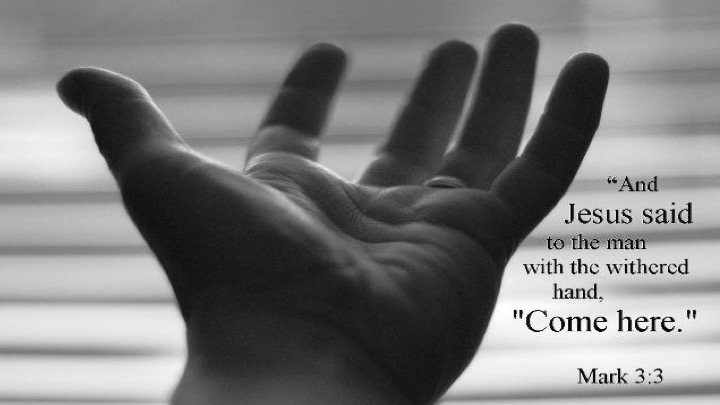
Again he entered the synagogue, and a man was there who had a withered hand.  They watched him to see whether he would cure him on the sabbath, so that they might accuse him. And he said to the man who had the withered hand, “Come forward.” Then he said to them, “Is it lawful to do good or to do harm on the sabbath, to save life or to kill?” But they were silent. He looked around at them with anger; he was grieved at their hardness of heart and said to the man, “Stretch out your hand.” He stretched it out, and his hand was restored. 

The Pharisees went out and immediately conspired with the Herodians against him, how to destroy him.

***


My husband and I have had more quality time together lately. Ever since I turned, twisted and lifted–and felt this sudden throbbing pain in my neck, shoulder and upper back.

We make small talk and listen to the radio when he drives me to and from my doctor’s appointments. Some weeks, I have had as many as 5 appointments! He drives me to church sometimes, too, and goes with me or waits while I visit members who are sick, in the hospital, rehab or nursing homes.

Slide18

After my doctor appointments or before my visits, we might go out for breakfast or lunch or a cup of frozen yogurt. One time, after my doctor’s appointment, we spontaneously went to a movie! We never used to do things like that!

We have had some adventures with wildlife going to and from my doctor appointments. On the way to physical therapy one day, a crane raced by us in the parking lot.

Slide21


 He or she was headed in the direction of a lawyer’s office, but then seemed to think better of it, turned and ran toward a pond. On the way home from the doctor Friday, Jim saw a turtle crossing the road, so he stopped the car and carried him to safety.


Later, I discovered that the turtle we rescued was a Florida softshell, a particularly aggressive breed that you probably shouldn’t pick up.

Every morning, Jim greets me with a smile, though he is tired after getting up to take care of the cat, who starts whining around 5:30 or 6 a.m. He lets me sleep in, if I can, because he knows I have trouble sleeping because of my neck.

“Good morning,” he says. “What can I bring you?”

He comes with ice packs; cold, fuzzy neck wraps; cold water, and hot tea with honey.

Slide28

When the pain was really bad, he would put his hand behind my neck and help me sit up.

One Monday about 2 weeks ago, I woke up not being able to talk! The doctor put me on Prednisone and “total voice rest.” Wow, that was hard! But Jim and I had more quality time–with me working from home. After sitting quietly next to me for a while reading, he said, “I’ve had such peace being home with you lately.”

I whispered, “It’s because I haven’t been talking.” We laughed.

I felt the same peace and knew that it was from God.  It was a gift of the Spirit– God letting us know, “I hear your prayers and I know you are hurting.  But you are healing. And I love you.  And I am still with you. My grace is all you need!”

Slide32


***


When I read our gospel lesson this week and thought about Jesus healing the man with the withered hand, I wondered, “Why did he pick him?” and “Why did he do it on the Sabbath, when he knew it would make the Pharisees mad?”

And then I realized…oh……  that was his intention.

This healing is different than when a leper came to him earlier in Mark, begging and kneeling, saying, “If you choose, you can make me clean.” Jesus is “moved with pity” and he stretches out his hand and touches him, saying, “I do choose. Be made clean!”

The man with the withered hand didn’t ask to be healed.  We don’t know if he was in any pain. He doesn’t speak at all. But Jesus knows the man’s need; he would be poor and marginalized from his community, which would believe God had cursed the man with a withered hand because of his or his parents’ sins.

The main reason for the healing, though, is that Christ wants to confront wrong attitudes and beliefs about the Sabbath. He first challenges them when his disciples pluck heads of grain as they walk through a field, perhaps that same day, since the stories are back to back. They ask Jesus, “Why are they doing what is not lawful on the Sabbath?”

It’s not clear in Scripture that this isn’t lawful. Deuteronomy 23:25 says that one can pluck grain by hand, but not with a sickle. Jesus replies with an example from Scripture that isn’t entirely accurate or in the same context. He asks if the Pharisees have read about David entering the house of God when they were hungry and eating the bread of the Presence that only priests are allowed to eat, and giving it to his companions. David doesn’t actually enter the house of God; the priest is Ahimelech–not Abiathar; and David is alone; he has no companions with him.

Biblical scholars don’t know what to make of Jesus’ response, when he misquotes Scripture. The consensus is that Jesus is revealing to his readers how the Pharisees, who are so worried about everyone else keeping the law, are ignorant of what Scripture really says. They don’t know what they are talking about. And their hearts are not in the right place! Their lives fail to demonstrate their love for God and neighbor –which, Jesus will say to his disciples, is the sum of all the commandments.

Jesus says to the Pharisees who question his disciples plucking grain, “The Sabbath was made for humankind, and not humankind for the Sabbath.” He is asking God’s people to see the law as God’s gift to them for their spiritual, physical and emotional wellbeing, rather than a measuring stick to judge and condemn. Jesus stirs the wrath of the Pharisees even more when he claims a higher authority than them, saying, “so the Son of Man is lord even of the Sabbath.”

Before he heals the man with the withered hand, Jesus asks those assembled, “Is it lawful to do good or to do harm on the Sabbath, to save life or to kill?” The room is silent. They know that saving the life of a human being or animal on the Sabbath is the exception to the rule of “rest.” But they are afraid of the Pharisees.

Notice this is one of the few times in the Bible that Jesus gets angry and is grieved “at the hardness of their hearts.” Both times that he is angry involves what is going on in the House of God–how God’s people are being taken advantage of or being persecuted. Remember when he cleanses the temple, turning over the tables of those selling animals to sacrifice?

Slide59

Jesus says to the man, “Stretch out your hand,”—and he does! And is healed.

And the Pharisees conspire with the Herodians to kill him.


***

I can honestly say I have learned a lot in these past few months. I will never again take for granted a pain-free existence. I am grateful for all of my good days, when I feel almost normal again and can lift my arms, nod my head, and turn my neck to the right and the left. I have learned the healing power of laughter and being present with people you love. And I am learning the importance of rest, especially Sabbath rest, a gift from a loving Lord.

I have learned to ask for help when I need it, and to receive it joyfully. I am still impatient with my body and get frustrated at times. But I am learning to persevere in hope, trusting the Lord will lead me in this journey to healing.

For the Lord knows our needs, just as he knew the needs of the man with the withered hand, without him saying a word.

God knows your hurts, even if you haven’t told Him. The Lord wants to carry your burdens, if only you would give them to him.

Christ’s peace lives inside you, a peace that surpasses human understanding, a peace that makes you whole and is meant to be shared with others.

God says, “I hear your prayers. I love you. I am still with you.”

And, “My grace is all you need.”


Let us pray.


Heavenly Father, thank you for loving us and for giving up your Son so that we would be reconciled with you and one another. Lord, we know you are listening now to our prayers and that you know our hurts, even the ones we haven’t told you about. We ask that heal us and make us whole. Give us your peace and strength when we encounter trials and suffering. Give us soft, loving hearts that desire to please you and obey your Word. Keep us from becoming legalistic and judgmental. Remind us that your Sabbath is a gift and that we need your Sabbath rest for the health of body, mind and spirit and the peace and wellbeing of the faith community. In Christ we pray. Amen.


Here am I


Meditation on Isaiah 6:1-8

May 27, 2018

Merritt Island Presbyterian Church

Slide25


In the year that King Uzziah died, I saw the Lord sitting on a throne, high and lofty; and the hem of his robe filled the temple.  Seraphs were in attendance above him; each had six wings: with two they covered their faces, and with two they covered their feet, and with two they flew. And one called to another and said: “Holy, holy, holy is the Lord of hosts; the whole earth is full of his glory.”   4 The pivots on the thresholds shook at the voices of those who called, and the house filled with smoke. 5 And I said: “Woe is me!  I am lost, for I am a man of unclean lips, and I live among a people of unclean lips; yet my eyes have seen the King, the Lord of hosts!”

     6 Then one of the seraphs flew to me, holding a live coal that had been taken from the altar with a pair of tongs. 7 The seraph touched my mouth with it and said: “Now that this has touched your lips, your guilt has departed and your sin is blotted out.” 8 Then I heard the voice of the Lord saying, “Whom shall I send, and who will go for us?” And I said, “Here am I; send me!”


***

Slide28


Ruby was about 4 when her family moved from Tylertown, Mississippi, to New Orleans. Her dad, Abon Bridges, had lost his job picking crops when new farm machines made his job obsolete. In New Orleans, Abon found work at a gas station. They move into a small apartment where Ruby shares a room with her sister and 2 younger brothers. Ruby’s mother, after taking care of the house and the children all day, tucks her 4 little ones into bed at night, says their prayers with them, and then goes to her job scrubbing floors in a bank.

Every Sunday, the family goes to church. “We wanted our children to be near God’s Spirit,” said Lucille Bridges, Ruby’s mother, in the award winning children’s book, “The Story of Ruby Bridges,” by Robert Coles.  “We wanted them to start feeling close to Him from the very start.”

In 1957, black children weren’t permitted to attend school with white children in New Orleans, despite the Supreme Court decision of Brown v. Board of Education three years earlier that effectively outlawed segregation, declaring “separate was not equal.” The New Orleans school board resisted integration and attempted to keep black children out of all-white schools by requiring an entrance exam for black children that was so hard, most children—white or black—couldn’t pass. But early in 1960, Ruby Bridges was one of six black children in New Orleans to pass the test. Her father was against her attending the all-white William Frantz Elementary school, at first, even though the school was closer to home than the all-black school she had attended for kindergarten the year before. But her mother persuaded him not to let this opportunity for Ruby—and for all African American children—pass by. She saw God’s hand in this. The other 3 children transferred 2 miles away from William Frantz– to McDonough No. 19 and became known as the McDonough Three. The remaining two of the six New Orleans children who passed the test stayed at their old school, fearing the violence of Little Rock, Arkansas in 1957, when 9 African Americans attempted to attend the all-white Central High School.

Ruby’s first day was Nov. 14, 1960, the day Judge J. Skelly Wright ordered New Orleans’ schools to integrate. Four federal marshals escorted Ruby and her mother to her new school.

Slide37


They were met by a mob of angry white people, yelling, threatening violence, throwing tomatoes and carrying signs with messages such as, “Integration is a mortal sin” and “God demands segregation.”

Norman Rockwell would later commemorate that day in his 1963 painting, The Problem We All Live With.

Slide41

As Ruby entered, parents of the 500 students at William Frantz removed their children from their classrooms.

The little girl spent the first day of school sitting in the office. All the teachers had left. But on her second day, Barbara Henry, a new teacher from Boston, arrived. She taught Ruby for more than a year in an empty classroom, as if she were teaching an entire class.

Slide42

 Also on that second day, a 34-year-old Methodist minister, Lloyd Anderson Foreman, broke the white boycott. He walked his 5-year-old daughter, Pam, through the angry mob, saying, “I simply want the privilege of taking my child to school …” By the end of the first week, another white child, 6-year-old Yolanda Gabrielle, returned to the school that separated all 3 children in different classrooms, though these were the only children in the school for the rest of the year.

The angry mob continued to gather to taunt Ruby every day.

Slide44

Every morning, a woman would threaten to poison her, while another held up a little black baby doll in a coffin. Marshals escorted Ruby for the rest of the year, overseeing her safety, and allowing her to eat only the food she brought from home.

Former U.S. Deputy Marshal Charles Burks recalled, “She showed a lot of courage. She never cried. She didn’t whimper. She just marched along like a little soldier, and we’re all very, very proud of her.”

Ruby’s family suffered for their decision. Her father lost his job. The grocery store the family shopped at would no longer let them shop there. And her grandparents, sharecroppers in Mississippi, were turned off their land.

But at the same time, they saw God’s grace. Many in the community, both black and white, showed support. A neighbor provided her father with a new job; local people babysat, watched and protected their home, and walked behind the federal marshals on the trips to school. Their church and the NAACP offered some financial and moral support.

Lucille Bridges says in The Story of Ruby Bridges, “Our Ruby taught us all a lot. She became someone who helped change our country. … She led us away from hate, and she led us nearer to knowing each other, the white folks and the black folks.”

In the face of mob violence, Ruby responded with love. Every day, she stopped a few blocks away from school to say a prayer for the people who hated her.

“Please, God, try to forgive these people,” she prayed. “Because even if they say those bad things, they don’t know what they’re doing. So you could forgive them, just like you did those folks a long time ago when they said terrible things about you.”


***

Isaiah, like Ruby, had a prophetic calling, but doesn’t learn of it till he is an adult and sees a vision of the Lord on His throne, asking, “Whom shall I send? And who will go for us?”

Slide14

But Isaiah is all too aware of his sinfulness in God’s presence. None of us feel worthy of serving the Lord of Hosts, not if we are honest with ourselves. Isaiah sees the seraphim—burning snakes with 6 wings each—attending to the Lord, he hears them singing God’s praises, and he imagines he will die.

 “Woe is me! I am lost!” he cries out, for he has “unclean lips” – a metaphor for sin —like “uncircumcised lips” in Exodus 6:12, 30. He confesses his own sin and declares the sin of his community, a people of “unclean lips” who have turned away from God and His Word.

“Woe to you who call evil good and good evil,” says Isaiah in chapter 5, “you who put darkness for light and light for darkness, who put bitter for sweet and sweet for bitter! All you who are wise in your own eyes, shrewd in your own sight,… who acquit the guilty for a bribe, and deprive the innocent of their rights!”

But God doesn’t give up on anyone. He is always beckoning sinners to return to Him and His ways of love and righteousness, peace and justice.

God removes Isaiah’s sin from him with a burning coal. None of us can take our own sin away or equip ourselves for God’s calling.

Slide22

We all need redemption through God’s Son and strength and guidance from the Spirit. Isaiah’s mission will mean suffering and hardship. God’s people don’t want to hear the truth just like our society today doesn’t want to admit to sins of racism, hatred, and prejudice, which are always hiding in the shadows, ready to rise up, without warning, and hurt and destroy.

God sends Isaiah out to go and tell people whose eyes are blind, hearts are hard, ears are deaf, and minds won’t comprehend to turn back to God and be healed.

Isaiah trusts the Lord.

“Here am I!” He says. “Send me!”


***


In one year of Ruby’s life, we see the important roles others played so she would fulfill her calling. Her parents, her teacher.

Slide64

The marshals. The child psychologist. The Methodist pastor who brought his daughter on the second day. Many other people—white and black—helped Ruby and her family, too, after the Supreme Court opened the way for change and Judge Wright did his part.

On Wednesday we honored our 13 VPK grads with a simple worship service. Many people—volunteers and staff– work behind the scenes to make this a powerful outreach to the preschool families every year.

This slideshow requires JavaScript.

God is glorified as each 4 or 5 year old child is lifted up and encouraged for who they are—children of God, as we are, given the spirit of adoption, joint heirs with Jesus Christ… We all have a calling, unique to the gifts and plans God has for us. And our callings are connected. We share the same Spirit; we serve the same Lord.

Ruby accepted her calling when was just 6, without knowing what racism was or the suffering or trials ahead.

Slide88

She thought she was just going to school that first day—thought all the shouting in the streets was Mardi Gras. Her faith still compels 64-year-old Ruby Bridges Hall to confront the problems of poverty, racism, and unequal educational opportunities through her foundation.

Slide89

In 2001, she was awarded the Presidential Citizens Medal. And in 2006, a California elementary school was named for her.

Like hundreds of thousands of others in the greater New Orleans area, she and her family lost their home in the catastrophic flooding of Hurricane Katrina in 2005. But the same storm brought new life to William Frantz Elementary School, which was on the school district’s list of closures before the storm. The school, under 5 feet of water after Katrina, was put on the National Register of Historic Places, renovated and now houses a public K-6th grade charter school, Akili Academy.  The school that is 89% black embraces 5 values: “Teamwork, Grit, Excellence, Enthusiasm and Kindness.”

Ruby’s story is told every year as part of the curriculum. A statue of her stands in the courtyard.

Slide93

 And Room 2306 is the “Ruby Bridges Room” to honor the little girl who spent a year alone in a classroom, shunned because of her skin color. A brave girl who answered God’s call. “Here am I.”


Let us pray.

Lord, we hear you calling to us now—to come and follow you. Here we are. Send us! Stir us to acts of bravery as we confront the problems of racism, prejudice, poverty, and other injustices in our society, rather than sweep them under the rug as past history. We ask for your healing to come to this land. Let us never be afraid to ask the hard questions and move forward, step by step, trusting your Spirit to guide and empower us to do your will. Thank you for the many gifts and blessings you have given us. May we use them for your glory and not be frustrated or discouraged by the darkness around us and if we don’t see immediate results and positive change. For Isaiah was called to preach to those without ears to hear, eyes to see and minds to comprehend. Keep us working to reveal and build up your Kingdom, which has no end. And teach us to pray every day—as Ruby did—for her enemies, that you would forgive them and lead us to love and forgive them, too. Through Christ we pray. Amen.


Breath of God


Meditation on Acts 2:1-21

Merritt Island Presbyterian Church

May 20, 2018

Slide59


When the day of Pentecost had come, they were all together in one place. And suddenly from heaven there came a sound like the rush of a violent wind, and it filled the entire house where they were sitting. Divided tongues, as of fire, appeared among them, and a tongue rested on each of them. All of them were filled with the Holy Spirit and began to speak in other languages, as the Spirit gave them ability.Now there were devout Jews from every nation under heaven living in Jerusalem. And at this sound the crowd gathered and was bewildered, because each one heard them speaking in the native language of each. Amazed and astonished, they asked, “Are not all these who are speaking Galileans?  And how is it that we hear, each of us, in our own native language?

Parthians, Medes, Elamites, and residents of Mesopotamia, Judea and Cappadocia, Pontus and Asia, 10 Phrygia and Pamphylia, Egypt and the parts of Libya belonging to Cyrene, and visitors from Rome, both Jews and proselytes, 11 Cretans and Arabs—in our own languages we hear them speaking about God’s deeds of power.” 12 All were amazed and perplexed, saying to one another, “What does this mean?” 13 But others sneered and said, “They are filled with new wine.”

14 But Peter, standing with the eleven, raised his voice and addressed them, “Men of Judea and all who live in Jerusalem, let this be known to you, and listen to what I say.15 Indeed, these are not drunk, as you suppose, for it is only nine o’clock in the morning. 16 No, this is what was spoken through the prophet Joel:

17 ‘In the last days it will be, God declares,
that I will pour out my Spirit upon all flesh,
and your sons and your daughters shall prophesy,
and your young men shall see visions,
and your old men shall dream dreams.
18 Even upon my slaves, both men and women,
in those days I will pour out my Spirit;
and they shall prophesy.
19 And I will show portents in the heaven above
and signs on the earth below,
blood, and fire, and smoky mist.
20 The sun shall be turned to darkness
and the moon to blood,
before the coming of the Lord’s great and glorious day.
21 Then everyone who calls on the name of the Lord shall be saved.’


Beginning at 11:20 a.m. England time yesterday, Rolls Royces carrying the British royal family and the wedding party pulled up at St. George’s Chapel in Windsor as the crowds cheered them on. Some people had camped out for days to claim their spots and get a good look at Prince Harry and his beautiful bride, Meghan Markle on their wedding day.

The wedding brought back memories of Charles and Diana’s wedding in 1981. Did any of you see their wedding? More than 750 million people watched that royal wedding, taking in every detail, which at the time, were very important to some of us.

Slide31

How beautiful Diana was, wearing a dress worth more than $41,000 U.S. dollars today. I even remember some of the funny things that happened. Poor Diana was so nervous—with 3500 invited guests watching and listening in person; she got Charles’ name wrong during the vows, calling him “Philip Charles Arthur George” instead of “Charles Philip Arthur George.”

Her 25-foot train got wrinkled on the way to the wedding, and her young bridesmaids couldn’t shake the wrinkles out before she walked down the aisle. India Hicks, who was just 13 at the time, recalls Diana sympathetically whispering, “Just do your best” to her bridal party.

And Clementine Hambro, granddaughter of Winston Churchill was just 5 when she was in Diana’s wedding party. Clementine tripped and fell and began to cry, to which Diana asked her gently, “Did you bump your bottom?”

Slide34

There were some similarities to Harry’s parents’ wedding, including the Cinderella procession afterward with the Duke and Duchess of Sussex riding in a horse-drawn open carriage, flanked by royal regiments on horseback. But there were important differences– signs of hope and much needed change, not just for attitudes in Britain society, but for America and the whole world.

This was Charles and Diana’s son, Harry, marrying a beautiful, outspoken American actress named Meghan Markle, who is bi-racial.

Slide40

About her ancestry, Meghan has said, “My dad is Caucasian and my mom is African American. I’m half black and half white. … I have come to embrace this and say who I am, to share where I’m from, to voice my pride in being a strong, confident, mixed-race woman.”

Meghan arrived at the church in a 1950 Rolls Royce custom made for Elizabeth’s coronation. She was 4 seconds late, the press pointed out. The bells were chiming the noon hour as she was helped from the car.

Two little boys held the tips of her enormous train as she walked up first 22 steps to the entrance and then down the aisle. Her little bridesmaids followed behind and passed by the bride, nearly forgetting to take the bridal bouquet.

Harry smiles at Meghan and goes off script, not caring that the whole world is watching. ”You look amazing,” he says to her. “I love you.”

The bride’s mother, Doris Ragland, came alone as she was the only one in her family to attend. Meghan’s father had heart surgery on Wednesday and wasn’t ready for travel. Doris wept openly throughout the service.

The archbishop of Canterbury read from 1 John: “God is love and those who live in love live in God and God lives in them.” The congregation sings “Lord of All Hopefulness” to the tune of “Be Thou My Vision.” A passionate passage from Song of Solomon was read. The Kingdom Choir sang a very moving, “Stand By Me,” following the Rev. Michael Curry’s charismatic, social justice message.

Curry, the first African-American leader of the US Episcopal Church, quoted Martin Luther King, “We must discover the power of love, the redemptive power of love. And when we do that, we will be able to make of this old world a new world.”

Slide50

Curry said, “There’s power in love. Don’t underestimate it. Don’t even over-sentimentalise. There is power, power in love….. I’m talking about some power. Real power. Power to change the world.”

***


It’s the power of love—REAL power—that comes to Christ’s followers gathered in Jerusalem on Pentecost. This familiar story we read every year, and recall its fine details, such as Peter’s joke about not being drunk at 9 in the morning. This Spiritual baptism is not limited by gender, age or social position. Slave or free, men and boys, women and girls, “all flesh” receive the Spirit in a demonstration of radical social equality that is the Kingdom of God. But with hearing the story every year, I worry that the “violent wind” may be diminished to something less than the wild, out of our control force that breathed life into human beings formed from dust at Creation. It is also important to remember that the Spirit comes to those with faith, those who have prepared their hearts, gathering together in one place, waiting in hope and prayer, as Christ tells them to do.

The first to benefit from the Spirit’s work on Pentecost through Christ’s followers are the devout Jews and proselytes who have come from all over to Jerusalem for the pilgrimage festival of Shavuot. The word Pentecost is Greek for 50th as Shavuot falls on the 50th day from the first Sunday after Passover. It’s no coincidence that God has chosen this day to give His Spirit to dwell with His people. For on Shavuot, the faithful celebrate the giving of God’s Word—the Torah—on Mt. Sinai. The Spirit compels Christ’s followers to speak of God’s “deeds of power” in languages that everyone can understand, languages the uneducated Galileans couldn’t possibly know on their own. Many take Peter’s message to heart; about 3,000 people are added to the church in one day.

The Spirit continues to give gifts to Christ’s followers today–each in a special way, as Paul explains in 1 Cor. 12:7-11. We need to trust the Breath of God that is in us and take the message to our community, as Peter and the disciples do on Pentecost. But most of us don’t feel comfortable preaching to crowds. Most of us aren’t comfortable preaching at all. The thought of sharing the gospel with the world is surely terrifying to some. But I think the most effective preaching involves few if any words, like St. Francis of Assisi said. Your life proclaims God’s work in you through the fruits of the Spirit, Paul tells the Galatians in 5:22-23. People will know you are following Christ by your love, joy, peace, patience, kindness, gentleness, and self-control.

Remember you have the Breath of God living inside you. We have the Breath of God among us when we gather together in faith, waiting, praying and hoping in him. And you have the Power of Love. Real Power…  …Power to change the world.”

Let us pray.

Lord God, thank you for sending your Spirit at Pentecost so that believers would be strengthened to share your message of love and redemption–and that the church would grow by 3,000 that day. Thank you that we have your breath now, within us, and that you continue to breathe on us your Spirit, refreshing and renewing us as we seek to do your will. Grow us, Lord, by your Spirit. Build our faith and numbers in all our ministries, including the preschool. Stir us to gather together every Sunday to seek you in faith, hope and prayer here, in this place. Then send us out to care for people in need and show we are your followers by our acts of kindness. Transform us with your Power of Love and use us to break down barriers between people– and change the world. In Christ we pray. Amen.


God is Love

Meditation on 1 John 4:7-21

Merritt Island Presbyterian Church

May 6, 2018

Beloved, let us love one another, because love is from God; everyone who loves is born of God and knows God. Whoever does not love does not know God, for God is love. God’s love was revealed among us in this way: God sent his only Son into the world so that we might live through him. 10 In this is love, not that we loved God but that he loved us and sent his Son to be the atoning sacrifice for our sins. 11 Beloved, since God loved us so much, we also ought to love one another. 12 No one has ever seen God; if we love one another, God lives in us, and his love is perfected in us.

     13 By this we know that we abide in him and he in us, because he has given us of his Spirit. 14 And we have seen and do testify that the Father has sent his Son as the Savior of the world. 15 God abides in those who confess that Jesus is the Son of God, and they abide in God.  16 So we have known and believe the love that God has for us.

       God is love, and those who abide in love abide in God, and God abides in them. 17 Love has been perfected among us in this: that we may have boldness on the day of judgment, because as he is, so are we in this world. 18 There is no fear in love, but perfect love casts out fear; for fear has to do with punishment, and whoever fears has not reached perfection in love.  19 We love because he first loved us. 20 Those who say, I love God,” and hate their brothers or sisters, are liars; for those who do not love a brother or sister whom they have seen, cannot love God whom they have not seen. 21 The commandment we have from him is this: those who love God must love their brothers and sisters also.


***

We shared a bedroom, growing up. My sister and I were giggly girls, not wanting to go to sleep while it was still light out when our parents put us to bed. We threw pillows at each other and argued over whether the door and windows should be left open or closed. Open, I said, as we had no a/c and Maryland summers are hot and humid. She said closed, worried about burglars and fire. We compromised–the door left open a crack ; my window opened; hers closed.

Susan is 2 and a half years older than me and 14 months older than our brother. She was a premature baby weighing only 2.5 pounds at her birth in October 1962. She spent her first 2 months in an incubator, fighting for her life, losing 50 percent of her body weight before slowly regaining and growing. Finally, at Christmas, the doctors let Mom and Dad take their baby home. She continued to be fragile through our growing up years, weighing only 98 pounds when she graduated from high school. But she was smart and a conscientious, straight A student. She played violin, studied Latin, Spanish and French and made plans to go to college.

But one evening, when I was about 15, I came home and discovered the house strangely empty— partially cooked dinner still on the stove, turned off. I don’t know how I learned what happened—whether my parents left a note, called or just, eventually, came home from the hospital. My sister had tried to commit suicide and was fighting for her life-again. I was stunned. She never told me she was depressed. I felt angry, hurt, sad. Our lives changed drastically after that. Our family would never be the same.

Susan did recover physically, but never came home. She was diagnosed with schizophrenia and placed in a state institution that has since closed because it was so terrible. It would be the first of more than 20 hospitalizations.

But she found hope and help through an organization called St. Luke’s House, which began in 1971 as a ministry of St. Luke’s Episcopal Church in Bethesda, MD. The church wanted to address the needs of patients being released from state psychiatric hospitals with no place to go. Susan lived in their group housing (they have more than 30 units with 111 beds). She received counseling and help finding a job, assistance with medical care, food, clothing, household items and transportation until she could afford to buy her own car. One of the greatest blessings about St. Luke’s is that it provides opportunities for recreation and socialization, knowing that friendship–love– is a basic human need and that people with mental illness often have a difficult time cultivating loving, lasting relationships with others.

***

Our passage in 1 John begins with, “Beloved.” This is an affectionate greeting, as some translations say “dear friends.” But there’s a deeper meaning, and John using this word twice in this passage and 6 times in this letter is making a point. This is the same John who uses the phrase “the disciple whom Jesus loved,” in his gospel, which many interpret as John writing himself and every believer into the story. We are all disciples whom Jesus loves. We are all God’s beloved.

John is telling us who God is in this letter and by omission who God is not. He isn’t like the psalmists who go on and on about God’s rescue and provision or God leading them to victory over their enemies. The psalmist would probably be disappointed with John’s definition–just as we want more from God in this world–healing for our loved ones, freedom from pain and suffering, and an easier life. John says, “God is LOVE.” And if you don’t love, then you don’t know God! And you know what love is? This is love– not that we loved God but that he loved us and sent his Son to be the atoning sacrifice for our sins, so that we might have life through him. He took the punishment we deserved, revealing that love means self sacrifice, allowing oneself to be vulnerable, and being willing to suffer if it would save those you love.

And what happens when God’s love is poured into us? It is perfected–made complete–in us. God’s love empowers us to love others–if we choose to do what “we ought to do,” as John says.

I have always thought the reason we might choose not to love is because the person is hard to love or has hurt us and we cannot forgive them. But I never really thought about another reason that people might choose not to love–fear–until this week. John contrasts fear and love in this passage, saying they cannot co-exist. With this, John may be telling us to overcome our fear of being vulnerable and open our hearts to fully love and be loved.

“Love has no room for fear,” John says in some translations. “Perfect love drives out fear.” Fear can block the Spirit’s transforming work in our hearts. For the one who fears, John says, is not made perfect in love.

***

Susan called me a few weeks ago to tell me surprising news. My 55 year old sister was getting married for the first time. She had met John 10 years ago through St. Lukes. He was bi-polar and had just been diagnosed with kidney cancer. She was on her way to visit him. Would I pray for his healing? I said I would.

Then, a couple nights ago, she called again–crying. John had died suddenly, without her saying goodbye. We talked for a long time. At the end of our conversation, I encouraged her to write down her memories of John. She sent me her tribute the next morning, and asked if I might share it with you. She hopes that her story might help someone who might be afraid to love–or afraid to share their feelings.

“Don’t wait to tell your loved ones,” she says, “how you feel.”

John was interested in history, politics, economics, science. He read the Washington Post from cover to cover. He read biographies– JFK, MLK. “He could explain things to me I didn’t understand,“ she said. They talked on the phone often.

When they went out together, she would pick him up at a bus stop, and they would go to local historic sites and parks. A favorite place was Brookside Gardens in Wheaton. He had positive outlook, she said, and was tender with her when she had depressive episodes. He would say, “I feel great! It’s a wonderful day!” They ate at McDonalds, and he picked up her tray and emptied it for her. He was kind, gentle, considerate. Before she dropped him off at the metro station at the end of each date, he would say, Thank you, I had a good time with you today. And she would say, “I had a good time, too.”

She didn’t tell him how she felt about him because she was afraid it would push him away. But when he got sick a few months ago, she started spending Saturdays with him at the nursing home. Finally, she got up the courage to tell him that she cared about him and wanted to marry him. He paused for a second and said, “I accept. I will have to get you a ring.  We need to go to Paris.” He told her he was 66. She said, “Age doesn’t matter.”

For those few months, she was happy to have a boyfriend and to be engaged. “I am so glad I didn’t hold back my feelings,” she said. Her only regret is that she hadn’t shared her feelings years ago. How different her life would have been!

After talking to her on the phone and reading her letter, I could only marvel at the change in her. She had peace, despite her sadness and loss– a peace brought about by her love for another–and the love of God being perfected in her heart.


Let us pray.

Holy One, we thank you for your love and for all the loved ones you have placed in our lives. Thank you that as we learn to love and open ourselves to love, your love is perfected in our hearts. Forgive us for our reluctance to be vulnerable and for not always feeling like loving. Help us to forgive those who have hurt us and bear witness to the loving Spirit that abides in us, transforming our hearts. We pray for my sister, Susan, and her healing and wholeness as she grieves the loss of her loved one. May we all feel your loving presence with us always and never be afraid to show our love for one another. In Jesus we pray. Amen.


Somebody’s Watching Over You

Meditation on John 10:11-18

April 29, 2018

Merritt Island Presbyterian Church

Slide14


11 “I am the good shepherd. The good shepherd lays down his life for the sheep.  12 The hired hand, who is not the shepherd and does not own the sheep, sees the wolf coming and leaves the sheep and runs away—and the wolf snatches them and scatters them. 13 The hired hand runs away because a hired hand does not care for the sheep.  14 I am the good shepherd. I know my own and my own know me, 15 just as the Father knows me and I know the Father. And I lay down my life for the sheep. 16 I have other sheep that do not belong to this fold. I must bring them also, and they will listen to my voice. So there will be one flock, one shepherd. 17 For this reason the Father loves me, because I lay down my life in order to take it up again. 18 No one takes it from me, but I lay it down of my own accord. I have power to lay it down, and I have power to take it up again. I have received this command from my Father.”

***


I came to a decision last week about our preschool chapel service. It’s time to split the group! The group has gotten so big that I am not able to give each child as much individual attention as I would like.

We have thirty-six 3, 4 and 5 year olds all wanting to answer my questions about Jonah, Joseph or Jesus at the same time. All wanting to be helpers, such as carrying the basket of musical instruments and collecting the children’s maracas, tambourines, sticks and cymbals. They want to show me their shark tooth necklaces and tell me about going on a cruise, losing a tooth or having a birthday. I want to congratulate them when they show me their age on their fingers… And tell them how sorry I am to hear how their father “accidentally” stepped on their baby pet spider.


God has blessed us with 36 precious children popping up out of their seats when they want to touch an object or see a picture up close–or just get a hug. They love Jim, too. At one of the first chapels he brought his guitar about a year ago, little Jacob cried out, “Oooo! Pastor Jim! You’re a rockstar!” They have had a special relationship ever since.

What led me to decide to split the group now and not wait till fall was when we were singing our greeting song at the beginning of chapel a week or two ago. I call the children by name and help them choose an item of clothing they want us to sing about, such as “Jeffery is wearing a red shirt, red shirt, red shirt, Jeffery is wearing a red shirt all day long.” Then they choose the next person we sing about and so on. But after 20 minutes, we still weren’t done! And we had the Bible lesson and other songs still to do.

The children aren’t shy about singing or sharing their feelings and the intimate details of their lives. They know we are listening, that we care, and that what they say is important to us. They know the sound of my voice–when I speak, read, laugh, shush, and sing. They listen to me and follow as I teach new rhymes, fingerplays and songs. They echo simple prayers, without hesitation.

They want to be loved–for everything they are and are gonna be.

They know I am watching them–and they are watching me.

Who are you watching over, in your life? Who is watching over you? For we are all called to be sheep. And we are also called to be shepherds, following in the footsteps of our loving Savior, who watches over us all.

***


Studying our gospel reading this week, I couldn’t help but think how much we who have been in the faith for many years have lots to learn from 3, 4 and 5 year olds. I can hear Jesus saying, as he does in Matthew 18:3, “Truly I tell you, unless you change and become like little children, you will never enter the kingdom of heaven.”

It’s easy to picture young children as the sheep that listen to Christ’s voice, lambs that Christ knows intimately–watches over and beckons to him by name before he leads them in right paths. Sheep do not have to pushed out of a sheepfold; they are not like cattle who are herded from behind. They are timid and follow their shepherd as he goes ahead of them; there is never a place we can go where Jesus has not yet been! They know his voice; they know him; that’s why they follow him. They won’t follow a stranger. They know he cares for them. He nourishes, disciplines, and protects them, helps them when they are sick or wounded. He stays with them and never abandons them–not like the “hired hand” that won’t risk his life for the flock . The point is not that the hired hand is bad but that belonging to Christ is everything. And He’s the one who chooses us and claims us as His own. His commitment to us is unconditional–based on what he has done for us. But his expectation is that we watch for him, listen to his voice–and only his voice– and obey.

Slide36

Jesus’ audience is both disciples and Pharisees in John 10. In chapter 9, Jesus heals a man who was blind since birth. The man responds to Christ, with, “Lord, I believe.” The Pharisees are not convinced.

So Jesus, in John 10, explains his mission to the Pharisees with the metaphor of a shepherd. He stirs their anger by declaring himself to be God, using OT language and imagery. The Psalmist in 100:3 says, “Know that the LORD is God.  It is he who made us, and we are his; we are his people, the sheep of his pasture.” “He tends his flock like a shepherd:” says Isaiah 40:11, “He gathers the lambs in his arms and carries them close to his heart; he gently leads those that have young.”

Slide32

The Good Shepherd, who will lay down his life for the sheep, is proclaiming the fulfillment of Zechariah 9:16-17, “The LORD their God will rescue his people, just as a shepherd rescues his sheep. They will sparkle in his land like jewels in a crown.  How wonderful and beautiful they will be!”

The Pharisees are divided in their reaction to Christ’s teachings. Some say, “He has a demon and is out of his mind. Why listen to him?” Others say, “These are not the words of one who has a demon. Can a demon open the eyes of the blind?”

Jesus will answer those who call him demon possessed or insane. “You do not believe because you do not belong to my sheep,” he says, adding for emphasis, “My sheep listen to my voice. I know them, and they follow me.”


***

A few weeks ago, we invited preschool and VPK families to attend a special chapel. We began like we usually do– singing “Good morning, good morning and how do you do?” and the song about the clothes we are wearing all day. I reviewed the Miracles of Jesus we had been learning — turning water into wine, calming a storm, walking on water, and feeding the multitude with a few loaves and fish. We prayed our simple echo prayer, and then, a bunch of volunteers and staff from the church and preschool led the children to do crafts and games on the theme of the Miracles of Jesus before eating lunch with their families.

This slideshow requires JavaScript.

While they were eating, a grandma visiting from California, thanked me for the chapel and taking time to get to know the children, especially her granddaughter. Would I invite her parents to church? She hoped so–and that other preschool families would come to our church, too.

Starting this week, Jim and I will be leading 2 chapels, back to back, beginning at 9:30. Our lesson this Tuesday? We will tell them about the Good Shepherd –how Jesus will go after the one sheep that is lost, though he may still have 99 in the fold. That’s how much our Savior loves us!

He has claimed us as His own. He calls us by name. “My sheep listen to my voice,” he says. “I know them, and they follow me.”

As Christ loves, we must love. To me, this means learning all of the children’s names and the important stuff that really matters: shark tooth necklaces, birthdays, loose teeth, and baby pet spiders that “accidentally” get stepped on.

The children want to be loved– for everything they are and are gonna be.

Slide79

Who are you watching over? Who is watching over you?

For we are called to be sheep. And we are called to be shepherds, following in the footsteps of our loving Savior, who watches over us all.


Let us pray….


Dear Lord, thank you for being the Good Shepherd, who has laid down your life for us, your sheep, so we may have life and have it abundantly. Thank you for calling us by name and knowing us better than we know ourselves. Thank you for caring about what we care about–every little thing that children and adults worry about. Help us to be more like children, Lord, so that we may be obedient to you and trust your commands. Thank you that you speak so we can hear your voice and for leading us to follow you in the paths you want us to go. Thank you that you are always with us, watching over us still, using us to be shepherds like you–and nurture your sheep. And finally, thank you, for the children and families you have blessed us with at the preschool. Help us to share the love of our Good Shepherd with them and bring them into your Kingdom fold. In Christ we pray. Amen.


Practical Resources for Churches

Everyone has a calling. Ours is helping you.

Consider the Birds

Pastor Karen shares thoughts on faith, scripture, and God's love and grace revealed through backyard wildlife.

F.O.R. Jesus

Fill up. Overflow. Run over.

Becoming HIS Tapestry

Christian Lifestyle Blogger

Whatever Happens,Rejoice.

The Joy of the Lord is our Strength

Stushie Art

Church bulletin covers and other art by artist Stushie. Unique crayon and digital worship art

The Daily Post

The Art and Craft of Blogging

WordPress.com News

The latest news on WordPress.com and the WordPress community.