“Have You Anything to Eat?”

Meditation on Luke 24:36b-48

First Presbyterian Church of Smithtown, NY

Pastor Karen Crawford

April 14, 2024

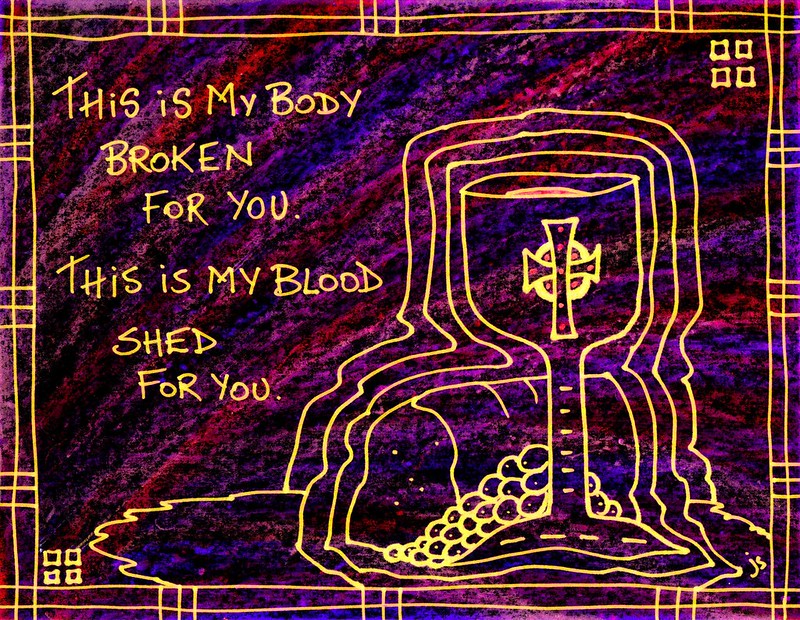
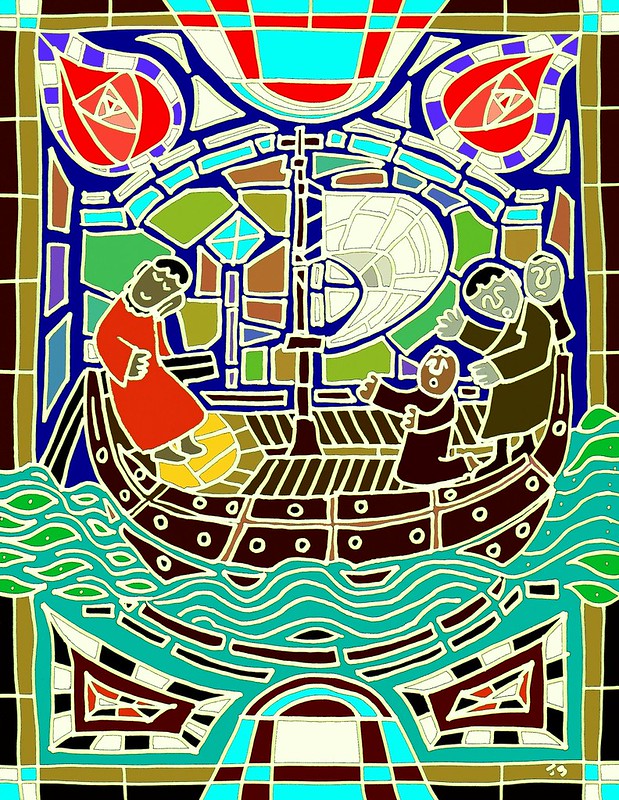
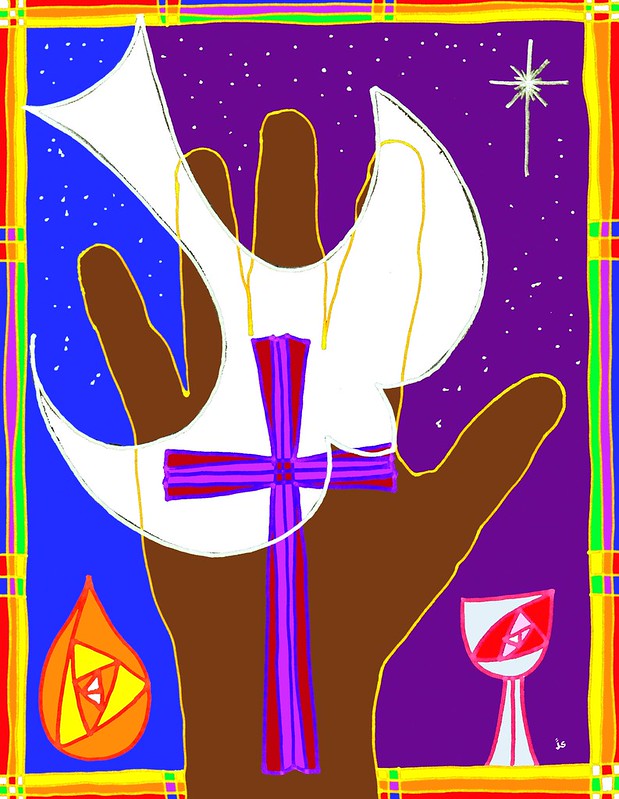
Art by Stushie, used with permission

I have a scar on my left wrist that is almost as old as I am.

There’s a story behind every scar, isn’t there?

I was thinking the other day how there’s only one person left in the world who really knows the whole story with the 3-inch scar on my wrist. That’s my mom, who will be turning 85 in June. I was maybe 2 or 3.

In all actuality, I don’t remember being injured. I don’t remember any pain. I only remember the story my mother has told me.

But there’s a picture of my dad holding me, not long after the injury. I have an ugly red scab on my wrist. And an ugly red scab on my neck, which has since faded to the point where I almost forgot about it—until a year ago, when I had my thyroid removed.

The surgeon made a cut right through the old scar. It’s barely noticeable now.

My mother told me that I reached for a pot of boiling soup on the stove. I didn’t want to wait for her to pour it into a bowl. I was at the age where I probably wanted to do everything myself and thought I could do everything myself. The pot of boiling soup poured down the front of me.

It was winter, and I was wearing a long-sleeved turtleneck, with cuffs at the wrists and collar. My mom, who was a nurse, worked quickly to remove the turtleneck, while I was screaming in fear and pain. She pulled my right arm out first and then the shirt over my head. The hot soup had soaked through the cuff on my left arm, at my wrist. I was seriously burned.

Mom took me to the hospital. There was nothing they could do for me. It was a burn in the 1960s. We could only wait for my body to heal itself.

Mom said she was told to soak my wrist. One day, the ugly scab came off—and there was new, pink skin underneath.

I was self-conscious about the scar on my wrist when I was in grade school. The wrinkly skin didn’t look like the rest of my arm. It had strange red and brown spots. The hair didn’t grow back normally. When I wore short sleeved shirts, sometimes my classmates asked me about it, thinking it was a fresh wound.

How ugly my wrist was, I thought back then. How I wish that I had never done what I had done—and then, I wouldn’t have an ugly scar.

This seemingly insignificant scar on my wrist comes to mind while I read this passage of one of the resurrection appearances in the gospel of Luke. This appearance happens right after the two disciples have been walking with the risen Christ on the road to Emmaus without knowing they are with Jesus. They are going home after a long, confusing, upsetting day that began with the discovery by the women of Christ’s empty tomb. What did that mean—the empty tomb? Did someone steal the body?

Meanwhile, they tell Jesus what happened that morning, and he opens the Scriptures to them, and their hearts are burning. They invite him inside their home. He blesses and breaks the bread, and their eyes are opened, and they recognize him. He vanishes, and they run back to Jerusalem that night to tell the other disciples what happened.

While the two disciples are sharing their story, Jesus surprises and terrifies the group by making another appearance, in today’s reading. He says, “Shalom! Peace be with you.” And even though the women shared the news of the risen Christ, and the two disciples shared the news of the risen Christ, the group can’t wrap their heads around what is happening.

People don’t just come back from the dead, do they? Especially those whom they have watched die in a cruel and terrible manner. And if people DO come back from the dead, well, doesn’t that mean they are ghosts? Just like some people nowadays believe in ghosts and relish stories of the paranormal on TV, they believed in ghosts in ancient times, too.

Jesus is saying to them, “Come on, I am not a ghost. Look at my hands and feet. Go ahead, do not be shy, touch me. You ever seen a ghost who looks like this? Didn’t think so. Anybody here got something to eat? I’ll have the broiled fish.” [1]  

“The Jesus who repeatedly ate with his disciples, with sinners (and tax collectors), and with Pharisees now eats his last meal before leaving his disciples in the ascension. He does this… to prove that he is not just a vision or a ghost, that he has really conquered death.” [2]

The disciples look at his scars, touch his flesh, hear his voice, and are filled with joy, but, at the same time, they are disbelieving and wondering what is going on.

Jesus is doing two things that he does best—eating and teaching them, opening their minds, once again, to the Scriptures in a way only Jesus can.

The scars capture my attention, as this is the second week we have discussed the appearances of the risen Christ and his showing them his scars. Seeing the scars, they aren’t stirred to anger or want revenge for the injustice of Christ being crucified. The scars don’t bring hatred or fear.

The scars tell the truth, and they are stirred to joy because of what God has done!

I am seeing the 3-inch scar on my wrist in a new way, after studying this passage. The Lord doesn’t want me to remember a childhood error, grabbing a pot of hot soup off the stove. God doesn’t want me to remember the pain. And I don’t!

The scar is a reminder to me of the love of my mother, who acted quickly to remove the soup-soaked turtleneck and get me to a doctor, right away. She may have saved my life that day, and she would do it again in an instant. Just as we would do the same for all our loved ones.

What if we saw all our scars not as ugly, not as stories of injuries or surgeries, but instead as marks of beauty, further proof of the faithfulness of our God, who has a wonderful plan for each of us? Rather than sadness, shame, or grief as we recall injuries, surgeries, and pain, what if we are moved, instead, to wonder, joy, and gratitude for all that God has done?

I am seeing that black and white photograph in a different light, that one my mom or another relative took of me, with the ugly red scab on my wrist and at my neck, sitting in my father’s lap.

The expressions on our faces tell the whole story.

Dad is smiling, and my head is tipped back as if I am giggling from being tickled or from something funny that he said—or both.

The ordeal is over. The danger has passed. I have a feeling that we might have just finished sharing a meal.

Dear friends, “the one whose life the church shares in Word and Sacrament is not a ghost or a disembodied spirit. He is the risen Lord.” [3]

“The passage ends as a kind of ordination service,” says Thomas Long, professor emeritus at Candler School of Theology. “Jesus has done his work, and it is now time for the disciples—then and now—to do theirs. Jesus sends them into the world, not as soldiers, diplomats, program planners, or celebrities, but as ‘witnesses.’

“It is the thinnest of all portfolios. The church has no weapons, no credentials, no powerful allies, no fancy remedies, or quick fixes; it is to offer only what it has seen and heard in Jesus. …That, of course, is what the world most needs: honest and courageous disciples who will get on the witness stand and tell the truth, the whole truth, and nothing but the truth.” [4]

Christ sends us out, with our scars and stories of redemption, miracles of healing, and the grace and love of our living, forgiving God.

The peace of Christ is with you!

He is risen! Hope is everywhere.

And WE are witnesses of these things.

Let us pray.

Loving God, thank you for healing us, over and over again, and the promise of eternal life by faith in your Son, Jesus Christ. We anxiously await the return of our Messiah, when we will finally live in resurrected flesh and blood bodies in a new heaven, a new earth. But until that time, help us to be your faithful witnesses—to tell the truth, the whole truth, and nothing but the truth, courageously, without embarrassment, fear, or apology. Christ is risen! Hallelujah! In Him, our stories and our very lives have been redeemed. Amen!


     [1] Thomas Long, “Third Sunday of Easter” in Connections, A Lectionary Commentary for Preaching and Worship, Year B, vol. 2, Lent through Pentecost (Louisville: Westminster John Knox Press, 2020), 232-233.

     [2] Justo L. Gonzalez, Luke from the series Belief: A Theological Commentary on the Bible (Louisville: Westminster John Knox, 2010), 279-280.

[3] Justo Gonzalez, 279.

[4] Thomas Long, 233.

What Do You Need to Believe?

Meditation on John 20:19–31

First Presbyterian Church of Smithtown, NY

Pastor Karen Crawford

Second Sunday of Easter

April 7, 2024

Art by Stushie, used with permission

Where were you on Friday when Long Island experienced an earthquake? Did you know it was an earthquake, right away?

The earthquake we felt this past Friday, April 5, was a magnitude 4.8 at its epicenter in New Jersey. Nassau and Suffolk County emergency response received more than 200 9-1-1 calls from those who were curious about it.

Catherine Jennings, a 9th grade earth science teacher at Half Hollow Hills High School in Dix Hills, just happened to be doing a lesson on earthquakes when the floor and desks started shaking. Her students looked at her, thinking that she must be staging it. “How could we be so lucky to have this happen at the exact moment that I am teaching about it?” she said. [1]

While the earthquake caught us all by surprise, tomorrow, on April 8, we are expecting another natural wonder here on Long Island. Is everybody ready with your special solar eclipse glasses?

All 50 states, except Alaska, will experience at least a partial solar eclipse. Those within a roughly 115-mile path from Texas through Maine through parts of Eastern Canada will experience a total solar eclipse. The total or near total eclipse is expected to visit and exit New York tomorrow afternoon, between 2 and 3:30 p.m. [2] An estimated 31.6 million people live in the path of totality this year, compared to 12 million who saw the eclipse in 2017.[3]

One of the interesting effects of the total eclipse, Nasa says, is that some of the nocturnal animals may wake up, thinking it’s nighttime, while other non-nocturnal animals may think it’s time to go to sleep. [4]

This natural event has stirred excitement and the planning of eclipse watch parties. If we miss seeing the eclipse tomorrow, North Americans will have to wait till 2044 to see another solar eclipse, but only if we are living in or willing to travel to Montana, North Dakota, South Dakota, or parts of Canada and Greenland. The next total solar eclipse to cross the continental U.S., from coast to coast, will occur in 2045. [5] However, if we don’t mind traveling to a remote part of northwestern Alaska, we would be able to see one as early as March 30, 2033.

I have mixed feelings about all this. I want to see it and hear about it. I am eager to marvel at the amazing photos. But also, I can’t help but wonder …. is seeing the eclipse going to make any lasting difference in my life?

 Basically, we are getting excited about not being able to see the light of the sun for as long as 4 minutes in the middle of the afternoon. We WILL get to see something that isn’t usually visible—and that’s the “sun’s corona, or outer atmosphere, which is usually obscured by the bright face of the sun.” [6]

But all the hype being generated is big business for tourism. Airlines are offering specialized experiences for eclipse travel. Hotels in the path of the total eclipse are raising their rates as about 12 million Americans plan on traveling to get a better view of the eclipse. [7]

It just shows the hunger that is inside of us to see something awe-inspiring and the lengths that people are willing to go—not to mention the money some are willing to pay—to see and experience a natural wonder for ourselves, and with it, be, somehow, forever changed.

We step into the room with Christ’s disciples today in the 20th chapter of John, hiding behind locked doors for fear of the religious authorities. The group, at this point, includes many more than the original 11 men (12 minus Judas Iscariot.) All the women who have followed and served Jesus and provided for him during his ministry are there, including Mary Magdalene, who was the first to meet the risen Savior that morning in the garden of the empty tomb. She runs to the other disciples saying, “I have seen the Lord!”

The fact that they are still hiding in fear reveals that they have dismissed her astounding news. All of them have failed to believe what they didn’t see with their own eyes and hear with their own ears, let alone touch with their hands.

This is an illustration of what the church looks like without the risen Christ. “It is locked off from the world, crouching in fear.” [8] And yet, there is no place our Lord would rather be than with his followers, gathered in his name, as he promises all of us. Into this room filled with terror, sadness, and disbelief, the risen Christ, who knows us better than we know ourselves, appears to bring hope and strength for his followers to carry on.

How do they recognize him? He is known by his scars, scars that could have been fully healed by God the Father in his raising but were left so that his followers could identify him. He still bears the marks on his hands from the nails and a wound in his side where a spear pierced him. They rejoice when they see him.

“John reminds us that the risen Christ is not stopped by the church’s locked doors…The risen Christ invades the church, pushing through the locked doors and bringing peace, his own presence, forgiveness, the Spirit, and life abundant.” [9]

The first person with whom they share the message of the risen Christ is Thomas, or Didymus, Greek for “Twin.” I find myself wondering where Didymus has been, when the rest of the disciples were locked in the room. Maybe he is the most courageous of the group. Maybe he left to find food for the others and to find out what is happening in the world. Maybe he just chose to be alone with his grief. But then, he comes back to the others, and they say, “We have seen the Lord.” Why would he believe them? After all, they didn’t believe Mary.

This is what Thomas needs to believe: he needs to see and touch the scars.

Jesus hears his request, and, a week later, he appears to Thomas and says, “Touch and see. Do not doubt but believe.”

This word translated “doubt” is not the best word for apistos (without faith or no faith). Doubt has more modern connotations of questions that arise amidst a faith journey. This is the beginning of Thomas’s faith or trust, which is the same word, and his calling as an apostle—one who is sent out to carry the message. He will go from having no faith to having all the faith that he needs for his calling– apistos alla pistos.

Thomas is rewarded by his honesty with the revelation that Christ is, indeed, fully divine. He is the only one to fall down and worship him, saying, “My Lord and my God!”

This isn’t the end of the lesson for Thomas or for us and Christ’s followers who will come after us—because there will be many more whose lives we will touch with our resilient faith.

 Jesus offers a greater blessing for those who didn’t see him when he was risen or know him as a human being—and yet we still believe, we still trust in him. This chapter closes with John saying that Jesus did many other signs in the presence of his disciples, but “these are written so that you may come to believe that Jesus is the Messiah, the Son of God, AND that through believing you may have life in his name.”

So I ask you now. Thomas needed to touch and see the Savior’s scars in order to believe and through believing, have life in his name. What do you need to believe and through believing, have life in his name? What do YOU need to go from apistos alla pistos—from no faith to faith?

Today, we had the joy of baptizing baby Elizabeth. Today is the beginning of her faith journey. The Spirit has claimed her and has given her gifts to use for God’s glory. Today, is the first day of our work to help her come to understand her gifts and grow to spiritual maturity, as well as support her family as they seek to raise Lizzie in the nurture of the Lord.

Dear friends, how will you do it? How will you encourage Lizzie and her parents to be faithful to their calling? How will you be a witness to the transforming work of the Holy Spirit, joyfully dwelling within you and flowing out to bless all humankind?

May we never be like the first church without the Risen Christ, cowering in fear and despair behind locked doors. May we, like Thomas, come to realize that meeting the Risen Savior is more than just an awe-inspiring sight, but rather an invitation to enter in to a deep and abiding relationship with him.

May we, like Thomas and the other disciples, be forever changed.

Christ is sending us out, this very moment, with the message of hope that never grows old, spoken on the eve of the empty tomb, “We have seen the Lord!”

Let us pray.

Holy One, thank you for sending your own Son, your Only Son, to suffer and give his life to save us from our sins. Thank you for your love and for knowing us better than we know ourselves—even knowing just what it is that we need in order to believe and through believing, have life in his name. Thank you for the invitation, right now, to all of us from our Risen Savior to enter into a deep and abiding relationship with him. Help us, Lord, to be faithful, to witness to the joy-filled, abundant life for all who seek to draw nearer to Christ and become more like him. Stir us to share the message of hope that never grows old, spoken on the eve of the empty tomb, “We have seen the Lord!” Amen.


[1] https://pix11.com/news/local-news/long-island/long-island-teacher-was-teaching-lesson-on-earthquakes-when-4-8-magnitude-quake-struck/

[2] https://ny1.com/nyc/all-boroughs/weather/2024/03/28/ny1-weather-blog

[3] https://dailyjournal.net/2024/04/05/faq-total-solar-eclipse-reminders-tips/#:~:text=An%20estimated%2031.6%20million%20people,than%20it%20did%20in%202017.

[4] https://science.nasa.gov/eclipses/future-eclipses/eclipse-2024/

[5] https://www.nbcnews.com/science/science-news/solar-eclipse-2024-everything-know-glasses-time-totality-explained-rcna146382

[6] https://dailyjournal.net/2024/04/05/faq-total-solar-eclipse-reminders-tips/#:~:text=An%20estimated%2031.6%20million%20people,than%20it%20did%20in%202017.

[7] https://www.foxbusiness.com/economy/eclipse-tourism-expected-bring-big-bucks-areas-path-totality

[8] Thomas Long, “Second Sunday of Easter” in Connections, Year B, Vol. 2 (Louisville: Westminster John Knox Press, 2020), 216.

[9] Thomas Long, 217.

Who Will Roll Away the Stone for Us?

Meditation on Mark 16:1-8

First Presbyterian Church of Smithtown

Easter Sunday, March 31, 2024

Pastor Karen Crawford

Art by Stushie, used with permission

    In January, 1997, the French Coast Guard transmitted its final message in Morse Code:

    “Calling all, this is our last cry before eternal silence.” [1]

    “Ships in distress had radioed out dits and dahs from the era of the (ship) Titanic to the era of the movie Titanic. In near instant time, the beeps could be deciphered by Morse-code stations thousands of miles away. First used to send messages over land in 1844, Morse code outlived the telegraph age by becoming (the language) of the sea. But by the late 20th century, satellite radio was turning it into a dying language. In February 1999, it officially ceased being the standard for maritime communications.” [2]

   April’s Atlantic Magazine tells the story of the last operational Morse-code radio station in North America, nestled within the Point Reyes National Seashore, north of San Francisco. The station—which is actually two buildings some 25 miles apart—”once watched over the waters of the Pacific and Indian Oceans.” [3] Both sites shut down in 1997, but a few years later, “a couple of radio enthusiasts brought them back to life. The crew has gotten slightly larger over the years. Its members call themselves ‘radio squirrels.’”  [4]  They get together every Saturday and “beep out maritime news and weather reports and receive any stray messages. Most of the time, they are communicating with a WWII-era ship permanently parked at the San Francisco pier.”  [5] Some of the machines they use date back to WWII.

     “To send a message, they (tap) each Morse-code letter into a gadget called a ‘bug,’ generating a loud, staticky noise that reverberates throughout the whole building. ‘It’s almost like jazz,’ one of the radio squirrels said, ‘a music of rhythm and timing that can sound different depending on who is doing the tapping.” [6] Volunteers start each Saturday morning “with ‘services’ for ‘The Church of Continuous Wave.’” [7] They share a meal on vintage plates, branded with the Radio Corporation of America’s old logo.

    Does it feel strange to read an Easter Scripture, without bumping into the Risen Christ? Mark’s gospel may feel abrupt and maybe like something is missing to those who are used to the Easter account in the gospel of John—when Mary Magdalene stumbles upon Jesus himself after she has seen the empty tomb and the angels. Jesus asks her, like the angels did, “Who are you looking for?” She doesn’t recognize him, in her state of distress. She supposes that he is the gardener, and she, again, asks for Christ’s body so that she might tend to it.

    Then, Jesus says her name, “Mary,” and finally, Mary recognizes him! And he sends her out to carry the message of his resurrection to the others.

    John’s resurrection account is definitely my favorite and my choice for most years when sharing my Easter message.  But Mark’s story speaks to me this year. It did in 2021, too, during the pandemic, when churches had been closed, and we were fragmented and discouraged.

     The detail about the three women’s greatest fear on the way to the tomb strikes me as very real this year. They keep asking one another, “Who will roll away the stone for us?” Of all the things they could or should be afraid of, such as being women at a cemetery at sunrise, visiting the tomb of someone who was crucified for crimes against the state, they are worried they won’t be strong enough to move the stone. Aren’t they worried that Roman soldiers might be there? Aren’t they worried there might be grave robbers?

     This is what we do. We worry about things that we anticipate will be problems or obstacles, and then, they never actually become problems or obstacles. We end up with other problems or challenges we never anticipated.

      They reach the tomb, and the large, heavy stone has been rolled away, and surprise, surprise, no Jesus. Instead, the three women—Mary Magdalene; Mary, mother of James who may also have been the mother of Jesus, and Salome, who might have been Mrs. Zebedee— discover a young man in a white robe, who knows why they have come. He immediately tries to comfort them. Because whenever people are in the presence of an angel of the Lord, it’s, frankly, terrifying.

     The young man says, Don’t be alarmed. I know the one you are looking for—Jesus of Nazareth, who was crucified. “He has been raised; he’s not here! Look, there is the place they laid him.”

    The angel charges the three women to carry the message of the Risen Christ to the men, who are probably still sleeping and given up hope. “Go, tell his disciples and Peter,” he says, “that he is going ahead of you to Galilee; there you will see him, just as he told you.”

Then the women—who followed Jesus while he was alive, had provided for him while he was in Galilee, and watched the crucifixion from a distance—run away. “Terror and amazement had seized them, and they said nothing to anyone, for they were afraid.”

They fail, just as the three male disciples—Peter, James, and John—had failed Jesus on the night he was betrayed, when he was agitated and brought them with him to the Garden of Gethsemane in Mark 14 to pray. And they kept falling asleep. Three times, he woke them up and scolded them.

     The men had failed. The women had failed. Mark’s gospel is over. Scholars agree that anything that comes after verse 8 isn’t part of Mark’s original account. Everything else was added by others later. The story ends in fear, with no one sharing the message with anyone.

    Why does Mark do that?

    Some think that Mark was interrupted or even died before he finished. Others think that the end of the story was lost. But many believe that Mark meant to end it with the women being too amazed and afraid to share. Theologian William Placher writes, “All through Mark, women have been faithful when men failed to be, and these women have come to the tomb to minister to Jesus’ body when the male disciples are long gone, but in the end, no human beings are completed faithful. Fear captures us all.” [8]

     It’s perhaps these features of Mark that speak to us today, “in our own age of uncertainty, when a Gospel that ends with Christ triumphantly present is harder to reconcile with the horrors of the world around us and the doubts within us. Mark throws the ball to us, as he did to his first readers. The three women run away silent, but we have heard the story; it is up to us, in our lives and our testimony, to tell it and keep it alive.” [9]

     The Lord will continue to find a way for us to communicate God’s unchanging message of hope in the Living Christ for generations to come, even if our methods of communication might change a little, just as Morse Code fell out of fashion.

    Ships didn’t stop communicating. Satellite radio was simply found to be a better way.

    But what explains the Radio Squirrels getting together every Saturday morning, for “services” for “The Church of Continuous Wave,” and to share a meal on vintage RCA plates? It seems to me that just when our society declares something, “old-fashioned” or “outdated,” it doesn’t take long for someone to be willing to bring it back to life.

    Morse Code isn’t quite extinct. The U.S. Navy still teaches it to some sailors, and in 2017, a British man who had broken his leg on a beach used it to signal for help in the dark with a flashlight. And while most of the Radio Squirrels are retired or nearing retirement, the last time The Atlantic’s photographer went to visit them, she spotted a 17-year-old “hovering around the squirrels in action. Born after the effective end of Morse code, he was nonetheless eager to help keep the jazz going.” [10]

I would like to close my Easter message today with a poem. This is Jan Richardson’s “Seen: for Easter Day.” [11]

You had not imagined

that something so empty

could fill you to overflowing.

and now you carry

the knowledge

like an awful treasure

or like a child

that curls itself

within your heart;

how the emptiness

will bear forth

a new world

you cannot fathom

but on whose edge

you stand.

So why do you linger?

You have seen,

and so you are

already blessed.

You have been seen,

And so you are

the blessing.

There is no other word

you need.

There is simply

to go

and tell.

There is simply

to begin.

Amen.


     [1] Saahil Desai, “The Radio Squirrels of Point Reyes” in The Atlantic, April, 2024, 17-19.

     [2] Desai, The Atlantic, 17-19.

     [3] Desai, The Atlantic, 17-19.

     [4] Desai, The Atlantic, 17-19.

     [5] Desai, The Atlantic, 17-19.

     [6] Desai, The Atlantic, 17-19.

     [7] Desai, The Atlantic, 17-19.

      [8] William C. Placher, Mark from the series Belief, A Theological Commentary of the Bible (Louisville: Westminster John Knox Press, 2010), 247.

      [9] Placher, 248.

     [10] Desai, The Atlantic, 17-19.

     [11] Jan Richardson, Circle of Grace (Orlando, FL: Wanton Gospeller Press, 2015), 154-155.

If You Have Love for One Another

Meditation on John chapter 13

First Presbyterian Church of Smithtown

Pastor Karen Crawford

March 28, 2024

Maundy Thursday

Art by Stushie, used with permission

I woke up Tuesday morning to discover the Francis Scott Key Bridge was no more.

Being a Maryland native and having lived in Baltimore for a number of years while I was studying to be a teacher, I was shocked to watch the footage of the mile and a half bridge on Interstate 695 collapse into the Patapsco River.

A cargo ship as large as three football fields, carrying 1.5 million gallons of fuel oil and lube oil and 4,700 cargo containers, lost power. And though the 22-member crew and a local harbor pilot did everything they could to avert the disaster, the ship drifted into one of the 47-year-old pillars. Those on board the ship were not hurt, but most of those working on the bridge, filling potholes in the middle of the night, were plunged into the 47-degree, dark waters below.

Soon, the stories of those whose day started as an ordinary work shift began to be shared. We learned about the six construction workers from Mexico, Guatemala, El Salvador, and Honduras. Divers recovered the bodies of two men inside a red pickup truck. Alejandro Hernandez Fuentes, a 35-year-old from Mexico, was the foreman of the construction crew and lived in Baltimore. Dorlian Ronial Castillo Cabrera, was a 26-year-old from Guatemala who lived in Dundalk, a blue collar community in Baltimore County.

A few days after the tragic bridge collapse, some miracle stories are coming to light. Two of the workers were rescued and survived. Another man escaped the collapsing bridge that night by running back to the end. He was a highway inspector with valuable knowledge about the construction site. He was commended that, in spite of the traumatic experience that left him shaken to the core, he was able to help the dive team map out the debris field before the divers went into the water.

“He almost died,” an official said of the highway inspector. “That man is a very special man. He was able to fight the fear and really help us out.”

The other four workers are still missing. The recovery efforts have been paused due to the danger to divers searching essentially blindly in the dark waters, with shifting debris all around them. Miguel Luna, a Salvadoran father of three who lived in Maryland for 19 years, is among the lost, as is 38-year-old Maynor Yassir Suazo Sandoval, a U.S. resident for 18 years who migrated from Honduras. Suazo was married with two children – an 18-year-old son and a 6-year-old daughter.

The missing men and their families were the subject of Masses and vigils across the city this week that we call Holy Week. Prayers for God’s help in recovering the lost were lifted up at an interfaith vigil at Mt. Olivet Baptist Church of Turner Station, a historically black community in southeast Baltimore County that was once a thriving steel mill town.

The interfaith community promised to support the families impacted by this tragedy.

Tonight, we hold in our hearts and prayers the families who lost loved ones and the city and county now struggling to recover in the wake of the bridge collapse. We do this while we recall what happened at the Last Supper—what Christ did and said. What his disciples did and said. And we consider how what we say and do bears witness to the love of God, revealed in Christ Jesus, our Savior and Lord.

This is what I hope you will remember from tonight’s message. Three things.

The meal. The towel. And the “new commandment.”

First, the meal.

It isn’t actually his last supper with his disciples. The Risen Christ will eat another meal with his beloved in John, a breakfast of bread and broiled fish that he will prepare for them on the shore of the Sea of Galilee. But this is the meal, tonight, that we think of as the “Last Supper” and imagine a certain way because of Leonardo di Vinci’s famous painting of the same name.

We don’t know exactly what is on the menu, but we know what is on Christ’s mind. He knows that “his hour had come to depart from this world and go to the Father.” He foretells his death, and he is passing on the mantle of authority to his disciples, much like Elijah to Elisha, equipping them for the work of his ministry. He wants them to be able to continue on when he is no longer with them in the flesh.  And Judas Iscariot is on his mind. This is why Jesus is “troubled” in spirit, a Greek word, tarassó, also meaning “agitated” or “stirred up.” Jesus identifies his betrayer at the supper, not by name or angry confrontation, but by handing him a piece of bread that he has dipped in a sauce, possibly made from fish. This is a gesture of warmth and intimacy—to share bread that one has dipped.

This is something important for us to notice—that Christ not only tells us to love our enemies; he shows us how by sharing food and offering friendship. This is further proof that the Table of the Lord is open wide to EVERYONE. No one who seeks to partake of the bread and cup and come to know Christ more should ever be excluded from the Lord’s Supper, where we are made one in Christ, united as Christ’s body for the world.

An unseen guest is present at the meal. Satan is there, though his disciples are unaware of The Accuser’s presence. He is in the heart of Judas before the meal, but then Satan enters Christ’s betrayer fully after he eats the bread that Jesus has given to him.

And now, the towel.

During supper, before Judas leaves, Jesus stands up, removes his outer garment, wraps a towel around his waist, and begins to wash his disciples’ feet. This is upsetting to the disciples because, according to Jewish Midrash, “not even a Hebrew slave was expected to perform such menial service.” (Mary Louise Bringle, Feasting on the Word, 279). Foot washing is an ancient form of hospitality, but usually water was brought so that the guest would wash their own feet.

The towel, the foot washing, is Jesus laying the groundwork for his final instructions, his “new commandment.” This is his sermon illustration. He says, “So if I, your Lord and Teacher, have washed your feet, you also ought to wash one another’s feet. For I have set you an example, that you also should do as I have done to you.”

Jesus is often using ordinary objects from his environment to teach spiritual principles. Such as when we he says, “Look at the birds…” Or “Consider the lilies of the field…” in the Sermon on the Mount. He is now using the towel as the object that brings the lesson home to them and stirs an emotional reaction.

“A towel,” one theologian says, “something used to dry dishes, wash children, wipe tables, clean wounds, cool fevers, warm aching joints, swaddle babies, mop up sweat, blot away tears. The mantle of Jesus’ authority is a tool of women’s work—of practical, daily, unglamorous service.” (Bringle, 279)

Peter’s refusing Christ’s humble act of service, saying, “You will never wash my feet,” is an example of how we find it hard to receive one another’s gifts of humble hospitality, even from someone we love and who loves us. We would have felt the same way if we were in Peter’s place. Sometimes, when we do receive hospitality from someone else, we immediately feel compelled to pay them back, in some way. This is what our society teaches us, but it’s not what Christ meant in his final instructions. God’s love, revealed in Christ, is sacrificial, unconditional, and everlasting. God’s love never ends.

Finally, the new commandment.

As we continue to hear updates on Baltimore’s recovery and learn about the economic impacts of the bridge loss, and even a temporary closure of what was the busiest port in the nation. As we continue to listen to debate over the question of who will pay for a new bridge, and speculation over who is to blame, I pray that we will keep our ears open to the stories that honor the men who lost their lives, those who worked all night at a low-wage, dangerous construction job, filling potholes on a bridge, something that most people would never consider doing.

I hope that we will remember to pray for the families impacted by this tragedy and the communities that will be affected by the loss of the bridge named for the 35-year old lawyer and poet who saw the U.S. flag of 15 stars and stripes flying victoriously over Fort McHenry, after a night of bombardment by the British Navy during the War of 1812, and he was inspired to write The Star Spangled Banner.

Prayer is one way we can ALWAYS show our love for one another and for all people in need of God’s healing, comfort, peace, and provision.

May we remember, through our own acts of humble service—the giving and receiving of acts of kindness and generosity—the meal, the towel, and the commandment for all Christ’s followers.

“Little children,” he says to us now. “I give you a new commandment, that you love one another. Just as I have loved you, you also should love one another. By this everyone will know that you are my disciples, if you have love for one another.”

Let us pray.

Holy One, we lift up the families of those who lost loved ones in the bridge collapse and the people of Baltimore who are struggling and will be struggling to recover from this event for a while. We pray that the interfaith community will be a strength and support to those in need. Thank you for Christ’s example of love through the washing of his disciples’ feet. Teach us how to heed that “new” commandment to reveal Christ’s love by loving others through the giving and receiving of acts of kindness and humility. Thank you that your love for us, shown in the giving of your Son, is sacrificial, unconditional, and everlasting. Thank you that your love never ends. Amen.

Hosanna!

Meditation on Mark 11:1–11

Pastor Karen Crawford

First Presbyterian Church of Smithtown, NY

Palm Sunday

March 24, 2024

Art by Stushie, used with permission

 I am so glad the rain has passed! Especially for our Egg Hunt and the children’s sake!

On Friday afternoon, the weather was clear and cool. Not a cloud in the sky. Needing a break from the computer, and longing for fresh air, I took out my new bike and went for a ride!

I took the same path through our neighborhood that I usually walk, only I went three times around—a Trinitarian journey.

Surprisingly, things looked different on this familiar path. And it was MUCH harder work, because, with the exception of a few times in the last couple of weeks, I hadn’t ridden a bike in years.

My legs burned when I peddled up the hills. I fumbled with the gears. I got out of breath. My whole body ached, yet I was exhilarated by the cool wind in my face as I soared downhill and around the curves.

I laughed when a squirrel ran toward me, stopped at the curb and stared at me, front paws lifted up, as if he were asking, “What are you doing?” or “Can I come and play?”

When I pulled up in my driveway, I was done! My legs weighed a ton. So stiff was I, after my Trinitarian ride.

But that’s how it should be if I am to be serious about exercise, I tell myself.

This is how the journey should be when I am serious about my faith, too. It shouldn’t be so easy or comfortable. I can’t just keep doing what I have always done. If I want to grow in faith, hope, love and witness, I may need to change, not the journey, necessarily, but the ride.

Jesus changes his ride on this journey to Jerusalem. He’s been there more than 33 times, for sure. Every year, he and his parents would take a pilgrimage there to celebrate the Passover. The city would be overflowing with thousands of pilgrims, some having traveled many miles and days on foot to remember the Exodus of their ancestors and give God thanks for releasing them from captivity, saving them from their enemies, and the Lord’s miraculous provision in the wilderness years.

On this journey to Jerusalem, Jesus will ride on a young donkey, never ridden. The “animal that has never been ridden before was traditionally reserved for the king.” [1] But it’s all a little ridiculous, says John Calvin, a French theologian, lawyer, and reformer from the 16th century. “Jesus is riding not on a royal steed but on a little donkey. It’s not even his own but had to be borrowed. He has no saddle, so that the people have to throw their cloaks on the donkey’s back. Those following him must have been a rag-tag miscellaneous group of the poor. Hard to imagine anything less like a triumphant royal procession.” [2]

Martin Luther, a German theologian and reformer writing near the same time as Calvin, said pretty much the same thing, without calling it “ridiculous.” “He sits not upon a proud steed, an animal of war,” says Luther, “nor does he come in great pomp and power, but sitting upon an ass, an animal of peace fit only for burden and labor and a help to man. He indicates by this that he comes not to frighten man, nor to drive or crush him, but to help him and to carry his burden for man.” [3]

There’s no question of Mark’s intent. This IS the fulfillment of the prophecy of Zechariah 9:9: “Rejoice greatly, O daughter Zion! Shout aloud, O daughter Jerusalem! Lo, your king comes to you; triumphant and victorious is he, humble and riding on a donkey, on a colt, the foal of a donkey.”

The spreading of the cloaks and leafy branches that honors Jesus as a king is an echo of an earlier story from Israel’s history. Jehoram became Israel’s king in 850 BCE, “but the Lord recognized his evil potential.” [4] God sent the prophet Elisha in 2 Kings 9:13 with “a secret message to Jehu, the commander of the royal army, anointing him as king, instead. Jehu’s officers ‘all took their cloaks and spread them for him on the bare steps; and they blew the trumpet, and proclaimed, ‘Jehu is king.’” [5]

The crowd going ahead of Jesus on his humble ride shouts, “Hosanna” – or “Save us, now!” “Blessed is the one who comes in the name of the Lord! Blessed is the coming kingdom of our ancestor David! Hosanna in the highest heaven!” (Mark 11:9-10)

And then, there’s something funny about Mark’s version of what has come to be known as Christ’s “Triumphal Entry”—even though it is anything but triumphal. He enters the temple, looks around at everything, and then, as it was already late, he goes back to Bethany with his 12 disciples!

One contemporary theologian and author, William Placher, formerly of Wabash College, calls Mark’s ending to Christ’s trip on the borrowed donkey an “odd anticlimax.” There’s no uproar or conflict with the chief priests and scribes, like there is in Matthew’s version, and none of the emotion of Jesus weeping over Jerusalem in Luke’s account. In Mark, on the next day, he will curse a fig tree that isn’t bearing fruit and, reaching the temple, turn over the tables of the moneychangers and drive out those buying and selling, but, well, it’s the next day.

“Calvin is so bothered by (the anticlimactic ending) that he argues Mark must have made an editing mistake.” [6]

But what if Mark is intentional in this twist of the narrative? Theologian Cindy Rigby of Austin Seminary writes, “What might we make of it and its implications for our lives? In twenty-first century American culture, we tend to value doing over thinking. Looking around or calling it a night are far less likely to be considered world-changing behaviors than condemning rampant corruption or calling out hypocrisy on no sleep…The Messiah in this story is not like the Jack Bauer of the television series,” she goes on. “He is not confined to twenty-four hours to save the world with no time to think or rest. It might even be the case that Jesus is looking around to determine what his plan is for the next day; that reflection and strategizing are the work of the untriumphant Messiah he is. Perhaps he wants to sleep on his radical plan, just to be sure it is what God is calling him to do and not an extension of his own bravado.” [7]

So, now is a good time for confession. I don’t usually read Mark’s account on Palm Sunday. I usually choose one of the other gospels because they are more dramatic.  This year I felt led to stick with Mark’s more reflective account of our humble king on a borrowed donkey, who quietly returns to Bethany—where his friends Mary, Martha, and Lazarus lived. He probably had a nice supper while he and the disciples talked about the wonderful parade that day, when the crowd seemed to be on his side, shouting to the one they hoped was their Messiah, “Hosanna! Save us, now! Hosanna in the highest heaven!”

Did Jesus know that the crowd would turn on him, in the end? And that his disciples, too, would deny and desert him?

Along with sharing the Palm Sunday reading that is more reflective, rather than dramatic, I am determined to keep riding my bike, though it makes me work harder than the pleasant, easy walk. I am determined also to be more reflective, as well. I have been rushing around a good bit throughout Lent, though I was hoping it wouldn’t be that way. I hope to encourage you to be more reflective, too, throughout Holy Week and the Season of Easter. Take time for rest and quiet, for listening and praying, for walking and bike riding, if you are someone who likes to do that, and enjoying the cool wind on your face as you soar downhill.

After my bike ride, I was delighted to read a devotion about Ole Kassow of Copenhagen, a man who loved bicycling. I felt the Spirit reassuring me that the things we are passionate about, dear friends, will be exactly the things that God will use to bless others and help us witness to Christ’s self-giving love.

 “One morning, when Ole saw an elderly man sitting alone with his walker in a park, he felt inspired by a simple idea: why not offer elderly people the joy and freedom of a bike ride. So, one sunny day, he stopped at a nursing home with a rented trishaw (a three-wheeled bike) and offered a ride to anyone there. He was delighted when a staff member and an elderly resident became the first riders of Cycling Without Age.” His nonprofit, now with chapters in 39 countries, [8] has blessed about 575,000 elderly people with 2. 5 million rides over the last twenty years. The oldest pilot was 90; the oldest passenger was 110. They have taken rides to “see a friend, enjoy an ice cream cone, and ‘feel the wind in their hair.’ Participants say they sleep better, eat better, and feel less lonely.” [9]  

Ole’s gift brings to life the words of Isaiah in 58:10-11, “Help those in trouble, then your light will shine out from the darkness, and the darkness around you will be as bright as noon. The Lord will guide you continually, giving you water when you are dry and restoring your strength. You will be like a well-watered garden, like an ever-flowing spring.” [10]

Christ’s followers know that the one who saves us calls us to a ministry with Him that is a lifelong marathon of service and sacrifice, patience and prayer. It’s never an easy sprint to the finish line. We are the tortoise in Aesop’s Fables in a society that roots for and rewards the hare. [11] Let us ask ourselves, as our Lenten walk draws us nearer to the cross, are we just being witnesses who cheer comfortably from the sidelines? Or are we ready to bear witness to our faith in the Son of God by going all the way to the cross with him and being changed by what we see and hear and feel?  

May we once again, be stirred to live and die, and live a new life of helping others, to the glory of the One to whom we cry, “Hosanna in the highest heaven!”

Let us pray.

Hosanna, dear Lord! Save us, now, we cry! Lead us onward in our journeys of faith. Guide us step by step. Take us to the cross with you. Touch our hearts. Stir us to trust you more, die to ourselves, and live new, abundant lives with you, to your glory. Teach us how to bear witness to the wonderful things that you have done through our serving, giving, and caring for others and engaging in the things that bring us passion and joy. Stir us to be more reflective throughout Holy Week and the Season of Easter, slowing down and listening for your voice, giving you our thanks and praise. Hosanna in the highest heaven! Amen.


     [1] William C. Placher, Mark, Belief Commentary Series(Louisville: Westminster John Knox Press, 2010) 156-159. He quotes Calvin from Harmony of the Evangelists, volume 2, page 447.

     [2] William C. Placher, 156. He quotes Luther in First Sunday in Advent, Sermons of Martin Luther, vol. 1, in Sermons on Gospel Texts for Advent, Christmas, and Epiphany, ed. John Nicholas Lenker (Grand Rapids: Baker, 1983), 19.

     [3] Placher, 156.

     [4] Placher, 158.

     [5] Placher, 158.

     [6] Cynthia L. Rigby, Connections: A Lectionary Commentary for Preaching and Worship, year B, vol. 2 (Louisville: Westminster John Knox Press, 2020), 112-113.

     [7] Cynthia Rigby, 113.

      [8] Cycling Without Age at https://cyclingwithoutage.org/

      [9] Patricia Raybon in Our Daily Bread, March 21, 2024.

     [10] Raybon, March 21, 2024.

     [11] The Hare and the Tortoise at https://read.gov/aesop/025.html

Healing Stories: Let Me See Again

Message on Mark 10:46-52

First Presbyterian Church of Smithtown, NY

Pastor Karen Crawford

Fifth Sunday in Lent

March 17, 2024

Art by Stushie, used with permission

Yesterday, when we gathered for our Spring Beautification Day, I watched a man pulling weeds. Another man climbed a tall ladder to restore a spotlight on our cross. Young men and older cleared out old furniture and pulled down ceiling tiles and blinds to make ready for a new, nursing mothers’ and baby changing room. A woman sorted through bags of donated shoes and clothing. Others labored in the kitchen, polishing offering plates, clearing shelves, and scrubbing cabinets, counters, and refrigerators. Others tidied the church office and vacuumed the choir loft.

Boy Scouts from Troop 214 came, with several adults, to help carry heavy items outside to a truck for donation or place in the trash. It was a mild, sunny Saturday morning, when people could have found something else to do, maybe more fun and relaxing.

They came, and they served.

One of the things I like about our beautification days is the way members take ownership of the spaces they are cleaning or organizing. You can tell by their movements and expressions that they know this is their church! These workdays provide an opportunity for people to use gifts and talents they might not ordinarily use on Sunday mornings.

I LOVE the comradery. Friends helping friends, laughing, and talking. By the end of the day, we are all better friends than we were before. We are always united when we engage in shared ministry, particularly hands-on ministry. Often, the experience leads to our eyes being opened to what we weren’t really seeing before. We start to notice things about the church building when we go through the nooks and crannies and closets. We come to see ourselves and our ministry with a fresh perspective.

Today, we continue our series of Healing Stories with the blind beggar in the tenth chapter of Mark. He is “Bartimaeus, Son of Timaeus,” and at first glance we are excited that, finally, the person whom Jesus heals has a name! Not so with Simon’s mother-in-law, healed of her fever. Not so with Jairus’s daughter, raised from the dead. Not so with the unnamed woman, healed of bleeding after she touched the fringe of Christ’s garment. Not so with the paralyzed man, lowered down on a mat through a hole dug in Jesus’s roof.

But then, we realize that we don’t actually know this man’s name, either. Bartimaeus is Aramaic for “Son of Timaeus.” So Mark is really saying, “Son of Timaeus” in Aramaic, then “Son of Timaeus” in Greek. All we know is this is Timaeus’ son.

Up to now, most of the healing stories have fallen into a pattern. Most were healed, not when they asked Jesus for healing, but when someone else asked for them. They were not marginalized or despised. They were very much connected to their community.

But today, the one who is healed is yelling by the side of the road. He is a beggar and has no one advocating for him. He hears Jesus, who is walking through Jericho on the way to Jerusalem for the Passover. His yelling annoys the people around him who tell him, very sternly, to shut up.

He shouts even louder! “Jesus, Son of David, have mercy on me!” “Son of David” is a messianic title. Bartimaeus is only the second person in Mark to call Jesus by this title. The blind man is the one who sees Jesus as he really is. [1]

Blindness was common in this part of the world, possibly caused by the glare of the sun and infection, when eyes became encrusted with matter. People didn’t know the importance of hygiene and cleanliness, and, if they were poor like Bartimaeus, they may not have had access to soap and clean water. Adding to the problem were the flies that persistently settled in the matter-encrusted eyes and spread the infection from one person to another. [2] 

Some things to notice about this healing story. It isn’t just a healing story. And this is often the case with healing stories, as we have discovered in this series. This is a call story. Even the word for “call” is repeated. But Jesus isn’t the first to call to him, like he does the fishermen in Mark chapter 1, “Follow me and I will make you fish for people.” Bartimaeus calls to Jesus and keeps calling, until Jesus stops in his tracks and says, “Call him here.”  The crowd calls to the blind man, “Take heart! Get up! He is calling you.”

Earlier in this chapter, at 10:17, a man approaches Jesus, asking, “Good teacher, what must I do to inherit eternal life?” After talking with him about his obedience to the Commandments, Jesus tells him that he lacks one thing. “Go, sell what you own, and give the money to the poor. And you will have treasure in heaven; then come, follow me.” When he hears this, the man is shocked and goes away grieving, for he has many possessions.  

Bartimaeus responds to Christ’s call by throwing off his cloak, likely his only possession! This is a bold action. “A blind man who tosses something aside in a crowd may never find it again. He is doing completely what the rich man could not bring himself to do—casting aside everything he possesses to come to Jesus.” [3]

The one who cannot see, but knows Christ’s identity, quickly finds his way through the crowd to the Holy One.

The next part is maybe my favorite part of this passage, when Jesus asks him a question. He wants to know about the blind man’s faith. He reveals the love and compassion of God in his kindness toward this man, who is obviously rejected by his community.

“What do you want me to do for you?” Jesus asks, echoing the question he asked of his disciples, James and John, vying for the most important positions in a misunderstanding of Christ’s kingdom just before they reach Jericho and hear the shouts of Bartimaeus. Jesus asks the two disciples, “What is it that you want me to do for you?” They say that they want to sit at his right hand and his left, in his glory. Jesus answers, “Whoever wishes to become great among you must be your servant, and whoever wishes to be first among you must be slave of all. For the Son of Man came not to be served but to serve, and to give his life as a ransom for many.”

Bartimaeus answers Jesus’s question. “My teacher, let me see again.” Jesus says, “Go; your faith has made you well.” There is no need for Jesus to physically touch Bartimaeus for this healing, not like when he took the hand of Jairus’s daughter and Simon’s mother-in-law and lifted them up. Not like in Mark chapter 8, when he heals a blind man in Bethsaida, who begs him to touch him. Jesus takes the man by the hand and leads him out of the village, puts his saliva on the man’s eyes, and lays his hands on him. Amy-Jill Levine calls this “a two-stage miracle”—only found in Mark. Jesus asks, “Can you see anything?” The man looks up and says, “I see people, but they look like trees, walking.” Jesus lays his hands on his eyes once again, and he sees everything clearly. [4]

This Greek word translated “made well” in chapter 10, in the healing of the Son of Timaeus, is sozein. You know what I am going to say because we have talked about this in our healing stories. This means made well physically or spiritually or both. [5] Jesus is essentially declaring, like he did to the woman who touched the fringe of his garment, “Your faith has healed you and saved you.”

We aren’t left wondering, when we reach the end of this passage, what will happen with Bartimaeus. Mark tells us that he follows Jesus on his way. Unlike the rich man, he has answered the call. Bartimaeus is the perfect disciple. He gets everything right, in contrast to the other disciples, who constantly doubt and misunderstand the mission of the one who came to suffer and give his life as a ransom for many. Despite their close proximity to Jesus, walking with him and joining in his ministry daily, they lack vision and insight.

I find hope in this passage for all who wish to be Christ’s followers, even those who are not perfect and don’t always get it right. That pretty much sums up the entire Body of Christ in the world. The Lord is SO patient with us. God’s love and mercy is everlasting. Have you ever stumbled and fallen? God still loves you. God still has a plan! Today is a new day!

I invite you to stay after worship today, when we gather for another important labor of our ministry—our annual meeting. Our focus is on celebrating the ministry and giving thanks to the Holy Spirit for guiding and helping us all the way. We give thanks for our faithful members, whose generous giving of themselves, their time, talents, and treasure, has made ministry possible and fruitful here in Smithtown—for many, many years. With God’s blessing, and our faithfulness, we will serve the Lord and our community for many, many more years to come.

Yesterday, at our church’s Spring Beautification Day, I saw the greatest servants working hard behind the scenes. Relationships were strengthened by a shared, hands-on mission in Christ’s name.

Friends, let’s keep on doing the good and kind things that we have been doing, and trust with the simple, childlike faith of Bartimaeus.

May the Lord bless us with vitality and abundance as we let go our tight hold on our possessions and embrace the Lord’s plan, God’s vision for this community that God so loves.

There is One who desires to heal and save us. One who invites us all to draw near, and asks us this day, “What do you want me to do for you?”

We cry out, with the Son of Timaeus, “Let us see again.”

Let us pray.

Heavenly Parent, thank you for your love and mercy, hearing us as we cry out to you for healing and salvation. Thank you for the strength and guidance of your Holy Spirit as we seek to follow in your loving ways. Help us when we stumble and fall, when we don’t get it right, like Christ’s earliest disciples. Bless us as we seek to be obedient to your Word. Give us your vision as your church, like you did for Bartimaeus, when your Son was walking the road to Jerusalem, drawing near to the cross where he would give his life as a ransom for many. In the name of our Precious Lord we pray. Amen.


      [1] William C. Placher, Mark (Louisville: Westminster John Knox Press, 2010) 154.

      [2] William Barclay, The Gospel of Mark (Philadelphia: Westminster Press, 1975) 189.

      [3] William Placher, 155.

     [4] Amy-Jill Levine, Signs and Wonders: A Beginner’s Guide to the Miracles of Jesus (Nashville:Abingdon Press, 2022) 92.

     [5] Willian Placher, 155.

God So Loved the World

Meditation on John 3:14-21

Pastor Karen Crawford

March 10, 2024

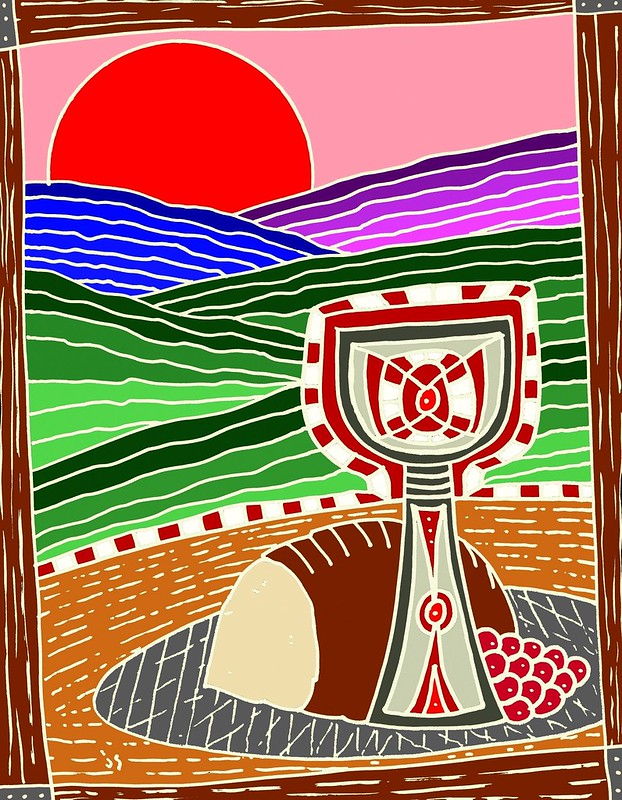
Stushie art, used with permission

   We honored the life of Lois Netter yesterday. Our sanctuary was filled with family, friends, and our church family who came to give thanks to God for the gift of her life and remember how she touched our lives with her kindness, goodness, and faith.

    During the sharing of memories, one speaker who had known Lois for more than 60 years said that Lois never had a bad word to say about anyone. In this day and age, it’s a rare thing to have someone who truly lives by the wise saying of Thumper’s mother in Walt Disney’s Bambi, “If you can’t say something nice, don’t say nothing at all.”

  She never complained, though she suffered a long time. She was positive and cheerful, a gracious host, a good cook. She was an avid reader and a member of numerous book discussion groups, including ours at the church. She was a deacon and longtime knitter whose prayer shawls provided comfort, beauty, and warmth to others for decades.  She was a former ESL teacher who lived overseas with her husband, Andy, a guidance counselor, touching the lives of students in Thailand, India, Japan, Pakistan, Peru, and Poland.

    Lois didn’t have a mold that everyone needed to fit in. She was curious about you, accepted you as you are, saw the good in you, embraced you for it, and told others about it. She was a good friend, compassionate and loyal.

   I wore the purple stole of Lent yesterday at her celebration of life in this Holy Season. I read a scripture often read as we draw nearer to Easter—the story of the raising of Lazarus in John 11. We wondered why Jesus waited to heal the one he loved, after he received word from his friends, Mary and Martha, that their brother was ill. Why did he wait until Lazarus died to return to Bethany? He was met on the edge of town by Martha, who, though grieving and disappointed with Jesus, had not yet given up hope. “Lord, if you had been here, my brother would not have died,” she says. “But even now I know that God will give you whatever you ask of him.”

   Jesus will say something surprising. “I am the resurrection and the life,” he says. “Those who believe in me, even though they die, will live, and everyone who lives and believes in me will never die. Do you believe this?”

   “Yes, Lord,” she says, “I believe that you are the Messiah, the Son of God, the one coming into the world.”

    Comparing these two conversations with Jesus—Martha in chapter 11 and Nicodemus in chapter 3—we find significant differences and common themes. Both are about life and death, suffering and salvation, belief, rebirth or resurrection, and healing. But Martha, though her brother has been in the tomb for 4 days and there is the stench of death, still holds onto her faith in Christ’s power to heal and save. The whole Jewish community is gathered around the sisters and at the tomb. Everything is said and done in the open. Jesus even prays aloud so that all would hear and know that he was speaking to the Father—and that God was the source of his healing power. When he calls forth the dead man from the tomb, he invites the community’s full participation in his healing and new life when he cries out, “Unbind him and let him go!”

    Nicodemus doesn’t have faith or friendship with Jesus, unlike Martha—not yet. His conversation is in secret, maybe because he is afraid. Much is made of his coming at night.Darkness and night symbolize the realm of evil, untruth, and ignorance,” says Raymond Brown, who was Professor Emeritus of Biblical Studies at Union Theological Seminary in New York. “In 23:30, Judas leaves the light to go out into the night of Satan; Nicodemus, on the other hand, comes out of the darkness into the light.” [1]

    Another reason is possible for Nicodemus coming at night. It’s also rabbinic custom to stay up at night to study the Law. And he may just want to be alone with Jesus. He has questions! He wants answers—and to know Christ more.

     Jesus connects the Old Testament wilderness stories with the promise of the New Covenant, saying,“And just as Moses lifted up the serpent in the wilderness, so must the Son of Man be lifted up, that whosoever believes in him may have eternal life.”

   With the pandemic years still so close to us in time—when illness and death seemed to surround us daily—the image of the serpent in the wilderness is more meaningful than ever! I think I usually skip over this imagery in this passage, probably because I don’t like snakes! But with the pandemic and the words of Jesus here, meant to bring light into our darkness, I am seeing things differently. The snake is a sign of Christ’s healing for the world.

     “It is one of the most unusual Christological symbols in the New Testament: Christ the Snake,” writes Roger Gench in Presbyterian Outlook. [2] “Odd though it may be, it is well worth pondering. In both the ancient and modern world, snakes were and are symbolic of our deepest, most ominous fears, but also of life, death and rebirth — indeed of healing. Psychologists have associated snakes in dreams as harbingers of transformation and new beginnings.” [3] Gench, a theologian in residence at Second Presbyterian Church in Richmond, points out that the American Medical Association’s logo is “the healing snake upon a pole.” [4]

     The Israelites in Numbers 3 complain against God and Moses, “Why have you brought us up out of Egypt to die in the wilderness? For there is no food and no water, and we detest this miserable food.” The Lord responds by sending poisonous serpents. Many Israelites die! But when the people confess their sin to God, the Lord tells his servant, Moses, to make a snake out of bronze and put it on a pole. Then, whenever someone is bitten, that person need only look upon the serpent of bronze in faith—and live!

    Nicodemus is a Pharisee and a member of the Jewish Sanhedrin, the highest governing body of the Jewish people, composed of 70 members—priests (Sadducees), scribes (Pharisees), and lay elders of the aristocracy. [5]When he asks Jesus, “How can anyone be born after having grown old?” he is talking about himself! He isn’t mocking him. He is struggling with Christ’s teaching, following the Jewish belief that it is in the struggle and wrestling with the Law, God’s Word, that truth is found, understanding dawns, and meaning is made for today.

     “Can one enter a second time into the mother’s womb and be born?” he asks. Jesus again mentions the kingdom of God and the need to be born of water and Spirit. The wind blows where it chooses, and you hear the sound of it, but you do not know where it comes from or where it goes.

      Nicodemus asks, “How can these things be?” You can almost see a smile dancing on his lips. And Jesus seems to return that smile, saying playfully, “Are you a teacher of Israel, and yet you do not understand these things?” Of course, Jesus knows what Nicodemus knows. That’s how this passage began, with Christ knowing “what was in everyone,” meaning their hearts.

     Soon, we reach today’s passage, when Christ brings up the story of the saving of the Israelites with the bronze snake lifted on a pole as foreshadowing his own suffering and death, when he is lifted on a cross so that “whoever believes in him may have eternal life.”

     Why would God do such a thing?  John 3:16: “For God so loved the world that he gave his only Son, so that everyone who believes in him may not perish but may have eternal life.”  Listen! The word translated loved (agapasen) in John 3:16 isn’t in the past tense in Greek. It is in the aorist, which defies time and “implies a supreme act of love.” [6] It is past, present, and future. God has always and will always love the world!  1 John 4:9 interprets and personalizes John 3:16, saying, “In this way was God’s love revealed in our midst: God has sent His only Son into the world that we may have life through him.”  

      Jesus is defining this New Covenant in himself as no longer exclusive to Israel. The proof of God’s inclusive love is in 3:17, through the giving of a Savior for all people. “Indeed, God did not send the Son into the world to condemn the world, but in order that the world might be saved through him.”

    Nicodemus will appear two more times in John’s gospel. He will remind his colleagues in the Sanhedrin (John 7:50-51) that the law requires that a person be heard before being judged. And he will come to Jesus once more at night, after the crucifixion. He will help another formerly secret follower, Joseph of Arimathea, prepare Christ’s body for burial in John 19. He will provide 100 pounds of spices for embalming–a sign of a royal burial, fit for the King of kings!

   Yesterday afternoon, when we shared memories of our friend and sister in the faith, we saw the signs of God’s love for the world in our very own community, in our very own church family.

    If we look around the room right now, we can see the signs of the love and grace of God in the Communion of the saints. The Spirit has brought you to worship today, to praise God and be strengthened for your journey. You have come to be encouraged in your walk with the Light of the World and to encourage someone else.  Like Nicodemus, you have come to know, a little bit more, the One who knows us completely.

     Like the snake-bitten Israelites who looked in faith upon the bronze serpent high on a pole—and lived, I invite you now to come in faith to Jesus, lifted high on a cross.  May you find healing for body and soul!

   If we listen for His voice, Christ will lead us to do His good works that testify to our faith.

   This is how otherswill come to know the God who so loves the world!

Let us pray.

Holy One, thank you for your love for the world, a love that was shown when you did not withhold your Only Son. But instead, you gave him up, lifted high on a cross for our healing, like the Israelites of old who were healed by the bronze serpent on a pole. Lord, show us the signs of your present and coming Kingdom in this Holy Season of Lent, signs that are all around us, if only we have eyes to see and hearts to walk in your Light—with you—each day. Lead us to do your good works, as our dear sister Lois did, and testify to our faith. Help us as we seek to share the good news of your love with all the world. In Christ we pray. Amen.

   [1] Raymond Brown, The Gospel According to John (I-XI) in the Anchor Bible series (New York: Doubleday, 1966) 130.

   [2] Roger Gench, “Fourth Sunday in Lent: March 14, 2021” in the column, “Looking into the Lectionary” in Presbyterian Outlook, March 12, 2021, at https://pres-outlook.org/2021/03/4th-sunday-in-lent-march-14-2021/

   [3] Roger Gench, March 12, 2021.

   [4] Roger Gench, March 12, 2021.

    [5] Raymond Brown, 130.

    [6] Raymond Brown, 133.

I Am the Resurrection and the Life

Meditation on John 11: 1-6, 17-27

In Memory of Lois Netter

Dec. 21, 1935 – March 2, 2024

Pastor Karen Crawford

I find that I am still looking for Lois in the congregation. I look for her in her pew.

I have looked for Lois every week in worship for a long time, probably since I met her at my first worship service here about two years ago.

There was a sweetness to Lois. A strength to Lois. She never dominated the conversation in the Narthex or parish hall. She was warm, but quiet. She was one of the family, the church family, but never needed to be the center of attention.

I came to know her through her serving on the Nominating Committee. She was well suited to her job with the Committee charged with prayerfully discerning and inviting others to accept leadership roles in the congregation. She was a team player, a peacemaker. She asked questions and listened carefully to the answers. She had follow-up questions. She valued inclusivity and diversity in the church, in the Body of Christ, and in the world.

 Lois didn’t have a mold that everyone needed to fit in. She was curious about you, accepted you as you are, saw the good in you, embraced you for it, and told others about it.

I came to know Lois through our book discussion group here at church. She was an active participant! I didn’t know, back then, that she was involved in numerous book discussion groups! She must have been reading non-stop!

When she wasn’t reading or attending book discussions, she might have been playing bridge. She played with a group from our church until recently. There may have been other bridge groups. And if she wasn’t reading, discussing books, or playing bridge, she might have been knitting. Lois used to knit a lot.

She and her friend, Carol Link, WERE our prayer shawl ministry. Lois used to knit a row, then pearl a row, knit a row, pearl a row; she did a basketweave stitch that looks like it is woven. She also did a Trinity stitch—knit 3 stitches, pearl 3 stitches, all the way…Lois, who had joined our church in the 1960s, had been in the prayer shawl ministry since the very beginning of the ministry, maybe 20 years.

And if she wasn’t knitting, she might have been cooking or baking, which she also loved to do, when she was feeling well. For many years, she hosted Wednesday night family dinners in her home. She shared meals with friends on other nights, going to the Thai Restaurant, or eating Chinese or Italian or getting take out and eating with friends in her home.

I came to know her better when I visited Lois at her home last year. I brought her Communion, and she served me tea and a whole plate of bakery cookies! She didn’t eat any. Her health situation had grown more serious. Her energy level was low. But she still smiled and laughed and was a gracious host.

 She didn’t complain of her illness. We talked instead about her life before she and her husband, Andy, downsized and moved to the one-story home in Kings Park, about 20 years ago.  She shared about working as a dental hygienist for the Roosevelt School District. That’s where she and Andy met. He worked as a music teacher and later became a guidance counselor. Andy went home to be with the Lord 18 years ago, March 1.

What started as a two-year sabbatical for Andy to work in Thailand in 1973-1974 was, for Lois, a great adventure. Their three children went with them. Carla went to second and third grade there; Jeff attended 8th and 9th; and Stephen, the middle child, 5th and 6th . The second year the family was in Thailand, Lois worked at the embassy. When the family returned home to Commack, she was ready for a new challenge. She went to Stony Brook University and earned a master’s degree, preparing to teach E.S.L.

The next time they would go overseas together, after Andy retired from the district, Lois taught English and Andy worked as a guidance counselor. For about 10 years, they lived and worked in New Delhi, India; Islamabad, Pakistan; in Japan, Peru, and Poland.

I left Lois’s home that day in Kings Park dreaming of faraway places. She had that effect on us. I wanted to hear more stories and know her more. I thought I had more time.

As Lois’s treatments continued, she was not able to come to worship or small groups, including our book group. We missed her. She wasn’t there for our discussion of All The Light We Cannot See, a work of historical fiction set in WWII.Her family would tell me that it was her favorite book. I loved it, too! I wonder what she would have shared? I know it would have been meaningful for the entire group. And that I would have come to know her more.

Lois and I talked by phone after my visit with Communion. I called her on her 88th birthday on Dec. 21, and asked if we could bring a group of carolers to sing in her front yard. She said, “Thank you, but no.” She shared some about her health and her family—that they were taking good care of her. Mostly I listened and when she fell silent, I always asked if she wanted to pray.

When she made the decision to stop treatments and go on hospice, she emailed the church, and I called her that day. She did something she didn’t usually do. She shared about the pain, and she cried. What was it going to be like, on hospice? she asked.

I told her what I knew and assured her that this would be a good thing for her and her family. She would receive personalized care. All of her questions and her family’s questions would be answered. They would manage her pain and make sure that she was as comfortable and peaceful as possible.

A few days later, I called to check on her. Her mood had lifted. Many people had sent her cards. She was being well cared for by hospice and her family, she said. She wasn’t in pain anymore! She said that whatever she could possibly need or want, she felt sure that the hospice worker would pick up the phone and make it happen that day.

As we talked, an edible bouquet was delivered, with a card that made her laugh. It said, “From your book buddy.”  Her question was, “Which one?”

At the end of our conversation, I asked, “Would you like to pray?” “Oh, yes,” she said. This time, she didn’t just listen silently. She chimed in and spoke to me and the Lord.  

When I said, “Goodbye,” I was overcome with sadness. She was ready to go. I wasn’t ready for her to go.

We always want our loved ones to be with us, forever. We never want them to suffer.

Why Jesus took so long to respond to Mary and Martha’s plea for help is a mystery. Why wouldn’t it bring glory to God if he healed a sick man, like he had done before? Why did he have to wait for Lazarus to die? And Lazarus was a close friend. As Martha writes, he was “the one whom you love.”

When Jesus arrives in Bethany, Lazarus is already in the tomb. Has been for 4 days. The community has lost hope and is deep in their grief. Martha hasn’t given up. She meets Jesus on the road, saying, “Lord, if you had been here, my brother would not have died. But even now I know that God will give you whatever you ask of him.”

Jesus says, “I am the resurrection and the life. Those who believe in me, even though they die, will live, and everyone who lives and believes in me will never die. Do you believe this?”

“Yes, Lord,” Martha says, “I believe that you are the Messiah, the Son of God, the one coming into the world.”

I reach the end of the passage, beyond what we read today, when Lazarus is called forth from the tomb. I wonder, is it her faith that restores Lazarus to life? Or was it God’s plan all along to reveal Christ’s power over death this way? Or was it both?

I believe that our faith matters—it makes a difference in the way we live our lives today. It makes a difference when we live with hope. We take risks. We persevere through hard things. We never give up. We rise up from the ashes! God’s mercies are new every morning. Great is thy faithfulness!

We need this reassurance today—that Christ still has the power over death. That we have nothing in this world to fear. Nothing can separate us from God’s love in this world and in the world to come. We, too, have the promise of resurrection with him—and not only that. We have the power to live new and resurrected lives by faith right now.

I have one question. Do you believe this?

I have talked with church members about Lois all week. We are all grieving. She will be remembered for her sweetness, her smile, her knitting, her bridge playing, her faithful work caring for others as a deacon, and for her passion for Bread for the World, an organization that seeks to remove the barriers to hunger, so that all who live in food insecurity may be fed.

Lois will be remembered for being a wonderful cook and gracious hostess. Most of all, how she always listened, with love and without judgment. She was a good friend. She made everybody feel valuable—and want to know her more.

Just before my husband had surgery at the end of January, we received a prayer shawl from the church. The card on the beautiful green blanket says it was made by Lois. We will treasure it always.

I wonder how many people were blessed by Lois’s knitted shawls and blankets over the years? Her handiwork reminds us of a precious child of God whom we were blessed to know—some of us for a long, long time; some of us for only a short while, a couple of years; and all of us, not nearly long enough!

But we are not people without hope, dear friends. Like Martha, we know Jesus, the Messiah, the Son of God, the one who is coming and has come into the world, who is WITH US NOW, in Spirit. Someday, we will be reunited with our loved ones, and all the mysteries will no longer be mysterious, when we are with Christ, face to face. He will wipe every tear. Death will be no more. Mourning and crying and pain will be no more.

I come to the end of my meditation, and all I can think of is my last phone conversation with Lois. Maybe you are remembering conversations you had with her, as well.

 “You are in our hearts and prayers,” I said, after we prayed. “I want you to know that you are loved by your Church and the Lord.” I asked, “Do you know you are loved?”

And she said, “Oh yes! Oh, yes!”

Amen.

Healing Stories: Stand Up, Take Your Mat, and Walk

Meditation on Mark 2:1-12

First Presbyterian Church of Smithtown

Pastor Karen Crawford

March 3, 2024: Third Sunday in Lent

Art by Stushie, used with permission and paid subscription

My husband, Jim, has rejoined us for worship today. He drove himself to church. He has come a long way since his knee replacement surgery in January.  Since then, we have had family and friends help in countless ways. We have felt your love and support throughout his healing journey. We are so thankful for all of you!

We all know the healing power of the prayers of the faith community—when we all go to Jesus together, anticipating a blessing, not only for the one needing the healing, but for the caregivers and those pleading on his behalf.

Our reading in Mark’s gospel is about the importance of the community’s work of faith for the healing of an individual and the overall wellbeing of the community.  

Jesus is at his home in Capernaum, after completing a short preaching tour. The news of his coming and the power and authority of his healing and teaching has now spread. Jesus isn’t looking for more work to do. It isn’t as if Jesus has “put out a shingle saying, ‘the doctor is in.’” [1] If word hadn’t gotten out, Bible scholar Amy-Jill Levine speculates, “he could have spent more than a few days on personal care. But as health care workers know, if people know you care, they will ask for it.” [2]

The village of Capernaum isn’t anything like Smithtown. I was just thinking about that the other day, how I am always out walking in my neighborhood, but I don’t actually know more than a few of my closest neighbors, and we have lived here two years in May. I wave to people, but I don’t expect to be invited into their homes! Nor, would I want all of my neighbors to come into my home. We value our privacy, don’t we?

Not so in Jesus’ time. “Life in Palestine was very public,” says William Barclay. In the morning, the door was opened and anyone who wished might come out and in. The door was never shut unless (someone) wished for privacy; an open door meant an open invitation for all to come in.” [3] Jesus now finds “crowds pressing around the door as though he were a movie star or well-known footballer.” [4]

Four people come to Jesus, bringing their paralyzed friend on a mat. The Greek word translated “brought to” (prospheron) is an echo of other gospel healing stories when those who are sick or suffering are not able to get to the healer in their own strength. The four can’t get in because of the crowds. I wonder which one of the group said, “Hey, let’s go up on the roof!” They climb up, dig a hole, and lower him down to Jesus.

Are you curious about the house? Me, too. “The roof of a Palestinian house was flat. It was regularly used as a place of rest and quiet, and so usually there was an outside stair (that led to it). …The roof… (had) flat beams laid across from wall to wall…The space between the beams (maybe 3 feet) was filled with brushwood packed tight with clay…The roof was of earth and often a flourishing crop of grass grew on top.” If you were wondering, what the mat bearers did to the roof didn’t damage the house beyond repair. [5]

But those who stop at nothing to help their friend in today’s passage come with hope and faith that if they can just reach Jesus, everything will be OK. They aren’t disappointed.

Notice this is no marginalized person, despite his disability. This is no outcast. We don’t know his status in the community, but we see the community caring for him. It’s curious to me, though, that no family members are mentioned. In a society where family is everything, where is his family? Is he an older person, with no living family members? Has he ever been married with children? Is he a widower, whose wife was not able to have children? Had he been well and strong in his youth but an accident or illness robbed him of his health and mobility?

I yearn for more details.

And then a new idea comes to mind. Maybe this is a young man and his friends are all near his age, which might explain their lack of hesitation at digging through the roof. His youth may be confirmed by Jesus’s greeting as he is lowered down in front of him. He calls him “Child” before he tells him that his sins are forgiven.

Isn’t that the most curious thing of all—that Jesus tells him his sins are forgiven before he begins the work of healing?  What’s amazing is that he says it after he sees, not the faith of the man on the mat, but the faith of his friends.

Some say his forgiveness is part of his healing. Many people believe that it’s because of their sin that they are sick. This was a common belief in the ancient world, that if someone was suffering, they must have done something wrong. They must have sinned. Think of Job’s friends!

 It is quite possible that Jesus is just telling him what this man needs to hear so that he can forgive himself and receive the gift of healing.

When Jesus begins to forgive others of their sins, the religious authorities grumble among themselves. Because who can forgive sins, except for God? Jesus senses their spirit and knows what’s on their minds and, even more importantly, what’s in their hearts. In forgiving the man with paralysis, “Jesus is not acting on his own initiative but by the virtue of the authority, exousia, that has been invested in him as the Son of Man.” [6] The key sentence in this passage is when he says, “The son of man has authority on earth to forgive sins.” He is the one of whom the prophet Daniel speaks in his vision in chapter 7, verses 13 and 14.[7]

“I saw in the night vision, and, behold, there came with the clouds of heaven one like a son of man, and he came even to the ancient of days, and was brought before him. And there was given to him dominion and honor and a kingdom, so that all the peoples, nations, and languages should serve him: his authority (exousia) is an everlasting authority, which shall not pass away, and his kingdom shall not be destroyed.”

Jesus, when he is betrayed, arrested, and interrogated by the council in Mark 14:62, will answer the High Priest, when he asks if he is the Messiah, the Son of the Blessed One, ‘I am.’ And he quotes Daniel’s vision, “And you will see the Son of Man sitting at the right hand of the Mighty One and coming on the clouds of heaven.”

In Mark 2, Jesus ends the argument with the religious leaders over his authority to forgive the man who wasn’t able to draw near to him on his own, but needed help from his friends. He ends the argument by healing him.

 “ ‘I say to you, stand up, take your mat, and go to your home,’ Jesus says. The man stood up and immediately took the mat and went out before all of them, so that they were all amazed and glorified God, saying, ‘We have never seen anything like this!’” The man who wasn’t marginalized with his disability—and was cared for by his neighbors—is now a living testimony in his own community to the power and authority of Christ to heal and forgive.

In a few moments, we will gather, once again, at the Lord’s Table, to experience Christ’s presence, partake of the bread and cup, pray, and be strengthened to labor with him in his ministry of forgiveness, healing, peace, and reconciliation.

Friends, we are those who carry the mats for people who cannot, in their own strength, draw near to Jesus. We are the ones who will stop at nothing to find healing for our loved ones, even if it means tearing a hole in a roof. But we are also those who are carried by others, when we are not strong enough to do it for ourselves.

In Mark 9:34 and 35, the disciples will have an argument. Who is the greatest among us?

Jesus answers, “Whoever wants to be first must be last of all and servants of all.” That word for servants, diakonos, is where we get our word for deacon.

When I consider this argument, I can’t help but think of the caregivers in chapter 2, carrying the man on the mat in Capernaum, the ones whose faith is praised by Christ, the greatest Servant of all, who was willing to suffer and give his life as a ransom for many.

I am wondering, with Amy-Jill Levine, why the disciples didn’t learn their lesson from the caregivers in chapter 2.  The question they “should have been asking is not, ‘Who is the greatest among us?’ but, ‘What can we do to help?’” [8]

Let us pray.

Christ, our Healer, thank you for inviting us to come to you boldly to seek forgiveness and healing. Thank you for your love and mercy and for the example of friends helping friends, carrying the mat of the paralyzed man, even cutting a hole in your roof, so that nothing would stand in the way of his healing. Lord, what can we do to help? Refresh, unite, strengthen, and guide us so that we may be your heart, hands, and feet for our families, friends, neighbors, and community. Lead us to join with you in your work in the world in a ministry of forgiveness, healing, peace, and reconciliation. In Christ we pray. Amen.
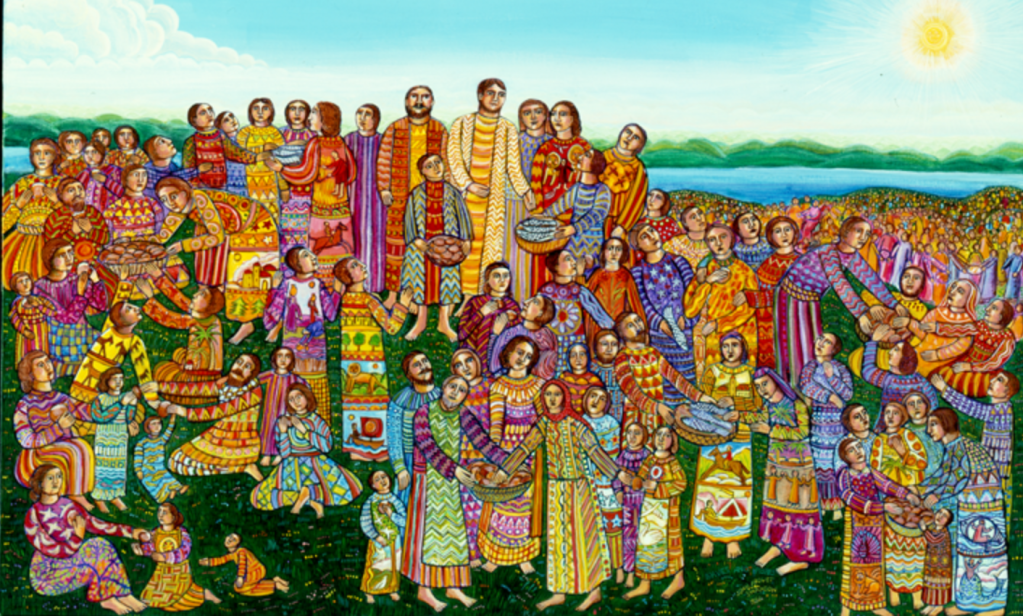
     [1] Amy-Jill Levin, “Take Up Your Pallet and Walk”in Signs and Wonders, a Beginner’s Guide to the Miracles of Jesus (Nashville, TN: Abingdon Press, 2022) 6.

     [2] Amy-Jill Levin, 6.

     [3] William Barclay, The Gospel of Mark, Revised Edition (Edinburgh, Scotland: The Westminster Press, 1975) 46.

     [4] N.T. Wright, Mark for Everyone, (Louisville, KY: Westminster John Knox Press, 2004) 16.

     [5] William Barclay, 47.

     [6] Walter T. Wilson, 149.

     [7] Wilson, 149.

[8] Amy-Jill Levine, 25.

Bibliography:

Barclay, William. The Gospel of Mark, Revised Edition. Edinburgh, Scotland: The Westminster   

       Press, 1975,46-52.

Collins, Adela Yarbro Collins. Mark, a Commentary. Minneapolis, MN: Fortress Press, 2007,

       183.

Levine, Amy Jill. Jewish Annotated New Testament, NY: Oxford University Press, 2011, 62-23.

Levine, Amy Jill. Signs and Wonders: A Beginner’s Guide to the Miracles of Jesus, Nashville, TN:

       Abingdon Press, 2022, 6-25.

Placher, William C. Mark. Louisville, KY: Westminster John Knox Press, 2010, 42-45.

Wilson, Walter T.  “Practicing Healing in Community” in Healing in the Gospel of Matthew:

       Reflections on Method and Ministry. Minneapolis: Fortress Press, 139-159.

Wright, N.T. Mark for Everyone. Louisville, KY: Westminster John Knox Press, 2004, 16-18.


Healing Stories: Healing on the Way to Healing

Meditation on Mark 5:21–43

Pastor Karen Crawford

Second Sunday in Lent

Feb. 25, 2024

Art by Stushie. Used with permission and paid subscription

Listen to the message through this link:

Art by Stushie

Our gospel reading today touches me deeply, in a personal way. There is so much I could say about this passage. What is on my heart is that what is said will help someone find hope for their healing or the healing of their loved one.

Today’s passage, specifically the story of the woman in the crowd, healed while Jesus is on his way to heal the synagogue leaders’ daughter, feels so real and relevant for today. Especially with the many details provided.

I have heard stories of women who were misdiagnosed or have undergone treatments that were ineffective and made them sicker than they were before. Women have shared with me how they left doctors’ offices feeling embarrassed and unheard, some of them being told that their pain or illness was all in their head. They left feeling as if they wasted their money and time.

Maybe you have heard some of these stories. Maybe you have a story to share.

My main question for this healing series is whether sickness or disability means the sufferer is an outsider or marginalized in their community. Did they become “other” because of their illness or disability? How did their family and community treat them—before and after the healing? Who was advocating for them? Were they seeking help for themselves? And finally, how did their lives change after their healing? Did they change, at all?

In today’s passage, those who are sick or disabled are not marginalized in their community. That is my conclusion after studying the passage and seeking the help of two Bible scholars. In fact, being gravely ill may mean, as in the case of the little girl, that the one who is sick is at the center of the community’s concern.

The controversial part of this passage is not the little girl’s story; it is the story of the healing of the woman. Past scholarship has emphasized how the woman must have been a loner, ostracized and marginalized because of her long illness that made her “impure” and unable to participate in synagogue and other community activities, which I no longer believe is true.

Today, I challenge you to see her in a different light.

Wendy Cotter, a tenured Professor of Scripture in the Theology Department of Loyola University in Chicago, comments on the “extraordinary attention” given to the woman’s situation. [1]This story is significant! Mark provides “six items of information” about her flow of blood when “flow of blood” may have been enough. [2] Mark says, “She had suffered for 12 years (5:25); she had suffered under many physicians (5.26); she had spent all her money (5.26); she was no better but rather was growing worse (5.25); she heard about Jesus (5.27); and she decided to come up behind him and touch his garments (5.27) because she said, “If I touch even his garments, I shall be made well (5.28).” [3]

What was the purpose of the narrator providing all those details? Cotter asks. The “lengthy and detailed introduction seems almost defensive, an excuse for her unfitting behavior, an explanation of innocence on the question of why she would touch Jesus.” [4] Cotter can’t understand why the narrator thinks her behavior “requires an excuse” and why the woman would seem so fearful. This is the part that usually ends with scholars going off on a tangent about the woman being ritually impure and suggesting that the woman must be ashamed, “that she has violated Torah by entering a crowd and touching another when she” is bleeding. But there is no mention of Torah in this story. The reason for her fearfulness, Cotter says, may have more to do with the context of the world of Greco-Roman antiquity. She says, “The ideal woman was expected to be found at home, surrounded by her family, shy, modest and quiet.” [5]

 I am not sure if the ideal woman of the Greco-Roman world is that different than society’s expectations for the ideal woman of today.

Dr. Amy-Jill Levine, professor of New Testament and Jewish Studies at Hartford International University, is also critical of the scholarship. “A number of commentators,” she says, “after addressing the woman’s ritual impurity (as if that, and not the fact that she’s had chronic bleeding, is her major problem), then argue that the woman felt shame. Similarly, based on no evidence whatsoever, commentators assert that the woman has been ostracized, and so Jesus becomes the one who restores her to community. Thus, commentators make the woman’s Judaism a context of shaming and ostracizing, and Jesus gets to be the social corrective. …  [6]

    Levine says that the woman visiting numerous physicians and spending all her money on them, “suggests she was being in public and proactive rather than secreted and shamed. Mark thus makes a plea for affordable health care. Next, the Gospel texts do not mention shaming, and it is unhelpful,” she says, “to project an image of shame onto women because their bodies are not behaving well. Likely everyone in the neighborhood knew about her condition, and probably her economic status as well.” [7]

 “What a fabulous woman!” Levine says. She advocates for herself, though she is weakened physically and may have been labeled as disabled today. “Perhaps she was unable to have children. Perhaps her bleeding is the result of pregnancy and childbirth…” (We don’t know.) “We do know, however, that her act is one of enormous courage. She knows that Jesus can heal, both by touch and at a distance…” [8]

   On the question of whether she was isolated and ostracized, Levine explains how “later rabbinic literature insists on the mitzvah, the commandment… of visiting the sick. …” [9]She challenges us to imagine her neighbors caring for her, bringing her food “when her bleeding made her too weak to prepare anything for herself.” [10] She suggests that instead of a loner, she may have been “fully embedded in a family that loved her…” [11] Maybe it was the love of her family that emboldens her to seek Christ’s healing.

She WANTED to live, dear friends! She had a life and wanted to have life more ABUNDANTLY. While she may have been annoyed, in pain, frustrated, and despairing, “there is nothing about a woman’s body, or any body, that should cause shame,” Levine writes. [12] She may have worried that Jesus would give the synagogue leader’s daughter priority because of his status. But that’s not what happened. He took time to talk with her and encourage her. I would argue that this intimate conversation was part of her healing. May we also be encouraged to approach God boldly. “That is what children, in healthy family relationships, do with loving parents,” Levine says. [13]

What Jesus says and does in these stories of healing intrigues me. I have so many questions. Why does he demand to know who in the crowd has touched him? Does he already know the person he has healed? Was he just giving her permission to speak with him? His command stirs her to come forward. She immediately, obediently, tells him what happened. He calls her “Daughter!” He compliments her on her faith that led her to approach him-because real faith compels us to act! Faith isn’t passive! “Your faith has made you well,” he says. “Go in peace and be healed of your disease.”

Cotter writes, “Jesus is indeed cosmically powerful, but that power is at the service of ordinary people, and in situations of frank human vulnerability…There’s no dramatic performance here for the sake of a crowd of people.”   [14]Only the parents and his disciples see Jesus take the little girl by the hand, and say in Aramaic, “Talitha koum,” “Little girl, get up!” They will be overcome by amazement. Though he tells them not to tell anyone, many will find out soon enough. Why does he tell the family to feed the little girl? Some say it’s to keep the focus on her wellbeing and off himself. [15]Others say the food will help with her healing and speculate if the little girl suffered from diabetes.[16]

One word stands out to me, as I finish my study of this passage, for now. The Greek word sozo, translated “healed” or “be made well.” Jairus says, “My little daughter is at the point of death; please come and lay Your hands on her, so that she will get well and live.” The 12-year-suffering woman thinks aloud, “If I only touch his cloak, I shall be made well.” Jesus will say to her,“Your faith has made you well.” Sozo. The word may also be translated “saved,” but it means more than being forgiven and escaping eternal damnation. Salvation can happen in this world, dear friends!

Dr. Levine says, “Salvation for (the woman) is having the bleeding stop. Salvation, in Jewish thought and here in the Gospel … is not primarily something that concerns life after death.

Salvation is also life during life; it is rescue from enemies and disease, from loneliness or accident, from flood or fire. It is something we will all need at one point or another, and it is something that we all can provide to others, if we try.” [17]

In both stories, hope is not lost! Faith matters—in the one advocating for the healing of his daughter and for the one pleading for her own well-being. Jesus cares about the bodies and lives of women and girls! Isn’t that wonderful? Even those whom the gospel writers fail to provide names. There may be a reason for that. What if the Lord wants us to put ourselves in these healing stories? Instead of seeing the woman and the little girl as nameless, we could see them as symbolic of the healing of every woman, the healing of every girl.

I hope that today’s message touched you in a personal way. That I found the right words, somehow. May you never lose faith. May you never give up. May you never stop praying for healing.

Let us pray. Holy One, thank you for your Son who has done all the work of suffering on a cross for our salvation. Thank you for your love and concern for our being made well in this world and in the world to come. We look forward to meeting our Messiah, face to face. When there will be no more sickness. No more disease or death. We long for that day when our mourning will turn to joy; you will wipe away every tear. Help us to be strong in our faith and never give up hope and prayer for healing for our loved ones and for ourselves, being made well, made whole, in body, mind, and soul. Amen.


     [1] Wendy Cotter, “Mark’s Hero of the Twelfth-Year Miracles” in A Feminist Companion to Mark (ed. By Amy-Jill Levine with Marianne Blickenstaff, Cleveland: The Pilgrim Press, 2004) 57-58.

     [2] Wendy Cotter, 57-58.

     [3]  Wendy Cotter, 57-58.

     [4] Wendy Cotter, 57-58.

     [5] Wendy Cotter, 57-58.

     [6] Amy-Jill Levine, Signs and Wonders, A Beginner’s Guide to the Miracles of Jesus (Abingdon Press. Kindle Edition) 77-80.

      [7] Amy-Jill Levine, 77-80.

      [8]  Amy-Jill Levine, 77-80.

      [9] Amy-Jill Levine, 77-80.

     [10] Amy-Jill Levine, 77-80.

     [11] Amy-Jill Levine, 77-80.

     [12] Amy-Jill Levine, 77-80.

     [13] Amy-Jill Levine, 77-80.

   [14] Wendy Cotter, 75.

   [15] Wendy Cotter, 75.

   [16]  Wendy Cotter, 73.

   [17] Amy-Jill Levine, 80.

Practical Resources for Churches

Everyone has a calling. Ours is helping you.

Consider the Birds

Pastor Karen shares thoughts on faith, scripture, and God's love and grace revealed through backyard wildlife.

F.O.R. Jesus

Fill up. Overflow. Run over.

Becoming HIS Tapestry

Christian Lifestyle Blogger

Whatever Happens,Rejoice.

The Joy of the Lord is our Strength

Stushie Art

Church bulletin covers and other art by artist Stushie. Unique crayon and digital worship art

The Daily Post

The Art and Craft of Blogging

WordPress.com News

The latest news on WordPress.com and the WordPress community.