Meditation on John 10:1-10
Reverend Dr. Karen Crawford
First Presbyterian Church of Smithtown
April 26, 2026 (Creation Care Sunday)
Jim and I have returned from our visit to Jim’s family in Northern Island. We did have a good time, although it rained and was quite chilly for all but 3 days. But it’s as the Irish say, “You don’t come to Ireland for the weather.”
Jim’s mother, Margaret Heaney, was born in County Down in 1899. She crossed the Atlantic to New York City, entering America through Ellis Island as a young woman of 30 on November 4, 1929. In an age and place where family was everything, she left her parents and all but one of her siblings behind. She came because she suffered from arthritis, and the cold, damp climate worsened her condition. And she came with an adventurous spirit, hoping to make friends, make her home here, find work, fall in love, get married, have children and watch them grow up and follow their dreams. And that’s exactly what happened. She met Daniel Crawford, from Glen Arm, County Antrim, Northern Island, on a blind date. They crossed the George Washington Bridge on opening day on October 25, 1931. They married two years later.
Last November was the first time I met Jim’s Irish family. We spent most of our time with one couple and only saw the other cousins and their families at a dinner. As we said goodbye, the other cousins urged us to come again, wiping away tears of joy and sadness.
It was my idea that we go, again, this year and take the time to visit the cousins and get to know them more. I joyfully anticipated being back in County Down, captivated, once again, by the beauty of the hills, the Mountains of Mourne, cottages beside windy roads no bigger than cow paths; and white and black sheep grazing in rolling green pastures, rising above the blue green Irish Sea.
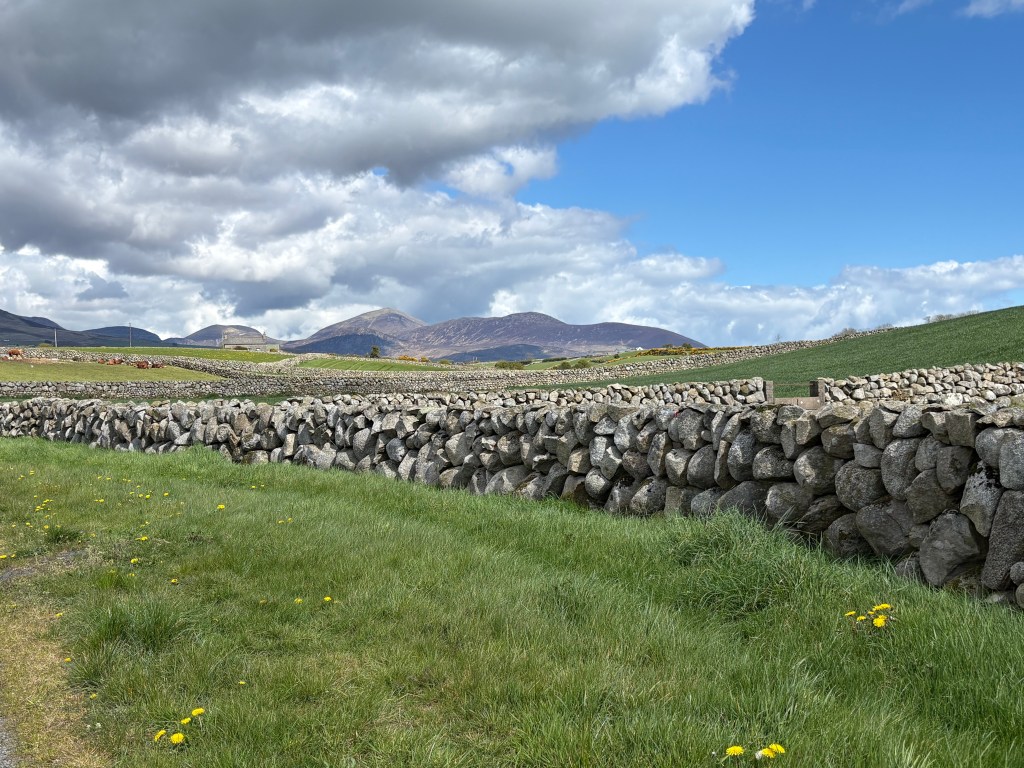
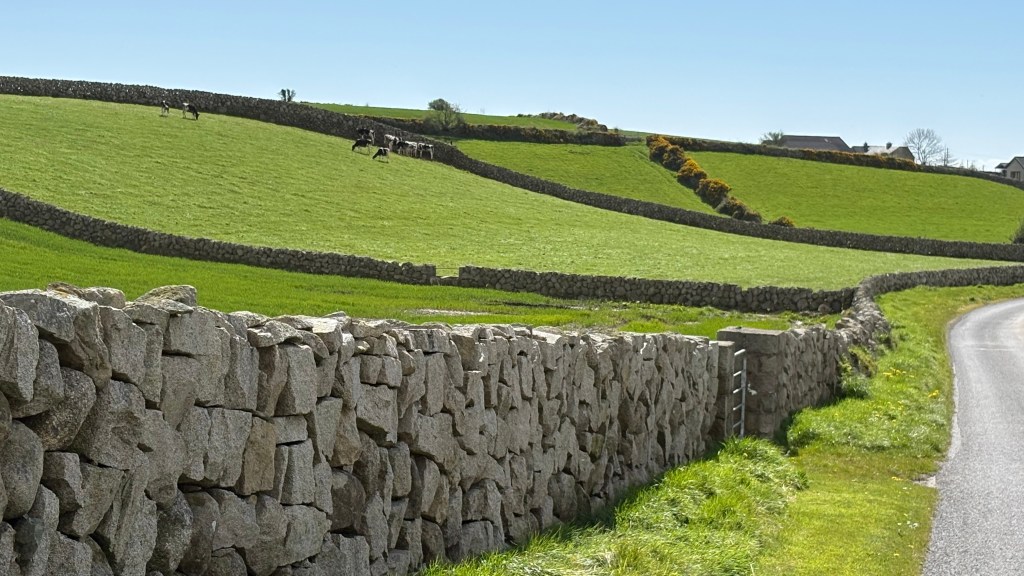
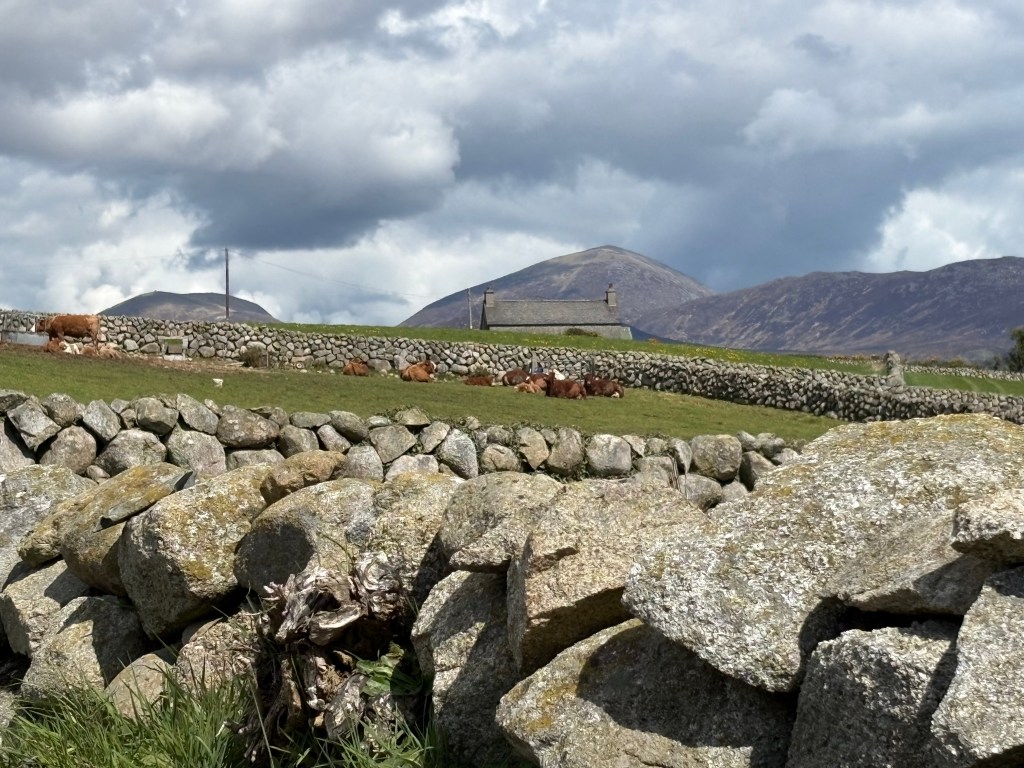
Finally, after we had been in Ireland almost a week, we were able to see and talk with all but the eldest cousin at a Sunday afternoon open house. Cousin Edward and I got to talking and next thing I knew, we were planning a visit to his farm the next day to see the new lambs with their mothers. Now Edward is a shy man in his 70s, never married and has lived alone in an old farmhouse for decades. It was a surprise to the rest of the family that we were invited.
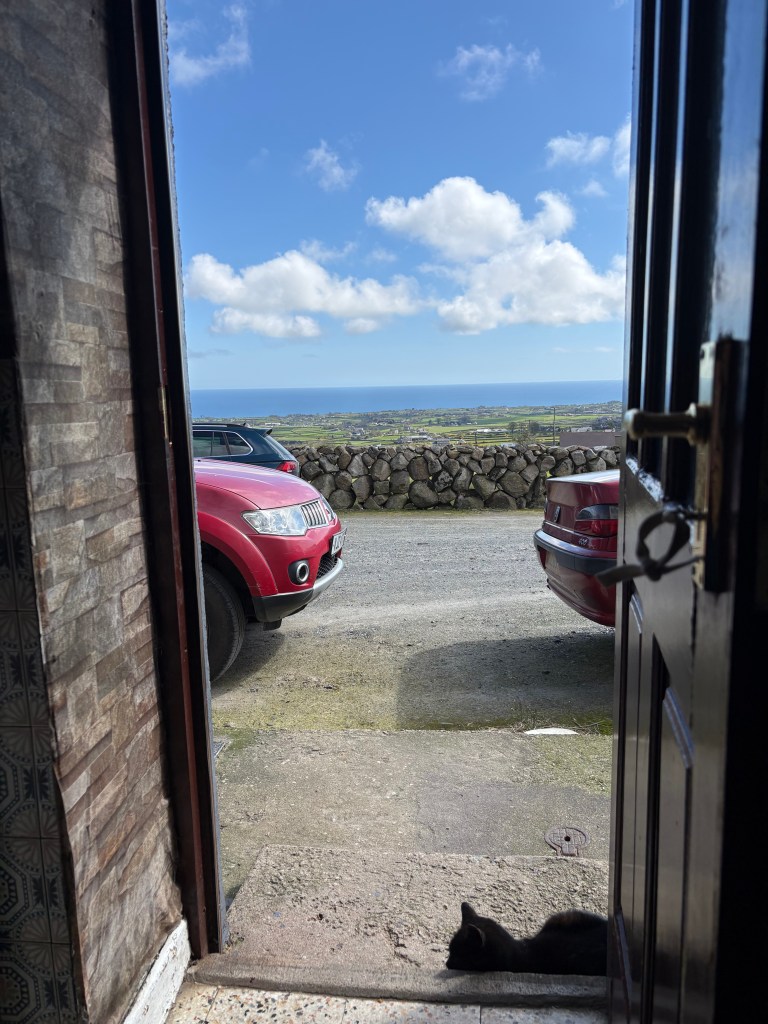
Edward, wearing tall boots, met us at our car and led us to an enclosure with stone walls where the youngest lambs were kept with their mothers.
I was moved when Edward called his sheep. He spoke in grunts that resembled the sounds that the sheep made. Sure enough, the sheep looked up and came closer when he called but then stopped when they saw us. For Jim and I were strangers.
Edward said he knew how to get them to come. He disappeared for a moment and came back with a bucket of feed he called “nuts” and dumped them in a trough in front of us. The sheep came running and noisily ate, while their lambs looked on curiously. They were a few days to a few weeks old, some with black faces and legs, others with black spots, and some that were pure white.
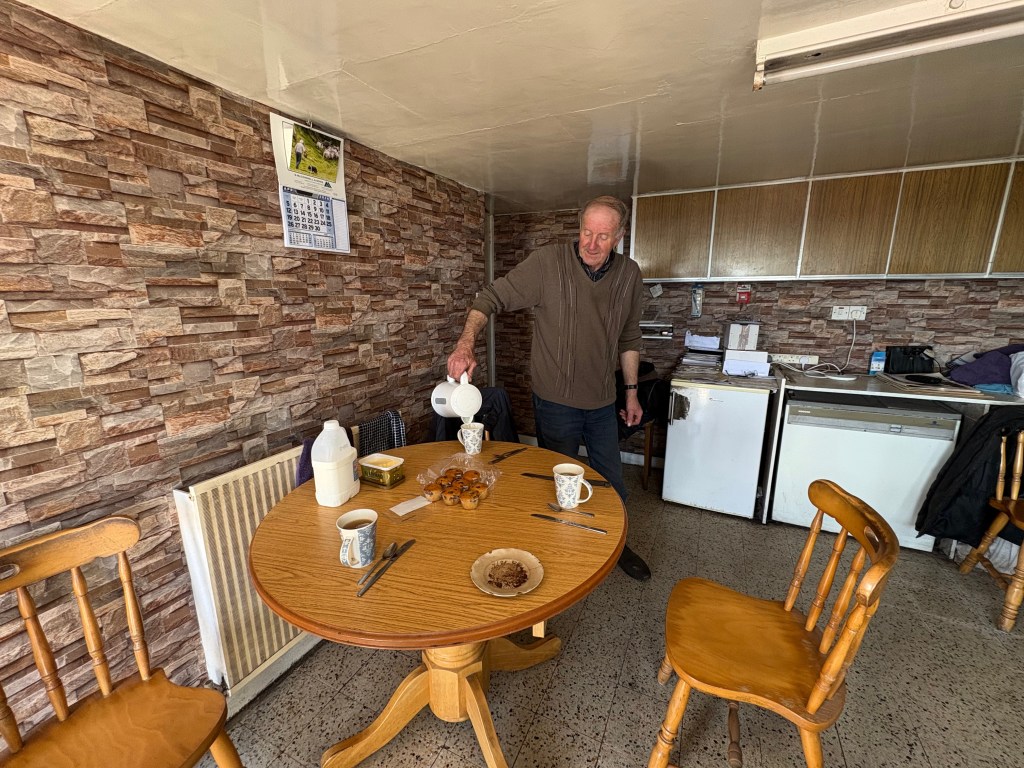
After he fed the sheep, Edward called us into his kitchen so that he could feed us. He had set the table with a couple of old mugs and one small plate for tea bags. He poured our tea and opened packages of blueberry muffins, pancakes, and biscuits. Then he sliced an apple tart, put a generous slab of it into my hand and urged me to eat. It was delicious!
Our experiences with sheep and farmers in Ireland helped me imagine God’s people long ago in pastoral Judaea. For miles around, all we could see were sloping, green pastures where sheep and cattle peacefully grazed inside walled enclosures. Edward said that sheep, unlike cattle, are prone to wander, even if there is plenty of good grass in their pasture; they need to be contained. Also, they don’t always want to follow where the shepherds want them to go, and this was true in Judaea, too. While sheep in Northern Island are raised for wool and meat, sheep in biblical times were raised mostly for wool. That meant that the shepherd and the sheep were together for many years and got to know each other well. Shepherds in Ireland mark their sheep with neon paint so their flock can be easily recognized. I don’t know if they actually name their sheep as they did in Judaea and as they do to this day in the Middle East.
The life of a shepherd in Northern Island, though difficult, isn’t as hard as the shepherd’s life in biblical times and places. William Barclay writes, “No flock ever grazed without a shepherd, and he was never off duty. There being little grass, the sheep were bound to wander; and since there were no protecting walls, the sheep had constantly to be watched. On either side of the narrow plateau, the ground dipped sharply down to the craggy deserts, and the sheep were always liable to stray away and get lost. The shepherd’s task was not only constant but also dangerous, for, in addition, he had to guard the flock against wild animals, especially against wolves, and there were always thieves and robbers ready to steal the sheep.”[1]
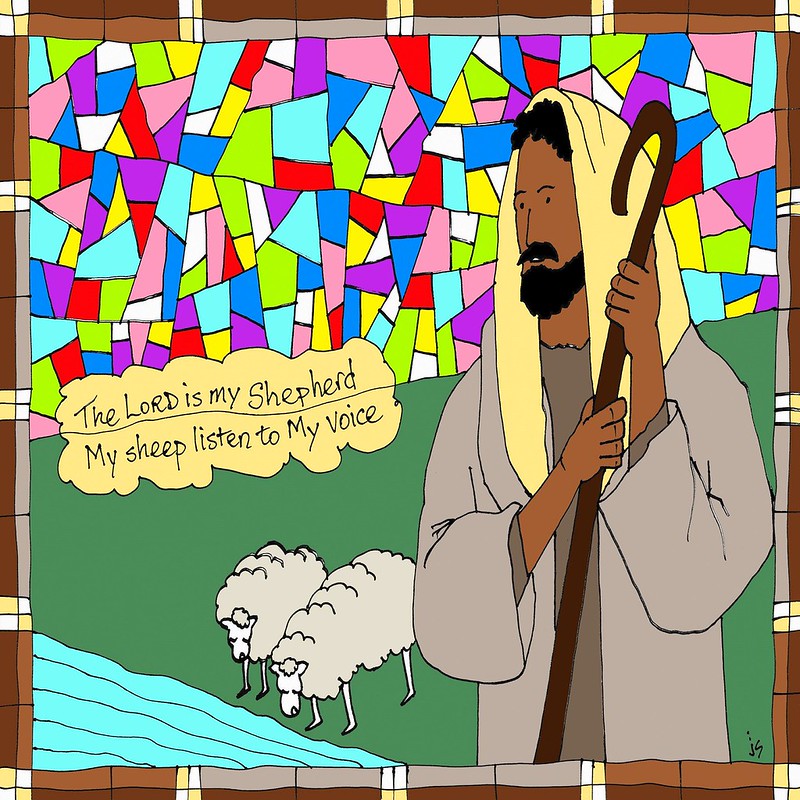
You may have noticed that the Bible is full of references to sheep and shepherds, providing a window into the world in which they lived and emphasizing the importance of the role of the shepherd to their society. Numerous Psalms feature God as the shepherd. “The Lord is my shepherd, I shall not want” (Psalm 23:1). “You led your people like a flock by the hand of Moses and Aaron” (Psalm 77:20). “We your people, the flock of your pasture, will give thanks to you forever” (Psalm 79:13). “For he is our God, and we are the people of his pasture, and the sheep of his hand” (Psalm 95:7 and 100:3).[2] In Isaiah 40:11, the Messiah, is pictured as a shepherd. “He will feed his flock like a shepherd; he will gather the lambs in his arms, and carry them in his bosom, and gently lead the mother sheep.”
Jesus is the good shepherd who will lay down his life for the sheep in John 10. He will risk his life to seek and save the one sheep that is straying (Matthew 18:12; Luke 15:4). His disciples are his little flock (Luke 12:32). He has pity upon the people because they are as sheep without a shepherd (Matthew 9:36; Mark 6:34). He is the shepherd of human souls (1 Peter 2:25) and the great shepherd of the sheep (Hebrews 13:20).
Two things stand out to me in our passage in John today. One is that Jesus calls himself the gate. I was intrigued to learn that shepherds really were and are the “gate” for the sheep. In “many Eastern sheepfolds, the shepherd lies down at night in the gateway of the enclosure, to stop the sheep getting out and to stop predators getting in.”[3] Jesus is promising safety, like the Psalmist says in 121:8, “The Lord will keep your going out and your coming in from this time on and forevermore.”
The other is the promise that Christ’s followers will hear his voice. This stays with me. So often, we are straining hard to listen for his voice. Do you ever feel that way? We doubt that we can hear him, but here in John’s gospel Christ is promising that we do and will hear him. He allows us to recognize his voice amidst the many voices and sounds that surround us in our busy lives. He calls to each of us in such a way that we can hear him, much like Edward and his sheep.
During my visit to Ireland, I found myself marveling at the courage of Margaret Heaney. It must have been difficult for her to leave her country and family behind at the age of 30 to find a new life in America. I wonder if she ever questioned during the early days—before she met and fell in love with Daniel—if she had heard the voice of the Lord in her decision?
On the second day of our trip, I wondered if I had misheard Christ’s voice. One of our hosts took me aside and said that it wasn’t a good time for the visit, after all. And I didn’t know what to do or say. We were already there. We had already planned on staying at hotels for some of the trip, but much of our time was spent with them.
Last night, I watched a video that I had taken of Edward and the sheep on a big screen, and I was back in County Down, captivated, once again, by the beauty of the hills, the Mountains of Mourne, cottages beside windy roads no bigger than cow paths; and white and black sheep grazing in rolling green pastures, rising above the blue green Irish Sea. I listened to Edward call them in their own language, watched him feed them nuts—and remembered how he hand-fed me tart and biscuits. I remembered how, when we left Edward’s house, I gave the big shy man a hug and he held me close, something that other family members said they had never seen him do before.
By the end of our stay, something in the air had changed. The Spirit was at work. The cousin with whom we stayed was reconnected with the others after decades of not staying in touch. In addition to the visit with Edward, we were invited for tea with Cousin Elizabeth, who then invited us to come and stay a night with her family on our next visit.The one who said it wasn’t a good time for us to visit invited us to visit again next year.
Right now, all I can think is that I am glad to be home. I am happy to know where the Lord wants me to be. Isn’t that a good feeling? To be safely gathered in Christ’s fold?
Dear friends, the one lesson that I am continually learning is that God’s plans are so much bigger than we can know. How else could the Lord use a trip to Ireland to bring about a family’s healing and reconciliation?
Brothers and sisters, hold onto the promise that we are Christ’s sheep. He laid down his life for us. He looks for us when we go astray. He came so that we may have life and have it abundantly. And now may the one who guides, feeds, loves, and protects us, calls us by name and allows us to hear his voice, keep your going out and your coming in from this time on and forevermore.
Let us pray.
Good Shepherd, thank you for coming to us so that we may have life and have it abundantly. Thank you for having a plan for us, for calling us by name and allowing us to hear your voice. Thank you for welcoming us into your everlasting fold and for guiding, protecting, feeding, and loving us. We ask that you continue to bring reconciliation and healing to our families near and far. Open our hearts to your Spirit’s transforming work. Lead us to righteous paths and keep us safely in your care, never giving in to temptation to go astray. In the name of our Triune God we pray. Amen.
[1] William Barclay, The Gospel of John, 62.
[2] William Barclay, 63.
[3] N. T. Wright, John for Everyone, Part One, 150.

