Ask for Help

Meditation on Mark 7:24-37

Pastor Karen Crawford

The Presbyterian Church, Coshocton, OH 43812

Sept. 5, 2021

Here is a link to our livestreamed worship, including my message:

https://fb.watch/7QGB_OErsT/

It’s been an emotional 4 weeks. The pandemic continues and has affected some members of our congregation. Hurricane Ida caused devastation and loss of life. Violence and chaos continue to reign in Afghanistan after the evacuation of U.S. troops, some of whom lost their lives in the process.

It’s also been a difficult time for me personally. A few weeks into Jim’s recovery from his knee surgery, I experienced my own health crisis. A week ago Thursday, I had surgery to remove my appendix and a mass that was creating a blockage.

I am getting stronger every day and praising God for his healing. But I find myself trying to figure out what the Lord has been saying to me through all these difficulties coming on top of each other. Definitely, that God is always with us in our struggles! And His love never ends.

 But I also know that God is trying to change my heart. He wants me to let go of my anxiety and fear when I encounter trials. James tells us that there are godly reasons for our struggles, Consider it pure joy, my brothers and sisters, whenever you face trials of many kinds, because you know that the testing of your faith produces perseverance. Let perseverance finish its work so that you may be mature and complete, not lacking anything.” (1:2-4)

One of the most important lessons I am learning is that it is good to have help from the Body of Christ. That may be a hard lesson for some who feel more comfortable doing for others than having others do for you. Sometimes, we need help and are afraid or embarrassed to ask.

I am so grateful for my faithful brothers and sisters. You have been Christ’s hands and feet!

One of the most amazing gifts I received after my surgery is a little book of wisdom called, The Boy, the Mole, the Fox and the Horse by British illustrator Charlie Mackesy.  I want to share some of it with you. I hope you will be blessed, too!

The mole asks the boy, “What do you want to be when you grow up?” “Kind,” said the boy.”

 “What do you think success is?” asked the boy. “To love,” said the mole.”

 “What is that over there?” “It’s the wild,” said the mole. “Don’t fear it.”

 “Imagine how we would be if we were less afraid.”

   Then the boy and mole encounter the fox. “I’m not afraid,” said the mole to the fox.

    “If I wasn’t caught in this snare, I’d kill you,” said the fox.

 “If you stay in that snare, you will die,” said the mole.So the mole chewed through the wire with his tiny teeth.

“One of our greatest freedoms is how we react to things,” said the mole to the boy.

  And the fox reacts by making a heart in the snow.

Then the boy, the mole and the fox meet a horse. “Hello.”

 “What is the bravest thing you’ve ever said?” asked the boy.

  “Help,” said the horse.

 “When have you been at your strongest?” asked the boy.

  “When I have dared to show my weakness,” said the horse.

 “Asking for help isn’t giving up,” said the horse. “It’s refusing to give up.”

We run into a few characters in our gospel reading in Mark who refuse to give up—and ask for help and the kind of healing only Jesus can give.  First, the Syro-Phoenician woman who seeks help for her child, and then a group of people who seek healing for a man, their friend presumably, who is deaf, with a speech impediment. Jesus will cure them both, but he doesn’t embrace the opportunity to help the Syro-Phoenician woman’s child, at first.

What’s the problem? Yes, she’s a woman, coming to Jesus alone, which was not culturally acceptable. Some scholars say that the request should have come to Jesus from a male head of the household.  But what’s an even larger problem? She’s not Jewish. She is “Syro-Phoenician.”  She is a Gentile.

“Syria was the name of the Roman province that included parts of present-day Syria, Lebanon, Turkey, and Israel. Phoenicians were an ancient Semitic people related to the biblical Canaanites, who inhabited city-states throughout the Mediterranean. One of their population centers was Tyre, a coastal city in present-day Lebanon, about twelve miles north of the border with Israel. So, both geographically and ethnically, the Syrophoenician woman represents someone on the borders between Jews and Gentiles.”  Her language and culture are Greek, “which also designates her as a non-Jew.” — Claudia Setzer, Professor of Religious Studies, Manhattan College, Riverdale, NY. 

The Syro-Phoenician woman, unlike the Samaritan woman at the well in John, may actually be a woman of means with some power. Gentiles were often more well off than their Jewish peasant neighbors in the Roman Empire. Some artwork depicts her as fair-skinned, well-fed, and well dressed.  

This painting shows her stroking the head of a dog, which were occasionally pets in the more well-off families, but more often they lived outside as scavengers, eating anything they could find.

In this time and place, calling someone a dog was one of the worst insults you could call anybody. When the woman begs for healing for her little daughter, Jesus says, “Let the children be fed first, for it is not fair to take the children’s food and throw it to the dogs.” The children Jesus is talking about? The Jewish people—God’s chosen people. Jesus believes, at this time, that his mission is only for the Jews—the “lost sheep of Israel,” as he says in this same story in Matthew 15:24.

Some scholars say that his answer only reveals his single-minded focus on the mission he believes God has called him to do. Others suspect that this may be a weak moment for Jesus. He has been caught with his “compassion down.” He has left his disciples and gone to Tyre—a Gentile community—hoping he won’t be recognized! He wants to be left alone. But in all fairness, he reveals a common bias against the Syro-Phoenician woman that every Jewish male in his culture would have shared with him at the time. Perhaps this is a test—especially for his original audience who would hear the story and ask, “Why is Jesus even talking with her?”

With Jesus’ response to the woman desperately seeking healing for her young child, we are seeing the human Jesus here—probably tired, wanting a break from his relentless mission, with all its frustrations. Scholars debate whether what Jesus says and does here constitutes a sin—turning away someone in need in such an abrupt, insulting manner. But that’s not the point of the passage—to reveal the weakness of our Messiah, of which the writer of Hebrews says,  “For we do not have a high priest who is unable to sympathize with our weaknesses, but one who in every respect has been tempted as we are, yet without sin.”—Hebrews 4:15.

 God wants to surprise and challenge us to see that this woman, a Gentile outside the covenant of Abraham, is the one who doesn’t take no for an answer. She is bold with her request and is rewarded for her boldness! The outsider stirs Jesus to see the situation in a new light. With her persistence and faith in his power to heal, she leads Jesus to see that his mission is not just to the Jews, but to the entire world that God so loves, as Jesus will tell Nicodemus in the gospel of John. Bowing to him, humbling herself at his feet, she says,  “Sir, even the dogs under the table eat the children’s crumbs.”

Jesus models that the Son of God can learn and grow while he seeks to know and be obedient to God’s will, putting aside his own personal preferences, as he teaches his disciples to pray, “Thy will be done.”  He models that there is no shame in admitting when we are wrong, and it’s never too late to do the right thing! He says to the woman, “For saying that, you may go—the demon has left your daughter.” She goes home, finds the child lying on the bed. And the demon gone!

This is what I am hearing the Lord teaching us through His Word: Persevere and ask for help—from the Lord and the Body of Christ, when you are in need. And as we pray for one another and serve one another, we see the Lord and come to know Him and reflect him, more and more–His goodness, His glory, His compassion and mercy. Walking in our Savior’s footsteps, we discover the truth of the epistle of James—that real religion is shown by acts of kindness to people in need, even if we are tired out, as Jesus seemed to be, and wanting some time alone, hiding out in Gentile country. If we claim to be religious, without caring for and praying for others, then we have no faith at all.

As for more personal lessons through my struggles…. God has also been dealing with my own unrealistic desire to be perfect and for my life to be perfect. But life is messy. And we are flawed and make mistakes, though always trying to be more faithful and obedient to God’s call.

Says the wise mole in Charlie Mackesy’s book, “The greatest illusion is that life should be perfect.”

The boy sees two beautiful swans swimming serenely in a pond and asks, “How do they look so together and perfect?”

“There’s a lot of frantic paddling going on beneath,” said the horse.

 “We don’t know about tomorrow, “said the horse. “All we need to know is that we love each other.”

 “When the dark clouds come, keep going.”

 “This storm will pass.”

 “Do you have any other advice?” asked the boy. “Don’t measure how valuable you are by the way you are treated,” said the horse.

 “Always remember you matter, you’re important, and you are loved, and you bring to the world things no one else can.”

 “Sometimes, all you hear about is the hate. But there is more love in this world than you could possibly imagine.”

Let us pray.  

Holy One, you invite us to come to you boldly, like the Syro-Phoenician woman, so we come to you in faith with our requests, knowing that you will respond to our cries. You want to hear us. And we long to hear your voice! Thank you, Lord, for your kindness to us, for sending your perfect Son when human beings were a perfect mess and couldn’t fix ourselves, no matter what we tried. Thank you for all your good gifts to us, especially your healing—body, mind, and soul. Help us, Lord, to see the needs around us and respond with wisdom, generosity, patience, and compassion, without prejudice, as your Son models for us. Help us to be gentle and use our words to lift up, never knowing what struggles others are facing. And when we make mistakes, Lord, as we always do, help us to see our wrongs and do our best to make them right—as Jesus did when he healed the daughter of the Syro-Phoenician woman. In His name we pray. Amen.

Aug. 22, 2021 Worship with The Presbyterian Church

Sarah Swigert and Becky Lerch, liturgists

Alice Hoover, organist

John Addy and Rick Troyer, banjo and guitar duet

Pastor Karen Crawford is isolating at home today in preparation for surgery to remove her appendix this week. She will return to lead worship and preach next Sunday.

This is the first half of our worship with The Presbyterian Church on Aug. 22, 2021. We apologize for the technical difficulties that prevented us from playing the full live-streamed recording. We will continue to live-stream at the church FB site at 10 a.m.

Give Me a Wise and Discerning Mind

Meditation on 1 Kings 2:10-12; 3:3-14

Pastor Karen Crawford

The Presbyterian Church, Coshocton, OH 43812

August 15, 2021

We are finishing week 2 following Jim’s knee surgery. These past two weeks have been nothing like any of the weeks we have experienced in our 16-year marriage. But I want you to know that Jim is doing better! Thank you for your prayers and cards and words of encouragement! His pain is a little less, and he’s getting around a little more. He has begun physical therapy at Three Rivers with Michelle. Isn’t she awesome? I took him for the first time on Wednesday and asked, “How long is this going to take?” She said,  “About 45 minutes.” And I asked, “Could you keep him about 4 hours so I can get my life back?” They said it was OK if I were a little late coming back from shopping at Buehler’s. So I was!

     That’s one of the new things in my life with Jim—I am doing all the driving and the shopping, for now. Jim used to do all the shopping—and there was a good reason for this. When I go to the store, I am distracted—and I get so excited, because I never go to the store! I end up buying way more than what’s on my list.  Then I get home and I’m wondering, “What should we have for dinner?”

Another thing I am not used to doing is cooking for the family. There’s a reason for that. It takes me forever!!! Jim plans ahead, shops for the ingredients, and knows how to throw everything together quickly and have dinner ready on time. And tasting delicious!

He also manages to wash all the dishes and have the kitchen clean every night. I often end up having pots soaking overnight and washing in the morning while I am unloading the dishwasher.

These last few weeks, we have had many decisions to make—about Jim’s care, his rehab, and PT and how we would set him up at home. I didn’t know we would need to rent a hospital bed. I had never done that before. Thank God for Betty Jo at Free’s Medical Supply!

We ended up moving our bedroom and my office downstairs in the basement so we could kind of live on one level of our split-level house. Jim would be able to use his walker and get to the only handicapped accessible bathroom.  Theoretically, I wouldn’t have to run up and down the stairs too much. The reality is that I am running up and down the stairs all day long. My friend, Sis, a retired gym teacher in her 90s, comforted me by saying,  “At least you are getting good exercise.”

   “That’s true,” I laughed. Now if only I could get more consistent sleep!

I had a terrible dream a couple of nights ago. I woke up in a panic! Has that happened to you? I dreamed that I came to church  and discovered it was Sunday morning. I was in my pajamas! And I didn’t have anything prepared for the service! Now you know a pastor’s nightmare!

That’s when I realized that my prayer needed to be more than, “Lord, help us and Lord, heal Jim.” It also needs to be, “Lord give us wisdom for all these decisions.  Guide us in your will every moment of every day.  Help us to be faithful to walk in your ways.”

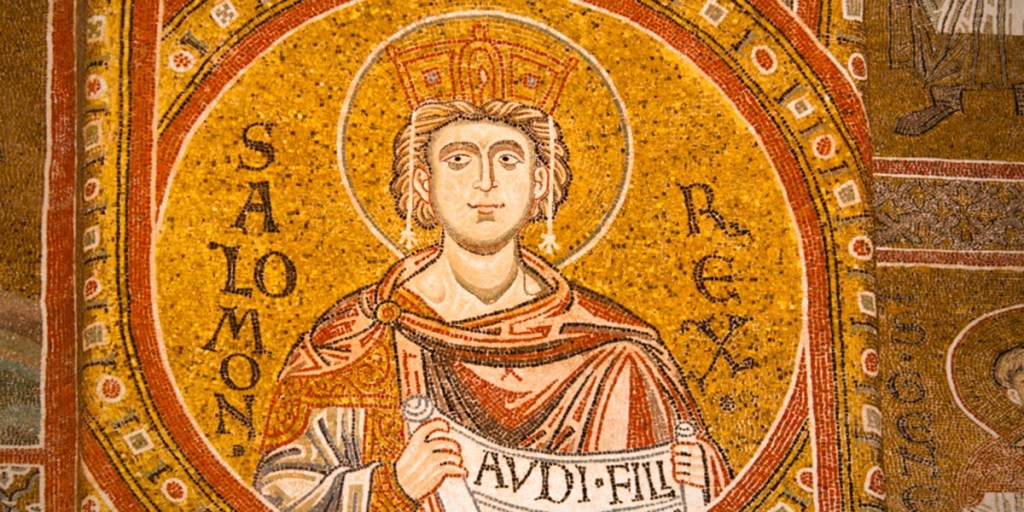
     Solomon is our example of the one king of Israel who knew his limitations—and how much he needed the Lord to be able to live out his calling from God. He had a dream encounter with God when he was worshiping him, offering sacrifices in the high place at Gibeon, at the beginning of his reign. When God asked him what he should give him, young Solomon answered humbly and eloquently, “You have shown great and steadfast love to your servant my father David, because he walked before you in faithfulness, in righteousness, and in uprightness of heart toward you; and you have kept for him this great and steadfast love, and have given him a son to sit on his throne today. And now, O Lord my God, you have made your servant king in place of my father David, although I am only a little child; I do not know how to go out or come in.”

      Solomon is all of 15 when his father dies or “slept with his ancestors,” as the Hebrew Bible so poetically describes death. He knew he had BIG shoes to fill. His father, David, was 30 when he was anointed king.

Acts 13:22 says that God testified “concerning him: ‘I have found David son of Jesse, a man after my own heart; he will do everything I want him to do.’” David led his army to conquer Jerusalem; he made it the capital and, having the Ark of the Covenant brought there,  he made it the center of worship for the Israelites. David was a musician and is considered the author of many of the songs in ancient Israel’s hymnal—the book of Psalms.

Though David was a sinful man, committing adultery with Bathsheba and having her husband, Uriah, killed, to cover up his sin and be with her, he would become the most beloved king in Israel’s history. He reigned 40 years over a united monarchy of Israel and Judah.

His son, Solomon, would go on to do great things, reigning from 970 to 931 BCE. Beginning in the 4th year of his reign, he used some of the enormous wealth that he and his father accumulated to build the First Temple in Jerusalem.

 Solomon is traditionally considered the author of several biblical books: Proverbs, Ecclesiastes, and Song of Solomon or Song of Songs.

But that day, when Solomon was offering sacrifices to the Lord on behalf of his people and worrying about how on earth he would ever be king of Israel, he had only one request of the Lord—wisdom.

 “Give your servant therefore an understanding mind to govern your people,” Solomon says, “able to discern between good and evil; for who can govern this your great people?”

God is pleased with Solomon’s request—as God would be pleased if we asked for the same. The Lord blesses him with more than he has requested. Solomon will have great wealth and long life.

What Solomon is best known for is his wisdom— the gift of a wise and discerning mind to lead God’s people. One famous example of Solomon’s wisdom is when two women came to him claiming to be mother of the same child. Solomon resolves the dispute by commanding the child be cut in two. One woman quickly renounces her claim, proving that she would rather give the child up than see it killed. Solomon declares the woman who showed compassion to be the true mother, entitled to the whole child.

      Our readings in 1 Kings and in Ephesians remind us that now is the time to live as wise people, not foolishly wasting these days God has given us. Let us prepare for our Lord’s return by seeking the source of all wisdom. Here is the promise in James 1:5,

 “If any of you lacks wisdom, you should ask God, who gives generously to all without finding fault, and it will be given to you.”

But what is wisdom? It’s not being smart or knowing the answers to every Jeopardy question. Wisdom isn’t the same thing as trivia or knowledge, which “puffs up.” And the wisdom of this world isn’t the same as the wisdom of the Lord.  Paul says in 1 Cor. 3:19-20:  “For the wisdom of this world is foolishness in God’s sight. As it is written: “He catches the wise in their craftiness” and again, “The Lord knows that the thoughts of the wise are futile.”

The wisest thing that young Solomon ever did was admit to God that he didn’t have a clue!! And that his calling to rule over Israel was something he couldn’t do on his own. He certainly hadn’t earned this calling from his own merit or good works. Just as we don’t earn our callings through good works.

The starting place for wisdom, then, is knowing, loving, and TRUSTING the Lord AND knowing ourselves and being honest with ourselves.  There is a wisdom in knowing our limits.  There is a wisdom in knowing our potential—because  nothing is impossible with God!  And we are God’s beloved!!!

Most of all, there is a wisdom in knowing  God is with us, we are with each other, and we are not alone. With the gift of wisdom comes  responsibility for FAITHFULNESS. Do you want to be pleasing to God? Seek to DO God’s will every day. Be faithful!

When you leave this place today, go, walking in the wisdom of the God who lights the path before us.  Go blessed by the God who journeys with us. The God who wants us to ask of him, like Solomon, “Give me a wise and discerning mind.”

Let us pray.

Dear Lord, sometimes we don’t know how to pray. We don’t know what to ask for. We feel overwhelmed in some of the seasons of our lives. But we always know that we need you, we love you, we trust you. We want to be pleasing to you, like Solomon was. Lord, give us a wise and discerning mind. Grant us wisdom for the many decisions that we are facing as individuals and as your Church, the Body of Christ. Heal the sick, bind up the wounds of the brokenhearted. Provide for those in need—body, mind, and spirit. And guide us in your will every moment of every day. Help us to be faithful to walk in your ways. In our Triune God we pray. Amen.

Get Up and Eat

Meditation on 1 Kings 19:4-8

The Presbyterian Church, Coshocton, OH 43812

Pastor Karen Crawford

Aug. 8, 2021

Link to our Livestreamed Worship on Facebook:

https://fb.watch/7iNc8UQTW5/

Elijah sleeping under the broom tree.

The week was off to a great start with VBS on Monday night! This year’s theme was Beach Party, with our programs mostly outside on the church lawn. Storytime and snacks were served up on beach blankets under some shade trees. Children listened to Bible stories on the theme of water and fish, such as Moses and the Israelites crossing the Red Sea on dry land; Jesus walking on water and calming the storm; Jonah and the Whale, told from the perspective of the whale; Jesus calling the disciples to be fishers of people; and, another miraculous picnic: Jesus feeding more than 5,000 people with a few loaves and fish. 

Jeff and other volunteers sent me photos from the nights that I couldn’t attend. Thursday, the last day, was water day. Janice filled wading pools with 600 water balloons. Some experiences that you don’t get from the photos, Jeff said, are the heat of the August night; the anticipation, “I’m so gonna get you!!” Then, splat!! The water balloon hits you in the back, and the water is COLD. And all the laughter!! And shrieks! Until all the balloons were thrown and everyone was SOAKED.

Jeff saw drivers slowing down as they passed the church, hearing the shrieks and laughter; grinning, then driving by slowly…. Jeff was still laughing on Friday when he shared the photos by text message and told me about the last evening.

Isn’t it wonderful that our VBS was a blessing to the children and families and volunteers AND a witness to the love, joy, and peace of those who happened to be driving by the church???? That’s what we have been praying for!!

Though too brief, Monday night was a feast that strengthened me through a long, dry, wilderness week—when Jim had his knee surgery, and we struggled with his care at home after two days and one night in the hospital.

While I was sad to have missed so much of VBS, the Lord spoke to me in the quiet at home through happy memories from Monday of this powerful outreach to children and families in our church and community. Whenever I was discouraged and weary, the Lord brought to mind the joy of all who participated in VBS—and all the seeds that were sown for the sake of the Kingdom. God was saying to me with these nourishing, uplifting reminders of his faithfulness in my life and in the life of our church, “Get up and eat.”

***

Elijah the Tishbite, the great prophet of Israel, is running for his life in our reading in 1 Kings today. Queen Jezebel, wife of King Ahab of Israel, has vowed to kill him.  

Jezebel   is a Phoenician princess in the 9th century who marries Ahab, the prince of Israel. Have you heard of Jezebel?  Phoenicia is located in what is now Lebanon. While Israel is struggling with internal tribal differences and susceptible to frequent invasions, it still follows the beliefs of Yahweh, the “one true” God. Phoenicia is a large, cosmopolitan, religiously diverse area. Jezebel had grown up in a wealthy family and was well educated by tutors. Her family worshiped many gods.

    When Ahab and Jezebel rule as king and queen of Israel, Jezebel continues worship of the nature god Baal and begins killing off the prophets of the Lord.

    You wouldn’t know it by his despair, but Elijah has just had a great victory over the prophets of Baal on Mount Carmel. After Baal fails to respond to its followers sacrifice and their shouting,  “O Baal, answer us!” from morning to noon, Elijah builds an altar and prepares a sacrifice to the Lord, pouring water over and around it. Then he prays to God and immediately fire falls from heaven and consumes everything.  When the Israelites see it, they fall on their faces and shout,  “The Lord alone is God. The Lord alone is God.” (I Kings 18:39). The prophets of Baal are seized and killed by sword.

Elijah’s fear and despair are triggered by a note from Jezebel’s messenger saying that he will be killed by the next day. He runs to Beersheba in Judah. Leaving his servant there, he goes a day’s journey into the wilderness. Under the broom tree, he finds shade and a place to pray.  But instead of asking God to deliver him from the queen, he asks the Lord to end his life.

He has had enough.

Even a great prophet of the Lord can become weary of body, mind and spirit. In more modern-day terms, we could say that he has PTSD. He is a prophet and a soldier for God. The fear and tiredness are talking when he says, “I am no better than my ancestors.”

Elijah, who prays for death, is one of only a few in the Bible who will not die. When his ministry draws to a close on earth and his assistant, Elisha, is prepared to take his place, Elijah will be taken up in a whirlwind and a fiery chariot will ride the sky.

God’s answer to Elijah’s prayer is sleep!!! He falls asleep under the desert broom tree!

This passage really brings home to me how the Lord cares for us– body, mind, and soul. We are not always good about taking care of ourselves! Especially caregivers! We can become so focused on our loved one that we don’t take the time for self-care. But God our maker knows how precious we are. He tenderly feeds us, when we don’t have the strength to carry on.

An angel awakens Elijah with,  “Get up and eat.” He doesn’t let the prophet oversleep!

Throughout this passage, we encounter phrases that connect Elijah’s story with the great story of God and God’s people in the Old Testament and New—and with our own story. Through God’s loving action, Elijah experiences redemption!

The broom tree and wilderness remind us of the Israelites’ time in the desert with Moses, when they camp at a place known for broom trees in Numbers 33:18-19.  The cake baked on hot stones reminds us of God’s provision of manna from heaven, tasting sweet like honey, when they were hungry.  Water in the stone jar reminds us of water provided by God from a rock when the Israelites are thirsty.  And when Jesus turns water into wine  and offers living water to the Samaritan woman  at the well in John.

The rest and nourishment prepare Elijah for his 40-day and 40-night wilderness journey to Mt Horeb, the Mountain of God. This is a spiritual journey that brings to mind Moses  spending 40 days and nights atop Sinai in Exodus 24:18;

memories of the rain falling on Noah’s ark;

and in the New Testament, when Jesus is tempted in the wilderness to prepare for his ministry —and, in his time of need and weakness, at the end of 40 days and nights, is ministered to by angels.

God will speak to Elijah on Horeb. He will surprise him as he passes by, not in the great and mighty wind, splitting mountains and shattering rocks. Not in the earthquake that follows, nor the fire. God’s voice will be heard as a soft murmur in the silence.

How does the Elijah story connect with your story today? Are you or a loved one weary in your journey of faith? Is life getting you down? Are you having trouble hearing from God in the noise of your life?

The Lord is teaching me to rely on Him for EVERYTHING—and that means learning to ask for help—from God and from others, when I need it. And that some days, the best thing we can say is that we made it through the day—and tomorrow will be better!! And that food and rest are necessary for mental and spiritual health.

And that worry is a waste of time and energy. As Jesus says in the Sermon on the Mount in the gospel of Matthew, today really does have enough worries of its own. So don’t worry about tomorrow!! God is still using angels to help us in our time of need! Only the angels are YOU and Me! Sometimes, God will use a complete stranger to minister to you or a loved one in need.

Do you know that God is with you, right now? And that his voice can be heard if you just stop running and giving into fear and despair? The Lord is speaking to us, offering nourishment for those who are weary in body, mind and soul:

 “Get up and eat.”

Let us pray.

Holy one, thank you for your love, for calling each of us your precious child and for having a plan for our lives. Thank you for our VBS and the many children and families our congregation was able to serve. Bless all our volunteers for their acts of kindness, sewing seeds of faith for your sake, sharing your love and grace. Reassure us, Lord, when we are weary and discouraged, in spite of how you have used us for your ministry. We still get tired! Keep us from obsessing over failures and weakness and to look to you for our strength. Remind us to take time to care for ourselves—to find nourishment for body, mind, and soul. And that you desire us to rest and eat, care for our physical bodies—and leave the worrying to you. Help us to know when to ask for help from you and others—and to recognize the angels in our midst. Use us, Lord, as your ministering angels, helping and encouraging others who are in need. We pray these things in the name of the Triune God—Father, Son and Spirit. Amen.

Practical Resources for Churches

Everyone has a calling. Ours is helping you.

Consider the Birds

Pastor Karen shares thoughts on faith, scripture, and God's love and grace revealed through backyard wildlife.

F.O.R. Jesus

Fill up. Overflow. Run over.

Becoming HIS Tapestry

Christian Lifestyle Blogger

Whatever Happens,Rejoice.

The Joy of the Lord is our Strength

Stushie Art

Church bulletin covers and other art by artist Stushie. Unique crayon and digital worship art

The Daily Post

The Art and Craft of Blogging

WordPress.com News

The latest news on WordPress.com and the WordPress community.