Weed

Tell Me About Your Garden Series

Meditation on Matthew 13:24-30

First Presbyterian Church of Smithtown, NY

Pastor Karen Crawford

March 30, 2025

Thank you to the 15 gardeners who opened their hearts, homes, and gardens to me for my garden spirituality research for my doctoral program last summer and fall. May God bless you for your kindness!

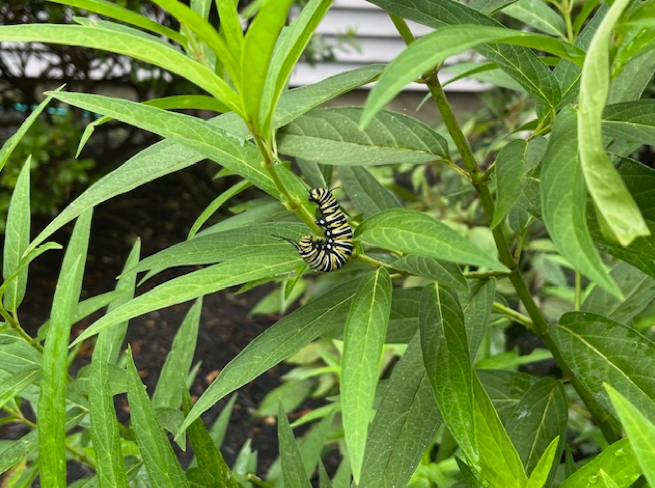
Monarch caterpillar on the milkweed that I grow from seed in my garden. Milkweed is, well, a weed and can be rather invasive. It also provides a home and nourishment for monarch butterflies, who lay their eggs ONLY on milkweed plants.

Listen to the devotion here:

What would the world be, once bereft

Of wet and wildness? Let them be left.

O let them be left, wildness and wet;

Long live the weeds and the wilderness yet.

             – Gerard Manley Hopkins (1844-1889)

Yesterday’s weather truly felt like spring. I opened the windows and went outside to do a little spring clean-up. This is that in-between time for gardeners here, when we are still planning our gardens; some of us are growing seedlings indoors, like Reese and his heirloom tomatoes, and getting beds ready for planting, in another month or so. Betsy is ahead of some of us. She has already begun direct sowing of seeds in her vegetable garden: Swiss chard and lettuce, kale and collard greens, and peas and spinach. Soon she will plant her seedlings started inside: broccoli, cauliflower, and onions.

My spring clean-up includes removing fall leaves, old growth from perennials, and very carefully pulling up weeds. I say very carefully because it’s hard to know, at this stage, if what’s pushing through the soil is a weed or a flower that has reseeded itself.

It’s always interesting in spring to discover your plants growing in unpredictable places. Sometimes, wind or rain carry them there. Other times, it’s the wildlife that help with the transplanting. Sometimes, it’s just a mystery that stirs us to wonder and laugh. Gardeners Ernie and Reese shared about vegetables and fruits showing up in places other than where they planted them. Reese says, “I think there’s always a certain amount of ‘Wow! Look at this!’” He sees a cucumber plant growing up out of the middle of his phlox. “How it got there, I have no idea, you know?” he says. “And I think that sense of wonder is one of the reasons why I got interested in biology and science…And that’s really where all the early scientists were. They were trying to explain what God had done.” The Newtons and Galileos never took God out of the picture, he says. “They were trying to explain God’s world.”

This year, my Blanket Flowers and Black-eyed Susans are springing up between the bricks in our front walk. A landscaper pointed to them during his talk on how to kill weeds. And I thought to myself, “But they aren’t weeds.”

Which brings me to an important question. What is a weed, anyway?

 Ralph Waldo Emerson, a lifelong gardener,“once said that a weed is simply a plant whose virtues we haven’t yet discovered.”[1] Other romantics of the 1800s felt the same way—that “weed is not a category of nature but a human construct, a defect of our perception.”[2] Weed became a symbol for “wilderness,” which was seen as a good thing. Naturalist Henry David Thoreau, Emerson’s disciple, had different feelings about weeds when he planted his bean field at Walden, which, though it strengthened his attachment to the earth, led him to wage a war. “Daily the beans saw me come to their rescue, armed with a hoe,” he writes, “and thin the ranks of their enemies, filling up the trenches with weedy dead.”[3]

But what about in the 21st century? What do we think now? A farmer in Minnesota once told me that a weed is a plant in the wrong place. Grass is a weed when you don’t want it growing on your farm field. But the majority view held by crop farmers was that weeds were plants that might interfere with the crops. When I planted perennials at the manse next to the church in Minnesota, a farmer expressed disgust. They were weeds that would end up seeding his nearby farm field! I never thought of that. I was just happy that the black-eyed Susans survived a Minnesota winter.

Gardening writer Michael Pollan did some research on the plants growing as “weeds” in his yard. He says that weeds “are plants particularly well adapted to man-made places. They don’t grow in forests or prairies—in the ‘wild.’ Weeds thrive in gardens, meadows, lawns, vacant lots, railroad siding… dumpsters and in the cracks of sidewalks. They grow where we live… and hardly anywhere else.”[4]

He makes another interesting observation. Weeds are not wild, contrary to what the romantic writers of the 1800s assumed. “They do better than garden plants for the simple reason that they are better adapted to life in a garden…Weeds have evolved with just one end in view: the ability to thrive in ground that (people have) disturbed.”[5] If Thoreau had a field guide with him at Walden, Pollan says, he would have learned that most of his weeds were “alien species, brought to America by the colonists. St. John’s wort, daisies, dandelions, crabgrass, timothy, clover, pigweed, lamb’s quarters, buttercup, mullein, Queen Anne’s lace, plantain, yarrow… not one of these species grew here before the Puritans landed.”[6] America had “few indigenous weeds” because it had “little disturbed ground” before the Europeans arrived. “Tumbleweed didn’t arrive in America until the 1870s when a group of Russian immigrants (settled in South Dakota), intending to grow flax. Mixed in with their flax seeds were a few seeds of weed well known to the steppes of the Ukraine: Tumbleweed.”[7]

So, I am back to my question. What’s a weed? For me, it’s an unwanted plant, often growing invasively in my yard. I actually like some plants others think of weeds—such as dandelions and clover, which help improve the soil and attract pollinators. Last year, I planted Solidago—better known as Goldenrod—which is often confused with Ragweed and mistakenly blamed for allergies. Goldenrod tolerates poor soil and produces abundant nectar in its yellow flowers for hummingbirds, bees, and butterflies in August/September, when many other flowers are finished blooming. And it is deer resistant, which is important where I live.

    But sometimes, a weed IS a plant that I purposefully grow by mistake. Have you ever made that mistake? The gardeners in our flock mentioned mint and scallions, I think. Evening primrose, a few years ago, was just a pretty, yellow flower that bloomed at night in my Ohio garden. The organist shared it with me, and I was captivated by it enough to take videos of the flowers as they opened, all at once, around 8:30 p.m. on summer nights.  On Long Island, it grew like a thick impenetrable wall, about 7 feet tall. It still had pretty, yellow flowers, but the plant overtook and overshadowed every other plant on that side of the deck. Before the end of the season, I pulled the evening primrose wall down and threw it on a pile with my other discarded plants that were growing like weeds, if not weeds themselves.

So, what does Jesus think of weeds?

He has some strong feelings about them as they interfere with the crops that are feeding the population. In his Parable of the Weeds in Matthew 13, weed seeds are sown among wheat, which, along with barley, is one of the most important crops in biblical times; bread is a mainstay of their diet. It’s remarkable to me that Jesus’ attitude toward the weeds growing in the wheat field is much the same as the crop farmers whom I knew in Minnesota. Weeds intermingle with and contaminate the crops. It’s too dangerous to kill or pull the weeds when the crop is growing, lest the wheat is pulled and damaged. The weeds will be harvested along with the crop, before the weeds are finally destroyed.

Jesus will interpret his own parable, but only to his disciples, beginning at verse 37. He doesn’t say this to a crowd mixed with seekers, scoffers, and unbelievers. This teaching is to encourage his followers that one day, evil will end. As Paul says, our enemies are powers and principalities of this present darkness—not human beings. One day, Christ’s peace and justice will reign, when the Kingdom of God comes to fruition and the Lord comes again to take us to himself. But there is a time of waiting, for the Lord is patient and desires all to come to know him. Jesus says, “The one who sows the good seed is the Son of Man;the field is the world, and the good seed are the children of the kingdom; the weeds are the children of the evil one, and the enemy who sowed them is the devil; the harvest is the end of the age, and the reapers are angels. Just as the weeds are collected and burned up with fire, so will it be at the end of the age (Matt. 13: 37-40, NRSVue).”

    You might be surprised to learn that of the 15 gardeners whom I interviewed for my project, only one or two expressed a serious dislike of weeding. Many say that weeding is their favorite gardening task! Faith says, “I like being outdoors, and I like the physical activity, cleaning out the beds, weeding, watering, and getting down in the dirt.” Pat remembers fondly gardening with her father. Her primary labors: watering and weeding. Jolene weeds a little every day. “It’s peaceful pulling the weeds,” she and other gardeners say.

     I had never really thought about it before, but I enjoy weeding, too, because it is up close and personal with the soil and plants. You have to pay attention to what you are doing, so you don’t pull up the plants you want to keep. But at the same time, I am not just looking at the weeds. I am listening to the birds. Enjoying the sun, the breeze, the blue of the sky. I am looking at all the new plants, and thinking how cute they are, with their tiny, unfurling leaves as they rise from the ground. I have hope. I am dreaming of what they will look like, in a few months, when the flowers are in bloom. I am remembering the people from my congregation who gave me many of these flowers to plant at the manse. And I am marveling at those that mysteriously end up growing between the bricks in my front walk. As other gardeners say, I lose myself and find myself in gardening. And when I go inside, I am a better person than when I went out. I am at peace with God, myself, and all Creation.

   Yesterday, when I was weeding, I caught sight of some evening primrose that seeded itself in the front yard. They looked happy and healthy—and I decided to leave them alone and give them another chance. Maybe this time, it will be the pretty yellow flower that it was in my Ohio garden, a flower unlike most others because it blooms at night. If not, I guess I will be pulling down 7-foot stalks and chuckling to myself.

Evening Primrose, growing to 7 feet in my Long Island yard.

    Once again, I am back to the question of what is a weed, and what does it mean to weed? Because if weeding brings us peace, and draws us nearer to the earth, over and over again, and helps us grow spiritually, then it can’t possibly be all bad.

    Pollan comes to a similar conclusion. Actually, that weeding isn’t a bad thing at all. He says that weeding is “the process by which we make informed choices in nature, discriminate between good and bad, apply our intelligence and sweat to the earth. To weed is to bring culture to nature—which is why we say, when we are weeding, that we are cultivating the soil. Weeding…is not a nuisance that follows from gardening, but its very essence.”

    Dear friends, as we continue our Lenten journey, I pray we will find time to be out in nature—losing ourselves and finding our true and better selves there. I pray that we will realize, more and more, how we are loved and cared for by a gracious and merciful God who doesn’t hold our mistakes against us. The Lord doesn’t see us as we might see ourselves as, I don’t know, the worst thing we might encounter while we are weeding: poison ivy. The Lord God who created us all in love, for love, sees us as precious and valuable. We are, to God, worth redeeming!  

Will you pray with me?

Holy Gardener, thank you for caring for us and all that you created. Thank you for redeeming us through your Son, Jesus Christ. Thank you for reminding us that one day, evil will end, and that peace and justice will prevail. Teach us to see ourselves and one another as you see us—not as undesirable weeds, but as precious and valuable. Remind us that you are with us in the simple tasks of every day, including pulling weeds in a garden, and are ready to teach us more about you and your love and grace, ourselves, and one another with every breath that we take. Amen.

`


     [1] Michael Pollan, Second Nature: A Gardener’s Education (NY: Grove Press, 1991), 98.

     [2] Pollan, Second Nature, 98.

     [3] Pollan, Second Nature, 108.

     [4] Pollan, Second Nature, 109.

     [5] Pollan, Second Nature, 109.

     [6] Pollan, Second Nature, 111.

     [7] Pollan, Second Nature, 111.

Spur

Tell Me About Your Garden Series

Third Sunday in Lent

Pastor Karen Crawford

March 23, 2025

Many thanks to the 15 gardeners who opened their homes, hearts, and gardens to me and shared their stories as part of my doctoral project for Austin Presbyterian Theological Seminary.

Listen to the devotion here:

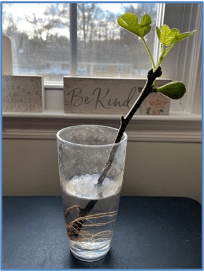
I transplanted my fig tree branch about a month ago. This was the branch that was given to me by two gardeners—George and Lottie—that I rooted in water. It was doing great in the water, though it took a while for the roots to grow. It was just a stick for a long time.

Finally, around Christmastime, it produced a green fig and then two leaves in January.

By February, I decided that it probably needed soil. Then, not long after I planted the fig tree in potting soil and gave it a good watering, the leaves shriveled and dried up. I thought, “Oh no.”

I asked myself, if I were a fig tree, what would my problem be? Is it not enough sun? Maybe it’s lonely on the bathroom counter? I brought the tree into my home office and put it in a sunny window, on top of my printer. Then, I tried to ignore it for a week or so and see if it might recover on its own. Maybe it was in transplant shock.

A couple weeks passed, and the leaves fell off. I looked at my cat, wondering if maybe he chewed them off, but he looked as puzzled as I was concerning the fig tree.

I mentioned the problem during our gardeners’ gathering on March 9. George and Lottie tell me not to worry. They will give me another branch. Fig trees are hard to grow, they say. Kaitlyn advises that I recycle it. Let it become soil again in the compost pile. Learn to let go. And that’s very tempting.

I put the tree out of my mind for a few days, then a week and a little more, as I was busy with ministry. Then, early this week, I transplanted the little seedlings that grew from seeds planted the end of February/beginning of March and the peace lily that Nanume Church had given me for my installation three years ago. The peace lily was completely root-bound. When I pulled it out of its pot, there was barely any soil left. No wonder the leaves had been turning yellow, despite my regular watering and its home in a sunny window. Now the peace lily is divided in three large pots, with fresh soil, enriched with compost. The plants already look greener and healthier, with new growth—only two days after the transplanting.

While all the transplanting went well for the seedlings and the peace lily, I can’t help but wonder how I might help the fig tree. Having this passage come up in the lectionary this week was fortuitous. At least, I thought so, but then I realized that it is one that scholars debate and find problematic. It isn’t as difficult as the passage in Matthew 21 where Jesus is portrayed cursing a fig tree that doesn’t bear fruit. That just doesn’t sit with me well, the picture of Jesus, through whom all things were made, cursing any part of God’s Creation.

In this passage in Luke, I don’t like how the man tells the gardener to cut down the fig tree in his vineyard, because for three years, he’s been watching that tree, and it hasn’t born any fruit. Maybe a fig tree takes longer to bear fruit than other trees. Maybe it had a hard three years, struggling with drought, insects, or some other problem that we don’t know about. But then something in me says, “Three years is a long time waiting for fruit. Maybe it IS a waste of soil, and it would be better, as Kaitlyn says, recycling it to the compost pile.

And then the gardener in the parable brings me joy. He intervenes on behalf of the fig tree and offers to do more to try and help it grow. He says, “Sir, let it alone for one more year, until I dig around it and put manure on it. If it bears fruit next year, well and good, but if not, you can cut it down.” This is the part that inspires me—what the gardener is willing to do to spur the tree to bear fruit. There is so much compassion here. And by helping the tree, he is helping the production of the entire vineyard. And he is helping himself, so that he can say to the man, perhaps the owner of the vineyard, next year, “I did all that I could as your gardener, and now look at all the fruit this fig tree is bearing.”

    This passage, when read alongside James 5, reminds me of how we are encouraged to live as we are waiting for Christ’s return—in loving community with one another. James encourages his church to be patient, until Christ’s coming, as “the farmer waits for the precious crop from the earth, being patient with it until it receives the early and the late rains. You also must be patient.” People living in Palestine in the First Century practiced dry farming, relying not on irrigation, but solely on the rains for crops to grow and bear fruit.

   This passage in Luke, read alongside Hebrews 10, makes me think about what we can do to “provoke or spur one another to love and good deeds,” just as the gardener was willing to loosen the soil around the tree and fertilize it to spur it to bear fruit. The writer of Hebrews says that the way to spur one another to love and good deeds is by “not neglecting to meet together” as some people were making a habit of not gathering, and by “encouraging one another all the more” as the Day of the Lord’s return approaches.

    Today’s lesson stirs me to consider my own growing conditions and seasons of abundance and dormancy. When have I had my most fruitful seasons, and born the fruits of the Spirit: love, joy, peace, patience, kindness, goodness, faithfulness, gentleness, and self-control? I will share some thoughts.

    First, being planted in the right soil helps! I know the old saying, “Bloom where you are planted,” and that’s true, but whenever possible, go and plant yourself with the people who spur you to love and good deeds. Don’t hang around too much with the barren fig trees, unless you are trying to fertilize them and spur them to love and good deeds. Stay away from places that aren’t good soil for you, places where you know you won’t be at your best, grow, and bear fruit.

   Second, don’t wait for others to feed you. Mature Christians know how to eat. Come to church with open hearts and minds, ready to be nourished. Open your Bible and read at home. Put on worship music and sing. Take a walk in nature, plant some seeds, visit a friend, help someone in need, and seek the Lord with confidence in prayer.

   Third, ask for help. Sometimes it’s hard to ask for help when you are struggling. But when you ask for help, you provoke someone else to love and good deeds. You give them a ministry opportunity and you make THEM feel needed. Everyone is needed. Then, it’s a domino effect. When they serve you or help the church family, they spur you and others to love and good deeds.

    So back to the gardener and the barren fruit tree. Don’t you wish that Jesus would tell us the end of the story? Don’t you want to know if the tree stayed barren or if, the following year, when the man returned, the gardener was able to say, “Come and see all the fruit your fig tree is now bearing. All because of a little manure and a lot of patience.”

    Scholars say this passage is about divine judgment deferred and an invitation to repentance. Our loving and gracious God is so patient. The God who knows us better than we know ourselves wants to be known. Christ welcomes all to receive his forgiveness and love, and then come, follow him.

    Finally, what about my fig tree, which is now back to being a stick? Well, after I transplanted the peace lily, I transplanted the fig tree, once again. At first, I thought, am I just wasting my time and my good transplant soil? But then I did it, anyway. I gave it a new, clean pot. When I pulled it gently out of the other soil, I saw that those wonderful roots that had grown last winter in water are now all gone. What happened in the first transplanting? I don’t know. Something must have been wrong with the soil. It’s a mystery.

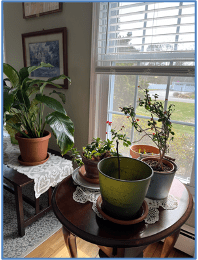
Now, the fig tree is on a sunny table with a flourishing Crown of Thorns with red flowers, a pot of Julie’s garlic, with green shoots pushing through the soil, and a healthy succulent, given to me by a church member when I arrived. Maybe living in a strong, growing community, with good soil and sun, will spur my barren fig branch to send out new roots and leaves. Perhaps, someday, it will bear fruit. I haven’t given up hope, not yet, just as the Lord never gives up on me.

What about you, dear friends? Do you need the gardener’s fertilizer and tender loving care? What spurs you to love and good deeds? What will you do to spur one another in this season of Lent?

Let us pray.

Gracious Gardener, thank you for your love and mercy for us, for being patient with us through all the seasons of our lives, seasons of abundancy and seasons of dormancy. Thank you for never giving up on us, no matter what, and the continual help we have from your Holy Spirit, feeding, guiding, and strengthening us to follow your Son. Spur us, dear Lord who is always with us, to love and good deeds. Teach us how to spur one another so that we all grow, bloom, and bear spiritual fruit. Amen. 

Sow

Tell Me About Your Garden Series

Meditation on Matthew 13:1-9, 18-23

First Presbyterian Church of Smithtown, NY

Pastor Karen Crawford

Second Sunday in Lent

March 16, 2025

You come to fetch me from my work to-night 
When supper’s on the table, and we’ll see 
If I can leave off burying the white 
Soft petals fallen from the apple tree. 
(Soft petals, yes, but not so barren quite, 
Mingled with these, smooth bean and wrinkled pea;) 
And go along with you ere you lose sight 
Of what you came for and become like me, 
Slave to a springtime passion for the earth. 
How Love burns through the Putting in the Seed 
On through the watching for that early birth 
When, just as the soil tarnishes with weed, 
The sturdy seedling with arched body comes 
Shouldering its way and shedding the earth crumbs.

                                                                             —Robert Frost, “Putting in the Seed”[1]

Thank you to the 15 gardeners, ranging in age from 51 to 102, for opening your homes and gardens to me and sharing your stories in the summer and fall of 2024 and as a group in early spring 2025 for my doctoral project for Austin Presbyterian Theological Seminary.

Listen to the devotion here:

       I planted seeds a few weeks ago. They started in my basement on what I expect was either Rev. Edwards’ or Rev. Hulsey’s old dining room table. It has been repurposed for an indoor potting area, which I am truly excited about. I have never had a place in my home to plant seeds and transplant seedlings. It’s kind of a basement she-shed, if you know what I mean.

    One of our gardeners, Betsy, helped me with my seed planting. She is much more experienced at planting seeds than I am. She has planted a vegetable garden from seed since she was a teenager and learned from her father. Last winter was the first time I have ever started seeds in the house. I liked it so much, that I planted seeds and transplanted seedlings all summer long and into the fall. And the plants lived, much to the surprise of our landscapers, who scratched their heads. “No one plants in July,” Craig, Jr., says.

     Now I am hooked. I can’t stop planting seeds.

     Betsy provided the soil this time, as last year, I used a combination of potting soil, an organic garden soil, and peat moss. But I had some issues with the seedlings sometimes getting moldy. Betsy brought me a special soil for seed germination and another soil for transplanting. We put the transplanting soil at the bottom of the seed containers and the seed germination soil on the top, carefully added the seeds, and finished it off with a few sprays of water.

     Within a few days, the seeds started to sprout. Echinacea, Black Eyed Susan, Dusty Miller, Lupine, Red Salvia, Columbine, Butterfly Weed, and Bee Balm. Pretty soon I realized the seeds would be better off upstairs where it was warmer and brighter. Now my she shed is the living room!

      Maybe you grow seeds, too. Do you? Betsy, Belinda, and Reese all start seeds indoors and also direct sow in their garden in spring. Reese grows heirloom tomatoes from seed, as well as peppers and Swiss Chard. Ernie tried growing from seed once, but didn’t have success.

      Belinda says, “I love growing from seed. That’s probably my favorite. …Then you feel like you grew it; it’s your creation. …I probably do more from seeds than existing plants because I get a kick out of it. I also feel that they’re hardier if you grow from seed.” Her husband, Brad, shares how he used to sell seed packets door to door when he was 10 or 11. “I would literally go door to door with my packs of seeds and say, ‘Do you want tomato, or do you want corn?’” Brad even got his own boys to sell seeds door to door one year. “We tried to rekindle my childhood,” he says, and laughs.

Bonnie says she grows marigolds from seed because she wants her granddaughter to “see the results of planting seeds.” “She helped me transplant them to the garden in the front,” Bonnie says. “They were huge last year. I never saw marigolds that tall!”

This year, her granddaughter is anxious to plant seeds with Grandma, again, but this time she wants to grow flowers to attract monarch butterflies. Me, too. That’s why I grow Butterfly Weed. Last year, I found a monarch caterpillar on my plant. That was exciting.

     In biblical times, field crops grown from seed were winter cereals, mainly wheat and barley. Only one summer cereal crop is named in the Bible, a kind of sorghum, “which thrives well in the mountains, without irrigation.”[2] Biblical folks also had fruit and nut trees—date palms, olives, figs, walnuts, almonds, pomegranates, and sycamore.      

      And they planted small gardens near their homes, growing lentils, broad beans, chick-peas, garden peas, onions, leeks, and garlic, as well as coriander, cummin, dill, bitter vetch—an ancient legume—and possibly a kind of carrot. Additionally, they grew watermelons, mentioned in Numbers 11:5-6, when the Israelites in the wilderness are missing the foods that they were accustomed to eating and stuck with eating manna.[3]

     The funny thing to me about the Parable of the Sower is that we never find out what kind of seed the Sower is sowing. The focus is on where the seeds lands, and of course it’s about discipleship. How can we be faithful followers of Jesus Christ? Our Sower in the gospel of Matthew sows his seed everywhere he goes, and the seeds land in four kinds of ground—the footpath, rocky ground, thorny ground, and good, fertile ground.[4]

     Jesus explains the parable, saying the one who “hears the word of the kingdom and does not understand it, the evil one comes and snatches away what is sown in the heart; this is what was sown on the path.” The seeds sown “on rocky ground, this is the one who hears the word and immediately receives it with joy, yet such a person has no root but endures only for a while, and when trouble or persecution arises on account of the word, that person immediately falls away.” The seed sown “among thorns, this is the one who hears the word, but the cares of this age and the lure of wealth choke the word, and it yields nothing.” Finally, there is the seed “sown on good soil, this is the one who hears the word and understands it, who indeed bears fruit and yields in one case a hundredfold, in another sixty, and in another thirty.”

     How should we respond to this teaching?

     Mary Ann Tolbert gives us all the characters in Jesus’ time to help us.  The scribes and Pharisees are those who rejected Jesus instantly, the first category. The “immediate joy and utter failure of the disciples, the second; the wealth, too great to give up,” the rich man in Matthew 19:23, the third.” But who is the fourth? The ones whom Jesus heals, such as the woman with a flow of blood in Matthew 9, to whom Jesus says, “Take heart, my daughter. Your faith has healed you.”[5]

    But there’s another way of interpreting the passage. We are the seed. On which kind of ground did we land? Are we those who didn’t understand the word, sown on the hard path, snatched by birds? Are we lacking in spiritual root, sown on rocks, scorched by the sun, falling away when trouble and persecution comes? Are we so overwhelmed with the “cares of this age and the lure of wealth,” that we yield nothing? OR are we the seed sown on good soil? Are we, indeed, bearing fruit and yielding a hundredfold?

   And there’s still another way to look at it, Barbara Brown Taylor says.[6]

“We hear the story and think it’s all about us, but what if we’re wrong? What if it’s not about us at all but about the sower? What if it’s not about our own successes and failures and birds and rocks and thorns but about the extravagance of the sower, who does not seem to be fazed by such concerns, who flings seed everywhere, wastes it with holy abandon, who feeds the birds, whistles at rocks, picks his way through the thorns, shouts hallelujah at the good soil and just keeps on sowing, confident that there’s enough seed to go around, that there is plenty, and that when the harvest comes at last it will fill every barn in the neighborhood to the rafters?”[7]

     What if the focus is about the grace and generosity of our Creator, who doesn’t “obsess about the condition of the fields.”[8] And isn’t “stingy with the seed.”[9] The Lord “casts the seed everywhere, on good soil and bad.”[10] This is a God “who seems to be willing to keep reaching in the Lord’s seed bag for all eternity, covering the whole creation with the fertile seed of God’s truth.”[11]

      And there’s one more way to interpret the story. This is my way. What if the Lord wants us to focus on the Sower’s generosity and kindness—and be like the Sower? What if we are called to sow extravagantly, without concern over whether the soil is good or bad, without judging if the seed is fruitful or not. Casting seed, sharing the Word, like it will never run out? Because it won’t.

      If you haven’t started sowing your actual seeds, yet, you still have time. One Long Island gardening expert says April is the month when her seed starting “takes root.”[12] Yes, you can start lettuce and broccoli inside as early as February and plant peas and spinach outside as early as mid-March.[13] But most of the tender seedling planting won’t happen around here till Mother’s Day. Maybe you haven’t had success with planting seeds in the past—planting actual seeds in the soil and nurturing plants and sharing the word of God with whom the Lord brings onto your path, into your life, and nurturing them in the faith.

     Be encouraged. It’s not up to us to judge the seed or the soil or our own skill for sowing. It’s not up to us to decide who receives the word of God and who doesn’t. Let us be like our generous, extravagant Maker, sowing seeds of kindness, grace, and truth, wherever we go.

     Sow like we’ll never run out. Because we won’t.

Generous and Extravagant Sower, thank you for your love, mercy, and grace. Thank you for offering your Word, the seeds of eternity, to all people. And that you are patient with us who may not respond right away to your call to be disciples. That you are patient with us who may struggle to share our hope in you with other people whom you bring into our lives. Teach us to be like the Sower, and be extravagant, generous, joyful, and merciful as we seek to be faithful followers of your Son. Amen.


      [1] Robert Frost, “Putting in the Seed,” The Poetry of Robert Frost, edited by Edward Connery Lathem (NY: Holt, Rinehart, and Winston, 1969), 123-124.

     [2] Zohary, Plants of the Bible, 41.

     [3] Zohary, Plants of the Bible, 85.

     [4] Barbara Brown Taylor, The Seeds of Heaven: Sermons on the Gospel of Matthew (Louisville: Westminster John Knox Press, 2004), 25.

     [5] Mary Ann Tolbert, Sowing the Gospel: Mark’s World in Literary-Historical Perspective (MN: Fortress Press, 1989),124.

     [6] Taylor, The Seeds of Heaven, 26.

     [7] Taylor, The Seeds of Heaven, 26.

     [8] Taylor, The Seeds of Heaven, 26.

     [9] Taylor, The Seeds of Heaven, 26.

     [10] Taylor, The Seeds of Heaven, 26.

     [11] Taylor, The Seeds of Heaven, 26.

    [12] Irene Virag, Gardening on Long Island, 25.

    [13] Irene Virag, Gardening on Long Island, 25.

Bread

Meditation on Exodus 16, selected verses, and Luke 4:1-13

First Presbyterian Church of Smithtown, NY

Pastor Karen Crawford

First Sunday in Lent

March 9, 2025

Precious Lord, take my hand

Lead me on, let me stand

I am tired, I am weak, I am worn

Through the storm,

Through the night,

Lead me on to the light.

Take my hand, precious Lord,

And lead me home. – Thomas A. Dorsey [1]


Thank you to the 15 gardeners, ranging in age from 51 to 102, for opening your homes and gardens to me and sharing your stories in the summer and fall of 2024 and as a group in early spring 2025 for my doctoral project for Austin Presbyterian Theological Seminary.

Listen to the devotion here:

I had semolina bread for dinner last night. My husband is the bread maker in our household. So I asked him, “What’s semolina bread?” It was delicious. Ours had sesame seeds on the crispy crust and was warmed in the oven with butter. He explained that semolina is a kind of flour made from durum wheat, the same type of flour used for making pasta. 

I had already been thinking about bread all week. We encounter Jesus in the wilderness, on this first Sunday in Lent, hungry and fasting for 40 days. The part in the story that stands out to me is the bread. For the first time, I smile a little when the devil tempts him, saying, “If you are the Son of God, command this stone to become a loaf of bread.”

How do you picture a loaf of bread? For me, the bread is a long loaf, like our Communion bread, and it comes wrapped in paper or plastic from a bakery or grocery store. The semolina bread we ate last night came from Uncle G’s.

But it didn’t really. And this is what I am getting at. When I think of bread, I think of the baked food that we eat, and even though I am mostly a vegetarian and a gardener, I don’t think of bread as being connected to the soil. Unlike other gardeners in our flock, I don’t grow many vegetables, at all.

Many of the gardeners told me that they want to grow FOOD for their families and themselves and FOOD to share with neighbors and friends. One gardener, I’ll call her Julie, said, “Well, flowers are pretty, but you can’t eat them. I like feeding people.” Betsy, Julie, Reese, and Belinda are mainly vegetable and fruit gardeners. Betsy is concerned about eating healthy and living in harmony with the earth. She does an extraordinary amount of canning, freezing, preserving, and cooking of what she grows. Nothing is wasted. Betsy, Belinda, Lily, and Julie make their own pickles, and Betsy and Belinda gave me raspberry jam and jelly, respectively, made from homegrown raspberries.

Jolene also grows food for her family, in addition to the multitude of annual flowers growing in containers around her yard. She grows five types of hot peppers—not sweet peppers—which she hangs, dries, grinds, and pours into jars to flavor her food. Her family’s favorite food grown in the garden, though, never actually makes it to her kitchen table. “Our best crop, she says, “is peas in the pod. We just love them.”

I have been doing them for years. I have never brought them in the house. I have never cooked them. We just eat them right off the vine. When the kids were younger and they had their friends over, I would see them out in the yard, picking them off the vine and eating them. One girl was like, “I don’t eat peas.” And I was like, “Well, you better try one of these.” And she was like, “Oh my gosh, these are delicious!” She was used to canned or frozen peas. There’s nothing like a nice raw pea from the peapod.

I can only imagine the girl who didn’t want to eat peas going home to tell her parents that night, “Guess what I ate? You should try them! They don’t taste anything LIKE peas!”

So, back to Jesus in the wilderness. I never could understand why the devil would tempt him with a stone, but bread in Jesus’ time was made into round loaves. A stone could resemble a loaf of bread in his culture. OK, so why bread? Why not tempt Jesus with a different food? Because bread was the food that everyone ate. That was the mainstay of their diet, along with fruits, such as olives, figs, and grapes. But there was another reason. The devil tempting Jesus to turn a stone into bread was to prove that he was the Son of God. For the Lord God had fed the Israelites bread in the wilderness in their 40 years of wandering.

God says to Moses in Exodus 16, “I am going to rain bread from heaven for you.” But what was bread from heaven? Was it even a vegetable or grown in the soil at all? In Exodus 16:14-15, we read how each morning, “When the layer of dew lifted, there on the surface of the wilderness was a fine flaky substance, as fine as frost on the ground. When the Israelites saw it, they said to one another, “What is it?” For they did not know what it was. Moses said to them, “It is the bread that the Lord has given you to eat.” 

He had to tell them what it was! Usually, when someone serves you food, and you have to ask them what it is, you’re probably not very excited about eating it. The Israelites called it manna, which means, “What is it?”

It was “bread” like they had never seen or tasted before. Exodus tells is that it was “like white coriander seed, and the taste of it was like wafers made with honey.” Jerusalem botanist Michael Zohary says that this is a mysterious thing because coriander is never found in the desert. So it must have really tasted “like coriander” and not have been coriander, which is an annual herb in the carrot family that is native to Israel and “occurs as a weed among winter crops. Once widely cultivated as a condiment, its leaves are sometimes used to flavor soups, puddings, curries, and wines. It also has some medicinal value.”[1]

You’re not going to believe what some scholars think manna really was. In 1891, a man suggested that “manna was a sweet exudation produced by small scaly insects feeding on the tamarisk tree.” The sweet liquid “hardens quickly, drops to the ground, and is collected by the Bedouin as a substitute for sugar or honey.” For a long time, this was considered the scientific explanation for bread from heaven, but then people got to thinking about how those insects are seasonal, and there’s not that many tamarisk trees in the Sinai. So, it’s still a mystery.

Whether the bread from heaven came from plants or insects doesn’t really matter to me. What matters is that God provided food for the hungry Israelites from the natural world around them that sustained them for 40 years. Did they get tired of it? Yes. But no matter what it was, it was a miracle.

In this season of Lent, I would like to challenge us to be more thoughtful and intentional about the food that we eat. Let food be a spiritual practice for us, as we remember that God is the source of ALL our nourishment—body, mind, and soul–and that it isn’t just food we need to nourish our bodies, but the Word of God. This is the phrase that is missing from our Luke reading, when Jesus answers, “It is written, ‘One does not live by bread alone.’ He is quoting from Deut. 8:3 (NRSV), which says, “He humbled you by letting you hunger, then by feeding you with manna, with which neither you nor your ancestors were acquainted, in order to make you understand that one does not live by bread alone, but by every word that comes from the mouth of the Lord.”

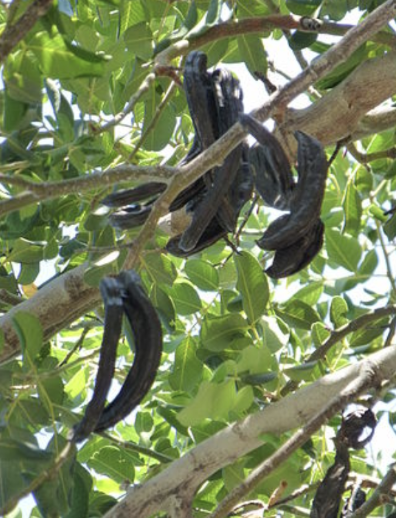
And I will close my devotion today with a discussion of one another biblical plant that was eaten in the wilderness—not by Jesus, but by John the Baptist. Do you remember what John ate? Locusts and wild honey, right? Well, I always thought locusts were, you know, grasshoppers. But I learned that scholars think John the Baptist was actually a vegetarian. They have identified the fruit eaten from the “locust” in Matthew and the pods in Luke, in the story of the Prodigal son eating the pods that the pigs were eating, as the fruit from a carob tree.

Carob, which has a sweet and chocolatey flavor, is native to Israel and is called, “St. John’s Bread.” The Arabs make a sweet syrup from the pulp of the fruit from the medium-sized evergreen tree; it contains as much as 50 percent sugar and is consumed by both human beings and animals.[2]

You know, we are so critical of our bodies. God doesn’t look at us in the same critical way that we do. Instead of us worrying about our weight, size, or shape, instead, let us eat without anxiety and give thanks to God for our food, especially when we eat bread, remembering the miracle feeding of God’s people in the wilderness and our daily bread, the Word of God, Jesus Christ, the true Bread from Heaven that nourishes us to eternal life.

Let us pray.

Holy One, thank you for your Bread from Heaven, the manna that fed your children for 40 years in the wilderness and Your Son, whose body nourishes us to eternal life. Thank you for feeding us every day. Help us to recognize what is truly food, grown from soil in your Creation, and be more intentional, especially during this holy season, about what we take into our bodies. Teach us to make good choices so that what we eat truly is food to strengthen us to serve you and our neighbors with joy, all the days of our life. Amen.

 [1] Thomas Dorsey in Giving Thanks, Poems Prayers and Praise Songs of Thanksgiving, edited by Katherine Paterson, 36.

[2] Michael Zohary, Plants of the Bible (Cambridge: Cambridge University Press), 92.

[3] Zohary, Plants of the Bible, 63.

What’s Important

Meditation on John 14

In Memory of Matthew John Kutil

May 29, 1966-March 4, 2025

Pastor Karen Crawford

First Presbyterian Church of Smithtown, NY

March 10, 2025

        Matthew Kutil was the best softball player our church team ever had. Coach John Agostini said Matthew won championships for us.

         He never did anything halfway. He was always full speed ahead.

         Sometimes, that full speed and impulsivity got him into trouble. When he was a young child, he was moving so fast that he traveled through plate glass doors, sustaining life-threatening injuries on two occasions. He received immediate medical attention, recovered and made the best of his situation, though his right arm, injured both times, took a long while for the wound to close and completely heal. It left a deep scar, but it didn’t keep him from doing everything he wanted to do and doing many things well.

         This was truly the story of his life, with all the ups and downs, all that was gained and lost.

          He always knew what was important—his family, his friends, the people he loved so completely, with all his being.

          And everyone loved him. Loved his energy, intelligence, enthusiasm, imagination, creativity, and silly sense of humor. He was the only one who could make his big brother, Todd, laugh until he cried.

           Everyone loved his playfulness, especially with his children, Matthew and Mia. If the family went to the beach, he would jump in the waves with his kids. He would build castles in the sand. He would stroll the boardwalk, walking and talking with his son.

           He wouldn’t be sitting in a chair, hanging out with the grownups.

           He watched Disney movies with his daughter and tried out new recipes so that he could make his family good food. He cooked breakfast for 16 on Christmas Day.

           He was athletic, running track and playing football and softball in high school. A diehard Giants and Knicks fan, he would watch every game with his son when he was home. He would practice baseball with him on the field at Calhoun.

           He was gifted in music, had the voice of an angel when he sang for his church as a small boy. He played piano and clarinet beautifully and competed and received awards on every level with his instruments. He played handbells as a youth and traveled with a group of teens from our congregation, ringing other places.

         He was sensitive, dissolving into tears and sobs when he went to see the 1979 Jon Voight and Ricky Schroder movie, The Champ, with his family. He worked hard in whatever he was doing, wherever he was. Majoring in Ag Business in college, he found enjoyment in construction and remodeling homes. He was a builder. He could make any place more beautiful and functional. He could fix anything.

         In his faith statement from Confirmation, a teenaged Matthew said that he believed in a good God, who is “taking care of everyone.” He thought of God not just in church, but when he was outside in nature. He said, “When I see all the beautiful things around us, like the trees, the blue sky, and the bright yellow sun, I think of the Creator of all these beautiful things.”

      What convinced him of God’s existence was the happiness that he had with his family and friends. “I’ve been brought up with loving and caring attitudes for my family and others outside of my family,” he said. As a member, he promised to care for and give people his love and understanding.

     He believed in the power of prayer. “When something happens to someone in the family,” he said, “I would expect that people would take time and talk to God so that everything comes out right.”

     Becoming a church member meant that he was part of a group, “of learning, caring, and giving people who are not just thinking about themselves,” and always “having someone behind you, wherever you go….”

     He wanted to help others who were struggling, who didn’t have happy families. He worried about other kids. “Maybe I would have new ideas,” he said, “for what the members of the church could do to help other kids coming into the belief of Jesus Christ.”

      He felt a certain responsibility “for the things that happen in the world,” he said. “Why do people have such suffering in their lives?” he asked. “Why do people hate each other and go to war? Why can’t people be equal? Perhaps I can make a difference.”

     In the 14th chapter of John, we hear Jesus trying to comfort his closest friends, who have become like family to him. He has told them that he is going home to be with the Father. But that that death won’t be the end. He will prepare a place for them in his Father’s house—and he is preparing a place for you and me. And he’ll coming again to take us to himself, so that where he is, we will also be.

    It’s the most distressing time in the lives of the disciples, so far, as they consider what their life will be like without Jesus in the flesh. But he assures them that they will not be orphans, they will not be alone. He will send his Spirit to be with them. And that he will hear their prayers, and whatever they ask of him, they will receive.

   The disciples are not convinced. Thomas want to know where Jesus is going when he dies? How can they know how to find him? How will they know the way?

    Philip wants to see the Father, before Jesus dies. “Show us the Father, and we will be satisfied,” he says.

    Jesus assures them that they DO know the way, for the way is through him, for Jesus is the way, the truth, and the life. Jesus assures them that they have seen the Father, because they have seen him. “Have I been with you all this time, Philip, and you still do not know me? Whoever has seen me has seen the Father.”

    Our Savior is ever so patient with all their questions, and he is even more so patient and gracious with our questions. One day, all of our questions will be answered. We see in a mirror darkly, the Apostle Paul says to us. We see only in part. But one day, we will see, face to face.

     Until then, we trust God for what we do not know. We trust God for what cannot see.

     Like Thomas and Philip, Matthew had questions in his faith statement as a youth, a statement that he took so seriously, for he never did anything half way. He believed that being a Christian meant that he would live his life differently and that being a Christian would “make a difference in his life,” he said.

      Do you believe that, too?

       Most likely, Matthew had questions and doubts throughout his life here. For this is what happens when we are on a journey of faith. In all our ups and downs in this life. In all that is gained and lost. You know what’s important, just like Matthew did. Your family, your friends, your church family, the people you love so completely, with all your being.

        Like the first disciples, first-hand witnesses to the miracles and wonders of Christ, Matthew had questions. The one difficulty he had with his believing, he said, was that he wanted to see, hear, and touch the One whom he professed to be his Savior. The One who now holds him in his loving embrace. The One whom he can now see face to face.

       Dear friends, you are not alone here. In the Church, you have someone behind you, wherever you go. And the Lord hears us when we pray. He offers us who have doubts and us who believe, a gift the world cannot give. Will you open your hearts to receive it? For in doing so, you just may make a difference in this world. You just may make the world a better place, as Matthew did with his love and joy.

     “Peace I leave with you; my peace I give to you,” our Savior says. “Do not let your hearts be troubled, and do not let them be afraid.” Amen.

Soil

Tell Me About Your Garden Series for Lent

Psalm 51:1-17; Genesis 4a-25                      

Ash Wednesday

March 5, 2025

One of our flock’s gardeners showing me how to compost!

Thank you to the 15 gardeners, ranging in age from 51 to 102, for opening your homes and gardens to me and sharing your stories in the summer and fall of 2024 and as a group in early spring 2025 for my doctoral project for Austin Presbyterian Theological Seminary.

Listen to the devotion through this link:

“For Ash Wednesday

All those days you felt like dust,

like dirt,

as if all you had to do was turn your face

toward the wind

and be scattered

to the four corners

or swept away by the smallest breath

as insubstantial—

did you not know what the Holy One

can do with dust?”—Jan Richardson[1]

        I recently became a composter with the gift of two specialized bins from fellow gardeners. I am amazed that my husband and I were able to fill the 50-gallon bin in just a few months, mainly with fruit and vegetable peelings, tea bags, coffee grounds, and leaves. Every day, when I go out to feed the birds, I bring our food waste to the bin, dump it in, and give it a turn. It makes me happy to do this, but I also lament all the years that we have simply thrown our compostable waste into the trash because it seemed like too much trouble or too complicated to compost.

        I am grateful to the gardeners in our flock who encouraged me and taught me how. When I see the big pile of now frozen fruit and vegetable waste, I hear the gardener who gave me the 50-gallon bin saying, “Be patient.” I can’t wait for the magical transformation to wonderful black soil to enrich my garden next summer.

        One of our gardeners, Kaitlyn, says she is learning through composting how to let go and how letting go leaves space for something new. “Sometimes, the plant is spent, and it’s time,” she says, “I tell the plant, ‘You are going to go to a new place. You are going to become soil, again.’”

       On Ash Wednesday, our foreheads are marked with palm ash and olive oil and we remember when God told the first human beings, after eating the forbidden fruit, “you are dust, and to dust you shall return.” Today and throughout this season, we remember our fragility and vulnerability, and our need for and connection to our Creator God, the Holy Spirit that sustains, transforms, and heals us, and the Son, our Redeemer, Lord, and friend.

       The word we translate “dust” is adamah in Hebrew. This word is found more than 200 times in the Bible and means both land and soil.[1] The first human being, adam, was made from adamah. But adamah doesn’t mean “dirt,” like something gets dirty and needs to be cleaned. Soil is both living and life-giving! A mere handful of it “has more living organisms than there are people on the planet.”[2] Soil is a gift from God.God’s love for the soil, say agriculturalist Fred Bahnson and theologian Norman Wirzba, is evident from the beginning, when God does not “create the world from a lofty and disinterested height or through means of violent force.”[3] The Lord, instead, “enlists and … engages the soil so that the earth puts forth all kinds of vegetation and fruit and ‘bring(s) forth living creatures of every kind….’”[4] In the second chapter of Genesis, the “centrality of the soil is (even) more pronounced.”[5] This is when the Lord God “fashions the first human being by taking the dust of the ground into his hands, holding it so close that it can share in the divine breath, and inspiring it with the freshness of life.”[6] Only when the ground is filled with God’s breath is human life, and the life of trees, animals and birds, possible at all.[7]   

     But not everyone loves the soil or gardening. The gardeners in my flock told me about family and friends who don’t want to get their hands “dirty.” One said that none of his friends labor in their own lawns. They prefer to pay people to tend their lawns for them.

     Sometimes, I wonder what Jesus would do, if he lived in our neighborhood. Would the one mistaken for a gardener in John chapter 20 tend his own lawn? Numerous biblical passages reveal his intimate interactions with soil as part of his ministry of teaching and healing. In the 9th chapter of John, Jesus uses soil to restore sight to a man born blind, spitting on the ground, making mud with his hands, and covering the man’s eyes with it. Then he tells him to go and wash in the pool of Siloam. He does so and comes home seeing.

    In the 8th chapter of John, when a woman accused of adultery is brought to Jesus for judgment, and the scribes and Pharisees demand that she be stoned, he bends down and writes with his finger on the ground. When they continue to press him, he straightens up and says, “Let anyone among you who is without sin be the first to throw a stone at her.” Once again, he bends down and scribbles with his finger on the ground. Most scholarship focuses on speculation over why she was brought alone and not with her male partner, the wisdom of the way Jesus handles the situation, and what Jesus might have been writing. Scholars do not usually discuss the fact that he was directing his attention to the soil, and thereby turning their attention to it, and our attention to it, as if the ground holds answers to the problem of sin.

     One by one, the crowd leaves. No one picks up a stone. Jesus straightens up, turns to the woman and asks, “Where are they? Has no one condemned you?” She replies, “No one, sir.” And he says, “Neither do I condemn you. Go your way, and from now on do not sin again.”

     Soil was of great interest to the biblical farmer, as well, who was “heir to a long agricultural tradition which originated in the Near East before the Neolithic period (ca. 7000 BCE) with the domestication of plants and animals.”[5] Farmers in ancient Israel faced unfavorable growing conditions; they often lacked fertile soil and sufficient water. Irrigation wasn’t always the answer as it caused salts to accumulate in the soil. “The farmers reacted to the decreased soil quality by increasingly cultivating barley instead of wheat” [6] because barley had a higher salt tolerance. Remember how Ruth and Naomi returned to Israel right at the beginning of the barley harvest?

    The farmer could restore soil fertility through the practice of crop rotation and “green manuring, the cultivation of legume plants to increase nitrogen”  in the soil and fallowing, letting the land rest in the Sabbatical year, as instructed in Ex. 23:10-11, “For six years you shall sow your land and gather in its yield;but the seventh year you shall let it rest and lie fallow, so that the poor of your people may eat; and what they leave the wild animals may eat. You shall do the same with your vineyard, and with your olive orchard.” The other biblical practice, embraced by avid gardeners, is composting, “one of the oldest biotechnologies” of humankind.[7] They used dung, compost, and ash for fertilizing.[8]

    Another plant we hear about on Ash Wednesday, in addition to the palm, is hyssop. In Psalm 51:7, the writer entreats the Lord to cleanse him from his sin. “Purge me with hyssop,” he says, “and I shall be clean; wash me, and I shall be whiter than snow.”

Syrian hyssop is a wild herb that grows “abundantly…among the dwarf shrubbery, usually on stony ground. The Arabs call it zaatar and use it in tea and in cooked and baked food. … Because of its association with cleaning, the hyssop plant was thought to possess powers of spiritual purification.”[1] It is a “handsome plant and… is rare in the Sinai, where Moses ordered the people to take bunches of it[2] in Ex. 12:21-22, and dip it in the blood (of the Passover lambs), and touch the lintel and the two doorposts” with it. It’s mentioned in 1 Kings 4:33 as a plant that wise Solomon, who knew his trees, talked about, from the cedar of Lebanon to hyssop that grows “out of the wall.” And finally, we find hyssop in John 19:28-30, when Jesus, “knowing that all was now finished, said (to fulfill the scripture), ‘I thirst.’ A bowl of vinegar stood there; so they put a sponge full of the vinegar on hyssop and held it to his mouth. When Jesus had received the vinegar, he said, ‘It is finished’: and he bowed his head and gave up his spirit.’”

     In this season of Lent, a time of drawing nearer to God, seeking forgiveness and reconciliation, and loving and serving others, I pray you will begin a spiritual practice, such as composting, which will strengthen your relationship with God and neighbor, and bring healing, fertility, and beauty to the earth. Remember, soil is a gift from God. We were all made from soil—animals, plants, and human beings. And one day, to soil we will all return, and new life will begin, again.

Let us pray.

God our Gardener, please forgive us for the ways we have fallen short of the calling to be tillers and keepers of the earth and lovers of God and one another. Stir us to seek you, with all our hearts throughout this season of Lent. Strengthen our relationships with you and our neighbors and help us to do our part to bring healing, fertility, and beauty to the earth. Thank you for the gift of soil and the promise of new and abundant life in the Son. Amen.

[1] Jan Richardson, Circle of Grace: A Book of Blessings for the Seasons (Orlando: Wanton Gospeller Press, 2015), 89.

[2 Michael Zohary, Plants of the Bible (Cambridge: University of Cambridge, 1982), 22.

      [3] Pamela Dolan, Contemplative Gardening (NY: Morehouse Publishing, 2022), 83.

       [4] Fred Bahnson and Norman Wirzba, Making Peace with the Land: God’s Call to Reconcile with Creation (IL: InterVarsity Press, 2012), 15.

       [5] Bahnson and Wirzba, Making Peace with the Land, 15.

       [6] Bahnson and Wirzba, 15.

       [7] Bahnson and Wirzba, 15.

       [8] Bahnson and Wirzba, 15. 

[9] Oded Borowski, “Agriculture,” in Anchor Bible Dictionary, Vol. 1 (A-C), edited by David Noel Freedman, (NY: Doubleday, 1992), 96.

      [10] W. Bidlingermaier and L.F. Diaz, Annals of Composting (USA: Ingram Content Group, 2021),14.

      [11] Bidlingermaier and Diaz, 8.

      [12] Borowski, 96.


      [8] Bidlingermaier and Diaz, 8.

      [9] Borowski, 96.

[10] Zohary, 96.

     [11] Zohary, 97.


Vision

 Devotion on Exodus 3:1-17 and Luke 9:28-36

Tell Me About Your Garden series

Pastor Karen Crawford

Transfiguration Sunday

March 2, 2025

“O God, light a candle in my heart.

And sweep the darkness from Your dwelling space. Amen.” – Marian Wright Edelman

Thank you to the 15 gardeners, ranging in age from 51 to 102, for opening your homes and gardens to me and sharing your stories in the summer and fall of 2024 and as a group in spring 2025 for my doctoral project for Austin Presbyterian Theological Seminary.

Listen to the devotion here:

    Some of the best moments of my study of Presbyterian gardening spirituality happened during the garden tours. It was all part of the sacred experience, walking the soil together, breathing the air, sharing a conversation more intimate and personal because I had come to visit the gardeners in the most ordinary and familiar places for them—right where they live.

     The walks usually followed the hour-long interviews, which, for all but two that happened outside, took place indoors, sitting around a kitchen table. I scribbled copious notes and recorded the audio during the interviews, being careful to ask all 15 gardeners the same batch of questions. But when we strolled outside, there were no set questions. No script. No notetaking. No recording devices.

      We stepped into the sunlight of August, September, or October afternoons, and the gardeners became my guides. We walked through their yards, stopping at trees, shrubs, flower beds, vegetable plots, fairy gardens, container gardens, and composters. My senses drank in the sights, smells, and sounds.  Gardeners shared more of their stories, thoughts, and feelings. I paid close attention and savored these moments, which ended all too soon.

    Looking back, now that it’s winter, cold, and the days are still short, I remember the glorious, bright sunlight. I can still see the hues of flowers—purple, red, orange, blue, white, yellow; noises of birds, squirrels, and bees, and traffic rumbling by and having to pause the conversation or talk louder to be heard. I remember seeing the leaves drying, crumpling, and changing colors as summer gave way to fall, and blue sky and white, puffy clouds overhead. I remember the warmth and humidity following the August flood. And the mosquitoes and how much more enjoyable gardening would be, the gardeners laughed, if only those pesky creatures would just go away.

I am reminded of something artist Georgia O’Keeffe once said, “When you take a flower in your hand and really look at it, it’s your world for a moment. I want to give that world to someone else. I want them to see it whether they want to or not.” [1] Minister, philosopher, and poet, Ralph Waldo Emerson writes, “Never lose an opportunity of seeing anything that is beautiful, for beauty is God’s handwriting—a wayside sacrament. Welcome it in every fair face, in every fair sky, in every flower, and thank God for it as a cup of blessing.” [2]

When I read these passages in Exodus and Luke describing holy experiences with Moses and God at the burning bush on Mount Horeb and Peter, James, and John on the mountain with Jesus (and Moses and Elijah), I think of the importance of the outdoor setting for these personal, intimate, and terrifying encounters between human beings and their God. If they hadn’t climbed these mountains, they wouldn’t have happened. But in both accounts, the people experience the divine encounters unexpectedly. They are not on a spiritual pilgrimage seeking to meet with their God. Nor are the gardeners, who are just laboring in the soil when they see or hear something beautiful or surprising that catches them off guard and stirs new thoughts and feelings, peace and relaxation. They may not hear God’s voice, but they sense they are not alone in God’s Creation. Some learn spiritual lessons from the plants they are tending, such as when they are pruning. They let go of things they were worried about. Their bodies may be tired from the physical labor, but they often feel happy and satisfied. Kaitlyn says,

“Whenever I go out to the garden, I have that sense of connection. I feel like God is always with me. But I see more physical evidence there, and I am by myself, and I am waiting on things growing, watching the fig tree, and all of a sudden, it happens. And I say, ‘Thank you!’ I just feel so much gratitude…. When I see the butterflies and hummingbirds, they always give me a sense of awe. Each bird species has its own amazing factor. Plants and trees. It is a spiritual practice for me. It’s a combination of physical, emotional, and spiritual.”


One could argue that seeing the Lord is the farthest thing from Moses’ mind that day on the mountain. It is a day like any other day, tending to his father-in-law Jethro’s flocks. This bush that burns without being consumed is an angel of the Lord, we are told. We eavesdrop on Moses’ thoughts, “I must turn aside,” he says to himself, “and look at this great sight and see why the bush is not burned up.”  The bush of this passage holds my attention, as well. Who is this God who speaks from bushes? Michael Zohary, professor of botany at the Hebrew University in Jerusalem, tells us,

“Rarely has an ancient nation attributed holiness to so many plants as did the Hebrews during the biblical period. Scripture abounds with rites, feasts, and commands associated with plants and their cultivation. Numerous passages indicate that trees and woods were used as places of worship… Mighty and aged trees were adored and deified, serving as symbols of godliness and divine power. The Hebrew allon (oak) and elah (terebinth) are identical or cognate with the words for ‘god’ and ‘goddess’ …  Perhaps the crowning example of the association of plants with holiness is embodied in the story of the ‘burning bush’ where God made his revelation to Moses.” [3]

Zohary believes this bush was an ordinary tropical shrub, Cassia senna, that likes warmth and grows up to one meter high in “stony wadis (or mostly dry riverbeds) both in the Sinai and in southern Israel.” [4] It has medical uses, “as a stimulant and purgative, under the name folia sennae.” [5]

When Moses hears God calling his name from the ordinary bush, he answers the Lord immediately, and removes his shoes, hearing that he is standing on holy ground. Peter, James, and John are also on holy ground, though they are only expecting to go up the mountain to pray with Jesus. They are the chosen three of the 12, who will experience unforgettable sights and sounds, when the one who has called them suddenly changes in his facial appearance and his clothes become “as bright as a flash of lightning.” [1]

      Luke lets us know that Jesus and the ancient prophets are talking about “the exodus, which they are about to fulfill in Jerusalem.” This exodus was begun at the burning bush, with God calling him to go back and set free the captives from their misery and bring them to a land where they will be nourished and blessed, for it is “flowing with milk and honey.” A cloud overtakes the three disciples who are fighting sleep, and they hear a voice, “This is my Son, my Chosen; listen to him!”       We are now just a few days from Ash Wednesday, the beginning of our Lenten journey. We have learned from these readings that divine encounters are waiting for us outside in God’s Creation. And that ordinary plants and bushes can speak to us in extraordinary ways. French novelist Marcel Proust reminds us that we don’t have to go far to have a transformative experience. He writes, “The real voyage of discovery consists not in seeing new landscapes but in having new eyes.” [1]

      Let us be ready for the unexpected—prepare our hearts, minds, and eyes to see what the Lord would have us see as we go about our daily routines, in our most familiar places, right where we live. For we, too, may be changed and used for God’s work, like Moses, Peter, James, and John, one day on a mountain with God.

Creator God who speaks from ordinary bushes, lead us outside to hear your voice and experience your presence in your Creation. Remind us that everywhere in this world we are standing, we are standing on holy ground. Speak to us with wise and gracious words. Keep us on the right path on this Lenten journey. Open our hearts, minds, ears, and eyes to see the world and ourselves with your vision. Draw us nearer to you and one another and teach us to love and wonder more. Amen.

[1] Marian Wright Edelman, “Hope” in Giving Thanks Giving Thanks, Poems Prayers and Praise Songs of Thanksgiving, edited by Katherin Paterson, 41.

[2] Georgia O’Keeffe quoted in F. Lynne Bachleda’s Blue Mountain: A Spiritual Anthology Celebrating the Earth, (Birmingham: Menasha Ridge Press, 2000), 43.

   [3] Ralph Waldo Emerson quoted in Donna Sinclair’s Spirituality of Gardening (Canada: Northstone Publishing, 2005), 93.

[4] Zohary, Plants of the Bible (Cambridge: Cambridge University Press, 1982), 45.

   [5] Zohary, 141.

   [6] Zohary, 141.  

[8] Marcel Proust quoted in Donna Sinclair’s Spirituality of Gardening, 92.

Like Trees

Meditation on Psalm 1:1-3

Tell Me About Your Garden series:

First Presbyterian Church of Smithtown, NY

Pastor Karen Crawford

Feb. 16, 2025 (Prelude to Lent)

“When I rise up

let me rise up joyful

like a bird.

When I fall

let me fall without regret

like a leaf.”—Wendell Berry [1]


Thank you to the 15 gardeners, ranging in age from 51 to 102, for opening your homes and gardens to me and sharing your stories in the summer and fall of 2024 and as a group in spring 2025 for my doctoral project for Austin Presbyterian Theological Seminary.

Listen to the devotion through this link:

Stushie art, used with permission

I went for a walk yesterday afternoon—before it snowed. I felt the need to be out with trees. It was cold outside, and the air was filled with the smell of wood burning in people’s fireplaces. I picked up a small branch from a blue spruce tree. I held it to my nose and breathed deeply. Ahh! The smell of fresh greens.

As I passed my neighbors’ homes, I admired the trees that lined the street. Some already had buds; others, I could see tiny leaves unfurling. As I walked, I turned my eyes to the tree canopy overhead. I marveled at the thought that trees intentionally reach out with their branches toward their tree neighbors, taking care to share the sunlight. German forester Peter Wohlleben says their roots reach out to one another, as well, and they share nutrients and important information about drought, animals and insect invasions, and more. When a tree is sick, it is often supported underground by neighboring tree roots that feed and nurse it back to health. [1] Another way trees communicate, Canadian professor of forest ecology Suzanne Simard learned, is through a shared fungal network underground. Nature magazine, publishing her findings in Aug. 1997, called the discovery “the wood-wide web.” [2]

I touched the fuzzy nubs of a pussy willow tree, stopped to take a picture. I remembered how my dad used to cut pussy willow branches and keep them inside the house in a vase all winter long. Like me, he was probably longing for spring. The fuzzy nubs stirred me to ponder, why do they call them pussy willows, anyway?


The Brooklyn Botanic Garden says these nubs appear at the “tail end of winter,” which is good news—that we might be at the tail end! “These soft silver tufts—as well as the plant itself—are named for their resemblance to tiny cats’ paws, and they feel so much like fur that young children often wonder if they are animals instead of plants.” 3

I caught sight of the bare places in my next-door neighbor’s yard, where about a half dozen mature trees used to thrive. When they were cut down, and the logs laid on the street, waiting to be removed, I mourned. Every time I looked at the logs and the fresh stumps, I hurt. When I asked why he cut down the trees, he said, “They were just too big.” I couldn’t think of anything to say, except that it was a shame. They were beautiful, healthy trees. But he didn’t want to live in a forest. I do!

Several of my gardening friends are tree lovers, like me, even though dense trees can create too much shade for sun-loving vegetables and flowers. Belinda and Brad planted a forest—50 Western Red Cedars—in their backyard to “create a peaceful, park-like solitude. Our little oasis,” Brad said. Another gardener, Kaitlyn, said her father passed on his love for trees to her. She planted a Redwood. She gave me a book about forest bathing or shinrin-yoku, and I learned that spending mindful, intentional time with trees not only lifts your spirits; it brings healing. Dr. Qing Li, Chairman of the Japanese Society for Forest Medicine, says many of us suffer from technostress, coined in 1984 to “describe unhealthy behavior around new technology… Symptoms run from anxiety, headaches, depression, mental fatigue, irritability, and loss of temper.” 4

Another gardening friend, Betsy, shared her frustration when the town cut down the mature Norway maple trees that lined the streets of her development when they were replacing sidewalks and curbs and resurfacing the road. Sure, they planted new trees, smaller ones of a different variety; the ones they destroyed were simply in the way.

Pat, her mother, said she had a similar experience as mine with a next-door neighbor cutting down mature, healthy trees so that they would have more grass, maybe for the children.

Didn’t they know that children love trees? They sure did when they came to the Sunday School picnic at the manse.


When Pat shared the story, I could hear the pain in her voice.    Grass doesn’t provide food or shelter for birds and squirrels and other wildlife like trees do.  Grass doesn’t give us fruit, nuts, and seeds to eat. Grass doesn’t clean the air we breathe. “A tree has the ability to provide an essential of life for all living things on our planet – oxygen, and the power to remove harmful gases like carbon dioxide.” 5. Grass doesn’t provide shade or privacy or the sounds of leaves whispering in the breeze. Grass doesn’t give off a sweet aroma like so many trees. Trees can live hundreds, even 1,000s of years, surviving droughts, storms, heat, and cold. They grow very slowly, but they last a long time.  Old Tjikko, a Norway spruce in Sweden, is the oldest known living tree in the world, at about 9,567 years old. 6

It’s no secret that people long ago had a closer relationship to God’s Creation. People today may be suffering from what Celtic teacher John Philip Newell calls “soul forgetting.” “We have forgotten who we are,” he says, “and have fallen out of true relationship with the earth and one another. Thus, the path to well-being is not about becoming something other than ourselves or about acquiring a spiritual knowledge that is essentially foreign to us. It is about waking up to a knowledge that is deep in the very fabric of our being, and it is about living in relationship to this wisdom.”7 Norman Wirzba, Duke University professor of theology and ecology, calls it “ecological amnesia.” [8 Like Newell, Wirzba says this growing separation from the land has led to a growing separation from people.

And that brings me to Psalm 1, when the writer urges us to live in harmony, in good relationship with one another and refrain from sitting at the seat of scoffers. We all have been around scoffers before. Pretty soon, everyone sitting with scoffers are miserable. No, God’s people are urged, instead, to take delight in the law of the Lord and meditate on it, day and night. The psalmist reveals his close connection to God’s world when he says, “They are like trees, planted by streams of water, which yield their fruit in its season, and their leaves do not wither. In all that they do, they prosper.”

He might not have known, as scientists know today, that trees are more like us than we ever expected. In addition to the social aspects of trees in the forest—who live in family groups and communicate with other trees of the same species for miles around, and those who care for weaker, neighboring trees—trees also experience pain when trunks and roots are cut or leaves are eaten by animals and insects. Trees being eaten will respond by manufacturing a bad-tasting chemical that will eventually, in 24 hours or so, flow to their leaves and discourage any more animals from eating.

The psalmist might not have known that the roots of the tree he was noticing, growing by the stream, were reaching toward the water because they could hear the sound of the river! That’s right! Trees can hear. Additionally, physicists in France “discovered that trees make different sounds when they are starved for water versus when they are simply thirsty.” 9 Trees have voices!

The psalmist who admires trees with leaves always green, bearing fruit in season, might not have known that trees are good medicine for people like us, who spend most of our lives inside buildings.10 Those who make time to walk in a forest or just sit under the trees and practice shinrin-yoku or forest bathing experience increased energy and a stronger immune system and decreased anxiety, depression, and anger. 11 Dr. Qing Li writes,

“We are part of the natural world. Our rhythms are the rhythms of nature. As we walk slowly through the forest, seeing, listening, smelling, tasting, and touching we bring our rhythms into step with nature. Shinrin-yoku is like a bridge. By opening our senses, it bridges the gap between us and the natural world. And when we are in harmony with the natural world, we can begin to heal. Our nervous system can reset itself. Our bodies and minds can go back to how they ought to be. No longer out of kilter with nature but once again in tune with it, we are refreshed and restored. We may not travel very far on our forest walk but, in connecting us with nature, shinrin yoku takes us all the way home to our true selves.” 12

As we prepare to enter the season of Lent, I pray that you will join me on a journey to find our true selves, living in right relationship with God, one another, and all Creation. I pray you will read and meditate on Scripture, as the psalmist urges, and spend time with your Creator—outside your usual, indoor surroundings. I pray you will never sit in the seat of scoffers. And may we all recover a sense of wonder for God’s Creation that we might have forgotten somehow, some way. May we all be like trees.

Holy One, help us to be more like trees, bearing good fruit through loving deeds, caring for those weaker than we are, sharing nourishment and nursing the sick, communicating regularly with our siblings in the Lord, and remaining green and firmly planted in your Word, with our roots reaching out to the flowing waters of the Holy Spirit. Stir us to leave our familiar, indoor surroundings, to be with you in your wonder-filled Creation. May we become our true selves, as you have made us to be, throughout this season of Lent and beyond. Amen.

  1. Wendell Berry from “Prayers and Sayings of the Mad Farmer” in Giving Thanks, Poems Prayers and Praise Songs of Thanksgiving, edited and with reflections by Katherine Paterson, illustrations by Pamela Dalton (San Francisco: Handprint Books, 2013) 41.

   2. Peter Wohlleben, The Hidden Life of Trees: What They Feel, How They Communicate—Discoveries from A Secret World (The Mysteries of Nature Book 1) (p. 3). Kindle Edition.

    3. Suzanne Simard, Finding the Mother Tree: Discovering the Wisdom of the Forest (NY: Alfred A. Knopf, 2021), 165.

   4. Ashley Gammell, “What Are Pussy Willows, Anyway?” Garden Stories at Brooklyn Botanic Garden, March 3, 2017, https://www.bbg.org/article/what_are_pussy_willows_anyway.

5. Qing Li, The Japanese Art and Science of Forest Bathing: How Trees Can Help You Find Health and Happiness (NY: Viking, an imprint of Penguin, Random House, 2018), 35.

6. Joanna Mounce Stancil, U.S. Forest Service, “The Power of One Tree: The Very Air We Breathe,” at the USDA blog, March 17, 2015, at https://www.usda.gov/about-usda/news/blog/power-one-tree-very-air-we-breathe#:~:text=A%20tree%20has%20the%20ability,the%20air%20we%20breathe%20healthier.

7. “Old Tjikko,” Wikipedia, the Free Encyclopedia. https://en.wikipedia.org/wiki/Old_Tjikko#:~:text=Old%20Tjikko%20is%20an%20approximately,individual%20tree%20of%20great%20age.

8. John Philip Newell, Sacred Earth, Sacred Soul: Celtic Wisdom for Reawakening to What Our Souls Know and Healing the World (New York: Harper Collins, 2021) 6.

    9. Norman Wirzba, “Reconciliation with the Land,” in Making Peace with the Land: God’s Call to Reconcile with Creation, a book he co-authors with Fred Bahnson, (IL: InterVarsity Press, 2012), 34.

    10. Jacki Lyden, speaking with the lead researcher, Dr. Alexandre Ponomarenko, in “All Things Considerered” on a podcast of NPR, April 28, 2013, at https://www.npr.org/2013/04/28/179675435/the-sounds-of-thirsty-trees.

11. Li, 14.

  12. Li, 64.

  13. Li, 15.


Worked all night, caught nothing

Meditation on Luke 5:1-11

First Presbyterian Church of Smithtown, NY

Pastor Karen Crawford

Feb. 9, 2025

Art by Stushie, used with permission

As we prepare to celebrate our 350th anniversary, I have been looking through old directories and history books. This week, I came across a black and white picture directory from 1968, featuring many young families. Who was here in 1968?

I recognize some names. Adele and Harold Carson, with their kids—Barbara, David, and Donna.  Guido and Mabel Agostini, with John, Janice, Richard, and Linda. Lillian and Neil Munro, with Michele and Neil. Ethel and Karl Kraft, with Kenneth and Deborah. Charlotte and Edward Cheatham with Andrea and Gregory. Harriet and Henry Yost, with Catherine, Deborah, and Kenneth. Lois and Andy Netter, with Jeffrey, Stephen, and Carla.  Evelyn and Ross Saddlemire, with Marcia, Terry, Lori, Susan, and Sandra. George and Virginia Newcomb with Gretchen. George Ludder with his family. Lucia Spahr with hers. And Bill and Shirley Russell. They look like teenagers! 

Who was the senior pastor in 1968? The Rev. William E. Brown, Jr. from Erie, PA. He graduated from Yale University and Divinity School. He was installed in 1962, following Rev. Raymond Case, who served as our minister for 24 years beginning in 1938. One remarkable thing that I learned about Rev. Case was his close relationship with the Shinnecock Nation. He was recognized as “a blood brother” in 1935 and was given the name Chief Speaking Wind.

Rev. Brown had served as assistant minister at Montview Boulevard Presbyterian Church in Denver, CO, before he accepted the call here. His wife, Margretha, earned a master’s in theology from Union Theological Seminary in NY. She served as Secretary of the Commission on Ecumenical Mission and Relations for our denomination, the United Presbyterian Church in the U.S.A. When the Browns moved here, their son, Neil, was 4, and Stina was born while they served here. Rev. Brown was called to serve as the Associate Executive for Synod Ministries with the Synod of the Covenant in Columbus, OH, in 1973. We also had an associate pastor in 1968: the Rev. Donald Knight.

At the time, our church’s ministry featured a large Sunday Church School that met during both services. We had a Sunday night Senior High Fellowship, Westminster Night on Wednesdays for Jr. High and a three-year Confirmation program, culminating in a 9th grade pastor’s class. We had Senior Choir, Chapel Choir for 7th through 12th grades, and Junior Choir for 4th through 6th grades, all directed by Mr. Robert Lawton. Our organist was Mrs. Gloria Sandbeck. The church office was “staffed by Miss Mary A. Hackett of Greenlawn,” says our directory, “who combines quiet efficiency with diplomacy, a gentle humour and genuine concern. Her equal would be hard to find.” Our ministry included United Presbyterian Women, with 8 circle groups, the Kirk Club, a Parish Program with 33 leaders; the Village Presbyterian Pre-School that opened in 1965; a Flower Guild led by Ethel Greenleaf; and a whole host of sports, recreation, community service, and prayer groups.

As I study our history, the leadership and ministries of the congregation, and as I see the smiling photos of all the young children and families, I think about our faithfulness as a congregation. I am thankful for the many children and adults who have grown up and served here, for generations. Some, continue to serve! I wonder, though, what happened to those children in 1968 who aren’t here anymore? Did they get married, take employment, move away? Are they still on Long Island? Did the seeds of the gospel sown here take root? As did the first fishermen who responded to Christ’s call, did they drop their nets and follow him? Did they become fishers of people?

I’ve never actually caught a fish before. Who here has caught a fish? Great! How’s that feel? How’s it feel to fish for hours and not catch a single one? Let us try to imagine working as a fisherperson in Jesus’s time, piloting a small boat without a motor and working at night, all night, while the world slept. In the First Century, those fishing on the Sea of Galilee, today in northeastern Israel, near the borders of Jordan and Syria, may have caught 27 different species of fish. [1] The ones most talked about are carp, catfish, sardines, and tilapia (nicknamed St. Peter’s fish probably because of this passage). Scholars think that the day Jesus fed 5,000 people with five loaves and two fish, they were probably tilapia. The Jewish people may not have eaten the catfish because they were bottom feeders, therefore unclean. On the morning that the risen Christ fed his disciples grilled fish for breakfast, in John 21, they were probably tilapia, too.

If the fishermen were using nets that day with Jesus, they wouldn’t have caught fish as small as sardines. We are left pondering which of the 26 species of fish filled those two small boats and nearly sank them on the Sea of Galilee, the lowest freshwater lake on Earth. Or maybe you aren’t curious about the fish. It’s OK. The point really isn’t what kind of fish. But the enormous catch is a sign for those three, tired fishermen who had nothing to show for their work. And it’s a sign for us today. Still, Simon Peter lets Jesus climb into his boat, and they put away from the shore a little bit, so he could inspire the crowds with his preaching and teaching.

We don’t know what he said to the crowds that day. That doesn’t really matter, either. The actual sermon wasn’t preached with words. The sermon was the miracle catch, which came when a reluctant fisherman revealed a tiny spark of faith in a stranger whose knowledge of commercial fishing didn’t come close to his. Simon answers Christ’s request to go out into the deep water and drop down the nets, “Master, we have worked all night long but have caught nothing. Yet if you say so, I will let down the nets.” That tiny spark of faith was all that was needed. “They caught so many fish that their nets were beginning to burst.So they signaled their partners in the other boat to come and help them. And they came and filled both boats, so that they began to sink.”

Simon Peter is overcome with emotion. He didn’t really think they were going to catch anything. He was waiting to say, “I told you so.” He can’t ignore this Jesus, who seems to look right into his soul. And he does. “Go away from me, Lord, for I am a sinful man!” he says.

I don’t know about you, but I can imagine this kind of scenario happening with Jesus and me. Maybe not in the context of fishing, but certainly in the context of ministry here in Smithtown.

I get discouraged, too. I get caught up in the day-to-day work and long hours because I haven’t learned how to say, “No,” yet. I take on more than I need to do. In the back of my mind, I think I am afraid I will disappoint someone—maybe I am worried about letting God down. Because of this problem of not being able to say, “No,” I end up carrying a heavy net around with me, wherever I am. Wherever I go. I’ve answered the call, but that big ole net gets in the way of following the Lord, freely and unencumbered, with no concern for the future or the past—successes or failures.

That’s what God’s grace is all about. We need to accept God’s grace for ourselves, just as Christ had grace and a plan for Simon Peter. He comforted him, saying, “Do not be afraid.”

The congregation looks different today. We don’t have as many groups and activities. We don’t have as many children. We only have one worship service and two, multi-age Sunday School classes. But that congregation in 1968 knew the future would be different from the past. The history in the directory that year concludes, “This Church, with its illustrious past, is our heritage. A heritage not alone of timber and stone, but of Love and Devotion to God. Its past is in our hearts. Its future is in the hands of the inheritors and their heirs.”

Our calling, love, and devotion to God and one another hasn’t changed in more than 2,000 years. We are still invited to trust in the faithfulness of Christ, the work of his cross, the promise of resurrection, and the guidance of the Spirit every day of our lives.

There will be sometimes when we take on more than we can handle, forget to ask for help, fail to rest when we need to take a Sabbath, and feel tired and discouraged, like the three First Century fishermen who worked all night, caught nothing.

The Spirit of the Lord is reminding us of our call. Do not be afraid. At this moment, we are invited to leave our boats on shore. Drop our nets. Follow him. And fish for people.

Let us pray.

Holy One, we are grateful for your invitation to leave the things of this world behind and follow you. Thank you for your love and grace and faithfulness to your church, for many generations. We pray for all those children in 1968 and all the children with whom you have trusted us to love and nurture in the faith today. May the seeds that were sown take root and grow. Help us to respond to your call, with hope and joy, without hesitation. Stop us when we take on too much, forget to rest, forgo the Sabbath, and get discouraged. Teach us how to fish for people, day by day. Amen.


      [1] https://aleteia.org/2020/04/16/what-kind-of-fish-did-the-risen-christ-feed-the-apostles

I Am Only a Boy

Meditation on Jeremiah 1:4–10 and First Corinthians 13:1-13

Pastor Karen Crawford

First Presbyterian Church of Smithtown, NY

Feb. 2, 2025

I wrote a long letter and emailed it to my friend, Britt, this week. She lives in Edmonton, Alberta, Canada, where the weather forecast for today is -11 degrees F, with a wind chill making it feel like -33F. Whenever I want to complain about how cold it is in winter, I remember Britt, and I stop complaining.

We met in the first class of my doctoral program three years ago. We entered the program at the same time, and we have been in every class together, twice a year, since then. We have often been study partners and have worked together on group presentations. She taught me how to communicate on WhatsApp, instead of texting or calling her.  But I hadn’t talked to her since last July, maybe, when the seminary approved my research proposal.

She has an ecumenical spirit. She is a pastor of more than 25 years in the United Church of Canada, which came about on June 10, 1925, in Toronto, Ontario, when the Methodist Church, Canada, the Congregational Union of Canada, and 70 percent of The Presbyterian Church in Canada entered into a union.

She is a strong preacher on peace and justice issues. She is compassionate and empathetic. She gave me a pin of a red beaded dress last summer so that I would remember the missing indigenous women who receive unequal treatment by law enforcement in Canada, who make excuses for their disappearances and don’t spend much time or effort searching for them.

Two years ago, when we went to Ghost Ranch, NM, for our summer seminar, she gave me a pin of an orange shirt and told me the story, how we wear orange in September to remember the indigenous children forcibly taken from their families and sent to cruel government boarding schools at an early age to be indoctrinated and americanized. Everything they loved and that made them who they were was taken from them—families, clothing, hair styles, language, foods they were accustomed to eating, all aspects of their culture and personal identities. These government schools operated in the US and Canada until the 1960s—and, as you can guess, living in such harsh conditions, many children died of malnutrition or other preventable illnesses and those who survived, were traumatized.

Britt is the only Canadian in our class. She was teased because of it. Even one of our professors made a joke about how nice Canadians are when he was flying on a Canadian airline. It’s kind of a stereotype—the nice Canadian. She didn’t mind being teased. She always had a great comeback, such as, “You’re just jealous of our free healthcare.” I don’t want to say she has an accent, because we New Yorkers have accents, too. Right? But when she says “a-b-o-u-t” (how do you say it?) “about,” it comes out sounding like she’s speaking of footwear—“a BOOT.” I think I have heard, “You betcha” a few times. She says, “Aye” instead of yes sometimes. And she extends the “o” vowel sometimes, and gives it a musical tone, going from high to low, such as at the end of the word “so.” It comes out like “sooooooooooo…..”

She responded almost immediately to my long email with an equally long email, beginning, “Karen, I am soooo glad to hear from you.” And there were 4 o’s in her so.

But even though she is teased a little because of her Canadian citizenship and accent, everyone listens when she speaks. Not just because of the way she talks, but because of what she says and how she carefully chooses her words so as not to hurt others and really engages with the people around her because of her knowledge and passion for the subject. She isn’t shy, but she doesn’t dominate the conversation. Britt speaks when she has something important to say, and she says it with sensitivity, good humor, and love, the greatest of all spiritual gifts.

We can tell that Britt, like Jeremiah, was called to be a prophetic preacher since she was young. She has learned to hear God’s voice and respond. Ministry was and has always been God’s purpose for her, the God who has known her since the Lord formed her in the womb, as God tells the reluctant prophet Jeremiah at the beginning of his book, which is by the way, the LONGEST book of the entire Bible. 52 chapters. More than 1,300 verses! The book contains many different genres of writing: poetic oracles, sermons, prayers, and prose narratives, sometimes all woven together. A notable image of Jeremiah is as the “weeping prophet,” (Westminster Study Bible, 1031) which has influenced art of Jeremiah over the ages.

Jeremiah contains one of my favorite passages, chapter 29, beginning with the 4th verse:

Thus says the Lord of hosts, the God of Israel, to all the exiles whom I have sent into exile from Jerusalem to Babylon: Build houses and live in them; plant gardens and eat what they produce. Take wives and have sons and daughters; take wives for your sons, and give your daughters in marriage, that they may bear sons and daughters; multiply there, and do not decrease. But seek the welfare of the city where I have sent you into exile, and pray to the Lord on its behalf, for in its welfare you will find your welfare. 

       Britt writes in a follow up note to me of an earlier call to ministry in a rural, very conservative part of Alberta, “After 9-11, I remember talking very briefly about how anger could not lead us to hate Muslims. Not a popular topic but thankfully nobody ran me out of town. In that place I was the person the nurses came to quietly to ask if I would visit a gay couple where one of them had cancer. So that was my place – to be the quiet corner of love in a community that got to know me as that kind of minister. I was admittedly pretty young then and not so certain about myself. I think as the years have gone by, I have obtained a more steady assurance of faith.”

      Jeremiah grew in confidence as the years went by, as well. He served the Lord in a prophetic career that spanned 40 years—627 to 587 BCE, during the historic reigns of Kings Josiah, Jehoiakim, and Zedekiah, son of Josiah of Judah. “This was a chaotic and tumultuous time of war in the ancient Near East” (Westminster Study Bible, 1031). “Judah…was geographically caught between the superpowers (Assyrian and Babylonian Empires and Egyptian leaders). Judeans contended with political, social, ecological, economic, and theological instability, and these realities are reflected” (Westminster Study Bible, 1031) in Jeremiah’s book.

       Before he served the Lord for 40 years, he had that moment of reluctance, hesitation, the first time he heard the Lord commissioning him a prophet to the nations (plural). He thought maybe the Lord got it wrong, saying, “Ah, Lord God! Truly I don’t know how to speak, for I am only a boy.” The Lord quickly answers, “Don’t say, ‘I am only a boy.’ For you shall go to all whom I send you, and you shall speak whatever I command you. Do not be afraid of them, for I am with you to deliver you.”

      You heard me tell the children today that it doesn’t matter how old we are, or what gender we are; the Lord calls to all who listens and wants to serve God and neighbor. The Lord knew Jeremiah since before he was born. The Lord knew my friend, Britt, since before she was born. And the Lord knew that we would meet and become friends and encourage one another in our ministries. At times, I have really needed her encouragement. At times, she has really needed mine. We can be the loving voice of God at times for one another.

The Lord knew you and me before we were born, too. God promises to lead us to the places the Lord wants us to go. For Britt, that was Alberta. For me, it was Long Island. It doesn’t matter if we have a funny accent. God promises to give us the words to say and lead us to say them when the Lord wants us to speak. Don’t be afraid.

      I leave you now with the encouraging words of Jeremiah to God’s people, to all of us who are serious about hearing God’s voice and desire to be faithful. This is Jeremiah 29:11:

     For surely I know the plans I have for you, says the Lord, plans for your welfare and not for harm, to give you a future with hope.”

Let us pray.

Lord God, thank you for knowing us before we were born, and having a plan for our lives, a plan for our welfare and not for harm, a future with hope. Forgive us when we, like Jeremiah, might be reluctant to be your prophet to the nations. Thank you for allowing us to hear your still, small voice, for leading us to the places you want us to go, strengthening us when we get there, and for giving us the words to say, when you want us to say them. Grant us the greatest spiritual gift of all so that whenever we speak, we will speak from a place of love. In Christ we pray. Amen.

Practical Resources for Churches

Everyone has a calling. Ours is helping you.

Consider the Birds

Pastor Karen shares thoughts on faith, scripture, and God's love and grace revealed through backyard wildlife.

F.O.R. Jesus

Fill up. Overflow. Run over.

Becoming HIS Tapestry

Christian Lifestyle Blogger

Whatever Happens,Rejoice.

The Joy of the Lord is our Strength

Stushie Art

Church bulletin covers and other art by artist Stushie. Unique crayon and digital worship art

The Daily Post

The Art and Craft of Blogging

WordPress.com News

The latest news on WordPress.com and the WordPress community.