Not Ashamed!

To see this morning’s sermon just click here:

Meditation on Hebrews 1:1-4; 2:5-12

Oct. 7, 2018

World Communion Sunday

Merritt Island Presbyterian Church

Slide73

      Long ago God spoke to our ancestors in many and various ways by the prophets, but in these last days he has spoken to us by a Son, whom he appointed heir of all things, through whom he also created the worlds.  He is the reflection of God’s glory and the exact imprint of God’s very being, and he sustains all things by his powerful word. When he had made purification for sins, he sat down at the right hand of the Majesty on high,  having become as much superior to angels as the name he has inherited is more excellent than theirs. Now God did not subject the coming world, about which we are speaking, to angels.  But someone has testified somewhere, “What are human beings that you are mindful of them, or mortals, that you care for them? You have made them for a little while lower than the angels; you have crowned them with glory and honor,    subjecting all things under their feet.” Now in subjecting all things to them, God left nothing outside their control. As it is, we do not yet see everything in subjection to them,  but we do see Jesus, who for a little while was made lower than the angels, now crowned with glory and honor because of the suffering of death, so that by the grace of God he might taste death for everyone.   10 It was fitting that God, for whom and through whom all things exist, in bringing many children to glory, should make the pioneer of their salvation perfect through sufferings.  11 For the one who sanctifies and those who are sanctified all have one Father. For this reason Jesus is not ashamed to call them brothers and sisters,  12 saying, “I will proclaim your name to my brothers and sisters, in the midst of the congregation I will praise you.”

***

Nearly 40 women from 4 congregations participated in our annual women’s retreat at Riverside a week ago Saturday. It was a time of relationship-building, encouragement and laughter, learning and fellowship, arts and crafts (that’s what the ironing was all about), prayer and worship, singing, and liturgical dance. The theme was, “Flourish”—growing in Christ. Four women shared formal presentations with the group, telling how God is working in their hearts and lives, leading and strengthening them to be whom God calling is them to be. Several talked about recognizing their own need to take risks and embrace the changes God wanted them to make so they could grow in Him.

This slideshow requires JavaScript.

One lesson that I always take away from our women’s retreats is that nurturing our spiritual health and growth should be a priority for every Christian—even more important than the responsibilities of the church, our work in the world, our families and friends, and personal needs and desires.  But spiritual growth doesn’t just happen! It requires intentionality—carving out the space and time in our life for spiritual pursuits “to be still and know,” as Psalm 46:10 says, “that I am God.”

Slide37

If your life is too scheduled, your life is too full so that you are exhausted and don’t have enough time for prayer, worship,  studying God’s word and showing God’s kindness to people in need, then you won’t experience much spiritual growth. You won’t deepen your relationship with the Lord.  And you will struggle in your relationships with your brothers and sisters in Christ.


Slide42

What the Lord has done for us and our relationships with Him and one another are of utmost importance to the author of Hebrews. Though it is called “The Letter to the Hebrews,” it’s not written in the form of a letter; it bears the marks of an early Christian sermon. We don’t know who the preacher was, says the Rev. Dr. Thomas Long, a well-known preacher and teacher of preachers in our denomination. He seems to be a well-educated Jewish Christian for  “the Greek of Hebrews has often been called the best in the New Testament.”

The preacher addresses “a real and urgent pastoral problem, one that seems astonishingly contemporary,” Long says.  “His congregation is exhausted. They are tired-tired of serving the world, tired of worship, tired of Christian education, tired of being peculiar and whispered about in society, tired of the spiritual struggle, tired of trying to keep their prayer life going, tired even of Jesus.  Their hands droop and their knees are weak says 12:2, attendance is down at church (10:25) and they are losing confidence.”  “Tired of walking the walk,” Long says, “many of them are considering taking a walk, leaving the community and falling away from the faith.”

What is surprising, perhaps, is the preacher’s response to spiritual weariness. He doesn’t “appeal to improved group dynamics, conflict management techniques, reorganization of the mission structures or snappy worship services,” Long says. The answer is knowing Jesus Christ and understanding what God has done for us in Him. This understanding leads us to shape our lives in grateful, faithful response. Knowing that the preacher is dealing with spiritual weariness gives a whole new meaning to the familiar passage, beginning at 12:1,   “Therefore, since we are surrounded by so great a cloud of witnesses, let us also lay aside every weight and the sin that clings so closely,  and let us run with perseverance the race that is set before us,  looking to Jesus the pioneer and perfecter of our faith, who for the sake of the joy that was set before him endured the cross,  disregarding its shame, and has taken his seat at the right hand of the throne of God.”

Slide54

At the beginning of our reading today, the preacher declares that the God of the Old Testament who spoke through the prophets is STILL speaking in these “last days” by a Son, not just with actual words, but through His mighty and gracious acts. The “last days” is this age that Jesus ushered in, the time of the “new covenant sealed in His blood,” as we say in our communion liturgy. The author of Hebrews declares the humanity and divinity of Jesus Christ. The atonement or “purification” as the preacher says, came about through one who was without sin, the “reflection of God’s glory and exact imprint of God’s very being.”

Slide61


All living creatures are dependent on God, Hebrews tells us, for he “sustains all things by his powerful word,” just as Jesus answers Satan in the wilderness in Matthew 4:4 with, “…‘One does not live by bread alone, but by every word that comes from the mouth of God.’”

Slide62

The lectionary skips to 2:5, then, from Christ’s superiority to angels to quoting the beautiful question in Psalm 8:4, “What are human beings that you are mindful of them, or mortals that you care for them?” This is another important message we always hear at our women’s retreats! We are reminded of how precious each one of us is to the Lord—how much God loves us!  God loves you! Have you accepted God’s love for you? Not understanding and accepting God’s love and the promise we have in His Son can lead to our spiritual weariness. This is a lack of faith! The preacher of Hebrews urges hearers to hold onto their faith, which he defines in 11:1 as “the assurance of things hoped for, the conviction of things not seen.”

Slide64

We can’t see everything clearly now, he says. We can’t understand everything.  But we do “see Jesus,” he says in 2:9. He makes himself known to us, especially in the breaking of the bread! His suffering death opened a new way of life to us. Now we’re living for His glory! We’re living for His pleasure! We’re living for His service.  “Consider him who endured such hostility against himself from sinners,” says Hebrews 12:3, “so that you may not grow weary or lose heart.” We, too, are being perfected through suffering and are enduring trials, says Hebrews 12:7, “for the sake of discipline.” Our Heavenly Father disciplines the ones he loves—His children. This is part of our sanctification, God shaping us into the people he wants us to be.  “The one who sanctifies and those who are sanctified all have one Father,” says Hebrews 2:11.

 Jesus is not ashamed to call us his sisters and brothers!  

 Jesus is not ashamed of us!

***

Slide58

In a few moments, we will celebrate our oneness with Christ and our brothers and sisters around the globe when we gather at the table.  World Communion Sunday started with Shadyside Presbyterian church in Pittsburgh, PA, in 1933, where Dr. Hugh Thompson Kerr served as pastor. Presbyterian Outlook says that Dr. Kerr came up with the idea when he was moderator of the General Assembly in 1930. His younger son, the Rev. Dr. Donald Craig Kerr, pastor emeritus of Roland Park Presbyterian Church in Baltimore, was sixteen in 1933. Donald Kerr says that World Communion Sunday “grew out of the Division of Stewardship at Shadyside. It was their attempt to bring churches together in a service of Christian unity—in which everyone might receive both inspiration and information, and above all, to know how important the Church of Jesus Christ is, and how each congregation is interconnected one with another. The concept spread… slowly at the start. People did not give it a whole lot of thought. It was during the Second World War that the spirit caught hold…. World Wide Communion symbolized the effort to hold things together, in a spiritual sense. It emphasized that we are one in the Spirit and the Gospel of Jesus Christ… (The) celebration of World Wide Communion Sunday was adopted as a denominational practice in the Presbyterian Church (US) in 1936.”  In 1940, when a predecessor body of the National Council of Churches promoted the celebration, the practice became widespread. Today, World Communion Sunday still carries a strong stewardship message, as it demonstrates, Rev. Dr. Kerr says, “that the church founded on Jesus Christ peacefully shares God-given goods in a world increasingly destabilized by globalization and global market economies based on greed.”

 We are all welcomed at the Lord’s table—all of us sinners who long to know and serve Christ more. We come to the table to remember what God has done for us, and share the gifts he has given to us, when he spoke His love, mercy and grace, first through the prophets, and now, in the last days, by a Son.

Accept God’s love for you. Accept that God, as Psalm 103:2 says, has removed your sins as far as the east is from the west! Today, you are a new creation in Jesus Christ! So, live, from this moment on, as a forgiven people! Forgive as you have been so graciously forgiven. Give as you have so generously been given! Love as you have been so lavishly loved! Show mercy as you have been shown mercy! Walk, as Jesus walked, in the ways of peace and justice. May God’s will be done on earth, in His Church, in our homes and schools and places of work, as it is in heaven.

As we partake of the bread and cup in faith, we are strengthened, fed, encouraged, and united by the Spirit–renewed, refreshed and reconciled in Him.

Jesus is not ashamed to call us his brothers and sisters! He is not ashamed of us!


Let us pray.


Holy One, Majesty on High, thank you for speaking to us of your love, mercy and grace, first through the prophets and now by your Son. Thank you for taking away our shame! Unite and grow us by your Spirit that we may truly be Christ’s Body for the world—heart, hands and feet. Revive the weary. Heal the sick and grieving. Bring joy to those needing encouragement. Give peace to those struggling with anxiety. Help us to accept and experience your love and forgiveness and to show your love and forgiveness to others. Lead us to make space in our minds and lives for spiritual pursuits—for prayer, worship, Bible study, and for serving others through compassionate and generous acts. Teach us to say no to things that are not good for us and yes to the things you want for us and the wisdom to know the difference. In Your Son’s name we pray. Amen.


Remembering Chuck Adams (1933-2018)

Words spoken during worship Sept. 23, 2018 at Merritt Island Presbyterian Church:
Today, we honor and give thanks for the life of a beloved member, Chuck Adams, who went home to be with the Lord Aug. 29.
Chuck was born in Kansas on Aug. 23,1933. He served in the Air Force for 4 years. He earned a bachelor’s in engineering from Kansas State and would later earn a master’s degree in Space Systems from Florida Institute of Technology. He worked at the Space Center at Vandenberg AFB in California before coming to Merritt Island to work at Lockheed at the Kennedy Space Center.
You could say that Chuck and Trudy met under the stars. Trudy was working evenings at the ticket booth at the Planetarium at Eastern Florida State. Chuck was a volunteer, working on the telescopes.
They got married on May 24, 1996, at a little chapel church on Courtenay Parkway. Chuck had 2 sons and a daughter with his first wife, now deceased, and 2 stepsons and 2 stepdaughters with Trudy. They have 9 grandchildren and 2 great grandchildren.
“Chuck was a practical romantic,” Trudy says. “I’ll never forget my first Christmas present from him was car parts and labor…”
With Chuck, “everything got fixed,” even things that you and I might have just thrown away. When a broomstick broke, he replaced the wood handle with a PVC pipe. Not pretty to look at, but it worked! Trudy called it a “Kansas broom.” They used that broom for many years.
In addition to star gazing, they enjoyed taking walks on the beach together early in the morning, finding shells. Chuck loved to travel. “We went all over the country in our little RV,” Trudy says. “Thanks to wide open spaces, we survived.”
Chuck joined MIPC with Trudy on Oct. 6, 2005. He was ordained a deacon in Jan. 2009 and served 3 years.
He was “a good man” and loved being with everyone at MIPC, especially the Bible study class.

Pray!


Click here to see the video of this sermon from September 23, 2018

Mediation on James 5:13-20

Sept. 23, 2018

Merritt Island Presbyterian Church

 13 Are any among you suffering? They should pray.  Are any cheerful?  They should sing songs of praise.  14 Are any among you sick?  They should call for the elders of the church and have them pray over them, anointing them with oil in the name of the Lord. 15 The prayer of faith will save the sick, and the Lord will raise them up; and anyone who has committed sins will be forgiven.  16 Therefore confess your sins to one another, and pray for one another, so that you may be healed. The prayer of the righteous is powerful and effective.  17 Elijah was a human being like us, and he prayed fervently that it might not rain, and for three years and six months it did not rain on the earth. 18 Then he prayed again, and the heaven gave rain and the earth yielded its harvest.  19 My brothers and sisters, if anyone among you wanders from the truth and is brought back by another, 20 you should know that whoever brings back a sinner from wandering will save the sinner’s soul from death and will cover a multitude of sins.

***

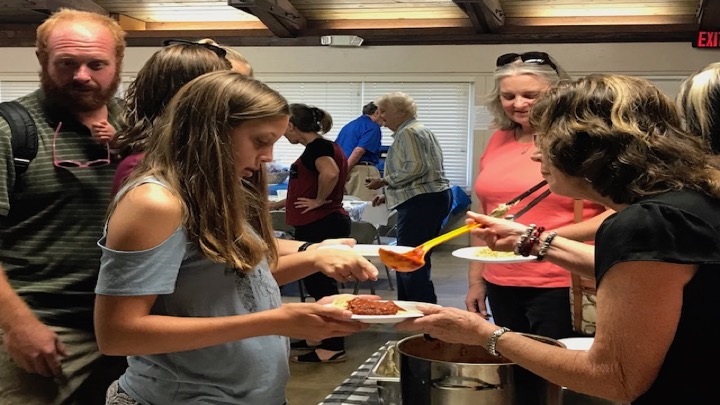
We have many reasons to be cheerful today after the wonderful outreach event we hosted at the church on Friday night!  The Silent Auction and Spaghetti Dinner were an example of how staff and volunteers at the church and preschool are working together for a powerful ministry to our community.

     We have many reasons to sing songs of praise to the Lord for His faithfulness!   God blesses those who labor to touch hearts and lives, drawing others closer to Him. We are motivated to do the good works God leads us to do, as James teaches us in the second chapter of his letter, so that our faith may be shown and Christ may be known by our works!

Slide16Slide17

 The Lord is preparing all our hearts and minds so he can use us even more.  An image came to mind yesterday, thinking and praying about the church. I remembered when I wove a reed basket in elementary school. I imagined God as the weaver. Have you ever woven a basket with reeds? You can’t use fresh cut reeds. You have to first dry them out completely in bunches —that takes time—3 to 7 days, depending on local humidity. In Florida, probably more than a week! Once they are dried out and you are ready to weave, you have to rehydrate the reeds, putting a couple at a time in warm (not hot) water and letting them soak about 10 minutes until they are pliable but not soggy. When you weave, you use only one reed at a time.  It can be a slow process, especially for the beginner.

I imagined we are that basket that God is weaving together—the church, with all its ministries, including the preschool; we are not only a work of art, we are becoming a strong, useful vessel God can use more and more! In His time.

We all have the same job to do while our weaver works. Just wait! Be patient! And pray, in faith! Pray God will heal us and make us whole.

***

Prayer and healing of the community are the main topics of our reading in James. But it might seem random if you only read this piece of the 5th and final chapter and nothing more. The letter was meant to be read its entirety, all at once. Knowing what came before is important to our understanding this text. So, here’s a quick recap: James has already told the church to be joyful during times of trial and suffering for God is building our faith. He says we reveal our faith by caring for people in need and other good works. Ask the Lord for wisdom, for he generously gives wisdom to all who ask. Don’t be greedy; stop doubting, coveting, and favoring the rich. Stop evil talk, for the “tongue is a fire.”  Stop your “conflicts and disputes,” because it’s really about pride and satisfying your own cravings and desires. Don’t judge one another. Don’t boast of what you will do tomorrow, for tomorrow belongs to the Lord.  Don’t oppress the poor who labor in your fields.

Then, just before today’s reading, James says, “Be patient, therefore, beloved, until the coming of the Lord.” Everything that James wrote before this in the letter is leading to this teaching. Instead of doubting, evil talk, and becoming embroiled in conflict and disputes, the Church needs to start living like it believes in the promise of Christ’s return for His beloved—and the hope of everlasting life with him. “Strengthen your hearts,” he says in v. 8, “For the coming of the Lord is near.” Job is our example, he says in 5:11, of one who suffered, but “showed endurance,” ultimately revealing “the purpose of the Lord, how the Lord is compassionate and merciful.”

On the other hand, suffering in the Body of Christ should not be ignored. Remember, this is the writer who says, “Religion that is pure and undefiled before God the Father is this: to care for widows and orphans in their distress…” What does James mean by “suffering?” NT scholar Scot McKnight says the word James uses for suffering, kakopatheo, appears in 2 Timothy (2:9 and 4:5) and may “describe physical persecution” (McKnight, 432), “hardship in war,” or “ordinary hardships in life.” It could mean depression or it could mean the same thing as the word translated “sick” in James 5:14. In any case, if you are suffering, you should pray.

Next, James contrasts those who are suffering with those who are “cheerful.” If you are cheerful, euthymeo, you are not necessarily the “life is good” happy, smiley person all the time. The word Euthymeo “evokes enthusiasm, courage, and a confident faith…often in the context of stress.” These are the encouragers of the community. Those who are cheerful should “sing songs of praise to God,” thanking the Lord and giving God the credit for His gift of “enthusiasm, courage and confident faith” (McKnight, 435). We have many encouragers in our flock, whose enthusiasm lifts others up.

Slide06

Then James moves to a new theme —sickness, sin and healing. The word he uses for sickness can mean “physical, spiritual (or) mental weakness…or on the verge of death” (McKnight, 434). If one member is seriously ill, the whole community is affected. James puts the responsibility for calling for the elders to come and “pray over them” on the one who is sick. The one who is sick—did you notice?— must also have faith in the healing power of prayer and confession.

Slide08


I love that he brings in a reference to Elijah, the beloved prophet of Israel, near the end, when he urges the church to believe in the power of their prayers. For he was “a human being like us,” James says, and yet when he prayed “fervently” that it might not rain, “for three years and six months, it did not rain on the earth. Then he prayed again, and the heaven gave rain and the earth yielded its harvest.”

Slide37

***

Friends, this Tuesday is the anniversary of my ordination to the ministry of word and sacrament—Sept. 25, 2011.  This is a very special time for me, remembering when I first heard that call and answered, with all my heart, “Here I am. Send me.” On that day, I was asked the constitutional questions in our Directory for Worship—and you who are ordained as elders and deacons will recognize these, for your answered these, too, and made the same promises:

Do you accept the Scriptures of the Old and New Testaments to be, by the Holy Spirit, the unique and authoritative witness to Jesus Christ in the Church universal, and God’s Word to you?

Do you sincerely receive and adopt the essential tenets of the Reformed faith as expressed in the confessions of our church as authentic and reliable expositions of what Scripture leads us to believe and do, and will you be instructed and led by those confessions as you lead the people of God?

Will you fulfill your ministry in obedience to Jesus Christ, under the authority of Scripture, and be continually guided by our confessions?

Will you be governed by our church’s polity, and will you abide by its discipline?

Will you be a friend among your colleagues in ministry, working with them, subject to the ordering of God’s Word and Spirit?

Will you in your own life seek to follow the Lord Jesus Christ, love your neighbors, and work for the reconciliation of the world?

Do you promise to further the peace, unity, and purity of the church?

Will you pray for and seek to serve the people with energy, intelligence, imagination, and love?

I said yes, with God’s help.

And then, I was asked the questions that only ministers are asked: Will you be a faithful minister of the Word and Sacrament, proclaiming the good news in Word and Sacrament, teaching faith and caring for people? Will you be active in government and discipline, serving in the councils of the church; and in your ministry will you try to show the love and justice of Jesus Christ?

I said yes.

And then, a ruling elder asked you these questions:

Do we, the members of the church, accept Karen as our pastor, chosen by God through the voice of this congregation to guide us in the way of Jesus Christ?

Do we agree to pray for her, to encourage her, to respect her decisions, and to follow as she guides us, serving Jesus Christ, who alone is Head of the Church?

Do we promise to pay her fairly and provide for her welfare as she works among us; to stand by her in trouble and share her joys?

Will we listen to the Word she preaches, welcome her pastoral care, and honor her authority as she seeks to honor and obey Jesus Christ our Lord?

And you said yes.

And then you, the Church, laid your hands on me and prayed for me —and promised to continue praying for me.

I have felt the strength of your prayers and encouragement.

And I have prayed for you and will continue to encourage you to do the powerful ministry that God has called us to do. I will serve with you, with all my heart.

 You were a strong witness for the Lord on Friday night, reaching out to bless others, giving generously of your time, talents and resources. I was so inspired by you! The preschool is the kind of incarnational ministry that I want to do, when we embody the gospel and reveal Christ through our relationships, our words and deeds, by being who God has called us to be. You have chosen to fully invest yourselves in this fruitful ministry to our community, because you love the Lord and you love His Church.

We are like a reed basket that God our maker is weaving together. In His time, our church will grow stronger, a beautiful vessel that God will use even more for His purposes. If we listen to and obey James’ teachings on how to live in beloved community, we will live looking to the future—not worrying about tomorrow—but living in joyful anticipation of the Lord, who is with us now and whose time of coming is drawing near!

 Let us be patient, then, and encourage each other.  Trust in the God of Elijah, who held back the rain when he fervently prayed and gave rain when he prayed again, so the earth could yield its harvest. Our prayers are as powerful as Elijah’s, when we pray in faith. Pray for one another. Pray for your church.

Pray God will heal us and make us whole.


This slideshow requires JavaScript.


Let us pray.

Heavenly Father, we thank you for hearing our prayers and for your love and grace that we have done nothing to earn. We lift our voices to sing praises to your Holy name! We pray for healing for all who are sick or grieving in our church family. Help us to be patient, wait and pray during times of suffering. Give us the gift of cheerfulness and stir us to encourage one another. We thank you for equipping us to do compassionate ministry for your sake. Thank you for our church and all its ministries, including the preschool, and for our director, teachers and volunteers. Thank you, most of all, for the children. Draw them closer to you and open up more opportunities for us to nurture their faith. Bless them and their families, Lord, watch over them, and keep them in your tender care. In Christ we pray. Amen.

A Good Listener September 16, 2018

Here’s the video link to this morning’s sermon, “The Good Listener,” based on James 1:17-27.  Just click here to watch the video: September 16, 2018


Meditation on James 1:17-27

Sept. 16, 2018

Merritt Island Presbyterian Church


         17 Every generous act of giving, with every perfect gift, is from above, coming down from the Father of lights, with whom there is no variation or shadow due to change.  18 In fulfillment of his own purpose he gave us birth by the word of truth, so that we would become a kind of first fruits of his creatures.  19 You must understand this, my beloved: let everyone be quick to listen, slow to speak, slow to anger;  20 for your anger does not produce God’s righteousness. 21 Therefore rid yourselves of all sordidness and rank growth of wickedness,  and welcome with meekness the implanted word that has the power to save your souls.  22 But be doers of the word, and not merely hearers who deceive themselves. 23 For if any are hearers of the word and not doers,  they are like those who look at themselves in a mirror; 24 for they look at themselves and, on going away, immediately forget what they were like.  25 But those who look into the perfect law, the law of liberty, and persevere, being not hearers who forget but doers who act—they will be blessed in their doing.   26 If any think they are religious, and do not bridle their tongues but deceive their hearts, their religion is worthless. 27 Religion that is pure and undefiled before God, the Father, is this:  to care for orphans and widows in their distress, and to keep oneself unstained by the world.

//www.biblegateway.com/passage/?search=James+1%3A17-27&version=NRSV

Slide20 

 While Jim and I were away in Montreat in August, our denomination announced the passing of a very special person who served the Church all her life. Katie Geneva Cannon was the first black woman ordained in the United Presbyterian Church, a predecessor to the PC (USA). She was the first African American woman to receive a Ph.D. from Union Theological Seminary in New York. She was the Annie Scales Rogers Professor of Christian Ethics at Union Presbyterian Seminary in Richmond when she went home to be with the Lord August 8 after battling leukemia. She was 68.

She had recently said, “Teaching is my ministry. I love to teach. To empower. To equip. To set people free… to live into the graces and gifts they have been given.” Speaking at Princeton Seminary last fall, she said, “The call to teach is like fire shut up in my bones.”

For many students, she was their first encounter with a seminary professor who was an African American woman.  She sought to “instill an embodied, mediated knowledge,” (Aug. 12, Christian Century)“opening the students’ eyes and hearts to the world as it truly is. She lifted the veil of racism, sexism, and classism while affirming who her students were and making them feel valued.”

Katie was the pioneer of womanist theology, a branch of inquiry that didn’t exist before Katie’s writings. For the term “womanist,” Katie credits her friend Alice Walker, author of the Pulitzer Prize-winning novel, The Color Purple. Womanist theology is an “interpretive approach that seeks to empower the neglected voices of African American women and the entire African Diaspora.” (Aug. 12, Christian Century). The approach “seeks to inspire, equip, connect and support black women to be change-makers in their communities…. She saw that in the academy and the church… the voices of African American women had been too often mocked or seen as insignificant.”

Born in 1950, she grew up in the highly segregated town of Kannapolis, North Carolina.  “It was against the law for Katie to go the library, play in public parks or swim in the local pool. She could not even enter the Kannapolis spelling bee.” But she had a genuine faith, accepting Jesus Christ at an early age and attending Covenant United Presbyterian Church in Kannapolis with her family.  Her parents were both ruling elders. Her view of the Church was shaped, however, in the context of the segregated Catawba Synod. The only school open to black children in her community was part of a local Lutheran church—and that’s where Katie went. By 5, she could recite the Lord’s Prayer, the Beatitudes, Psalm 23, the Ten Commandments and answers to catechetical questions, such as  “Who is God?” and “Why did God make us?”

Even as a child, she recognized that there was a “profound disconnect between the egalitarian spirit of the gospel and her oppressive, racist context.” She asked herself, “What did we do as black people that was so bad? A good God would not do this.”  Her struggle with these questions would stir her as a student and professor to focus on “Christian ethics and the culpability of human beings in perpetuating systemic injustice.”

Katie’s was not always a voice that the Church, her community and world wanted to hear.

The NT epistle of James has also not always been a welcome voice to everyone in the Church, though it is one of the “catholic” or universal letters and not addressed to one particular worshiping community. Luther hated it, calling it a  “letter of straw” in the preface to James in his 1522 NT translation

http://www.ctsfw.net/media/pdfs/lutherandthescripturesjames.pdf

Slide32


Zwingli had a more favorable view, arguing, “the letter is misunderstood when read in the papist fashion” (Zwingli, Defense of the Faith)  https://en.wikipedia.org/wiki/Huldrych_Zwingli

Slide33

Calvin, not naming any names but you know he’s talking about Luther says, “There are also some at this day who do not think it entitled to authority. I, on the other hand, am inclined to receive it without controversy.” (Luke Timothy Johnson, James, 142)

https://en.wikipedia.org/wiki/Luke_Timothy_Johnson

Slide34.jpeg

https://en.wikipedia.org/wiki/John_Calvin

Luther thought it contradicted Paul’s teaching on grace, works and faith. Calvin held that Paul and James are “not in disagreement” (Johnson, 143). Other theologians have complained that there’s not enough about Jesus, for his name only comes up twice—at the greeting and in 2:1, where I imagine he speaks from a place of emotion,  “My brothers and sisters, do you with your acts of favoritism really believe in our glorious Jesus Christ?!!!!!” (Exclamation points added.) In modern lingo, “How can call yourself Christians and behave this way??????”

James would be dismayed to learn that certain passages of his letter have been used to argue over hot button issues and sometimes divide the Church. For example, in the 17th and 18th centuries, James 5:14-16 was cited during heated debates about the anointing of the sick.

https://www.biblegateway.com/passage/?search=+James+5%3A14-16&version=NRSV;NIV

But the Spirit stirs us to open our hearts to hear something new from James that will strengthen our witness and help us serve as the Body of Christ for the world today. If we were using a womanist approach of interpretation that Katie Cannon pioneered, we would listen for the voices that were not being heard in the text—the voices of women, children, poor and oppressed–and then listen and speak for the voices that are not being heard now. But the truth is, we aren’t really good listeners as a society. We all want to speak and have our voices heard, and we get upset when we think others aren’t listening to us! I think that’s why blogs and FB posts  have become so popular. They don’t require having an actual conversation– listening and responding to someone else.  For listening is an act of love and obedience in Scripture.

The Lord always listens to us, ready to respond in love. First Peter 5:7 says,  “Cast all your anxieties on him, because he cares for you.” Hebrews 4:16 says, “Let us then with confidence draw near to the throne of grace, that we may receive mercy and find grace to help in time of need.” Matthew 7:7 says, “Ask, and it will be given to you; seek, and you will find; knock, and it will be opened to you.”  So, with the Spirit’s help, we study the epistle of James with open hearts, ready to listen for the voices of the poor and oppressed and for God’s voice speaking to us today.

James tells us everything we have has come from a gracious, good and generous God, who longs to give us every perfect gift from above. Every generous act of giving, he says in 1:17, comes from God! When we are stirred to give, it’s because God’s love compels us. James reminds us of our purpose and identity as the Beloved of a God who will never change. And we are, James says in 1:18, becoming a kind of “first fruits” of his creatures. What does this mean? Here’s a mini-stewardship sermon. In the OT, the acceptable offering to God is the “first fruits.” We don’t give what’s left over to God. We give to Him from our increase FIRST, and we give our best. But James is saying we are the first fruits.  Our lives are an offering to the Lord!

After he talks about God’s gifts to us and reminds us who we are—the Beloved of God, first fruits of God’s creatures, James tells the Church how they have lost their way. They have stopped listening to each other.  Good listeners aren’t always talking. Actually, if you are talking, you aren’t listening, you’re talking! Good listeners are “slow to speak.” Good listeners don’t get angry, for once we are angry, it is even painful to be with that person, let alone speak to them. Once we are angry, the conversation is over and the relationship has suffered. Good listeners are  “slow to anger, for anger doesn’t produce God’s righteousness.” The Church in James time–which was all the churches since this is a letter not just to one congregation–has ceased to bear the fruits of righteousness; they have become people who consider themselves “religious,” and are judgmental of others. They are caught up in political battles over what to believe, how to do church, and even who to accept into the fold. They have become people who hear scripture read in Church, but it doesn’t penetrate their hearts! The evidence is that they have neglected the poorest members of their community. They have forgotten how to love God and neighbor!

And then we have come to the voices that we have been listening for—the ones who were not heard during James’ lifetime and the ones for which we must speak today. James says, “Religion that is pure and undefiled before God, the Father is this: to care for orphans and widows in their distress and to keep oneself unstained by the world.”

In honor of Katie Cannon and to continue her legacy of encouraging and building up women so they may use their gifts for the Church and be change-makers in their communities, the PC (USA) has founded a scholarship called, “The Women’s Ministry Fund.”   https://www.presbyterianmission.org/story/presbyterian-mission-agency-announces-scholarship-fund-in-memory-of-katie-geneva-cannon/

I hope her story inspires you to want to be a good listener, listening for voices in Scripture and in our society that others might not want to hear, voices of women, children and the poor and oppressed and seek to correct systemic injustice. May we all learn to be good listeners, for the Lord always listens to us, and responds with love and mercy.

These last few lines from Katie’s obituary seem to sum up a life faithfully lived, despite the pain of her childhood, growing up with segregation.

“With all her works and accolades, Katie Cannon was an approachable and kindhearted person. She was generous in sharing her time, talents, and resources. She lived the words of the song, “If I Can Help Somebody As I Travel On Then My Living Shall Not Be In Vain.”


Let us pray. Lord God, we thank you for all the faithful saints of the Church, people like Katie Cannon. Thank you for her service for so many years, for sharing her gifts of teaching and her prophetic voice, urging us to hear the voices that the Church had long ignored, believing they were not significant, and speak for those whose voices have been silenced. Thank you that for Katie pain has ended and she has entered into your loving embrace. May we all live as doers of your Word, Lord, bearing the fruits of righteousness by the power of your Spirit. Teach us to listen, really listen, to one another with open hearts and minds. May we never allow anger or pride hurt the Body of Christ. Help us to hear your voice every day as we seek to walk with you and live for you. In Jesus name. Amen.


The Heart of Worship


Meditation on  Mark 7:1-8, 14-15, 21-23

Sept. 2, 2018

Merritt Island Presbyterian Church

Here’s the link to the video of this sermon. Just click here to watch.

Slide10

      Now when the Pharisees and some of the scribes who had come from Jerusalem gathered around him, they noticed that some of his disciples were eating with defiled hands, that is, without washing them.  (For the Pharisees, and all the Jews, do not eat unless they thoroughly wash their hands, thus observing the tradition of the elders; and they do not eat anything from the market unless they wash it;  and there are also many other traditions that they observe, the washing of cups, pots, and bronze kettles.)  So the Pharisees and the scribes asked him, ‘Why do your disciples not live according to the tradition of the elders, but eat with defiled hands?’   He said to them, ‘Isaiah prophesied rightly about you hypocrites, as it is written, “This people honors me with their lips, but their hearts are far from me; in vain do they worship me, teaching human precepts as doctrines.”   You abandon the commandment of God and hold to human tradition.’  Then he called the crowd again and said to them, ‘Listen to me, all of you, and understand: there is nothing outside a person that by going in can defile, but the things that come out are what defile.’ For it is from within, from the human heart, that evil intentions come: fornication, theft, murder, adultery, avarice, wickedness, deceit, licentiousness, envy, slander, pride, folly. All these evil things come from within, and they defile a person.’  

***

I have just returned from Montreat where I took a 30-hour class called, “The Art of Transitional Ministry.”

Slide13

Slide18

This was the second part of the basic course I took 2 years ago to strengthen my skills and help the church navigate the adventures that are ahead of us. One of our instructors told us, after her greeting, “All pastoral leaders are leaders of transition because we live in a time of constant transition.”

Slide15

We brainstormed a list of transitions churches are going through today.  Do any of these sound familiar to you? Some are moving from larger, multi-generational congregations to smaller, aging congregations, with fewer children, youth and young adults. Some are experiencing a decline in pledging and giving. Some are going through leadership transitions—pastors and staff, elders and deacons. Some have sessions of only 5 or 7 and are still having trouble filling openings! We talked about shrinking Sunday schools and choirs; change in regular attendance and change in attitudes about joining a church; change in activities and programs. We talked about churches struggling with divisions because of “national politics” or struggling with congregational splits, due to actions of the General Assembly to open up ministry leadership to all who possess leadership gifts, regardless of their sexual orientation.

Many of the changes and transitions are not negative; they are cause for joy and celebration! A church is re-opening a closed nursery after new families have come! Others have thriving preschools and mid-week enrichment or tutoring programs; others are enjoying new energy and purpose, looking for new ways to do hands-on ministries and welcome neighbors and strangers in the changing neighborhoods around their churches. One church is reaching out to Cameroonian refugees. Isn’t that cool? Others have growing interfaith relationships or are incorporating new technology and new music styles in worship.

We are reconsidering the language we use to talk about church. We are rethinking our definitions for “mission” and talking more about being “missional.” “Missional” churches aren’t just gathering places for the saints; we are people whom God is equipping and sending out to serve in Christ’s name! Our “mission” isn’t just telling people how they may be saved, so they will go out and tell others how they may be saved, too. There’s a kind of superiority to that—that we have all the answers and people just need to listen and do what we say! Our shared “mission” is more than coming to church on Sunday, though that is foundational to our faith. Our “mission” is to live lives of worship, learning to walk humbly in Christ’s ways, love tenderly, doing justice and showing mercy and grace, so that others will see Christ in us and want to know Him more.

Slide17

During our discussion, on that first day at Montreat, one church’s transitional experience stood out to me as profound. A pastor said her congregation is moving from being “consumers” to “disciples.” Some of us whispered, “Wow.”

That made me think of the Pharisees—and the problem they had—that human traditions got in the way of being obedient to God’s commands. And that the problem was with their hearts. And how easy it would be–for some who love the church and our Sunday worship and the music as I do—to fall into the sin of being “religious consumers” and place too much value on human traditions. We could begin to think that the sum of our human traditions is what being the Church is, rather than being the spiritual Body of Christ, formed for His loving purposes.

Slide21


How easy it could be to make worship all about us. When it’s all about Him!  At the heart of worship is loving Jesus with all our hearts.

Slide22


 The Pharisees in Mark’s gospel have come from Jerusalem and have been following him around and plotting against him since he healed a man with a withered hand in the synagogue on the Sabbath.


Slide24

So, they are looking for something to use against him—and the hatred they feel toward him is intense. They aren’t just wanting to embarrass or humiliate him; they want to, scripture says, “destroy him.”

Slide06


They see his disciples are eating without washing their hands. That doesn’t seem like a big deal to us, but it is. They are drawing a line in the sand and saying that Jesus and the disciples are not one of them.


Slide26

They are outsiders and outlaws, disobeying the “tradition of the elders” and by doing so, they and not just their hands have become defiled or unclean. They exaggerate, though, when they say, “all the Jews do not eat unless they thoroughly wash their hands.” Scholars can’t find biblical support for this as a universal requirement. Numbers 18:8-13 talks about this requirement only for Jewish priests and their households who eat meat sacrificed to the Lord in the temple. (William Placher, Mark, 101).

But this is key to understanding the passage;  the Pharisees are looking for something to hold against Jesus and his disciples—something that they may sincerely believe is true, when it isn’t—that if they eat without washing their hands, they will be made unclean, even if what they eat is permissible by dietary laws. They are  consumers of their religion, knowing and relishing all the rules and knowing how to use them to their favor and, they hope, to bring about the downfall of their enemies.

Jesus isn’t flustered or startled. He has a plan. He uses their attack as a teaching opportunity. They are hypocrites, he says, and he quotes Isaiah 29:13; this is the first “scriptural rebuttal” in Mark (Marcus, 449).

 “This people honors me with their lips, but their hearts are far from me,” he says; “in vain, do they worship me, teaching human precepts as doctrines”—meaning their worship, which is how they live their whole lives in submission to God’s commands—is ALL ABOUT THEM.  “You abandon the commandment of God and hold to human tradition,” Jesus adds, meaning human tradition actually replaces and violates God’s commands.

Unfortunately, the lectionary omits an important piece of the passage, when Jesus gives an example of how the Pharisees use human traditions to break the commandment to “honor your father and mother.”

Slide34

The sons dedicate their property to the temple. If their father or mother gets into financial trouble, the sons are supposed to help them by selling some of their property and giving their parents the money. But if they have dedicated their property to God, they can say, “Sorry, I can’t help you,”  “thus making void the word of God,” Jesus says in 7:13, “through your tradition that you have handed on.” You’ve been doing this a long time and teaching it to your children!  “And you do many things like this.”

Jesus isn’t finished with his lesson, which isn’t just for the Pharisees and his disciples; it’s for everyone, including us. He calls the crowd together and tells a short parable. “Listen to me,” he says, Listen up!  “all of you, and understand: 15 there is nothing outside a person that by going in can defile, but the things that come out are what defile.” With his parable, Jesus declares all foods “clean” and blasts those who hold to the dietary laws—that’s everybody in his community! Think how many people he is offending with his message, especially the religious authorities! He criticizes those who hold to the food laws, but fail to love, as he will say in Mark 12:30-31, the Lord their God with all their heart and soul and mind and strength…and their neighbor as themselves. The evil intentions that stir us to sin against God and neighbor, he says, come not from the devil! We can’t say the devil made me do it! The evil intentions come from within the human heart!

What’s interesting is how this passage seems to foreshadow what will happen with the early church in Acts. Some of you have been reading Acts in Sunday school– how the food laws are, at first, a stumbling block for the Jewish apostles to share the gospel with Gentiles. But in Acts 10, Peter has a vision of a sheet of animals that the food laws proclaim unclean coming down from heaven. Some of my Bible professors called this the “meat blanket .”  A voice commands, “Get up, Peter. Kill and eat.” Peter says, “Oh, no, I couldn’t do that,” because he’s never done that before. He was taught this was wrong! But the voice from heaven repeats the command—isn’t that what God does when we don’t listen the first time– and says,  “Do not call anything impure that God has made clean.”

Slide41

Peter eventually realizes God isn’t just talking about food; he’s talking about people.  “You are well aware that it is against our law for a Jew to associate with or visit a Gentile,” he will say to a Gentile named Cornelius, who invited Peter to his home to share his message of the Risen Christ. “But God has shown me that I should not call anyone impure or unclean.”


***


In a few moments, we will gather around the Lord’s table.

Slide46

 Our Lord welcomes all to come to Him, wherever we are on our journeys of faith. We come to spiritually partake of a heavenly banquet, to feed on Christ’s body, broken for our sakes and His blood shed for the forgiveness of sins. We come as people who still struggle with sin and doubt, but also as the Redeemed. We come with sincere faith—because if we don’t have faith, it won’t mean anything to us. We come with open hearts, praying for a glimpse of God’s Reign, to experience God’s presence, and receive His grace. We come not as religious consumers but as joyful disciples, seeking to be closer to the One who loves and accepts us as we are, but loves us too much to leave us that way. We come to be transformed, united, reconciled. For there are no divisions in Christ’s Body. We are one in Him.

We come with gratitude for all that God has done, for the promise of eternal life with Him. We come to be strengthened and encouraged, equipped and sent out as Christ’s Body for the world!  As we come, we can’t help but remember that worship is not about us. It’s all about Him.


Let us pray.


Holy One, We love you and thank you for Jesus, who died so that we may be reconciled and brought into right relationship with you and one another. Thank you for your promises to us—that you will be with us always, that by your Spirit we are made one in You. That we are Your Church, so therefore we do not fear for our future, for in life and in death, we belong to you. Strengthen us through all the transitions you have planned for us. We trust in you for all the adventures that lay ahead. Make us, Lord, into your faithful, joyful disciples. May we never be merely religious consumers, seeking to have our desires fulfilled, rather than seeking to be pleasing to YOU. Draw us closer to you in worship. May it be all about you. Send us out to live as your Redeemed in gratitude to YOU. In Christ’s name we pray. Amen.


Blessed are Those Who Mourn

Slide1

Meditation on Matthew 5:1-12a

In Memory of Henry Grady Winston, Jr.

Aug. 25, 2018

When Jesus saw the crowds, he went up the mountain; and after he sat down, his disciples came to him. Then he began to speak, and taught them, saying: “Blessed are the poor in spirit, for theirs is the kingdom of heaven. Blessed are those who mourn, for they will be comforted. “Blessed are the meek, for they will inherit the earth. Blessed are those who hunger and thirst for righteousness, for they will be filled. Blessed are the merciful, for they will receive mercy. Blessed are the pure in heart, for they will see God. Blessed are the peacemakers, for they will be called children of God. 10 Blessed are those who are persecuted for righteousness’ sake, for theirs is the kingdom of heaven. 11 Blessed are you when people revile you and persecute you and utter all kinds of evil against you falsely on my account. 12 Rejoice and be glad, for your reward is great in heaven…”                                                                                                                            

***

Henry and I met about 3 years ago, when I came to be pastor of Merritt Island Presbyterian Church. He wasn’t able to attend worship regularly because of his health and mobility issues, so I visited him in his apartment in what is now “Solaris.” He came to his church with his daughter, Peggy, when she was in town and said he always felt better after coming. He was a member of MIPC for more than 50 years. He encouraged me in my ministry, thanking me when I brought him communion and read scripture with him. We had good conversations about the church; he told stories, but didn’t gossip. He didn’t look back with rose-colored glasses or long for the past. He was honest, a truth teller, about his experiences and sometimes disappointments years ago. I appreciated his openness and loyalty to a church of imperfect people, knowing their need for a Savior and longing to be perfected by Christ.

We talked about things we had in common, for Henry, though he moved to Florida in 1967, was a northerner like me. We both had lived in Pennsylvania; he was from the borough of Conway in Beaver County, Western PA, and I had lived in York County in South Central PA for 14 years. He and I both loved cats and pickles. He loved his family most of all. And I had moved to Florida to be closer to my aging parents. We just celebrated my dad’s 84th birthday with him yesterday. Henry showed me pictures and talked about his children, grandchildren and his wife, Betty, who died of cancer 20 years ago. He talked about when his family embarked on an adventure, moving to Florida to get out of the cold winters when the two boys—Skip and Paul–were young and kept coming down with croup. They didn’t have croup after they moved to Florida, Henry said. Not once. He talked about how lucky and blessed he felt when he and Betty both got jobs with Southern Bell. He was a hard worker and had come from humble beginnings. His family, when he was young, had lived on a small farm in North Carolina, with no running water, before they moved to PA, where his dad found work on the railroad. He held onto the faith that was formed when he was a child. Among his personal belongings, Peggy discovered his certificate, from June 14, 1935, of “regular attendance and faithful work in the primary department of Vacation Church School” at the Presbyterian Church of Jackson Springs, NC.

VBS certificate


He served his country in the Navy in WWII from March 1944 till Feb. 1946. During his service, he was sent to the Pacific to help with the 1946 evacuation of the Bikini Atoll in the Marshall Islands before our country conducted its largest nuclear weapons’ test–a 15-megaton atomic bomb. Although I knew Henry had been in the Navy and had told him that both my parents were in the Navy, I didn’t know he had served in WWII. I think that, like many veterans, he loved his country and was proud to serve it, but nothing made him happier than to come home to his family.

He was a supportive father, coaching softball and driving his son, Paul, to all his sports’ practices and events, including all the way to Lincoln, NE, for wrestling matches. Those who knew him and Betty as neighbors when they lived in a home on Merritt Island near the church called him, “The mayor of Grenada.” He was outgoing, spoke with a soft voice and had keen hearing. He was a friend to many and was on the hospitality committee at Solaris, giving tours to prospective tenants and welcoming new folks into the community.

He had a joyful, playful spirit. When he was younger, he and Betty bowled in a league and played bridge. When he was at the hospital a few weeks ago, he had the nurses write on his white board, “I’m the BINGO champion.” I meant to ask him what that was all about—how do you get to be a BINGO champion? Is there a strategy with BINGO? He and a man named Al had a competition going. But soon after I got to Henry’s room, a tall woman named Ursula arrived to give him physical therapy and assured me she wanted me to stay, as I was his loved one. Henry, though weak and exhausted from his health crisis that had brought him there, threw back his head and laughed heartily. “My loved one?!” he said. “She’s my pastor!” Later, when we were alone, I told him it would have been OK with me if he hadn’t protested. “I do love you,” I said. “And I am your pastor.” But I did get from his jubilant response that he was glad I was his pastor. Henry accepted me as the first female pastor he and his church have ever had.

He tried his best to sit up, stand and walk with his walker for Ursula. We were both a little afraid of her. He never lost his sense of humor. When she asked if there was someone living with him—meaning someone to take care of him when he was discharged—he smiled and told Ursula he lived with 86 women! He was telling the truth; there are probably 86 women living at Solaris. But he didn’t tell her that he lived at Solaris. I volunteered to fill in that little detail.

***

Jesus, in his Sermon on the Mount, paints a picture of the Kingdom of God that is here now, but is also in the future, when His Kingdom comes to fruition. But His Kingdom is hard to see, no impossible to see, without the Holy Spirit illuminating it for us as we study God’s Word and pray for our eyes to be opened. For Christ’s Kingdom, as he will tell Pontius Pilate in John 18:36, “is not from this world. If my kingdom were from this world, my followers would be fighting to keep me from being handed over to the Jews. But as it is, my kingdom is not from here.”

This message is for those who seek to be nearer to God—to know Christ more and be like Him. We are the ones Jesus is talking about who are blessed—or “happy” as some translations say, though we might not always feel happy in this world of suffering.

Not all of our sufferings are due to our fragile bodies being just temporary dwelling places for Christ’s Spirit until we are glorified with Him. We suffer because our world—all Creation–is broken and corrupted by sin. The good news is that the Spirit is working in us now; we are being transformed, re-created. The Apostle Paul says in 2 Cor. 5:17, “So if anyone is in Christ, there is a new creation: everything old has passed away; see, everything has become new!”

Listen to the promises of Jesus…The Kingdom belongs to the poor in Spirit! The pure in heart will see God!  God’s children are peacemakers! The earth belongs to the meek—those who are submissive, obedient and humble! Those who hunger and thirst for righteousness will be filled! The merciful will receive mercy! And those who mourn, as you do now, will be comforted.

Those who have been persecuted—falsely accused, ridiculed, rejected— will rejoice because our reward is great in heaven, not because of our own goodness or worldly accomplishments, but because the love, grace and mercy of God has been poured into us by the Holy Spirit, leading us to live each day with strength, courage, peace and faith.

***

Henry recognized God’s hand in his life and appreciated His blessings, even when life was really hard. The physical therapist, before she left his hospital room, told Henry that it would be best if he went to rehab before going back home.

Henry just nodded his head and looked sad. He didn’t complain, get angry or show frustration. He had his family, his faith and his friends. He knew what was important, as the Apostle Paul tells us in 1 Cor. 13:8, how “love never ends.”

He thanked me for coming to see him and for praying for him—that day and the times before. He told me to go find Peggy because she would want to see me before I left. But he was also sending me off to minister to his family, because he knew. God was preparing his heart for what was to come. He was worried about his loved ones, those who would mourn for him.

He would want me to share with you now the hope and promise of the resurrection and the glorious Kingdom that may be hard to see now because there’s so much darkness in this world. But there’s goodness, too. And love! The Kingdom is here AND it’s coming soon! He is coming again for His Church. And we will be blessed! We will rejoice! You who are peacemakers will be embraced as the children of God! You who are merciful will receive mercy! You who hunger and thirst for righteousness will be filled!  You who mourn, will be comforted! Every tear will be wiped away when you see Him face to face!

Amen.

Give me wisdom!

Meditation on 1 Kings 2:10-12; 3:3-14

Merritt Island Presbyterian Church

Aug. 19, 2018

To see the video of this sermon, click here.

Slide087

10 Then David slept with his ancestors, and was buried in the city of David. 11 The time that David reigned over Israel was forty years; he reigned seven years in Hebron, and thirty-three years in Jerusalem.  12 So Solomon sat on the throne of his father David; and his kingdom was firmly established…  Solomon loved the Lord, walking in the statutes of his father David; only, he sacrificed and offered incense at the high places.  The king went to Gibeon to sacrifice there, for that was the principal high place; Solomon used to offer a thousand burnt offerings on that altar. At Gibeon the Lord appeared to Solomon in a dream by night; and God said, “Ask what I should give you.”  And Solomon said, “You have shown great and steadfast love to your servant my father David, because he walked before you in faithfulness, in righteousness, and in uprightness of heart toward you;  and you have kept for him this great and steadfast love, and have given him a son to sit on his throne today.  And now, O Lord my God, you have made your servant king in place of my father David, although I am only a little child; I do not know how to go out or come in.   And your servant is in the midst of the people whom you have chosen, a great people, so numerous they cannot be numbered or counted. Give your servant therefore an understanding mind to govern your people, able to discern between good and evil; for who can govern this your great people?”

 10 It pleased the Lord that Solomon had asked this. 11 God said to him, “Because you have asked this,   and have not asked for yourself long life or riches, or for the life of your enemies, but have asked for yourself understanding to discern what is right, 12 I now do according to your word. Indeed I give you a wise and discerning mind; no one like you has been before you and no one like you shall arise after you.  13 I give you also what you have not asked, both riches and honor all your life; no other king shall compare with you.  14 If you will walk in my ways, keeping my statutes and my commandments, as your father David walked, then I will lengthen your life.”

***

Our children and youth performing arts ministries got off to a great start this week, with some new children joining us. We had crafts  and auditions for The Best Christmas Pageant Ever  and Wrapping All the Way.

Slide058

Slide060

Slide059

Slide061

My most special time with Kids Klub and One Purpose Productions comes when we gather in a circle for caring and sharing. They share about bee stings and lost or wiggly teeth. Taking dance lessons and starting school. Concerns for sick friends, siblings, parents or grandparents. Older brothers and sisters going off to college. Parents on long business trips or deployed in the military. I listen carefully with an open heart, ready to respond as their pastor. Because even though most of the children and youth are not members of our church, the Lord has brought them to us so that we would minister to them!

When one young boy, his first day at Kids Klub, shared how he couldn’t sleep at night, I asked why. He said he was afraid of the dark– that aliens might come. I told him how I used to be scared of the dark when I was a kid. But then I learned that monsters and aliens aren’t real. His sister, sitting on the other side of me, was listening intently. She looked up at me and echoed,  “Not real?”  “No,” I said, shaking my head. And I felt prompted to add,  “We never have to be afraid of anything because Jesus is always with us.”

It was God’s gift of His wisdom for that moment to really listen to a child, with an open, loving heart, and be prompted to speak a word of peace.


Solomon’s story teaches the importance of seeking and using God’s wisdom. The Lord gives Solomon, says 1 Kings 4:29,  “very great wisdom, discernment, and breadth of understanding as vast as the sand on the seashore.”  “He was wiser than anyone else,” says 1 Kings 4:31-34, and “his fame spread throughout all the surrounding nations.” Solomon was like a rockstar in his time, composing more than a thousand songs and 3,000 proverbs. But he also had a scientific mind. He would  “speak of trees, from the cedar that is in Lebanon to the hyssop that grows in the wall; he would speak of animals, and birds, and reptiles, and fish.  People came from all the nations to hear the wisdom of Solomon…”

He wisely judged the case of two women who gave birth in the same house on the same night, but when one woman’s son died, she switched the babies while the other woman slept and tried to pass off the other woman’s son as her own. Solomon infamously said, “Bring me a sword,” and, after they did, he said, “Divide the living boy in two; give half to one and half to the other.” The mother whose son was alive begged the king, “Please, my lord, give her the living boy; certainly, do not kill him!” Her child was restored to her.

But like all the other kings of ancient Israel, including his father, David, Solomon didn’t always live in obedience to God. He isn’t a perfect model of wisdom, not like Jesus, “who has become for us wisdom from God,” says Paul in 1 Cor. 1:30, “that is, our righteousness, holiness and redemption.”

Slide077

Solomon is, after all, just a human being with all the temptations of wealth and power. That’s the whole point of this book, says Dr. Walter Brueggemann,  one of the most influential Old Testament scholars of the last several decades.

Slide078

Brueggemann says though 1 Kings seems to be just a history of the kings of Israel,  it actually serves a theological purpose; it “delegitimates the kings” and shows how they “have, in fact, forfeited their authority and are not really kings.   Thus, the book should be named with a question mark of incredulity—“Kings???”

Our reading begins when Solomon is young in his reign, and we already see his weakness. He loves many “foreign women.” Solomon makes a political alliance with Egypt by marrying the Pharaoh’s daughter, bringing her to the “city of David,”  which, at this time, is Jerusalem, not “Bethlehem,” as the gospel of Luke tells us in the story of Christ’s birth.

Slide082

He goes to Gibeon, a Canaanite city about 6 km north of Jerusalem,  to offer a “thousand burnt offerings” on the altar in the high places.”

Slide083

Slide084

Because this comes right before telling us how he loves the Lord, we might assume that this reveals his devotion to God, but  high places in the Old Testament were  “often associated with apostasy” Brueggemann says. Solomon will love, along with the Pharaoh’s daughter, Moabite, Ammonite, Edomite, Sidonian, and Hittite women–all nations the Lord had told Israel from which not to enter into marriage, “For they will surely incline your heart to follow their gods.” And that’s what happens. He ends up worshiping idols, along with his God.

But don’t miss that he seeks the Lord in the right way at the very beginning of his reign—and for the right reasons. He comes to the Lord humbly in a vision God gives him. After God invites him to speak, he says, “I am only a little child; I do not know how to go out or come in. Give your servant therefore an understanding mind to govern your people, able to discern between good and evil; for who can govern this your great people?” And don’t miss God’s grace and steadfast love—the same grace and love the Lord has for us! God blesses him with wisdom, prosperity and long life, despite his sin. God blesses Israel for his humble faith and spiritual request so that he may live out God’s calling to him.

Wisdom brings justice, peace, and prosperity to His reign in Jerusalem for 40 years; 480 years after Israel fled captivity in Egypt, Solomon began to build the House of the Lord, the Temple.

Slide091

Judah and Israel were “as numerous as the sand by the sea; they ate and drank and were happy.”  Solomon reigned “over all the kingdoms from the Euphrates to the land of the Philistines, even to the border of Egypt.”

Slide093

After Kids Klub this week, I began to think how wisdom may be one of the most undervalued spiritual gifts— though it isn’t the greatest, which is love, says 1 Cor. 13. I urge you to seek God for wisdom to live out your calling every day.  As Jer. 29:11 says, “For surely I know the plans I have for you, says the Lord, plans for your welfare and not your harm, to give you a future with hope.”

James 1:5 promises that God will not deny our request: “If any of you lacks wisdom, you should ask God, who gives generously to all without finding fault, and it will be given to you.”

 But the problem with wisdom is that we have trouble recognizing it. What the world calls “wisdom” isn’t the wisdom of God.  The wisdom of this world is deceptive and destructive, at odds with the things of God. Paul says in 1 Cor. 3:19,  “For the wisdom of this world is foolishness in God’s sight. As it is written, ‘He catches the wise in their craftiness.’” Isaiah 5:21 says, “Woe to those who are wise in their own eyes and clever in their own sight.”

        God’s wisdom doesn’t depend on human situations or worldly possessions. Ecclesiastes 2:26 says, “To the person who pleases him, God gives wisdom, knowledge and happiness, but to the sinner he gives the task of gathering and storing up wealth to hand it over to the one who pleases God.” God’s wisdom is granted to those with humility and  a heart-felt, genuine faith, who love the Lord and desire to use His gifts to serve and bring goodness to the world.

Slide103

James 3:17 says, “Wisdom comes to the humble, those who love peace and are merciful. But the wisdom that comes from heaven is first of all pure; then peace-loving, considerate, submissive, full of mercy and good fruit, impartial and sincere.”

So let us come humbly, friends, as little children, to approach the throne of grace. Let us ask for God’s wisdom so that we may work for peace and justice and reveal God’s Reign.  As Psalm 37:30-31 says, “The mouths of the righteous utter wisdom, and their tongues speak justice. The law of their God is in their hearts; their steps do not slip.”

Slide107

We ask for wisdom so that, together, we may walk the paths the Lord wants us to take. And not fall, as Solomon did, into idolatry. Let us walk with confidence, trusting in Jesus, looking to Him who has become for us wisdom from God, righteousness, holiness and redemption.

Let us pray.

Heavenly Father, thank you for your grace, for sending Christ, when we fell into sin, to become for us your wisdom, righteousness, holiness and redemption. Lord, we all cry out to you, “Give us wisdom.” Lead us to do your loving work of peace and justice. Stir us to reach out to our community and share your grace and the hope of our salvation through your Son. Bless our ministries, especially those to children and young families. Bless our teachers—staff and volunteers. Raise up more leads among us and build Your Church. Empower us all to serve with energy intelligence, imagination and love, relying on your mercy and rejoicing in the power of the Holy Spirit as we witness to your present and coming Reign. In Jesus we pray. Amen.


Imitators of God


Meditation on Ephesians 4:25-5:2

Aug. 12, 2018

Merritt Island Presbyterian Church

To see the video of this sermon, click here.

          25 So then putting away falsehood, let all of us speak the truth to our neighbors, for we are members of one another. 26 Be angry but do not sin; do not let the sun go down on your anger, 27 and  do not make room for the devil. 28 Thieves must give up stealing; rather let them labor and work honestly with their own hands, so as to have something to share with the needy. 29  Let no evil talk come out of your mouths, but only what is useful for building up, as there is need,  so that your words may give grace to those who hear. 30 And  do not grieve the Holy Spirit of God, with which you were marked with a seal for the day of redemption. 31  Put away from you all bitterness and wrath and anger and wrangling and slander, together with all malice, 32  and be kind to one another, tenderhearted, forgiving one another, as God in Christ has forgiven you. Therefore be imitators of God, as beloved children, and live in love,  as Christ loved us and gave himself up for us, a fragrant offering and sacrifice to God.


Ruth Ganter was expected to join us today to talk about her Sneaker ministry, but she has been sick. She is getting better and feeling stronger every day.

Ruth will be 90 soon, but she isn’t slowing down much, not when there are people in need.  In addition to her sneaker ministry, she serves at the Hospice Thrift Shop in the Village Green Shopping Center.  She found her calling years ago, when she was an admissions clerk at a hospital in New York and met a volunteer, a “pink lady…and she was wonderful,” Ruth says.  “She inspired me to be a volunteer.”

Ruth was at the Sharing Center from its beginnings in the 1980s and worked there 17 years, doing just about everything—cook, truck driver, whatever was needed. She didn’t have a desk because she never sat down, she says. One day, someone donated a bag of shoes—all for the left foot. Instead of throwing them away, she gave them to Church Women United and invited them to each take one and have Sneaker Sunday at their churches,  asking for money so that she may buy shoes for children.

***

No part of the New Testament, says biblical scholar Ralph Martin (1), is more relevant to the modern church than Ephesians, though it was written in the first century, after the fall of Jerusalem in 70 C.E. Ephesians teaches about the universal role of Christ in creation and redemption, but also  “faces the reality of evil which still presses upon human life both personal and societal.” Christ reigns victorious over the cosmos,  but the world is still “plagued by evil powers,” which must “be resisted and overcome.”

The key point is that Christ’s followers are not what they used to be because of what Jesus has done.  The dividing wall of hostility between us has been broken down in Christ, who is our peace.  We are reconciled with Him AND one another with His blood.

Unity is a gracious gift to the Church, the Body of Christ. Unity doesn’t mean uniformity. We are all unique and supposed to be that way! And it doesn’t mean we never change, which might be the case if the church were a static object, like a building. Ephesians tells us, says Martin, that “the Church is an organism,  pulsating with life and made up of living persons who are responsible for growth of character and personal development,” (Martin, 47) according to the gifts God has given to us.  Change is a sign of health and vitality, a fruit of the Spirit.

Ephesians provides a vision for the new life that begins with our letting go of the past. We have to take off and put away the old, like heavy winter clothing in Florida. Not useful.  We need to seek His will, day by day, and walk as he leads us to do the things he wants us to do, as Ephesians 2:10 says,  “ For we are what he has made us, created in Christ Jesus for good works, which God prepared beforehand to be our way of life.”

Ephesians 4:22-23 says, Take off the old and put away…. the sin that characterized (in 4:22):  “your former way of life,” your old self” and  “be renewed, in the spirit of your minds.”

 Put on the new… Put on Jesus Christ like a garment,  4:24 “clothe yourselves with the new self, created according to the likeness of God in true righteousness and holiness.”

The new way of life doesn’t just happen. We choose to live, says 4:2-3,  “with all humility and gentleness, with patience, bearing with one another in love, making every effort to maintain the unity of the Spirit in the bond of peace.”  Mutual love means accepting all our sisters and brothers in the faith as they are, without judgment, and helping to bear one another’s burdens, as Jesus does for us.  28 “Come to me,” He says in Matthew 11:28-29, “all you that are weary and are carrying heavy burdens, and I will give you rest. 29 Take my yoke upon you, and learn from me; for I am gentle and humble in heart, and you will find rest for your souls.”

Ephesians 4:25… Take off, put away—falsehood. Speak the truth to your brothers and sisters. We are members of one another. When a person lies to one person, everyone in the Body is hurt! Ephesians 4:26 says, Be angry, if you must, but make sure it is about the right things and isn’t just your pride. Be angry about lies, cruelty, injustice, oppression, poverty, hunger, prejudice, racism—but don’t hold onto your anger and become bitter. It will destroy you and hurt all the members of the Body.

Take off, put away…thieves, give up stealing  (4:28) “rather let them labor and work honestly with their own hands, so as to have something to share with the needy.” This characterizes the old life that was all about us, what we want or think we deserve or have earned, without consideration for our neighbor in need.

Take off, put away…evil talk.  4:29. Evil talk happened in 1st century churches and it happens today! We can’t take back what we shouldn’t have said! Being a Christian doesn’t mean you don’t sin anymore; it means you feel convicted when you do!  The Spirit moves us to turn back to the Lord to confess as God’s beloved children. Jesus, in 1 John 1:9, says,  “If we confess our sins, he who is faithful and just will forgive us our sins and cleanse us from all unrighteousness.”

Speak words that build up (4:29); there was a need for that in the 1st century and a great need for it today! Sometimes, the only kind word someone hears in a day may come from you! Think how good you feel when someone says something kind to you!

When we show grace to others who have hurt us, we are truly imitators of God, whose love lasts forever. Our kindness is our witness to our present and future hope in Jesus Christ, who is coming again on the day of redemption, to gather us to himself and take us to live forever with Him. Only then will our transformation be complete.

As we sing in Hymn of Promise,  In our end is our beginning; in our time, infinity; In our doubt there is believing; in our life, eternity, In our death, a resurrection; at the last, a victory, Unrevealed until its season, something God alone can see.”

In baptism, Christ has claimed us for His own! The Holy Spirit lives in us. We have the power to overcome!


***

Our church is full of kind people, whose grace bears witness to the Savior’s love.  The air conditioner broke down in the fellowship hall just before a recent Faith Formation Ministries workday. The volunteers still worked for hours in the heat to get the stage ready for our children and youth performing arts programs that begin this week.


Their spirit reminds me of Ruth Ganter, nearly 90 years young. People ask her, “How many pairs of shoes do you buy every year?” And, “How much money do you need?” She doesn’t worry about numbers. She spends a lot of her own money to make sure that every child has sneakers for school-so they can run and play exercise.  “Every penny I get,” she says, “is on a child’s foot…I buy shoes till I run out of money.”

She doesn’t judge others. She doesn’t take note of skin color or the size of people’s bodies or ask questions. She tells the schools to not just give the children the shoes, but to put them on their feet!

The thing that matters with giving and serving is your heart. Being motivated by love for God and love for neighbor.

Live as God’s beloved children! Forgive, for the Lord has forgiven you!

The Church is a living organism, not a static object. Change is a sign of health and vitality, a fruit of the Spirit!

Put on …… kindness…..

Put on……. love….

 Be imitators of God!


Let us pray. Heavenly Father, thank you for calling us your beloved children—and for sending your Spirit to live inside of us and transform us into your likeness. Forgive us for our sins.  Help us, Lord, to take off the old self and put away the past and our former lives to make room for the new. Stir us to believe in the Church that is not a building, but a living organism, united as your Body, with Christ as our head. Let us hear your voice and respond with gratitude and joy. Teach us to love and serve you and our neighbors, sharing from the abundance you have given us. Grant us an authentic faith that stirs us to pray without ceasing, to bravely follow you into paths of righteousness and truth, and to be gracious and kind as we seek to imitate you. In Jesus’ name we pray. Amen.


Bread from Heaven

Meditation on Exodus 16: 2-4, 9-15

Merritt Island Presbyterian Church

Aug. 5, 2018

      The whole congregation of the Israelites complained against Moses and Aaron in the wilderness. The Israelites said to them, “If only we had died by the hand of the Lord in the land of Egypt, when we sat by the fleshpots and ate our fill of bread; for you have brought us out into this wilderness to kill this whole assembly with hunger.”

       4 Then the Lord said to Moses, “I am going to rain bread from heaven for you, and each day the people shall go out and gather enough for that day. In that way I will test them, whether they will follow my instruction or not….

        9 Then Moses said to Aaron, “Say to the whole congregation of the Israelites, ‘Draw near to the Lord, for he has heard your complaining.’” 10 And as Aaron spoke to the whole congregation of the Israelites, they looked toward the wilderness, and the glory of the Lord appeared in the cloud. 11 The Lord spoke to Moses and said, 12 “I have heard the complaining of the Israelites; say to them, ‘At twilight you shall eat meat, and in the morning you shall have your fill of bread; then you shall know that I am the Lord your God.’”

         13 In the evening quails came up and covered the camp; and in the morning there was a layer of dew around the camp. 14 When the layer of dew lifted, there on the surface of the wilderness was a fine flaky substance, as fine as frost on the ground. 15 When the Israelites saw it, they said to one another, “What is it?” For they did not know what it was. Moses said to them, “It is the bread that the Lord has given you to eat.”


One of our members brought her two-week-old baby and her 7-year-old daughter to visit me at the church this week. I was blessed to be at the hospital with her, her husband, and family when the baby was born. On Thursday, she shared her surprise that she was able to function on so little sleep. But how happy she is! She is in love with her baby, she says, and always wants to be close to him.

I held the little guy, being careful to support his head and neck and keep him securely cradled in my arms, marveling—as you can’t help but do this—at the vulnerability, helplessness and adaptability of human beings in our first weeks of life. So much for this child is altogether new! What a different life he has now than when he lived within the secure confines of his mother’s womb. What a different life his family has now, focused on meeting the needs of their youngest member—truly a blessing from the Lord, who is filling their home with more love and joy.

One of the hardest things for new parents is that babies cannot express their needs or desires with words. They can only cry if they are hungry or tired, hurting or lonely, too cold, too wet, too warm. Sometimes it is difficult to figure out what they want—or really need.

This little guy wants to eat all the time, his mother says, but doesn’t know when he has had enough. He eats till he overflows through the mouth and nose. The good news is that he is growing in every way, learning to adapt to this new life and world, learning to trust in those who love and care for him.

Annika and Silas

***

In the 16th chapter of Exodus, it’s been a month and a half since Israel fled from their captivity in Egypt. God’s people behave, in some ways, like a newborn, says biblical scholar Dean McDonald, and God is like the young parents, trying to work out a feeding schedule that will meet the child’s desires and needs. But this passage is not just about food for God’s people in a situation of scarcity. It is about God’s desire to live in relationship with us—and for us to live by faith. It is also encouragement for those who struggle in their walk with the Lord. Our God who never turns his back on his children, no matter how unfaithful. Isaiah 49:15 says,  “Never! Can a mother forget her nursing child? Can she feel no love for the child she has borne?  But even if that were possible, I would not forget you!”

While the wilderness life is a new beginning, full of possibilities, it is strange, frightening, and disorienting for the Israelites to leave the place in which they have lived all their lives, in spite of the cruelty they have endured.  Israel has been in Egypt for generations, since their ancestor Joseph was second in command to one of the pharaohs and brought his family there to live during a great famine. Now the city dwellers are refugees, taking on a nomadic existence with thousands of other refugees. They are just 6 weeks into their relationship with 83-year-old Moses,  who hears the voice of God but needs his younger brother, 81-year-old Aaron, to speak for him.

Slide20

The people are continually anxious, even after their miraculous crossing of the Red Sea on dry land  and the drowning of the Egyptian armies behind them.

Slide21

But who wouldn’t feel traumatized after just narrowly escaping genocide, after years of fear and abuse? And it isn’t just their own wellbeing they are worried about. Their families are with them.

We know their relationship with Moses and Aaron is in deep trouble when our reading begins with,  “the whole congregation of the Israelites” complaining against them in the wilderness. Does that word “congregation” jump off the page at you? It does for me. This is a worshiping community, united by their faith in the God of Abraham, Isaac and Jacob, their ancestor who wrestled with an angel and was given a new name, “Israel.” Have they have forgotten God’s merciful rescue and kindly provision in the past? Or maybe they just think it can’t happen again.  They create a false, hopeless narrative that spreads to every person– thousands of people– in this congregation. Bad news travels quickly, even when it doesn’t make any sense. Why would Moses be attempting to kill them when he risked his own life to intercede on their behalf with the Pharaoh and remains faithful to God’s call to help His people, despite the dangers? The whole congregation sinks into despair.  “If only we had died,” they say, “by the hand of the Lord in the land of Egypt, when we sat by the fleshpots and ate our fill of bread.”

The story doesn’t end there because our God is loving and merciful. He never stops reaching out to His children, though they often turn away and choose fear and despair rather than looking for God’s blessings and evidence of His tender care for human beings.  Because when you believe God wants to bless you, you will see His blessings and loving hand in your life.

True to His promise to His people who cry out for meat and bread, God sends quails in the evening to “cover the camp;” and in the morning, when the dew lifts, a fine, flaky substance—like frost on the ground–appears. The people ask one another, “What is it?” They don’t ask Moses, which is more evidence of their distrust. The Hebrew word for “What is it?”  is manna! Moses overhears them and says,  “It is the bread that the Lord has given you to eat.” Israel decides to call it manna—“What is it?” rather than “Bread from heaven.”  They have to gather it each morning, 6 days a week and twice as much the day before the Sabbath, to keep and eat on the Lord’s Day and not work.  Baked, boiled or raw, they eat their fill of this food (Exodus 16:31) that is  “like coriander seed,” in shape and size, but it’s white and tastes like  “wafers made with honey.” Does that sound like cookies to you? It does to me!

Slide34

Moses doesn’t want Israel to forget God’s amazing provision, so he tells Aaron to put some in a jar and  “place it before the Lord, to be kept throughout your generations.” Remarkably, the manna never breeds worms or becomes foul like the manna some Israelites attempt to hoard, not trusting that God will provide enough for everyone, every day. The Israelites eat manna for 40 years says Exodus 16:35,  “until they came to a habitable land; they ate manna, until they came to the border of the land of Canaan.”

Slide33

I wish I could say that manna was enough for the Israelites to have faith. Spiritually, they remained like newborn infants, continuing to cry out for God to feed them, instead of trusting in His love. And they soon tired of manna and wanted the food they remembered from Egypt, in the good old days, when they lived as slaves.

***

In John’s gospel, Jesus puts himself into the Exodus story. He has just fed a multitude with a few loaves and fish –and everyone is filled! But then the crowd follows him everywhere because they want more material blessings.

Jesus has something better in mind. He invites those who want to follow him to do the work of God! What is that work?  To believe in the one whom God has sent!

Jesus says to all of us, “Do not work for the food that perishes, but for the food that endures for eternal life, which the Son of Man will give you.”

Trust in the one who is with you always.  Do you feel you are on a wilderness journey? Are you worried that you may have lost your way? Well, the wilderness isn’t a bad place to be. If you lose yourself,  let go of your own expectations for yourself, past disappointments and broken dreams, then, it is much easier for the Spirit to do its work in you—so you can become all that God wants you to be.

In the wilderness, the glory of God is revealed  and you have no choice but to trust in his loving provision—his spiritual manna for every day. Human beings, we like to think we are independent. We don’t want to need anyone for anything. But that’s not Christian. For we all need Jesus. And we need each other to grow up in every way in Him. To no longer be spiritual infants who are more interested in having our desires met, rather than having loving relationships with the Lord and in the Body of Christ.

In a few moments, we will celebrate communion at the Lord’s Table. Jesus invites us all to come to Him for the food that endures–that which comes down from heaven and gives life to the world. I hope you will all come in faith to the one who is “the bread of life.”  By faith, our hearts and minds will be transformed.

By faith, we will work for the food that endures for eternal life, the food that cannot be earned but is a GIFT to those who believe in the Son of God.

“Whoever comes to me will never be hungry,” Jesus says. “And whoever believes in me, will never be thirsty.”

Slide45


Let us pray.

Holy One, Come to us now in our wilderness. Encourage anyone who feels lost that they are in a good place, that they are right where the Lord wants them, right where His Spirit can do his healing, transforming work. Thank you for the gift of eternal life through believing in Your Son and His suffering work on the cross so that we may be forgiven for all our sins. Feed our souls with spiritual food that we will no longer behave as infants, crying out for our needs and desires to be met. Help us to grow up in every way, and especially to grow in loving relationship with you and one another. In Christ we pray. Amen.


Hope and Faith of a Child


Meditation on John 6:1-21

Merritt Island Presbyterian Church

July 29, 2018

Slide46

         After this Jesus went to the other side of the Sea of Galilee, also called the Sea of Tiberias. A large crowd kept following him, because they saw the signs that he was doing for the sick. Jesus went up the mountain and sat down there with his disciples.  Now the Passover, the festival of the Jews, was near. When he looked up and saw a large crowd coming toward him, Jesus said to Philip,  “Where are we to buy bread for these people to eat?” He said this to test him, for he himself knew what he was going to do. Philip answered him,  “Six months’ wages would not buy enough bread for each of them to get a little.” One of his disciples, Andrew, Simon Peter’s brother, said to him,  “There is a boy here who has five barley loaves and two fish. But what are they among so many people?”  10 Jesus said,  “Make the people sit down.” Now there was a great deal of grass in the place;  so they sat down, about five thousand in all. 

Slide35

11 Then Jesus took the loaves, and when he had given thanks, he distributed them to those who were seated;  so also the fish, as much as they wanted. 12 When they were satisfied, he told his disciples,  “Gather up the fragments left over, so that nothing may be lost.” 13 So they gathered them up, and from the fragments of the five barley loaves, left by those who had eaten, they filled twelve baskets. 14 When the people saw the sign that he had done, they began to say,  “This is indeed the prophet who is to come into the world.”

            15 When Jesus  realized that they were about to come and take him by force to make him king, he withdrew again to the mountain by himself.

       16 When evening came, his disciples went down to the sea, 17 got into a boat,  and started across the sea to Capernaum. It was now dark, and Jesus had not yet come to them. 18 The sea became rough because a strong wind was blowing.  19 When they had rowed about three or four miles, they saw Jesus walking on the sea and coming near the boat, and they were terrified.  20 But he said to them,  “It is I; do not be afraid.”   21 Then they wanted to take him into the boat, and immediately the boat reached the land toward which they were going.

Slide20

***


Slide24

It was a sweltering 95-degree day last month in Birmingham, Alabama. Austin was handing out chicken sandwiches to homeless men. The red satin cape he wears, the 4-year-old says, makes him go faster.  “It blows in the wind,” he says with a smile, in a June 2018 article at CNN online.

Slide31

He is met with high-fives and pats on the shoulder at the homeless shelter. He has become a familiar face to the homeless men and women gathered on the sidewalk outside the Firehouse Ministries’ red brick building. His dad, TJ, helps him drop off meals every week.  It all started when Austin and his dad were watching an animal show on TV. A mother panda left her cubs and Austin was worried what would happen to them. TJ said the cubs would be homeless.  Austin hadn’t heard that word before. He learned more about “homeless” when his dad took him downtown to the city shelter after that.

“He said,  ‘Can we feed them?'” TJ says.  “I didn’t expect to feed homeless people that day. But when a 4-year-old asks you, what can you say?”

Slide33

They went to Burger King and bought chicken sandwiches. Austin agreed to use his allowance to buy food for homeless people instead of a weekly toy. Austin, who has an older brother with autism, has learned sensitivity, acceptance and compassion for people, though they may be different in appearance or behavior.


He soon became a local celebrity. His passion to help people in need—and possibly all the media attention—stirred Burger King to give him a $1,000 monthly allowance for a year so he could fulfill his mission. The mayor calls him  “the city’s ambassador.”  In a time when we often hear criticism of young people for being too “materialistic” or lacking people skills— here’s evidence that some young folks do “get it”—maybe more than adults! Austin, the mayor says, understands the importance of helping others—not just with material assistance, but by showing love.

Slide55

Love has the power to transform–especially when the source and acts of kindness are unexpected—through a small child, wearing a superhero costume, emblazoned, “# Show Love.”

Slide27


***


Austin reminds me of the child in our gospel reading today—the boy who gave his lunch to Jesus and a multitude ate until they were full.  This is an amazing thing to happen in a time and place when the average person never had enough food to eat, let alone feel full. Though we don’t know much about the boy—not even his name—he has the typical food of a poor person—five barley loaves and a couple of dried fish—neither of which were as large as we might imagine them to be. Wheat bread was more commonly eaten; barley loaves were cheaper and only eaten by the poor.

Today’s reading begins with a problem that isn’t really a problem, but an opportunity to reveal God’s power in Jesus Christ—and care for people in need. Jesus has crossed the sea to get away from the crowd, but is still being followed by them. People have seen the  “signs that he was doing for the sick.” They want to see some more!

Jesus doesn’t evade them long.  Actually, I think he is purposefully leading them up the mountain so that he can do another sign—and test his own disciples’ faith. For this passage isn’t really about what Jesus will do for the crowd. It’s encouragement for his true followers, the ones who have heard and answered his call, to let go of all doubt and fear–and learn to trust in him for everything!

Now this is different from the Matthew 14 account of the feeding of the multitude, when the disciples bring up the subject of eating first. They are exhausted after a day of ministering to the sick. They tell Jesus,  “This is a remote place, and it’s already getting late.  Send the crowds away, so they can go to the villages and buy themselves some food.”

But in John 6, Jesus is the first to mention the people’s need for food, revealing more of his divine character. The one who heals is eager to provide for His children, knowing their needs before they ask!  As the crowd approaches, Jesus turns to Philip.  “Where are we to buy bread for these people to eat?” Philip seems surprised by his question. Though he was quick to respond to follow Jesus at his invitation in John 1:43, he is also a down to earth, numbers guy. Where to buy bread, indeed! The real problem is they don’t have enough money!

“Six months’ wages,”  he says in the NRSV translation,would not buy enough bread for each of them to get a little.” What he really says is  “200 denarii would not be enough for each to have a mouthful.”  One denarius is a day’s wage in Matt. 20:2.

Slide43

Andrew interrupts then to point out the boy offering his lunch.  “But what good is that for so many?” Andrew says. He is asking the question every church asks, at one time or another. How can we possibly meet such a tremendous need around us with such a small offering? With an aging membership? With so few people? With so many needs of our own?  How can what we have be enough to do the acts of love that Christ urges us to do?

Andrew’s question immediately precedes another “sign.” Jesus tells everybody, then, not “sit down,” but “recline”—the usual position for eating a meal. After giving thanks to God,  Jesus himself and not the disciples in John’s account serves the people, passing first the bread and then the fish to 5,000 men—plus women and children!

Slide48

After studying this passage, I’m left puzzling over 2 questions.  First, was the boy really the only one with food in the crowd?  Or was the real miracle not one of Christ’s provision, but His love unleashed in the crowd that stirs them to acts of generosity and kindness?  Did they have more than enough food for a feast all along, but fear that there wouldn’t be enough held them back from sharing what they had with others? Through the boy’s tiny but significant gift, a multitude is fed, with 12 baskets of bread left over!

And the second question is,  who are we in the story? Are we in the multitude, trying to follow Jesus wherever he goes, but only for personal reasons– looking for our own wants and needs to be met? Are we wrestling with fear and doubt, like those closest to him on a mountain, wanting to help people and do compassionate ministry in Christ’s name, but thinking it’s not possible with our resources? Have we embraced a gospel of abundance—or not? Have we forgotten, like his 12 disciples, that  Jesus is the source of everything we will ever need?

Are we like those same disciples, gathered in a boat, tossed about by storms, seeing Jesus, but in our fear, not recognizing the one who has the power to walk on water and calm every storm in our lives?  The one whose love is unconditional and never ends?

May we all be more like the child of hope and faith.


***

 About 5,000 men, women and children will pass through the doors of the shelter in Birmingham this year. Many will be touched by Austin and TJ’s acts of kindness and generosity, bringing hope and faith that lives can change!

Slide25

People CAN change!  God’s love transforms our hearts!

One homeless man tells Austin on that sweltering June day—95 degrees in Birmingham,   “It’s because of you that I want to be a better person.  You’re showing love, everywhere you go, right?”

“I am,” says Austin,  handing him a paper-wrapped sandwich and a cold drink, superhero cape fluttering in the breeze.

He explains to the adults who might not “get it”– like he does.

He says,  “Show love means you care about someone no matter what they look like.”

Slide26

Let us pray.


Holy One, we want to be more like you—always thinking about the needs and cares of others, before we worry about our own. Forgive us, Lord, as we struggle with fear and doubt, thinking we never have enough resources to do all that we are called to do—showing your love through acts of compassion, kindness, and generosity. Give us the faith and hope of a child who, though he was poor in material possessions, was willing to give up all that he had to eat—some barley bread and a few dried fish—so that a multitude could be fed! Thank you, Lord, for your unconditional love, for washing away our sins with your work on the cross, and for being the source of everything we will ever need! Amen.

Practical Resources for Churches

Everyone has a calling. Ours is helping you.

Consider the Birds

Pastor Karen shares thoughts on faith, scripture, and God's love and grace revealed through backyard wildlife.

F.O.R. Jesus

Fill up. Overflow. Run over.

Becoming HIS Tapestry

Christian Lifestyle Blogger

Whatever Happens,Rejoice.

The Joy of the Lord is our Strength

Stushie Art

Church bulletin covers and other art by artist Stushie. Unique crayon and digital worship art

The Daily Post

The Art and Craft of Blogging

WordPress.com News

The latest news on WordPress.com and the WordPress community.