Lady with the Lamp


Meditation on John 21: 1-19

April 15, 2018

Merritt Island Presbyterian Church

Slide16

   21 After these things Jesus showed himself again to the disciples by the Sea of Tiberias; and he showed himself in this way. Gathered there together were Simon Peter, Thomas called the Twin, Nathanael of Cana in Galilee, the sons of Zebedee, and two others of his disciples. Simon Peter said to them, “I am going fishing.” They said to him,  “We will go with you.” They went out and got into the boat, but that night they caught nothing.

Just after daybreak, Jesus stood on the beach; but the disciples did not know that it was Jesus. Jesus said to them,  “Children, you have no fish, have you?” They answered him, “No.” He said to them, “Cast the net to the right side of the boat, and you will find some.” So they cast it, and now they were not able to haul it in because there were so many fish.  That disciple whom Jesus loved said to Peter, “It is the Lord!” When Simon Peter heard that it was the Lord, he put on some clothes, for he was naked, and jumped into the sea. But the other disciples came in the boat, dragging the net full of fish, for they were not far from the land, only about a hundred yards off.

When they had gone ashore, they saw a charcoal fire there, with fish on it, and bread. 10 Jesus said to them, “Bring some of the fish that you have just caught.” 11 So Simon Peter went aboard and hauled the net ashore, full of large fish, a hundred fifty-three of them; and though there were so many, the net was not torn. 12 Jesus said to them, “Come and have breakfast.” Now none of the disciples dared to ask him, “Who are you?” because they knew it was the Lord. 13 Jesus came and took the bread and gave it to them, and did the same with the fish. 14 This was now the third time that Jesus appeared to the disciples after he was raised from the dead.

15 When they had finished breakfast, Jesus said to Simon Peter, “Simon son of John, do you love me more than these?” He said to him, “Yes, Lord; you know that I love you.” Jesus said to him,  “Feed my lambs.” 16 A second time he said to him, “Simon son of John, do you love me?” He said to him, “Yes, Lord; you know that I love you.” Jesus said to him, “Tend my sheep.” 17 He said to him the third time, “Simon son of John, do you love me?” Peter felt hurt because he said to him the third time, “Do you love me?” And he said to him, “Lord, you know everything; you know that I love you.” Jesus said to him, “Feed my sheep. 18 Very truly, I tell you, when you were younger, you used to fasten your own belt and to go wherever you wished. But when you grow old, you will stretch out your hands, and someone else will fasten a belt around you and take you where you do not wish to go.” 19 (He said this to indicate the kind of death by which he would glorify God.) After this he said to him, “Follow me.”

***

Florence thought of herself as different as she grew up. She wants things that other girls don’t want. She is born in 1820 in Florence, Italy, to an extremely wealthy, cosmopolitan English couple on an extended European honeymoon.

Slide33

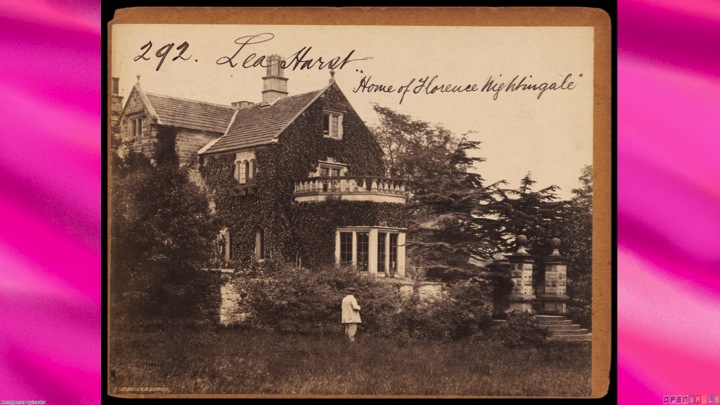
The Nightingales owned 2 large estates, Lea Hurst in Central England and Embley Park in South Central England. They move in social circles that include politicians, writers and poets, such as Tennyson. Flo’s father is a liberal humanitarian who fought for the reform of Parliament. Her maternal grandfather was an abolitionist. She is well-educated; her father teaches her to read French, German, Italian, Latin, and Greek; she excels in math. But it is the Victorian Age. She is expected to marry well and have children. She turns suitors away.

Slide35

Flo further shocks her family when at 16 she announces that God is calling her to be a nurse. Paid nursing is a job for poor, uneducated and often elderly women, with a reputation for drunkenness, bad language, and loose morals.

Florence is headstrong. She persuades her parents to allow her to take a 3-month course in Lutheran Deaconess training in Germany. Within a year, she becomes the superintendent of the “Institution for Sick Gentlewomen (governesses) in Distressed Circumstances” in London.

In 1853, the Crimean War breaks out. British forces are seriously depleted after the October 1854 Battle of Balaclava and the ill-fated “Charge of the Light Brigade.”

Slide37


Word of the horrible conditions for wounded British soldiers reaches the Minister of War, who is an acquaintance of Flo. He invites her to take 38 female nurses to work in a military hospital in Turkey on trial. She says yes. Her family doesn’t approve; it means being in close contact with men of all sorts, without a chaperone.

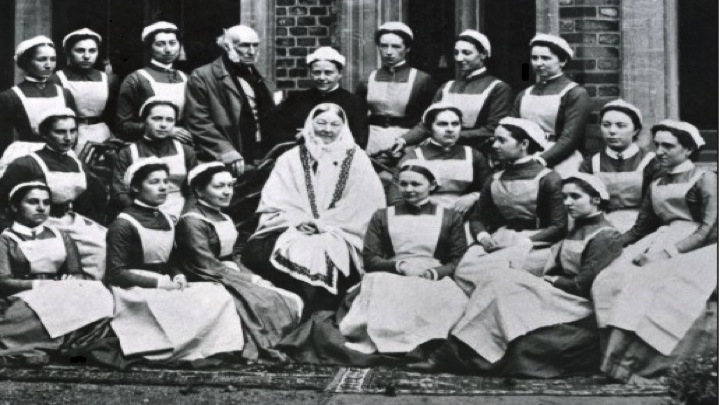
Florence and the 38 nurses arrive in November 1854 at Scutari Barracks in Constantinople, where wounded soldiers are shipped across the Black Sea. The conditions are horrifying; 2,000 men lying on mattresses 18 inches apart in 2 rows, with barely enough space to walk between. Food is scarce; there’s not enough running water, no way to keep patients clean, even if the importance of sanitation and the dangers of bacteria were known—and they weren’t. Vermin and disease are rampant—typhus, typhoid, cholera, dysentery.

Slide39Slide38

No one has told the doctors that the nurses are coming; they are shown to their quarters in a tower infested with rats and a dead Russian soldier on the floor. But soon thousands more wounded arrive; the nurses’ help is needed. Flo attempts to organize the hospital and the distribution of supplies, arguing with doctors and writing letters to government officials, trying to improve overall conditions.

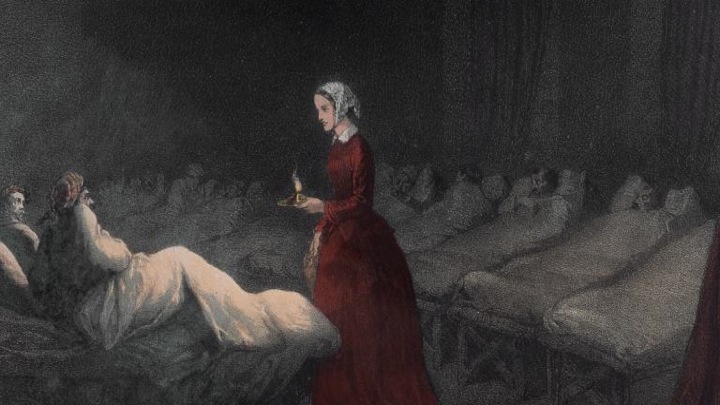
But how she becomes a heroine to the British people is that she is devoted to the common soldier. She endears herself to them, walking the halls at night with her lantern, sitting up talking with them. The soldiers write about Florence in their letters home. She writes hundreds of letters to their families, expressing condolences when soldiers die, assuring them that their sons had “the best care” and passed “peacefully.” The soldiers affectionately call her “the Lady with the Lamp.”

Slide40

When the war ends in 1856, Flo goes home to her family, who, though disapproving of her work, embrace her celebrity status. But Flo is filled with anger about all the death she has witnessed. She is even more upset when she learns that more soldiers died at her hospital than any other. They died not from their wounds, but infectious diseases caused by unsanitary conditions. All pride in her war service evaporates. She is unable to forgive herself for not seeing the link between the conditions at the hospital and the alarming death rate.


***

In our gospel reading today, Peter is having trouble forgiving himself, too. He can’t move forward with what the Lord has called him to do. The passage starts with Peter declaring that he is going fishing—by himself. He doesn’t invite anyone; perhaps he’s running away from the leadership gifts that his community recognizes. The others immediately say, “We’ll go, too.” You can almost imagine him shrugging his shoulders,  “Whatever.”

The passage comes after the risen Christ has appeared a number of times to the disciples. Christ gives them his peace and His Spirit and sends them out to do a work of forgiveness. Then comes chapter 21 and the story of Peter’s commissioning to care for Christ’s “sheep”– the ragtag bunch of disciples that will grow into a great flock in Acts, when Peter preaches on Pentecost. In John 21, Jesus waits for the disciples to be exhausted from their fruitless fishing all night, so that he may bless them with another “sign.” Casting on the “right” yields more fish than they can haul in, bringing to mind 3 years earlier, in Luke 5, when the fishermen reluctantly cast empty nets at Christ’s insistence, and then leave their nets and miraculous catch to become fishers of people with Him.

I love the details in this passage, including the one about Simon Peter needing to put on his clothes. Does it remind you of Adam and Eve after they eat the forbidden fruit? They are “naked and ashamed” and attempt to cover themselves. I think Peter, too, feels vulnerable in Christ’s presence.

Now Jesus invites the disciples to bring their catch to a shared meal. He serves them, and we remember the Last Supper. Eating together affirms that the risen Jesus is no ghost; he is flesh and blood, but also divine, as revealed by the miraculous catch. Jesus calls Peter by his formal name, asking him if he loves him—“more than these.” The “more than these” could mean,  “do you love me more than you love the disciples?” or  “do you love me more than the other disciples love me?” Jesus asks 3 times, leaving no doubt in Peter’s and our minds that Christ remembers how Peter denied him 3 times before the cock crowed, just as Peter hasn’t forgotten or forgiven himself. Peter responds emotionally the third time, “You know I love you!”

Yes, Christ knows—and wants to use Peter, not despite his weakness, but with his weakness; for Christ’s power is made perfect in weakness (2 Cor. 12:9). Jesus wants to make sure Peter will be a humble, servant leader of the Church, reliant on the Spirit and motivated only by LOVE– for Christ and His Church.

And it is this way with us, friends. God wants to use us, not in spite of our weaknesses, but working through them to accomplish his purposes. His Spirit equips us with everything we need, including faith and the ability to forgive ourselves and one another. He wants our only motivation to serve Him and the Church to be LOVE.

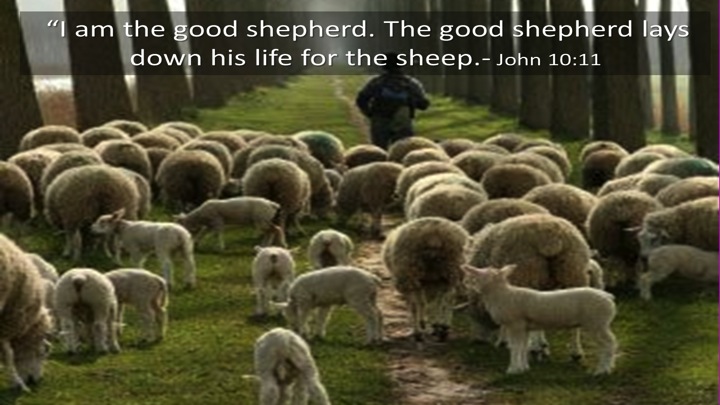
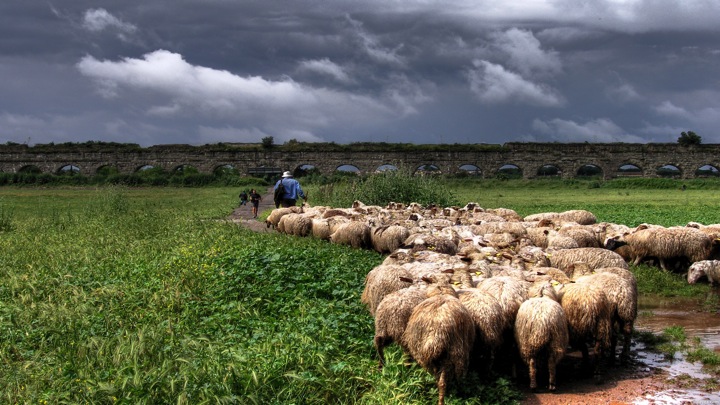
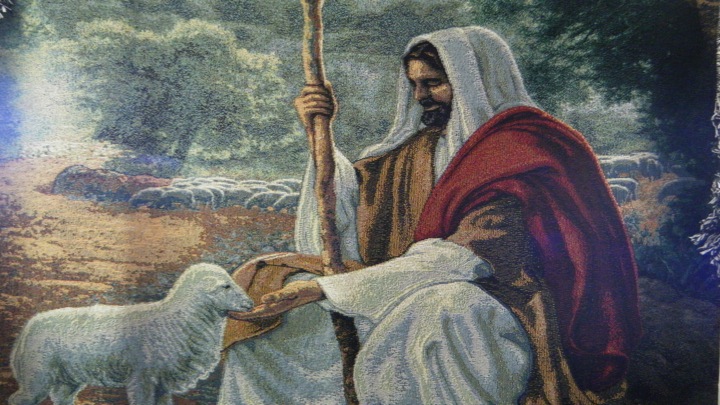
The Good Shepherd is calling us now,  “Follow me.”

***

I don’t know if Florence ever forgave herself for what she saw as her great failure during the War. But God used her in a powerful way, with her weaknesses. From age 38 on, she was often confined to her bed with brucellosis, an infection caught during the war. In 1856, Queen Victoria rewarded her with $250,000 and an engraved brooch–the “Nightingale Jewel” for her war service.

Slide55

 She used the money to establish St. Thomas’ Hospital and the Nightingale Training School for Nurses.

Slide54

Slide34

She wrote thousands of letters advocating for public sanitation and healthcare reform for the British army and civilian hospitals. She was consulted about field hospitals during the U.S. Civil War and on public sanitation issues in India.

Slide56

Among her honors, she receives the Order of Merit from King Edward in 1907 and a celebratory message from King George on her 90th birthday in May 1910.  She dies three months later.

       I have to think that her strength during the war and afterward, during her prolonged illness, came from the same One whose voice she heard at 16, calling her to be a nurse. Flo was laid to rest at her family plot, refusing burial at Westminster Abbey. Her marker bears a plain cross with only her initials and dates.

Slide57

She may never have realized the importance of her wartime service –when she showed comfort and compassion to thousands of wounded soldiers. When she wasn’t the rich heiress Florence Nightingale, but was only “the Lady with the Lamp.”

Let us pray.

Holy One, we thank you for your love and forgiveness for us, when we feel we have failed you and ourselves. Help to us to fully accept ourselves in our weakness and to rejoice in your grace and mercy. Thank you for your plan to use our weakness for your work and your glory. Lead us to acts of bravery and humility, shining your light and never seeking worldly rewards, such as appreciation from other people. May we always seek to obey and please you. Let our motivation for our actions every day be LOVE. In Christ we pray. Amen.
So I Send You


Meditation on John 20:19-31

April 8, 2018

Merritt Island Presbyterian Church


Slide57


19 When it was evening on that day, the first day of the week, and the doors of the house where the disciples had met were locked for fear of the Jews, Jesus came and stood among them and said, “Peace be with you.” 20 After he said this, he showed them his hands and his side. Then the disciples rejoiced when they saw the Lord. 21 Jesus said to them again, “Peace be with you. As the Father has sent me, so I send you.” 22 When he had said this, he breathed on them and said to them, “Receive the Holy Spirit. 23 If you forgive the sins of any, they are forgiven them; if you retain the sins of any, they are retained.”

       24 But Thomas (who was called the Twin), one of the twelve, was not with them when Jesus came. 25 So the other disciples told him,  “We have seen the Lord.” But he said to them, “Unless I see the mark of the nails in his hands, and put my finger in the mark of the nails and my hand in his side, I will not believe.”

26 A week later his disciples were again in the house, and Thomas was with them. Although the doors were shut, Jesus came and stood among them and said, “Peace be with you.” 27 Then he said to Thomas, “Put your finger here and see my hands.  Reach out your hand and put it in my side. Do not doubt but believe.” 28 Thomas answered him,  “My Lord and my God!” 29 Jesus said to him, “Have you believed because you have seen me? Blessed are those who have not seen and yet have come to believe.”

30 Now Jesus did many other signs in the presence of his disciples, which are not written in this book. 31 But these are written so that you may come to believe that Jesus is the Messiah, the Son of God, and that through believing you may have life in his name.


***

Journalist Ken Fine wanders Hillsborough Street in Raleigh, NC, feeling sad about his girlfriend of 5 years breaking up with him.

Then, the sound of a Mozart concerto prompted him to raise his eyes, he writes in a January 2017 article for Indyweek. “There he was. A heavy-set man with shoulder-length hair, the brown curls showing signs of gray….The violin under his chin and the bow in his hand were worn. I’d seen him before, playing that same instrument: on Franklin Street in Chapel Hill as a young boy, my hand in my mother’s as we walked to Pepper’s Pizza for a pregame slice; on Durham’s Ninth Street as a teenager, cutting it up with friends…. He was a constant to thousands of kids like me, who’d grown up in the Triangle.

“In the twenty minutes I sat there listening to him—this man I didn’t know, but who wasn’t quite a stranger—on that stormy February afternoon in 2008, I was reminded of happier times. Reminded that life, even in its worst moments, was full of possibility. Full of hope.

“When the wind picked up and the sky darkened, I turned to leave. The music stopped. Suddenly I was overcome by emotion, tears welling up in my eyes. The fiddler placed a soft hand on my shoulder.

“You gonna be OK?” he asked.

“I think so,”  I replied.

“Well, I know so,”  he said, a half-smile forming on the right side of his mouth. “How about one more song for the road?”

Most people didn’t know the violinist’s name or story or how mental illness led to him choosing a life on the streets. How when he played his violin was the only time he felt peace. He never asked for money…. Never had “ill words for passersby,” Ken says. Business owners appreciated his presence outside their storefronts. The town affectionately called David McKnight the Franklin Street Fiddler, the Mayor of Ninth Street, or Hillsborough Street’s Handel.

“He was our musician,”  Ken says.

David was born in 1947, the son of civil rights leader and Charlotte Observer editor “Pete” McKnight. He didn’t pick up the violin until 6th grade but quickly displayed his talent. Smart, charismatic, popular, funny, athletic. In high school, he was voted slide “most likely to succeed.”

During his senior year, he began showing symptoms of mental illness; the diagnosis is unknown. He attended Duke University and played the university mascot, the Blue Devil, on the field. He left school early to travel the world; he would earn a degree later in life. He spoke twelve languages. When he returned home several years later, he became a reporter for The Durham Morning HeraldThe News & Observer, and The Charlotte Observer. When he became an editorial writer for The Fayetteville Observer in the mid-seventies, he formed a folk band and, for about 5 years, they played at festivals and small venues across the state.

In 1978, he left his job to run for Senate against incumbent Jesse Helms. Though he was just 29 and too young to serve as a Senator, 9,000 people voted for him. His campaign was radical–no fancy clothes or prepared talking points. And no car! He wore out 6 pairs of shoes walking 1,654 miles across his state with his fiddle, promising voters he wouldn’t “fiddle around” in Washington.


Slide36

He never again held a steady job after losing the election. He refused help from family and friends; refused to take medication, believing it would affect his playing.

Those who walked by as he played his violin, wouldn’t likely see that his life, without his knowing it, was a gentle witness to those with so-called “normal” lives –those who were, unlike him, too busy to reach out with kindness and compassion to someone in need.


***

In our gospel today, we pick up where we left off on Easter–after the risen Christ appears to Mary Magdalene in the morning, and Mary runs to tell the disciples, “I have seen the Lord!” That night, Jesus appears to the disciples–minus Thomas– huddled in fear behind locked doors. My first response is, “Guys, didn’t you hear what Mary said?!”

But that’s the whole point of this passage–that only those who see Jesus and hear him speak to them personally believe in His resurrection. The male disciples need even more proof of his identity than Mary; they need to see the marks on his hands and side. This is John emphasizing that the risen Christ is both human–bearing the scars of his crucifixion in his flesh–and divine; locked doors fail to keep Jesus out when he wants to enter a room! Thomas, a week later, will proclaim his faith with, “My Lord and My God!”

The risen Christ brings his fearful, unbelieving disciples what they need to do His work in the world. First, he greets them with His peace, which he has offered before.  “Peace I leave with you; my peace I give you,” he tells them in John 14:27. “I do not give to you as the world gives. Do not let your hearts be troubled and do not be afraid.” Then he gives them a gift they must “receive” by faith. He breathes His Spirit on them, bringing to mind God breathing life into humanity, formed from the dust of the earth at Creation. But also, it reminds us of Pentecost in Acts, when the promised Spirit comes as a rushing wind, with tongues of fire to fill a larger group of disciples gathered in Jerusalem 50 days after the Passover. The Spirit in John 20 will form a new community of believers and empower them to take the message of God’s forgiveness to the world, so that all who believe on Him will have “life in his name.” “As the Father has sent me,” Christ tells his faithful, “so I send you.”

And Thomas? Why is he singled out when none of the disciples believe until they see for themselves? Thomas, up to now, has been loyal to Jesus. When Christ prepares to return to Bethany to his friend, Lazarus, who is dying in John 11, Thomas is the only one who doesn’t try to talk him out of it. “Let us also go,” he says, “that we may die with him.”

He speaks for all the disciples when he says in John 14 that they don’t understand what Jesus is talking about —going to “prepare a place for them.” He says, “Lord, we don’t know where you are going, so how can we know the way?”

I think Thomas is every follower of Christ. We declare our love and commitment to the Lord one minute and struggle with fear and doubt the next. But Christ pursues us, like he does Thomas, who honestly declares his unbelief–not in Jesus, but that Jesus has risen from the dead. The truth is that the risen Christ is always with us, but, like the first disciples, we don’t always recognize him. We expect a glorious king, when Jesus tells us in Matthew 25 that he is the stranger we invite in, the poor, hungry and thirsty person we feed and clothe, and the one who is sick or in prison that we visit. That when we are serving people in need, we are serving him.

Slide51

***

Eventually, the people of Charlotte figure out that David McKnight, the homeless violinist, has given the community a precious gift when he shares himself and his music with them for 30 years, expecting nothing in return. But it takes him getting sick. He was diagnosed with cancer in November 2016. Ken, after hearing about the inoperable brain tumor, decides to finally thank him for his kindness on that stormy night in Feb. 2008–when David played Dylan’s Blowin in the Wind and his gentle words lifted him. Ken was reminded of happier times. That life, even in its worst moments, is full of possibility. Full of hope.

He visited David on Jan. 12, 2017 in a healthcare facility. But he has waited too long. “I don’t know if he understood,” Ken says. David can only speak in “a mumble, a hodgepodge of sounds that only resemble actual words.” His appearance is so changed that Ken doesn’t recognize him at first. His fiddle is stashed behind the bathroom door.

On Jan. 15, 2017, two days before David dies, the community hosts a 3-hour musical tribute for him. More than 200 people come. David is too sick to attend. But it is live-streamed into his hospice room. At the event, someone announces that they are raising money to build a statue of him, violin in hand, to erect on Ninth Street.

Slide53

They pass a bucket, Ken says, “church-style.” The bucket is full before it makes its way around the hall.

***

Friends, don’t doubt. Believe!

Today is a new day, a fresh beginning for us.

Act kindly. Love boldly. Help others. Share what you have with people in need. Forgive, as God forgives you.

Live faithfully so others may see that you trust in the Messiah, the Son of God, who offers to all who believe life in his name.

“As the Father has sent me,” Christ says to us, “so I send you.”


Let us pray. Heavenly Father, we love you and trust in your Son, the Messiah, whom you sent to save us from our sins. Renew us with your Spirit. Pour your peace in our hearts so that we may be peacemakers. Lead us in your loving ways so that we may boldly reveal the new life in your name you offer to all who believe. Help us to acts of creativity, generosity and kindness, especially to people in need. Open our eyes to ways we can help others; give us courage to act. Stir us to forgive as you have so mercifully forgiven us. Use us to work for you and make our community a kinder, gentler, happier place. In Christ we pray. Amen.

Raised with Him

Meditation on John 20: 1-18

April 1, 2018

Easter Sunday

Merritt Island Presbyterian Church


Slide46

     20 Early on the first day of the week, while it was still dark, Mary Magdalene came to the tomb and saw that the stone had been removed from the tomb. So she ran and went to Simon Peter and the other disciple, the one whom Jesus loved, and said to them, “They have taken the Lord out of the tomb, and we do not know where they have laid him.” Then Peter and the other disciple set out and went toward the tomb. The two were running together, but the other disciple outran Peter and reached the tomb first. He bent down to look in and saw the linen wrappings lying there, but he did not go in. Then Simon Peter came, following him, and went into the tomb. He saw the linen wrappings lying there, and the cloth that had been on Jesus’ head, not lying with the linen wrappings but rolled up in a place by itself. Then the other disciple, who reached the tomb first, also went in, and he saw and believed; for as yet they did not understand the scripture, that he must rise from the dead. 10 Then the disciples returned to their homes.

11 But Mary stood weeping outside the tomb. As she wept, she bent over to look[a]into the tomb; 12 and she saw two angels in white, sitting where the body of Jesus had been lying, one at the head and the other at the feet. 13 They said to her,  “Woman, why are you weeping?” She said to them, “They have taken away my Lord, and I do not know where they have laid him.” 14 When she had said this, she turned around and saw Jesus standing there, but she did not know that it was Jesus. 15 Jesus said to her, “Woman, why are you weeping? Whom are you looking for?” Supposing him to be the gardener, she said to him, “Sir, if you have carried him away, tell me where you have laid him, and I will take him away.” 16 Jesus said to her, “Mary!” She turned and said to him in Hebrew, “Rabbouni!” (which means Teacher). 17 Jesus said to her, “Do not hold on to me, because I have not yet ascended to the Father. But go to my brothers and say to them, ‘I am ascending to my Father and your Father, to my God and your God.’” 18 Mary Magdalene went and announced to the disciples, “I have seen the Lord”; and she told them that he had said these things to her.


***


The first time I met Fred Rogers, I was a little kid. I saw him on his Public Television Show, Mr. Rogers Neighborhood.  I liked his puppets and the toy trolley  that introduced the land of Make-Believe. I wasn’t sure why he was always putting on a sweater and sneakers in the house. I always took off my sweater or jacket when I came home. I never wore shoes in the house. And his urban neighborhood was very different from my country dwelling. For one thing, we didn’t have people from the community ringing the doorbell all the time, bringing packages and stopping by to say hello.

Slide34


But it was always a beautiful day in his neighborhood. And he looked right at me and called me his friend. The youngest of 3, with 2 working parents, I was a latchkey kid and lonely sometimes.

The second time I met Fred Rogers, I lived in another town and had 3 young children of my own. My life was chaotic and exhausting. But I always looked forward to lunch with Mr. Rogers and my kids at the middle of the day. That was one of the few times my oldest would sit on my lap, quietly transfixed on Trolley, and the world of Make Believe, puppets, musical guests and factory tours.


 I will never forget his excitement seeing how crayons were made. Rogers reminded me that it was a beautiful day in the neighborhood–and how blessed I was. I appreciated that he talked with my children about expressing their feelings in positive ways, being kind and to never be afraid to learn new things and ask questions. I liked that he sang all the time, even though he didn’t have an amazing voice. I didn’t know that he wrote all the songs he sang. One of my favorites is, “It’s You I Like.”

“It’s you I like,
It’s not the things you wear,
It’s not the way you do your hair
But it’s you I like
The way you are right now,
The way down deep inside you
Not the things that hide you…

It’s you I like.”


***

We can only imagine the sorrow and terror the first disciples felt on the morning after the Sabbath that followed Christ’s death. Were all their hopes and dreams of the Kingdom Christ proclaimed destroyed at the foot of the cross?

In John, Mary–and not any of the original 12 male disciples–is the first to arrive at the tomb, coming while it is still dark–probably between 3 and 6 a.m. It would be unusual and dangerous for a woman to come alone to a tomb, when grave robbing is common. But perhaps the grief is so great, she isn’t thinking clearly. All she can think about is Jesus’ body is gone! She doesn’t even react to seeing the angels in his tomb. It’s as if she cannot take it all in, nearly running into Jesus when she turns to leave–then mistaking him for a gardener.

The repetition of, “Woman, why are you weeping” always touches my heart, revealing that Christ and the angels care about Mary’s grief, though his death and resurrection are part of a much larger plan for the world. Mary has been a faithful follower since Jesus cast 7 demons out of her.  Because she is named more than a dozen times in the gospels, you might argue that she plays a more important role than most of the male disciples. Of course, Jesus knows she is looking for him when he asks, kindly and gently, “Whom are you looking for?” I can almost see a twinkle in his eye. Can’t you?

She doesn’t recognize Jesus until he calls her by name. This makes me think of Isaiah 43:1,  “Fear not, for I have redeemed you; I have called you by name, you are mine.”

Jesus sends Mary off to be his messenger, telling the men at home, probably still sleeping, “I am ascending to my Father and your Father, to my God and your God.”

She tells them that and more.

She says,  “I have seen the Lord!”

It won’t be until much later– after more appearances of the Risen Christ and the coming of the Spirit–that the disciples come to understand what has happened and begin to think of what it all means.

On Easter, we celebrate our risen Lord and that we will be raised to new life with Him, a life of kindness and service that begins, with the Spirit’s help, in this world.

For Christ’s love compels us,” Paul says in 2 Cor. 5, “because we are convinced that one died for all, and therefore all died. 15 And he died for all, that those who live should no longer live for themselves but for him who died for them and was raised again …. 17 Therefore, if anyone is in Christ, the new creation has come: The old has gone, the new is here! 18 All this is from God, who reconciled us to himself through Christ and gave us the ministry of reconciliation.”


***

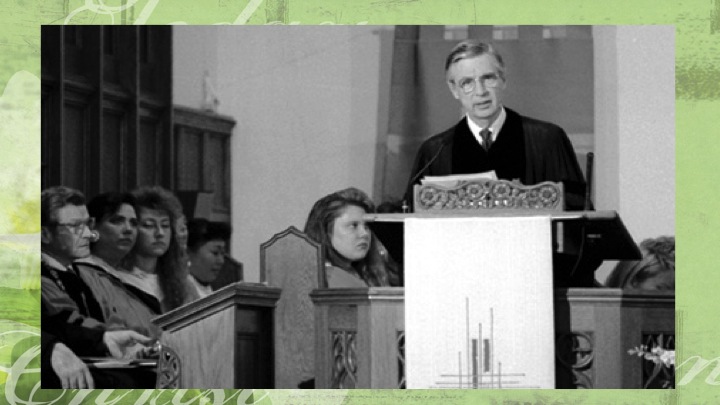
The third time I met Mr. Rogers was just a few years ago, and everything became clear. He wasn’t just a TV personality and his show, which celebrated 50 years in February, was no ordinary children’s program. He was a Presbyterian pastor, with a master’s from Pittsburgh Theological Seminary and a bachelor’s in music composition from Rollins College. Everything he was doing was a calling and a ministry, ordained by our denomination.

Slide48

Without mentioning God, Jesus or Scripture, he revealed the Kingdom of God for children and families through his beautiful, loving neighborhood. His question, “Won’t you be my neighbor?” is an echo of the Good Samaritan parable, when a lawyer asks Jesus, “Who is my neighbor?” The neighborhood and Fred Roger’s gentle, joyful manner with children and adults were an invitation to embrace the love of God for all human beings, and to love, as He loves, even those who are different from us and may not love us.

Slide49

Mr. Rogers had the courage to address topics other children’s programs would not dare talk about, such as divorce, death, and racism. In 1968, his was the first children’s show to feature an African American as a regular member of the cast. Francois Clemmons, a classically trained tenor whom Rogers met in church, was persuaded to play a police officer named Officer Clemmons.

Clemmons recalls that in 1969, when some white people in Pittsburgh didn’t want African Americans swimming in public pools, the show featured Rogers, pants’ legs rolled up, resting his feet in a plastic baby pool on a hot day. He invited Officer Clemmons to come, sit down, roll up his pants’ legs, and rest his feet in the water with him. The camera closed in on the two brown feet next to the two white feet as they talked and sang about friendship. Near the end of the scene, Fred helped dry Officer Clemmons’ feet with a towel. They revisited this scene in their last episode together in 1993.

Slide53Slide52

Mr. Rogers never wanted the children to know he was sick–and frighten them. He died of cancer in 2003, just a few months after he stopped working. He had won 4 Emmy awards, a Peabody and a Presidential Medal of Freedom, among other honors, including having one of his iconic sweaters on display at the Smithsonian. But an acceptance speech for a 1997 Lifetime Achievement Award at the Daytime Emmys revealed his gratitude and humility, and took the audience by surprise.

Slide54

Fred said, “All of us have special ones who have loved us into being. Would you just take, along with me, ten seconds to think of the people who have helped you become who you are. Ten seconds of silence.”

And then he lifted his wrist, looked at the audience, looked at his watch, and said, “I’ll watch the time.” There was stunned silence as people slowly realized that he wasn’t kidding. Then the seconds passed, and the tears started to flow as people did as he asked.

My friends, on this joyous Easter Sunday, in this beautiful church, when we are reminded of Christ’s resurrection and our promise of being raised with him, will you take a moment and consider who loved you into being– who helped you become who you are, encouraged you in your walk of faith? And told you what a special person you are. Because you are.

After 10 seconds, Mr. Rogers looked up from his watch and said softly, “May God be with you all.”

Let us pray.

Holy One, we thank you for the blessings of this day–of time with loved ones and remembering loved ones and beautiful Easters past. Thank you for all the saints who showed the way to follow Christ, saints such as Mary Magdalene, who isn’t even called a disciple, though we know she was. Thank you for their persistence and obedience to your Son’s command to share the Good News. Christ is risen from the dead! Thank you for sending your Son to be the sacrifice for our sins–for making a way when there was no way for us to be reconciled with you and one another. Help us to reveal through our kindness and service, using all the gifts and resources you have given us, to our hope in Christ and the promise of being raised with Him to new life. In His name we pray. Amen.


Sightings


Meditation on Luke 19:28-44

Merritt Island Presbyterian Church

Palm Sunday: March 25, 2018


Slide01

         28 After he had said this, he went on ahead, going up to Jerusalem. 29 When he had come near Bethphage and Bethany, at the place called the Mount of Olives, he sent two of the disciples, 30 saying,“Go into the village ahead of you, and as you enter it you will find tied there a colt that has never been ridden. Untie it and bring it here. 31 If anyone asks you, ‘Why are you untying it?’ just say this,‘The Lord needs it.’” 32 So those who were sent departed and found it as he had told them. 33 As they were untying the colt, its owners asked them, “Why are you untying the colt?” 34 They said, “The Lord needs it.” 35 Then they brought it to Jesus; and after throwing their cloaks on the colt, they set Jesus on it. 36 As he rode along, people kept spreading their cloaks on the road. 37 As he was now approaching the path down from the Mount of Olives, the whole multitude of the disciples began to praise God joyfully with a loud voice for all the deeds of power that they had seen, 38 saying,

Slide11


“Blessed is the king
who comes in the name of the Lord!
     Peace in heaven,
and glory in the highest heaven!”

39 Some of the Pharisees in the crowd said to him, “Teacher, order your disciples to stop.” 40 He answered,“I tell you, if these were silent, the stones would shout out.”

     41 As he came near and saw the city, he wept over it, 42 saying, “If you, even you, had only recognized on this day the things that make for peace! But now they are hidden from your eyes. 43 Indeed, the days will come upon you, when your enemies will set up ramparts around you and surround you, and hem you in on every side. 44 They will crush you to the ground, you and your children within you, and they will not leave within you one stone upon another; because you did not recognize the time of your visitation from God.”


***


Our spring festival yesterday, our Eggstravaganza, was such a blessing.  That’s what I heard from families and from volunteers who shared stories with me at the end. We had all sorts of help from our congregation with this powerful outreach to the community. Thank you for your faithful response to our invitation to serve!

This slideshow requires JavaScript.

We planned for a multitude, hoping 900 plastic, candy-filled eggs would be enough. Turned out, it was plenty! We had a nice crowd, but it wasn’t crowded.

Families said this was a good thing. One mom had come from an egg hunt at a large church in Titusville; the entire town was invited, she said. They left early and drove to Merritt Island.

This slideshow requires JavaScript.

The children could take as long as they wanted for our activities. The leaders could spend more time helping each child and talking with family members.

As we prepared for this big event, we hoped and prayed for opportunities to build relationships, bless and serve our neighbors. We prayed that whoever would come, would have their hearts open to experience the peace and joy of the Lord.

I trusted that God would use us to bear witness to the compassion and gentleness of Christ our Savior, our humble, servant king.


***


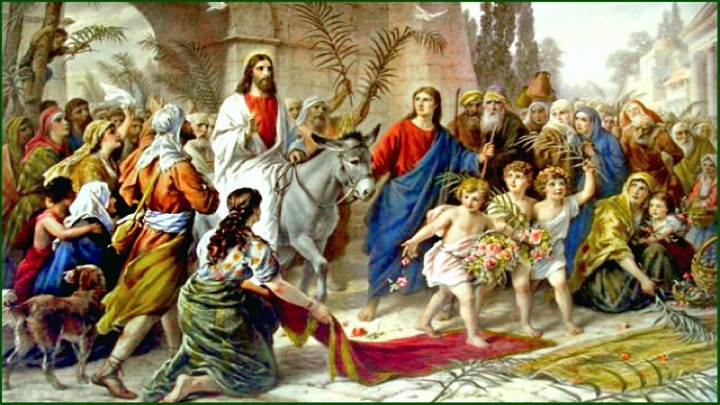
Today on Palm Sunday, the first day of Holy Week, we remember Christ’s dramatic entrance into Jerusalem. After ministering throughout Galilee, he has nearly reached the city of his destiny, the goal of his wanderings. But first, a colt must be found and brought to Jesus. Those following Jesus will recognize the symbolism of Christ riding on the back of a colt, never been ridden, as fulfilling Zechariah’s prophecy.

At the Mount of Olives, Jesus sends two disciples to find and untie a colt in the “village ahead.” We encounter a number of points of uncertainty with this text. One is that Luke names two villages, but which one is the one “ahead?” The first one mentioned is “Bethphage,” meaning “house of unripe figs;” the actual site is uncertain, though there is a “Bethphage” religious site on the road from Jerusalem to Jericho, with a Franciscan church on it. The other village, “Bethany,” which means “house of dates” or “house of misery,” (another point of uncertainty and debate) is where Mary, Martha, and Lazarus lived –and where Lazarus was raised from the dead –and where a woman anoints Jesus with expensive perfume. Bethany is also where the risen Christ will ascend into heaven in Luke 24.

Then, Jesus sends the disciples to get a “colt.” But Luke uses the Greek word “polos,” which means “a young animal, foal,” but isn’t the usual word for donkey– “onos” — which Matthew uses. “Polos” could mean a young horse. But that wouldn’t fit with Zechariah’s prophecy in 9:9:

“Rejoice greatly, Daughter Zion! Shout, Daughter Jerusalem!  See, your king comes to you, righteous and victorious, lowly and riding on a donkey, on a colt, the foal of a donkey.”

Still, the important message is not the geography or vocabulary of this passage. It’s that the disciples trust him and things go exactly as Jesus tells them. This ride of the Messiah is part of God’s larger, mysterious plan. Who has Jesus become in the eyes of this crowd of disciples? Their spreading of their cloaks on the road is the welcome of a king. They celebrate Jesus by singing praises to God for all His “deeds of power, beginning with the first line of Psalm 118:26. But they substitute “the king” for “he.”“Blessed is the king who comes in the name of the Lord. And,“Peace in heaven, and glory in the highest heaven!” reminds us of the angels singing at Christ’s birth in Luke 2:14.

All peace and joy is interrupted when some Pharisees, who use the human title of “Teacher,” urge Jesus to rebuke his disciples. They may fear the Roman Empire’s response to this display of adoration. But Jesus rebukes the Pharisees, instead.

As he draws nearer to the Holy City, he weeps, knowing the terrible fate of Jerusalem.

If only they had recognized the things that would make for peace, he says. This is a play on the name Jerusalem, which contains the Hebrew root S-L-M, “shalom,” for a peace that is also “wholeness and completeness.” Christ’s identity is hidden from the Pharisees, but what about the crowd of followers, who give our humble, servant king a royal treatment on the road to Jerusalem, but then betray and desert him at the cross?

Slide72

***


Yesterday, I had many sightings of our Lord. But I was looking for him, hoping in him, trusting and expecting to see him.

I saw Christ in the laughter and smiles of children, parents, and grandparents.

This slideshow requires JavaScript.

In the encouraging words and warmth of volunteers.

I saw Christ in the provision of not just all that we needed, but more than what we needed.

In the intimate conversations that just happened, without my seeking them. One lady shared her joy that the adoption of her child is finally complete. She had tears in her eyes.

One grandmother who came with her grandchild told me she misses Kids Klub so much, she wants to come back. The grandmother vowed that she will work hard to make that happen.

This slideshow requires JavaScript.

Her granddaughter came up to hug me at the end of the morning to say goodbye and thank you– for everything. Her eyes sparkled.

And I saw Christ, alive again, forevermore.

Our humble, servant king.


Let us pray. Holy One, thank you for your blessings to us, for your Spirit that is with us always, helping us to do your will. Thank you for Jesus, our humble, servant king who, though he died on the cross, lives again and forevermore. Thank you for the many volunteers who serve this congregation, who love you with all their hearts and give so much of themselves for your sake. Help us, Lord, to love one another, and to share Jesus with the world. Heal us of our hurts, forgive us for our sins, and change us into the image of your Son, more and more. In His name we pray. Amen.

We Wish to See Jesus


Meditation on John 12:20-33

March 18, 2018

Merritt Island Presbyterian Church

    20Now among those who went up to worship at the festival (of the Passover) were some Greeks.  21They came to Philip, who was from Bethsaida in Galilee, and said to him, “Sir, we wish to see Jesus.” 22Philip went and told Andrew; then Andrew and Philip went and told Jesus. 23Jesus answered them,  “The hour has come for the Son of Man to be glorified.  24Very truly, I tell you, unless a grain of wheat falls into the earth and dies, it remains just a single grain; but if it dies, it bears much fruit.  25Those who love their life lose it, and  those who hate their life in this world will keep it for eternal life.  26Whoever serves me must follow me, and where I am, there will my servant be also. Whoever serves me, the Father will honor.  27“Now my soul is troubled. And what should I say—‘Father, save me from this hour’? No, it is for this reason that I have come to this hour.  28Father, glorify your name.” Then a voice came from heaven,  “I have glorified it, and I will glorify it again.” 29The crowd standing there heard it and said that it was thunder. Others said,“An angel has spoken to him.”30Jesus answered, “This voice has come for your sake, not for mine.  31Now is the judgment of this world; now the ruler of this world will be driven out.  32And I, when I am lifted up from the earth, will draw all people to myself.” 33He said this to indicate the kind of death he was to die. 

***

Our cat, Melvyn, as many of you know his story, was a stray that showed up at my church in rural Minnesota one day.  When I petted him, the orange and white tabby followed me home. He was hungry and dirty. I fed him on the back steps. Then he cried at the back door all night, in the rain. In the morning, I opened the door and the wet cat came in. I fed him again and he decided to stay with us, even though my husband didn’t like cats, and worried that he might be plotting to kill us.


Five years and 1,200 miles later, Melvyn is still with us. He follows Jim and me all around the house. Wherever we go.  I think Melvyn is still grateful that we let him come and live with us, after living outside in Minnesota for who knows how long. I am pretty sure he never thinks about his old life anymore.  And he’s not the same scraggly, wild cat he used to be. Our love and care of him has transformed him.  

Our cat’s devotion to those who love, nourish and rescue him from harm makes me think of the devotion God deserves from us because of his love, forgiveness and astonishing gift of new, abundant and everlasting life.

***

Slide32

Our gospel reading begins with the arrival of some “Greeks,” who don’t directly approach Jesus. They go to one of his disciples, Philip of Bethsaida in Galilee.  One reason why the Greeks don’t go to Jesus may be that they are Gentiles and may fear rejection. Gentiles and Jews in ancient times do not associate with each other. They are uncircumcised, unclean. They don’t follow the food laws. They don’t speak Hebrew or live according to the Torah. They eat meat sacrificed to idols. They may worship other gods. But they may be God-fearers, Gentiles who worship the God of Abraham,  if they are in Jerusalem at the time of the great pilgrimage festival of Passover.

Slide33

Why choose Philip? Possibly because his name is Greek, named for the father of Alexander the Great.  And he speaks Greek, coming from a predominantly Greek-speaking area. But also because he is willing to speak to the strangers; he is an enthusiastic follower of Jesus who is not timid about reaching out to others.

Slide34

He is a fisherman when Jesus calls him in John 1:43–the third disciple to respond to Christ’s invitation, “Follow me.”

Slide37

Philip immediately obeys, then tells his friend, Nathanael, in John 1:45, “We have found the one Moses wrote about in the Law, and about whom the prophets also wrote—Jesus of Nazareth, the son of Joseph.” And although Nathanael makes a rude remark about Nazareth, Philip invites his friend to,  “Come and see.”

Slide35

Philip doesn’t go straight to Jesus with the Greeks’ request. He consults with Andrew, who has also introduced someone to Jesus. Andrew, in 1:40-42, after answering the call, tells his brother, Simon, “We have found the Messiah.” And he brings him to Jesus,  who looks at Simon and gives him a new name–“Cephas”–Peter. It isn’t clear why Philip goes first to Andrew for advice. He may be worried about the threats to Jesus’ life after he raises Lazarus from the dead; but those are coming from within the Jewish community, not from the Gentiles. Another reason for his hesitation may be that the disciples might not understand, yet, that the Messiah has come to save the world– and not just the Jewish people.

When Philip and Andrew finally go to him, Jesus doesn’t say if he will speak to the Gentiles, only that their coming signals the arrival of his “hour.”  The cross and his glorification loom ahead. But we can assume that he does welcome the Greeks because he says that when he will be “lifted up,” he will “draw all people” to himself. With the parable of a seed that dies but bears much fruit, he speaks of his death so that others might live, but also so that his disciples would be willing to give up their lives for His sake.

The most moving part of this passage is when we encounter the humanity of Christ. With the cross drawing near, Jesus says,  “Now my soul is troubled. And what should I say,  ‘Father, save me from this hour?’” This is an echo of his prayers in Mark 14:35-36 and Matthew 26:39 that “if possible the hour might pass from him.”  36 “Abba, Father,” he says in Mark, “everything is possible for you.  Take this cup from me.” But Jesus will always respond in perfect obedience to God. “Yet not what I want, but what you want,” he says in Mark, Matthew and Luke 22:42.  “Father,” he says in John 14:28, “Glorify your name.”

Christ promises his everlasting presence to all who follow him, saying in John 12:26,  26Whoever serves me, must follow me,  and where I am, there will my servant be also.” This passage will come to mind later, in John 14, with another promise of his everlasting presence with his followers. After Jesus washes the disciples’ feet, breaks bread and shares the cup, and gives them a new commandment–to love one another, he comforts his fearful friends.  “Do not let your hearts be troubled,” he says.  “Believe in God, believe also in me.” He will prepare a place for each one of them in His Father’s house. And he will come again to take them to himself. “So that where I am,”  he says, “there you may be also.”

***

Friends, the Greeks’ wish to see Jesus and Philip and Andrew’s reluctance to bring them to him stirs me to ask if we might be    hesitant to share Jesus with people who are different from us  –in language, culture, nationality or religion? How comfortable are we speaking with those of other faiths or those with no faith at all? We know what Jesus would say about our reluctance. For he was lifted up to draw all people to himself.

Let us recommit ourselves to following the Lord ever so closely and gratefully, being open to sharing Christ with everyone. Let us reveal God’s love through encouraging words and acts of kindness and generosity.  We can trust him to transform our hearts, remove fear or prejudice from us so we may reach out to others, like Philip and Andrew, extending invitations to friends, siblings and strangers to, “Come and see.”

Slide54

Let us pray.

Heavenly Father, thank you for your transforming love for us and for your everlasting presence with us. We praise and thank you that you desire to draw all people to yourself. Guide us in your will; use us for your loving work. Remove all fear from us, Lord, for people who might be different than us. May we be perfectly obedient to you, following Christ’s example. Thank you for the ministries you have blessed us with at MIPC and for all the children and youth who participate in them. Bless them and their families, Lord! Empower us by your Spirit to reach out to our neighbors near and far, to be bold and invite friends, siblings and strangers to “come and see.” In Christ we pray. Amen.


If God So Loved the World…


Meditation on John 3:14-21

March 11, 2018

Merritt Island Presbyterian Church

     And just as Moses lifted up the serpent in the wilderness,  so must the Son of Man be lifted up, that whoever believes in him may have eternal life.  ‘For God so loved the world that he gave his only Son, so that everyone who believes in him may not perish but may have eternal life.  ‘Indeed, God did not send the Son into the world to condemn the world, but in order that the world might be saved through him.  Those who believe in him are not condemned;  but those who do not believe are condemned already,  because they have not believed in the name of the only Son of God. And this is the judgement,  that the light has come into the world, and people loved darkness rather than light because their deeds were evil. For all who do evil hate the light and do not come to the light,  so that their deeds may not be exposed. But those who do what is true come to the light, so that it may be clearly seen that their deeds have been done in God.’ 

***


 The Rev. Jack “John” Borgal looks up reluctantly from his work–stacking and labeling boxes in a warehouse in a town on the Maryland/Pennsylvania border.  He smiles tentatively and invites me in with a gesture. He stutters and his hands flutter. He looks with wonder at the rows and rows of boxes of winter clothes–about 1,200 of them, ready for shipping to the Ukraine. It is as if he were seeing the project of his passion to help the poor in tangible ways through my eyes, the eyes of a stranger, a reporter from the York Daily Record.

And he is amazed at what God has done.

Slide18


Every day, John stops at the post office to pick up boxes of clothing on his way to the warehouse. UPS delivers still more boxes to the warehouse in the afternoon. Volunteers from a church in Indiana would arrive in a few days to load the boxes onto a freight container. Then the donations would begin their month-long journey across the ocean to Kiev, where missionaries would distribute the items to people in need.

From 1992 to 2005, when I covered John’s story for the paper, the ministry had shipped more than 22,000 Dole banana boxes filed with clothing, shoes, and personal care items to 22 countries.  The warehouse in rural Fawn Grove, now called the Fawn Grove Compassion Center, is the only one of its kind in the Church of the Nazarene.

The ministry started with one empty banana box in John’s church.  Inspired by his passion to serve and give, donations of clothing, shoes and personal care items poured in. At first, boxes were stored inside the church–in the basement, hallways and even the pastor’s garage. The ministry grew and the church added storage trailers to the parking lot. The first container of clothing was ready to be shipped in 1992 to Mozambique,  a country embroiled in civil war and ravaged by drought and famine. But there was one small detail John had overlooked–the $8,000 shipping cost. He despaired briefly, but didn’t give up.

He asked the churches that sent in a box of clothing to send $8 for shipping. And they did. John taped all 1,200 boxes in the first shipment by himself.

John, appointed to the unpaid position of Compassion Ministries Coordinator for the Mid-Atlantic District of the Church of the Nazarene in 1991, learned that people in churches who couldn’t afford to go on mission trips and didn’t have much money to give still wanted to help people living in poverty.

  “They wanted to do more than pray,” John said. So he began to send monthly letters to the 90 plus Nazarene churches in the district asking for donations and teams of volunteers to help with the sorting, packing and loading of banana boxes.

The ministry in Fawn Grove continued to grow until, in 2000, Nazarene Compassionate Ministries hired him full time. A year later, the Fawn Grove church  took a leap of faith and borrowed $60,000 to pay for a 45 by 105 foot warehouse to store donations until they could be shipped.

The ministry branched out to include crisis care kits after the Kosovo conflict in 2000  and to countries recovering from natural disasters. In 2004, they started shipping packages of school supplies for children whose families could not afford them. Twenty containers holding 1,230 banana boxes each shipped in 2004 for missionaries to distribute in Poland, Jamaica, Nicaragua, Panama, Liberia and other places; 5,000 banana boxes were shipped to tsunami victims in Southeast Asia , Romania  and the Ukraine. A shipment of lightweight clothing and seven small refrigerators for vaccines traveled to HIV positive orphans and their caregivers in Zambia.

People in the Fawn Grove church contacted me at the newspaper when John received a $10,000 Passion Award from the Servant Christian Community Foundation, based in Kansas City. Their letter included one detail that made his ministry even more amazing to me. His ministry came together not long after he was diagnosed with a mental illness, bipolar disorder, which led him to give up serving as full time pastor and administrator of their Christian school.

It was John’s concern for the poor of God’s world that brought him wholeness and peace as he sought to serve the Lord with what he could do, without mourning what he could no longer do.

The organization that awarded him $10,000 for his ministry called him,  “Banana Box Man.”

Slide45


***

John made the connection between God’s love for the world in John 3:16-17, and what God requires of us who have been saved from our sins.

The context of John 3 is that a Pharisee named Nicodemus,  a respected teacher and leader of the Jewish people, has come to Jesus at night with burning questions. He begins, “Rabbi, we know that you are a teacher who has come from God; for no one can do these signs that you do apart from the presence of God.” His use of “we” hints that he is not the only secret believer in Christ.

Why at night? Some say it was because Jewish teachers studied at night, especially those who worked during the day. More likely, he comes at night to avoid being seen. As we read in John 12:42 and 43,  “Nevertheless many, even the authorities, believed in him.  But because of the Pharisees they did not confess it,  for fear that they would be put out of the synagogue…”   Coming to Jesus at night is also symbolic of him leaving the darkness of ignorance and sin and moving to the dawn of understanding in the light of Christ. Jesus, in John 12:46, speaks in terms of light and darkness again, saying,  “I have come as light into the world so that everyone  who believes in me should not remain in the darkness.”

Jesus foreshadows his death on a cross when he says that the Son of Man will be “lifted up.”  He compares his work for salvation to Moses’ in v. 14, who lifts up the serpent in the wilderness so that Israel,  who sinned against God and are dying after being bitten by snakes, would be saved.

All who believe in him, Christ says, and only those who believe in Him– will have “eternal life.”

Then Jesus talks about works and how they reveal who are believers. He isn’t saying that our works save us. He is simply saying that if we are his disciples, then we will do good deeds that will be “clearly seen” and be a witness to our faith. Others will see our deeds have been “done in God.” But some love the darkness and hate the light.  They don’t want their evil deeds exposed.

At the end of this passage, we are left wondering what Jesus thinks of Nicodemus. If he is a model for discipleship, his is very different than the model of discipleship of the Samaritan Woman with whom Jesus speaks at a well in John 4.  Though she won’t understand, at first, she will be moved during the conversation to believe in Christ and tell the world about him. Many come to the faith because of her. Is Jesus scolding Nicodemus in this conversation or encouraging him on his journey of faith? For one day in the future, Nicodemus and others will come out of the darkness to “do what is true” in the light. Nicodemus will reveal his heart for Christ  when he comes with Joseph of Arimethea to the cross in John 19:39. Together, they remove Christ’s body, then carry, anoint and bury him in an empty tomb.

We are left wondering, in this passage in John 3, about this God who sent the Son into the world, not to condemn it, but so “the world might be saved through him.” Has he left the door open a crack to the possibility that every human being might be saved?

We ask ourselves if what we do reveals the light of Christ within us. And does God desire to use us more to bring about his plan for the world’s salvation?

***

John Borgal thought his ministry years were over. He felt useless, worthless when he was diagnosed with a mental illness. But God had given him the gift of faith and a passion to help people around the world, people that God so loves.

John knew that God loved him and had a plan for him, just as we can be certain that God loves us and has a plan for us, too.

     If we believe in the God who so loves the world, the God who desires no one to perish, but all to have eternal life, then we, also, must love and serve the needy of our community and world.

“For we are God’s handiwork,” Paul says in Ephesians 2:10,  “created in Christ Jesus to do good works, which God prepared in advance for us to do.”

The blessings of service and giving are that we will find, as John Borgal did, our own healing and wholeness.

I leave you, once more, with a challenge. What new compassionate ministry can you and I do, starting small, and asking the Lord to grow it?  What will reveal the light of Christ to those who walk in darkness?

John’s ministry started with one empty banana box–sturdy, stackable, and free from local grocery stores.  His ministry grew by steps and leaps of faith and support from his church and denomination. One banana box at a time.

It has been nearly 13 years since I met with John. I looked for him on the Web yesterday. And I found him on a 2017 Facebook post for the Fawn Grove Compassion Center.

They call him, “Banana Box Man.”

Slide20


Let us pray.


Heavenly Father, we thank you for your great love for the world that led you to send your Only Son to save us from our sins. Thank you for your desire for no one to perish, but for everyone to have everlasting life with you. Help us, Lord, that we may always walk in your light and be a witness to your mercy and grace and not be tempted to slip away to the darkness and hide our sins from you. Give us energy, compassion and creativity to help people struggling in poverty. Guide us in your will. Grant us faith and a willingness to make sacrifices for our neighbors, to give from the heart and from our abundance, Lord, because we have more than we think we do. Stir us to begin small and partner with other groups, perhaps, as John Borgal did, to serve and care for needy people in the world that you so love. In Jesus’ name we pray. Amen.


Love Me and Keep My Commandments


Meditation on Exodus 20:1-17

March 4, 2018

Merritt Island Presbyterian Church

Slide38

    20 Then God spoke all these words: I am the Lord your God, who brought you out of the land of Egypt, out of the house of slavery;  you shall have no other gods before[a] me.  You shall not make for yourself an idol, whether in the form of anything that is in heaven above, or that is on the earth beneath, or that is in the water under the earth.  You shall not bow down to them or worship them; for I the Lord your God am a jealous God, punishing children for the iniquity of parents, to the third and the fourth generation of those who reject me,  but showing steadfast love to the thousandth generation of those who love me and keep my commandments.   You shall not make wrongful use of the name of the Lord your God, for the Lord will not acquit anyone who misuses his name.  Remember the sabbath day, and keep it holy. Six days you shall labor and do all your work. 10 But the seventh day is a sabbath to the Lord your God; you shall not do any work—you, your son or your daughter, your male or female slave, your livestock, or the alien resident in your towns.  11 For in six days the Lord made heaven and earth, the sea, and all that is in them, but rested the seventh day; therefore the Lord blessed the sabbath day and consecrated it.  12 Honor your father and your mother, so that your days may be long in the land that the Lord your God is giving you.  13 You shall not murder.[c  14 You shall not commit adultery.  15 You shall not steal.  16 You shall not bear false witness against your neighbor.  17 You shall not covet your neighbor’s house; you shall not covet your neighbor’s wife, or male or female slave, or ox, or donkey, or anything that belongs to your neighbor.

*** 

The Preschool hosted a rummage sale Friday and Saturday.  They offered all sorts of things at bargain prices–glasses and wood or ceramic kitty cats; a clock that played Mozart or Vivaldi on the hour. Lamps and tables. Clothes and shoes. Toys and golf clubs and golf carts. An ice cream maker–barely used– or a waffle iron, still in its box. It was, as they say, “Everything but the kitchen sink,” only they had a kitchen sink, too, thanks to the Ritters!  So far, the sale has raised more than $400 for this important ministry to young families in our community.

Slide26

I went on Friday and marveled at the “treasures” that people choose to keep or give away. I dropped off my donations, and brought home a few more, much to my husband’s amusement. I bought a beautiful oriental carpet and a ceramic water pitcher with purple iris  that reminds me of my yard in York, PA, years ago and all the perennials, bulbs and iris that bloomed every spring.

The items are even more special to me because they belonged to friends.  I will always think of them affectionately when I see the carpet and water pitcher in my home.

I will keep them close to my heart.

***

The people of God spend 11 months at the foot of Mount Sinai  waiting for Moses to bring God’s Word to them. They arrive in the wilderness of Sinai on the “third new moon after the Israelites had gone out of the land of Egypt.” Time is marked by how long it has been since their release from captivity, just as the Lord identifies himself in our passage today by recalling what he has done for them thus far, I am the Lord your God, who brought you out of the land of  Egypt, out of the house of slavery.”

Slide45

     This is a God who hears the cries of his people and mercifully responds. In the chapter before this one, God compares himself to an eagle in his rescue of his people. He says, “You have seen what I did to the Egyptians, and how I bore you on eagles’ wings and brought you to myself.” The image of God as an eagle carrying His people is later picked up by the prophet Isaiah in 40:31– “but those who hope in the LORD will renew their strength. They will soar on wings like eagles…” Now, at the foot of Mt. Sinai, God is drawing his people closer to himself, asking them to listen to his voice and keep his covenant so they may have the promise of being his “treasured possession.”

    What we call The Ten “Commandments” are literally in Hebrew, “10 Words”– ha-d’varîm. The word for “keep” appears in both the Deut. 5 and Exodus 20 accounts of the giving of the Ten Commandments. This keepshamar in Hebrew– means “to  hold onto, care for, watch, guard and protect,” such as when God places a human being in His Garden in Genesis and tells him to  “till it and keep it.” Shamar appears again when Cain kills Abel. God asks Cain where Abel is. Cain answers, “I don’t know.  Am I my brother’s keeper?”

Slide53

When the Lord calls us to love him and keep his commands or words he doesn’t mean follow them halfheartedly, as we might follow laws made by human beings. These “words” are a covenant between God and his people; this is the way of life God desires for the health and wellbeing of the community. These 10 words, Jesus says in Matthew 22:34-40, are summed up in one word –LOVE.  Love God with all your heart, soul and mind, and love your neighbor as yourself.

The first commands reveal our relationship with the Lord–that he alone is the one we worship and love, most of all. Nothing in this world should ever take his place. The Sabbath figures prominently in this list, taking up what editors have divided into 3 verses. Not only are we to remember the Sabbath and keep it holy, we are told how we may not spend this day; we may not work! This places our relationship with the Lord above what we do for a living; for it is the Lord who has created all things. Everything we have has come to us from His grace. What’s more, we observe the Sabbath because God showed us the way; he rested on and “blessed” the seventh day.

The commands that follow the Sabbath reflect our relationships with others. First, our parents–honor them, with the promise of long life.  Then, our neighbors. The command not to murder means much more than that; we must do everything we can to guard and preserve our neighbor’s life.  For yes, Cain, we are our brothers’ and sisters’ keepers!  The command against adultery means we should love our spouses and hold sacred the covenant of marriage.  The command against “false witness”– means that we should be honest and kind in our communications with others,  only using our words for good. The warning against wrongful use of God’s name doesn’t just mean we shouldn’t swear; it means we should always have the right attitude toward God and speak of him with reverence, gratitude and humility.

It’s interesting that stealing and coveting are two separate commandments. They seem to me to stem from the same sin of greed. Jesus warns his followers to be on guard against greed in Luke 12:15. “Take care,” he says, “For one’s life does not consist of the abundance of possessions.” The one who steals acts on the sins of greed and coveting. It is also interesting that coveting is the last command on the list–a prominent position– and that there is so much detail about what not to covet– not your neighbor’s house, wife, male or female slave, ox, donkey, or ANYTHING that belongs to your neighbor. Wouldn’t it have been enough to say not “anything that belongs to your neighbor”? Coveting must be a big problem for the ancient people of God, as is idolatry, also in a prominent position at the top.  

      God’s people still struggle to live in obedience to His commands. Let us remember that keeping them is a matter of the heart. If we love him, we show our love by our obedience, as Jesus says in John 14:15.

There are blessings for those who keep His commandments. We have the promise of God’s love to the “thousandth generation.”  And there are other blessings, says Psalm 119, when we “delight” in God’s law and “rejoice in following his statutes as one rejoices in great riches.” We are strengthened and sustained. We receive wisdom and understanding, for God’s word is “a lamp unto our feet, a light unto our path.” We are kept from sinning when we “hide” God’s words in our heart and meditate on them. “How can a young person stay on the path of purity?” the psalmist asks. “By living according to your word. I seek you with all my heart; do not let me stray from your commands.”

***

I left the rummage sale Friday encouraged to see our congregation’s support of our preschool ministry. Thank you, friends, for your kindness and generosity! It’s not too late for folks to find a “treasure,” as Pat Smith says, to take home. The sale continues today in the fellowship hall after worship. The Ritters’ sink is still available!

Maybe you will find something that has special meaning to you. I hope that what you choose and keep close to your heart will remind you of this message about keeping God’s commands.

Let us delight in his teachings, his Words. Let us rejoice in them, hiding them in our hearts, as the psalmist did, so that we might not sin. When we obey the Lord, we show our love for Him.  He has always been faithful to us, hearing our cries, answering our prayers with mercy and grace. He has sent His Son to rescue us and reconcile us with Him. He will love us always– to the “thousandth generation!”  And when we are weary, he will lift us up on wings like eagles.  And we will soar with Him.

Let us pray.

Holy One, we confess that we are often disobedient. We don’t feel like loving all our neighbors all the time. We often struggle with discontentment, coveting what others have, wanting more. Forgive us, Lord. Thank you for your love and mercy and for using ordinary people to do your work. Thank you for the power and guidance of your Spirit and the generosity of volunteers and staff who give of themselves and their resources so that your kingdom may grow. Thank you for the children you have brought to our preschool. Please, Lord, we would welcome even more for our preschool and church! Thank you for the Scouts and the Academy with whom we share our facilities and campus. May we be a blessing to one another and dwell together in peace and unity.  In Christ we pray. Amen.
I Will Bless Her


Meditation on Genesis 17:1-7, 15-16

Feb. 25, 2018

Merritt Island Presbyterian Church


When Abram was ninety-nine years old, the Lord appeared to Abram, and said to him, ‘I am God Almighty; walk before me, and be blameless.  2And I will make my covenant between me and you, and will make you exceedingly numerous.’ 3Then Abram fell on his face; and God said to him, 4‘As for me, this is my covenant with you: You shall be the ancestor of a multitude of nations.  5No longer shall your name be Abram, but your name shall be Abraham ; for I have made you the ancestor of a multitude of nations.  6I will make you exceedingly fruitful; and I will make nations of you, and kings shall come from you.  7I will establish my covenant between me and you, and your offspring after you throughout their generations, for an everlasting covenant, to be God to you and to your offspring after you.15 God said to Abraham, ‘As for Sarai your wife, you shall not call her Sarai, but Sarah shall be her name.  16I will bless her, and moreover I will give you a son by her. I will bless her, and she shall give rise to nations; kings of peoples shall come from her.’


Slide29


Are any of you swimmers? I used to be on a community swim team when I was young. Much to my mother’s disappointment, I don’t really swim anymore.

Something stirred me this week to remember learning how to do a back dive. Can any of you do a back dive? We were lined up at the high diving board in the deepest end of the pool. The coach taught us how to do the dive, step by step, with one of the students modeling each position. Then, one of the lifeguards climbed the ladder and demonstrated a magnificent back dive.

Slide25

And then it was our turn to climb the ladder, one by one. Each of us went out to the end of the board where one of the lifeguards waited to serve as our spotter. She or he made sure that we were in the right position before we dove to keep us from hurting ourselves. One of the lifeguards waited in the pool for us at the ladder–ready if one of us may be in trouble in the deep water.

Slide26


Well, my legs shook every step up that ladder. I really didn’t want to do the back dive, for one, because I am afraid of heights. Just doing a regular dive off the high dive was hard enough for me. But also because there is a moment right before and after you jump that you really can’t see what is below when you do a back dive. You don’t have the same wide vision or control of a dive going straight ahead. You really have to have a lot of confidence that everything is going to be all right before you jump off a diving board backwards.

I thought of my diving experience when I was studying our gospel lesson this week. This reminds me of Jesus’ call to follow him — to take up our crosses, as he took up his cross for all of us. He has given us our mission–to bring the hope of his salvation to the world and to obedient to his will, though it might mean taking some risks, doing some things that are not easy, things we don’t even know how to do, yet, and may not think are possible. To reject the mission is to seek only what is comfortable, safe, pleasant and personally profitable for us. To reject the calling is to allow our hearts to be seduced into loving the things of this world more than God. The temptation is always for us to be people pleasers, as Paul says in Galatians 1:10, instead of God pleasers.

Slide32

But like the lifeguard who modeled the back dive, Jesus has already gone ahead of us and shown us how to live. He has already experienced everything we will experience–and more. We can trust him to be with us now and always to guide us every moment, every step — not just at the top on the diving board– or just watching from the side of the pool.

And if we flounder in deep waters–or maybe I should say, “when we flounder,” we will not be lost. Isaiah 41:10 says, “Fear not, for I am with you; be not dismayed, for I am your God; I will strengthen you, I will help you, I will uphold you with my righteous right hand.”


***

In our Genesis reading today, we are reminded that the God of the Old Testament hasn’t changed in his faithfulness or his expectations for his people to live in obedience to his Word. We learn that the God who requires Abram to walk “blamelessly” before him– to commit his way to the Lord–also longs to bless him.

Abram hears the voice of God and believes his promise, accepting the new identity God gives him–Abraham–the ancestor of a multitude of nations, though he is 99 years old and not yet a father. And he accepts the new name God has given Sarai, his 90-year old wife. She shall be Sarah and will give rise to nations and kings of peoples, though she has not yet been able to conceive.

Slide42

Abram believes the Lord when God says, “I will bless her and I will give you a son by her.”

He believes, in spite of the human impossibility and despite the many years of waiting he has already endured. For nothing is impossible with God!

The Lord first makes the promise of a child to Abram when he is 75, but before the blessing, he must go to a land that the Lord will show him. He leaves most of his family in his hometown of Ur, bringing only his wife and his brother’s son, Lot.

Abraham will continue to believe the Lord, though there will be more divine messages before the promise is fulfilled. Sarah finally gives birth to Isaac, a name meaning “He laughs.” “For God has brought me laughter,” she says, “everyone who hears will laugh with me.”

But God has a much bigger blessing in mind when he calls Abram and blesses him–just as God has a reason for his calling and blessings to us. God intends Abram to be a blessing to the world. This is what the Lord intends for us!

God tells Abram in Gen. 12, “I will make of you a great nation; And I will bless you; I will make your name great, And you shall be a blessing….And in you, all the families of the earth shall be blessed.”

The God of the Old Covenant and New remains faithful to us, showering us with blessings to share and be empowered to serve in Christ’s name. Paul in 2 Cor. 9:8 says, “And God is able to provide you with every blessing in abundance, so that by always having enough of everything, you may share abundantly in every good work.”

This is a God who longs to bless everyone. Jesus says in John 10:10, “I came that they may have life, and have it abundantly.”

***

My swim team days are over. Did I ever do the dive? Yes, once or twice. That was enough for me! I was happy to find this week that my old community swimming pool in Damascus, MD, is still going strong.

Slide57

Slide58


The swim team, the Damascus Dolphins, actually looks larger than when I was a kid.

     But is it my imagination, or does the world seem different today? Has it become a more dangerous, violent place for children?

The biggest thing I worried about in high school was doing my homework, passing math, and finding time to be with my friends. I never once thought a shooter would come and take the lives of classmates and teachers. But this scenario has played out, over and over, in my own children’s lives. Columbine High School in 1999.

Slide59

Slide60Slide61

Virginia Tech in 2007.

Slide62Slide63


Sandy Hook Elementary in Dec. 2012.

Slide64Slide65

A community college in Roseburg, Oregon in 2015.

A high school in Parkland, FL on Ash Wednesday.

Slide69Slide70

In dark days like these, the Church needs to remember Christ’s call to take up our crosses and follow Him. What is the cost of discipleship? That means risking our very lives to do what Christ would have us do. Is our thinking and what we value so firmly rooted in the things of this world that we can no longer hear the voice of God, crying out for us to change? We have to take responsibility for who we have become, and stop looking for someone to blame. We are a society who would rather fight than reconcile. We embrace divisiveness. Brokenness has become our normal. We would rather “solve” our conflicts by ending the relationship instead of listening, learning from each other, and forgiving one other.

Slide71

     Listen to the words of Paul to the Philippians in 2:3, “Then make my joy complete by being of one mind, having the same love, being united in spirit and purpose. Do nothing out of selfish ambition or empty pride, but in humility consider others more important than yourselves. Each of you should look not only to your own interests, but also to the interests of others.…”

Slide78

Psalm 127:3 says every child is a gift, a blessing from the Lord! May we never take life for granted! One child–Isaac, a name that means “He laughs”–made Abram Abraham, the father of many nations. One little boy made Sarai Sarah and gave rise to nations.

Our God who raised Jesus from the dead can do much more than what we know is possible! God LONGS to bless us, as he did Abraham and Sarah, with new identities. In Christ, we are a new creation. He offers each one of us new lives by his transforming grace. May God grant the Church the strength, wisdom and courage to truly be the blessing God has called her to be– for all the families of the earth, an instrument of reconciliation, healing, and peace.

Slide79


Let us pray. Holy one, we have become an angry, violent people, embracing conflict and brokenness. Forgive us, for this isn’t your will for us. It isn’t the way of the cross. Give us humble hearts, seeing others as more important than ourselves. Teach us how to listen and learn from one another, how to love and forgive. Heal what is broken in our homes, schools, churches, and communities, especially in the wake of another tragic shooting. We thank you for your love for us and your longing to bless us and make something beautiful of our lives, new creations in Jesus Christ. Lead us to be a blessing, as Abram and Sarai were, for all the families of the earth. In Jesus’ name we pray. Amen.

Angels in the Wilderness

Meditation on Mark 1:9-

Feb. 18, 2018

First Sunday in Lent

Merritt Island Presbyterian Church


9 In those days Jesus came from Nazareth of Galilee and was baptized by John in the Jordan.  10And just as he was coming up out of the water, he saw the heavens torn apart and the Spirit descending like a dove on him.11And a voice came from heaven, ‘You are my Son, ‘the Beloved;  ‘with you I am well pleased.’ 12 And the Spirit immediately drove him out into the wilderness.  ‘13He was in the wilderness for forty days, tempted by Satan; and he was with the wild beasts; and the angels waited on him. 14 Now after John was arrested, Jesus came to Galilee, proclaiming the good news of God, 15and saying, ‘ ‘The time is fulfilled, ‘and the kingdom of God has come near;  ‘repent, and believe in the good news.’ 


***

They sang about two birds on a hill. One named Jack. One named Jill. Fly away Jack. Fly away Jill. Come back, Jack. Come back, Jill! Then they were teapots. “Tip me over and pour me out!”

Slide028

Our Tuesday morning chapel with the 3, 4 and 5 year olds was the highpoint of my week. We finished our month-long study of Joseph with motion songs and prayer.

Slide029

Then teachers, other staff and volunteers from the church joined with me to lead the children to make “Joseph coat” crafts with grocery bags, paper plates, and color by number sheets.

We even made Joseph puppets on tongue depressor sticks. I was so blessed on Tuesday with the children and all those who wanted to teach them about God’s love and faithfulness. It felt as if angels were all around!

The children learned through drama, storytelling and crafts how Joseph suffered many challenges and dark days–his own brothers’ stealing the special coat that was a symbol of his father’s love. They throw him in a pit and leave him for dead. Then Joseph is sold into slavery and taken to Egypt. While there, though he serves his master faithfully, he is falsely accused of a crime and thrown into jail where he languishes for years in another kind of wilderness. But it is all part of God’s plan to move him into a position where he can interpret Pharaoh’s dreams, with his God-given gift. He warns of years of great famine to come. He saves the lives of thousands, including his own brothers, who come to Egypt for help. And Joseph, with God’s gift of mercy and grace, is able to forgive his brothers, saying in Genesis 50:20,

20 Even though you intended to do harm to me, God intended it for good, in order to preserve the lives of many people, as he is doing today.”

***

The wilderness is a place of suffering and testing for Joseph–and for Jesus in our gospel in the first chapter in Mark today. Jesus goes to the wilderness to be baptized in the Jordan by John. Like the account in Luke and unlike the baptism in Matthew and John, the voice that speaks, speaks directly to Jesus, assuring Jesus of his relationship to God the Father, who says, “You are my Son, the Beloved; with you I am well pleased.”

Slide055


Christ’s identity as the Son is declared from the opening first verse of the book of Mark, “The beginning of the good news of Jesus Christ, the Son of God.” His identity is proclaimed at his Transfiguration on the mountaintop, and finally, at the cross, when a centurion watches him die, and says, “Surely this man was the Son of God!”

What follows the baptism is the Greek word for “immediately” —euthys— the first occurrence of one of Mark’s favorite words. He uses euthys 41 times, while the word is only found 10 other times in the entire New Testament. You won’t be able to count the 41 uses of euthys ­in the English text of Mark because translators have used other synonyms or phrases to avoid Mark’s constant repetition of the same word.

But this actually takes away from that sense of speed, urgency and movement that Mark is trying to convey. Jesus is immediately driven by the Spirit into the wilderness. The strong verb for driven will be used again when Jesus drives or casts out evil spirits from the possessed. Jesus is already in the wilderness for the baptism, but now he is in the wilderness, deeper still.

Slide062

He is separated from all human beings. This is no refreshing retreat, no sweet time with God. It is the opposite–a time when he feels far from God as he is “tempted” by Satan. This is usually when temptation comes–when we feel separated from the Lord. These 40 days are a test to prepare him for his ministry and to show us how to withstand temptation and trials. Hebrew 4:15 tells us, “For we do not have a high priest who is unable to sympathize with our weaknesses, but we have one who in every respect has been tested as we are, yet without sin.”

Slide063

These 40 days take us back to Noah’s ark in Genesis, when water covered the earth. The frightening, wilderness experience leads to God’s covenant with every living creature, and the sign of God’s promise never to destroy all flesh on earth again–a rainbow.

The 40 days take us back to the story of Elijah in 1 Kings 19:8, who was fed with bread from heaven, but then journeyed through the wilderness without any food for 40 days to the mountain of God.

Slide069

Christ’s 40 days of testing take us back to the Israelites’ exodus from captivity in Egypt to wander in the wilderness for 40 years.

Slide070

The wilderness is a dangerous place for the Israelites and Jesus, who are with “wild beasts.” Deut. 8:15 says, “He led you through the vast and dreadful wilderness, that thirsty and waterless land, with its venomous snakes and scorpions.” Christ’s testing moves us forward to “a new Exodus, a new way of salvation,” a gracious gift from the same loving God who never leaves the Israelites, though they feel abandoned. In Exodus 17:7, they ask Moses, “Is the Lord among us–or not?” After experiencing the parting of the Red Sea and God feeding them with manna and quail, they still complain bitterly to Moses in Exodus 17:3, “ Why did you bring us out of Egypt, to kill us and our children and livestock with thirst?” God responds with gracious provision in 17:6-7, causing water to come from a rock so that all may drink.

Slide077

Absent from Mark’s account of Jesus’ testing is his fasting and the dialogue with Satan we remember from Matthew and Luke, beginning when Satan says, “If you are the Son of God, command these stones to become loaves of bread.”

Jesus answers Satan’s tests with God’s Word, as we should. “Man does not live by bread alone, but by every word that comes from the mouth of God.’ Jesus says. And, “Do not put the Lord your God to the test.” And, “Worship the Lord your God, and serve only him.”

What touches my heart in this brief, swiftly moving passage that starts with baptism and ends with Christ’s proclamation that the Kingdom of God has come near, is when Satan leaves and a weary Jesus is waited on– by the angels. You may not imagine angels as anything more than God’s messengers. Eternal beings, yet created by God, they were present when God created the world. In Job 38, the Lord answers Job out of a storm, saying, “Where were you when I laid the earth’s foundation? … while the morning stars sang together and all the angels shouted for joy?” While only 3 angels are named in the Bible — Gabriel, Michael and Satan, the fallen angel, angels are too numerous to count. Hebrews 12:22 speaks of “thousands upon thousands of angels in joyful assembly” in the heavenly Jerusalem of Mount Zion. Angels, in obedience to God, protect us from harm. Psalm 91:11-12 says, “He will command his angels concerning you to guard you in all your ways.”

What is meant by the angels “waiting on” Jesus in our Mark passage? The Greek word is diakonein; from which comes our word “deacon.” Bible scholar Joel Marcus says diakonein describes “the waiter’s task of supplying someone with food and drink,” though the word comes to mean ‘to serve’ more generally.

It makes me feel good to know that Jesus, whom God made a little lower than the angels when he emptied himself and took on our fragile human form, needed help from heavenly beings in the wilderness. And the angels were all around.

Slide084


***
Friends, we have begun our 40 days of Lent, a season when we seek to know God more and grow in love and grace.

Slide094

We scrutinize our overly busy routines and start carving away what we don’t really need to do. Come on, you know you are doing too much! As Jesus says to his friend, Martha, who demanded that Mary help her in the kitchen when Jesus came over for dinner, “Martha, Martha, you are worried and upset about many things, but few things are needed—or indeed only one.” Let us carve out times of quiet devotion, delightful moments with the Lord and His people.

Slide098

Let us also add on time to bless and serve–to minister like the angels that were with Jesus in the wilderness. And the angels that are always with me, especially during our preschool chapel. I am sure there are things you have wanted to do for the Lord, but you say that you don’t have time or energy to do them. Why not?

We live in a wilderness, now. The time between the resurrection and the fullness of God’s Reign. A time of joy and abundance, resting in God’s promises and steadfast love. But also a time of testing, hardship, and suffering. The good news is that the wilderness, as Israel discovered long ago, is where God is. For all our needs, for everything, we can trust Him. And his angels all around.

Slide107


Let us pray.

Holy One, we thank you for sending your Son, who experienced all the temptations and suffering that human beings can possibly experience, and yet did not sin. Come to us now in our wilderness journeys. Heal us body, mind and soul. For those who feel as if you are far from them, make your presence known. For those who feel you with them, reassure them of your love. Thank you for your angels all around us, protecting us from harm, at your command. Draw near to us, Lord, as we seek to draw closer to you throughout this Holy Season of Lent and beyond. Show us how we might change our routines so that we do only the things that you want us to do. Help us carve away the excess busy tasks and carve out more sweet, peaceful, healing time with you. Nourish us with your Word and Spirit. Stir us to bless and serve one another and reach out with your love and grace to children of all ages. Let us wait on them as if we are the angels who restored Jesus when he was weary in the wilderness. In Christ we pray.

The Power of the Beloved

Meditation on Mark 9:2-9

Feb. 11, 2018

Merritt Island Presbyterian Church

Slide004

2 Six days later, Jesus took with him Peter and James and John, and led them up a high mountain apart, by themselves. And he was transfigured before them,  3and his clothes became dazzling white, such as no one on earth could bleach them.  4And there appeared to them Elijah with Moses, who were talking with Jesus. 5Then Peter said to Jesus, ‘Rabbi, it is good for us to be here; let us make three dwellings, one for you, one for Moses, and one for Elijah.’ 6He did not know what to say, for they were terrified. 7Then a cloud overshadowed them, and from the cloud there came a voice, ‘This is my Son, the Beloved;  listen to him!’ 8Suddenly when they looked around, they saw no one with them any more, but only Jesus. As they were coming down the mountain, he ordered them to tell no one about what they had seen, until after the Son of Man had risen from the dead.

***

Slide018

Martin Luther King, Jr., loved to sing! His mother, Alberta, was the organist and choir director of Ebenezer Baptist Church, in Atlanta where her husband, Martin’s father, preached.

Slide019

The church was a short walk from their home at 501 Auburn Ave.  

Slide020

Alberta would take him to sing in other churches beginning when he was very young, receiving praise for, “I Want to Be More and More Like Jesus.”

Slide022

In 1939, he sang with his church choir at the Atlanta premiere of Gone With the Wind.

Slide023

When he was little, Martin befriended a neighbor boy who was white. When they started school at 6 years old, Martin had to go to a school for African Americans; his friend went to a “whites-only” school. Martin lost his friend soon afterward when the child’s father no longer wanted the boys to play together.

Martin suffered from depression much of his life. He struggled with his faith. His father was a harsh man who whipped him regularly. When he was 13, he told his Sunday school teacher that he didn’t believe in the bodily resurrection. After that, “doubts began to spring forth unrelentingly,” he said. Years later, he would say that the Bible has “many profound truths which one cannot escape.” Martin attended Morehouse College at 15, skipping 2 grades in high school. He earned a bachelor’s in sociology in 1947 when he was 18.

Slide027

He decided to pursue the ministry to “answer an inner urge to serve humanity.” He attended Crozer Theological Seminary in Chester, PA. While there, he fell in love with the daughter of a German immigrant woman. His friends talked him out of marrying her, saying, “an interracial marriage would provoke animosity from both blacks and whites” and would damage “his chances of ever pastoring a church in the South.” He broke off the relationship.

He married Coretta Scott on June 18, 1953, in Heiberger, Alabama.

Slide029

They had 4 children.

Slide032


At 25, he was called as pastor of the Dexter Ave. Baptist Church in Montgomery, Alabama.

Slide034


He pursued graduate studies in systematic theology at Boston University, earning a doctorate in 1955.

Slide035

In December of that year, the Rev. Dr. King would lead the Montgomery bus boycott after Rosa Parks, a young African American woman, refused to sit in the back of a city bus.

Slide036


The boycott lasts 385 days, ending when a U.S. District Court rules against segregation on all Montgomery public buses. Following the boycott came years of speeches and traveling, organizing and participating in protests and marches, working for Civil Rights for African Americans, including the right to vote and attend school with whites.

Slide038


He was arrested and jailed 29 times and stabbed in the chest by a letter opener in 1958 when signing his book, Stride Toward Freedom.

Slide041

Slide042

Slide043

His sermons criticized racial injustice and emphasized “man’s need for God’s love.” But more than his sermons, his speeches, filled with allusions to Scripture, will be long remembered. In his “I Have A Dream” speech, delivered in Washington, D.C., in 1963, he imagines a world where “justice is a reality for all God’s children.”

Slide046

“I have a dream that my four little children,” he says, “will one day live in a nation where they will not be judged by the color of their skin, but by the content of their character.” This bears echoes of Hebrews 4:12, The Word of God “judges the thoughts and attitudes of the heart,” and 1st Samuel 16:7, “For man looks on the outward appearance, but the Lord sees the heart.” Martin also quotes Amos 5:24, “We will not be satisfied until justice rolls down like waters and righteousness like a mighty stream.” He alludes to Isaiah 40:4-5, imagining a future when “every valley shall be exalted, every hill and mountain made low. The rough places will be made plain and the crooked places made straight. And the glory of the Lord shall be revealed, and all flesh shall see it together.”

While the “I Have A Dream” speech is the most famous of his speeches, his “Mountaintop” speech has strong connections with the Transfiguration account in Mark. Martin has received a “mountaintop-like” vision that has strengthened him to trust in the Lord for whatever may come. He makes this speech in Memphis, TN, in 1968, the night before his assassination.

Slide057

“We’ve got some difficult days ahead,” Martin says to those gathered in the Mason Temple, headquarters of the Church of God in Christ. He has just told them about the bomb threat on his plane that delayed his flight. “But it doesn’t matter with me now. Because I’ve been to the mountaintop. And I don’t mind. Like anybody, I would like to live a long life. Longevity has its place. But I’m not concerned about that now. I just want to do God’s will. And He’s allowed me to go up to the mountain. And I’ve looked over. And I’ve seen the promised land. I may not get there with you. But I want you to know tonight, that we, as a people, will get to the promised land. So I’m happy, tonight. I’m not worried about anything. I’m not fearing any man. Mine eyes have seen the glory of the coming of the Lord…”

Slide058

***

The disciples in our gospel today, have already seen Christ’s miracles- – the deaf can hear, the blind can see, the paralyzed begin walk. He casts out demons, feeds a hungry crowd with a couple of loaves and fish. Walks on water. Calms a storm. But still, his disciples don’t understand who he is and why he has come. The divine encounter follows Peter declaring that Jesus is the Messiah, but then rebuking Jesus when he foretells his own death and resurrection. The point of the vision is not to strike terror in the disciples’ hearts, though it does make them very afraid, but to reveal Christ’s identity and power as God’s Beloved Son.

Mountains are a biblical symbol for a holy place. Moses receives the 10 Commandments on a mountain. Elijah, in 1 Kings 19:17, in a time of despair, goes back to the mountain, and after wind, earthquake and fire, he encounters God in “a sound of sheer silence.” On the mountain with Peter, James, and John, Jesus’ clothes become a “dazzling white,” as he speaks with Moses and Elijah, reminding us of the radiance of Moses’ face in Exodus 34:29-35, when he had been talking with God– so bright that he has to cover it with a veil when he speaks to the Israelites.

Slide064

Peter, frightened and confused, doesn’t know what to say–but neither do the others. He is the only one with the courage to speak. And when he does, he asks what he can do to serve the Lord, Moses and Elijah with his gifts and talents. He offers to build 3 “dwellings” or “tabernacles” — holy places where each may be worshiped. That’s when the cloud overshadows them and things get even scarier.

Slide068

Clouds are symbols of life and hope in semi-desert regions. The Lord appears in a pillar of cloud in Exodus, leading the Israelites through the desert. Now in Mark, a voice comes from the cloud telling the disciples that Christ is “God’s Son, the Beloved.” This reminds us of his baptism, when Jesus comes up out of the river, the “heavens are torn apart,” the Spirit descends “like a dove,” and a voice declares, “You are my Son, the Beloved; with you I am well pleased.”


Slide070

But now the voice coming from the cloud commands the disciples to “listen to him.” Because they haven’t been listening, not in the full sense that it is meant. They haven’t believed what Jesus has said about what is to come. They haven’t always trusted him enough to do what he has said. Remember how Peter sinks in the water when he attempts to walk to Jesus?

Slide071


Jesus scolds them frequently for having so little faith. They will need help, even after this divine vision on the mountaintop, to trust and obey. They will have it when the Power of the Beloved comes to them at Pentecost like a mighty, rushing wind, with tongues of fire.

***

We pray for the Power of the Beloved as we ordain and install deacons and elders today, charging them with the work of loving and serving the Lord by loving and serving people. Your leadership isn’t like that of those elected to serve on boards of non-profits and businesses. Your job is to strive to be the greatest servant of all, imitating Christ.

Slide073

It’s a big responsibility. People will look up to you as an example. It will be a humbling experience, sometimes a thankless job. You will pour your whole self into it, investing all your heart, and you will get tired sometimes. Listen for God’s voice every day, study His Word, and pray you will learn to trust and obey the Lord.

You are not alone. Though you may still feel fearful and confused at times, like Peter, James and John on the mountaintop, The Power of the Beloved–our Savior– will strengthen and guide you as you seek to walk in His ways. Allow yourself to be transformed by Him. You will also have the power of the Beloved–all of us–who will surround you with our love and prayers. We are in this together.

Don’t try to make the church into a human institution. That’s always a temptation. Don’t measure its health or vitality with human measuring sticks, such as dollars in the bank. We are the Body of Christ; we belong to Him. Like Martin Luther King, Jr., our work goes beyond the walls of a church building. We sow seeds; we work for peace, justice, equality and reconciliation in our world. We are the voice for the voiceless, stewards of the gospel of grace.

***

Martin Luther King, Jr., loved to sing.

Slide075

His last words before he was shot on his hotel balcony on April 4, 1968, were spoken to his musician, Ben Branch, scheduled to perform that night at an event King planned to attend.

Slide076


“Ben, make sure you play “Take My Hand, Precious Lord” in the meeting tonight,” Martin said. “Play it pretty.”

This slideshow requires JavaScript.

Let us pray.

God of the mountaintop, Lord of the valleys, sea and sky, we praise you and thank you for Your Son, The Beloved, who has taken our sins away with his death on a cross. Thank you for the new and abundant life you offer to all who trust in Him. Thank you for your power that lives in and among us and guides and strengthens us to do your will. Help us, Lord, to listen, really listen to you, and be all that you desire us to be as a church and as individuals. Forgive us for living each day, not always in faith, but in fear and trembling, like the 3 disciples on the mountaintop with Jesus. Lead us to be your servants, stewards of your gospel of grace, working to right wrongs in the community, country and world– correct injustices, fight bigotry, oppression and discrimination, labor for human rights, and speaking up as the voice for the voiceless. In Christ we pray. Amen.


Practical Resources for Churches

Everyone has a calling. Ours is helping you.

Consider the Birds

Pastor Karen shares thoughts on faith, scripture, and God's love and grace revealed through backyard wildlife.

F.O.R. Jesus

Fill up. Overflow. Run over.

Becoming HIS Tapestry

Christian Lifestyle Blogger

Whatever Happens,Rejoice.

The Joy of the Lord is our Strength

Stushie Art

Church bulletin covers and other art by artist Stushie. Unique crayon and digital worship art

The Daily Post

The Art and Craft of Blogging

WordPress.com News

The latest news on WordPress.com and the WordPress community.