
Meditation on Mark 7:24–37
First Presbyterian Church, Smithtown
Pastor Karen Crawford
Sept. 8, 2024
Art by Stushie
Jim and I went to the powwow at the Shinnecock Nation on Labor Day. This was the 78th year for this Labor Day Weekend event that includes a host of Indian nations and draws thousands of people. We went to celebrate Native American peoples, their histories and cultures, traditions and ways of life, languages and beliefs.
I had heard about the Shinnecock Presbyterian Church being involved with the event. I learned how the church is the oldest continuous Indian congregation in the U.S. and has served the Shinnecock people since the late 1600s. The powwow guidebook describes the church as “a place to gather and offer prayers of thanksgiving and hope for the continued health, prosperity, and unity of the people.”
The former pastor led the opening prayer each day. Women in native clothing danced to a dramatic reading of the Lord’s Prayer in a Native American translation. Then, the Lord’s Prayer was led in one of the native languages. It was quite moving to see and experience. From our lawn chairs, Jim and I listened to the native songs, heard the stories, and watched the native dances performed by people of all ages.
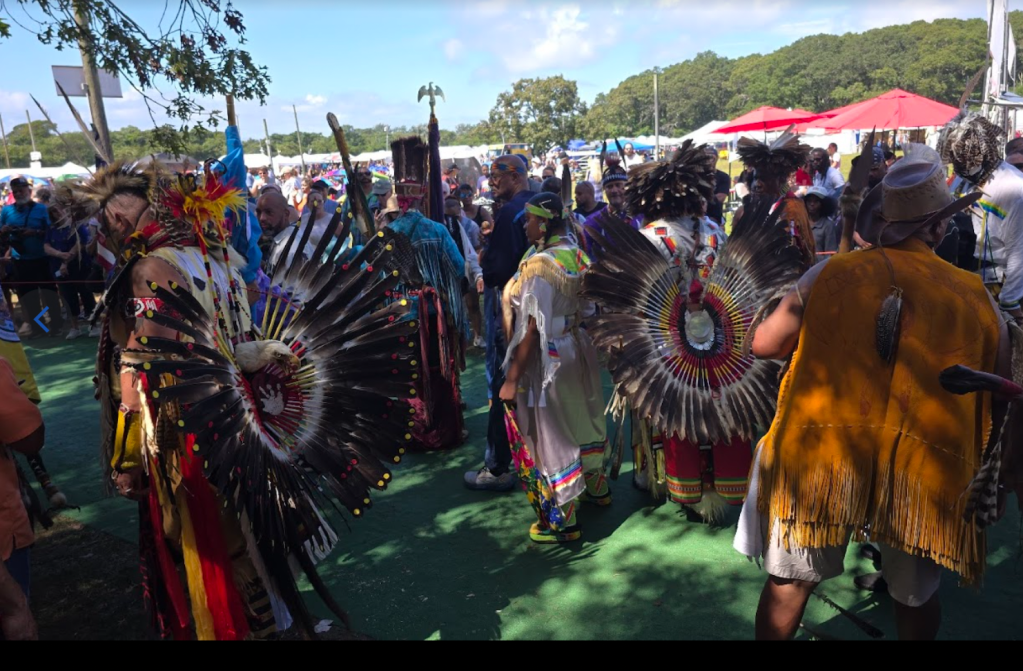
Then there came a moment when I felt extremely uncomfortable. Visitors—with my skin color—were asking to pose with Native Americans in ceremonial garb wandering through the gathering. It was as if they were being treated like Disney characters and not real people, our Long Island neighbors.
Those who live on the reservation have children and grandchildren who attend Southampton public schools and pursue higher education and careers, just like our children and grandchildren. The powwow guide featured photos and descriptions of their students pursuing Arizona Sheriff Training or studying Aerospace Engineering, Business, Healthcare Administration, Kinesiology, Accountancy, Computer Information Systems, Early Childhood Education, and 2D graphic design, to name a few areas of study. One young lady dreams of working in television at NBC and is studying Media, Culture, and Communication at NYU.
There were other people profiled, as well, adorable babies born since the last powwow and children and adults recognized for excellence. Congratulations were offered to Officer Kedi Goree on her promotion to Detective with the Southampton Town Police Department. She is the first female Shinnecock member on the Southampton Police Department. Three young Shinnecock men are pictured in uniforms as new members of the Southampton Fire Department.
And how can we not celebrate and give thanks for Rosemary Graham Rogers, who served 40 years as the organist and music director for the Shinnecock Presbyterian Church, introducing a variety of musical styles and organizing all the annual holiday programs and children’s performances? She developed a program to teach tribal members piano and voice. The 94-year-young woman loves drawing and painting and has sold her handmade greeting cards at the powwow.
I left the event both happy and sad, as we drove by homes on the reservation where our Native American neighbors reside, many who live below the poverty line. I was glad we didn’t have to see the multi-million-dollar mansions of the rich and famous surrounding them on what was once native lands and still would be, if the world was a fair and just place.
As Jim drove us home from the powwow, I closed my eyes and heard the music we had listened to, saw the colorful clothing of the ceremonial dress, and the beautiful dances we had watched as I drifted in and out of sleep.
I wondered, as we start a new school year, how the children from the reservation are treated in Southampton schools. Are they ever made to feel, I don’t know, like they are outsiders or don’t belong there, when, in fact, their ancestors have lived on Long Island for about 13,000 years?
Our culture isn’t the only one plagued by prejudice and unequal treatment of people.
In our reading in the second chapter of James, the writer is scolding the young congregation for showing favoritism based on wealth and status. “My brothers and sisters,” James writes, “do you with your acts of favoritism really believe in our glorious Lord Jesus Christ? For is a person with gold rings and in fine clothes comes into your assembly, and if a poor person in dirty clothes also comes in, and if you take notice of the one wearing the fine clothes and say, ‘Have a seat, here, please,’ while the one who is poor you say, ‘Stand there,’ or ‘Sit at my feet,’ have you not made distinctions among yourselves, and become judges with evil thoughts? Listen, my beloved brothers and sisters. Has not God chosen the poor in the world to be rich in faith and to be heirs of the kingdom that he has promised to those who love him?’”
Then, in our gospel reading in Mark, we are horrified to hear Jesus dismissing the Syrophoenician woman’s request to heal her little daughter, possessed by an unclean spirit. She begs for help, and he says the unthinkable. “Let the children be fed first, for it is not fair to take the children’s food and throw it to the dogs.” He is essentially calling the woman and her people “dogs,” which was the worst kind of insult back then when dogs were not the cute pets we treat like family members today.
Jesus marvels at her persistence for her daughter’s sake, as she responds, “Sir, even the dogs under the table eat the children’s crumbs.” He tells her to go home; he has healed her little girl because of her faith. Scholars debate why Jesus treats this Gentile woman this way. Some say that Jesus reacts badly to a request for healing from a Gentile because he is weary from ministry and annoyed that she has sought him out when he is taking some time for himself. Others say that we misunderstand his tone of voice, that he was merely stating a fact and not being cruel. Still others say this underscores the reality that Jesus didn’t heal everybody who was sick. And he didn’t fix everything that was broken in his world, as others expected him to do.
Honestly, we can’t know why Jesus said what he did. But I can’t help but question why the original editors would include this story in two of the gospels (Mark and Matthew, where she is called the Canaanite woman), if not to highlight something important to us. I think we need to know that even Jesus struggled with his own cultural prejudice, probably learned from childhood. As a human being, he would struggle with all the same feelings and temptations that we do in the context of his ancient world. And yet, when the woman confronts him about his bad attitude, he recognizes that he was wrong! He changes his mind, and he changes his behavior! From that moment on, he is different.
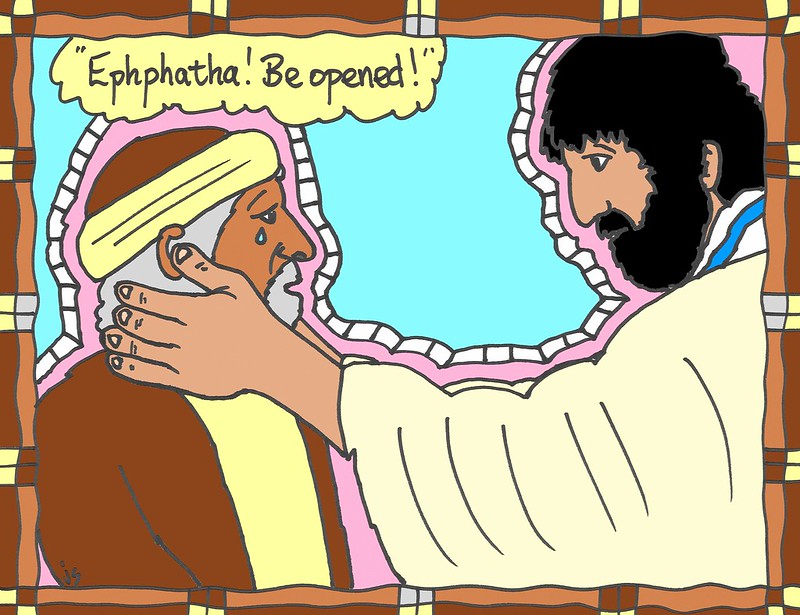
We see evidence of this change when he returns from the Gentile region of Tyre and continues to the region of the Decapolis, a center of Hellenistic and Roman culture. Some people bring him a man who is deaf, with impaired speech, and beg for Jesus to lay hands on him and heal him. He responds by taking the Gentile man away from the crowd. He puts his fingers in his ears and uses his own saliva on the man’s tongue to heal him. Jesus looks up to heaven, lets out a great sigh, and says, “Ephphatha!” or “Be opened!” as Mark translates.
The man’s hearing is restored and his tongue “released.” From now on, he can speak “plainly.” He is returned to life to the fullest in his community and is no longer without voice.
This “Ephphatha” or “Be opened!” moment captures my imagination, as it comes after he almost blunders with a woman seeking the healing of her little girl, possessed by a demon. It’s as if Jesus himself has gained a new understanding of who he is and what he is called by God to do. His mind has been opened and never again will he see things the same way.
And it’s like this with you and me, my friends. When we worship, study the Bible, and seek to walk with Christ each day, we begin to see things in a different way. In this Season of Creation, we are becoming more aware, with the Spirit’s help, of our broken relationships with our human and non-human neighbors. We cannot help but be persuaded to have a change of mind and heart—to look inside ourselves and to hope and act with Creation, seeking to mend what is broken, heal what is hurting, and work for peace and reconciliation.
Maybe it’s coincidence, or maybe it’s the Spirit’s timing. This week we received an email inviting us to join in our synod’s mission to help with home repairs on the Shinnecock reservation. Even if we are not able to attend and physically help them on September 28, I have included information about the mission in our bulletins for you to share with others and as a reminder for us to hold the Shinnecock people in our prayers, just as the Presbyterian church on the reservation does every week—offering prayers of thanksgiving and hope for the continued health, prosperity, and unity of the people.
May we continue to have these moments, my sisters and brothers, along our faith journeys, moments of “Ephphatha!” or “Be opened!” that will change our hearts, minds, and lives forever, just as it did for the Gentile man whom Christ healed in the gospel of Mark –and for all who witnessed the healing or heard the story later, though Jesus asked them to keep it a secret.
May we be moved to share our testimonies and proclaim the goodness of our Lord, as those who were astounded beyond measure, saying, “He has done everything well; he even makes the deaf to hear and the mute to speak.”
Let us pray.
God our Creator, thank you for your love for us and for the example of your Son, who struggled with many of the same feelings and temptations with which we struggle. Thank you for your grace, when we don’t always get things right the first time. Open our eyes to what we need to see about ourselves and our relationships with human and nonhuman creatures. Help us to hear your voice clearly and find the right paths for our lives. Transform our hearts and minds so that we may be used as vessels of healing and instruments of your peace. In our name of your Son we pray. Amen.

