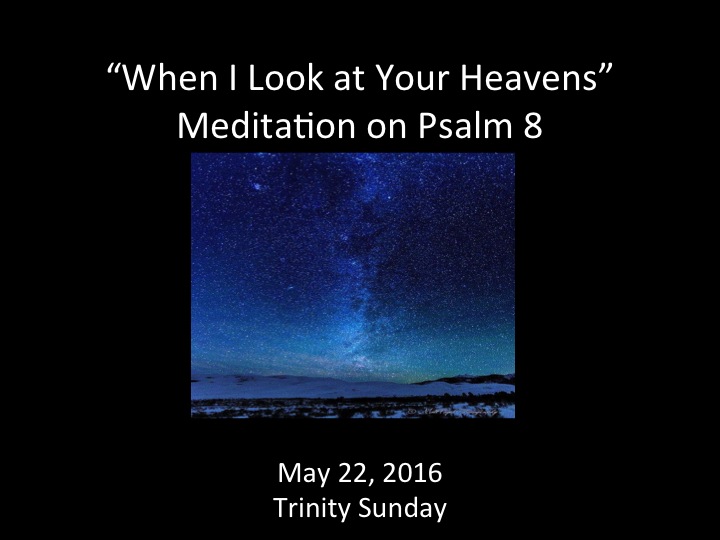
“When I Look at Your Heavens”

Meditation on Psalm 8

May 22, 2016

Trinity Sunday: MIPC

Slide01


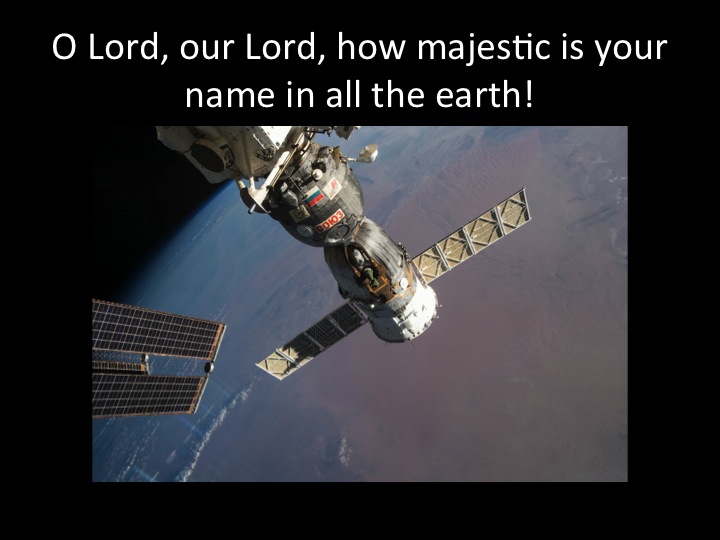
To the leader: according to The Gittith. A Psalm of David. O Lord, our Lord,
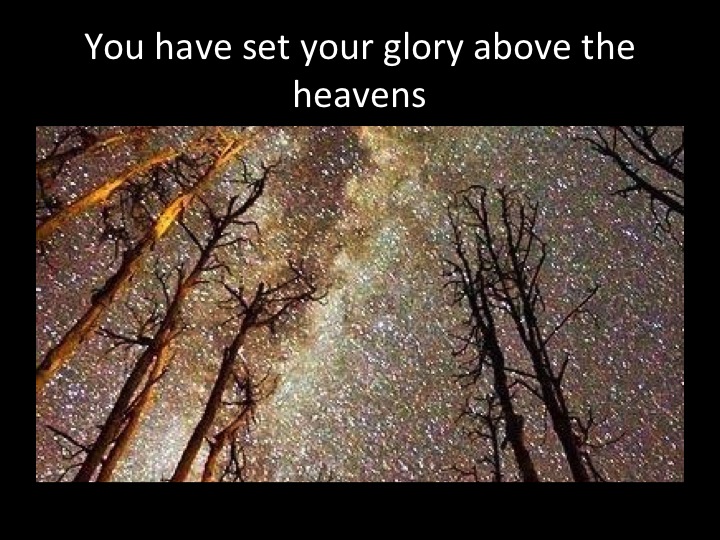
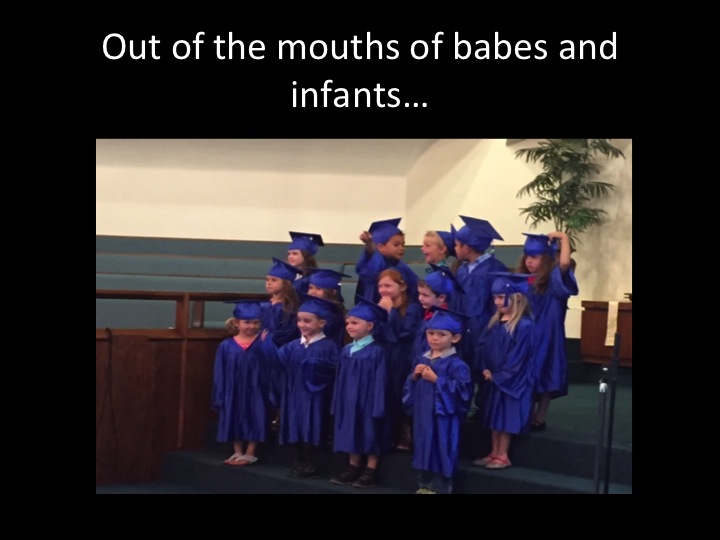
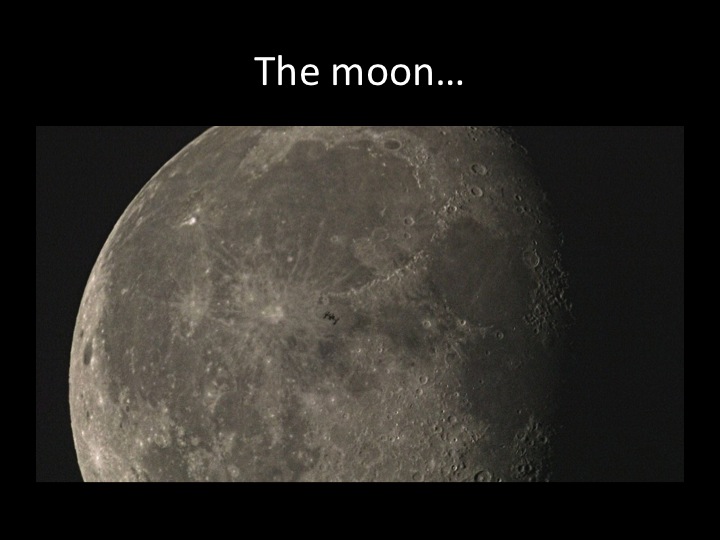
how majestic is your name in all the earth! You have set your glory above the heavens. Out of the mouths of babes and infants you have founded a bulwark because of your foes, to silence the enemy and the avenger. When I look at your heavens, the work of your fingers, the moon and the stars that you have established; what are human beings that you are mindful of them, mortals that you care for them? Yet you have made them a little lower than God, and crowned them with glory and honor.
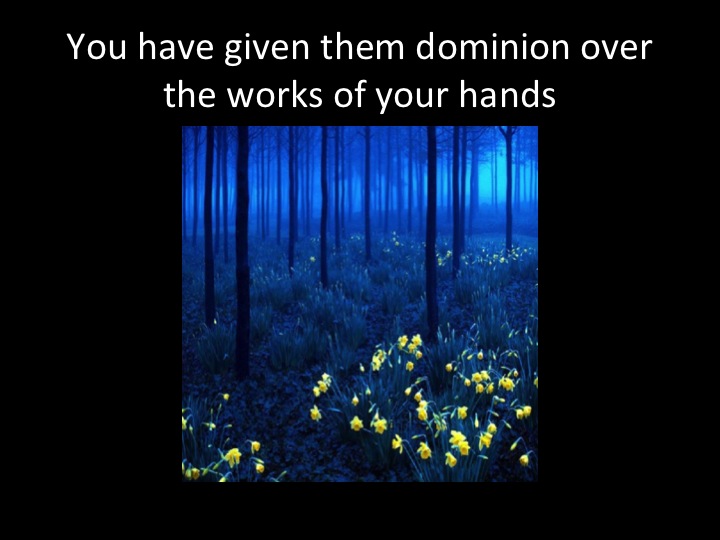
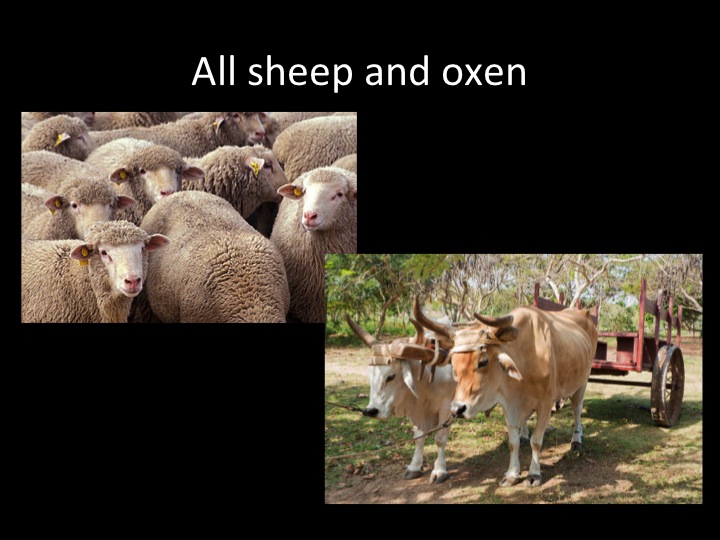
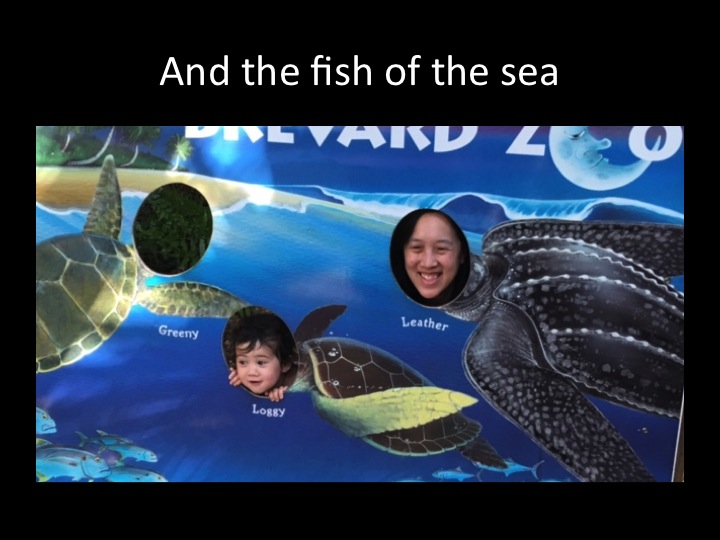
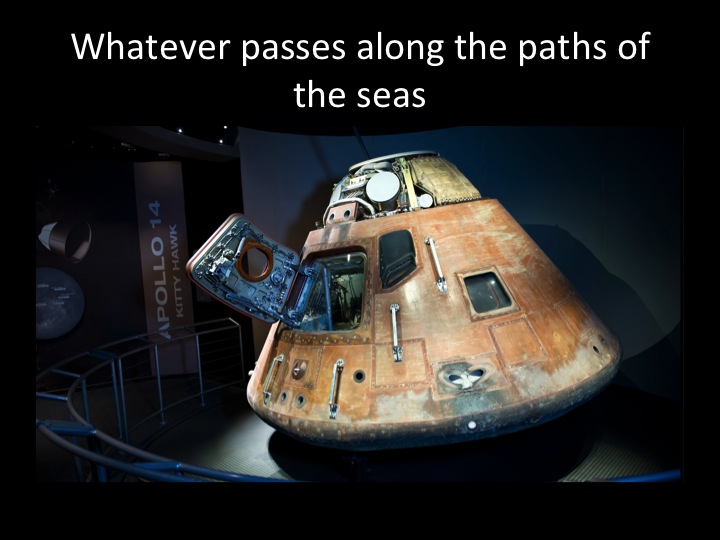
You have given them dominion over the works of your hands; you have put all things under their feet, all sheep and oxen, and also the beasts of the field, the birds of the air, and the fish of the sea, whatever passes along the paths of the seas. O Lord, our Lord,
how majestic is your name in all the earth!

***

When our granddaughter, Jessi, came to visit us last weekend, I was in awe of the little girl. She had changed so much since the last time we had seen her at her home in Boston–when she was only 10 months old, not yet walking, and hardly talking. We wanted to get to know her, but she and her parents, Daniel and Hiu-fai, were only staying with us 3 days. I found myself watching her intently–making mental note of her expressions, the sound of her voice, her laughter, her likes and dislikes. What made her sad or afraid.

Happily, she still had many new things to experience with us here, her first time in Florida! They went to the beach.

Slide02

Jessi liked the water, but was a bit intimidated by the ocean! She loved playing in the sand.

Slide03

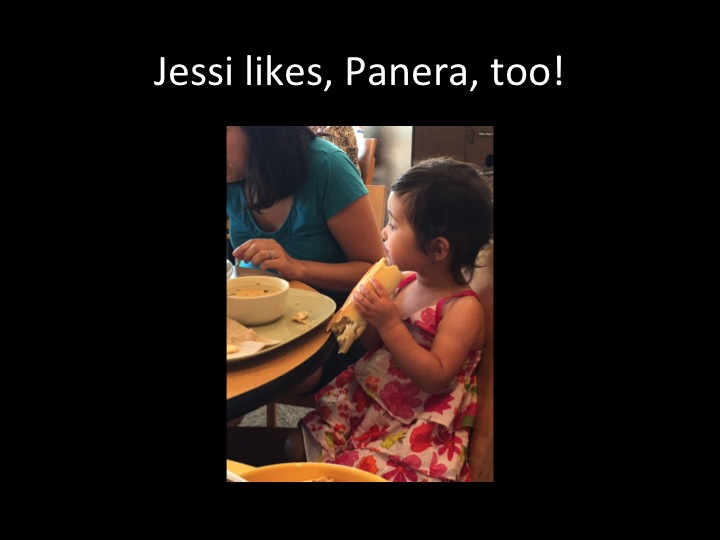
After church on Sunday, we went to lunch and learned that Jessi loves Panera bread!

Slide04

We went to the zoo after that. Jessi saw her first baby giraffe!

Slide05

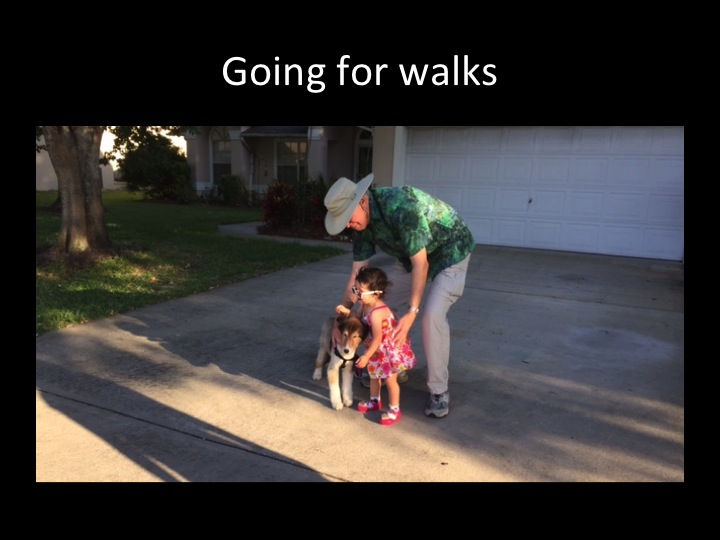
We went on a walk in our neighborhood. slide Jessi made friends with Molly, our sheltie.

Slide06

The friendship grew to love.

Slide07


Slide08


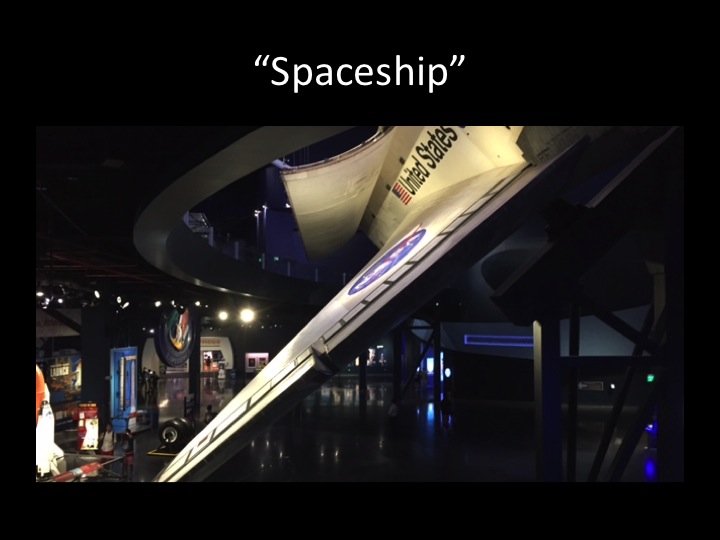
On Monday, our last full day together, we went to Kennedy Space Center.

Slide09

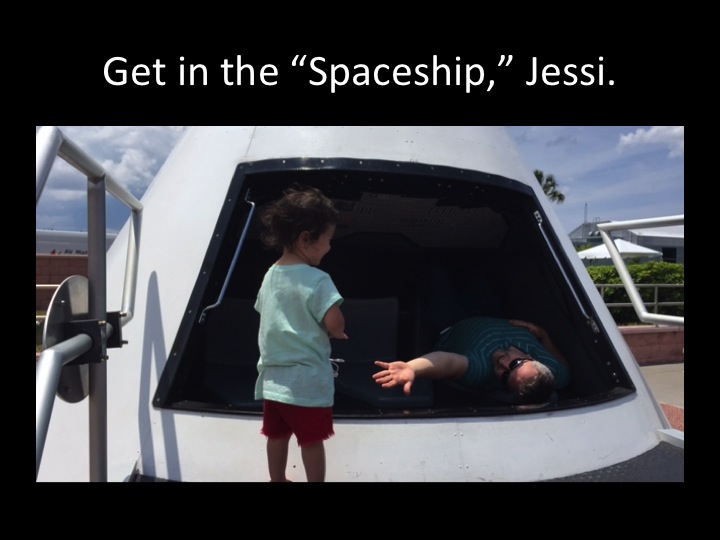
Jessi was excited about seeing “spaceships.”

Slide10

Slide11

Slide12

Slide13

Slide14

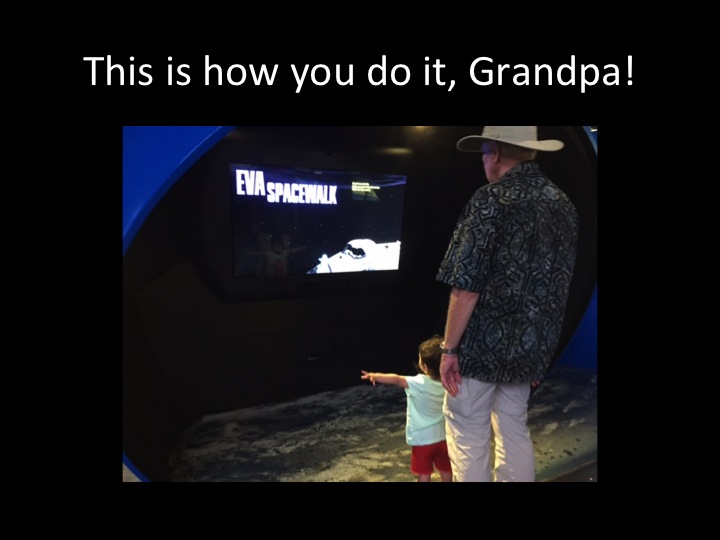
She showed Grandpa how to spacewalk.

Slide15


On the way to the Vehicle Assembly Building, Jessi sang, “The wheels on the bus go round and round.”

Slide16


We experienced many touching moments together that day. I particularly enjoyed the newest Imax feature, “A Beautiful Planet.”

Slide17

The movie provides breathtaking views of our world, and shares the hopes for future space exploration. But it also highlights the need to take better care of our beautiful planet. Cosmonauts went into space to learn and experience new worlds; they came back with revealing photos of the earth, wounded by human abuse, giving us new understandings of the world in which we live.

I felt inspired, as well, when we listened to the 1962 clip of Kennedy’s, “We go to the moon speech” at one of the exhibits.

Slide18

No doubt it helped change the course of history and lifted our country out of fear and into hope. Here is a small excerpt. “I do say that space can be explored and mastered without feeding the fires of war,” said JFK, “without repeating the mistakes that man has made in extending his writ around this globe of ours. There is no strife, no prejudice, no national conflict in outer space as yet. Its hazards are hostile to us all. Its conquest deserves the best of all mankind, and its opportunity for peaceful cooperation may never come again. But why, some say, the Moon? Why choose this as our goal? And they may well ask, why climb the highest mountain? Why, 35 years ago, fly the Atlantic? Why does Rice play Texas? We choose to go to the Moon! … We choose to go to the Moon in this decade and do the other things, not because they are easy, but because they are hard; because that goal will serve to organize and measure the best of our energies and skills, because that challenge is one that we are willing to accept, one we are unwilling to postpone, and one we intend to win …”

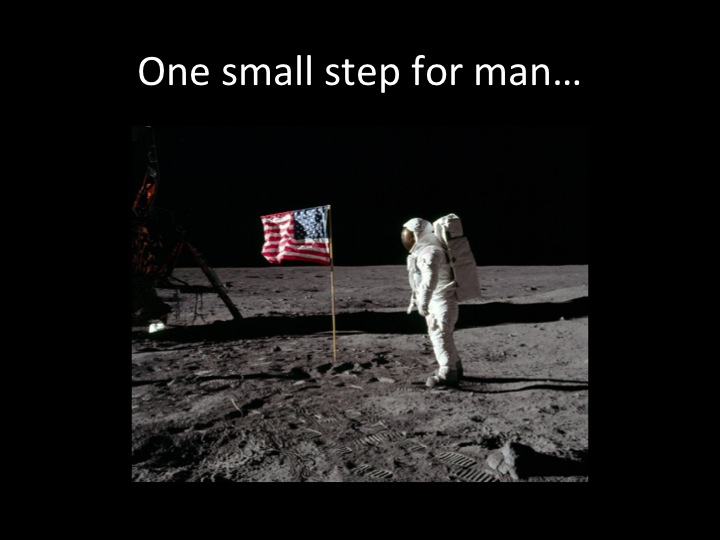
Well, you know how the 60s ended. We did get to the moon and safely back.

Slide19

What you might not know is that Psalm 8 went to the moon, too, with the Apollo 11 mission. It went on a disc the size of a silver dollar; with messages from 73 other countries; God’s Word remains there today.

***

Psalm 8 is the first hymn of praise in the book of Psalms; its poetic voice is personal–“I” and “You”– conveying the intimate relationship between God and the psalmist. It is one of a large collection of “psalms of David,” which could mean that David wrote them or commissioned them to be written or authorized them for use. We know this psalm was used in worship because there are notes to the worship leader after the title, “to the leader, according to the Gittith.” Gittith may be the tune to which it is sung or a stringed instrument–perhaps a zither– that was played as the psalm was sung.

The Psalm’s focus is on creation, taking us back to Genesis. The first line–repeated at the end — is difficult to translate. The first word is the proper name of God –YHWH–which isn’t spoken in Hebrew because of its holiness. It is translated “Adonai” meaning “Lord” or “our Lord.” Like Abraham when he longed for a child, the psalmist looks up at the night sky with awe and wonder as he both praises and questions the Lord.

If you are a little puzzled by the second verse that begins–“Out of the mouths of babes and infants.” Don’t be feel badly. Scholars struggle with this verse, too. Many believe it to be another illustration of what seems to be weak and foolish in this world to human beings is, in God’s reality, what is wise and strong. The young children’s song of praise to God will serve as protection from God’s enemies.

Looking at God’s creation, the psalmist can’t help but compare human beings with the Lord. For it is when we seek to know the Lord better that we begin to see and understand ourselves as we really are. In the face of God’s magnificent acts of creation, the psalmist realizes how seemingly unimportant and insignificant human beings are. And yet, we aren’t unimportant or insignificant to God! The psalmist asks in verses 3 and 4,

Slide21

The psalmist describes how the Lord views human beings, created in God’s image. We are just a “little lower than God,” says verse 5. The word, elohim, translated “God” here is sometimes translated as “gods” with a small g or “divine beings.” If we connect this passage to the elohim in the story of Creation, then it makes sense to translate elohim as it is in Genesis–God. We find something different from the author of Hebrews. He translates this word “angels” when he interprets Psalm 8. He speaks from a New Testament perspective, as Hebrews testifies to God’s love for us revealed in the sacrifice of his Son for our sakes.

Slide22


Psalm 8:5 tells of God’s gifts and expectations of us with royal language. God has “crowned” human beings with “glory and honor and given them dominion over the works of (God’s) hands.” God expects us to tend and care for the Creation–just like when the Lord formed man from the dust of the earth and put him in the garden to “tend it and keep it.” The “works of God’s hands” are “all things” God has created. The earth, air, water, plants, animals, human beings are “under our feet.” They are not ours to trample, crush or destroy, but to watch over and care for–for all of our days.

***

My message today, on this day we honor our new graduates, is especially for our young adults. You will change in the years to come. You are already not what you were when you woke up this morning. Trust the Spirit. Embrace the changes. Don’t be afraid.

God loves you and wants a relationship with you even more than Jim and I long to have a relationship with our little granddaughter who lives in Boston. The Lord wants to be your comfort and strength and help you as you experience new things. But you have to seek to have a relationship with the Lord. God wants to hear your voice, your laughter; share your likes and dislikes. God also wants to be the one you go to when no one else seems to be listening, when no one else seems to care.

God will always be there.

Keep on hoping and dreaming, though the going may get hard. And it may take years of overcoming obstacles and fears, possibly failures, too, before you begin to see your visions coming true. Our nation’s space exploration story is one of hopes and dreams, with years of struggle, fears and failures, the greatest of which was the loss of astronauts’ lives. We have more obstacles to overcome ahead–especially as we set our sights on Mars. But we have successes behind us, including what most people thought before 1969 was never going to happen–we went to the moon and safely back!

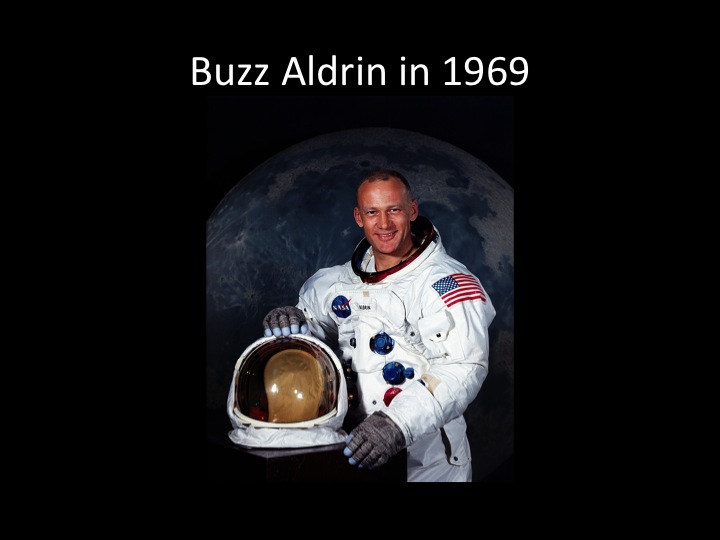
On the Apollo 11 mission, astronaut Buzz Aldrin,

Slide23


an elder in a Presbyterian church in Houston, read aloud Psalm 8:


Slide24

You have set your glory above the heavens.

Slide25

Out of the mouths of babes and infants you have founded a bulwark because of your foes, to silence the enemy and the avenger.

Slide26


Slide27

the moon

Slide28Slide29

and the stars that you have established;

what are human beings that you are mindful of them,

Slide30

mortals that you care for them?

Slide31

Yet you have made them a little lower than God,

Slide32

and crowned them with glory and honor. You have given them dominion over the works of your hands;

Slide33

you have put all things under their feet,

Slide34

all sheep and oxen,

Slide35


and also the beasts of the field,

Slide36

the birds of the airSlide37


and the fish of the sea

Slide38

whatever passes along the paths of the seas.

Slide39

O Lord, our Lord, slide how majestic is your name in all the earth!

Slide40

Let us pray. Majestic Lord, we lift up your Holy Name and give you our thanks and praise! We come to you as weak and frail human beings, seemingly insignificant and unimportant. But we are not insignificant and unimportant to you, our Lord! Thank you for your love and for making us in your image, but a little lower than you, and for crowning us with glory and honor, though we don’t deserve royal treatment. Thank you for entrusting your beautiful Creation to us to tend and keep, to watch over and care for. Help us, our Lord, to better care for our world, to be more faithful stewards of the works of your hands. Lead us to share your love and healing Words with a wounded and broken world. And we ask that you continue to guide, strengthen and bless the teens and young adults of our church family. Lead them to walk in the paths you want them to go–and to hold on to their faith, no matter what. We ask these things in your Son’s precious name. Amen.

“Living the Spirit-filled Life”

Slide01

Meditation on Acts 2:1-21

Pentecost 2016/MIPC

     When the day of Pentecost had come, they were all together in one place. And suddenly from heaven there came a sound like the rush of a violent wind, and it filled the entire house where they were sitting. Divided tongues, as of fire, appeared among them, and a tongue rested on each of them. All of them were filled with the Holy Spirit and began to speak in other languages, as the Spirit gave them ability. Now there were devout Jews from every nation under heaven living in Jerusalem. And at this sound the crowd gathered and was bewildered, because each one heard them speaking in the native language of each. Amazed and astonished, they asked, ‘Are not all these who are speaking Galileans? And how is it that we hear, each of us, in our own native language? Parthians, Medes, Elamites, and residents of Mesopotamia, Judea and Cappadocia, Pontus and Asia, Phrygia and Pamphylia, Egypt and the parts of Libya belonging to Cyrene, and visitors from Rome, both Jews and proselytes, Cretans and Arabs—in our own languages we hear them speaking about God’s deeds of power.’ All were amazed and perplexed, saying to one another, ‘What does this mean?’ But others sneered and said, ‘They are filled with new wine.’

       But Peter, standing with the eleven, raised his voice and addressed them: ‘Men of Judea and all who live in Jerusalem, let this be known to you, and listen to what I say. Indeed, these are not drunk, as you suppose, for it is only nine o’clock in the morning. No, this is what was spoken through the prophet Joel:
“In the last days it will be, God declares,

       that I will pour out my Spirit upon all flesh,
and your sons and your daughters shall prophesy,
and your young men shall see visions,
and your old men shall dream dreams.
Even upon my slaves, both men and women,
in those days I will pour out my Spirit;
and they shall prophesy.
And I will show portents in the heaven above
and signs on the earth below,
blood, and fire, and smoky mist.
The sun shall be turned to darkness
and the moon to blood,
before the coming of the Lord’s great and glorious day.
Then everyone who calls on the name of the Lord shall be saved.

****

It started with, “I like your dress.” That’s what I said to the little brown-haired girl squirming on the bench in front of me on Saturday morning.

Jim and I were gathered with a crowd in a large gymnasium in Marshall, Minnesota, waiting for commencement to begin. Our youngest son, James, was graduating from Southwest Minnesota State University with a bachelor’s degree in social work.

Slide02


I was happy for him and proud that he chose to stay in Minnesota on his own to finish his senior year of college when we moved to Florida last fall. But I was sad, too. We hadn’t seen him since Christmas. And we were returning to Florida on Sunday. We would have 1 day and 1 night–a supper and a breakfast together–and that’s all. It will probably be months before we see him again.

The little brown haired girl wore a sleeveless, flowered dress.

Slide03


She was about 6 or 7 years old. She methodically tapped the bottoms of 2 “Dixie” cups together, staring off with a glum expression.

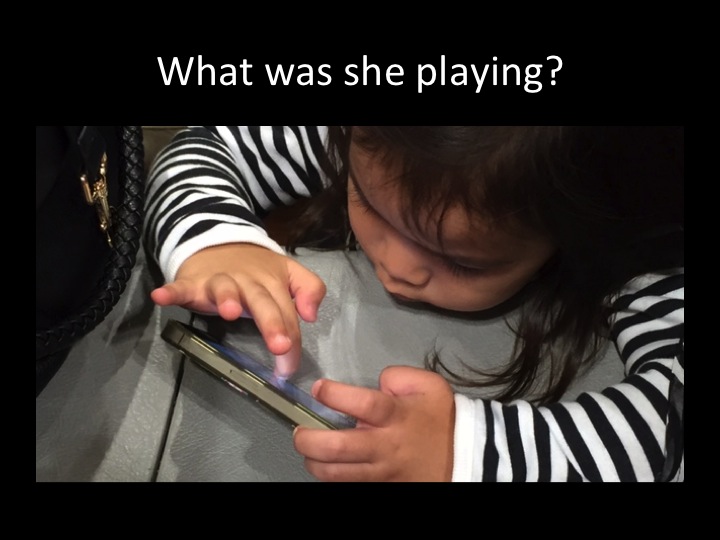
The older woman sitting quietly beside her wore the traditional dress of her culture and the coverings of her faith. Another little brown haired girl–who looked about 3 –sitting on the other side of the woman was staring intently at the woman’s phone.

Slide04


She was playing some kind of a game. Turned out it was, “Hello Kitty Nail Salon.” She rubbed her fingertips on the screen back and forth until bright color was filled in for each nail. Then she added Hello Kitty art.

Slide05

Slide06

“I love Hello Kitty!” I said and motioned to my Hello Kitty purse on the floor and my Hello Kitty phone cover.

Slide07

The little girls laughed and included me in their game after that, showing me every nail they filled in and every design they chose. They squealed with delight when they painted the nails a sparkly blue–and pointed to mine, some of which are sparkly blue.

We laughed together. Then, I showed them photos of Hello Kitty Nail Art from Google.

Slide08

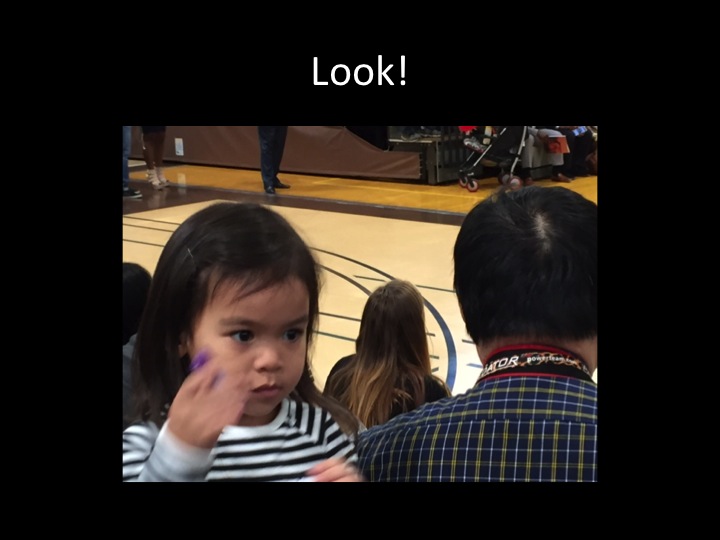
Excited, their voices grew louder. And a man dressed in traditional garb, sitting next to the 3-year old girl, turned to the children and said something in a firm voice in a language I didn’t know. But from his serious expression, I am pretty sure he was telling them to be quiet and sit still, cause that’s what they did–for a minute or 2.

The graduation exercises had begun. Then all the speeches. Then the graduates came walking in to “Pomp and Circumstance.” And there was James!

Slide09


Not long afterward, the little girls left the room with the man. I worried that maybe I got them into trouble. I shouldn’t have worried. They had visited one of the vendors in the lobby. They came back carrying lip gloss with Disney’s “Frozen” characters.

Slide10

Slide11

I complimented them on their purchases and told them how grown up they looked with their lip gloss “makeovers.”


Slide13


Slide12


They looked pleased with themselves.

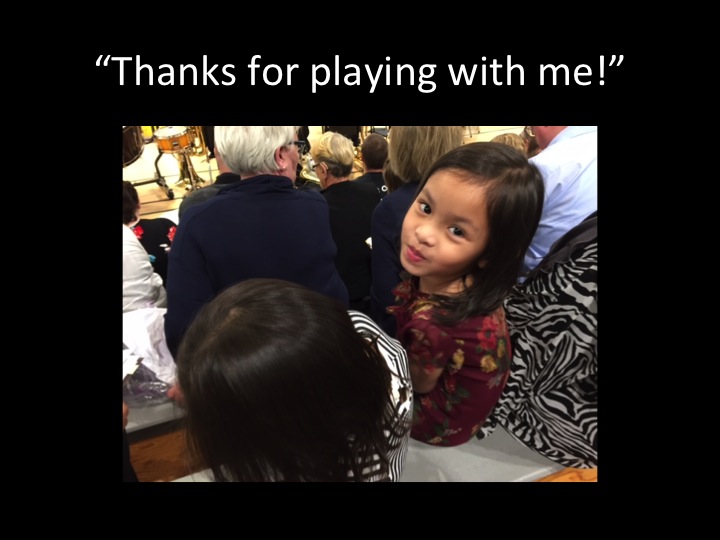
The family left before the end of commencement. But before they left, the little brown haired girl of 6 or 7 turned to me suddenly and said very seriously, “Thank you for playing with me!”

Slide14


“It was my pleasure,” I said. “Thank you!”

As they walked away, I realized that my mood had lifted almost instantly with our Hello Kitty exchange. A breath of fresh air blew into our minds and hearts. As we left the gym, I thought about how the Spirit visits us each day, comforting, teaching and guiding us in big and small ways that we might not even notice.

I hadn’t planned on reaching out with the love and joy of Jesus Christ that day. I only thought of my own and my family’s needs and desires. But the Spirit used me, anyway, because it’s always with me, even if I forget. It led me to reach out to a little brown haired girl from a different culture. Because the Spirit won’t stop working in us to do the reconciling work of the Lord until that Great Day when Jesus returns for His Church.

Something stirred my heart to speak to her–not to tell her that Jesus loved her, perhaps, but to show Jesus’ love with a simple, encouraging word.

The healing conversation started with, “I like your dress.”


Slide15


My experience with the Spirit at commencement was but a glimmer of what the followers of Jesus Christ experienced in Acts 2; 120 of Christ’s followers gather in a house in Jerusalem to pray and wait on the Spirit, as Jesus told them to do. The followers include Mary, the mother of Jesus, Jesus’ brothers and the original 12 disciples except for Judas Iscariot; Matthias was chosen to take Judas’ place. We don’t know what kind of a house it was or if it was the upstairs room mentioned in the first chapter. It could possibly have been the Temple as that is referred to as a “house–” the house of God. The problem is they were “sitting together”; they didn’t usually sit when they worshiped in the Temple.

“Pentecost,” by the way, is Greek for “50th day.” Pentecost falls 50 days after Passover and is a pilgrimage festival called “Shavuot” in Hebrew or “Feast of Weeks.” It marks the giving of the 10 commandments to Moses, and the book of Ruth is traditionally read.

So Jerusalem is crowded with “devout” pilgrims coming from the diaspora to worship the Lord and be with God’s people. Here are some of the places mentioned. Is it “every nation” in the whole world?

Slide16

Not quite. Scholars say the language points to the future fulfillment of the Great Commission in Matthew.

And what of this “sound … like the rush of a violent wind”?

Slide17

This wind–or what sounded like a fierce wind– enables every person to hear the message of the Risen Christ in his or her native language, though it was preached by Jesus’ disciples from Galilee, who couldn’t possibly know that many languages. This fulfills Old Testament prophesy of Joel 2:28-32 that Peter quotes beginning at verse 17 and the promise of resurrection for Israel in Ezekiel 37:13-14: “13And you shall know that I am the Lord, when I open your graves, and bring you up from your graves, O my people. 14I will put my spirit within you, and you shall live…”

But even though every person hears and understands, not everyone believes. Some are amazed and others “sneer,” accusing them of being “filled with new wine.” New wine hasn’t had time to begin turning to vinegar and the alcoholic content is at its height. Here is a 1st century wine pressing trough in Jerusalem.


Peter responds to the scoffers, “Drunk? We’re not drunk. It’s only 9 o’clock in the morning!” Don’t you love that? This is Peter, who didn’t always say the right things. It’s like he’s saying, “Well, we could be drunk–if it were later in the day!”

Slide20

But this is Peter, powered by the Spirit. Suddenly he is eloquent and bold, preaching his first sermon from verse 14 to 39. He doesn’t hold back, despite the fact that what happened to Jesus could easily happen to him. In verse 36, Peter declares, “Therefore let the entire house of Israel know with certainty that God has made him both Lord and Messiah, this Jesus whom you crucified.”

Slide22

When many of the people heard this, they were “cut to the heart” and asked Peter and the other apostles, “Brothers, what should we do?” Peter answers, in verse 38, “Repent and be baptized every one of you in the name of Jesus Christ so that your sins may be forgiven and you will receive the gift of the Holy Spirit.”

Three thousand were added to the Church that day– all because of the power of God flowing out in response to Christ’s followers faithful gathering for prayer, anticipating the coming of the Lord.

The promise of the Spirit-filled life is in vs. 21, “Everyone who calls upon the name of the Lord shall be saved.” But the Spirit that dwells within us is for God’s work and not just for our own well-being, not just for our own salvation. The Spirit came, will come, and is already here because the Lord wants to draw all people to Himself. And the Spirit won’t stop working until Christ in all His glory returns for His Church.

Slide23

So let us keep on calling on the name of the Lord–crying out to Him together, and following God’s voice in our Spirit-filled lives.

Slide24


Slide25

May we be as bold as Peter. May we allow God to use us. May we be stirred to share the message of God’s mercy and grace with the world–not just with our words, but with acts of kindness and love.

Slide26

The life-changing conversation may begin with a simple encouraging word to a little brown-haired girl sitting in front of you.

“I like your dress.”

Slide27

Let us pray.


Holy Spirit, fall afresh on us. Renew us. Transform us. Make us into the image of Jesus Christ. Change our hearts and minds so that we aren’t always just thinking of ourselves, but that we are concerned for the wellbeing of the world that doesn’t yet know your love, mercy and grace. Stir us to reach out with love and kindness to people outside our familiar, comfortable circles of friends and family. Move us to share your grace with people of different cultures, languages and faiths. Draw us to gather for prayer, like the apostles long ago, and wait expectantly for the Great Day of the Lord, when Jesus, in all His glory, returns for His Church. In his name we pray. Amen.

The Household of God

Slide08

Meditation on Acts 16:9-15

May 1, 2016

***

   During the night Paul had a vision: there stood a man of Macedonia pleading with him and saying, ‘Come over to Macedonia and help us.’ When he had seen the vision, we immediately tried to cross over to Macedonia, being convinced that God had called us to proclaim the good news to them.

    We set sail from Troas and took a straight course to Samothrace, the following day to Neapolis, and from there to Philippi, which is a leading city of the district of Macedonia and a Roman colony. We remained in this city for some days. On the sabbath day we went outside the gate by the river, where we supposed there was a place of prayer; and we sat down and spoke to the women who had gathered there. A certain woman named Lydia, a worshipper of God, was listening to us; she was from the city of Thyatira and a dealer in purple cloth. The Lord opened her heart to listen eagerly to what was said by Paul. When she and her household were baptized, she urged us, saying, ‘If you have judged me to be faithful to the Lord, come and stay at my home.’ And she prevailed upon us.


***


I can’t wait for our silent auction and luncheon today! You know that I love eating, and I hate cooking!

Slide09


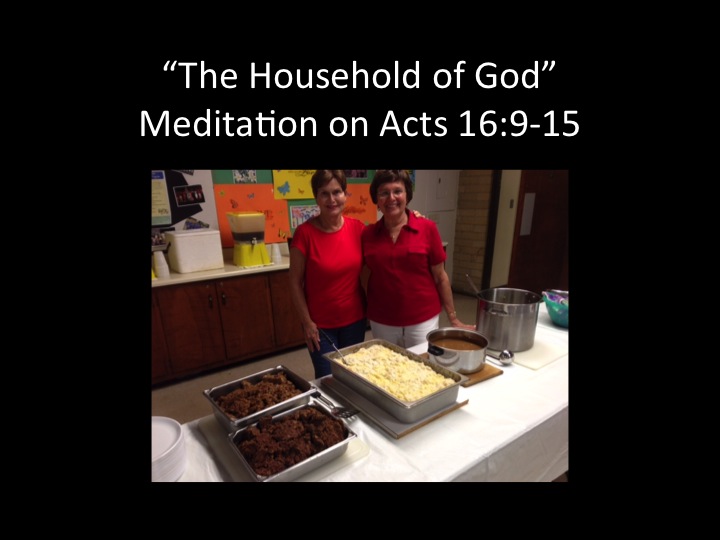
But I also look forward to the fellowship. It feels good to be with our brothers and sisters in the Lord. We are members of the Household of God, which goes beyond what we can see or imagine. When we gather at the table for a congregational meal, much like when we gather for Communion, we witness to our unity, our joy and our love.

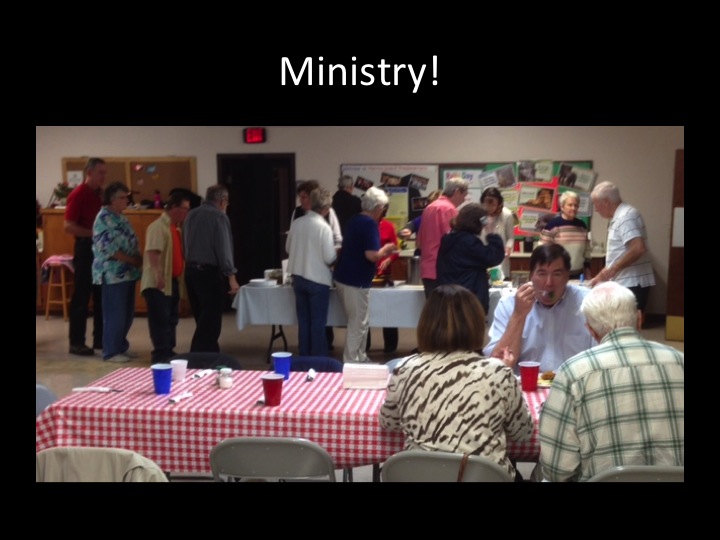
Our Tuesday night suppers have brought me peace and a feeling of closeness with all our regulars and our wonderful Fellowship Committee.

Slide10

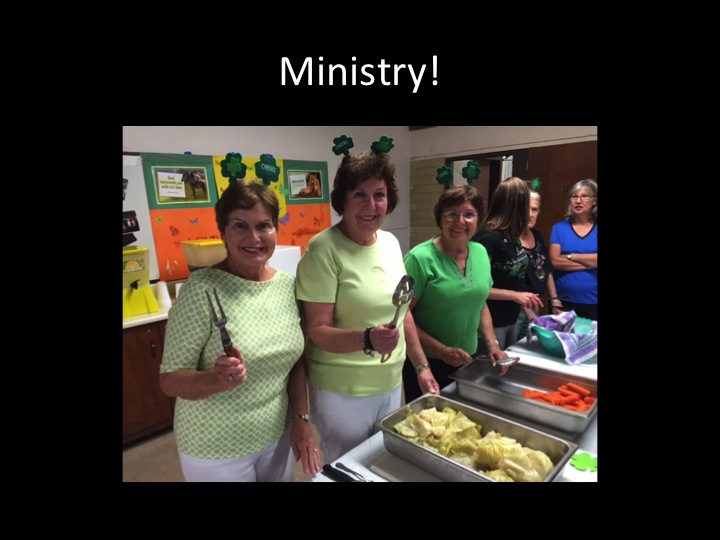
They work hard to bless us, preparing and serving meals for our congregation and friends from September through April! Very few churches offer this kind of ministry.

Slide11

If you didn’t come to our Tuesday night suppers this season, you missed out on opportunities to minister to people in need and to have others, at times, minister to you.

Slide12


Today I have yet another reason to be happy we are gathering for a congregational meal.

Slide13

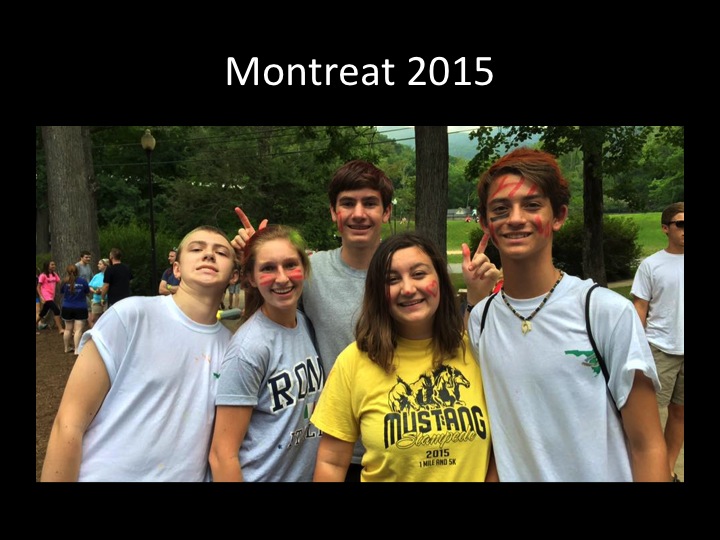
The proceeds from our silent auction will help pay for the youth to attend the Montreat Youth Conference in July. I am hoping to go with them. Friends, relationships take time and space to blossom and grow. At the conference, our teens and adult leaders will be sharing housing and eating, worshiping, studying and enjoying recreational activities together.

Slide14

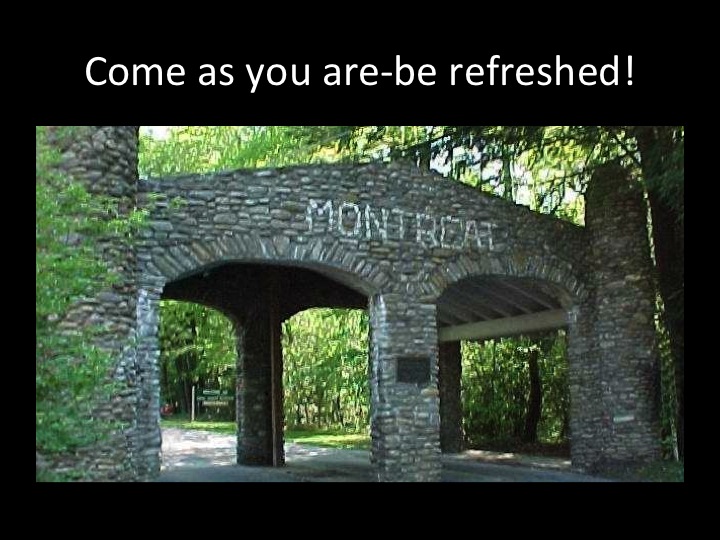
The conference, “A World of Difference”, invites teens to come just as they are, to get away from the stress and routine of their lives and be refreshed as they listen for God’s voice in a beautiful, wooded setting.

Slide15


What’s exciting about the conference is not just the spiritual and biblical teaching and inspiring worship, but that our teens will meet youth from all over the country who are trying to be Christians in what is, essentially, a secular society. I pray that our youth, coming from a congregation with so few teenagers, will be empowered and affirmed in their faith, being reassured that they are not the only teens who care about Jesus and the Church.

Slide16

It is good for them to see that they are not the only youth in the Household of God! May they be stirred to become more faithful followers, humble servants of Him.

Slide17


***


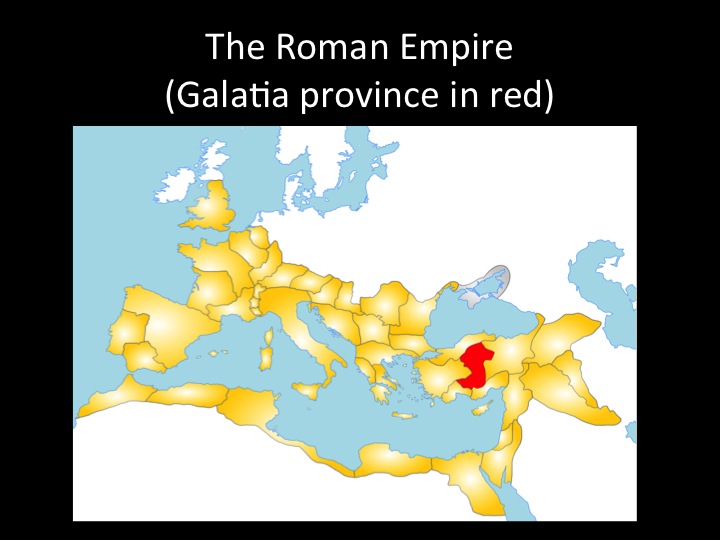
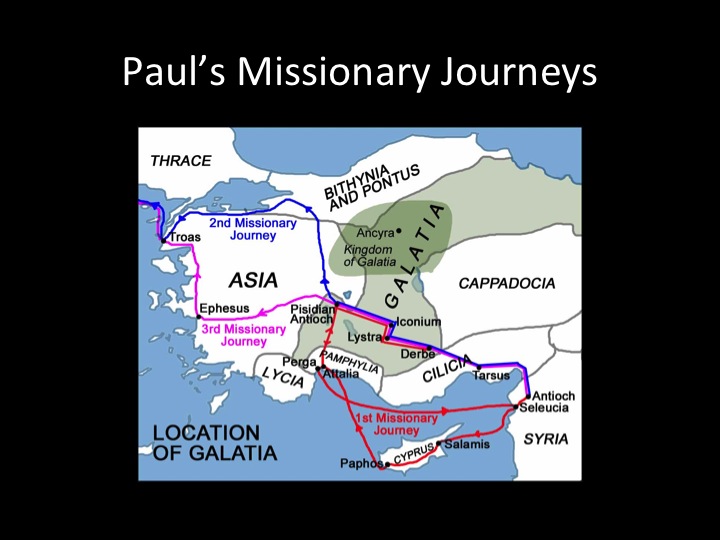
In the Acts of the Apostles, we have excellent models of Christ’s humble servants, moved to acts of kindness and hospitality. In Acts 16, Paul is journeying with Silas in the southeastern province of Galatia, visiting the cities Paul and Barnabas had evangelized 2 or 3 years before- Derbe, Lystra, Iconium, and probably Pisidian Antioch.


Slide18

At Lystra, young Timothy (believed to be a teenager at the time) joins them in their mission work. Timothy’s mother and grandmother are Jewish believers; his father is a Greek nonbeliever. The churches at this time are growing in faith and number, “day by day,” 16:5 tells us. As the three men pass through the Phyrygian and Galatian region, the Holy Spirit stops them from going to Asia and Bithynia. They end up reaching the sea at Alexandria Troas, a Roman colony and regular port of call for vessels journeying between Asia and Macedonia. Ancient Macedonia was a region north of Greece, a border territory, in what is southeastern Europe.

Slide19


In Acts 16:9, Paul sees a vision of a man of Macedonia, appealing to him for help.

Something interesting happens in the text in verse 10. The narrative voice turns from third person to first person. Let’s look at verse 10. “When he had seen the vision, we immediately tried to cross over to Macedonia, being convinced that God had called us to proclaim the good news to them.” This is the first part of the “we/I” section of Acts. Some think this means that Luke, the author, possibly the physician mentioned in Col. 4:14, joins Paul, Silas, and Timothy at this point of the journey and includes himself as a witness in the account.

The group sails and ends up, 2 days later, in Philippi, a city in Macedonia, which Luke identifies as a Roman colony, unlike the other Roman colonies that Paul evangelizes. The reason is probably because the law of a Roman colony is important to the story of Lydia. Women in Macedonia were known for their independence and under Roman law, which governed life in the colony, freeborn women with three children and freedwomen with four children were granted the right, among other privileges, to undertake legal transactions on their own initiative.

On the Sabbath, Paul, Timothy, Silas and Luke don’t go to a synagogue, as they usually do when they first enter a town. Perhaps this town didn’t have a large enough Jewish population to support a synagogue, which must, by Jewish law, have at least 10 men at every service. They go outside the gate of the city by the bank of the river Gangites. They have heard about a group of faithful women who gather at the river on every Sabbath to go through the Jewish service of prayer. They sit down with them, and Paul begins teaching them about Jesus.

Slide22


It’s important that this story follows Peter’s vision of the meat blanket and God’s Kingdom being opened to all people–Jew and Gentile– and the Jerusalem Church coming to agree with him. For one of the women–Lydia, a name that means “the Lydian woman,” is a God-fearing Gentile from Thyatira, a province of Asia. Thyatira lay in the territory of the ancient kingdom of Lydia. The people of that area were famous for the manufacture of purple dye, extracted from the juice of the madder root. Lydia had come to Philippi as a trader in that dye.

Verse 14 tells us that God initiates Lydia’s conversion. “The Lord opened her heart to pay heed to what Paul was saying.” Notice that it isn’t an intellectual understanding that makes her a Christian! Her heart is open to hearing from the Lord. Lydia, who is Paul’s first convert in Europe, is immediately baptized in the river, along with her whole household.

This is one of at least 4 instances in Acts when an entire household is baptized after the head of the household comes to believe. This happens with Cornelius in Acts 10 and 11, with the Philippian jailer later in Acts 16, and with Crispus in Acts 18. Lydia’s is the only account when the head of the household is a woman. This brings to mind Peter’s promise in Acts 2 to the new believers in Jerusalem who heard his preaching and were “pierced to the heart”: “Repent, and each of you be baptized in the name of Jesus Christ for the forgiveness of your sins; and you will receive the gift of the Holy Spirit. For the promise is for you and your children and for all who are far off, as many as the Lord our God will call to Himself.”

Lydia’s household would include more than just her immediate family; as would the households of Cornelius, the Philippian jailer, and Crispus; it would also include servants and other dependents. We don’t know if Lydia is married or a widow; Luke doesn’t tell us. But it’s clear that Luke intends for her acts of kindness and hospitality to be proof of her devotion to the Lord and His Church. Verse 15 says, “When she and her household were baptized, she urged us, saying, ‘If you have judged me to be faithful to the Lord, come and stay at my home.’ And she prevailed upon us.” Other translations say, “She would take no refusal.”

God opened her heart; she, in turn, joyfully opened her home. She wouldn’t take no for an answer!

And the word “household” came to have a broader meaning for Christians than just families, servants and other dependents living together. Household came to mean the Church of every time and place, connected by one Savior, one faith.

Paul tells the Ephesians, in chapter 2:19-20: “So then you are no longer strangers and aliens, but you are citizens with the saints and also members of the household of God, built upon the foundation of the apostles and prophets, with Christ Jesus himself as the cornerstone.”

***

Brothers and sisters, I thank you for your kind support of the youth! Thank you for your donations, your encouragement of them and your love and prayers for those who may be, because of their youth and all the pressures they feel in this secular world, the most vulnerable members of the Household of God. May the Lord open the hearts of all who attend the conference–adults and teens– and may they feel the peace and joy of God’s loving presence on their journey there and back. May the Spirit stir them to renew their commitment to Christ so that they may go and share God’s love with the world.

Slide24

Like Lydia, may they be moved to acts of kindness and hospitality as Christ’s ever-faithful followers, humble servants of Him.


Let us pray.


Heavenly Father, thank you for your love and grace that led you to give up your only Son, the Risen Savior, for our sakes! Thank you for opening our hearts so that we, like Lydia, Cornelius, Crispus, and the Philippian jailer would hear your voice and be stirred to be your followers. Be with our youth, Lord, as they seek to witness to your saving love in a secular world, where so many young people don’t have hearts to love you and serve the Church. Bless the youth leaders and other volunteers as they seek to nurture our young people and lead them on straight paths. Stir us all to pray more, to gather in quiet places like Lydia and the other woman at the river Gangites. Empower us to acts of kindness and hospitality that give evidence of the authenticity of our faith and build up the Household of God. Help us to be your humble servants. In Christ we pray.


Even the Gentiles…

Slide01

Meditation on Acts 11:1-18

April 24, 2016

Now the apostles and the believers who were in Judea heard that the Gentiles had also accepted the word of God!! So when Peter went up to Jerusalem, the circumcised believers criticized him, saying, ‘Why did you go to uncircumcised men and eat with them?’ Then Peter began to explain it to them, step by step, saying, ‘I was in the city of Joppa praying, and in a trance I saw a vision. There was something like a large sheet coming down from heaven, being lowered by its four corners; and it came close to me. As I looked at it closely I saw four-footed animals, beasts of prey, reptiles, and birds of the air. I also heard a voice saying to me, “Get up, Peter; kill and eat.” But I replied, “By no means, Lord; for nothing profane or unclean has ever entered my mouth.” But a second time the voice answered from heaven, “What God has made clean, you must not call profane.” This happened three times; then everything was pulled up again to heaven. At that very moment three men, sent to me from Caesarea, arrived at the house where we were. The Spirit told me to go with them and not to make a distinction between them and us. These six brothers also accompanied me, and we entered the man’s house. He told us how he had seen the angel standing in his house and saying, “Send to Joppa and bring Simon, who is called Peter; he will give you a message by which you and your entire household will be saved.” And as I began to speak, the Holy Spirit fell upon them just as it had upon us at the beginning. And I remembered the word of the Lord, how he had said, “John baptized with water, but you will be baptized with the Holy Spirit.” If then God gave them the same gift that he gave us when we believed in the Lord Jesus Christ, who was I that I could hinder God?’ When they heard this, they were silenced. And they praised God, saying, ‘Then God has given even to the Gentiles the repentance that leads to life.’ 


***


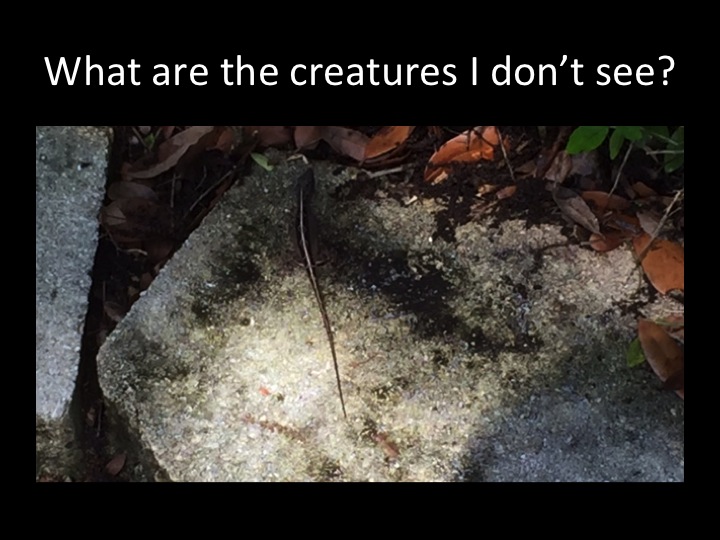
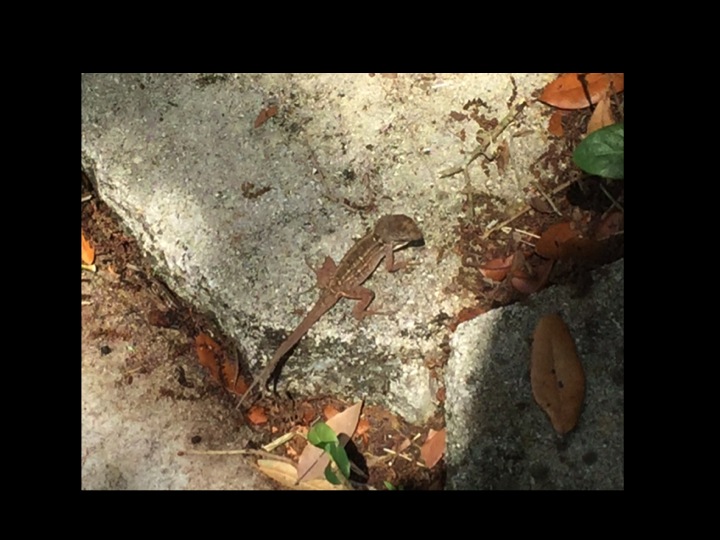
I have enjoyed my “winter” and now “spring” in Florida, especially being able to get out of the house every day and go for a walk. When I was walking this week with my son, Jacob, looking at my surroundings and enjoying the sunshine, I wondered, what are the creatures that I don’t see? Of course, at each step, the sidewalk and the flowerbeds seem to come alive with those lizard-like creatures, scampering about. What are they?

Slide02

Slide03


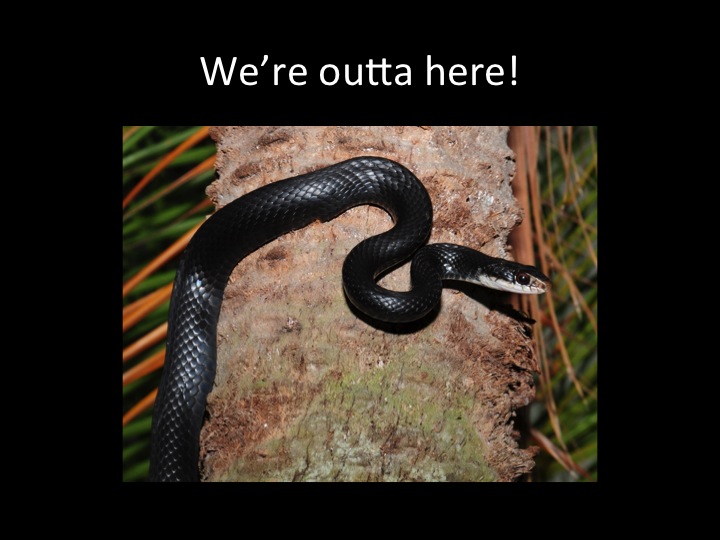
Didn’t have those in Minnesota! But here for 6 months, I barely see them anymore. And, then suddenly, Jacob and I turn a corner, and there is a swish right next to us. Swoosh! We stop and stare after the retreating creature.

Slide04


“It’s a snake,” Jacob said. “It’s a snake!” I said. Then we start walking again. More quickly this time, just in case the snake might change its mind and come back.

Slide05

“He was big,” Jacob said, gesturing with his arms.

“He was big,” I agreed, motioning with my arms, a little wider.

Kinda like the fish that got away.

Slide06


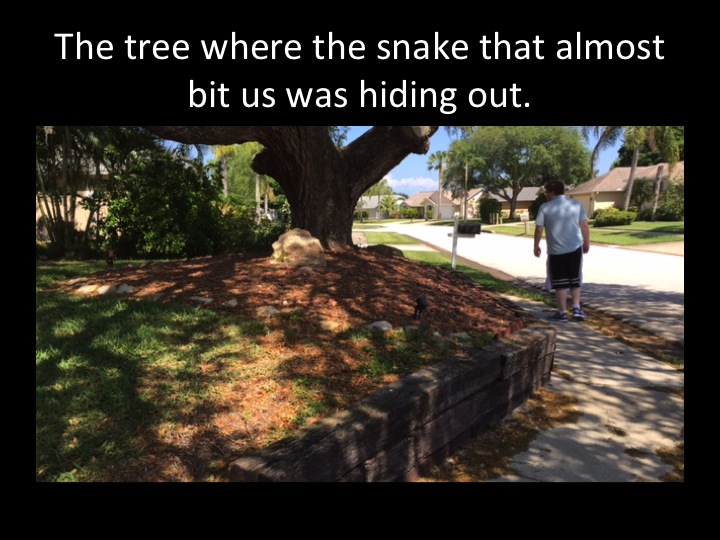
Here’s the tree where we saw the snake that almost bit us. It’s a good story, anyway.

Slide07


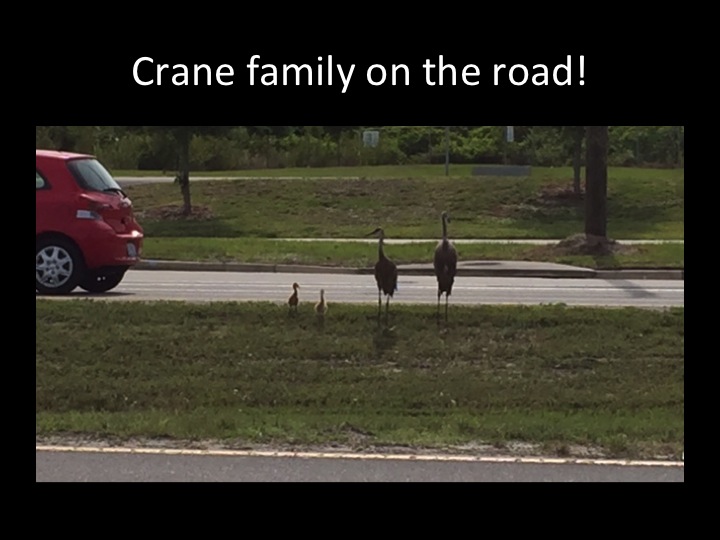
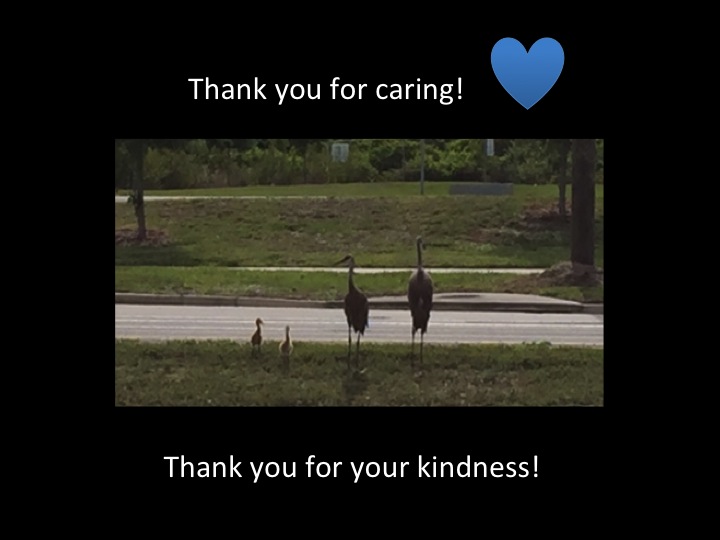
As I walk with Jacob, I also recall what I saw on my drive home from the church the day before. A whole family of cranes–on Wickham Road in Melbourne. Momma, Poppa, and 2 baby birds. At rush hour!

Slide08


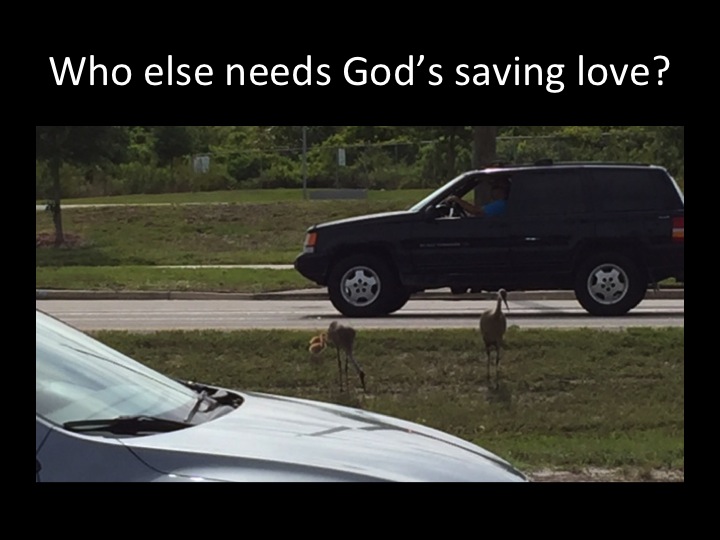
And no one seemed to notice them, at least they weren’t slowing down, except to stop at the traffic light. Those birds were in real danger! I pulled over and parked. What could I do? As I watched the cranes, I thought about the Church. “Who else is in danger of being lost?”

Slide09


Who else needs God’s saving love?

Slide10


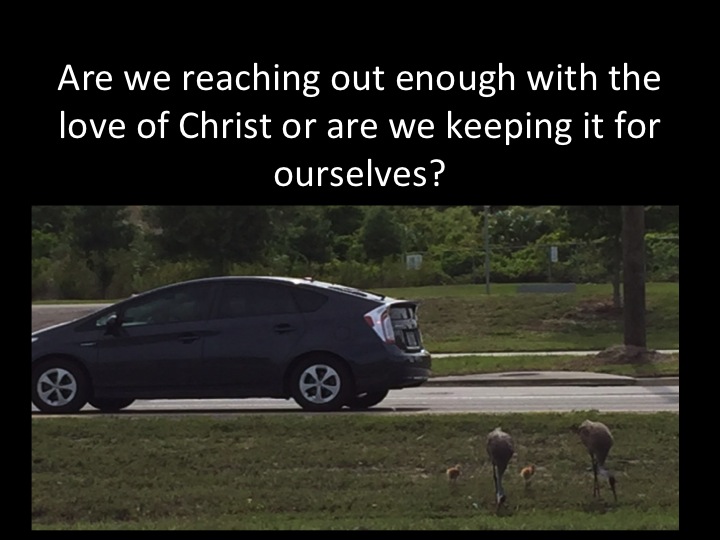
Are we reaching out enough with the love of Christ or are we keeping it for ourselves?

Slide11


How, I ask myself, as I often do, can we be more welcoming to all who come through our doors?


Slide12

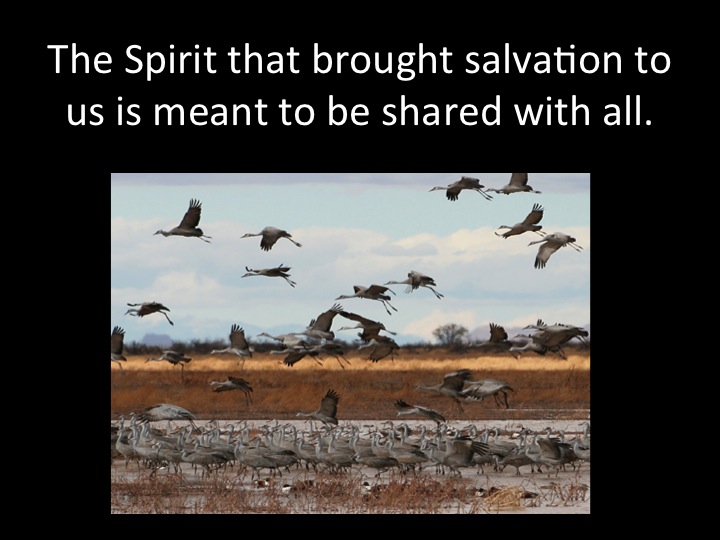
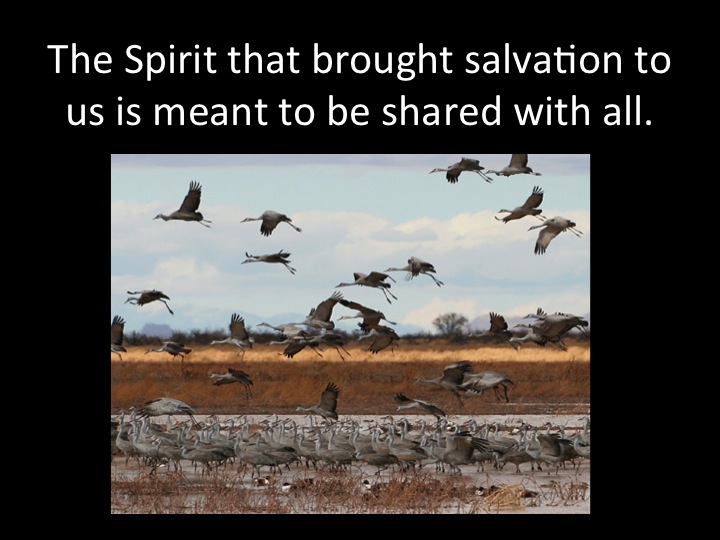
And how can we take the message of the gospel to the world? For the same Spirit that brought salvation to us is meant to be shared with ALL.

Slide13

***

This was the conclusion of the Early Church in Acts chapter 11. Peter and the apostles had been led by the Spirit to reach out to even the Gentiles.


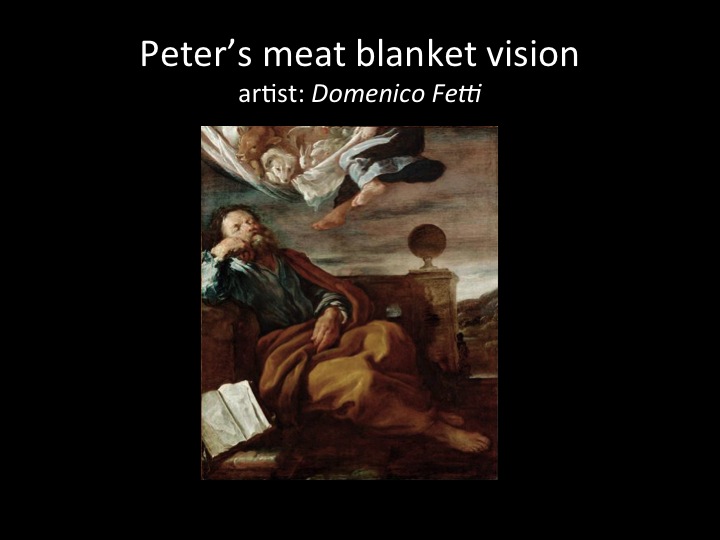
The definition of a Gentile, in the Jewish faith, is anyone who is not Jewish. The word “Gentile” is actually not a nice word to say; it’s an insult. It doesn’t just mean “not Jewish;” it meant people who are unclean (which is a nice way of saying dirty) and profane (offensive to God and religious people). So, some Gentiles had come to Peter, a Jewish apostle of Jesus, wanting him to come with them to a Gentile home to preach and baptize a Gentile household that wanted to receive the same Spirit the apostles had received. And Peter went to the Gentile household because he had received a vision of animals–some prohibited by Jewish law and others permitted. This vision taught him not only was it OK to eat the food of the Gentiles, but that God wanted the Church to grow. The gift of salvation is to be offered to ALL!

Slide14


Up to then, only Jewish believers had been permitted in this new faith community that worshiped, fellowshipped, and ate together. But the dietary restrictions were only one thing that separated Jews and Gentiles. Prejudice was just as powerful a barrier. Jewish people were forbidden from accepting a Gentile’s hospitality, even if the Gentile offered foods permitted by Jewish law. If a Jewish person even entered a Gentile building or handled articles belonging to a Gentile, they would be declared ceremonially “unclean” and could be barred from the synagogue.

In Peter’s vision, God says, “Get up, Peter; kill and eat.”


Slide15

Peter protests. “By no means, Lord,” he says in 11:8, “for nothing profane or unclean has ever entered my mouth!” Then he hears the voice again, “What God has made clean, you must not call profane.” Just to make sure that Peter is listening, this happens 3 times, before the blanket with all of the animals is taken up into heaven.

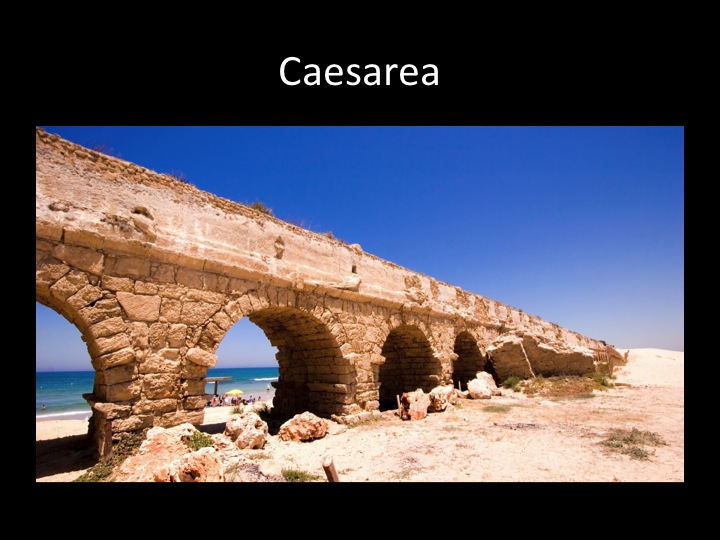
Meanwhile, God has given a vision to a Gentile. Cornelius the Centurion’s vision is described in Acts 10. An angel of the Lord appears and tells him his prayers are answered and that he should dispatch men to go and bring back Simon (Peter) to Cornelius’ house. Cornelius lived in the Gentile city of Caesarea, an ancient port on the Mediterranean coast.

Slide16


Caesarea was the capital of the Roman province of Judea since 6 C.E. and the place where Paul would be imprisoned before being sent to Rome for trial. Cornelius was in charge of the Italian cohort of the Roman army –about 1,000 men. And Acts 10:2 says he was a “religious man.” He and his household were “Godfearers”– worshipers of the God of Israel. What’s more, they demonstrated their faith by performing acts of charity to the Jewish people and praying to God “regularly.” It’s questionable whether they were permitted into the synagogues, but they may have been. What stood in the way of their conversion was not diet or prejudice. It was circumcision–the sign of God’s covenant with Abraham. They had not been circumcised. In Gen. 17:13-14, God says to Abraham, “Your flesh will embody my covenant as an enduring covenant.  Any uncircumcised male …will be cut off from his people. He has broken my covenant.’”

Slide17

Knowing the background, let’s go back to the first 2 verses of Acts 11. “Now the apostles and the believers who were in Judea heard that the Gentiles had also accepted the word of God!! So when Peter went up to Jerusalem, the circumcised believers criticized him, saying, ‘Why did you go to uncircumcised men and eat with them?’”

Slide18

     Now you understand why Peter is really in a pickle. Jerusalem is kind of the headquarters for Christianity at the time and believers all over Judea had been talking about what had happened with Peter and the Gentiles before he arrived and had a chance to explain.

Peter’s defense is that it wasn’t his idea. This was all God’s idea, revealed to Peter in a vision. Peter is just being obedient to God’s commands. He and the Centurion were led by the Spirit to do this incredible thing–to offer God’s salvation in Jesus Christ to people that Peter and other Jews had called “unclean” and “profane.” And they didn’t just baptize and say, “Good luck with the Christianity thing!” They welcomed them as brothers and sisters in the Church, united in Christ, without requiring them to be circumcised first.

As Paul would say in Galatians 3:28, “There is neither Jew nor Gentile, neither slave nor free, nor is there male and female, for you are all one in Christ Jesus.”

Slide19

And again in Colossians in 3:11: “Here there is no Gentile or Jew, circumcised or uncircumcised, barbarian, Scythian, slave or free, but Christ is all, and is in all.”

Slide20


Peter closes his argument by asking the Jewish followers of Christ, “If then God gave them the same gift that he gave us when we believed in the Lord Jesus Christ, who was I that I could hinder God?”

The Jewish believers, moved by the Spirit’s work, respond with stunned silence, then by praising God. “This God,” they say, “has given even to the Gentiles the repentance that leads to life.”

Slide21

***

Friends, when I got home from the funeral and reception at our church last night, I felt the Lord had answered my question of how we can be more welcoming to those who don’t know Jesus and how we can reach out to the world. I was reminded how our funerals and the gatherings that follow are a powerful outreach, uniting people from a variety of denominations and religious traditions, touching the hearts of some people who haven’t been to church in years. Pete’s chilidog reception in the fellowship hall was packed! And I am so proud of my church–and grateful to the many people who worked so hard to share the love of Christ through acts of kindness, big and small.

Slide22

How we will be more welcoming? How we will take the gospel to the world, brothers and sisters? The Spirit will lead us.

And God will use us, as long as we know the same Spirit that brought salvation to us is meant to be shared with ALL.

Slide23


Let us pray.

Holy One, Thank you for your Word and Spirit that brought salvation to the Jews and even to the Gentiles–and to this flock. May your Spirit continue to guide, transform and empower us today. Thank you for the many saints who ministered to the family and friends of Pete McCalman yesterday. Bless them, Lord, for their kindness and generosity. Bless the friendships that were renewed. We pray, Lord, that you will bring peace and comfort to those mourning the loss of loved ones. And we ask that you would reveal to us more opportunities to share the same Spirit that brought salvation to our flock to our community and world. In Christ we pray. Amen.
Slide24


So Great a Cloud of Witnesses!

 Pete family photo

Merritt Island Presbyterian Church

Meditation on Hebrews 12:1-3

April 23, 2016

     Therefore, since we are surrounded by so great a cloud of witnesses, let us also lay aside every weight and the sin that clings so closely, and let us run with perseverance the race that is set before us, looking to Jesus the pioneer and perfecter of our faith, who for the sake of the joy that was set before him endured the cross, disregarding its shame, and has taken his seat at the right hand of the throne of God. 3 Consider him who endured such hostility against himself from sinners, so that you may not grow weary or lose heart.


Pete was in the greeting line on the first Sunday I led worship here last October. You could easily pick him out of the crowd because of his height and impeccable, distinguished appearance. He had a confident way of carrying himself. After that first Sunday, I could always tell when he was in worship; it helped that he always sat in the same pew. He welcomed me that first day with his smile and Southern charm and told me he was happy I was here. And I knew he meant it. My first impression of Pete was sincerity and gentleness.

In the coming months, I discovered that he wasn’t shy about sharing his opinions on many subjects. He was not afraid to speak his mind. But whether he was talking about the church, music, technology, sports or “women drivers,” –whatever topic came up in conversation– you might not always know if he was being serious. He had a tendency to joke around even with people he had just met. This drew people to him, as did his “colorful” expressions. His children called them “Popisms” and compiled a list of them one year to give to him as a gift. Here are some of them: “Does a goat stink?” “Great day in the morning!” “You’re a caution!” “Full as a blivit.” “It doesn’t take much to amuse some people.” “That’s all you get for a nickel.” “Bruno did it.” “Are you going to make a career out of that??” “Take 2 and butter 1.”“Who stepped on a rabbit?” And, “Hold her head up, Miss Mitchell, she’s headed for the alfalfa field!”

Pete also liked to say, “Patience is a virtue.” This is fitting for Pete, who definitely had to learn patience as he endured and persevered through a difficult childhood and trials in young adulthood. His family didn’t have money for college, but Pete was smart and determined to go. He found work in a co-op program and paid his way through Georgia Tech, earning his degree in 1961. The natural-born athlete, who was good at many sports, made a hard choice and gave up playing basketball for his college after the first year because he couldn’t afford to play; he needed to work.

Though Pete had a colorful way of expressing himself, he didn’t always share personal things. I didn’t know just how fragile Pete’s health was and that he had been in chronic pain since he returned to Merritt Island in Dec. 2014. He had moved to TN to live with his son, Mark, daughter-in-law, Donna, and grandson, Graham, for 5 and ½ years. Pete had been a caregiver to his wife, Lila, as she battled cancer for 2 years, retiring earlier than he had planned from the Kennedy Space Center so he could take care of her. Some time after Lila went home to be with the Lord in 1998, Pete’s mother, Julia, came to live with him at his invitation; he was her caregiver by choice for 7 years.

Pete was matter of fact about his own health issues. What frustrated him was that he was no longer able to walk without a walker because he was growing unsteady on his feet, that he had to give up driving, and that his mind wasn’t as sharp as it used to be. He told me these things as we ate lunch with about 10 other church members in the dining room of the “Tower” of Courtenay Springs Village, the retirement community in which he and the others lived. He entertained me with stories throughout our meal. After lunch, Pete invited me to continue our conversation at his home in the penthouse. I couldn’t say no to Pete, he was so charming, though I was worried that saying yes to him might hurt other folks who also wanted me to visit. But I sensed that Pete had something important to say.

He wanted to talk about his family and share Lila with me through photos and stories. I think he wanted me, who had never met her, to know her and love her, as he did. She was still with him in his heart, every day. She had been a professional model and church members describe her as “beautiful inside and out.” The penthouse at Courtenay Springs had been the home Pete and Lila had dreamed of living in together someday, when they got older, Pete retired, and they sold their home in South Merritt Estates. Her cancer stole that dream away.

Pete missed Lila so much. He told me he felt ready to go home to be with the Lord. He had lived a good life. He had run the race of faith that Christ had set before him. He had not grown weary of doing good. He had not lost heart.

When I was choosing a scripture for today, these 3 verses in Hebrews came to mind. “Since we are surrounded by so great a cloud of witnesses.” And I thought, “That’s Pete!” He is one of the many witnesses to the saving work of Jesus Christ–just as we are. Pete persevered in the faith, despite obstacles and trials, despite his suffering–his physical and emotional pain.

The book of Hebrews is actually a sermon meant to be read or heard all the way through, at once. This sermon was passed from congregation to congregation as a letter, though it doesn’t have the form of a letter; there’s no greeting or recipient mentioned, except in the title, which may have been added later–“The Letter to the Hebrews”–as the earliest Christians were Jewish or “The Hebrews.” It is written for a general or universal audience. It is written for us.

It helps our understanding to look back at chapters 10 and 11. In 10, we learn that Jesus’ sacrifice was once for all people, and we are called to persevere in hope. We always think of persevering as getting through something hard. But it’s also holding onto something–our hope! In 10:23-24, we read “Let us hold fast to the confession of our hope without wavering, for he who has promised is faithful. And let us consider how to provoke one another to love and good deeds.” Then in the first verse of chapter 11, we learn that “faith is the assurance of things hoped for, the conviction of things not seen.” The remainder of the chapter gives biblical examples of faithfulness (Abraham, Moses, David and others) –to provoke us to love and good deeds.

Chapter 12 begins, “Therefore,” meaning all that came before it– the definition of faith and the biblical examples of faithfulness–was building up to this point. “Therefore, since we are surrounded by so great a cloud of witnesses”– who are the witnesses? Christians of the past, present, and future. Look around the room at the cloud of witnesses–and think what a small part of the great cloud it is! This surrounding is a good thing; it means we are protected, strengthened by God’s Spirit that lives in every believer and the faithfulness of those who came before us, and those who are with us in the present and future.

Verse 1 continues, “Let us also lay aside every weight and the sin that clings so closely, and let us run with perseverance the race that is set before us.” This means let go of whatever activity or attitude that is keeping you from living the hopeful, joyful life of service that God wants you to live –and has set before you. It is within your grasp, with the Spirit’s help! And what is the secret to keeping our hope and holding onto the faith? It’s not just looking around us at other people, and it’s not looking down at ourselves and becoming frightened or overwhelmed by our difficult situations. It’s looking to the one from whom our faith originates, the source, who wants to build up and make perfect our faith. That looking down and being afraid or overwhelmed is the sin that clings so closely. This sin is like a garment that we wear. The second verse assures us that this sin can be laid aside; removed. We have the power within us to choose a life of hope and service over a life of fear. If we look to Jesus to heal us–and make us whole.

***

It wasn’t easy for Pete, just as it isn’t easy for many of you who are struggling now. But he loved his family. He enjoyed many friendships, the camaraderie of his bridge groups and going with friends to every spring training game for the Washington Nationals in Viera. And he loved his church. He continued to serve the Lord through his participation in worship, when he was well enough, and through his giving. The last time I talked with Pete, he had stopped by the church to make sure that we had the dedication correct in the front of the new, Glory to God hymnals he had purchased for the church. He bought 73 of them! All are dedicated to Lila. You will likely find at least one of them in your pew.

Pete, surrounded by a great cloud of witnesses that includes you and me had run with perseverance the race that is set before all of us. Let us now lift our eyes from our own problems or struggles. Let us all look to Jesus, to build up and make perfect our faith. He longs to heal us and make us whole. He endured the cross because he knew the joy would come with his resurrection. Human beings would be saved through Him.

Friends, don’t grow weary in doing well. Don’t lose heart! The joy–and the healing–will come.


Loving God, thank you for Jesus, who died to make a way for human beings to be reconciled with you through belief in your suffering work for our sakes. Thank you for your grace that covers all our sins, your love that goes on and on, unconditionally. Remove from us the sin that clings to each one of us like a garment–the attitude or activity that gets in the way of us living lives of hope and service–the way you want us to live. Heal us, Lord, and make us whole. Lift our eyes up and away from our own problems so that we see your love and grace and we are empowered to be Christ’s witnesses. Strengthen us to persevere through struggles and sorrows help others as we run this race together, following Jesus, until we see Him, face to face. In his name we pray. Amen.


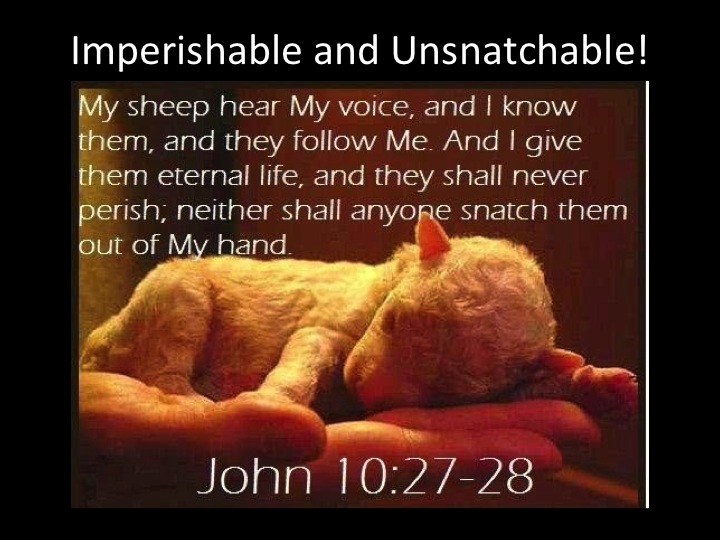
Imperishable & Unsnatchable!

Slide15

Meditation on John 10: 22-30

April 17, 2016


At that time the festival of the Dedication took place in Jerusalem. It was winter, and Jesus was walking in the temple, in the portico of Solomon. So the Jews gathered around him and said to him, ‘How long will you keep us in suspense? If you are the Messiah, tell us plainly.’ Jesus answered, ‘I have told you, and you do not believe. The works that I do in my Father’s name testify to me; but you do not believe, because you do not belong to my sheep. My sheep hear my voice. I know them, and they follow me. I give them eternal life, and they will never perish. No one will snatch them out of my hand. What my Father has given me is greater than all else, and no one can snatch it out of the Father’s hand. The Father and I are one.’ 


***


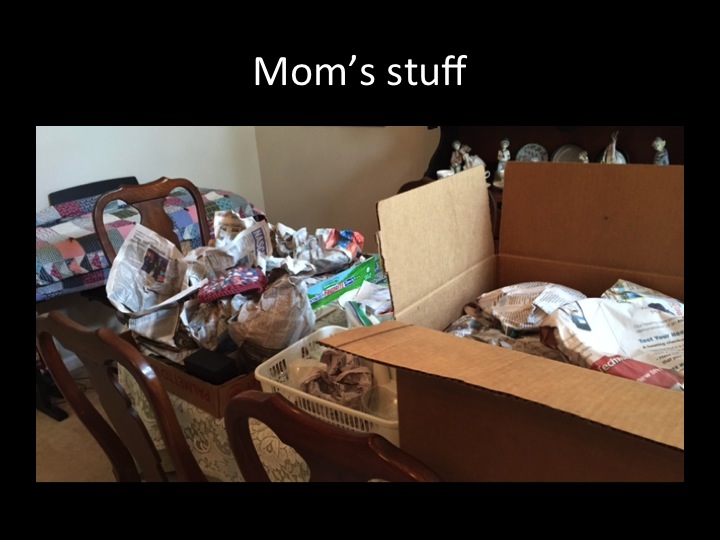
My mom and dad came to visit us on Monday. They brought more stuff that they couldn’t fit in their new home in a retirement community. Stuff that they thought maybe we would want or could find homes for. The stuff came in bags and cardboard boxes, loosely wrapped in newspaper.

Slide16


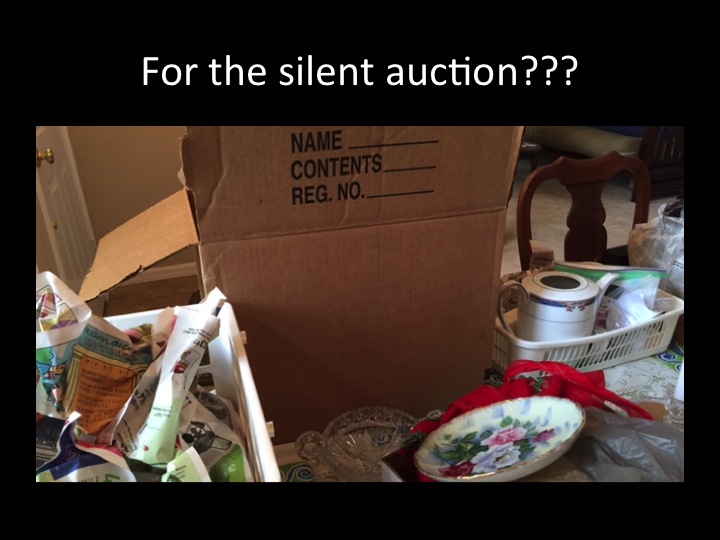
And there it sat until Friday when I went on a treasure hunt, looking for interesting things Jim and I could donate to the silent auction for our youth’s trip to Montreat.


Slide17


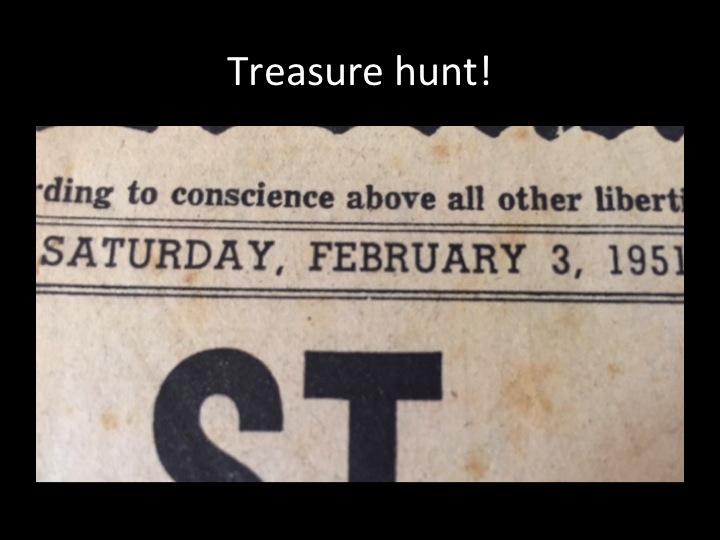
Here’s some of what I found! This is a newspaper dated Feb. 3, 1951.

Slide18


One of the front-page stories caught my eye. Freeze predicted for all of Florida tonight. Real winter gripped Florida today. Two inches of snow fell in St. Augustine, blanketing the Oldest City in white.”

Slide19

Check out the full front page. See the children making a snowman!


Slide20

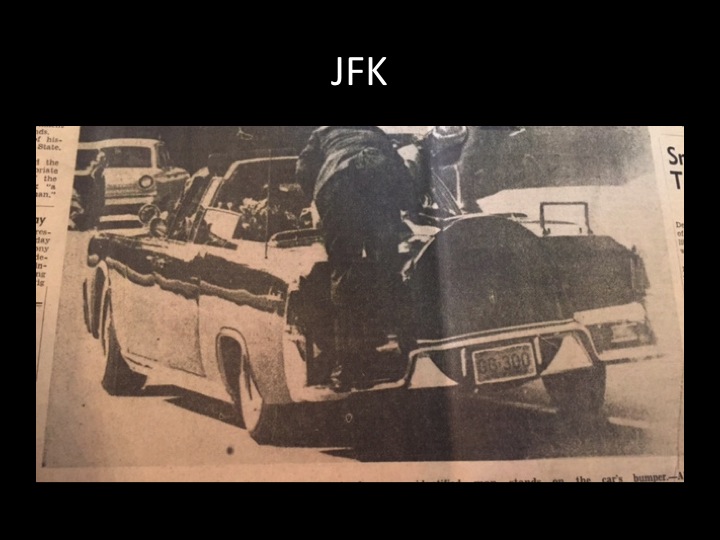
I also found some sad mementos that I imagine some collectors would love to have. Here is a Washington, D.C. newspaper from November 1963–the day President Kennedy was shot.

Slide21

There are other moving photos from that day.

Slide22

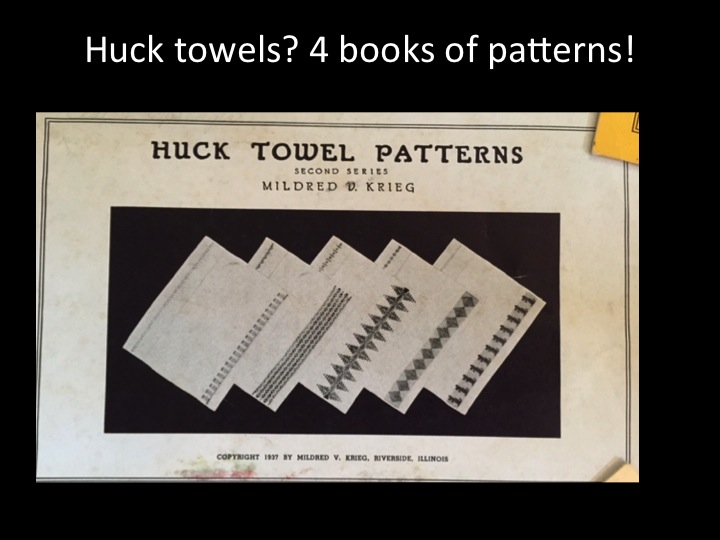
     And there are other interesting–and less sad–finds. Grandma saved 4 books of patterns for decorating huck towels from 1937. I didn’t even know what “huck towels” were!

Slide23


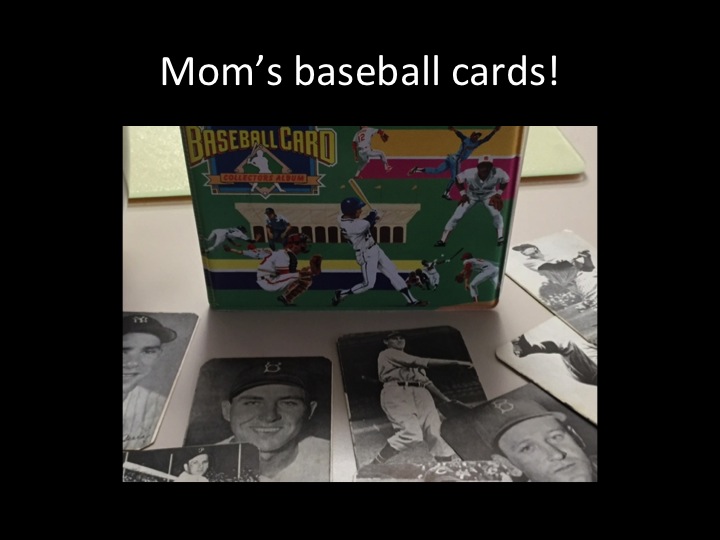
This next find is even more exciting than huck towels. My mom collected baseball cards and kept them in a little photo album.

Slide24

I learned that Yogi Berra’s real name was “Larry.”

Slide25


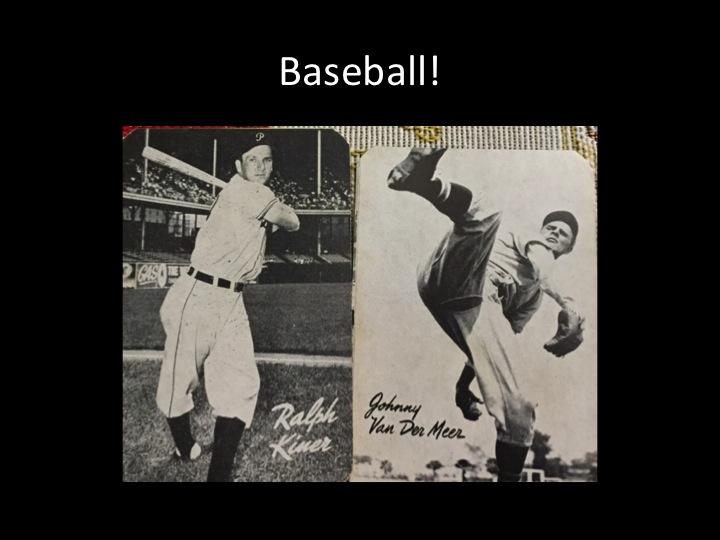
Does anyone remember Ralph Kiner or Johnny Van Dor Meer?

Slide26


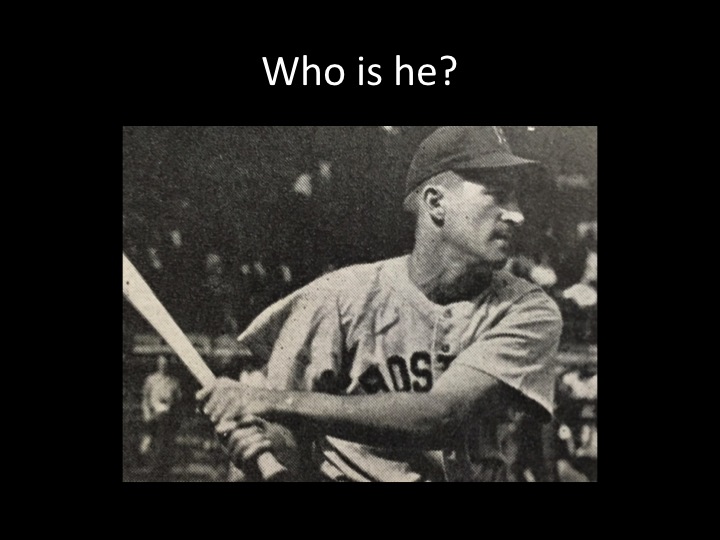
Does anyone know who this is?

Slide27


This next item will be more familiar to you. Does anyone still have a record player that can play 45’s? Do you remember Glen Miller and his orchestra?

Slide28


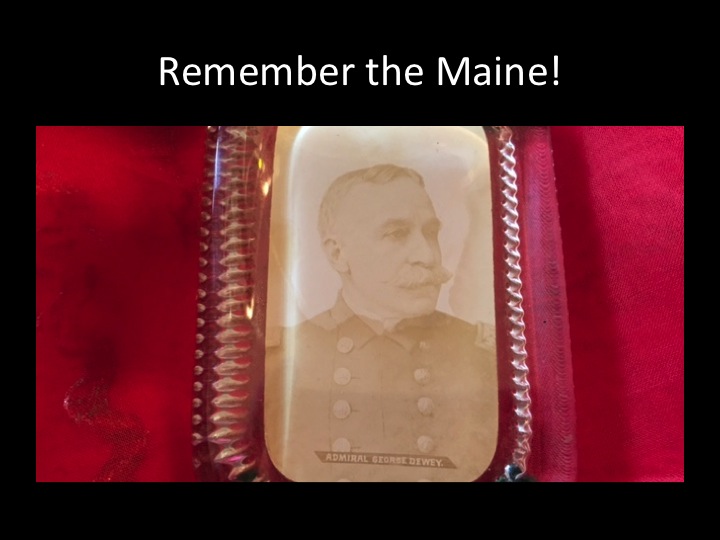
And for military history buffs, here is a glass paperweight of Admiral Dewey. “Remember the Maine!”

Slide29


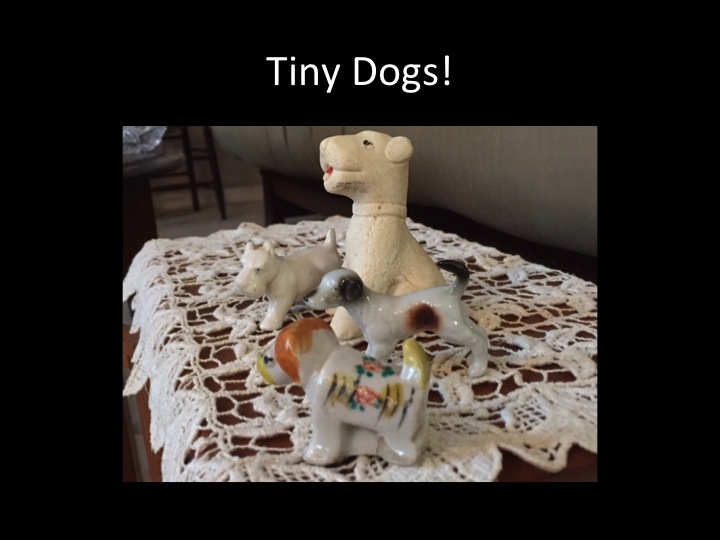
And for the kids and other young at heart, some tiny porcelain dogs.

Slide30


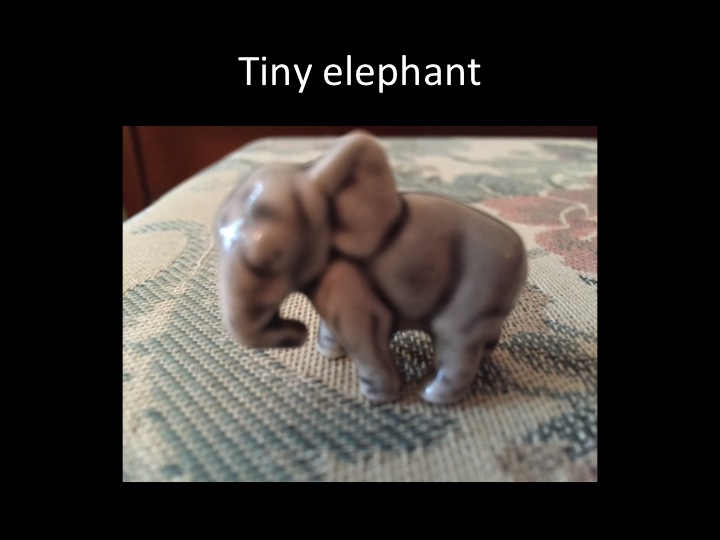
And a tiny elephant.

Slide31


Are you thirsty?

Slide32


Sorry. This Coke bottle isn’t real. It’s only about 2 inches tall.

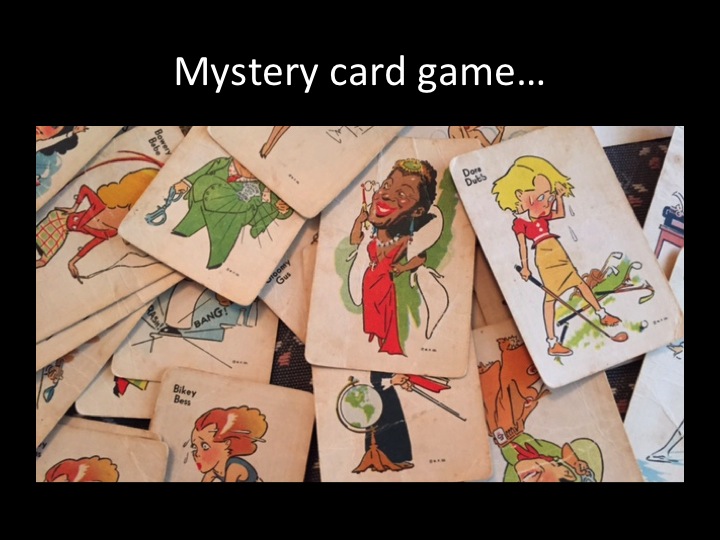
And then my Mom had a couple of card games when she was a child. This one, I don’t have a clue what it is. Maybe you know who these people are.

Slide33

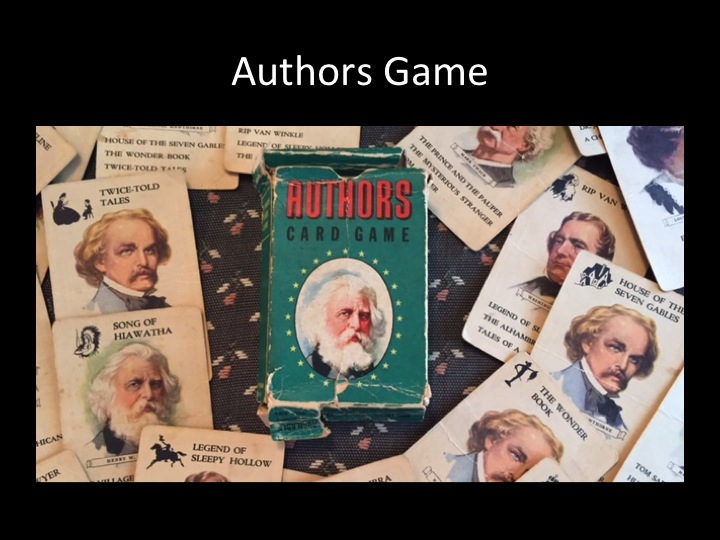
But this one is a game that helps you learn famous authors and their writings.

Slide34

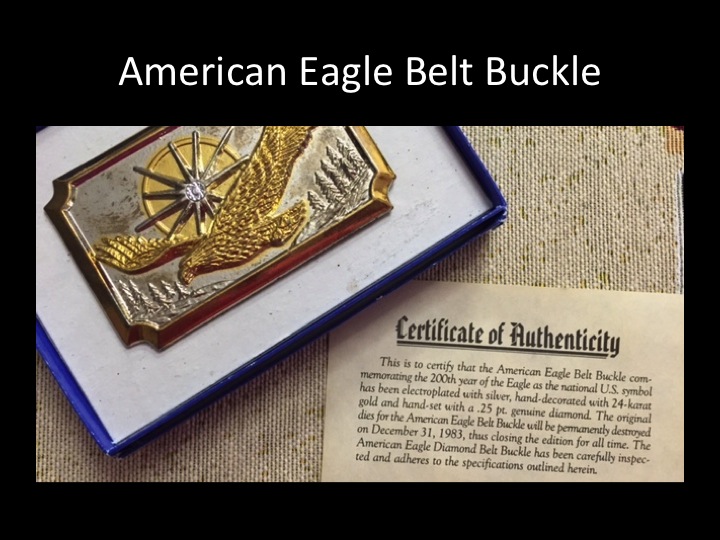
This limited edition Eagle Belt Buckle has never been worn. It’s in the original box with a certificate of authenticity.

Slide35

Antique game pieces, anyone?

Slide36

This next thing is cool. I think this was my dad’s.

Slide37


It’s a map measure, with a little wheel on the bottom.

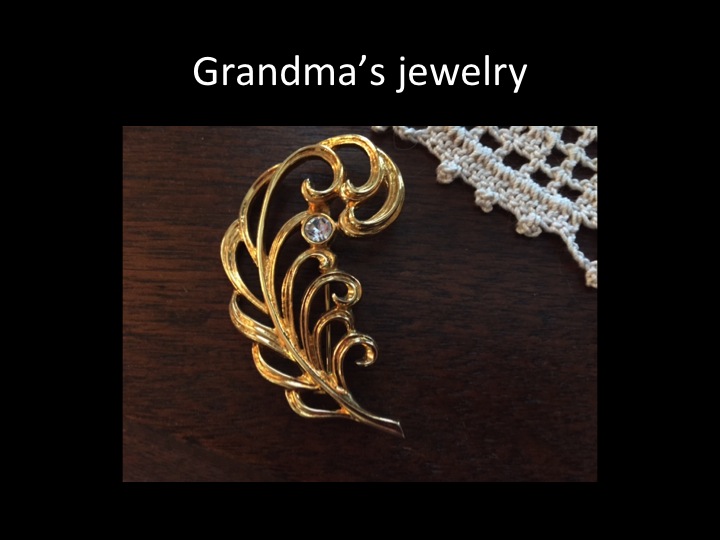
Here’s one of Grandma’s pretty pins.

Slide38

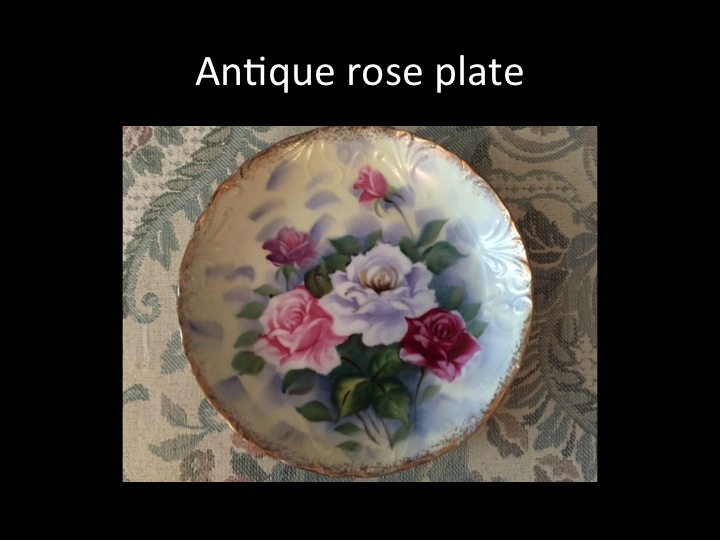
But she had even more dishes than jewelry! This is a small, decorative plate.

Slide39


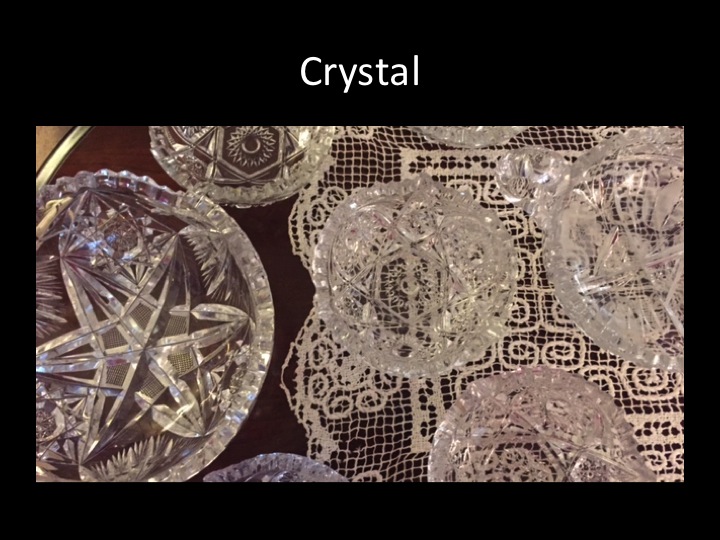
She had crystal.

Slide40


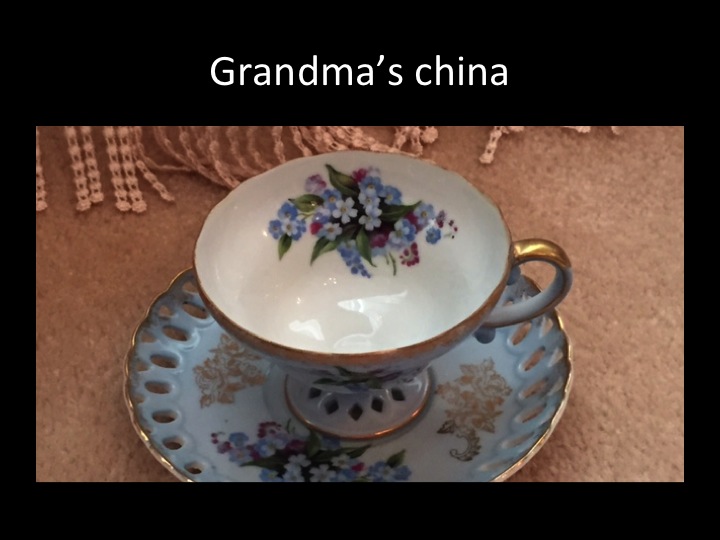
She had many adorable teacups and saucers that she used when company came to play bridge or pinochle. Everybody got a different cup, so you always knew which one was yours.

Slide41


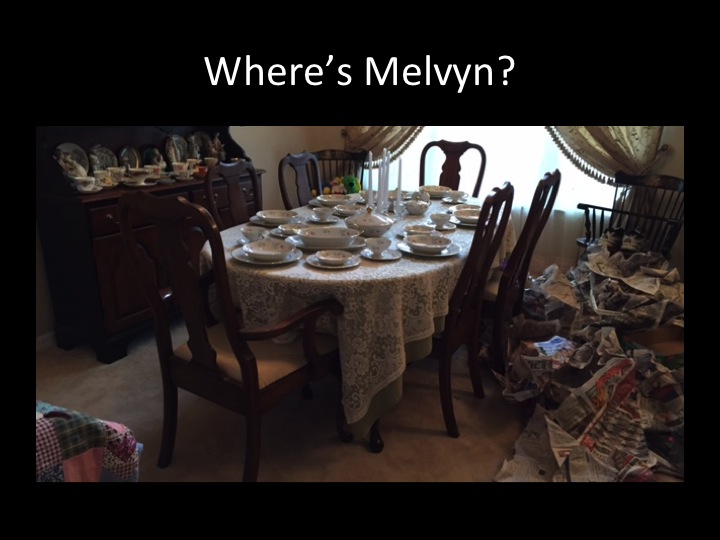
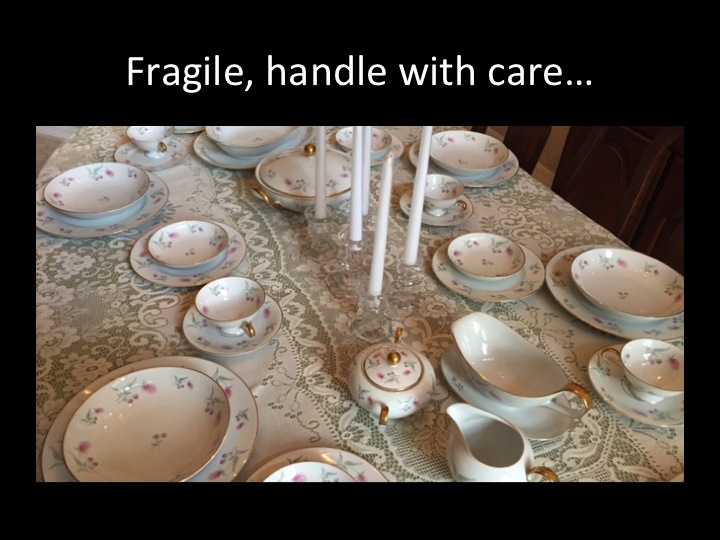
Finally, I began to unwrap my grandmother’s dishes-a complete setting for 12, with all the additional platters, bowls, etc. I didn’t know where to put them all–and they were so pretty, with their gold trim and delicate flowers. So I decided to set my dining room table. Just for fun, can anyone see where Melvyn is hiding?

Slide42


Then Jim walked in and asked, “What are you doing with all those? Why did you unwrap them?” I hadn’t planned on keeping any of the things my parents had brought.

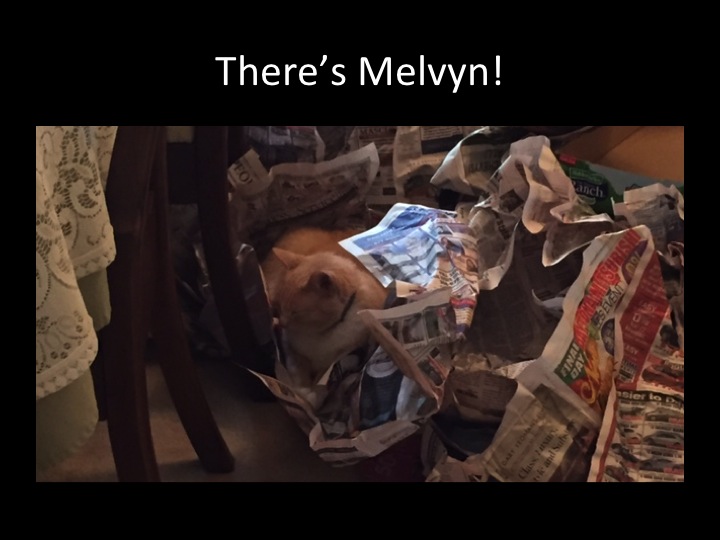
(There’s Melvyn!)

Slide43


But as I unwrapped the dishes, I remembered the suppers our family ate at Grandma and Pop Pop’s house. She was a good cook and always had a crowd of her friends and other relatives stop in when we would come for a visit. After supper, I used to help her wash the dishes by hand. She didn’t have a dishwasher. And even if she did, those dishes with their gold trim are probably not dishwasher safe.

Slide44

I guess I changed my mind about keeping the dishes because I thought, “What would Grandma think if I gave away her dishes because they are too fragile–and we might break them if we use them?” Recalling her generosity and kindness, I know she would be glad if we used them and enjoyed them at our gatherings of friends and family.

With my aging parents having to give up so many of their belongings when they moved to the retirement community, and my dad struggling with health challenges, I am learning to put “things” into perspective. I am learning, again, the lesson of what really matters –and it’s not our belongings or accomplishments–it’s our family, friends, and faith– knowing to whom we belong and our true purpose in life–serving God, loving people.

So much of this life is fragile, including life itself. As a pastor, visiting the sick and comforting those grieving the loss of loved ones, I am often reminded of the fragility of life here. But as Christians, we needn’t fear the future. Rather, we who are imperishable and unsnatchable should make the most of the days God has given us– mending our broken relationships, listening for the Good Shepherd’s voice, seeking to obey, and sharing the hope of eternal life for all who trust in Him.


***

   Our gospel today opens with Jesus talking with the Pharisees about things that really matter–who Jesus is and the way to eternal life. It is the Feast of the Dedication–Hanukkah- when the shepherd readings from the Hebrew Scriptures were commonly read in the synagogue, readings such as Ezekiel 34:23, “I will set up over them one shepherd, my servant David, and he shall feed them: he shall feed them and be their shepherd.” It’s “winter,” when the “cold winds sweep in from the east across the … desert.” (Ray Brown, 405) Jesus is walking on the east portico of the Temple, the only portico “whose closed side would protect it from the east wind.”

       The question of whether Jesus is the Messiah has come up again. In John 7:26, during the Festival of Booths, the people of Jerusalem were asking, “Can it be that the authorities really know that this is the Messiah? Yet we know where this man is from; but when the Messiah comes, no one will know where he is from.” In John 7:31, many in the crowd believe in him and are saying, “When the Messiah comes, will he do more signs than this man has done?” But in 7:41-42, the people are divided, saying, “This is the Messiah,” or “Surely the Messiah does not come from Galilee, does he?” Now in chapter 10, the Pharisees demand, “How long will you keep us in suspense?” (Other translations say, “How long will you keep annoying us?”) “If you are the Messiah, tell us plainly.”

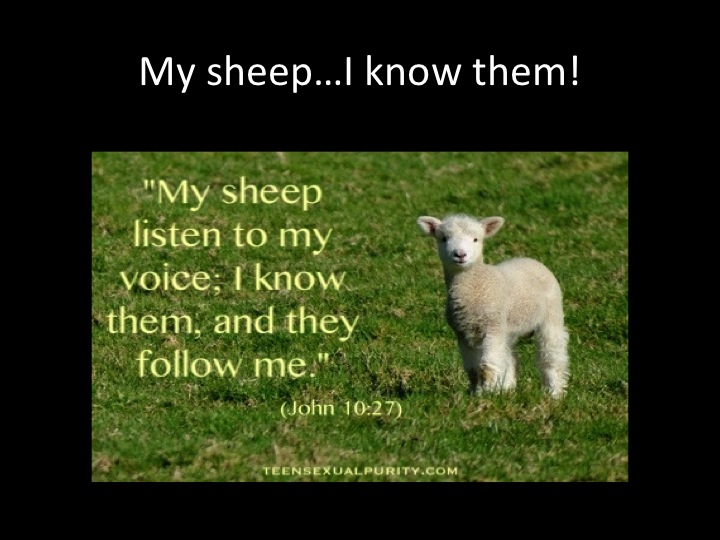
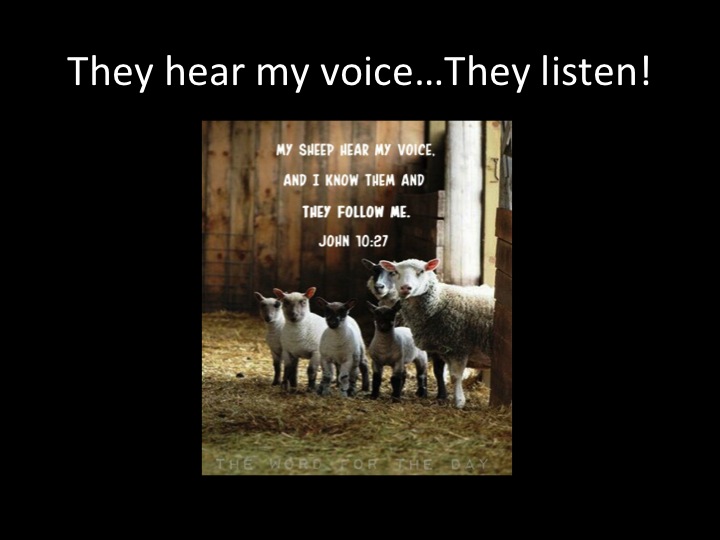
Jesus says, “I have told you and you do not believe.” The reason is simple enough. “You do not believe,” Jesus says, “because you are not my sheep.” In contrast to the unbelief of the Pharisees, Christ describes his flock’s obedience and faithfulness. “My sheep listen to my voice; I know them, and they follow me.”

Slide46


     Imagine how his first audience is hearing this. Jesus is saying, “You do not believe in me not because I am not a shepherd, but because you are not sheep.” The problem is with them–not Jesus! Earlier in chapter 10, Jesus compares the Pharisees to thieves, bandits, and hired hands; now they are not among God’s chosen, even though they are descendants of Abraham; they are not among the sheep the Father has given to Jesus! It’s not surprising that after our passage ends at verse 30 — “I and the Father are one”– the Pharisees take up stones in verse 31 and prepare to stone Jesus for making himself God. But he eludes their grasp and crosses the Jordan–returning to where John had baptized him. Many come to believe in him there.

      The Pharisees were angered when they heard condemnation in the Good Shepherd’s remarks–that they were not his sheep because they did not believe he was the Messiah. But there is only good news for those who are Christ’s sheep–for those who believe on Him and have accepted His sacrifice on the cross for the sins of the world. If you are worried, my friends, that you are not hearing God’s voice when you seek the Lord, be reassured. Jesus promises in verse 27 that his sheep will hear God’s voice! God will answer your prayers!


Slide47


If you worry that God isn’t intimately involved in your life, listen to verse 27 again: Christ’s sheep are known by the Lord, the God who created you! And if you sometimes worry that you might unintentionally choose a wrong path, that you might make a mistake, hear this and be at peace: verse 27 also says that Christ’s sheep will follow him! If our hearts’ desire is to be pleasing to Him and obey, Christ will lead the way.

Slide48

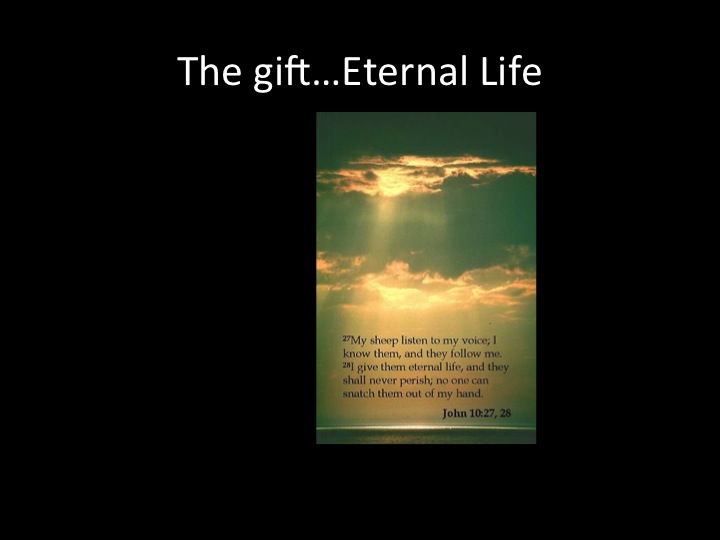
And as we read on in this passage, the promises just keep getting better. I give them eternal life,” Jesus says in verse 28. “And they shall never perish.” Eternal life cannot be earned, my friends! It is only a gift.

Slide49

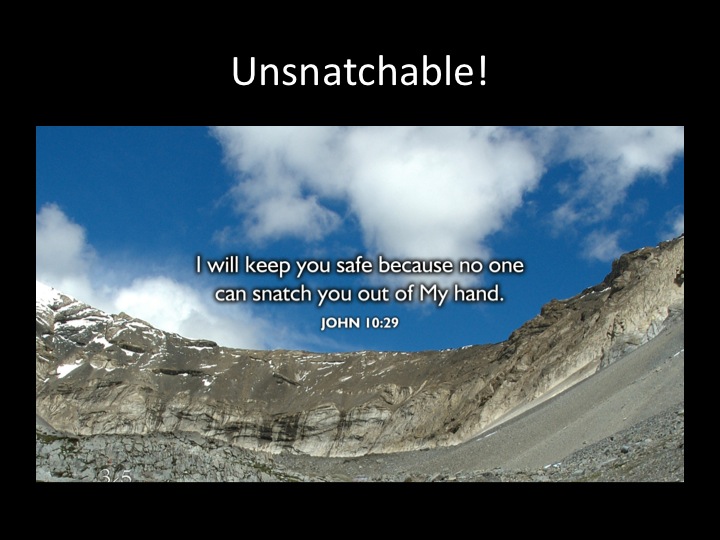
And it cannot be lost. If you are Christ’s sheep, your salvation is secure. You cannot slip out of or be snatched from the Lord’s grasp.

Slide50

With echoes from Isaiah 43 and 49, Christ says in verses 28 and 29, No one will snatch them out of my hand. What my Father has given me is greater than all else, and no one can snatch it out of the Father’s hand.”

Slide51

   Fellow sheep, you are imperishable and unsnatchable. Make the most of the days God has given you. Mend your broken relationships. Listen for the Good Shepherd’s voice. Seek to obey. And share the hope of eternal life for all who trust in Him.


Let us pray.


Good Shepherd, we are your sheep, grateful for all you have done for us on the cross–taking our sins away. Thank you for holding us tightly in your grasp–for the protection and security of your hand. Thank you that we cannot lose the salvation that is your gracious gift. Help us, Lord, to listen for and hear your voice. Guide us to paths and pastures of righteousness. Lead us to be your faithful, joyful, obedient sheep, following in your footsteps, reaching out to people in need, sharing the good news of eternal life with words and acts of love with a world so desperately in need of a savior. In Christ we pray. Amen.


What’ll we do now?


Meditation on John 21:1–19

April 10, 2016

fish-christian-symbol

     After these things Jesus showed himself again to the disciples by the Sea of Tiberias (the Sea of Galilee); and he showed himself in this way. Gathered there together were Simon Peter, Thomas called the Twin, Nathanael of Cana in Galilee, the sons of Zebedee, and two others of his disciples. Simon Peter said to them, ‘I am going fishing.’ They said to him, ‘We will go with you.’ They went out and got into the boat, but that night they caught nothing. Just after daybreak, Jesus stood on the beach; but the disciples did not know that it was Jesus. Jesus said to them, ‘Children, you have no fish, have you?’ They answered him, ‘No.’ He said to them, ‘Cast the net to the right side of the boat, and you will find some.’ So they cast it, and now they were not able to haul it in because there were so many fish. That disciple whom Jesus loved said to Peter, ‘It is the Lord!’

     When Simon Peter heard that it was the Lord, he put on some clothes, for he was naked, and jumped into the lake. But the other disciples came in the boat, dragging the net full of fish, for they were not far from the land, only about a hundred yards off. When they had gone ashore, they saw a charcoal fire there, with fish on it, and bread. Jesus said to them, ‘Bring some of the fish that you have just caught.’ So Simon Peter went aboard and hauled the net ashore, full of large fish, a hundred and fifty-three of them; and though there were so many, the net was not torn. Jesus said to them, ‘Come and have breakfast.’ Now none of the disciples dared to ask him, ‘Who are you?’ because they knew it was the Lord. Jesus came and took the bread and gave it to them, and did the same with the fish. This was now the third time that Jesus appeared to the disciples after he was raised from the dead. When they had finished breakfast, Jesus said to Simon Peter, ‘Simon, son of John, do you love me more than these?’ He said to him, ‘Yes, Lord; you know that I love you.’ Jesus said to him, ‘Feed my lambs.’ A second time he said to him, ‘Simon son of John, do you love me?’ He said to him, ‘Yes, Lord; you know that I love you.’ Jesus said to him, ‘Tend my sheep.’ He said to him the third time, ‘Simon son of John, do you love me?’ Peter felt hurt because he said to him the third time, ‘Do you love me?’ And he said to him, ‘Lord, you know everything; you know that I love you.’ Jesus said to him, ‘Feed my sheep. Very truly, I tell you, when you were younger, you used to fasten your own belt and to go wherever you wished. But when you grow old, you will stretch out your hands, and someone else will fasten a belt around you and take you where you do not wish to go.’ (He said this to indicate the kind of death by which he would glorify God.) After this he said to him, ‘Follow me.’


***

I’m back! Jim and I had a restful vacation. We had two friends from Minnesota visit with us. We ate together and came to see the church, and we went to the beach. Of course!

Pat and Sharon LeGare photo


It was chilly that day–a cool breeze–and even Pat, a Minnesota native, was cool in shorts. But notice there’s some very hardy person behind us swimming! Brr! That water was cold!

Anyway, it was good to see them and just talk for hours. I’ve been gone 6 months! It was hard to say goodbye to them. They are such encouraging, joyful people! Pat was on the PNC at my last church. He was the first person I met in Renville as he made the initial interview by phone. He picked Jim and me up in his truck when we arrived at the Minneapolis airport the first time I went to Minnesota. He even loaned me his 2003 mustang convertible when I came a second time to meet the congregation.


Yellow mustang convertible


I rode around Renville in style. :o)

Sharon brought two precious gifts for me on this trip–letters from her granddaughters. Anna’s envelope says, “My forever favorite.” Jade is turning 15 this summer. She wrote on her envelope, “To the awesome Pastor Karen”!

Jade and Anna with fish

Here’s Jade (to the left) and Anna (far right) a couple of years ago. In between is their little brother, Jr., and a friend or a cousin, standing second from the left. They caught all these fish! They learned how to fish from Pat, who has a boat, and lives with Sharon on Lake Andrew. Pat loves all kinds of fishing, especially ice fishing!

Jade writes:

“Hi Pastor Karen how are you doing I just wanted to say hi and tell you I really miss you. Guess what! I’m going to have a quinceneara! It’s a Mexican tradition where if a girl turns 15 they throw a big party! I get to wear a big, poofy dress. It’s going to be pink with sparkles all on the top and two strips going down the front. My quinceneara is going to be butterfly themed. If you still lived here, I would’ve loved to have you there. I’m in softball. My really favorite part is batting. I love holding that bat and putting all my might into it and hitting the ball over their heads. We also got another dog. His name is Koda show photo of Koda; he’s really energetic and playful. Grandpa is going to take me on a fishing trip! I’m so excited. I hope we catch lots of fish. I really really miss you Pastor Karen, so do Anna and Jr. Hope to see you soon, Pastor Karen. Goodbye. Love, Jade.”

I might get emotional if I read Anna’s letter aloud, too. So I will just share that one of my special memories of them is when I presided over the wedding of their parents, Augustine and Carrie, a couple of years ago.

Tin and Carrie's Wedding

The children participated in our hand bell choir and Sunday school, and they came and brought friends with them to our summer “Camp in a Van” program last July, which happened to fall on the week of my birthday. And guess what? Carrie and Tin and the kids surprised me with a big ice cream cake.

ice cream cake!

Everyone knew I loved ice cream because I used to send the children DQ gift certificates on their birthdays. I would say, “You can’t have a birthday without ice cream!”

While I read Jade and Anna’s letters, other happy memories came to mind. I was reminded of the relationships that blossomed and grew in that rural community of faith while I ministered there. And I felt strengthened to continue in my labor of love here. I am so blessed and honored to be a child of God, loved by God, forgiven by faith in Jesus Christ.

Talking with Pat and Sharon and reading their granddaughter’s letters, I felt, once again, the Lord calling my name, saying, “Follow me!”


The cross


Our gospel reading in the final chapter of John today is a “reaffirmation of call” story. The risen Christ has already appeared to Mary Magdalene in the garden at the tomb and to the disciples on a number of occasions. Our reading follows “many other signs” that Jesus does in the presence of his disciples, John writes. In 20:22, Jesus breathes his Holy Spirit on them and urges them to go and spread the message of forgiveness. He has already appeared to Thomas, who had refused to believe until he could see and touch Jesus with his own eyes and hands.

Then the book seems to come to an end at 20:31, “But these are written so that you may come to believe that Jesus is the Messiah, the Son of God, and that through believing you may have life in his name.” And then we come to today’s reading–chapter 21, which scholars believe was added later, with the transition “after these things.” Jesus had already appeared to his disciples on numerous occasions (in chapter 20) to urge them to keep on with the ministry. But in 21:14, we discover a contradictory statement when we are told, “this was (only) the third time that Jesus revealed himself to the disciples after his resurrection from the dead.”

At the beginning of today’s passage, you get the feeling that the disciples are kind of lost. Seven of them are gathered at the Sea of Tiberias–in Galilee, once again. They are wondering, “What’ll we do now?” They have been ministering with Jesus, witnessing his miracles and sitting under his teaching for 3 years. But he died on a cross. And despite all the resurrection appearances, they go back to where their story with Jesus began–when Christ first called to them from the shore (in Matthew, Mark and Luke) and invited those who were already fishermen to be “fishers of men.”

Here, at the end of John, Peter announces, “I am going fishing.”

It’s striking that he says, “I”–and doesn’t invite the others! Fishing wasn’t the rod and reel kind we mostly do. It was hard physical labor, involving the dragging of nets from a small boat, working at night. Is he trying to get away from the others? What is happening to this group that Jesus had urged to be known by their love for one another–the group for which he had prayed would be ONE.

But then the other disciples say, “We will go with you.” So maybe it’s just Peter, feeling bad. Peter, after all, was the one who denied the Lord 3 times before the cock crowed on the night Jesus was arrested -just as Jesus said he would. Maybe Peter was feeling like a failure– or just weary from it all.

So… Seven men in a little boat. Fishing all night. Catching nothing. And then it’s daybreak and who’s on the beach? Jesus, but they don’t know it’s him, despite him calling them affectionately, “Children.” But they know it’s him-when?–after the miraculous catch following Jesus’ instructions to throw out the net, again, from a different side. When they know it is the Lord, Peter, the impulsive, passionate one, swims the 100 feet to shore, while the others bring in the little boat loaded down with (do you recall how many?) 153 fish!

   Now we are having breakfast with Jesus–and it’s a potluck or “pitch in” as Carl says, because Jesus already had bread and fish cooking over a fire. Yet he says, “Bring some of the fish you caught just now.” Returning to God a portion of what the Lord had given them, sharing with one another. This breakfast is important because it proves that Jesus is a real, live human being and not just a ghost–‘cause ghosts don’t eat! This is important to John’s theology–that Jesus is fully human and fully God. This fellowship meal is also important because it shows the love of God– how Jesus hasn’t stopped caring about the disciples and that he is determined to use them for His Father’s salvation work, though every single one of them deserted him in the end!

I could tell you so much more –about the 2 different words John uses for love, when Jesus asks Peter if he loves him–and Peter answers with a different word for love, one that means friendship, not the more noble, reverential love word that Jesus uses. I can tell you about the 3 different words for fish in this passage.  I can tell you about the 2 different words for feed and sheep when Jesus urges Peter, if Peter loves him, to “Feed my lambs”( v. 15) “Tend my sheep” (v. 16) and “Feed my little sheep” (v. 17). But that’s not what I want you to remember from this passage. I want you to see that the miracle catch, the breakfast & appearance of the risen Christ—it’s all about relationship–with God and one another. And it’s about being obedient to the call to discipleship,  and hearing the call not just one time, but being strengthened and encouraged to persevere, day by day, moment by moment, in our callings–until Jesus Christ comes again.

And though persecution and suffering may come, as Jesus warns Peter in 21:18. “But when you grow old, you will stretch out your hands (crucifixion language), and someone else will fasten a belt around you and take you where you do not wish to go.”


***

I was inspired by Jesus’ breakfast with his disciples–to encourage them to keep on with the ministry–and be strengthened till the end, though there would be suffering in the road ahead. I decided to share this with our faithful staff on Thursday. We had a refreshing time of prayer and sharing. We had my favorite breakfast of all. Donuts!


Donuts!

Donuts 3


Donuts 4

Donuts 10


Friends, do you hear Jesus calling us? Do you hear him calling you?

The cross


“Follow me.”


Let us pray.

Holy One, we thank you for opening our hearts to receive your Word –urging us to continue day by day, moment by moment, in the ministries to which you have called us. Thank you for your love, your patience, your grace that covers all our sins when we, like Peter, stumble and fall and our hearts or lives betray your command to love you more than anyone or anything. Help us, Lord, to encourage one another so that we persevere, despite the trials, sorrows and suffering that may lie ahead. Build up our faith for your miraculous provision as we seek to walk in your ways, reaching out to care for one another and people in need–feeding your sheep, tending your lambs. Strengthen us to follow you. In Christ we pray. Amen.


The Gardener

Easter lily

Meditation on John 20:1-18

Easter 2016

***

     Early on the first day of the week, while it was still dark, Mary Magdalene came to the tomb and saw that the stone had been removed from the tomb. So she ran and went to Simon Peter and the other disciple, the one whom Jesus loved, and said to them, ‘They have taken the Lord out of the tomb, and we do not know where they have laid him.’ Then Peter and the other disciple set out and went towards the tomb. The two were running together, but the other disciple outran Peter and reached the tomb first. He bent down to look in and saw the linen wrappings lying there, but he did not go in. Then Simon Peter came, following him, and went into the tomb. He saw the linen wrappings lying there, and the cloth that had been on Jesus’ head, not lying with the linen wrappings but rolled up in a place by itself. Then the other disciple, who reached the tomb first, also went in, and he saw and believed; for as yet they did not understand the scripture, that he must rise from the dead. Then the disciples returned to their homes.

      But Mary stood weeping outside the tomb. As she wept, she bent over to look into the tomb; and she saw two angels in white, sitting where the body of Jesus had been lying, one at the head and the other at the feet. They said to her, ‘Woman, why are you weeping?’ She said to them, ‘They have taken away my Lord, and I do not know where they have laid him.’ When she had said this, she turned round and saw Jesus standing there, but she did not know that it was Jesus. Jesus said to her, ‘Woman, why are you weeping? For whom are you looking?’ Supposing him to be the gardener, she said to him, ‘Sir, if you have carried him away, tell me where you have laid him, and I will take him away.’ Jesus said to her, ‘Mary!’ She turned and said to him in Hebrew, ‘Rabbouni!’ (which means Teacher). Jesus said to her, ‘Do not hold on to me, because I have not yet ascended to the Father. But go to my brothers and say to them, “I am ascending to my Father and your Father, to my God and your God.” ’Mary Magdalene went and announced to the disciples, ‘I have seen the Lord’; and she told them that he had said these things to her.


My parents finally moved this week. I say, “finally,” because it was something we talked about for a long time–them moving from their home in Port Orange to a retirement community in Orange City. It was hard for them to give up their home and so many things they loved. But Dad is where he can have nursing care if he needs it, and Mom can have help caring for him. They live in a nice, little 2-bedroom cottage. They even bought new “wheels” to get to activities in their community, such as bridge, art classes, concerts and meals in their choice of restaurants. This is my brother, Steve, driving Dad in their new golf cart.


Golf Cart

Jim and I last saw my parents on Monday–the day before their move. The packers were there and people were in almost every room of their house. And there was stuff everywhere! And Dad was in the kitchen, amidst the noise and chaos, quietly trimming dead flowers and leaves off a flower arrangement someone had given my mom. Snip snip went his little scissors. I watched him gently handle the blossoms, leaves and stems, and I remembered The Gardener of my childhood.

Dad’s been retired 25 years or more, but when he worked full time in a government office in Maryland, he would become, in the evenings and on weekends, The Gardener, caring for growing things. He grew houseplants on our large, enclosed porch — African violets with fuzzy leaves and purple blossoms

african_violet_2


and hanging baskets of ivy, fern, spider, and wandering Jew.

zebrina+pendula+(own)5


In winter, he kept bulbs in refrigerator drawers, nestled with onions and potatoes. He tended flowering trees and evergreens. We had azaleas and rhododendrons.

Azaleas


He cultivated roses.


Roses


We had fruit trees and a large vegetable garden, growing squash and zucchini, broccoli and beans, asparagus, peppers and tomatoes.

tomato plants


We even had a strawberry patch for a while, and Mom made freezer jam.


strawberry patch

When my parents moved to Florida in 1990, Dad reluctantly left the big yard “up north”–and all the physical labor that was too much for him. But he brought with him a few plants, including a bulb in a pot that he inherited from his mother–another gardener! It hadn’t bloomed in years. It looked dead, actually. It had been forgotten when Grandma’s Alzheimer’s disease became more advanced and taking care of Grandma was all my grandfather could do. Dad planted the bulb in his Port Orange yard, and wouldn’t you know it? It bloomed the first year–a gorgeous, red amaryllis. Dad took pictures every time it bloomed and retold the story with a bemused expression.

amaryllis_minerva_4


Once dead. Now alive! And my father, even without a yard of his own, is still–at heart–The Gardener.


***


In our gospel reading today, Mary has an unexpected encounter with the gardener–or at least someone who looked like one–when she goes to the tomb. This is Mary from a village on the west shore of the Sea of Tiberius called Magdala and later Tarichaea, meaning “salted fish.” This is the only gospel that features Mary the Magdalene alone at the tomb, but every gospel consistently features this Mary at the tomb– looking for Jesus.

John’s account of Mary the Magdalene speaking with Jesus without even knowing it is my favorite resurrection story. Let’s look at John 20:15: “Jesus said to her, ‘Woman, why are you weeping? For whom are you looking?’ Supposing him to be the gardener, she said to him, ‘Sir, if you have carried him away, tell me where you have laid him, and I will take him away.’”

I don’t think it’s a coincidence that she supposes him to be the gardener. This tells us that he looked like an ordinary person. Even as the Risen Savior, he wasn’t otherworldly looking, with light beams shooting out of bright white garments. He was truly God who had become one of us and had come to comfort and reassure his own! We suspect that Mary didn’t recognize Jesus not because he had changed so much in appearance but because she didn’t expect to see him alive–not after seeing his cruel death. She doesn’t have the “sight” that faith provides– until Jesus calls her name. This brings us back to John 10:3, when Jesus says, “The gatekeeper opens the gate for him, and the sheep hear his voice. He calls his own sheep by name and leads them out.” By the way, the Greek word “Rabbouni” Mary uses and John translates as “teacher” isn’t just “teacher” ; the form of the word is a term of endearment, expressing affection and respect.

Finally, it is important that he looks like a gardener. We only find this “gardener” encounter in John’s account. This image takes us all the way back to Genesis.

197px-Hieronymus_Bosch_-_The_Garden_of_Earthly_Delights_-_The_Earthly_Paradise_(Garden_of_Eden)


     After God creates by speaking into existence the heavens and the earth and forms man from dust, the Lord God becomes a gardener, so that human beings would have a beautiful place in which to live and food to eat.

Genesis 2:8, “And the Lord God planted a garden in Eden, in the east; and there he put the man whom he had formed.”

But all along, God didn’t plan to be the only gardener. He had made a companion/partner to care for and enjoy Creation with Him.

Gen. 2:15, “The Lord God took the man and put him in the garden of Eden to till it and keep it.”

Before today’s reading, when Jesus appears to Mary looking like a gardener, Jesus had a history with gardens, but not as someone who works the soil. On the night before his crucifixion, Jesus takes three of the disciples with him to a garden.

Garden of Gethsemane

Garden of Gethsemane 2

This is what the Garden of Gethsemane looks like today. Gethsemane, a name meaning “oil press,” is at the foot of the Mount of Olives across the Kidron Valley from Jerusalem. An ancient grove of olive trees stands to this day.

In Matthew 26:36-39, “Jesus went with them to a place called Gethsemane; and he said to his disciples, ‘Sit here while I go over there and pray.’ He took with him Peter and the two sons of Zebedee, and began to be grieved and agitated. Then he said to them, ‘I am deeply grieved, even to death; remain here, and stay awake with me.’ And going a little farther, he threw himself on the ground and prayed, ‘My Father, if it is possible, let this cup pass from me; yet not what I want but what you want.’”

The garden of prayer soon becomes a place of betrayal. Luke 22:45-48 says, “When (Jesus) got up from prayer, he came to the disciples and found them sleeping because of grief, and he said to them, ‘Why are you sleeping? Get up and pray that you may not come into the time of trial.’ While he was still speaking, suddenly a crowd came, and the one called Judas, one of the twelve, was leading them. He approached Jesus to kiss him; but Jesus said to him, ‘Judas, is it with a kiss that you are betraying the Son of Man?’”

After Jesus dies, he is buried– in a garden.

In John 19:41-42, we read, “Now there was a garden in the place where he was crucified, and in the garden there was a new tomb in which no one had ever been laid. And so, because it was the Jewish day of Preparation [the day before the Sabbath] and the tomb was nearby, they laid Jesus there.”

Here is an example of a garden tomb in Jerusalem.

The_Garden_Tomb_2008

This one has been a place of pilgrimage since it was discovered in 1867, and considered by some to be the site of the burial and resurrection of Jesus. This contradicts the traditional story of the Church of the Holy Sepulchre in Jerusalem–another site claiming to be where Jesus died and was buried. The story goes that the Emperor Constantine, who became a Christian in the 4th century, built the church on top of a temple that Emperor Hadrian built for the goddess Aphrodite in the 2nd century to cover up the cave in which Jesus was buried.

The truth is, we don’t know the exact site of Jesus’ tomb. It doesn’t matter. What’s important is what the gospels tell us– that early on the first day of the week, when Mary and other loved ones come looking for Jesus, the stone has been mysteriously rolled away or removed. And the tomb is empty!

Easter Tomb


And the place of betrayal and death has become a place of hope and promise for all people who believe on the Son.

Once dead. Now alive! Our Risen Savior comes to us as one of us, but also God.

The Gardener.

Let us pray.

Holy One, thank you for your Word that tells us the story of your Son’s cruel death, though he committed no sins, but also His miraculous Resurrection–how you raised Him from the dead. And now, by your grace, the world has the hope and promise of eternal life with You through faith in the work of Your Son for humanity’s sake. Father, we could never be good enough to redeem ourselves, but knowing that and loving us so, you were willing to come and dwell with us and truly become one of us so we may be brought back into right relationship with you. Help us on this day when we celebrate your Son’s triumph over the grave to be your loving, comforting presence to others in need, especially those mourning the loss of loved ones or suffering from illness or disease. Lead us to boldly share our hope with the world, proclaiming our faith through humble service and acts of compassion and love. Christ is alive! He is risen from the grave! Alleluia! Amen!

religious Easter


The Things That Make for Peace

Palm Sunday road

Meditation on Luke 19:28-44

March 20 (Palm Sunday) 2016

     After he had said this, he went on ahead, going up to Jerusalem. When he had come near Bethphage and Bethany, at the place called the Mount of Olives, he sent two of the disciples, saying, ‘Go into the village ahead of you, and as you enter it you will find tied there a colt that has never been ridden. Untie it and bring it here. If anyone asks you, “Why are you untying it?” just say this: “The Lord needs it.” ’ So those who were sent departed and found it as he had told them. As they were untying the colt, its owners asked them, ‘Why are you untying the colt?’ They said, ‘The Lord needs it.’ Then they brought it to Jesus; and after throwing their cloaks on the colt, they set Jesus on it. As he rode along, people kept spreading their cloaks on the road. As he was now approaching the path down from the Mount of Olives, the whole multitude of the disciples began to praise God joyfully with a loud voice for all the deeds of power that they had seen, saying, ‘Blessed is the king who comes in the name of the Lord! Peace in heaven, and glory in the highest heaven!’  Some of the Pharisees in the crowd said to him, ‘Teacher, order your disciples to stop.’ He answered, ‘I tell you, if these were silent, the stones would shout out.’ As he came near and saw the city, he wept over it, saying, ‘If you, even you, had only recognized on this day the things that make for peace! But now they are hidden from your eyes. Indeed, the days will come upon you, when your enemies will set up ramparts around you and surround you, and hem you in on every side. They will crush you to the ground, you and your children within you, and they will not leave within you one stone upon another; because you did not recognize the time of your visitation from God.’


***


Friday began as an ordinary day. I was working from home, preparing for Sunday worship. Jim was out running errands, one of which included dropping off our two dogs at the groomer. Molly the sheltie and Mabel the Pomeranian were carrying in all sorts of debris from the trees outside–matted in their long, thick hair. And it’s hot enough now for their “summer” haircuts.

So on Friday I am working on my prayers and liturgy, when the phone rings. “Hi, this is so and so from Doggie D-tails. Did you know that Mabel is crawling with fleas?”

My heart sank. “Oh, no! Not fleas!” The dread of every pet owner! If one indoor pet has fleas, they all do–and they’re in your house, so you’ve got them, too.

Ctenocephalides felis
Ctenocephalides felis, cat flea or flea, isolated on a white background


“Oh, no!” I said again, as the nice lady told me about using Borax on our carpet to kill the flea eggs that were going to keep hatching every couple of days. Oh, joy.

Then I remembered how poor Melvyn the cat had been scratching himself lately until hunks of his hair came out. I should have known it was fleas! All the signs were there. How did we miss it? What were we thinking?

The rest of Friday was anything but ordinary for the Crawford household. Poor Melvyn had his first bath since he decided to move in with us 3 years ago.


melvyn bath 5


I lathered him up with the flea shampoo–and there they were–crawling all over his body, trying to hide, trying to survive. Those bad ole fleas were going to die! Melvyn wasn’t crazy about his first flea bath. Maybe his first bath ever because I had never given him a bath. He didn’t have fleas in Minnesota when he showed up at our door. And he became an indoor kitty as soon as he came inside and said, “This is a good place. They feed me here. I think I’ll stay.”

He was a good boy in his bath. He didn’t thrash around or scratch me. He tried to climb out, but I wouldn’t let him, so he looked deep into my eyes and let out a mournful yowl. I think he figured out, though, that if I were going to kill him, I would have done it by now.

And then, baths aren’t too bad when Mom keeps the water and soap out of my eyes and ears– holds me in her lap and rubs my belly and my chin.

Melvyn bath 1


I don’t think he cared for the wire brush, though.

Melvyn bath 2


I held him and brushed him, and the fleas were jumping off him –and landing on me. Bad ole fleas! After a few minutes of towel drying and brushing, Melvyn began to relax in my arms. I think he sensed that his itchy body was going to get better.

Melvyn bath 3


Or maybe he was remembering that it was almost time for lunch!

I had my work cut out for me before Molly and Mabel came home–cleaning, bleaching, washing, vacuuming–eradicating the fleas.

Molly looked much better–and happier–after her flea bath and haircut.


Molly before

Molly after

Mabel looked and felt much better, too.

Mabel before

Mabel after 2

***

Our reading in Luke today recounts Jesus’ “triumphal entry” into Jerusalem. His journey to the Holy City–and to the cross– began in Galilee about 3 years earlier. Most recently, he was with his disciples in Jericho, where he calls to Zacchaeus, a short, unpopular toll-collector, who climbs a tree so he can catch a glimpse of Jesus as he passes by. Then Christ, who came to eat and drink with sinners and seek and save the lost, invites himself to Zacchaeus’ house for dinner.

Jericho is 27.75 km (around 17 miles) from Jerusalem. Jesus is truly going “up” to Jerusalem in this journey, as verse 28 tells us. Jerusalem is about 2,500 feet above sea level; Jericho is more than 800 feet below it. Once Jesus reaches the Mount of Olives, the path to the Holy City descends for about a mile, as seen in this modern photo.

Palm Sunday road 2


Jesus and his followers have made the entire journey on foot, thus far. But now he sends two of his disciples to borrow a colt from the “village ahead” for him to ride for this final mile, not because he is tired, but so his identity as the Messiah, Jerusalem’s “king,” will be proclaimed, as will the fulfillment of the prophecy of Zechariah 9:9:  “Rejoice greatly, O daughter Zion! Shout aloud, O daughter Jerusalem! Lo, your king comes to you; triumphant and victorious is he, humble and riding on a donkey, on a colt, the foal of a donkey.”

Coming up from Jericho on the Roman road, one would approach the villages of Bethphage and Bethany on the hill overlooking Jerusalem from the east, above the Kidron Valley. The small village of Bethphage, whose name means “House of Unripe Figs,” was on the Mount of Olives and is only mentioned in this episode in the New Testament. This scene appears in all 4 gospels, with some differences. Luke’s animal is a “colt” –the Greek word polos— the same as Mark’s. Polos could mean a “young horse, a colt” or a “young male donkey.” Matthew uses the word onos meaning “donkey” and talks about 2 animals–a female donkey with a foal–and has Jesus somehow riding both. Luke, like Mark, specifies that Jesus ask for an animal that has never been ridden.

Are some of you looking for the word, “Hosanna”? This is the Greek transliteration of the Hebrew or Aramaic word that means not “Praise God” but “Save us, now” or “Please, save us!!” Hosanna is in Matthew, Mark, and John, but not here. And how about the palm branches? Where are they? The palms are only mentioned in John. Matthew says, “cut branches” and Mark says, “leafy branches.” Luke, Matthew, and Mark talk about the people’s cloaks that are spread on the back of the animal before Jesus rides and laid down in the road before him.

Jesus’ arrival brings division in Israel, as Simeon in Luke 2:34-35 prophesies when Jesus is 8 days old, “‘This child is destined for the falling and the rising of many in Israel, and to be a sign that will be opposed so that the inner thoughts of many will be revealed—and a sword will pierce your own soul too.’” The crowd praises God for all the powerful deeds they have seen while some Pharisees insist that Jesus make his disciples be quiet. Why? Are they afraid the noise will attract Roman soldiers and give them an excuse to punish them? More likely they are offended or angry that the crowd is declaring Jesus the Messiah by singing from Psalm 118, only substituting “king” for “the one” : “Blessed is the one who comes in the name of the Lord.”

These words echo Jesus’ own in 13:35, when he laments, “Jerusalem, Jerusalem, the city that kills the prophets and stones those who are sent to it! How often have I desired to gather your children together as a hen gathers her brood under her wings, and you were not willing! 35See, your house is left to you. And I tell you, you will not see me until the time comes when you say, “Blessed is the one who comes in the name of the Lord.”

Studying this passage, I am moved by Christ’s sorrow over the two things that Jerusalem fails to see: “the things that make for peace” and its “visitation from God.” The people of Jerusalem don’t recognize that Jesus is the Messiah–sent from God to save us from our sins. The crowd of Jesus’ so-called disciples also fail to understand who Jesus is and what it will mean at his journey’s end. They don’t understand that knowing Jesus means serving Him, seeking to be like the one who, as Paul teaches in Philippians, “emptied himself of His divinity” to become a slave, taking on our fragile, human form. He “humbled himself and became obedient to the point of death—even death on a cross.”

Not even the original 12 foresee Christ’s death and resurrection, though Jesus warns them 3 times in Luke–in 9:21, 9:44 and 18:31-34, when he “took the twelve aside and said to them, ‘See, we are going up to Jerusalem, and everything that is written about the Son of Man by the prophets will be accomplished. For he will be handed over to the Gentiles; and he will be mocked and insulted and spat upon. 3After they have flogged him, they will kill him, and on the third day he will rise again.’” They understand “nothing about all these things.” “What (Christ) said was hidden from them, and they did not grasp what was said.”

Friends, we might be tempted to read this passage and say, “What’s wrong with Jerusalem? Why don’t they see?” Or, “What’s wrong with his disciples who don’t grasp what Jesus is teaching them?” But that’s not why we read God’ Word–to condemn others. We read Scripture so that our hearts will be open to hear God’s will for our lives. The truth is that we often fail to see things God wants us to see—good and bad– when the signs are right in front of us. Think of how I was blind to the fleas that were on my pets, and yet I saw all the signs. I should have known!

Palm Sunday marks the beginning of Holy Week in our Lenten journey, as we remember with gratitude the ministry and sacrifice of Christ. Like the disciples of Jesus’s time, we need help to recognize God’s visitation--the Spirit’s guiding, healing presence with us. So come with me now. Let us draw ever nearer to the throne of mercy and grace to confess our blindness and disobedience and find forgiveness and unconditional love. Let us ask the Lord to illumine for us the things that were hidden from God’s people long ago- things we fail to recognize even today. May the Lord reveal to us–so that we may show the world– the things that make for peace.

The cross looms ahead.


Palm Sunday photo


Let us pray.

Holy One, we thank you for your Word that guides us throughout our lives. Open our eyes, Lord, to the things that we need to see. Forgive us for our spiritual blindness and disobedience. Humble our hearts throughout this Holy Week and draw us nearer to you. May we feel your loving presence with us each day. Stir us to boldly confess our sins and receive your forgiveness and unconditional love. Speak to us of your will and teach us the things that make for peace so that we may be a light to the world–and be the people you have ordained for us to be. In Christ we pray. Amen.
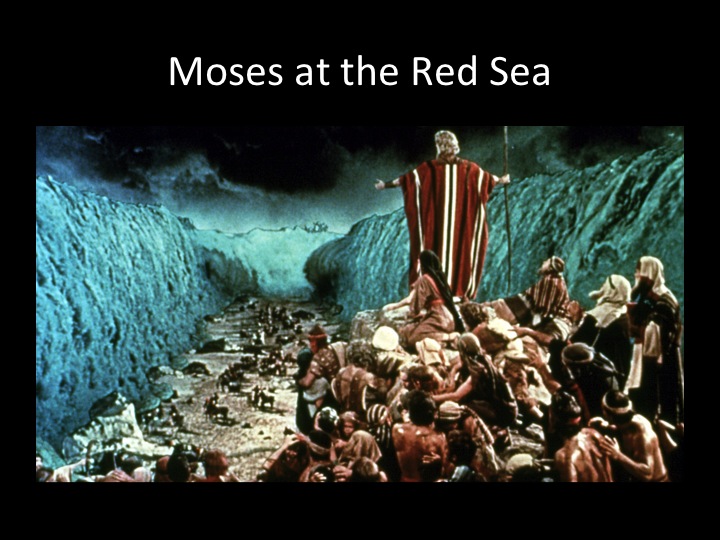
 

A Fragrant Offering


Meditation on John 12:1-8

March 13, 2016

Six days before the Passover Jesus came to Bethany, the home of Lazarus, whom he had raised from the dead. There they gave a dinner for him. Martha served, and Lazarus was one of those at the table with him. Mary took a pound of costly perfume made of pure nard, anointed Jesus’ feet, and wiped them with her hair. The house was filled with the fragrance of the perfume. But Judas Iscariot, one of his disciples (the one who was about to betray him), said, ‘Why was this perfume not sold for three hundred denarii and the money given to the poor?’ (He said this not because he cared about the poor, but because he was a thief; he kept the common purse and used to steal what was put into it.) Jesus said, ‘Leave her alone. She bought it so that she might keep it for the day of my burial. You always have the poor with you, but you do not always have me.’


***

Today, we reach a milestone in our ministry of just 5 months together–a baptism! Baptisms are times of joy and celebration in the life of the Church as we welcome the newest member into our family of faith. In baptism, the Church is refreshed and renewed by the same Spirit that marks, seals and claims as God’s own those being baptized. Baptizing baby Oscar will always be particularly meaningful to me because he is our first–together, in this place.

     And today, we begin a new tradition at our church for our baptismal gifts. In addition to the beautiful banner a member of our congregation made for Oscar and his family, Oscar will receive a white baptism blanket, created by Heavenly Handmade, a crafting fellowship group of our congregation. Since we began meeting once or twice a month in January, the group of about 7 has knitted or crocheted the baptism blanket and 15 or more prayer shawls to give to people in need of God’s comfort and healing touch.

Each shawl or blanket is unique, a work of art, a labor of love! We use different patterns and yarns of a variety of colors, weights and textures. Some members of the group have been knitting or crocheting for years. Others, like me, have been crocheting just a little while and need more help. Still, I never feel like the little bit I can do isn’t good enough–because of the love and encouragement of this very special group of people. I am richly blessed! I feel almost guilty because of my joy when I am with them, as we labor with yarn, hook, and needles, creating something beautiful, for Christ’s sake.


***


We hear of another gift, given from a heart of love and gratitude, in our gospel lesson today. Mary of Bethany is the giver and Jesus the recipient at a dinner given in his honor at Mary’s family home. The joyful meal follows Jesus’ raising her brother, Lazarus, from the dead, after he was in the tomb for 4 days and the stench of death had already set in!

This passage is called the “anointing of Jesus,” and yet it wasn’t ordinary practice to anoint someone’s feet; it was usually their head or face. Jesus explains that Mary bought the perfume for his burial, presumably to prepare his body for the tomb. Her gift is worth a whopping 300 denarii — 300 silver pieces! This is about a year’s pay for average laborers, who receive only 1 denarii (or silver piece) for a day’s work.

This Mary could be confused with the unnamed “sinful” woman in Mark and Luke who weeps as she pours an alabaster jar of valuable perfume on Jesus’ feet and wipes them with her tears as he dines at Simon’s house. The first few times I read this passage in John this week, I mistakenly imagined Mary weeping, but she isn’t crying! She isn’t a so-called “sinful woman”–a lady of the night, like in Mark and Luke, seeking forgiveness for her sins. This is the faithful Mary whom Martha criticizes in Luke for just sitting at Jesus’ feet and hanging on his every word while Martha is doing all the work to get dinner ready. This is Mary who comes to Jesus at Lazarus’ tomb and kneels at his feet, saying, “Lord, if you had been here, my brother would not have died.”

Only Jesus knows the loving, grateful heart that stirs Mary’s generous offering to Him. She chooses to give all that she is and from what she has– what is of great value to her society, a world that is supremely smelly by our standards. The climate is hot–without a/c or glass windows to keep out dirt, wind, heat and smells from neighbors’ herds of goats and sheep. There is no deodorant. No daily bathing with perfumed soap and treated water, no daily shampooing of the hair nor machine-washing clothes with powerful dirt and odor fighting detergents. No toilets or modern sewers. You get the idea.

The Greek word translated perfume (myron) usually refers to a perfume or ointment made from myrrh. Either as a dried powder or liquid, myron was made from a gummy resin from a low, shrubby balsam tree that grows in west-central South Arabia. It was used as incense and in cosmetics, perfume, medicine, and burial preparations. But John uses the word to mean simply perfume, for this myron is not myrrh. Verse 3 says, “Mary brought in a pound of expensive perfume made from real nard and anointed Jesus’ feet.” Nard or “spikenard” would be, for a woman living in Bethany–2 miles from Jerusalem– more exotic and difficult to acquire than myrrh. Nard is a fragrant oil derived from the root and spike of the nard plant, which today grows in the mountains of Northern India. Verse 3 continues, “Then she dried his feet with her hair, while the fragrance of the perfume filled the house.”

     Mary’s gift was truly a fragrant offering to the Lord! It brings to mind the fragrant offerings of ancient Israel. Numbers 15:3 says, “And you present to the LORD food offerings from the herd or the flock, as an aroma pleasing to the LORD–whether burnt offerings or sacrifices, for special vows or freewill offerings or festival offerings….

This passage in John also calls to mind 2 Cor. 2:4-6, when Paul refers to Christ’s followers as life-giving fragrance for the world: “But thanks be to God, who in Christ always leads us in triumphal procession, and through us spreads in every place the fragrance that comes from knowing him. For we are the aroma of Christ to God among those who are being saved and among those who are perishing; to the one a fragrance from death to death, to the other a fragrance from life to life.”

Immediately following Mary’s extravagant gift, when the house fills with the beautiful scent, Judas Iscariot, one of the 12, responds angrily, ‘Why was this perfume not sold for three hundred denarii (300 silver pieces) and the money given to the poor?’  Then, John interrupts with a rare narration to explain Judas’ motivation. Verse 6 says, “It was not because he was concerned for the poor that he said this, but because he was a thief. He kept the common purse and used to steal what was put into it.” This foreshadows what will happen later in the Garden of Gethsemane, when Judas will betray Jesus for a mere 30 pieces of silver.

Mary doesn’t respond to Judas’ attack, just as the women who anointed Christ’s feet in Luke and Mark with their tears and expensive perfume say nothing in their own defense. But Jesus speaks up for Mary. He tells Judas, “Leave her alone!” Then Jesus makes a remark that has sometimes been misunderstood to mean that we shouldn’t bother to help people in need because there will always be people in need. Jesus says, “You always have the poor with you, but you don’t always have me.”

The OT scripture Jesus is quoting actually means the opposite– that God commands us to care for people in need precisely because there will always be people in need. Deut. 15:11 says, “Since there will never cease to be some in need on the earth, I therefore command you, ‘Open your hand to the poor and needy neighbor in your land.’”

With Christ’s talk of not always being with them, the Lord is preparing those who love him–the faithful and not so faithful–for what is to come–the passion, his death on a cross for the sins of the world.

Friends, we live always in the shadow of the cross, but we also live in the presence of the risen Christ. Let us not become distracted by Judas’ unfaithfulness, lest we miss the call to faithful discipleship. May we remember Mary’s fragrant offering of all that she had and all that she was, in the midst of a world of treachery and betrayal–not just out in the world in which Jesus lived but amongst Christ’s own followers.

Don’t be afraid to be vulnerable, like Mary! The Lord welcomes us to come to Him just as we are. His grace covers all our sins! The gifts God has given us are meant to be shared with the Lord and God’s people. Don’t think you have nothing to give or that your gifts aren’t good enough! Maybe–like me learning crochet– you haven’t begun to discover all the gifts the Lord has given you to use for His sake! Our gifts are ALWAYS acceptable to the Lord, a fragrant offering, when they come from a heart of love and gratitude and a desire to be pleasing to Him.


Let us pray.   Holy One, we thank you for your love and grace, always welcoming us to come to you, just as we are, and seek your face. Help us to trust you so that we are willing to be vulnerable, a fragrant offering of all that we are and all that we have, what is most valuable to us in this world. Thank you for the gift of faith and for sending your Son to show us the way back to you–through belief in His suffering work on a cross for our sakes. Thank you for claiming baby Oscar as your own by baptism and filling him with your Spirit. Please strengthen and guide him to walk in your ways. Empower us as the Church to support and encourage baby Oscar and his parents, Kara and Oscar, as they seek to nurture him in your love and grace. May he and all the other children of our church come to profess Christ as their Savior and live as his faithful followers all of their days. In your Son’s name we pray. Amen.

Practical Resources for Churches

Everyone has a calling. Ours is helping you.
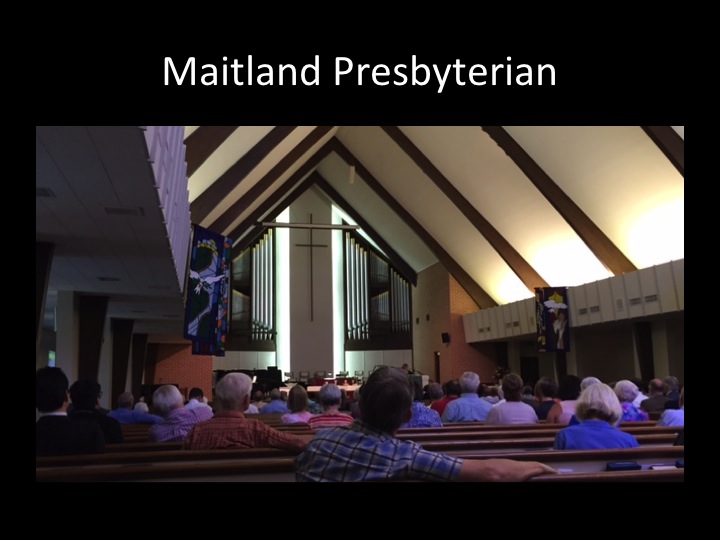

Consider the Birds

Pastor Karen shares thoughts on faith, scripture, and God's love and grace revealed through backyard wildlife.

F.O.R. Jesus

Fill up. Overflow. Run over.

Becoming HIS Tapestry

Christian Lifestyle Blogger

Whatever Happens,Rejoice.

The Joy of the Lord is our Strength

Stushie Art

Church bulletin covers and other art by artist Stushie. Unique crayon and digital worship art

The Daily Post

The Art and Craft of Blogging

WordPress.com News

The latest news on WordPress.com and the WordPress community.