Meditation on Acts 2:1-21
Reverend Dr. Karen Crawford
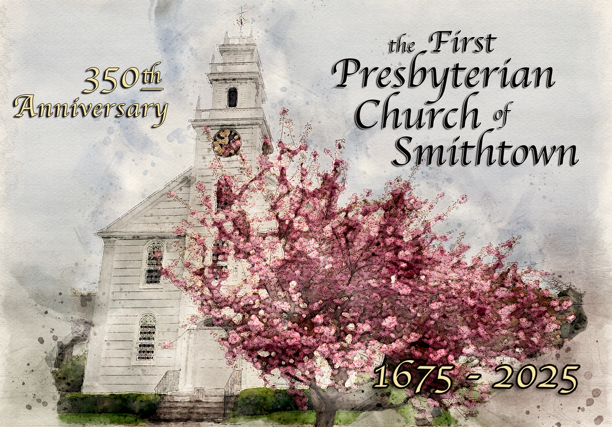
First Presbyterian Church of Smithtown
Pentecost
May 24, 2026
I was at our presbytery offices in West Islip this week for a General Assembly training. I am one of two ministers of Word and Sacrament commissioned by the presbytery to go to GA in Milwaukee at the end of June, along with two elders and a Young Adult Advisory Delegate. As I was preparing to leave the presbytery offices, I couldn’t help but wonder about the beginnings of Presbyterian Christianity here on Long Island. How did we come to be the people we are today, still led by the Spirit? I left the offices with two slim books—the 1963 Religious History of Long Island and the other a tiny blue presbytery manual and directory from 1931.
Smithtown is one of 13 churches to be members of what is now the Presbytery of Long Island at its organization in 1790: Newtown, Huntington, Hempstead, Jamaica, Smithtown, Brookhaven (Setauket), South Haven, Bridgehampton, West Hampton, Southampton, East Hampton, Aquebogue (Jamesport), and Mattituck. We had been reluctant to give up our Congregationalist leanings and wait until 1749 to join its predecessor—the Suffolk Presbytery, formed in 1717 by the churches of Jamaica, Newtown, Southhampton, and Setauket. Perhaps we are persuaded by our long relationship with Setauket, with whom we share our first and second ministers, Reverend Nathaniel Brewster and Reverend George Phillips. Or maybe it is because we are in a time of uncomfortable transition, in-between pastors, once again, that we decide to embrace Presbyterianism.
Within a year following our application to join the presbytery, we dismantle our old meeting house and move it from its original location, a frontier settlement at the intersection of Moriches and River roads. We reassemble the building at its present location on land given by Obadiah and Epenetus Smith. By September 1751, we are able to call our next pastor—the Rev. Napthali Dagget. But he leaves the church 4 years later for lack of financial support. It isn’t until 1763 when we are able to invite a Yale grad, the Rev. Thomas Lewis of Fairfield, CT, to serve as our minister. And then the American Revolution comes along; the British occupy the Island. Presbyterian churches are desecrated. From 1775 to 1784, the Presbytery of Suffolk is prevented from meeting.
Following the Revolution, the Presbyterian church is one of a number of denominations that organizes on a national basis. The General Assembly of the Presbyterian Church (USA) is organized on May 21,1789, in the Second Presbyterian Church of Philadelphia as “The General Assembly of the Presbyterian Church in the United States of America.” The Rev. John Witherspoon, the only active member to sign the Declaration of Independence, is the first presiding officer and preaches the sermon at the opening service of worship. While the General Assembly meets in Philadelphia, the first United States Congress to convene under the new Constitution is also in session in the same city!
The early 1800s sees revivalism in Presbyterian churches under leaders such as abolitionist Lyman Beecher, ordained at East Hampton in 1799, with an annual salary of $300 plus firewood. Following the 1804 duel of Burr and Hamilton, Lyman gains popular recognition when he gives a sermon before the Presbytery of Long Island that is promptly published as The Remedy for Duelling in 1806. (https://en.wikipedia.org/wiki/Lyman_Beecher) Lyman’s preaching leads to the Old School/New School controversy and a split in the Long Island Presbytery, as well as splits among other Presbyterians. The separation involves “differences over theology, governance, and reform, especially slavery,” says James Smylie (A Brief History of the Presbyterians, 78-79). “The Old School (is) doctrinally more conservative than the New School and ha(s) many adherents in the South. New Schoolers (are) exploring fresh ways of expressing their Reformed theology. Many (are) located in New York, the Midwest and the border states…They (are) attempting to articulate more clearly the human response to God’s gracious love shown in Jesus Christ. Despite New School professions of faithfulness to the Reformed faith, Old School adherents, especially in Pennsylvania, suspect a lack of New School orthodoxy” (Smylie, 79).
“Some people (think) that the Old School-New School division (is) an ominous national event because of the role Presbyterians played in society. Cyrus McCormick, Presbyterian Industrialist, considered the PCUSA (Old School) as the only institution holding the country together” (Smylie, 80). William Lloyd Garrison consider(s) the division between the Old School and the New School Presbyterian churches a sign of the coming division of the nation….” (Smylie, 80)
The Old School/New School split on Long Island leads to the formation of a Second Presbytery of Long Island. The organizational meeting of the Second Presbytery is held at the Smithtown Presbyterian Church on Oct. 30, 1832, when our present sanctuary is only a few years old (Dick Mehalick, Church and Community 1675-1975, The Story of the First Presbyterian Church of Smithtown, 51-52). Others who join with us are Babylon, Brookfield (later Manorville), Brookhaven, Fresh Ponds, Huntington, Middle Town (now Middle Island), Moriches, South Haven, and Sweet Hollow. The pastor of our church, the Rev. Ithamar Pillsbury, is appointed Stated Clerk of the new presbytery. Setauket and Westhampton soon join us. At the time of the split, the Presbytery of Long Island adheres to the “New School Assembly” while the Second Presbytery of Long Island is “Old School.” Donald Broad of Setauket Presbyterian describes Old School and New School in this way. “The Old School was Scots Irish, anti-revival, strict confessionalist, and pro-slavery. The New School was New England Puritan, pro-revival, liberal interpretation of the Confession, and anti-slavery” (Jane Des Grange, Long Island’s Religious History, 36).
In 1861, Southern presbyteries withdraw from the Old School Assembly. Commissioners meet in Augusta, GA, to form “The Presbyterian Church in the Confederate States of America.” Benjamin Palmer, pastor of First Presbyterian Church of New Orleans, is elected moderator. The body sends out the “Address of the Southern General Assembly to all the Churches of Jesus Christ,” explaining the reasons for the division of Presbyterians and making a “vigorous defense of slavery, as well as the ‘spirituality’ of the church, not preserved by former colleagues in the North” (Smylie, American Presbyterians: A Pictorial History, 106).
When we consider the history of Presbyterianism in America, we can’t help but see our imperfection and brokenness as a Church, prone to arguments and divisions—even today. And yet, we also see the work of the Spirit that has continued since the Church’s first dramatic formation on Pentecost. This must be how the Holy Spirit works in imperfect human beings, ordinary people still moved to do extraordinary acts of ministry—together.
Each year on Pentecost, we are reminded that the Church isn’t something that we can see or grasp or control. The Church isn’t merely human. The Church is empowered and guided, as it was on that long ago day, by the fire of the Holy Spirit.
All are gathered in one place when the Spirit comes to everyone, all at once. They are compelled to speak in other tongues, as the Spirit gives them ability. Yes, they are divided back then, the crowds who have come to Jerusalem to celebrate the Feast of Weeks or Pentekostos, the word for 50th, for it was celebrated on the 50th day after the presentation of the first sheaf to be reaped of the barley harvest. Pilgrims from many nations watch and listen to the gospel being shared in their own languages. Some are astonished and amazed, wondering how uneducated, unsophisticated Galileans can possibly know all these languages. Others ridicule them, accusing them of drunkenness.
But then Peter stands and preaches the sermon of his life, starting with a joke like a late night comedian. “These men are not drunk, as you suppose; for it is only 9 o’clock in the morning.” Peter would declare Joel’s prophecy fulfilled.
In the last days it will be, God declares, that I will pour out my Spirit upon all flesh,
and your sons and your daughters shall prophesy,
and your young men shall see visions,
and your old men shall dream dreams.
Even upon my slaves, both men and women,
in those days I will pour out my Spirit,
and they shall prophesy.
The Spirit will touch the hearts and minds and transform the lives of EVERYONE who hears the message of God’s love and grace, a message that will never change. God’s salvation is still offered to everyone. No small print here, like we see on store coupons with expiration dates. No exclusions. No manmade rules. There’s only one requirement, says Joel and Peter. EVERYONE who calls upon the name of the Lord shall be saved.
The schism that led to the formation of the Second Presbytery of Long Island would be healed after the Civil War, in 1870. At the reunion, the western part of the Old School Assembly becomes the Presbytery of Nassau. The eastern part with the New School body formed is the Presbytery of Long Island until 1963, when an act of General Assembly would redraw the borders of the Presbytery to include Suffolk and Nassau counties.
Alas, Southern Presbyterians who split during the Civil War would not reunite with Northern Presbyterians until 1983, when the Presbyterian Church (U.S.A.) is formed. The denomination would be the largest and most diverse member of the reformed family of churches on the continent. At the time of the reunion, the Church writes a new confession. The Brief Statement of Faith, included in our Book of Confessions, leads us to say what we believe about each person of the Trinity.
This is what we confess about God the Holy Spirit:
We trust in God the Holy Spirit,
everywhere the giver and renewer of life.
The Spirit justifies us by grace through faith,
sets us free to accept ourselves and to love God and neighbor,
and binds us together with all believers
in the one body of Christ, the Church.
The same Spirit
who inspired the prophets and apostles
rules our faith and life in Christ through Scripture,
engages us through the Word proclaimed,
claims us in the waters of baptism,
feeds us with the bread of life and the cup of salvation,
and calls women and men to all ministries of the church.
In a broken and fearful world
the Spirit gives us courage
to pray without ceasing,
to witness among all peoples to Christ as Lord and Savior,
to unmask idolatries in Church and culture,
to hear the voices of peoples long silenced,
and to work with others for justice, freedom, and peace.
In gratitude to God, empowered by the Spirit,
we strive to serve Christ in our daily tasks
and to live holy and joyful lives,
even as we watch for God’s new heaven and new earth,
praying, “Come, Lord Jesus.”
Let us pray.
Holy Spirit, thank you for coming as a rushing wind and tongues of fire on Pentecost, the Feast of Weeks, alighting on and dwelling in ordinary people and leading them to do extraordinary acts of ministry. Thank you for the example of Peter, an imperfect disciple whom you empower to persevere in his witness of the Living Christ all the days of his life. Do the same with us, dear Breath of God. Forgive us, heal our Church from any brokenness. Make us one. Empower all Presbyterian Christians to love and accept everyone, to share God’s gracious love in Jesus Christ, and stir others to call upon the name of the Lord and be saved. Lead us to serve Christ in our daily tasks, live holy and joyful lives, as we watch and wait for the new heaven and the new earth, praying in one voice, “Come, Lord Jesus.” Amen.

