Meditation on Matthew 22:15-22
First Presbyterian Church of Smithtown, NY
Rev. Dr. Karen Crawford
Oct. 18, 2026
I visited Tom Deakins at St. Catherine’s Hospital last Sunday. He had been hospitalized with symptoms of a stroke, but the MRI machine had been broken for the first anxious days of his stay. Finally, the machine had been repaired, but he was still waiting his turn for the scans and other necessary tests that would hopefully lead to diagnosis and treatment. His wife, Marci, and two of their adult daughters were waiting and worrying and so tired of waiting and worrying about what was going on or not going on or what the next steps would be.
I listened, and we held hands and prayed. After we hugged goodbye and as I made my way back to my car, I thought about how important the timing is for our pastoral visits. What seems random to us, looking back, was all part of God’s plan. The Blessing of the Animals was, sadly, going to be rained out that day, and I was being sent to be the peaceful presence of Christ when it was most needed for Tom and his family. Of course, I didn’t know any of this before I arrived.
This is truly our highest calling, my friends, as followers of the Living Christ—to walk beside those going through difficult times and offer a gentle, listening ear, encouragement, love, and prayer. This is what makes us different from the secular, transactional world around us that values money and possessions over all things. We offer the presence, hope, love, and grace of Christ and our heartfelt prayers, no strings attached. We expect nothing in return.
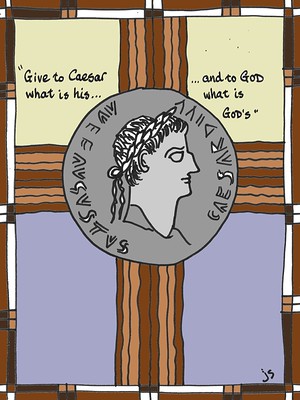
This offering of ourselves to our neighbors in need is the context in which we are studying a passage about stewardship from Matthew’s gospel today. We bring our own context to the Scripture, and as our context changes, our own understanding and application of the Scripture changes, too. Today, I am seeing new things in this familiar story that includes that unforgettable but sometimes misunderstood quote, “Give therefore to Caesar the things that are Caesar’s and to God the things that are God’s.”
Matthew tells us from the beginning that the Pharisees and the Herodians, a political faction of wealthy elites who were pro-Roman and supported the Herodian dynasty, are plotting to entrap Jesus. They are in the temple courtyard, with an audience listening in. These two groups have come together in their mutual dislike and fear of Jesus, who is growing in popularity with the masses. They are hoping to force him to say that it IS or ISN’T lawful to pay taxes “to Caesar.”
If he says it IS lawful, this would be a betrayal to his faith community, which was being overwhelmed by a complex, multi-layered system of oppressive civil (Roman and Herodian) and religious taxes. The coins are seen as pagan and idolatrous by the Jewish community and viewed with animosity; they feature Caesar’s head with a laurel wreath and suggest that he is a god, with the saying, “Tiberius Caesar, Son of the Divine Augustus.”
Historians estimate that Judeans are paying 30% to 60% of their total income or production. They have Roman imperial indirect taxes, such as customs duties, road tolls, bridge fees, and market taxes collected at ports, city gates, and major trade routes. They have a corrupt tax collection system, “where private contractors or publicans bid for a region’s franchise. These collectors (make) a profit by extracting far more than the official Roman rate and using extortion, threats, or inflated property values.”[1] They have local and regional taxes, as well, paid to client kings and governors, such as Herod Antipas or Roman prefects, such as Pontius Pilate, who “levied local infrastructure, court, and building taxes to finance grand architectural projects, including the expansion of the Temple Mount and palaces.” They have religious taxes, too, as every adult Jewish male is required by Exodus 30 to pay an annual half-shekel to support the operations of the Second Temple in Jerusalem.”[2] And they have Roman imperial direct taxes, such as the tributum soli (a land and agricultural property tax) and the tributum capitis (a poll or head tax levied on individuals). This poll or head tax is what is being debated here.
But even better than forcing Jesus to say that it IS lawful to pay the poll taxes to Caesar is to trick him into saying that it isn’t lawful, so they can arrest him for treason.
Jesus responds aggressively to the attempt at entrapment. “You hypocrites!” he says, not being fooled by their false flattery and manipulation. “Why are YOU putting ME to the test?” Then, my favorite part. “Show me the money,” he says. And it dawns on me for the first time, after seeing this passage countless times. This isn’t just an object lesson or an attempt at distraction. Jesus doesn’t have any of these idolatrous coins in his pocket! By his asking for them to produce one, he is revealing just how hypocritical they are!
And now for the most important part of the passage. What exactly does Jesus mean, after asking them whose head is on the coin, by, “Give therefore to Caesar the things that are Caesar’s and to God the things that are God’s?” He has come up with a trick answer to the trick question. And that’s why the Pharisees and Herodians are amazed by what he says.
Some people take this to mean that there is a way to separate our money and possessions into two categories, some that belong to Caesar and some that belong to God. Or that the Lord doesn’t really care about what we do with our money; money is something worldly and not spiritual and therefore doesn’t matter for eternity.
But that would be far from the truth. That’s not what Jesus means here. In the Old Testament, dozens of Proverbs and other scriptures speak about faithful attitudes toward money and giving, such as Proverbs 22:9, “A generous man will be blessed” and Proverbs 15:27, “A greedy man brings trouble to his family.” In fact, Jesus spoke about money, wealth, and possessions more than almost any other topic, devoting about 15% of his recorded words and 16 of 38 of his parables to the topic of money.[3] For example, let us recall when Jesus startles a would-be follower in Mark 10, who asks what he must do to inherit eternal life. Jesus tells the man to sell all that he has and give his money to the poor. And then, follow him. But the man goes away sadly, unwilling to part with his great wealth.
The key to understanding this passage in Matthew is through contemplating what Jesus means when he tells us to give to God “the things that are God’s.” I ask you, “What things belong to God?” And, “What things don’t belong to God?”
Psalm 24:1 declares, “The earth is the Lord’s and the fullness thereof, the world and those who dwell within.” My friends, we belong to God. All that we are. All that we will become. All our gifts and possessions have been given to us for God’s loving purposes!
After these last couple of weeks of pastoral care to members of our flock with serious health issues, and caring for my husband, struggling with severe back pain, I have to say that it is comforting to consider that we belong to God in every way. God cares for you and me! We are not alone in our struggles! Knowing that we cannot separate the things of God and our faith from the things of anything else in this world brings me peace. Worrying about money and seeking to accumulate possessions is a hindrance to the calling that we have been given as the Body of Christ to shine light into darkness and reveal the Lord’s goodness and healing to a broken world.
Dear friends, you have such compassion and generosity, never hesitating to offer yourselves—all your gifts, including your time and talents and even cooking—to those in need—including Jim and me! We are so grateful for your kind words and fervent prayers. They have given us strength when we have felt weak and vulnerable.
This is truly our highest calling as followers of the Living Christ—to walk beside those going through difficult times and offer a gentle, listening ear, encouragement, love, and prayer. This is what makes us different from the transactional world around us that values money and possessions above all things. We offer the presence, hope, love, and grace of Christ and our heartfelt prayers, no strings attached. We expect nothing in return. Our treasure is in heaven, Amen?
Marci and Tom are grateful for your kindness, as well. They reached out yesterday with a letter for their church family and asked me to share it with you.
“First, Tom and I would like to thank everyone who offered prayers, concern, and help during Tom’s recent health crisis,” Marci says. “As many of you know, Tom was hospitalized the day after we returned from vacation with symptoms of a stroke. Many tests later, a stroke was ruled out, although several other medical conditions came to light, which in combination led to his symptoms. With treatment, including minor surgery, he is at home, well on the way to recovery. Again, our sincere gratitude for your prayers, thoughts and support. We know that they were a large part of the positive outcome he is experiencing. With much love and appreciation, Tom and Marci Deakins.”
Let us pray.
God of All Comfort, thank you for the ways that you provide for our needs through the Body of Christ—our friends and family. Thank you for having a good plan for us and for being faithful to use us for your loving purposes. Thank you for leading us to bring your Son’s peace to our brothers and sisters who are hurting or otherwise needy and for granting us the power to reveal your comfort, love, mercy, and grace to those most vulnerable around us. Watch over and keep our flock in your tender care, dear Lord. Give us courage to live into our calling as followers of your Son, the Living Christ, to walk compassionately beside those going through difficult times and listen gently, encourage, love, and pray. Lead us to be your light in darkness, your healing in a broken world. Amen.
[1] Alan D. Campbell, “Monetary System, Taxation, and Publicans in the Time of Christ” in Accounting Historians Journal, vol. 13, issue 2, fall 1986, accessed Oct. 17, 2026, at https://egrove.olemiss.edu/cgi/viewcontent.cgi?article=1276&context=aah_journal.
[2] Jerry Boyer, “Jesus, the Temple Tax, and Fourfold Atonement,” Feb. 16, 2021, accessed Oct. 17, 2026, at https://theopolisinstitute.com/jesus-the-temple-tax-and-four-fold-atonement/
[3] https://support.envoyfinancial.com/bible-verses-about-money-and-stewardship/
Art by Stushie, used with permission

