Meditation on Acts 2:37-47
Rev. Dr. Karen Crawford
First Presbyterian Church of Smithtown
World Communion Sunday
Oct. 4, 2026

We don’t know the exact day or even the season when the first church is organized in Smithtown. No records remain concerning its formation. But historians believe that the year is 1675. And that the first church is this church.
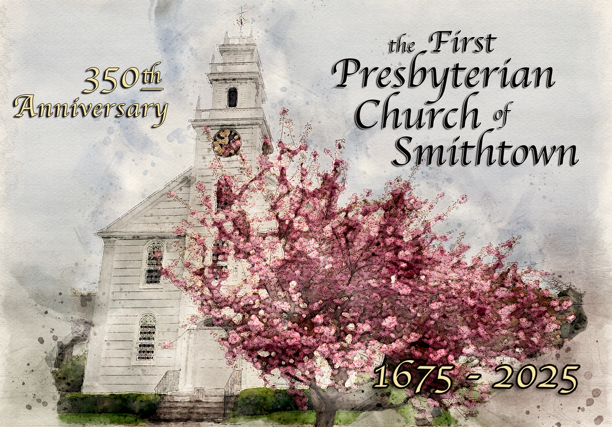
A year ago, we celebrated our 350th anniversary. We gathered for worship in the afternoon to rededicate ourselves and our 200-year-old sanctuary for God’s loving purposes. We invited local and state dignitaries; synod and presbytery leaders; former pastors and their families; and all our members, past and present. After worship, we shared a special meal. That celebration has now become part of our history that I feel led to share today.
Nine years have passed in 1675 since English immigrant Richard Smith receives the clear title to the lands comprising Smith’s Town.[1] Smith had come to the New World with a tide of religious refugees seeking freedom from persecution, land to farm, and a community in which to raise their children to live out their dreams. Smith’s church in 1675 is more like a family chapel. The little wooden meeting house is built on a frontier settlement on a rise of a hill off a dirt wagon path, where Moriches and Nissequogue River roads intersect.[2]
Smith and his family are Congregationalists, free to govern their churches and worship as they choose without interference from a higher church authority. Congregational churches had been in existence on Long Island for 25 years in 1675, but only one Presbyterian Church had been founded—in Jamaica three years before at the western end of Long Island.[3] The first presbytery, the Presbytery of Philadelphia, would be formed in 1706, followed by the Synod of Philadelphia in 1717. The first General Assembly would be called more than a century after our congregation was founded—in 1789, after the Revolutionary War, with the creation of a national Church, the Presbyterian Church in the United States of America.
There aren’t enough pastors in the 1600s and 1700s for every Congregational church on Long Island, and little money to pay them. Smith’s family and neighbors solve the problem by sharing pastors with the Congregational Church of Setauket in the early years. The first minister is probably Nathaniel Brewster, who serves Setauket from 1665 to 1690.[4] Brewster is among the first graduation class of 9 men from Harvard College. Our first recorded minister is shared with Setauket, as well, beginning in 1697; he is George Phillips, another Harvard grad.[5] Richard Smith passes away in 1692, but his children and their families and neighbors continue to gather at the meeting house.[6] Finally, the church is able to call its first resident minister in 1712—a 28-year-old Yale grad named Daniel Taylor, who takes on a second job as the town clerk. Another pastor, Abner Reeve, is called to serve the flock at the meeting house in 1735. The 25-year-old Yale grad is from Southold, Long Island.[7]
The little flock joins the Suffolk Presbytery a few years later, though some members are reluctant to give up their Congregationalist leanings. In 1750, they sense the Lord leading them to a new mission field. The business center of the Town, which had grown to about 700 people, had evolved in our present general location. So, the little wooden building is dismantled and reassembled here on donated land from Obadiah and Epenetus Smith.[8] The flock in 1750 numbers just 7 people, who, at the time, don’t have a resident pastor. They are in one of those uncomfortable interim periods, like the ones we weathered in the 2oth and 21st centuries. Naphtali Daggett, a 1748 Yale grad who would be ordained here in September 1751, dedicates the rebuilt Church. The seven members are Obadiah Smith, Susannah Smith, George Phillips, Elizabeth Phillips, William Saxton, Dorcas Saxton, and Mary Blydenburgh.[9] It is an act of hope and faith for the fledgling congregation. Soon after the relocation, 14 more people join, including a man named Peter with no last name, an African American who may have been brought here as a slave in his youth.[10]
The congregation has tough times ahead. The early years of the church’s second century are characterized by political turmoil.[11] The colonists are defeated in the Battle of Long Island. The entire island falls under British military rule in 1776. Some residents flee across the Sound to Connecticut. Those who stay are harassed by British troops. These troops help themselves to 6,396 feet of lumber from our meeting house and from the fencing and horse sheds on the property.[12] And our minister from 1774 to 1787, the outspoken patriot Joshua Hartt, a Princeton grad, is fired on by a British soldier during worship, but is miraculously unharmed. He is arrested and placed in British prisons on several occasions.[13]
By 1797, the church is struggling. Session records say that the congregation is “destitute of a pastor and … in a deranged and broken situation.”[14] The Presbytery advises the divided church to draw up a covenant that each member would sign. And they do. The congregation promises to “watch over one another in the Love of the Lord and give up (themselves and theirs) to the discipline of the Church, according to the direction of Christ.”[15] They promise to “hold Communion with each other in the Word of God, and in the careful and diligent Use of the Ordinance of Jesus Christ, so long as (they) continue together in this relation(ship) by the Grace of God.”[16] Disagreement continues between factions in the congregation in 1810, this time, over the use of the meeting house. Caleb Smith, President of the Board of Trustees, orders that “no person be permitted to enter without permission.”[17] The following year, in 1811, a new minister, Bradford Marcy, comes to serve Smithtown and Babylon concurrently. During his pastorate, Articles of Agreement are drawn up reuniting dissenting members.[18]
In 1823, the congregation votes to build a new church. The Trustees have $1,410 for that purpose,[19] and the builder will be George Curtiss. The old meeting house is put up for sale at public auction.[20] The flock waits two years after their new house of worship is finished in 1825—till all the debts have cleared—before this building is dedicated for a holy use.[21] Ithmar Pillsbury, a minister representative of the presbytery, presides over the service on Sept. 9, 1827, because the church is, once again, without a resident pastor.[22] It is another act of hope and faith for the now 32 members.[23] With the new building, the pastoral leadership of the Rev. Pillsbury, installed in 1830, the congregation’s outreach, and by the grace of God, the church grows by 52 new members, and will rise again in 1840, under a new pastor’s leadership. Many old Smithtown names are recorded at this time: Smith, Blydenburgh, Wheeler, Miller, Mills, Hallock, Arthur, Saxton, Hawkins, Conkling, Davis, Wood, Vail, Bailey.[24]
As we consider our beginnings as a congregation, and our persevering in hope and faith in God’s grace, it is good to recall the powerful Spirit that formed the first ever Church of Jesus Christ. This is the story from Acts that we hear today, on World Communion Sunday, as we celebrate the Spirit that continues to empower and connect all of Christ’s churches around the world.
The Spirit that comes on Pentecost as tongues of fire equips Christ’s followers to share the gospel with worshipers from many nations who had come to Jerusalem for Shavuot or the Feast of Weeks. The Spirit leads Peter to deliver a sermon that cuts to the heart of his hearers. Convicted, they ask him what they must do to be saved. Peter, as John the Baptist preached by the Jordan, tells them to repent and be baptized. But this is a new kind of baptism. This one, he says, is “in the name of Jesus Christ so that your sins may be forgiven,” and to receive “the gift of the Holy Spirit.” The promise of the Spirit is for those being baptized AND their “children, and for all who are far away, everyone,” says Peter, “whom the Lord our God calls to him.” About three thousand people are added to the Church that day. Three thousand! And all the new Christians devote themselves to the apostles’ teaching and to fellowship, to the breaking of bread, and the prayers.
What touches my heart is the “awe” that comes upon everyone “because many wonders and signs were being done through the apostles.” Retaining that sense of awe and wonder in what the Lord is doing in our midst can be a challenge for us if we get bogged down in the weeds of day-to-day ministry, such as the ever-present worries of fixing our aging building and paying the bills. But maybe the problem lies with our faith and not our resources. New believers in the first Church held onto things loosely; they didn’t hesitate to share their possessions and goods or sell them and distribute the proceeds when there was a need. Worship was a priority and not just once a week. They worshiped “day by day,” spending much time together in the temple. They broke bread in each other’s homes and ate with “glad and generous hearts, praising God and having the goodwill of all the people.” And the Lord blessed them for their faithfulness. “Day by day the Lord added to their number those who were being saved.”
Dear friends, the Spirit who was with our ancestors is with us still. Our call to love and serve God and neighbor has never changed, though Smithtown hardly resembles the tiny, pioneer town it once was. May we leap like a deer over every obstacle and weather every storm like an oak tree. May we never forget where we came from—a family chapel in a little wooden meeting house on the rise of a hill, off a dirt wagon path, where Moriches and Nissequogue River roads intersect. May we embrace our history but never get stuck in the past. May we forgive one another and dwell in peace during times of uncomfortable transitions and uncertainty. May we retain our sense of awe and wonder in what the Lord is doing in our midst. May we lean into our future with courage, hope, faith, and God’s grace. And may we remember that WE and not the building are God’s house, a holy temple, and servants of our Master Lord.
Let us pray.
Holy God, we thank you for the centuries of ministry we have experienced here in the name of your Risen Son, for the promise of transformation through baptism, and your Spirit that continues to lead and empower us. Thank you for all your beloved children who have come before us—the thousands who joined the first Church on Pentecost and the thousands who have worshiped here over the centuries, loving one another, serving you and this community, planting and watering seeds, and praying for growth. Lord, fill us with your awe and wonder and help us overcome the challenges of day-to-day ministry. Guide us into the future with courage, hope, faith, and grace. Amen.
[1] J. Richard Mehalick, Church and Community: 1675-1975, the Story of the First Presbyterian Church of Smithtown, NY (Second Edition, 2010), 17.

