Meditation on Matthew 20:1-16
Rev. Dr. Karen Crawford
First Presbyterian Church of Smithtown, NY
Commissioning the Choirs and Welcoming New Members
Sept. 27, 2026
Do animals have morals? What do you think? Maybe it depends on the animals.
I listened to an NPR/TED Talk yesterday with that title, “Do animals have morals?” “Empathy, cooperation, and fairness seem like distinctly human traits,” says the teaser. “But biologist Frans de Waal explains why… animals might share those same qualities.”[1] DeWaal is a professor of psychology at Emory University, director of the Living Links Center at the Yerkes National Primate Center, and author of Chimpanzee Politics, Our Inner Ape, Primates and Philosophers, The Bonobo and the Atheist, and other publications.

In his lecture from Sept. 2014, DeWaal discusses research with chimpanzees on what he calls the pillars of morality: reciprocity, fairness, empathy, and compassion. In a study of prosocial behavior in animals, buckets of tokens are placed in front of two chimpanzees in separate cages. If the first chimp gives the researcher a red token, then only they are fed, and not the other chimp. If the chimp gives a green token, then both chimps are fed. What color do you think the chimps choose overwhelmingly? They prefer the prosocial green over the red so that both chimps are fed.
Later DeWaal shows a video of two capuchin monkeys in a well-known fairness study to show that animals can perceive an inequity. Two capuchins in side-by-side cages can see what the other is eating. They are trained to give the researcher a stone to receive a reward of a cucumber or a grape. When both are given cucumber, they are happy to eat it 25 times in a row. But when they deliberately create an inequality and give one cucumber and the other a grape, what happens? The one who receives cucumber after the other receives a grape gets mad and throws it back at the researcher. They yell and throw a temper tantrum and pull on the door to try to get to the grapes. In another test, two groups of monkeys do the same task, but receive unequal rewards. When the monkeys are asked to do the same task again, the ones who received the lesser reward refuse to do it. The researcher’s conclusion? Even monkeys reject unequal pay.
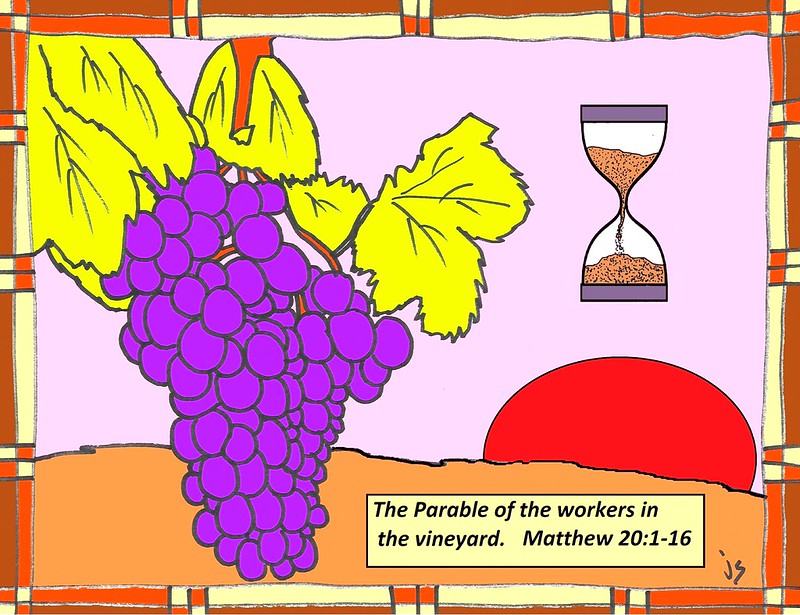
People have always been sensitive about unequal pay—going back to ancient times. We find it here when Jesus shares a parable about the Kingdom of God in our reading in Matthew. A landowner goes out to the marketplace at different times of the day, beginning early in the morning, and hires groups of workers for his vineyard. The first group is promised a denarius for a day’s work, which is typical for that time and place. I remember my grandfather, who was born in 1888, saying each night, “Another day, another dollar.” Have you heard that saying before? It must go back to ancient times. But then the landowner goes out at 9, noon, 3, and 5 and hires more workers. “Why are you standing here idle all day?” he asks those at 5. They say to him, “Because no one has hired us.” He invites them to work without telling them their pay. When evening comes, the owner tells the manager to pay everyone the same—one denarius, promised to the earliest group there at sunrise. The manager must start with those who have only been working since 5 p.m. When the first group is paid last, they think that they will receive more than one denarius, because they have been working the longest and hardest of all. It’s only fair, right? But they only receive what they had been promised at sunrise—one denarius. How do they feel when they receive it, though it is fair pay for a day’s wages? They grumble against the landowner, saying, “‘These last worked only one hour, and you have made them equal to us who have borne the burden of the day and the scorching heat.’” The landowner responds, “Am I not allowed to do what I choose with what belongs to me? Or are you envious because I am generous?”
This is such an interesting picture of the work of the Kingdom. The reward is the same for all who accept Christ’s call to labor. Our work is to seek to follow him by sharing the hope of Christ for eternity and the forgiveness, mercy, grace, generosity, and unconditional love of God. This is our work. The reward is the same. Whether you have been a Christian for a long, long time—maybe 50, 60, even 70 years. Or only for a short while—6 months or even 1 week. The reward is the same. Still, we labor on, longing for the day when we see Christ face to face. When we hear, “Well done, good and faithful servant. Well done.”
I puzzled over this passage this week and especially on Friday, which was the anniversary of my ordination—Sept. 25, 2011. When you serve the Lord in ordained ministry—as a minister of Word and Sacrament, Deacon, or Ruling Elder, you wake up and say YES to the Lord, each day. Every day, you say YES. It’s the same if we are serving as a Trustee. We wake up and say YES. We don’t do it for a reward. We do it because we have passion for the labor and the One who calls us to the work. I always know when it is the anniversary of my ordination. It’s a serious day for me. The whole day, even if I am busy caring for my flock or my family, I am listening for God’s voice, as I ask, once again, “Is this the labor to which you are calling me? Do you still want me to minister for you?” Every year, I hear the answer. STILL YES. And I answer, “I pray that you will find me faithful.”
With every year that passes, I am aware of the deepening of the commitment, my growing responsibilities, desire to be faithful, and the changing shape or form that my ministry is taking. The work gets harder. It is emotional, at times. It can be tiring. You really feel like you are laboring in the vineyard from sunrise to sunset on a scorching day—and every spiritual muscle is feeling the exertion. But you also sense the presence of all the laborers working with you, surrounding you. You feel their comforting presence in the vineyard. For this work we do for God, we never do alone.
On Friday, when I remembered how the ministers in Minnesota laid hands on me and prayed at my service of ordination and installation 15 years ago in the little town of Renville, I was preparing for an indoor picnic at the manse with the Albarella family—Kerrianne and Craig, Natalie, little Craig, and 4-year-old Aiden, whom we baptized 3 years ago. I was thinking about what food and drink they might like. Jim and I prepared cheeseburgers and hot dogs, French fries, carrot and celery sticks with ranch dressing, tomato slices, grapes, applesauce, and apple juice. We had Mickey Mouse ice cream pops and brownie bites for dessert. I have never seen children eat so many vegetables and get so excited over tomatoes before!
I don’t recall using hospitality gifts in my ministry as often as I use them here with my ministry in Smithtown. But I have enjoyed having the people of God come to our home for ministry meetings, Bible and book studies, food, and fellowship these four years. I enjoyed the celebration of our 350th anniversary with our community and our country’s 250th with the town of Smithtown on July 4th. I didn’t know that about me—that I would enjoy these community celebrations. I always knew I would enjoy pastoral care and ministry with children and youth, but I had no idea how satisfying it would be. I knew that I would enjoy ministering to people who were grieving, sharing stories of their loved ones, and celebrating their lives. But I had no idea how sweet our worship would be, how I would look forward to it every week and season—Lent and Easter, Advent and Christmas Eve, Ordinary Time. I had no idea how this kind of ministry that I am doing in Smithtown would fill my cup to overflowing.
What makes it so special to me, dear friends, is that I am laboring with you. YOU are the ones whom God has called me to serve and nurture in faith, hope, love, and witness. You are the ones whom God has called me to encourage, to say to you, “Labor on. Don’t get caught standing around, idle. Your gifts are needed! And you are invited!”
One day, dear sisters and brothers, we will meet the One for whom we long to see face to face. We will hear him say, “Well done. Well done.”
Let us pray. Heavenly Vine Grower, thank you for inviting us to labor in your vineyard, for the promise of our eternal reward, and our experience of your presence, grace, generosity, mercy, forgiveness, and unwavering love in this world. Thank you for this ministry here in Smithtown and for the workers gathered here to worship and be equipped for all you are calling us to do with the gifts you have given us. Thank you that we have one another and you are with us always. Use us for your glory. Give us strength and joy to persevere as your laborers, no matter the difficulty, stormy weather, or scorching heat. And fulfill our longing, dear Lord, to see your Son’s face, and hear him say, “Well done, good and faithful servant. Well done.” Amen.
[1] Frans de Waal, “Do Animals Have Morals,” NPR/TED talk (Sept. 5, 2014) accessed Sept. 26, 2026 at https://www.npr.org/2014/08/15/338936897/do-animals-have-morals.

