“Where are we to buy bread for these people to eat?”

Meditation on John 6:1-15

Pastor Karen Crawford

First Presbyterian Church of Smithtown, NY

July 28, 2024

“Loaves and Fishes,” acrylic painting, 1986
John August Swanson, artist

“A shoe factory sends two marketing scouts to a region of Africa to study the prospects for expanding business. One sends back a telegram saying,

“SITUATION HOPELESS STOP NO ONE WEARS SHOES

“The other writes back triumphantly,

“GLORIOUS BUSINESS OPPORTUNITY STOP THEY HAVE NO SHOES.” [1]

This story is from a book called, The Art of Possibility: Transforming Professional and Personal Life by Rosamund and Benjamin Zander. Has anyone heard of this book before? This was required reading for an interim ministry training I attended in Montreat, NC, five or six years ago.

The Zanders write, “To the marketing expert who sees no shoes, all the evidence points to hopelessness. To his colleague, the same conditions point to abundance and possibility. Each scout comes to the scene with his own perspective; each returns telling a different tale. Indeed, all of life comes to us in narrative form; it’s a story we tell.” [2]

So, this is my question. Are you a person who sees the world through a perspective of abundance and possibility? Or are you a person who sees the world through a perspective of scarcity and limitations? In other words, are you a half-full glass kind of person? Or are you a half-empty glass kind of person?

What’s YOUR story? Where did YOU get your perspective? What were your parents’ and grandparents’ stories? Did you grow up in an especially hopeful time or was it a time of anxiety and scarcity? How did that shape who YOU are today?

I was thinking about my grandparents this week who lived through the Great Depression. I found an old photo of Grandma in her 20s in a wedding dress from May 8, 1936. That would make a big difference in how you see the world—the narrative you know and tell for the rest of your life, if you grew up in a family that struggled during a time when many families across the country were struggling.

My mother’s mother used to tell stories of not having money growing up as Norwegian immigrants in a big family, with 11 children, in Pleasantville, NJ, near Atlantic City. But they still had fun, even without much money. They rolled up the living room carpets and danced with their friends to records on the Victrola. If the ice cream man came down the street, they might look under the couch cushions to find a nickel to buy a treat. I always thought that was amazing—that the couch cushions might be a good source for ice cream money. And that ice cream cost only a nickel!

But throughout Grandma’s life, even when she wasn’t poor as an adult, after she married a butcher from City Island, she had a certain narrative or perspective that wasn’t going to change. She was always afraid of scarcity—of not having enough. She was warm and hospitable, generous and kind, giving of herself to friends, neighbors, family, and church family. She was faithful to attend worship, always active in her church, busy with choir and rummage sales. When I was anxious, she would tell me to pray and “trust in the Lord.”

But she was afraid something might happen, and nothing would ever take that anxiety away, even when she was living with my parents in her last years in Florida. She lacked nothing.

Jesus knew his disciples well, just as he knows us well. It’s interesting to see the different perspectives of Christ’s followers in John chapter 6 today. He knew what questions to ask, what buttons to push, to help grow their faith and transform their thinking. In this case, he was testing Philip, asking him a question, though Jesus already knew what he was going to do.

There’s a crisis. A true situation of scarcity exists on the northeastern hillside of the Sea of Galilee, the lowest freshwater lake on earth. This miracle appears in all four gospels. This story was passed down, from anxious generation to generation, community to community, to give them hope, especially in times of real scarcity and need.

A crowd of people has been following Jesus because they see him healing the sick—they see the “signs,” John says. Jesus and his disciples have crossed to the “other side of the Sea” and climb a mountain to get away from the demands of ministry, take a rest from the crowd. The people find Jesus, anyway.

When he looks up and sees the crowd coming toward him, he asks Philip, “Where are we to buy bread for these people to eat?”

Notice he doesn’t say, “Where are we going to get the money to buy bread for people to eat?”

Philip, with his math mind, quickly calculates how much money they would need to buy bread for everyone, saying, as if Jesus had asked, “Where are we going to get the money to buy bread for people to eat?” “Six months’ wages would not buy enough bread for each of them to get a little.” In Greek, this is “200 denarii” not six months’ wages. One denarius is the usual pay for a day’s work as a laborer.  

So Philip—glass half empty or half full? At least he’s thinking about how it could be possible to help all the people in need. Philip knows the compassion and healing power of Christ is real. But, like us, he has the only perspective he knows—and that’s one where they only have a little bit of money to care for all the disciples—a true situation of scarcity, and now they need a lot more money to buy a whole lot of bread to feed a hungry and persistent crowd.

But then there’s Simon Peter’s brother, Andrew. He impresses me! He seems to have a good relationship with children. In a society that ignores children, he notices and befriends a child—speaks with him. The boy shows the former fisherman his five barley loaves and two measly fish—probably enough for a little boy’s lunch, and no more.

What is the child’s perspective? Is he a half empty glass person or half full? He has hope (doesn’t he?) that the little bit of food he has will make a difference. He has that child-like faith that Jesus says all of us need to enter the Kingdom of God. And gentle Andrew honors the boy’s generosity and tells Jesus about this gift. He doesn’t send the boy away.

Then Andrew does what we do when we are afraid to get our hopes up or when reality sets in. Have you ever had your hopes up about something and then realized that it just wasn’t going to happen? “It isn’t possible.” Or maybe that’s just what we tell ourselves to protect our hearts from painful disappointment.

After telling Jesus about the gift, Andrew says, “But what are they among so many people?” He’s having doubts. Suddenly, the boy’s gift isn’t enough. Andrew is, after all, in the “real” world with Philip, measuring the amount of food against the number of people and coming up extremely short.

Jesus then tells the disciples to make the people sit on the grass. This writer knows how to build suspense! What are the disciples thinking when they are telling people to sit on the grass? They have already decided that there’s no way Jesus can feed all those people. But they do it, anyway. They trust Jesus, though the math doesn’t add up, and it doesn’t make sense. They are examples to us, not always, but at this moment in the story.

And what are those people thinking when Jesus’s disciples are telling them to sit on the grass—and not telling them to go home? “Something good is going to happen. But what?” Jesus has given them hope for a miracle, like the signs they have seen when he has healed the sick.

Jesus blesses the bread—gives thanks to God. And then, in John’s account, Jesus himself gives the food to 5,000 people. He doesn’t give it to the disciples to distribute. The food comes directly from Jesus to the hands and mouths of the hungry. When everyone has had enough and are “satisfied,” he asks the disciples to gather up all the leftovers, “so nothing may be lost” or wasted. From the fragments of five barley loaves, after 5,000 people have eaten, the disciples fill 12 baskets. This is the miracle that persuades the crowd, now with full bellies, “This is indeed the prophet who is to come into the world.” And they want to take Jesus by force and make him their king!

This is the world they know—a world where a king is the only answer, though kings have come and gone and don’t care if they are hungry.

I think of situations in our lives where our own anxiety and thoughts of scarcity hold us back from taking risks or simply living in the peace of the present. I didn’t live through the Great Depression. I have never gone hungry. But, like my Norwegian-American grandmother, I worry sometimes. Maybe it’s just in my nature to do that.

This passage is powerful if we let it challenge the way our minds work. We are like Philip, immediately doing the math, any time we consider doing compassionate ministry. We are like Andrew, hoping for a miracle that begins with a small gift, but then reality sets in or we just talk ourselves out of it. We think it just isn’t possible.

When are we going to let go of anxiety and fear and live faithfully, as Christ is calling all his disciples to do? We live in an anxious age, with 24-hour news telling us we should be worried and fearful. Yes, there are real things to worry about in this world. And yet, the abundant blessings of God surround us. God’s mercy and goodness will follow us all the days of our lives. Like my faithful grandmother, we lack nothing, when we trust in the Lord!

Let us believe in a God who provides more abundantly than we can ever imagine. In Christ, we are new creations. I’m not a half empty glass person. And I’m not glass half full!

Like the psalmist sings, “My cup runneth over!”

Will you pray with me? Let us pray.

Holy Spirit, fill us now to overflowing! Breathe on us, your new Creations. Remove from us all anxiety and fear for scarcity. Transform our thinking. Help us to live in this present moment, trusting your abundance, trusting in the love and embrace of a God who is never going to let us go. Thank you for your provision, sometimes in surprising ways, for our families and church family for many generations. Give us a hunger for spiritual things, a hunger that only Christ our Savior, the Bread of Life, can satisfy. Use us to reveal your mercy, peace, and grace to our anxious world. In Christ’s name we pray. Amen.  


     [1] Rosamund Stone Zander and Benjamin Zander, The Art of Possibility: Transforming Professional and Personal Life (NY: Penguin Books, 2000), 9.

     [2] Rosamund and Benjamin Zander, The Art of Possibility…, 9.

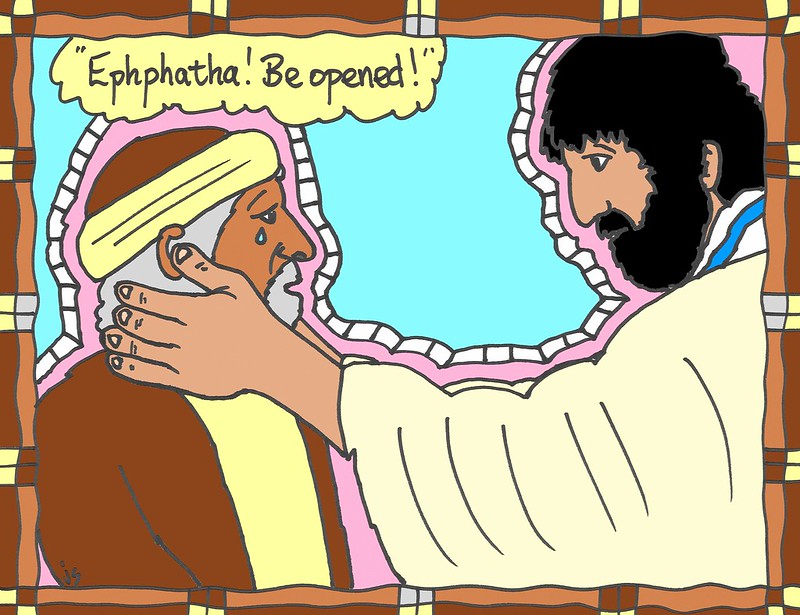
Is Not This the Carpenter?

Meditation on Mark 6:1–13

First Presbyterian Church of Smithtown, NY

Pastor Karen Crawford

July 7, 2024

(art by stushie, used with permission)

I had this funny thought yesterday. What if I had stayed in York, Pennsylvania, and never accepted that first call to ministry in rural Minnesota?

My ministry journey would have been completely changed. I might never have ended up here!

In Minnesota, I was welcomed with open arms. I immediately had a confirmation class of 5 students—all girls. I had so many weddings, as people had been waiting for years for a called pastor to marry them in the church. Babies needed baptizing—more than any of us expected. People wanted and needed pastoral care—and I did many home visits, driving out to the farms and to members in town and the nursing home. I led an ecumenical Bible study at a senior living community.

I served the people with energy, intelligence, imagination and love—just as I had promised to do at my ordination and installation.

If I had stayed in York, PA, where I had raised my three boys, people in the community would have already known me as the religion reporter for the York Daily Record/Sunday News. While I maintained good relationships with my sources, would they have accepted me as a minister, after years in journalism and teaching before that?

But I never had the opportunity to serve as a minister in York, PA. I experienced a kind of rejection from my home presbytery. The EP told me, while I was meeting with the Committee on Preparation for ministry, that I wasn’t going to find a job when I graduated. If I did find one, it would take two years or more, and I would probably have to work another job, too, and I wouldn’t have benefits, which my family needed. Additionally, it was a conservative presbytery based in Lancaster County, where most churches wanted a young, male pastor, preferably with 2 young children, another on the way, and a stay-at-home spouse who could teach Sunday School and make casseroles for potlucks.

When I told her I was ready to accept a full call to a wonderful church in Minnesota, she was angry! She said that I would regret it. To the leader of my first presbytery, I wasn’t good enough.

I never did regret my decision, though I was homesick, at times, and it wasn’t easy.

It was out of our comfort zone, but it was also an adventure.

Jesus is taking risks and stepping out of his comfort zone in our reading in Mark chapter 6, though we wouldn’t normally assume that it would be risky for Jesus to return to his hometown.

This is his first time home with his family since chapter 3, when the crowds are following him around and demanding his healing power so much that he and his disciples cannot even eat! When his family hears what he is doing and how some people are saying, “He has gone out of his mind,” they go “out to restrain him.” When the crowd tells Jesus that his family has come, he famously looks around and says, “Who are my mother and my brothers?…Here are my mother and brothers! Whoever does the will of God is my brother and sister and mother.”

It took a lot of guts for Jesus to come home after that! Now, he is teaching in the synagogue and people are astounded. They take “offense.” The Greek word is skandalizo, which means “to stumble, to take offense.” [1]  They are thinking, “Who cares about what he says and does? He cannot be worthy of respecting or following.” [2]

What is interesting to consider is why his family and community may have been upset with him, other than their unbelief. The reason may be closer to home. Theologian Matthew Skinner says, “When the crowd refers to him without referring to his father, they may be emphasizing that this grown son has left a widowed mother and siblings to fend for themselves while he travels around Galilee leading a movement.” [3]

They identify Jesus by his former occupation—the family business, which he never talks about and never does. We never hear, in the gospels, how Jesus is still working as a carpenter after he begins his public ministry.

“Is not this the carpenter,” they ask now, “the son of Mary and the brother of James and Joses and Judas and Simon, and are not his sisters here with us?”

Notice they didn’t bother to name his sisters? That always bugs me! But this gives us an even clearer picture of Nazareth, a town of probably 400 in Jesus’s time. Everybody knows everybody, and they never forget one of their own, who has turned his back on his family and hometown.

So, if you haven’t wondered, yet, are you wondering now why Jesus ever went back to Nazareth?

His reaction might help us understand. First, he isn’t surprised. It’s inevitable, he says. “Prophets are not without honor, except in their hometown and among their own kin and in their own house.” But then he tries to do some of the deeds of power he had been doing for the first five chapters of Mark. He still cares about his community! He hasn’t forgotten them! Their negative reaction hasn’t stolen his compassion for people in need. But he is only able to lay “hands on a few sick people and cure them.”

This does catch him by surprise.  He is “amazed at their unbelief,” which prevents him from healing all the people who are sick and suffering.

This brings us to a key point. Friends, the power of the Spirit works WITH your faith in Christ. Both are needed. Your faith AND the power of the Spirit.

That leads us to another key point—what happens after the rejection? And what should we do, when we are rejected?

Jesus goes out among the villages teaching. He KEEPS going. One rejection doesn’t null and void his anointing from God. Then he calls the 12, regathers them, as if his rejection at Nazareth has taken the wind out of their sails or distracted them. Jesus brings them back, equips them with his authority (exousia! The power of God!) and begins to send them out, two by two, for encouragement, comfort, and support, and to do the ministry he wants them to do.

He doesn’t want them to bring any extra stuff, beyond what is necessary for the mission. Sandals. A staff for walking in rugged areas. No money. No food. No bag with extra supplies. He wants them completely dependent on those who may or may not welcome them into their homes when they come as strangers knocking on doors.

He has already given them an example to follow when he was rejected in his hometown, of all places. The pairs of disciples obey—going out of their comfort zones, without Jesus. They go in his name and proclaim repentance, heal the sick, cast out demons. They go with realistic expectations—knowing that they may not always be welcome and won’t be able to do deeds of power if the people have no faith. And they know that they may be rejected by the people who know them the best.

The Holy Spirit is speaking to us now, motivating us as disciples of Jesus Christ that one failure, one rejection, is only a bump in the road. It’s no cause for alarm! It shouldn’t slow us down, discourage us, or cause us to question our mission—or the loving purposes of God.

The Holy Spirit leads us on, propels us forward, to witness to our faith with Christ’s authority. Exousia!  and equip more disciples, in Jesus’ name.

I am so glad that I said yes to the call to Minnesota—and that would lead me on this path, where I ended up here, with another call to serve people, whom I love!!!!

God is calling you, too, to take a risk and offer all your gifts and talents, for the sake of the Lord and Christ’s Church.

Before I could accept that first call to ministry, I had to leave behind the identities I used to have—some that made me so proud. I loved being the religion reporter for the York Daily Record! I had worked hard as a freelance writer and teacher for two years before that position finally opened.

Maybe you have been pigeon-holed into one kind of service or ministry, something you are good at and have done for a long time or stopped doing because you grew weary of it. Maybe it’s your family and close friends who only see you one way, as Jesus’ family and community only saw him as a carpenter.

Don’t be afraid of rejection by the people who know you, or think they know you, best.

You are capable of much more that what you have ever done. We can do all things through Christ who strengthens us!

Or perhaps it’s you that’s holding you back—because you aren’t ready to let go of a rejection or bad experience that you once had. That’s hard! None of us want to be hurt while we are pouring out our hearts into loving service for the Lord. I can’t make anything in the past go away, but I know the One who can help you forgive—yourself and others—and move on to the new and exciting adventure God has planned for you!

Maybe you lack confidence that what you know, all your skills and abilities, what you have, and all that you are, at this moment, in Jesus Christ, are truly ENOUGH for what the Lord is calling YOU to do.

Will you pray with me?

Holy God, thank you for the example of Jesus and the disciples knowing even in the face of rejection that they were good enough, strong enough, kind enough, and competent enough. Thank you for calling me enough, too. Help us to pay attention to all the prophetic voices around us, even those we think we know best and perhaps might dismiss because we know them. Teach us to notice the gifts for ministry that our brothers and sisters possess—and encourage them to live into their gifts. Build up our faith. Keep us going on adventures and doing the loving, healing acts that you want us to do, with the Spirit’s help. Amen.


     [1] Matthew L. Skinner, Connections: A Lectionary Commentary for Preaching and Teaching, Year B, Vol. 3 (Louisville: Westminster John Knox Press, 2021), 140-142.

     [2] Matthew L. Skinner, Connections,Year B, Vol. 3, 141.

     [3] Matthew L. Skinner, Connections,Year B, Vol. 3, 141.

Living in the Calm

Meditation on Mark 4:35–41

First Presbyterian Church of Smithtown

Pastor Karen Crawford

June 30, 2024

Art by Stushie, used with permission

What are you afraid of?

What started out as a lighthearted conversation stirred some more serious thoughts later.

Jim was picking up a bug with a napkin under the kitchen table yesterday—a bug that our cat, Liam, happened to be playing with. “What’s that?” he asked, with a disgusted look on his face.  “Oh, it’s just a bug,” I said. “Let me know if you find a tarantula, and then I will be sure to move away.”

Jim said we probably won’t see too many tarantulas on Long Island. I hope not!  “You just don’t like spiders,” he said. That’s true. I don’t like snakes, either. Who remembers that old Jim Stafford song from the 70s, “Spiders and Snakes?” They are good for the environment, but I don’t want to be sitting next to them. Or touching them.

So, what are you afraid of? Have you ever shared your deepest fears?

Psychologists on the web claim they can cure us of all our fears—taking away anything that holds us back from success, anything that makes us depressed. From the UK, psychotherapist Maggie Morrow at Klearminds.com promises same day appointments to help us with all our phobias. She says, “Around 10 million people in the UK suffer from some type of phobia.” (And we thought it was just an American thing.) But what exactly are people so afraid of? she asks. The 5 most common phobias in the world, she says, are:

  1. Arachnophobia (fear of spiders) (See? I am not alone!)
  2. Ophidiophobia (fear of snakes)
  3. Acrophobia (fear of heights)
  4. Agoraphobia (fear of crowded or open spaces)
  5. Cynophobia (fear of dogs).

I am thinking that, instead of calling Maggie Morrow, we would save money and have more fun talking to our neighborhood psychiatrist from one of my favorite movies, A Charlie Brown Christmas. Charlie says, “I think there must be something wrong with me, Linus. Christmas is coming but I’m not happy. I don’t feel how you’re supposed to feel.”

Charles Schulz

He goes to see Lucy, who tries to get to the root of his problem. “Are you afraid of responsibility?” she asks. “If you are, then you have hypengyophobia. How about cats? If you’re afraid of cats, you have ailurophasia.

Charlie says, “Well, sort of. But I’m not sure.”

Lucy asks, “Are you afraid of staircases? If you are, then you have climacaphobia. Maybe you have thalassophobia. This is fear of the ocean…Or gephyrophobiafear of crossing bridges. Or maybe you have pantophobia. Do you think you have pantophobia?

Charlie Brown: What’s pantophobia?

Lucy: The fear of everything!

Charlie Brown: THAT’S IT!

Lucy: That’ll be 5 cents please.

In today’s passage in the gospel of Mark, the disciples, a number of them fishermen, are faced with one of their greatest fears. Anyone here a fisherman? Like to fish? Do you go out in a boat? What’s your greatest fear, other than not catching any fish and getting sunburned?

Imagine yourself in the wooden boat with the disciples. Everyone is tired from a day of ministry—outside in the elements. It’s nighttime! It’s dark. They have no lights. Jesus has been preaching and teaching the crowds all day. They probably didn’t stop to eat or rest. And now they are getting ready to cross the Sea of Galilee, which is actually a freshwater lake, to bring Jesus’ message to the Gentiles.

Let me tell you about your boat.  The Ancient Galilee boat from the First Century A.D., also known as the “Jesus Boat,” was discovered on the northwest shore of the Sea of Galilee in Israel in 1986. Anyone heard of the Jesus Boat before? There’s no proof that the boat actually belonged to Jesus and his disciples or that they ever stepped inside, but it’s a good example of boats in that time. “The remains of the boat—27 feet long, 7.5 feet wide and with a maximum preserved height of 4.3 feet—first appeared during a drought, when the waters of the Sea receded.” [1]

The Sea of Galilee Boat or “Jesus Boat” on a metal frame in the Yigal Alon Museum in Kibbutz Ginosar, Tiberias, Israel

There would have been a small mast and sail in fair weather. The men would have used oars to guide and power the boat.

Here’s the situation. Verse 37. A great windstorm arose, and the waves beat into the boat, so that the boat was already being swamped.” Their greatest fear? Capsizing or sinking—and drowning.

This isn’t the only story of Jesus and his disciples being afraid on the water. I am beginning to wonder if the disciples weren’t the strongest swimmers, either. In Matthew 14, the disciples are in their boat on the lake shortly before dawn (so, in the dark again), and Jesus goes out to them, walking on the water.  They see him and are terrified, thinking he is a ghost. Jesus says: “Take courage! It is I. Don’t be afraid.”  

        “Lord, if it’s you,” Peter replies, possibly showing off a little, “tell me to come to you on the water.”  “Come,” Jesus says.

Then Peter gets down out of the boat, walks a few steps on the water and comes toward Jesus.  But when he sees the wind, he is afraid, and begins to sink. He cries out, “Lord, save me!”

     In Matthew 14, like it is in today’s passage in Mark, the lesson is about faith verses fear and doubt. Jesus reaches out his hand and catches him. “You of little faith,” he says, “why did you doubt?” 

         It’s also about our human response when something scary or tragic is happening; we wonder if God is still with us. We wonder if God really cares. In today’s reading in Mark 4, after Jesus is awakened from his sleep in the stern, the disciples are all asking, “Teacher, do you not care that we are perishing?” Jesus doesn’t answer that question. The one who was sent by a God who loves the world rebukes the wind and says to the sea, “Be silent! Be still!”

 The wind ceases in your little wooden boat, dear friends. Just a word from your Lord, and the wind ceases. Don’t worry if you can’t swim through the troubles in your world. There is a “dead calm,” in the wake of Jesus’s words. I wonder at the writer’s use of the word “dead” before calm in this situation—if maybe they are trying to make a stark contrast between what could have happened, and what really did happen.

       A miracle—a powerful story, indeed, for those who live and work on the water, as many did in Jesus’s time and place.  “Who then is this,” they ask each other later, “that even the wind and the sea obey him?”

      Even though they have spent all this time with him, they still don’t know who he is. He continues to surprise them with his works of wonder.  No one ever asks him again, “Don’t you care? Don’t you care that we are perishing?”

       So, let me ask you again, more seriously this time. What are you afraid of? Have you ever spoken your deepest fears aloud?

        Honestly, I don’t think any of the phobias that our neighborhood psychiatrist Lucy talks about with Charlie Brown are what keeps us awake at night. It’s not the five greatest fears in the UK, according to Maggie Morrow at Klearminds.com. That’s not what keeps us from “living in the calm” and trusting the Lord, every day, every moment, with all our hearts.

 It seems that you and I, we are often responding to stormy weather—storms that we see coming, storms that catch us by surprise. We are often leaning into prayer, encouraging one another, asking our faithful, loving Lord to help us in our time of need.

After worship today, we are gathering for a special time of fellowship. I’m calling it a picnic because we are serving picnic foods, including icees and juice boxes for the kids and young at heart. Every time we gather for fellowship after worship, is a special time. It isn’t just about eating together, although something wonderful always happens when two or more are gathered in Christ’s name, when we break bread. It’s about listening and telling our stories—sharing about the storms in our lives—and where Jesus was in the midst of our storms. So don’t rush off right after worship. Stay a little while longer. The Spirit wants to use you to help someone else. You have been equipped by the Word and Spirit in worship. The fellowship time is an opportunity to reach out to our guests, make them feel at home, and to minister to one another. We are all ministers, in the Body of Christ, empowered by the Spirit of peace!

What are we afraid of? What are our deepest fears? For me, something happening to the ones we love. That is the worst, for me. Is it for you, too?

Jesus says to us now, “Why are you afraid? Have you still no faith? Don’t you know that I care?”

No matter what happens, what storms we face tomorrow, we won’t be alone in the little wooden boat. We will be there for each other, taking turns being the peaceful presence of Christ for one another, not afraid to be vulnerable with one another. And the God who never sleeps will be with us, always in control.

The One who rebukes the wind and says to the sea, “Be silent! Be still!”

Will you pray with me? Let us pray. God of the wind and waves, land and seas, we worship you and give you thanks for always being with us. Thank you for your Spirit that strengthens us in the most difficult moments. Help us to recognize your presence in the midst of our storms. Thank you for caring for us, always, when we are fearful and full of doubt and when we are faithful and full of certainty. Teach us how to live in the calm, dear Lord, to trust you, every day, every moment, with all our hearts. In the name of Jesus, our Lord and Savior, we pray. Amen.


      [1] https://en.wikipedia.org/wiki/Sea_of_Galilee_Boat

All I Really Need to Know I Learned in Sunday School

Meditation on Matthew 7:24-29

First Presbyterian Church of Smithtown, NY

Pastor Karen Crawford

June 23, 2024

Sunday School Recognition Day

Some years ago, Robert Fulghum had a best-selling book called, All I Really Need to Know I Learned in Kindergarten. Does anyone remember that book? I found a list of things he said that he learned. Do you agree with these? Nod if you do.

  1. Share everything.
  2.  Play fair
  3. Don’t hit people.
  4.  Put things back where you found them,
  5. CLEAN UP YOUR OWN MESS.
  6.  Don’t take things that aren’t yours.
  7. Say you’re SORRY when you HURT somebody.
  8. Wash your hands before you eat.
  9. Flush.
  10. Warm cookies and cold milk are good for you.
  11. Live a balanced life – learn some and drink some and draw some and paint some and sing and dance and play and work everyday some.
  12. Take a nap every afternoon.
  13. When you go out into the world, watch out for traffic, hold hands, and stick together.
  14. Be aware of wonder. Remember the little seed in the Styrofoam cup: The roots go down and the plant goes up and nobody really knows how or why, but we are all like that.
  15. Goldfish and hamster and white mice and even the little seed in the Styrofoam cup – they all die. So do we.
  16. And then remember the Dick-and-Jane books and the first word you learned – the biggest word of all – LOOK. [1]

As I prepared for this day when we recognize the caring labor and inspiration of Sunday School teachers and the faith and growth of our students, I thought about everything I learned in Sunday School as a child, growing up in a Lutheran congregation in Maryland. Yes, all that we learned in kindergarten is important for our lives, but we learned some of those same lessons in Sunday School—and so much more. Here’s some of what I learned in Sunday school:

  1. Jesus Loves Me, This I Know!” We learned this through the singing of the song at our Sunday School opening and through the study of all the gospel stories of Jesus and the good things he did, and how he tried to teach his disciples to be loving like him. We learned about Jesus’ love through the welcome and kindness of all our teachers. I might not remember their names today, but I do remember they were nice.
  2. Sunday School tastes good. Snacks and drinks—especially when the weather was warm in our unair-conditioned classrooms—were important to us. Don’t underestimate the power of one cookie or graham cracker on a beverage napkin and a juice box to set a joyful tone for the class.
  3. Sunday School is social. It’s about people! We made friends with children older and younger than we were in multiage classrooms, children who didn’t attend the same schools that we did. We only saw them when we went to Sunday School, but we knew each other’s names, sometimes their brothers and sisters, and they were our friends, just the same.
  4. Sunday School is fun. We laughed and played games.
  5. Sunday School is also school, a place of study. We brought our Bibles to class and learned to read by studying the Old Testament and New Testament. We learned BIG words and some old-fashioned ones we don’t hear anywhere else, such as “begat.” We learned to ask questions about our reading and looked for meaning in the text and application for our lives today.
  6. Sunday School is inclusive and not competitive. There are no grades or tests, no pass, no fail. What a relief for some children who struggle with academic tasks! Children of all abilities are accepted and helped in Sunday School.  But there are expectations for behavior. We learned to obey our teachers, listen to one another, and wait to speak in turn, raising our hands, sitting on small chairs at children-size tables or on a large carpet on the floor, coloring our Bible story handouts, and making crafts with scissors and colored paper, cotton balls and popsicle sticks, and, of course, Elmer’s glue all.
  7. We learned that God likes it when we pray and listens to our prayers. We learned how to pray, with one person talking at a time, heads bowed, eyes closed, hands folded. We learned The Lord’s Prayer. We learned to say thank you, every time we spoke to God, and especially before snack.

Looking back, I realize now that everything I learned in Sunday School helped to prepare me for ministry! And there was a big gap between Sunday School and seminary; I didn’t begin seminary until I was 40! But the seeds were sown when I was young. Can you imagine this could happen to any of our Sunday School children and youth today? I wonder what God has planned?

I am captivated by the imagery of the wise person in Matthew 7 building a house on solid rock. This passage comes near the end of Christ’s teaching to the crowds in the Sermon on the Mount. This is a great summary of the Christian life!

Jesus says, “Everyone, then, who hears these words of mine and acts on them will be like a wise man who built his house on rock. The rain fell, the floods came, and the winds blew and beat on that house, but it did not fall because it had been founded on rock.”

What were some of those teachings of the Sermon on the Mount, beginning in Matthew 5? The Beatitudes: “Blessed are the poor in spirit…. Blessed are those who mourn…. Blessed are the meek…. the merciful… the pure in heart…. the peacemakers….. Also, “You are the salt of the earth….You are the light of the world….And do not think that I have come to abolish the law or the prophets; I have come not to abolish, but to fulfill.”

In his Sermon, Jesus brought a fresh interpretation to scriptures studied from childhood, beginning, “You have heard that it was said.”

“You have heard that it was said to those of ancient times, “You shall not murder,”…But I say to you that if you are angry with a brother or sister, you will be liable to judgment….so when you are offering your gift at the altar, if you remember that your brother or sister has something against you, leave your gift there before the altar and go, first be reconciled to your brother or sister….”

Jesus said, “You have heard that it was said, ‘An eye for an eye and a tooth for a tooth.’ But I say to you, ‘Do not resist an evildoer. But if anyone strikes you on the right cheek, turn the other also….’” And, “You have heard it said, ‘You shall love your neighbor and hate your enemy.’ But I say to you, ‘Love your enemies and pray for those who persecute you so that you may be children of your Father in heaven.’”

“Don’t store up for yourselves treasures on earth, but store up treasures in heaven…”

“No one can serve two masters; no one can serve God and wealth.”  

“Do not worry… .But strive first for the Kingdom of God and his righteousness and all these things (that we worry about) will be given to us, as well.”

And, “Do unto others as you would have them do unto you.” And, “wolves may come in sheep’s clothing, but they are known by their fruits.”

Then we get to today’s scripture, which ties up everything Jesus has taught so far in what editors divided into 3 chapters. “You who listen and live by my teachings are the wise person who has built your house on the rock.”

No matter what happens in your life, friends—rain falls,  floods come, winds blow and beat on your spiritual house—you will NOT fall or fail. You have the strong foundation of your faith in Jesus Christ and your commitment to living out your faith, as the Lord would have you do.

A song from Sunday School popped into my mind when I was studying this scripture this week. It was probably from when my children were in Sunday School. Pablo, can you and the choir help me? Maybe some people in our congregation know it….?

The wise man built his house upon the Rock,
And the rains came tumbling down.
The rains came down and the floods came up,
But the house on the Rock stood firm.

Last Tuesday night, the Session, our Treasurer, and some of the spouses gathered for a picnic at the manse. At one point, I looked around at the people sitting on lawn chairs eating, talking, and laughing, and I thought, “I bet everyone here went to Sunday School.” Just look at their faithfulness! They serve their church, their families, their communities through their professions and volunteering! They may be known by their fruits!”

Friends, while everything we learned in kindergarten has helped us live our lives, everything we learned in Sunday School has helped us live our lives of faith, answering the call to follow Jesus Christ.

And it all started when someone, long ago, welcomed us to a Sunday School class. Maybe we were scared to leave our families in church. But then they smiled at us, shared the words of Jesus and the stories of God, offered us food, drink, and friendship, and taught us, “Jesus Loves Me, This I Know.”

Will you pray with me?

Holy One, thank you for your love and for our Sunday School teachers—those who nurture the faith of our young disciples and help build a good foundation for the Christian life. Stir each of us, Lord, to gratitude for those who taught us and all the inspiring lessons that we have learned—all of your words that have made us better people today. Then, embolden us all to be teachers and builders of hope and faith in our next generations. Lead us to bear the fruit of this good foundation we have had, beginning in childhood, and be like the wise person who built their house upon rock. In Christ we pray. Amen.


     [1] Robert Fulghum, All I Really Need to Know I Learned in Kindergarten: Uncommon Thoughts on Common Things, 15th Anniversary Edition (Ballantine Books,2004) 1.

Seed, Scattered and Sown

Message on Mark 4:26-34

First Presbyterian Church of Smithtown

Pastor Karen Crawford

June 16, 2024


Art by Stushie, used with permission

I was happy to hear that everything went well with the gifts of children’s clothing and baby wipes and diapers at Smithtown’s homeless shelter while I was away. Thank you to all who gave these gifts for families in need, and to Linda Goodwin and Joanna Marmelstein for organizing this mission outreach and going there to share our gifts.

Then, I saw photos of a little garden yesterday, made possible by our Deacons. They continue to quietly give of themselves to help others, especially children. They have a heart to help children! I told Barbara Ruoff, the moderator, how it touched me to see the green sprouts and pretty petunias popping out of the metal containers on the grass—and to hear of the labor they have been doing.

Barbara told me how the garden came into being.

“The Deacons approved some money for Laurie to buy plants at Borella’s where they give us a discount,” she said. “We also provided some soil. I went to the shelter one afternoon, and the kids and I planted flowers and vegetables in two of the bins. It was so much fun to plant with the kids,” she went on. “At the end of our planting one of the boys, who is about 7 or 8 years old, said, ‘I think when I grow up, I would like to be a gardener!’”

“That’s all I need!” Barbara said. “What a reward!”

Every day, the Lord gives us opportunities to bless others when we scatter and sow seeds of hope and faith. Every day, we make a choice—to participate in our Divine Gardener’s holy labor—or to let the opportunities to grow the Kingdom pass us by.

As I read these two familiar seed parables, the gardener in me says, “Hold on! What is this scattering seed?” No good gardener just scatters seed on the ground, without preparing the soil and carefully covering each one to a specific planting depth. And who is this “someone?” I wonder, who just scatters seed? It is mysterious, indeed. But then it becomes more mysterious when the one who scatters, “would sleep and rise night and day, and the seed would sprout and grow, he does not know how.”

Jesus really has our attention here, doesn’t he? The story illustrates some ancient agricultural techniques. That is how some crops were planted—by seeds simply being scattered on the ground. Jesus’s first hearers are nodding their heads. They know this. Only, those who are not Christ’s followers don’t know the hidden meaning in the parable. Jesus explains this only to his disciples.

Yes. We know who scatters seeds every day. It’s us. We are working for the Gardener, the Lord of the Harvest. We scatter, with the Spirit’s help, as we interact with friends, neighbors, family, and strangers every day. We have no idea what is happening with the seeds of kindness and goodness that we are spreading and the sharing of God’s word through our actions. Will they take root? We don’t know. We don’t know if the people will receive them or if there will be growth, if they do. That isn’t up to us, just like it wasn’t up to the farmers in Jesus’ time.

 The work of the Kingdom is for all of us—and yet—we don’t know what we are doing, not on a spiritual level. It’s a secret. Only God knows what is happening in the hearts and minds of human beings. We can trust God to use us to be gardeners for the Son.

Of these two parables, the gardener in me connects with the mustard seed story more than the story of the scattered seed. It just grows like a weed, that mustard seed, no matter what the soil. I can hear Jesus telling all of us to be like a weed! Grow to be a tree! You are that tiny seed with great potential Christ has planted—and in your planting and growing, you are also growing the kingdom, you see.

Let’s think for a moment about “opportunity.” That word is on my mind. We often think of opportunity as something we should seize so good things will happen for us—maybe we’ll get rich! One dictionary provides two definitions of opportunity. One is, “A set of circumstances that makes it possible to do something.” Another is, “a chance for employment or promotion,” such as, “career opportunities in our New York headquarters.” When “opportunity knocks, a chance for success or advancement occurs.”

But what does the Bible say about opportunity? The Apostle Paul in Ephesians 5:15-20 says this:


“Be very careful, then, how you live—not as unwise but as wise, making the most of every opportunity, because the days are evil. Therefore do not be foolish, but understand what the Lord’s will is.  Do not get drunk on wine, which leads to debauchery. Instead, be filled with the Spirit, speaking to one another with psalms, hymns, and songs from the Spirit. Sing and make music from your heart to the Lord,  always giving thanks to God the Father for everything, in the name of our Lord Jesus Christ.”

Opportunity, then, is not to make good things happen for ourselves, but to do what is pleasing to God. We have another chance to be faithful, to do what is right. Jesus, in John 4:35, speaks of the work of the gospel as an opportunity that presents itself every day, to those who have eyes to see. “Behold, I say to you, lift up your eyes and look at the fields, for they are already white for harvest!” 

I think of this little boy, planting with Barbara; he was so moved by the experience. Her caring ways and loving spirit are what he needed. The act of planting in the soil, watering, and waiting for growth is a beautiful miracle from God. But it wouldn’t have happened if Laurie and Barbara hadn’t taken the opportunity to serve those in need, as passionately as if they were serving the Lord.

On this day when we honor our fathers, I can’t help but remember gifts my father gave me and the example he was for our family. He went home to be with God in August 2019. He was a cartographer, but his hobby was gardening, until his health prevented it. I can picture him now, standing with his watering can, putting water in the saucers underneath his African violets on a white, wheeled plant cart on our porch, so the leaves wouldn’t get wet. I can see him with his foot on a shovel, digging out the sod, widening a bed for flowers or vegetables. I always marveled at his strength when he did that, because I was just a little girl, and I couldn’t dig with a shovel or push a heavy wheelbarrow like he did, with ease. I can see him bending over the miniature roses that he grew, along with perennials and shrubs. He would harvest these little yellow and red flowers with scissors and a smile, bring them inside, and place them in water in tiny vases.

My father sowed seeds of kindness and patience, every time I was with him. He was a great listener. Today, on Father’s Day, I wish that we could be together, once again. I would tell him all about the garden at the manse—the Shasta daisies that have grown as tall as Jim, the echinacea with their purple flowers and strong stalks, both of which were started from seed last year. I am sure he would love the red roses cascading on our front walk and would remind me to remove the spent flowers so the plants will keep blooming. I would tell him about this garden our deacons have helped to plant at the homeless shelter with the children. He would be impressed—especially the part about the small boy who has already decided that one day, given the opportunity, he will be a gardener, too. I wonder who influenced my father; who was his gardening teachers? How did the Lord stir that joy inside of him, a joy that stayed with him all his nearly 85 years—and has been passed onto me?

Dear friends, you are the seeds Christ has planted, right here in good soil. This is the best soil—worship on Sunday morning, with your fellow seedling sisters and brothers in Christ. You are the seeds, scattered and sown. It is a great mystery. God only knows. The Heavenly Father will bring forth the growth in you, if you continue to take every opportunity to do God’s will and seek to be pleasing to the Lord each day.

You have the seeds of God’s Word, hidden deep within you. When you leave here today, you will have opportunities to scatter and sow. Don’t hesitate! Opportunities in God’s economy are for blessing others. Don’t worry about whether your seeds of kindness and generosity will take root. That’s not our job. Just keep on going and sowing and giving of yourself—the person you are now, the person you are becoming. Trust the Lord of the Harvest, who is enabling you to grow and be transformed, more and more.

You aren’t what you were yesterday or even this morning. The Spirit is cultivating a whole new YOU.

So, have you had a hard week? A hard couple of weeks, maybe? I’m with you. It’s been rough. God has always been faithful to us—to me and to you. God always will be!

The presbytery met yesterday in Oceanside. Everyone was assigned to a prayer group and given a prompt for spiritual reflection.  I am going to leave you with these thoughts today.

Picture in your mind a white daisy growing up from the mud. Can you do that right now?  Close your eyes. In your spiritual life, what feels like the “mud”? What is flourishing, like the flower?

Where do you see opportunity…. to bloom?

Let us pray.

Holy One, Loving Gardener, thank you for scattering and sowing us, those whom you created in your image and planted seeds of your Son’s righteousness within us. Thank you for the good soil in which we have been firmly planted, in our families and right here in this church, where our seedling sisters and brothers are gathered. Help us to be that good soil for others, nurturing hope and faith. Stir us to be generous, giving of ourselves and our resources, without fear or worry. Transform and grow us as Your Son’s disciples, a family of God, so that we may never miss an opportunity to scatter and sow seeds of kindness, goodness, and love, so that we may never miss an opportunity to bloom. Amen.

Send Me!

Art by Stushie, used with permission

Meditation on Isaiah 6:1–8

Pastor Karen Crawford

First Presbyterian Church of Smithtown, NY

Trinity Sunday/Memorial Day Weekend

May 26, 2024

I can’t remember the moment when I heard God calling me to parish ministry. I don’t think it was just one moment, actually, but rather a gradual illumination, a slow dawning, that this was God’s will for my life.

Looking back at those first years of ministry, I remember many joys and sorrows, highs and lows. Some of the most difficult struggles weren’t the challenges of the wintry climate of Minnesota or my flock, but those that were within myself—when I began to doubt my own abilities and gifts.

The one lesson that the Lord is trying to teach me—and all of us, I believe—is that our feeling of not being worthy or good enough to serve the Lord and God’s people has nothing to do with God’s call and claim on our lives. In fact, I might argue that the feeling of inadequacy almost always goes along with the call. If you aren’t feeling inadequate, then maybe you don’t understand what the Lord is requiring of you.

And if you’re someone who is kind of a perfectionist, then you are always going to feel like you aren’t good enough. Who am I talking to, now, when I talk about perfectionism? You will focus on your flaws and past mistakes and believe that everything in the scheme of things must be fixed and perfect before God can use you. This is, in fact, a sinful way of looking at things because it doesn’t acknowledge Christ’s suffering work that accomplished our forgiveness, once and for all. Our sins have been blotted out—not with a hot coal, but with the One who died on a cross and lives, again. Those with perfectionistic tendences believe that we have something more to do to somehow earn or achieve God’s forgiveness and our worthiness to follow God’s Son, Jesus Christ.

Here is my most recent struggle. I’ve shared with some of you that I am still experiencing some blurred vision and headaches after my eye surgeries, particularly when I am reading and writing and working at the computer. A doctor this week told me that the lens implants have become cloudy, something that can happen. The way to correct it is to have another surgery, in three months or so.

This little setback has worked on my confidence—made me become concerned that I would be able to do what I need to do for my class that starts in Austin in about a week.

That’s what I mean about the struggle with self-doubt and fear of failure—and how this is the REAL cause of our hesitation in answering the call to serve the Lord with our lives—devoting ourselves more fully to following Christ. This is what leads us to say, “No, Lord. I’m not the one. I’m not good enough. Don’t send me!”

Are we surprised that Isaiah has an overwhelming feeling of inadequacy in the presence of a Holy God, sitting on a throne, high and lofty, in his vision recorded in chapter 6? The hem of God’s robe filled the whole temple! Seraphs, snake-like creatures with wings, are all around. Isaiah describes them as each having “six wings: with two they covered their faces, and with two they covered their feet, and with two they flew.” And they calling to one another, singing: “‘Holy, holy, holy is the Lord of hosts; the whole earth is full of his glory.’”

The pivots shake with the voices. The house of the Lord is filled with smoke. Isaiah says, “‘Woe is me! I am lost, for I am a man of unclean lips, and I live among a people of unclean lips; yet my eyes have seen the King, the Lord of hosts!’” His personal and communal confession makes us wonder if this is just the ordinary inadequacy of sinful human beings in the presence of God–or is there something more going on?

In part, the answer lies in the time in which he lives, “the year that King Uzziah died,” around 738 BCE. This is a pivotal point in Israelite history. “Uzziah’s death marks a transition from political stability to the looming Assyrian crisis. (And) yet it is far more about a change in God’s time,” says biblical scholar Robert A. Ratcliff.  This is a time when the “will of God can be more clearly seen and the presence of God more clearly felt.” [1]

Terrible things are about to happen, right when God’s will and very presence would be revealed to Isaiah, for the sake of God’s children. The Lord is about to do a new thing in the midst of a war, which will lead to the Assyrians’ capture of Samaria, the capitol of the Northern Kingdom of Israel in 720 BCE, and many of the Israelites being carried off into captivity.

So you are wondering, right now, how then, can we relate to Isaiah’s story, those of us certainly living in difference circumstances, in the 21st century? We can connect with his call story, because it raises “the daunting question of what it means to be chosen to fulfill God’s purposes.” [2]

For we, too, are chosen. Yes, we are !

 In Scripture, frequently those who receive the call realize its potential to upend their lives” [3] and so they resist. “Jeremiah objects due to his youth and inexperience in public speaking.” Moses pleads with God to send someone else, saying that he has a speech impediment, a stutter, when he is really terrified to return to Egypt, where he is wanted for murder. When God calls Jonah to go and preach to Israelites’ enemies, the Ninevites, Jonah heads in the opposite direction, rather than obey the troubling voice of God.

But after Isaiah’s initial resistance—and the seraph’s touching his mouth with a burning coal, so that his guilt has departed and his sin has been blotted out—Isaiah answers God’s question, ‘Whom shall I send, and who will go for us?’ with an obedient and enthusiastic, ‘Here am I. Send me!’”

Isaiah will have his work cut out for him. The people will not listen to Isaiah’s prophetic word. They will resist God’s claim on their lives and refuse to embrace the Lord’s call to return to their faith and faithfulness. In his lifetime, Isaiah, the one whose name means, “The Lord is my salvation,” and is a descendant of Judah and Tamar, is ridiculed and persecuted, enduring beatings and imprisonment during his 55 to 60-year ministry, which will end in martyrdom. He would never know the importance of his life, ministry, and writings for God’s people in Judaism or for Christianity. You may not realize that “his writings are mentioned more than 400 times in the New Testament, making it the most popular Old Testament book (for Christ’s followers), along with the Psalms.” [4]

I come to the end of my message, and I feel the heavy burden of perfectionism, once again—stirred by Isaiah’s terrified outburst in God’s presence. If Isaiah, God’s prophet, felt inadequate with God’s call on his life, then how can we ordinary, flawed human beings become comfortable, confident, and secure in what the Lord is calling us to do as individuals and as a church of Jesus Christ?

Because we are all called to do our best to develop and use the gifts that God has given us for God’s glory and Kingdom purposes. All of us are ministers—even the youngest child in our church family is called to love and serve God and neighbor and proclaim our hope in Christ through words and acts of kindness. This is what ministry is all about—living our faith.

The answer is surely the Trinity, who makes it possible for us to live into and embrace our callings and be faithful to the One who never expects us to be perfect. Our Creator has made God’s choice! And it’s YOU! And it’s ME! Don’t be like Jonah and run from your call. Remember how his story ends with him spending time in the belly of a whale praying, before coming to himself and vowing to do what God calls him to do.

Be like Isaiah, who was aware of his own sinfulness in the presence of a Holy God, yet still allowed God to use him in a mighty way.

Christ has given us the Spirit to guide and empower us to do even greater works for God the Father than Jesus and his first disciples were able to do. This whole focus on “perfection” in our society, is a distraction from living out the fullest expression of our faith.  

I don’t like to say that it was God’s will that I would struggle a bit with my vision right now. I don’t know what the Lord has planned for me. But I can trust in God’s love. Isaiah says in chapter 55, “My thoughts are not your thoughts, nor are your ways my ways, says the Lord. For as the heavens are higher than the earth, so are my ways higher than your ways and my thoughts than your thoughts.”

 But maybe this is a pivotal time in my life, when I will realize and feel keenly, through some of these struggles, the power and presence of our loving and gracious God.

So, what are you thinking? What stands in the way of your stepping out of your comfort zone and being more faithful to God’s call?

What will it take for you to let go of your fear and insecurity and say, with Isaiah, “Send me!”

Will you pray with me? Let us pray.

Holy, holy, holy, Three in One! We are fearful and intimidated by your call on our lives, knowing that being faithful and obedient will involve some struggle, but also that we can rely on the strength and guidance of your Spirit, always present with us. Help us now to overcome the temptation to perfectionism anything that stands in the way of our confidently answering your question to Isaiah, ‘Whom shall I send, and who will go for us?’ ‘Here am I; send me!’ In the name of our Triune God—Father, Son, and Holy Spirit—we pray. Amen.


     [1] Robert A. Ratcliff, “Isaiah 6:1-6” in Connections, Year B, V. 3 (Lousville, Westminster John Knox Press, 2021), 5.

     [2] Ratcliff, 5.

     [3] Ratcliff, 5-6.

     [4] Harold Songer, “Isaiah and the New Testament” in Sage Journals, v. 65, issue 4, December 1968.

The Secret of Happiness

Meditation on Ezekiel 37:1–14

First Presbyterian Church of Smithtown

Pastor Karen Crawford

May 19, 2024

Pentecost

Art by Stushie, used with permission

The title of my message today is, “The Secret of Happiness.” I would love to know, right now, before I start preaching, does anyone already know the secret of happiness? Have you found it?

Do you want to share it with the rest of us?

Spoiler alert. This message is not going to provide all the answers to the question, “What is the Secret to Happiness?” But…maybe, with the Spirit’s help, it will lead us closer to the One who DOES have all the answers, who knows us better than we know ourselves, and has the power to heal and transform our hearts and minds.

At the beginning of the week, I was doing my exercises with our denomination’s program “Call to Health.” It’s an app for my phone—and it offers articles, videos and suggested activities to improve the well-being of pastors. It’s been around a while—though having it as an app might be something relatively new. And, up to this year, I have largely ignored it, until I decided that I wanted to earn enough points to be eligible for a 50% decrease in my health insurance deductible next year. Yes, I was motivated to save money!

So, with my less than enthusiastic attitude, I watched one of the healthy videos on Monday—and was surprised to find that it was more interesting and helpful than I thought it would be. Although I can’t seem to locate the video, anymore, I believe it was called, “The Secret of Happiness: Gratitude.”

Now we’ve been hearing about the power of gratitude for years—not just in the church for our faith, but popular psychology has been telling us that grateful people are happy people. Oprah Winfrey is one of the proponents of gratitude journals—this started back in the 1990s. Anyone ever keep a gratitude journal? They are still wildly popular today.

But it didn’t always work for Oprah. She says at her website, “For years I’ve been advocating the power and pleasure of being grateful. I kept a gratitude journal for a full decade without fail—and urged you all to do the same. Then life got busy. My schedule overwhelmed me. I still opened my journal some nights, but my ritual of writing down five things I was grateful for every day started slipping away.” [1]

A few years ago, when she came across a journal entry from 1996, she wondered why she no longer felt the joy of simple moments. Since that time, she had “accumulated more wealth, more responsibility, more possessions. Everything, it seemed, had grown exponentially—except my happiness,” she writes. “How had I, with all my options and opportunities, become one of those people who never have time to feel delight? I was stretched in so many directions, I wasn’t feeling much of anything. Too busy doing.”  The truth was, she was busy in 1996, too. But she had made gratitude a daily priority. She went through the day “looking for things to be grateful for, and something always showed up.”  

That’s what got me thinking that the problem with ascribing all the power for happiness, for Christians, into mustering up our own gratefulness, pulling us up by our gratefulness bootstraps, so to speak, no matter the changing circumstances of our lives, is that it leaves out the component of faith and fails to recognize the power of the Spirit to transform our hearts and minds. We can’t make ourselves be happy or grateful—not without the Lord’s help. The good news is that we can ask God for these spiritual gifts—for that is what they are. Love, joy, faith, patience, kindness, goodness, gentleness, thankfulness, self-control —all of these are gifts from God, poured into our hearts.

Yes—we should be looking for things for which to be grateful, as we ask in faith for the Lord to reveal them. And then we will experience the wonder and joy of God’s presence and recognize the hand of God in our lives, in a new way!

In the video that I watched on Monday, the interviewer met with about four people on camera separately—young and older, male and female. He asked them to think of the person who had made the greatest impact on their lives—the one who inspired them to be who they are today. They each named the person—a mother, sister, friend, and possibly a teacher, I can’t recall the detail. They were then urged to write that person a letter, expressing their gratitude. Some of them wrote long letters—though they might not have been the long letter-writing kind. Next the interviewer surprised them by saying, “Let’s call that person right now and read them your letter.”

 You can imagine how this stirred an emotional response in the writer and the one who listened on the other end of the phone—on speakerphone, so we could hear all the conversation. Something happened when those letters were read, when those beautiful, loving, grateful words were shared and received. Something happened—not only to the two people directly involved, but to the interviewer, whose mood was obviously lifted, and yes, to me, who just watched and listened to all this play out.

So, here we are on Pentecost, and I chose the Ezekiel reading to encourage us of the power of God’s Spirit—the very breath of God—present thousands of years ago when Israel was homesick and grieving in exile, losing all hope, and present right now, in this place, within us and in our midst today.

I chose Ezekiel rather than Acts because I have been visiting people going through life’s difficult transitions, longing for home. Some are grieving the loss of their own good health or mobility, despite modern medicine and prayer. Some have had to move out of the home where they lived for many years and accept that the old way of life is gone. For some, the move comes within years of losing a spouse, and this adds to the grief and loss. In this situation, how could anyone feel grateful or happy, if they are being honest? What are they going to write in their gratitude journals?

So, what is this promise from God through the prophet Ezekiel that was meant for the ancient Israelites and is relevant for us today? Here is what I want you to remember. The Spirit’s transformation doesn’t just happen—not in the Pentecost story in Acts and not in the dry bones story in Ezekiel. The Spirit comes after the church in Acts gathers for prayer and worship for days after the risen Jesus has ascended. Yes, it’s all about God and God’s power—the coming of the Spirit and the work of the Spirit, but we have to believe in it and we have to seek it, with all our heart and soul, mind and might.

In this familiar Ezekiel passage, the Spirit comes when the situation is bleak—when a miracle is truly needed. Hope is all but lost for the exiles. The prophet seeks God, and the Lord brings him not to a high, beautiful place. This is no mountaintop experience! God takes Ezekiel to a valley of dry bones. Death and decay are all around!  Theologian Amy Erickson says, “The tragedy here is not merely that these formerly living, breathing humans will never again have life, but that their bones are lying in a heap in some unnamed Babylonian valley, uncared for and haphazardly dispersed outside of a family tomb… Further, their bones are languishing outside the land of Israel.” [2]

In response to God’s question of can these bones live, the prophet says, “O Lord God, you know.”  This is something like our expression, “God only knows!” The Lord tells his prophet to preach to the bones! That’s just what every preacher wants to hear. Go and a share a message with the dead. But the Lord promises that there will be life when Ezekiel prophecies. Ezekiel does what God commands, “and breath came into them, and they lived, and stood on their feet, a vast multitude.”

The whole house of Israel is like the dry bones in the valley, God explains to Ezekiel. But I will breathe new life into them. And I will take them home.

It was a Monday morning when I watched the video on gratitude—The Secret to Happiness—and I had chores to do, and I can’t explain why I felt such joy in hearing the conversation between the grateful one and the one who had made a big impact on their life. It occurred to me that they probably had no idea the difference they and their relationship had made in the loved one’s life.

Just like you and I have no idea whose lives we have touched and will touch in the future through our loving relationship with them and each other.

On Monday and throughout this week, I have thought of those who have made a big impact on my life—so many people!—and with these thoughts, I have felt joy and gratitude, the same gifts that God wants to give everyone to strengthen and support us in our lives of faith!

We don’t always have a mountaintop experience with the Lord. Sometimes, God brings us to the valley of dry bones where we look at a dark reality. We aren’t going to escape difficulties in this world, my friends. We didn’t become Christ’s followers to have an easy life. But we remember what the psalmist sings in 121,  “I lift up my eyes to the hills– where does my help come from? My help comes from the LORD, the Maker of heaven and earth.”

Shhhh. Listen. This is the Secret to Happiness. Here it is. The One who has put God’s spirit inside human beings at Creation, and came like a mighty, rushing wind in Jerusalem on Pentecost, and brought dry bones back to life in a Babylonian valley, is breathing with a fresh breath on us now to give us the power to live more abundantly.

The Spirit’s transformation doesn’t just happen while we go about our daily routine, checking off items on our to-do list. Don’t be too busy doing that you stop feeling and seeking the One who longs for a more intimate relationship with you. Take time to reflect. Take time to pray, wherever you are. Keep on looking for that which brings you gratitude and you will become more grateful and joyful, with God’s help.

Who are the ones who have made a big impact on your life? Can you think of one person who particularly inspired you? I encourage you to write them a letter—and share it with them by phone or in person, if they are still with us, because you need to hear their reaction—and they need to hear your words of praise and thanks. Because sometimes, you have no idea how much you are making a difference in someone’s life. You have no idea how dry their bones are feeling—and how life-bringing your Spirit-led, powerful words may be.

And it’s in your thanks and praise that you will find new life for your own dry bones, too.

Let us pray.

Holy Spirit, breathe on us now new life into our dry, weary bones. Lift us from desert valleys of discouragement onto high places of joy and peace. Help those who may be going through difficult life transitions and health challenges. Be with all of us, Lord, as we seek your presence and to be obedient, like Ezekiel, even if it seems like a crazy thing you want us to do. Empower us by your Spirit to draw others nearer to you and in so doing, grow in relationship with you who is our spiritual home. In the name of the Father, Son, and Holy Spirit we pray. Amen.


      [1] Oprah Winfrey at https://www.oprah.com/spirit/oprahs-gratitude-journal-oprah-on-gratitude

       [2] Amy Erickson, “Day of Pentecost (Ezekiel)” in Connections: A Lectionary Commentary for Preaching and Teaching, Year B., Vol. 2 (Louisville: Westminster John Knox Press, 2020), 329.

And He Was Carried Up into Heaven!

Meditation on Luke 24:44–53

Pastor Karen Crawford

Ascension of Our Lord

May 12, 2024

Art by Stushie, used with permission

It’s so good to be back with my flock today—after being away two Sundays! It felt like a long time for me.  I missed you so much. Thank you for your cards and calls!

My eye surgeries went well. I am seeing better and better, each day—especially the dramatic return of vivid colors and fine details. The shadows are gone! I can see all the expressions on your faces, even the Presbyterians sitting in the back of the sanctuary!

Yesterday, I was looking through the materials that the surgical center gave me with post op instructions and supplies.  I found two plastic cards with information about the lens implants, which came from The Netherlands. Each has my name, the name of the surgeon and the surgical center, and the dates of my surgeries.

I have decided to keep the cards, but not for the usual reasons. I put them in my wallet as a reminder of a miracle and Christ’s faithfulness to help me in my time of need. The cards record the procedure that signaled an end of a long struggle with low vision and the beginning of my healing journey.

I will NEVER go back to the way I was seeing before the surgery!! And I am just beginning to realize the changes this will mean—a whole new quality of life. I have been wearing glasses since I was a little girl and contact lenses for 30 years or more. The last few years, my vision could no longer be adequately corrected by glasses or contact lenses. Now, I wake up in the morning, open my eyes, and I can see!

In a way, the implant cards remind me a little of our baptism certificates. Both help us recall what God has done. Baby Mia may look like the same child she was before she was baptized this morning. But she isn’t the same, not spiritually. Nor are we, after the promises we made to help her parents nurture her in the faith. She will never go back to being the child before she was claimed by Christ in the waters of baptism. A former life has ended. A new life, with the Holy Spirit, dwelling inside her, helping and guiding her to become all that God wants her to be, has begun.

There’s no going back!

Ascension of the Lord arrives quietly, 40 days after the Resurrection, but without any of the fanfare of Easter.

If you are looking for the Ascension accounts in the Bible, Luke is the only evangelist to describe it as a specific event. The commissioning scene on a mountain in Matthew 28 implies Christ’s leaving, without any details. The original ending of Mark has no departure, but at verse 19, it says, he was “taken up into heaven, and sat down at the right hand of God.” John’s gospel has a long farewell discourse, and resurrection appearances, but no ascension.

Every time we baptize, install, and ordain, we recite the Apostles’ Creed, affirming our belief in the Ascension. We say, “on the third day he rose again from the dead; he ascended into heaven and is seated at the right hand of God the Father almighty; from thence he shall come to judge the living and the dead.”

But what does the Ascension mean for us as Christians? John Calvin, in his Institutes of the Christian Religion, shares his thoughts on what God accomplished through the Ascension. “From this (the ascension) our faith receives many benefits. First it understands that the Lord by his ascent to heaven opened the way into the Heavenly Kingdom, which had been closed through Adam. Since he entered heaven in our flesh, as if in our name, if follows, as the apostle says, that in a sense we already ‘sit with God in the heavenly places in him,’ so that we do not await heaven with a bare hope, but in our Head (Jesus Christ) already possess it.” [1]

It’s a curious thing, but even Luke’s account says little about the actual leaving in these 9 verses that close his gospel; only one verse says anything about it. But we find wonderful details in this one verse! It’s the best goodbye ever! Verse 51, “While he was blessing them, he withdrew from them and was carried up into heaven.” He leaves his loved ones with a blessing and final instructions.

He isn’t telling them anything new, with his last words. He repeats what he has already told them—for our sakes, as well as theirs. Let’s take a closer look at his instructions and consider what they might mean for us today.

One: he tells them to keep studying the Scripture. What Scripture did the disciples have? What we call the Old Testament!  Some Christians think we don’t need the Old Testament anymore, and yet, Jesus says we do. He says, “Remember everything I have taught you. How I am the fulfillment of the law of Moses, the prophets, and the psalms.” He had opened their minds to a new understanding of the Scriptures that they have heard since they were children. His Spirit continues to open to us a new understanding of Scripture for our lives, each day.

And two, he assures them, and us, once again, what all this was for—the Messiah’s suffering and rising from the dead on the third day. This isn’t a random act of terror! We all need to be comforted that God is still in control when bad things happen, and we are frightened or grieving and feel so out of control. The disciples need assurance that God has a plan! The apostle Paul explains in Romans 8:28 how “all things work together for good for those who love God and are called according to his purposes.” This is what Christ’s death, rising, and now ascension has accomplished for the world: “repentance and forgiveness of sins” may be proclaimed in Christ’s name to all the nations.

Something more in his last words helps us with our lives today—and that’s when Jesus tells them what to do RIGHT NOW. We sometimes feel paralyzed, frozen in fear, grief, or anxiety. The worst thing is not knowing what to do next! The disciples must be feeling overwhelmed by all that’s happened, but then Jesus says, “Listen. Stay here. Don’t go anywhere, yet. You are in the right place! I am sending my Spirit to strengthen and help you in your mission to all the nations.” He is saying that to us, as well. “Stay here. My Spirit will guide and strengthen you in your mission, which begins right here, in your faith community.”

Here’s something else I want you to notice. How do the disciples receive and respond to Christ’s last words? This is the amazing part! They aren’t afraid. They aren’t sad, according to Luke. And they will never go back to be the people they were before the Ascension. This sight, this experience, signals a whole new quality of life.

Theologian Fred Craddock says, “The disciples are not dejected and downcast by the departure of Christ, nor do they look longingly back to Galilee and the life they knew before he called them to follow him. Instead, they look for the power from on high, and in this hope, they return to Jerusalem and to the temple, full of joy and blessing God.”

“Luke has come full circle,” he goes on. “He began his gospel with a scene in Jerusalem, in the temple, at the hour of worship. Events in that opening scene generated anticipation in the reader: God is at work and something marvelous is about to happen. The reader is again in Jerusalem, in the temple, at the hour of worship. Events in this closing scene again generate anticipation: God is at work and something marvelous is about to happen.” [2]

There’s one thing left that I am pondering… Now that I have experienced another miracle from God and have been blessed with this special gift of restored vision; what will the Lord require of me? For those who witnessed the miracle of the Ascension and the blessing from Christ as he was carried up to heaven were then empowered for ministry. For the rest of their lives, they had this shared, bittersweet memory of the day they said goodbye to Jesus, an experience that would help them persevere through difficult times.

James 1:17 tells us that every blessing, every good gift, comes from God—the Father of Lights. And Luke 12:48 says, “From everyone who has been given much, much will be required; and from the one who has been entrusted with much, much more will be asked.”

You have many special gifts, too, dear friends. Every day, I am seeing more of them as you are generous in your giving, your offering of yourselves! I know that God has a plan for us, so that we would be a blessing for others. I look forward to that shared labor with you.

Do you know that on May 1, we passed the second anniversary of my call to ministry in Smithtown with you?

The one thing I have learned in these past two years is what I remember saying in my first message to you! That we need one another! Ministry is about friendship, caring for one another, serving with our gifts and talents. We don’t want to bother people with our needs. We all want to be independent—that’s the American way—but that’s not God’s design for the Church. Christ prayed that his followers would be one and be known as his disciples by their love for one another.

I invite you to continue walking with me on this journey of faith and healing, embracing a new quality of abundant life, received by baptism, claimed by Christ. May it comfort you and bring you peace to know that we still belong to him!

May we be encouraged to share our testimonies as God leads us, bearing witness to the faithfulness of Christ. May we never cease our gathering together regularly, like the first disciples, for joyful worship, blessing the Lord continually.

For God is at work and something marvelous is about to happen!

Let us pray.

Holy One, thank you for the Ascension of Your Son, who now sits at your right hand in glory. We anxiously await his return and the promise of our glory with him. Thank you for the miracles of healing we hear about every day and experience for ourselves in this world. May we never cease to be grateful for your love and healing, grace and mercy, and forgiveness for all our sins. Empower us to be your witnesses, dear Lord, to proclaim the good news to all the nations, beginning right here, where we live. In the name of Your Son, Risen, Ascended, Glorified, and Coming Again, we pray. Amen.


    [1] John Calvin, Institudes of the Christian Religion 2.16.15, ed. John T. McNeill, trans. Ford Lewis Battles, 2 vols. Library of Christian Classics 20-21 (Philadelphia: Westminster, 1960), 1:524.

    [2] Fred Craddock, Luke in “Interpretation: A Bible Commentary for Teaching and Preaching,” (Louisville: John Knox Press, 1990), 295.

“Keeper” of the Garden

Meditation on Genesis 2:4b-10, 15

First Presbyterian Church of Smithtown, NY

Pastor Karen Crawford

April 21, 2024

Creation Care Sunday

We hosted a funeral at the church yesterday. The service was not for a member but for someone with Smithtown family connections. Everything went smoothly. Special thanks to our volunteers who helped behind the scenes!

After the funeral, I felt so happy that God had used me, relieved that the family, whom I had never met before yesterday except on the phone and on Zoom, was pleased, blessed, and grateful. But also, I was tired, after pouring myself into this very important aspect of our ministry together.

Today, I want to share with you how God always ministers to me after I minister to grieving families with funerals that we Presbyterians call “services to witness to the resurrection.”

The Lord draws me outside to breathe the air. I always take a walk, though it might be a short one, as it was yesterday, just around our yard. I admire all that is growing around me, and in my mind, I begin planning for the new thing that I will add to the garden. This has been my tradition since the pandemic—to plant a new flower, shrub, or tree after every funeral, to truly witness to the resurrection and bring new life into the world.

Yesterday, when the sun came out after the rain, I dreamed of the flowers and vegetables that I started from seed in the house and hope to plant this summer. I ordered some more coneflower seeds, as well—mixed colors—and a deep blue perennial salvia to plant with my scarlet red variety.

I can’t put into words the joy, comfort, and spiritual and emotional lifting up that I experience whenever my hands are in the soil with green growing things. I feel a closeness to the Lord God, our Creator, who formed the first human being— adam in Hebrewin God’s own image, from the dust of the earth or adamah—and breathed God’s own Spirit—ruach—into his nostrils.

In today’s passage in Genesis chapter 2, we learn that the first job given to human beings in the Creation story is to be tillers and “keepers” of the Garden, with a capital G. The root of the Hebrew word for “keeper” is shamar. Shamar means keep, guard, preserve, protect, watch over, observe, treasure, retain, and wait for.

This word, shamar, is the same word Cain uses in Genesis 4 when God confronts him after he attacks and kills his brother in the field. “Where is your brother Abel?” God asks. “I don’t know,” Cain replies. “Am I my brother’s keeper?”

God doesn’t answer that question—and of course, we all know the answer. Yes, we are our brothers’ and sisters’ keepers—shamar. To guard, preserve, protect, watch over, observe, treasure, retain, and wait for.

So, alongside today’s passage in Genesis 2, we read that we are keepers of all our human neighbors and keepers of all that God created and entrusted to us, for as long as we live on the earth.

On this day that we celebrate the gift of God’s Creation and remember our calling to care for our home that we share with every generation, I invite you to think about and pray for our beautiful yet fragile earth. What we might do as a church to be better stewards of that which the Lord has entrusted to us?

Prayer is powerful! Prayer will help bring about change! Prayer will open our hearts and minds to hear from the Holy Spirit and will lead to our transformation and our transforming work, right here in our community.

What has really convicted me of late is the problem of plastic pollution and how my buying products in plastic containers or wrapped in hard or soft plastic is adding to the problem. It seems so out of our control—so many products come in plastic!

The National Oceanic and Atmospheric Administration, in its “Guide to Plastic in the Ocean,” [1] says it’s a problem that we can do something about it. The top 10 items of trash picked up in the ocean in 2017 were “food wrappers, beverage bottles, grocery bags, straws, and take out containers, all made of plastic.” [2] Scientists think that about 8 million metric tons of plastic entered the oceans in 2010. That’s the weight of nearly 90 aircraft carriers, and that was 14 years ago! The problem continues to grow. [3]

Unlike some other kinds of waste, plastic doesn’t decompose. It doesn’t break down or go away. (It) can stick around indefinitely, wreaking havoc on marine ecosystems. We have all seen pictures of wildlife entangled and trapped in plastic that makes its way to our oceans.

And, “as the plastic is tossed around, much of it breaks into tiny pieces, called microplastics… These fibers, beads, and microplastic fragments can all absorb harmful pollutants like pesticides, dyes, and flame retardants, only to later release them in the ocean.” [4]

We are urged to reduce our use of plastics, to reuse and recycle as much as possible, and to participate in a marine litter clean up in or near our community.

When I started the Doctor of Ministry program with Austin Seminary two years ago, I didn’t realize how passionate was my concern for God’s world, and that it truly is my faith that stirs my heart to compassion and love for all God’s creatures. I say that because not everyone who observes Earth Day, for example, is a Christian. This makes sense because the one thing we share with the diversity of people around the world is this planet we call home.

But I was surprised to learn through my reading that not all Christians are concerned for the earth and all that lives in it. Some have been taught that certain scriptures support the view that it doesn’t matter what happens to our world, it doesn’t matter how we treat the earth and its inhabitants, because our world is passing away! Some say that human destruction of the world might even hasten Christ’s return! He will come again and take us away from all our problems, many that we created. Loss of habitats for wildlife; extinction of native animals and plants; pollution of the air, water, and soil—they claim that none of these will matter, when we all get to heaven.

Christianity, itself, as it is lived out in the West, may be a root cause of our ecological crisis. This is according to Lynn White, a medieval historian, who wrote in 1967 that Christianity is the most anthropocentric or human centered religion the world has ever seen. Church Fathers, as early as the Second Century, have taught that human beings share, “in great measure, God’s transcendence of nature. Christianity, in contrast to (many other ancient religions) not only established a dualism of man and nature but also insisted that it is God’s will that man exploit nature for his proper ends.”

White believed that what we do about ecology depends on what we believe is the relationship between human beings and nature. He held up for our example someone whom he called the “greatest spiritual revolutionary in Western history”—Saint Francis of Assisi. [5] He praised his belief in the virtue of humility” [6]not just for individuals but for all people. Francis attempted to present an alternative Christian view of nature and humanity’s relation to it; he tried to substitute the idea of the equality of all creatures, including human beings, for the idea of humanity’s “limitless rule of creation.” [7] He tried, and he failed, at least he did in the 13th century, and was branded a heretic.

I believe that the way we live our lives—the way we treat ourselves, one another, all our neighbors and our world—reflects our belief in our connection to one another and all living creatures through Jesus Christ. Our liturgist read today in Colossians chapter 1, “for in him all things in heaven and on earth were created, things visible and invisible, whether thrones or dominions or rulers or powers—all things have been created through him and for him.He himself is before all things, and in him all things hold together.”  That phrase, “all things,” comes up again in 1:20 when we read how Christ’s suffering work wasn’t just to bring peace with God and human beings. “Through him God was pleased to reconcile to himself all things, whether on earth or in heaven, by making peace through the blood of his cross.”

Stirred by the convictions of my faith, I asked our Session if the Confirmation class and I could host a speaker from Sweetbriar Nature Center after worship today. Sweetbriar serves our community by helping sick and injured wildlife and seeking to release them, when possible, back into the wild. Those who cannot be released because they would not be able to survive are cared for indefinitely by mostly volunteers at the center.

I am looking forward to the live animal program called, “Caring for Wildlife.”  I hope that it will give us answers to the question, “What can we do to help wildlife in need?”

Thank you to all who bought our little succulents planted in church anniversary mugs. Thank you to Betty Deerfield and Peg Holthusen for helping us! We have a few more plants available. So far, we have raised more than $500 to help Sweetbriar and our church family in our labor of love…

Love for all creatures, that is. Human and nonhuman. All creatures, great and small.

Will you pray with me?

Let us pray.

God, our Creator of the world and all that is in it, thank you for your love for all creatures, including human beings. We praise you for our calling as Christ’s followers to care for one another and show your love and grace to all our neighbors. Reveal to us what we might be able to do as a church to be better stewards of the world you have entrusted to us. Forgive us when we haven’t paid enough attention to our daily habits, when we have thought and acted more like consumers than good stewards of your wonderful Creation. Transform our hearts and minds and the hearts and minds of all human beings so that we may understand our connection to the world around us in Jesus Christ. Help us to live as if we are equal to and not superior to plants and animals, all things in heaven and on earth, all that you have created in, with, through, and for your Son. Remind us often that your world was not given to us simply to satisfy human desires and exploit for our own purposes. Teach us how to be tillers and  keepers, dear Lord. Keepers of the Garden with a capital G. Lead us to guard, preserve, protect, watch over, observe, treasure, retain, and wait for all creatures, great and small. Amen.


[1] https://oceanservice.noaa.gov/hazards/marinedebris/plastics-in-the-ocean.html

[2] https://oceanservice.noaa.gov/hazards/marinedebris/plastics-in-the-ocean.html

[3] https://oceanservice.noaa.gov/hazards/marinedebris/plastics-in-the-ocean.html

[4] https://oceanservice.noaa.gov/hazards/marinedebris/plastics-in-the-ocean.html

     [5] Lynn White, “The Historical Roots of Our Ecological Crisis”in Science (V. 155, No. 3767, March 10, 1967), 1203-1207.

      [6] White, 1203-1207.

      [7] White, 1203-1207.

Meditation on Romans 8

In Memory of Gillette Dauphinot Piper

First Presbyterian Church of Smithtown, NY

Pastor Karen Crawford

April 20, 2024

Gillette did not have an ordinary childhood. But how could she? She was born in 1941, a time that lives on in the American memory, the year Japanese forces attacked Pearl Harbor, and our world would be forever changed.

Gillette didn’t have ordinary parents.

 Her mother was Nancy White, daughter of the general manager of Hearst Magazines. Miss White, as she preferred to be called even after her 3 marriages, would rise to become editor-in-chief of Harper’s Bazaar from 1958 to 1971. This was a time when there were only two major women’s fashion magazines in America (Harper’s Bazaar and Vogue). [1]

Gillette’s father was Clarence J. Dauphinot, Jr., the son of a Wall Street investment banker. The 1935 Princeton graduate worked as a runner at Kidder, Peabody & Company on Wall Street during the Depression. In 1946, he moved to Brazil to start, with two associates, Deltec International. The asset manager would become known for helping to develop Latin America’s financial markets after World War II.[2]

By the time Gill was born, Nancy was a single mother and was busy with her own life and career. Gill was sent to boarding school and even a convent, briefly. The woman who raised her was her grandmother, Virginia Gillette White, who lived in Smithtown, with husband, Thomas Justin White, who died in 1948, when Gill was 7. “Gammy” and Gill’s cousins provided the family that she needed. Their home, an old mill that Gammy was renovating, was the place where memories were made, laughter was heard, and Gill’s self-concept was nurtured and shaped. Sadly, in 1958, Gammy died. Gillette, still a teenager, had lost the one who mothered her.

Revealing an inner strength, Gillette went on to Barnard College, spending a year studying at the Sorbonne in Paris. She graduated in 1963 summa cum laude, with a degree in French Literature. She landed a job in New York City as a department store buyer. She was elegant and graceful, high society, a sought-after young lady of New York.

She met her future husband while working in Bermuda; he was on a transatlantic sailboat race. William Scott Piper III, a doctor, would serve in the Army in Japan during the Vietnam War. They had three children: Scott (William Scott Piper IV), born in Japan; Derek (Dauphinot Derek Piper), born in Denver; and Michel (now Michel Bauer), born while they were living in Arizona. When Gill’s husband finished his orthopedic residencies, they moved to Miami, where he worked as an orthopedic surgeon.

A deep struggle with alcoholism would bring Gill to seek professional help. She entered a program and took it seriously; there, she found her path to healing. She left with a desire to help others find healing, too.

She went back to school and completed a Master’s in Social Work from Barry University in 1985. She became a family therapist. The woman who looked forever young and never lost her sense of style discovered that she had gifts for helping young women and teen-aged girls with substance abuse issues.

But more suffering was ahead. Gill would have to deal with a great loss. Derek, her middle son, had graduated from medical school and pursued medical relief work in Central America and Southeast Asia when he was diagnosed with advanced brain cancer. He died in 2006. He was just 36.

Gill’s grief nearly broke her; she never fully recovered from the loss.

Her faith journey that began with Catholicism in her childhood would bring her to study Buddhism and practice meditation. The one who went on numerous ocean sailing trips and safaris in Africa was stirred to travel to Burma (now Myanmar) on pilgrimage.

Although she continued to grieve Derek, she told people that the only thing that got her through losing him was her faith. She had had a vision on a retreat and had spoken with her grandmother. She believed in an afterlife.

The Apostle Paul, in his letter to the Romans, assures us that we cannot avoid suffering in our lives, but that suffering is only to be endured for a time. Nothing may be compared to the glory that will be revealed to us—not just in heaven—but as we seek to live as Christ in this world. Our world is groaning in the pains of a kind of rebirth, being transformed, like us, into a new creation. The Spirit empowers us to pray when we have no idea how or what words to say. The Spirit intercedes for us with God so that what God intends may come to fruition. The Spirit also empowers us to live abundant lives with our Risen Savior by faith.

This is how all things work together for good—not that all things ARE good in this world. But that those who love the Lord and seek to live for him and show Christ’s love, through acts of kindness and service, will shine His light into dark places and give hope where hope is so desperately needed.

And what can be better news than the assurance that we are not condemned for what we do or fail to do? We can live with confidence, in freedom, without fear. We have a God who loves the world, wants the best for us and knows what’s best for us—a God who knows us better than we know ourselves!

A God who has a plan for everyone’s life, so that no one’s existence is ever ordinary!

Our loving Lord was willing to become one of us, humbled himself and took on fragile human form, so that he may experience all the sufferings and losses that we will ever experience. Christ modeled a new way to live, reaching out to strangers and foreigners, outcasts and marginalized people, sharing meals with the rich and poor, educated and illiterate, blessing small children, and welcoming all to come to him and cast our heavy burdens upon him.

We are never alone in our struggles.

Gill didn’t let her struggles and pain defeat her. She overcame many hardships. To those who knew her well and admired her tenacity and grit, she said, “What’s my choice? I have to go through it.”

The loss of Derek was followed, four years later, by another loss—the end of her marriage. For Gill, divorce led to a new beginning. She left Miami and moved to a retirement community in Sarasota, where she could be closer to Michel. Her beloved companions were Mozart, her Labrador, and Haydn, the Labradoodle.

She didn’t let chronic neck and back pain and injuries from falls keep her from doing the things that she wanted to do. She stayed active—playing tennis and doing yoga and Pilates at 82. She talked about current events and history. She loved going to the opera, parties, and dancing.

A memory the family will always cherish is Gill dancing with her grandkids at a wedding, though she had had recent hip surgery. The tiny woman who had cardigans and purses in every color, who loved tropical flowers and animals, could be surprising, silly, and funny. Once, she named a stray cat, “Treetop.”

Even in “retirement,” she continued to find her life and sense of self-worth through serving others. She was a philanthropist for women’s rights. She supported an international organization called Women for Women, which invests in women survivors of war and conflict, providing them with social and economic skills to transform their own lives. And she worked to improve her community, volunteering many hours to organize the local lending library.

When I asked her family what they will miss about her, Michel said she would miss her support, elegance, and generosity. “I always knew that she would be there for me and my family,” she said.

Even as we miss our loved ones, dear friends, and long to see them in the world to come, there’s One we can count on to be with us now and strengthen us all of our days.

Let us remember and be inspired by the one thing that helped Gillette carry on after the tragic loss of her son, Derek— her faith!

What can be more wonderful, friends, than the knowledge that nothing we do, nothing we say or fail to say, no choice that we make, no mistake, no things present nor things to come, no suffering, no trial, no struggle, no loss of any kind can separate us from the love of God in Christ Jesus our Lord?

Amen.


Practical Resources for Churches

Everyone has a calling. Ours is helping you.

Consider the Birds

Pastor Karen shares thoughts on faith, scripture, and God's love and grace revealed through backyard wildlife.

F.O.R. Jesus

Fill up. Overflow. Run over.

Becoming HIS Tapestry

Christian Lifestyle Blogger

Whatever Happens,Rejoice.

The Joy of the Lord is our Strength

Stushie Art

Church bulletin covers and other art by artist Stushie. Unique crayon and digital worship art

The Daily Post

The Art and Craft of Blogging

WordPress.com News

The latest news on WordPress.com and the WordPress community.