Reverend Dr. Karen Crawford
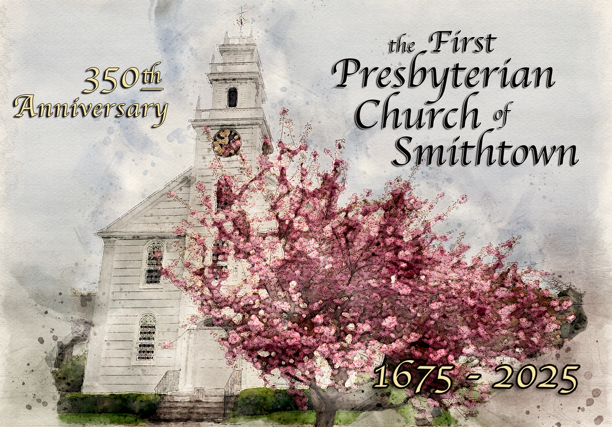
First Presbyterian Church of Smithtown
July 5, 2026
You are not going to hear the story of Miriam today! Lord willing, you will hear all about Miriam next Sunday as I begin my series on Amazing Children of the Bible. On this weekend, as we celebrate the 250th anniversary of the Declaration of Independence, I have been inspired to share a different message with my flock. I hope that’s OK!
It all started when I was on a bus headed to Milwaukee airport on Thursday, having finished my work as a commissioner to the General Assembly. I received a text message from Dawn at the church office. Nicole, one of the organizers of Smithtown’s July 4th celebration at Town Hall, had contacted the church. I was recommended by the mayor and town historian, Richard Smith, to lead the opening and closing prayers. She said the ceremony would last about 20 minutes and that I would also be welcome to speak about the history of our church and the role of faith in the founding of our country.
I said yes.
It was last minute. I wouldn’t have much time to prepare. I was a little tired from my trip. And I knew it was going to be hot standing outside Town Hall. But it was the right thing to do. They didn’t have other clergy for the event, and I knew that praying for peace and unity for our country would be important to fit in on the day of parades, flags, and family barbecues. And I looked forward to telling the story of our patriot pastor, the Reverend Joshua Hartt.
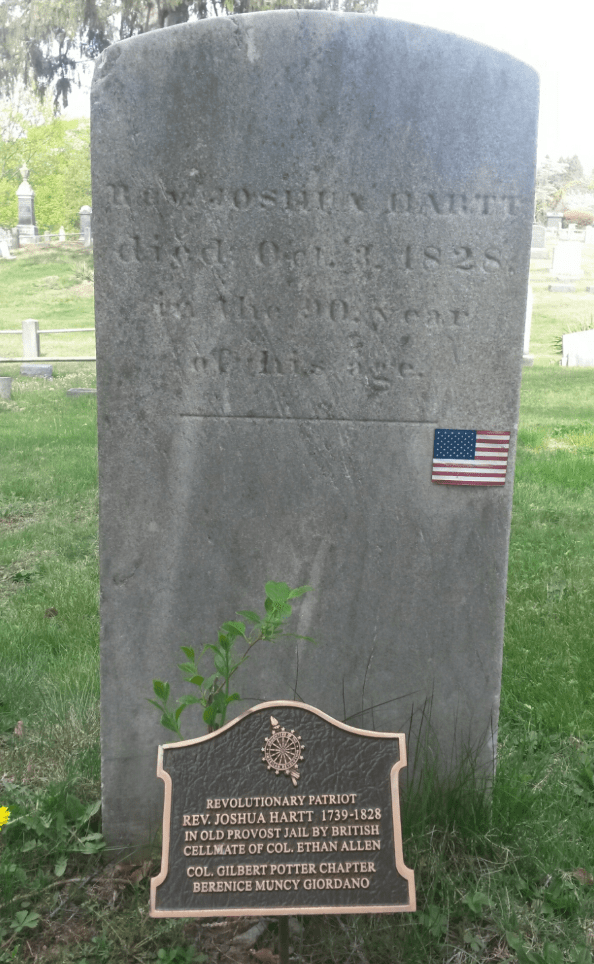
He was born on a farm in Dix Hills in 1738. At 32, he was ordained a minister, and at 36, in 1774, he came to serve the Presbyterian Church in Smithtown. Joshua soon earned a reputation for preaching “fiery sermons against British rule, calling on parishioners to take up arms in the patriot cause.”[1] He said, “He who hath no sword let him sell his garment and buy one.” And “Beat your plowshares into swords and your pruning shears into spears and let the weak say I am strong.”[2]
One Sunday, he stepped into the pulpit and was fired upon by two British soldiers. Either the soldier was a poor shot or Hartt, an imposing figure of 300 pounds, simply ducked in the nick of time.[3] Hartt was uninjured, but bullet holes were left in the church as a reminder of the danger of speaking out against an unjust government. Hartt would be arrested on several occasions because of his inflammatory preaching, including once when he was placed in chains, thrown in a wagon, and hauled to Provost Prison in New York City. During his imprisonment from May 27 to October 25 in 1777, the 39-year-old “came near to dying from an illness and want of food. A fellow prisoner was the celebrated Colonel Ethan Allen, who had captured Fort Ticonderoga in the early days of the war. Allen attended the ailing Rev. Hartt and by his lively manner and cheerful conversation did much to make his sickness and confinement endurable. One day Ethan Allen knelt at Rev. Hartt’s bedside and prayed for his recovery. Soon after, Rev. Hartt, through the assistance of a Tory friend, was paroled from the prison.”[4]
Hartt wasn’t the only one preaching fiery sermons in Presbyterian churches during the Revolutionary War years. The most famous Presbyterian leading the opposition to the British at the time was the Rev. John Witherspoon, the only clergyman to sign the Declaration of Independence. The prominent Scottish American Presbyterian minister had emigrated in 1768 to serve as president of the College of New Jersey (now Princeton University).[5] He was a fiercely outspoken leader in the Patriot cause that King George III dismissed as a “Presbyterian rebellion.”[6]
George III wasn’t alone in his assessment of the situation. Horace Walpole, earl and youngest son of the first British prime minister, upon hearing that the American colonial possessions of Great Britain had written their Declaration of Independence, he wrote in a letter to a friend, “One has griefs enough of one’s own, without fretting because cousin America has eloped with a Presbyterian parson.”[7] That Presbyterian parson was John Witherspoon.
As Dissenters from the established Church of England, Presbyterians mistrusted British colonial power—and were not afraid to assert a right to religious freedom when it was threatened. Presbyterian influence in the colonies grew in the mid 1700s, shaped by the Great Awakening and an influx of Scottish and Scots Irish immigrants, most of whom were Presbyterian. With words and actions—and sometimes with violence—these religious dissenters challenged colonial rule and felt moved to defy the status quo in the name of God.[8]
Ambrose Serle, secretary to British General Howe in New York City, wrote to the British Secretary of State in 1776 telling him that the American Revolution was ultimately “a religious war.” He said that “the revolt would not and could not be sustained were it not for the Presbyterian ministers who bred it. He lamented the fact that almost every minister in America seemed to double as a politician.”[9]
Many Americans today aren’t aware that the majority of the 56 delegates from the 13 colonies who gathered in Philadelphia in the hot summer of 1776 for the Second Continental Congress were people of faith. Their families came here from Europe for a fresh start, new opportunities, a better life, and, most of all, freedom to live out their faith without fear of persecution. The signers of the Declaration were Deists and Unitarians. They were Roman Catholics. The majority of those who helped shape and then voted for Jefferson’s Declaration of Independence were Anglicans, Congregationalists, and Presbyterians.[10]
The 12 Presbyterians who signed the document were physician Benjamin Rush, James Smith, George Taylor, lawyers James Wilson and Thomas McKean, William Floyd, Philip Livingston, Richard Stockton, John Witherspoon, John Hart, Abraham Clark, and Matthew Thornton, although not all of them made it into John Trumball’s famous painting of the presentation of the Declaration to Congress in 1776.[11] “George Duffield of Philadelphia’s Third Presbyterian Church (today’s Old Pine Church, next door to the Presbyterian Historical Society) served as chaplain to the Continental Congress, and patriot pastors (such as Joshua Hartt) supported the war effort from their pulpits in every state. Everyday Presbyterians felt the war’s impact in their communities and houses of worship. British troops occupied Boston, New York, Philadelphia, Charleston, and Savannah. From New England to the Carolinas, Presbyterian churches were seized to quarter troops or damaged by forces loyal to the Crown.”[12]
The Declaration, amended in committee and presented to Congress on July 4, 1776, asserts that all human beings are created equal and endowed by God with certain inalienable rights, among them life, liberty, and the pursuit of happiness. It also asserts that just governments derive their authority and powers from the “consent of the governed.” And that people have the right to change the government when it becomes destructive to these ends and does not provide for their safety and happiness. The document includes references to God the Creator, Provider, and Judge, the source of nature and nature’s laws.[13]
It felt strange to be the only minister at Smithtown’s 4th of July celebration. It felt strange that the local and state leaders sitting on either side of me had not been given permission to speak more than 90 seconds each. I was the guest speaker, the one to share a message after one of Richard Smith’s relatives read the Preamble to the Declaration. Well, it turned out that he read not just the Preamble, but the entire Declaration. People, wilting in the heat and tired of standing, began to disperse.
At the podium, I looked out and saw members of my church, red faced and perspiring in the heat with me, but smiling as they stood on Town Hall’s lawn. Some had found a little patch of shade under a small tree. I felt a surge of confidence and joy. “Today, my friends,” I said, “I am grateful. Grateful for my family and my flock here in Smithtown, with its long history of ministry in this community through times of plenty and times of need and uncertainty. I am grateful to Reverend Hartt and all the brave patriots willing to speak up and act out, though it might mean arrest and imprisonment, injury or loss of life. I am grateful for our town and country that has weathered struggles from within and without.”
By the grace of God, we continue in hope for our future as the United States of America, enjoying our lives and liberties, including our freedom of speech and freedom to live out our faith as God leads us to do. We continue in hope in our pursuit of happiness, dwelling in a land of purple mountains majesties and fruited plains. I encourage all of you, my siblings in Christ, to pray for your nation, just 250 years young, a country larger and more diverse than those who first envisioned our system of government ever imagined. We embrace our freedoms, earned at a cost of those who gave their lives in the American Revolution, the Civil War about a century later, and many more wars and conflicts of the 20th and 21st centuries so far. We are still struggling to find unity amid our differences and diversity of cultures, languages, ethnicities, and religions.
We are Deists and Unitarians. Roman Catholics. Anglicans, Congregationalists, Presbyterians, and many other varieties of Protestant faiths. We are also Jewish, Hindus, Buddhists, Muslims. We are people not affiliated with any religion at all.
We are ALL children of a God who urges us to love one another and live together in peace.
Will you pray with me?
Holy One, thank you for your grace and the Spirit that continues to dwell with us in this nation that we call home, the United States of America. Thank you for those who labored and struggled and continue to labor and struggle to figure out what it means to live with this new kind of government—250 years young—in a land much larger and more diverse than Richard Smith ever imagined. Strengthen us to pursue peace and unity with one another and neighbors around the globe. Help us to reflect your grace, generosity, and gentleness and walk in the way of righteousness and justice. Heal our divisions. Make us whole. Amen.
[1] “Reverend Joshua Hartt (1738-1829),” Northport Historical Society Museum, accessed July 4, 2026, at https://www.huntingtonny.gov/filestorage/13747/99540/16499/Reverend_Joshua_Hartt.pdf
[2] Richard Mehalick, Church and Community (1675-1975) The Story of The First Presbyterian Church of Smithtown, New York, (2010), 65.
[3] J. Richard Mehalick, Church and Community (1675-1975), 66.
[4] J. Richard Mehalick, Church and Community (1675-1975), 66-67.
[5] James Smylie, A Brief History of the Presbyterians (Louisville: Geneva Press, 1996), 57-58.
[6] A Presbyterian Rebellion,” Presbyterian Church, USA (March 15, 2019) accessed on July 4, 2026 at https://pcusa.org/a-presbyterian-rebellion
[7] Glenn A. Moots, “Early America’s Political Pulpit” in Law and Liberty, Dec. 28, 2021, accessed July 4, 2026 at https://lawliberty.org/classic/early-americas-political-pulpit/.
[8] “Presbyterians and the American Revolution” (Louisville:PresbyterianHistorical Society, 2026) accessed July 4, 2026, at https://pcusa.org/historical-society/exhibits/presbyterians-and-american-revolution#1
[9] George Grant, “The Presbyterian Rebellion” (July 2, 2026) accessed on July 4, 2026, at https://learn.ligonier.org/articles/the-presbyterian-rebellion.
[10] Kevin DeYoung, “The Presbyterian Signers of the Declaration of Independence” in Clearly Reformed (May 12, 2026) accessed July 4, 2026 at https://clearlyreformed.org/the-presbyterian-signers-of-the-declaration-of-independence/
[11]James Smylie, American Presbyterians: A Pictorial History, (Philadelphia: Presbyterian Historical Society, 1985), 39.
[12] “Presbyterians and the American Revolution” (Louisville:PresbyterianHistorical Society, 2026) accessed July 4, 2026 at https://pcusa.org/historical-society/exhibits/presbyterians-and-american-revolution#1.
[13] James Smylie, American Presbyterians, 60.

