
Meditation on Romans 5:8 – 6:11
Reverend Dr. Karen Crawford
First Presbyterian Church of Smithtown, NY
June 21, 2026
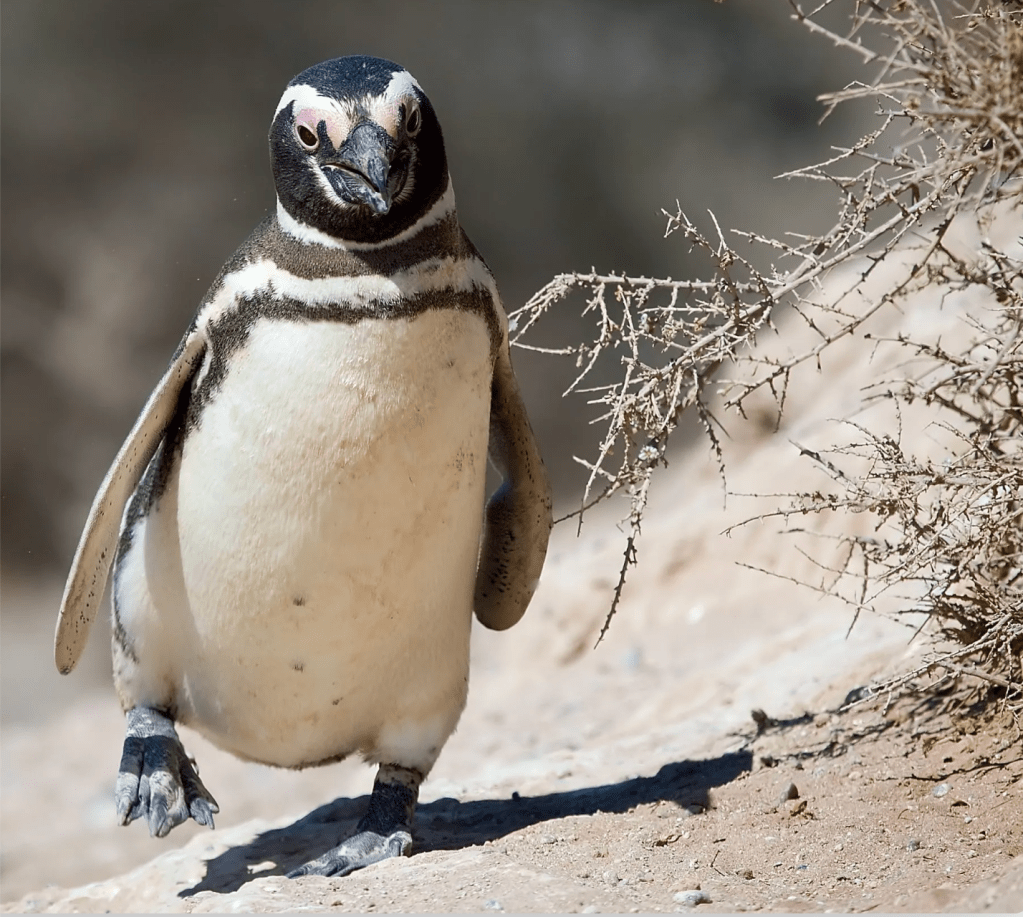
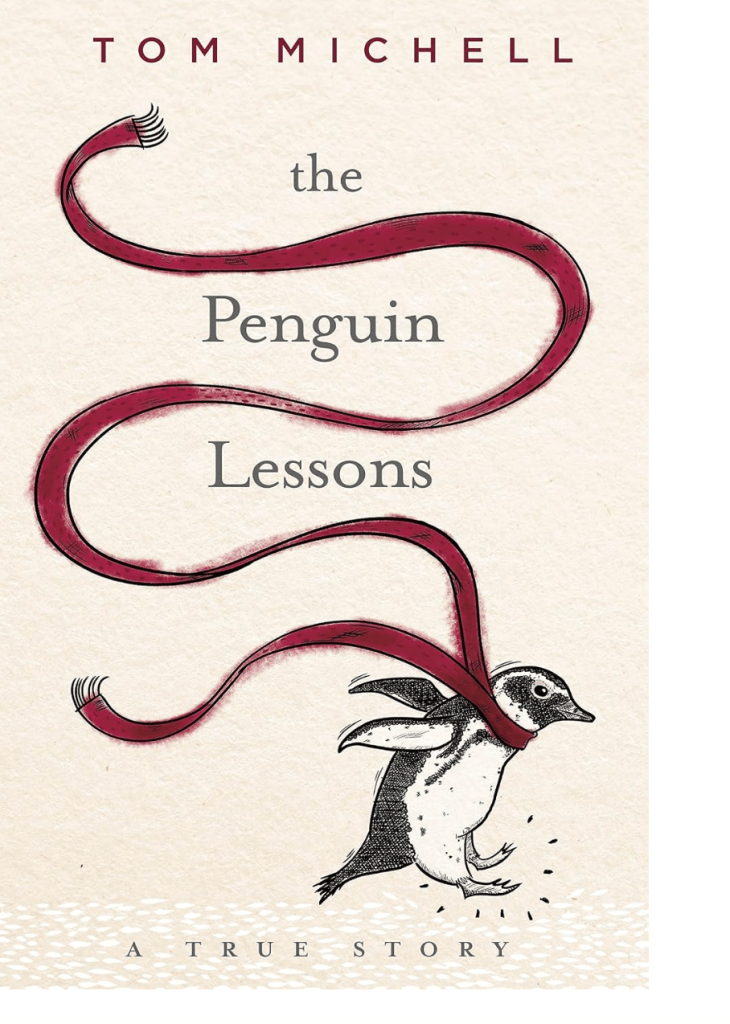
Tom Michell was taking a walk by the sea, on holiday at Punte Del Este in Uruguay, when he saw the penguins washed up on the sand. It was a dreadful sight, he says in his memoir, The Penguin Lessons: What I Learned from A Remarkable Bird. “Hundreds of oil-drenched penguins lay dead in the sand, from the high-water mark to the sea, and stretching far away along the shore to the north. Dead penguins, covered in thick, cloying, suffocating oil and tar….”
Then, out of the corner of his eye, he saw something move. “One valiant bird was alive, a single surviving soul struggling amidst all that death.”
He hesitated. Tom was a single man of 23, an Englishman working as a teacher at a boarding school in Buenos Aires, Argentina. It was 1976, and the country was in chaos. “Terrorism was rife; murders and kidnappings were everyday events.” Tom wasn’t thinking about his job or the violence and mayhem that day as he stood on the beach. He saw the penguin and had a surge of hope.
He carefully approached the large bird, maybe 14 pounds—it’s open, red-tongued beak, looking as if it were prepared to attack and jet-black eyes “sparking with anger.” He used wood and fishing net to lift “the furious creature, twisting and turning in its efforts to escape.” He managed to carry it by its feet for the mile or so walk to where he was staying. Before he could begin to clean it, the penguin clamped his beak on Tom’s finger. He yelped in pain and had to attend to the wound before he could begin to pour the dishwashing liquid down the creature’s back and work the soap into his short, stubby feathers.
As he rinsed the thick black goo from his body, the exhausted penguin suddenly lay still. Within moments, the terrified, hostile, and resentful animal became a docile and cooperative partner in the cleanup operation. The transformation occurred as Tom washed off the first of the detergent, as if the bird had suddenly understood that he was not being murdered; he was being saved. After that, he seemed to be a totally different animal, relieved of his affliction. At the second dose of detergent, “he held his wings out helpfully, so that no part should be missed.” Tom rubbed the soap all over the penguin’s feathers and scraped off the gooey mixture. After each wash “he shook himself like a dog to dry.” When he was finished, he left the bird in the bathtub and walked to the market to buy fish. But then he had a disturbing thought. He had removed all the penguin’s natural oils. If he released him now, he might become “waterlogged, sink, and drown.”
Still determined to set the bird free and return to his normal routine, he rubbed the bird with butter and olive oil and took him to the sea near where he was staying, where there was no sign of oil spill. He took him “to the water’s edge and placed him in the sand, expecting him to rush into the sea and swim away, happy to be free. But he didn’t.” He walked straight back to Tom. Tom would find out years later from a wildlife rehabber that penguins won’t go into the water alone. After repeated attempts to set him free, Tom gave up when he followed him to the road and was nearly hit by a speeding van. Tom ran into the street, scooped him up and discovered he was soaking wet and icy cold, without any waterproofing on his feathers.
“What am I going to do with you?” Tom asked. This was the first of many penguin lessons—don’t go into the ocean alone!—that he and others would learn from the friendly, affectionate bird that had, of all things, the gift of being a good listener.
The penguin came to live on Tom’s terrace at school and took walks with him around the grounds. He named him “Juan Salvador,” which means “God is Gracious” and “Savior.” The penguinwon the hearts of the students, who took turns feeding him his daily sprats and chose him as their rugby mascot. He won the hearts of the teachers and staff, who came to visit him and share their problems with him. Someone pointed out that he should have been named, “Juan Salvado,” Salvado meaning “Saved.” Thus, he had a new name.
Paul in Romans is trying to tell us about the transformation that has happened in us because of Christ. The love of God has been proven, he says, because while we were still sinners, Christ died for us. This is the God whom Jesus calls Father, who knows us intimately and sees everyone as precious. Jesus in Matthew 10 asks his disciples, “Are not two sparrows sold for a penny? Yet not one of them will fall to the ground apart from your Father.And even the hairs of your head are all counted. So do not be afraid; you are of more value than many sparrows.”
The one whose trespass brought about humanity’s condemnation, says Paul, is Adam. Not Eve, as some have taught! Only Jesus, fully human and fully God, was able to make the sacrifice that would bring us into right relationship with the Lord and one another. He did it for love.
Paul has evolved in his theology by the time he writes Romans for Gentile and Jewish Christians toward the end of his third missionary journey, perhaps A.D. 57. Douglas Moo writes, “For almost 25 years, Paul has planted churches in the eastern Mediterranean. Now he prepares to bring to Jerusalem a practical fruit of that work, one that he hopes will heal the most serious social-theological rift in the early church–the relationship between Jew and Gentile in the people of God.”[1]
What brings these groups together for Paul in Christ? Baptism. It unites us with Christ in his death and resurrection and with one another as Christ’s Body. We have been raised in the waters of baptism to live as a new people. But here’s the thing. We still sin, even after we are baptized. The good news is that the grace of God is sufficient for all sin. We are forgiven! Then Paul challenges us, just as we are getting comfortable at the thought of all that grace. “What then are we to say?” he asks. “Should we continue in sin in order that grace may increase? By no means!”
Our being united with Christ and one another in baptism means that we have the power of Christ to rise above the sins that bring us down and trip us up. He tells the Galatians, “As many of you as were baptized into Christ have clothed yourselves with Christ.” We can’t put on Christ until we take off the old ways of thinking and being—such as holding onto anger and unforgiveness; being cynical or selfish—none of these attitudes fit the new spiritual outfit. This transformation in Christ happens when we live and grow in Christian community, worshiping and serving God and neighbor together.
Our Elders and Trustees came for a picnic at the manse on Tuesday night. The Deacons will be coming for their picnic in July. Looking around the group, I sensed a peace and comfort with one another that wasn’t as noticeable when I came. Relationships have been strengthened. I believe that we are in the midst of a spiritual transformation. The proof is our increasing love for one another. And we have become a people of hope.
You know I am going to go back to the penguin—right?
Juan only lived with Tom and the children at the school for 8 short months. A colleague was caring for Juan while Tom was away when the penguin died and was buried in a garden. Tom was inconsolable, especially because he hadn’t been with him when he passed. No more would there be the “telltale patter of feet excitedly running up and down, accompanied by the occasional squawk.” These sounds had become an integral part of his school life, “just as the bells that marked the changing events of the day. Now there would be just a dreadful silence… No more would the boys knock at his door to collect fish; no more the laughter and delight that he brought to so many.”
But it had been a privilege to know and love such a remarkable bird. He knew that he would never be the same. However, no one experienced a more radical transformation through knowing Juan than a student named Diego from Bolivia, who didn’t seem to be good at anything and was often ridiculed. He was homesick, immature, limited in his English, and academically behind. He was small and uncoordinated when it came to rugby. But he loved Juan Salvado and visited him every day.
A few months after Juan came to live with Tom, he arranged for the penguin to go for his first swim in the school pool. He had molted and had new feathers with the natural oils for water protection. Diego and Tom watched the bird in awe as he navigated the pool with speed, skill, and acrobatics.
Diego asked if he could swim with the penguin. He had never seen the boy so animated. “His eyes were sparkling and he seemed to be truly alive for the first time since (he) had known him.” Tom was worried that Diego might not be able to swim. He was surprised to learn that not only could Diego swim, but he swam magnificently, chasing after the bird, who swam circles around him.
Over the next few weeks, Diego earned the respect of his peers. His academic skills improved. He appeared to grow three inches. Even his clothes fit him better. And,“when at last the swimming gala was held, the results were as everyone anticipated: he won every race for which he was eligible to enter and broke every (school) record that he was allowed to contest.”
“A child had gone down to the water to swim with a penguin, and shortly afterward, a young man had emerged. There had been a rebirth, a new beginning. The ugly duckling had become a swan; the caterpillar had metamorphosed into a butterfly; the fish had found its way back to the water.
“Diego had done years of growing up in just a few short minutes, and Juan Salvado, the penguin extraordinaire, had had something to do with it.”
Let us pray.
Holy One, how can we thank you enough for your abundant grace for sinners? How can we thank you enough for your love, shown in the sacrifice of your Son? Help us, dear Lord, to grow up in the faith, live into our baptisms, and never take your grace for granted. Strengthen us to put away our old ways of thinking and being. Help us to be good listeners. Stir us to love one another as you love us and to care for the earth so that all creatures may thrive on land, in the sea, and in the air. And thank you for the animals that you have created, such as the remarkable Magellan penguin named Juan Salvado, the single survivor of an oil spill, who brought delight and transformation to the humans he met. In Christ’s name we pray. Amen.
[1] Douglas Moo, The Epistle to the Romans, 3.
 Sharing God's Love and Grace