
Meditation on 1 Samuel 17:12-47
The Reverend Dr. Karen Crawford
First Presbyterian Church of Smithtown
July 26, 2026
I enjoyed my birthday week—having ice cream, going out to lunch, and going on a two-hour lighthouse cruise with Jim, leaving from Orient Point. I received emails, texts, Facebook messages, cards, and phone calls, including one from my brother. He called to wish me happy birthday and tell me that I am getting old. Does anyone have brothers that tell them stuff like that? Of course, I answered, “Not as old as you!” And he said of our sister, “And I’m not as old as Susan!”
I got to thinking this week that when you pass 60, it’s good to be the youngest in your family. We are actually quite close in age. Steve is about 18 months older than I am. Susan is about 2 and ¾ years older than I am. But because we were so different from one another in appearance and personality as children, I never had a teacher say to me, “Oh, you are Susan’s little sister. Or, oh, you are Steve’s little sister.”
This was not the case with David. Everyone knew him and his brothers and their father Jesse, who lived in Judah and was descended from the tribe of Judah. He was a farmer, a breeder and owner of sheep, a prominent resident in the town of Bethlehem, where David and many generations later, Jesus was born. Jesse was the son of Obed and the grandson of Ruth the Moabite and Boaz, a wealthy landowner in Bethlehem and relative of Ruth’s father-in-law, Elimelech.
David might have been 15 at the time of his battle with Goliath. His brothers (Eliab, Abinadab, and Shammah) were at least 20 and older as they fought under King Saul when 20 was the minimum age for enlistment. They also had sisters, Zeruiah and Abigail, (mentioned in 1 Chronicles 2:16) but they don’t show up in this passage.
The armies of Israel and Philistine were entirely made of men at the time. Some women fought for Israel in other battles, however. Deborah, whose story is in Judges 4 and 5, was the only female judge who adjudicated cases from her seat under a palm tree. She led the Israelite army to war against the Canaanites, behaving “like a general, ordering the commander Barak to attack the Canaanite general Sisera’s troops at Kadesh (Judges 4:6-7). Barak says he will only go to war if Deborah goes with him—and she does (Judges 4:9-10, Judges 5:15).[1]
During David’s time, “the kingdom of Philistia (is) a powerful confederation known as the Pentapolis—featuring the five city-states of Gaza, Ashdod, Ashkelon, Ekron, and Gath.”[2] The Philistines are an ancient people who settled along the southern coast of Canaan around 1050 BC, occupying part of the Judean Hill Country. They possessed superior arms and military organization, possibly because of their local monopoly on smithing iron (1 Samuel 13:19). Deuteronomy 2:23 and Jeremiah 47:4 say they came from the coasts of Caphtor, which may have been Crete.[3] They are one of the groups of “Sea Peoples” mentioned in Nolan’s film adaptation of The Odyssey.
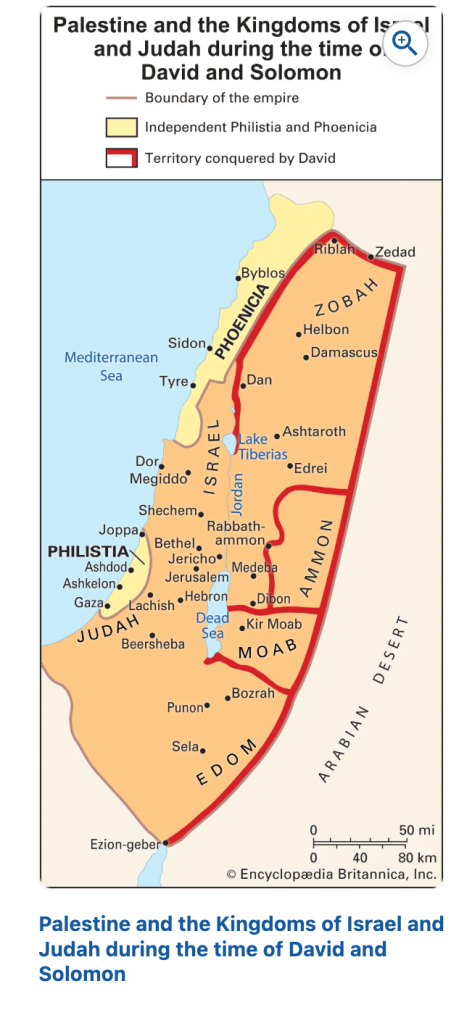
David is ruddy and handsome, and although he isn’t old enough to enlist, he follows Saul, like his brothers who fight. He goes back and forth each day to Bethlehem from the battle at the Valley of Elah, about 20 miles from Jerusalem today, to feed and tend the sheep. When he is not there, he leaves a “keeper” in charge. His father sends him to check on his brothers and bring them bread to eat and cheese for the commander. His father, concerned about their safety, asks for some “token” of his sons when David comes back.
How do his brothers feel about David coming to check on them? They don’t want him around. His eldest brother Eliab hears him talking to the men about a reward for killing Goliath, and Eliab’s anger is kindled. Who is the eldest sibling in their family? What’s your job? Looking after your younger brothers and sisters. Eliab says, “Why have you come down? With whom have you left those few sheep in the wilderness? I know your presumption and the evil of your heart, for you have come down just to see the battle.”
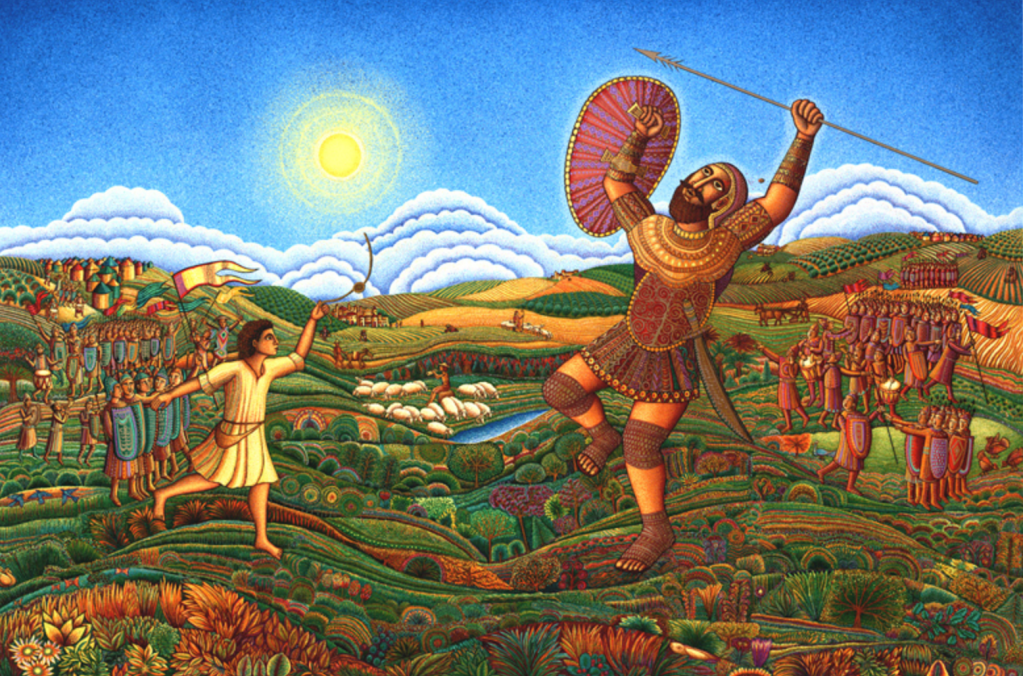
David’s answer is petulant. His, “What have I done now? It was only a question,” makes you think that he is often in trouble with his older brothers. Saul hears what David says about fighting Goliath, and he sends for him. The king says, “You’re just a boy.” Goliath has been training for battle since his youth.
But David tells Saul how he has defended his flock from wild animals. “Your servant has killed both lions and bears,” he says, “and this uncircumcised Philistine shall be like one of them, since he has defied the armies of the living God.” David reveals his faith, then, to the one who was anointed Israel’s king by the prophet, priest, and judge, Samuel. “The Lord, who saved me from the paw of the lion and from the paw of the bear, will save me from the hand of this Philistine.” Saul says to David, “Go, and may the Lord be with you!”
The Lord wins the battle that day. The “boy” who isn’t big enough or strong enough for the armor and weapons is able to kill the giant with a slingshot and a few small stones, picked from the wadi, or dry riverbed. After the giant comes down, David will cut off his head as proof that he truly is a worthy warrior for Saul.
David is not only a warrior. The shepherd is a man after God’s own heart. He possesses musical gifts, playing a small harp called a lyre and writing many of the psalms.
But David is far from perfect! He is proud and impetuous and brash, arrogant as Israel’s king at 30 years old, 15 years after he kills Goliath. David sees beautiful Bathsheba one day, wants her, and takes her as his own. It doesn’t matter if she wants him—or that she is married. He is devious and deceitful. He attempts to trick her husband Uriah, a soldier in his army, into having sex with her to hide that she is pregnant with David’s child. And David is a murderer. When Uriah refuses, the king sends him to the front to be killed. David will later confess and repent of his sin when the prophet Nathan confronts him. It may have been this time when he writes Psalm 51, which begins, “Have mercy upon me, O God, according to thy lovingkindness: according unto the multitude of thy tender mercies blot out my transgressions. Wash me thoroughly from mine iniquity, and cleanse me from my sin. For I acknowledge my transgressions: and my sin is ever before me. Against thee, thee only, have I sinned, and done this evil in thy sight.”
David will be remembered as the one who unites the 12 tribes of Israel. He captures Jerusalem, brings the ark of the covenant to it, and makes the city both the national and religious capital. In his reign of 40 years, he leads the military to victory over the Philistines, Moabites, and Syrians. He expands Israel’s borders and secures the nation’s sovereignty. While David will not build the Temple in Jerusalem, he drafts the first plans and amasses large quantities of materials needed for the project, including gold and silver. His son, Solomon, will be the one to build it. We will learn more about Solomon later.
I admire David’s courage, as a lad of 15. How was able to speak so confidently to his older brothers and so boldly to the king? But I also know that he did not find his strength in himself. He believed that The Lord, who saved him “from the paw of the lion and from the paw of the bear” saved him “from the hand of (the) Philistine.”
As the years pass and he struggles with parenting, as well as his responsibilities as king, he is humbled. Perhaps then he learns to trust the Lord even more. That has been the case for me. Age and life have a way of doing that for us.
Dear friends, may we, like David, learn to trust, more and more. May we feel the hand of God upon us. May we overcome our fears and do things that others may say we cannot. And may we encourage our sisters and brothers to take risks and try new things, knowing that we are not alone in a task that the Lord has called us to. Let us say to one another, as Saul says to young David with his slingshot, “Go, and may the Lord be with you!”
Let us pray with the words of my favorite psalm of David—Psalm 23.
The Lord is my shepherd; I shall not want. He maketh me to lie down in green pastures: he leadeth me beside the still waters. He restoreth my soul: he leadeth me in the paths of righteousness for his name’s sake. Yea, though I walk through the valley of the shadow of death, I will fear no evil: for thou art with me; thy rod and thy staff they comfort me. Thou preparest a table before me in the presence of mine enemies: thou anointest my head with oil; my cup runneth over. Surely goodness and mercy shall follow me all the days of my life: and I will dwell in the house of the Lord for ever.
Amen.
[1] Caryn-Tamber-Rosenau, “Women Warriors,”in The Shalvi Hyman Encyclopedia of Jewish Women (June 23, 2021) accessed July 25, 2026 at https://jwa.org/encyclopedia/article/women-warriors#pid-15732.
[2] https://www.britannica.com/topic/Philistine-people, accessed July 25, 2026
[3] https://www.britannica.com/topic/Philistine-people, accessed July 25, 2026

