Meditation on 2 Kings 5:1-14
Reverend Dr. Karen Crawford
First Presbyterian Church of Smithtown
Aug. 30, 2026
Has anyone seen hummingbirds this summer? Does anyone plant certain flowers known to attract and feed hummingbirds? Do you make your own sugar water? Who does both?
I was thinking this week as I washing out the hummingbird feeders and putting in new sugar water, “Why do we like hummingbirds so much?” They bring a sense of wonder and beauty, don’t they, whenever we see them? Even people who aren’t normally bird watchers like to see hummingbirds. Especially when these elusive creatures appear and disappear so quickly at your flowers or feeders, that you may blink your eyes and wonder if you were seeing things. Maybe it was just a big bee, right?
God has created them to be the smallest of all the birds, about the size of a large paperclip and weighing about the same as a penny.[1] They are the fastest of all birds. Their normal flight speed is 20 to 30 miles per hour, when they are moving between flowers and feeding sites.[2] But they can dive at speeds of up to 60 miles an hour during courtship displays. They are the only birds capable of flying forwards, backwards, up, down, and upside down, while also hovering in place. They are remarkably smart.[3] Their brains make up 4.2% of their body mass, compared to just 2% for humans.[4] They remember every flower and feeder they visit, along with the precise time it takes for specific plants to refill with nectar. They can recognize people and often approach and hover around those who regularly fill their feeders. They have been known to look in the windows at people who have fed them. That explains why we have caught one male hummingbird hovering and looking in our kitchen window while we are at the table![5]
In Native American cultures, the hummingbird is a sacred symbol ofjoy, healing, love, and resilience. Because of its incredible speed and boundless energy despite its tiny size, many tribes view the tiny bird as aspiritual messenger, a bringer of good luck, and a fierce protector.[6]
Today, we continue our Amazing Children of the Bible series with the story of the Little Maid of Israel. This is a passage that comes up in our 3-year lectionary cycle, but I have never actually heard a sermon on the Little Maid. Perhaps she, like the elusive hummingbird, is deemed too small and insignificant. When I tried to look up the Little Maid in my scholarly Anchor Bible Dictionary, the only place I could find her story was in the long entry on the powerful soldier Naaman, the commander-in-chief of the army of Aram-Damascus, who had achieved fame on the battlefield and was trusted by his king, Ben Hadad.[7]
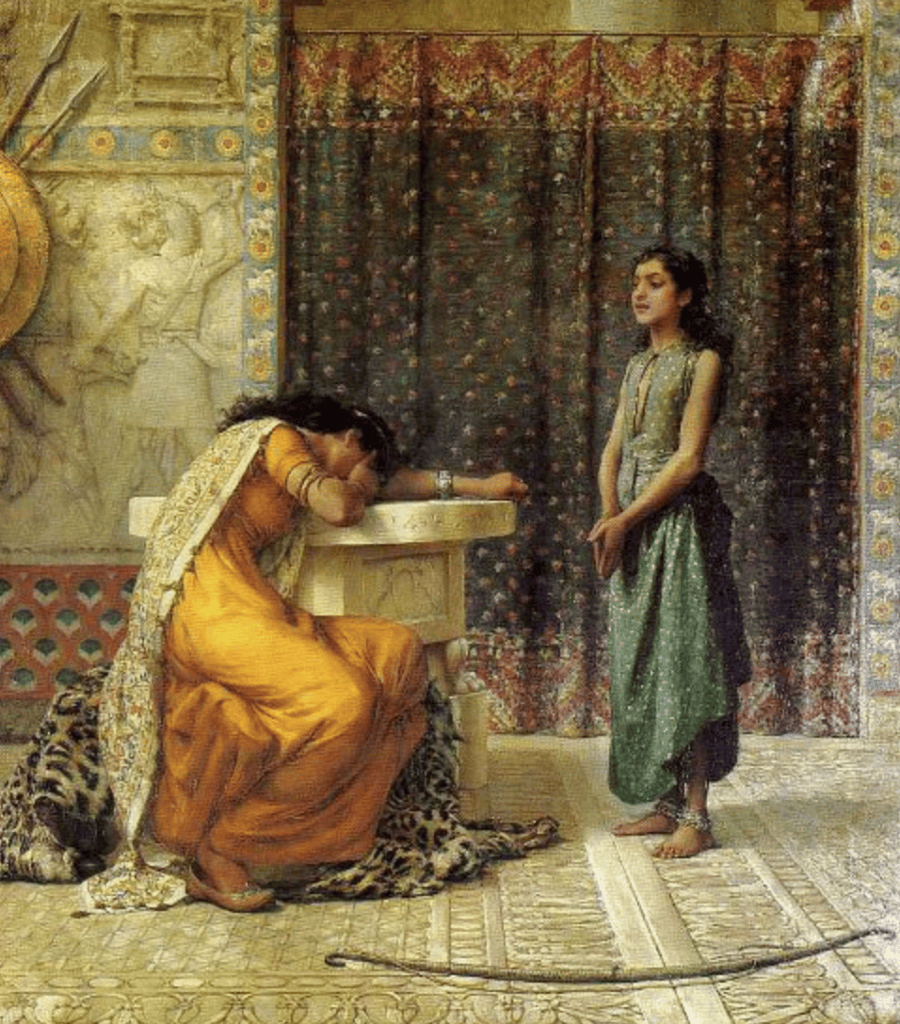
The Little Maid, as she has become known, is the nameless girl from Northern Israel who serves Naaman’s wife, who also is not named. Both the Little Maid and the mistress play vital roles in this story of faith and healing, demonstrating how none of us are too small and insignificant to be used in mighty ways by our God. The Little Maid is an unlikely heroine because she is a slave, a female, and a child, probably under the age of 12—three conditions that would make her voiceless and powerless in her own society. She is even more vulnerable because she lives in enemy territory, far from her family, her home, and her community of faith.
Perhaps preachers don’t find enough to share about the Little Maid because she appears in only two verses in this passage and nowhere else in the Bible, while Naaman and his healing are even mentioned by Jesus, without mention of the Little Maid. In Luke 4:27, in his first sermon in his hometown, Jesus says, “And there were many in Israel with leprosy in the time of Elisha the prophet, yet not one of them was cleansed—only Naaman the Syrian.” Maybe preachers don’t want to linger long at these two verses about the Little Maid in 2 Kings 5:2-3, “Now the Arameans on one of their raids had taken a young girl captive from the land of Israel, and she served Naaman’s wife. She said to her mistress, ‘If only my lord were with the prophet who is in Samaria! He would cure him of his skin disease.’”
That the little girl clings to the faith of her childhood is remarkable in an era when worship of foreign gods and idols is rampant in Northern Israel, under the leadership of King Ahab. We read in 1 Kings 16:30, “Ahab son of Omri did evil in the sight of the LORD, more than all who were before him. And as if it were a trivial thing for him to walk in the sins of Jeroboam son of Nebat, he married Jezebel, the daughter of Ethbaal king of the Sidonians, and then proceeded to serve and worship Baal. First, Ahab set up an altar for Baal in the temple of Baal that he had built in Samaria. Then he set up an Asherah pole. Thus Ahab did more to provoke the LORD, the God of Israel, to anger than all the kings of Israel before him.” When the Little Maid is captured by the Syrians in a raid, this isn’t a one off. This is a time, the middle of the 9th century BCE, when there are almost continual conflicts between Israel and Syria and only short intervals of peace.[8]
So, what can we know about the character of the Little Maid? First, as we mentioned, she is truly a child who worships the God of Abraham, Isaac, and Jacob. Second, her faith stirs her to a compassion that goes beyond what she has been taught as a child when she seeks to care for the enemy of Israel. Remember when Jesus shocks his disciples and the Pharisees when he says to the crowd in Matthew 5:43-44, “You have heard that it was said, ‘Love your neighbor and hate your enemy.’ But I tell you, love your enemies and pray for those who persecute you.” The Little Maid doesn’t appear to resent her servitude or bear hard feelings when she tells her mistress about the prophet Elisha, living in Samaria, the capital of the Northern Kingdom, and his healing power that comes from God.
And third, what’s equally telling of her character is that she has earned the trust of her enemies, including her unnamed mistress and Naaman; they listen eagerly as she shares how Naaman, feeling quite desperate and hopeless because of a seemingly incurable skin disease, might be healed. Naaman then goes and tells the King of Aram what the girl from Israel has said, and he trusts her, as well, and sends Naaman to his enemy, King Ahab, with a pile of money and a letter asking for help from the prophet. Ten talents of silver, weighing 754 pounds, and six thousand shekels of gold, weighing 151 pounds, would have been a massive fortune. Oh, and he brings ten sets of garments fit for a king.
The whole scheme nearly backfires when King Ahab assumes that this gift and request are a ruse to start another war. Elisha intervenes and sends a message telling him to send Naaman to him. The general comes with horses and chariots (the power and machinery of war) and halts at Elisha’s home, only to be greeted by a messenger, telling him to go wash in the waters of the Jordan. Naaman is furious at the prophet’s refusal to meet him face to face. And why would he wash 7 times in Israel’s waters when the waters of his native Damascus are much better? It will be, once again, servants who persuade Naaman to do the right thing. For the high and mighty don’t know the will of God. It’s only the little people who know what Naaman must do.[9] And the God of Israel heals the great general through the sacred waters of the Jordan—the waters in which Israel crossed into the Land of the Promise after 40 years of wilderness wandering. The sacred waters where thousands of years later John will baptize Jesus Christ to show us the way. Naaman will be a changed man after his healing in the Jordan. He will bring home to Aram-Damascus some earth from Israel as a symbol of a newfound faith in Yahweh, the God of Israel.[10]
Dear friends, Jesus has claimed Karina James Sabella today for his own through the waters of Baptism. She has been healed of her sins—washed clean—and has left behind her old identity to take on the garment of Christ.

Her church family has welcomed her into Christ’s Body and vowed to help her parents raise up Karina in the nurture and admonition of the Lord. She has been filled with the gifts of the Spirit that she will need as she seeks to follow Jesus with her life. I hope that we will remember from this message how God often uses what the world deems insignificant, such as a nameless Israelite girl, taken captive by Syrians, to accomplish God’s loving purposes.
May we keep on treasuring God’s creatures great and small, especially the small, and the strength of the faith of a little child, such as Karina Sabella, beloved of God. May the hummingbird be for us, like they are in Native American cultures, a symbol ofjoy, healing, love, and resilience. And may the elusive sight of the tiny, intelligent, speedy creature be a reminder of God’s everlasting presence with us—that when God seems invisible, the Lord may just be moving faster than we can see.[11]
Will you pray with me?
Holy God, we thank you for loving the small, seemingly insignificant people of this world, such as the Little Maid of Israel, a slave, whose faith, hope, bravery, and compassion led to the healing of the Syrian general in the waters of the Jordan. Help us to love our neighbors and our enemies, as the Little Maid models for us. Grant us wisdom and guide us as we seek to nurture Karina Sabella and all the children in our church in the faith, hope, and love of your Son. And thank you for the small, amazing creatures, such as the hummingbird, that remind us of your everlasting presence with us, that when you seem to be invisible to us, you may be moving faster than we can see. In Christ we pray. Amen.
[1] https://oakdale.wbu.com/hummingbirds-fun-facts
[2] https://www.fws.gov/story/hummingbirds-north-america
[3] https://www.nbcnews.com/id/wbna11697039
[4] https://elemscience.jordandistrict.org/wp-content/uploads/sites/8/6.4.2.4.7-Five-Amazing-Facts-about-Hummingbirds.pdf
[5] https://www.birdsandblooms.com/birding/birding-basics/hummingbird-meaning/
[6] https://www.thegrandhacienda.com/post/hummingbirds
[7] T. R. Hobbs, “Naaman,” in Anchor Bible Dictionary, v. 4 (K-N)(NY: Doubleday, 1992), 967-968.
[8] Hobbs, “Naaman,” 968.
[9] Hobbs, “Naaman,” 968.
[10] Hobbs, “Naaman,” 968.
[11] https://www.christianitytoday.com/2021/03/hummingbird-wings-god-invisible/

